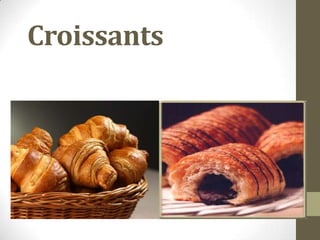
Croissants
Croissants-History
• Originated in Austria in 1686 during the war between Austria
and Turkey. A group of bakers working at night in Austria
heard the Turkish troops tunneling under them and sounded
the alarm which lead to their defeat.
• Their reward was the right to create a pastry in the shape of
the crescent on the Turkish flag.
• Originally it was similar to bread dough the French refined it
to what we know today
Classification
• Croissants are a laminated yeast dough.
• Flour yeast, milk and sugar are combined to make a
dough. (sounds like a detrempe)
• Then chilled butter is rolled into the dough through
a series of folds
• Much of the same procedures in handling it is the
same as puff pastry.
Key points in Producing
• A dough of flour yeast, milk and sugar is rolled out into a
rectangle and small dollops of cold butter are placed in a
layer over this dough.
• Instant yeast is used , this seems to hold up best all the
way through the production process
• The rectangle is folded into thirds or like a letter the
dough is turned 90 degrees to the right and rolling away
from you is folded again into a rectangle .This is a fold.
This is repeated 3 more time for a total of 4 turns
More Key Production Points
The dough is rested
for 20-30 minutes
after every 2 turns
to allow the gluten
to relax and the
butter to chill
again. This finished
product is called a
paton
It is essential that
you keep neat and
even sided and
corners while
rolling and folding
Production continued
• The finish paton needs to be chilled quickly and thoroughly.
Freezing for 90 minutes is recommended, This will stop the
yeast from overdeveloping overnight
• This paton can be frozen for up 2 months, or the paton can be
formed into product and those frozen for 30 days
• Croissant is rolled into thin sheet and triangles are up and
rolled starting at the long side to create the classic crescent.
• They are proofed, lower heat and humidity are necessary, if
the proof box is too warm the butter will melt out of the
dough
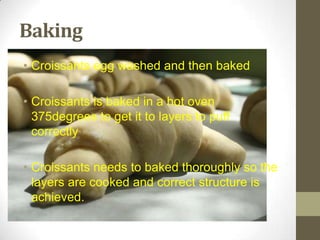
Baking
• Croissants egg washed and then baked
• Croissants is baked in a hot oven
375degrees to get it to layers to puff
correctly
• Croissants needs to baked thoroughly so the
layers are cooked and correct structure is
achieved.
Varieties
• Croissants can be filled too. Chocolate batons are
place in rectangle pieces of croissant dough and
are folded and sealed These are called pain au
chocolat.
• Ham and Cheese can also be placed in the
rectangles and are folded and sealed up. These
are called croissant jambon et fromage
• Other savory or sweet fillings can be used in
rectangle shaped croissants.
• It is key that they are segregated out and clearly
labeled
Summary
• It is a yeasted laminated
dough
• Key points in producing, how many
folds and turns
• Type of yeast used
• What is a paton ?, what is done with it
• Procedure to bake
• Varieties

Croissants

  • 1.
  • 2.
    Croissants-History • Originated inAustria in 1686 during the war between Austria and Turkey. A group of bakers working at night in Austria heard the Turkish troops tunneling under them and sounded the alarm which lead to their defeat. • Their reward was the right to create a pastry in the shape of the crescent on the Turkish flag. • Originally it was similar to bread dough the French refined it to what we know today
  • 3.
    Classification • Croissants area laminated yeast dough. • Flour yeast, milk and sugar are combined to make a dough. (sounds like a detrempe) • Then chilled butter is rolled into the dough through a series of folds • Much of the same procedures in handling it is the same as puff pastry.
  • 4.
    Key points inProducing • A dough of flour yeast, milk and sugar is rolled out into a rectangle and small dollops of cold butter are placed in a layer over this dough. • Instant yeast is used , this seems to hold up best all the way through the production process • The rectangle is folded into thirds or like a letter the dough is turned 90 degrees to the right and rolling away from you is folded again into a rectangle .This is a fold. This is repeated 3 more time for a total of 4 turns
  • 5.
    More Key ProductionPoints The dough is rested for 20-30 minutes after every 2 turns to allow the gluten to relax and the butter to chill again. This finished product is called a paton It is essential that you keep neat and even sided and corners while rolling and folding
  • 6.
    Production continued • Thefinish paton needs to be chilled quickly and thoroughly. Freezing for 90 minutes is recommended, This will stop the yeast from overdeveloping overnight • This paton can be frozen for up 2 months, or the paton can be formed into product and those frozen for 30 days • Croissant is rolled into thin sheet and triangles are up and rolled starting at the long side to create the classic crescent. • They are proofed, lower heat and humidity are necessary, if the proof box is too warm the butter will melt out of the dough
  • 7.
    Baking • Croissants eggwashed and then baked • Croissants is baked in a hot oven 375degrees to get it to layers to puff correctly • Croissants needs to baked thoroughly so the layers are cooked and correct structure is achieved.
  • 8.
    Varieties • Croissants canbe filled too. Chocolate batons are place in rectangle pieces of croissant dough and are folded and sealed These are called pain au chocolat. • Ham and Cheese can also be placed in the rectangles and are folded and sealed up. These are called croissant jambon et fromage • Other savory or sweet fillings can be used in rectangle shaped croissants. • It is key that they are segregated out and clearly labeled
  • 9.
    Summary • It isa yeasted laminated dough • Key points in producing, how many folds and turns • Type of yeast used • What is a paton ?, what is done with it • Procedure to bake • Varieties