CRM FOR
SALES:
5 THINGS YOURS
SHOULD BE
DOING
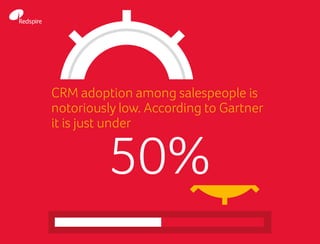
CRM adoption among salespeople is
notoriously low. According to Gartner
it is just under
50%
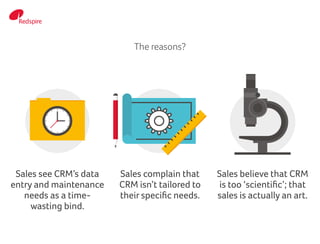
The reasons?
Sales see CRM’s data
entry and maintenance
needs as a time-
wasting bind.
Sales complain that
CRM isn’t tailored to
their specific needs.
Sales believe that CRM
is too ‘scientific’; that
sales is actually an art.
These are misconceptions.
To counter such false impressions, it’s
essential to highlight the benefits of CRM
to your teams.
A good CRM solution will help your team to:
Increase automation
A good CRM solution will help your team to:
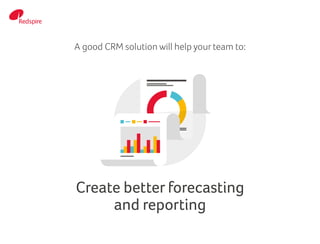
Create better forecasting
and reporting
A good CRM solution will help your team to:
Boost alignment
A good CRM solution will help your team to:
Go mobile
A good CRM solution will help your team to:
Drive business benefits.
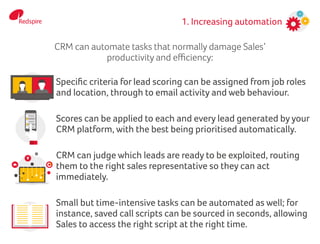
1. Increasing automation
Specific criteria for lead scoring can be assigned from job roles
and location, through to email activity and web behaviour.
Scores can be applied to each and every lead generated by your
CRM platform, with the best being prioritised automatically.
CRM can judge which leads are ready to be exploited, routing
them to the right sales representative so they can act
immediately.
Small but time-intensive tasks can be automated as well; for
instance, saved call scripts can be sourced in seconds, allowing
Sales to access the right script at the right time.
CRM can automate tasks that normally damage Sales’
productivity and efficiency:
Automation means sales
teams only deal with
the best leads, reducing
cycle times and boosting
conversion rates.
2. Creating better forecasting and reporting
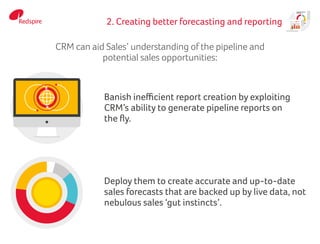
Banish inefficient report creation by exploiting
CRM’s ability to generate pipeline reports on
the fly.
Deploy them to create accurate and up-to-date
sales forecasts that are backed up by live data, not
nebulous sales ‘gut instincts’.
CRM can aid Sales’ understanding of the pipeline and
potential sales opportunities:
3. Boosting alignment
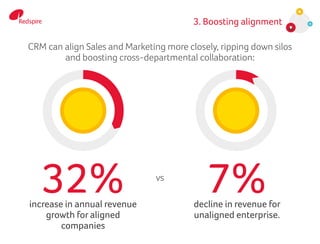
increase in annual revenue
growth for aligned
companies
decline in revenue for
unaligned enterprise.
32% 7%
CRM can align Sales and Marketing more closely, ripping down silos
and boosting cross-departmental collaboration:
vs
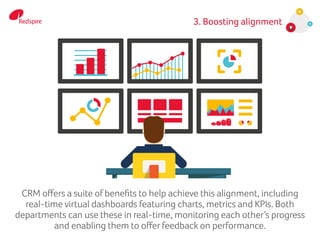
CRM offers a suite of benefits to help achieve this alignment, including
real-time virtual dashboards featuring charts, metrics and KPIs. Both
departments can use these in real-time, monitoring each other’s progress
and enabling them to offer feedback on performance.
3. Boosting alignment
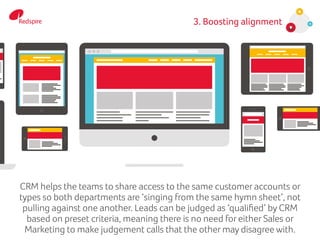
CRM helps the teams to share access to the same customer accounts or
types so both departments are ‘singing from the same hymn sheet’, not
pulling against one another. Leads can be judged as ‘qualified’ by CRM
based on preset criteria, meaning there is no need for either Sales or
Marketing to make judgement calls that the other may disagree with.
3. Boosting alignment
Purchase histories can be
easily tracked, offering
excellent opportunities for
up- and cross-selling, thus
maximising the potential
of your existing client base.
3. Boosting alignment
4. Going Mobile
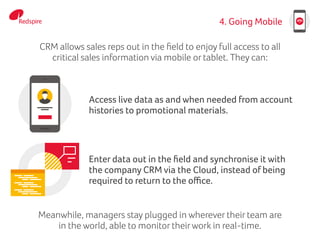
Access live data as and when needed from account
histories to promotional materials.
Enter data out in the field and synchronise it with
the company CRM via the Cloud, instead of being
required to return to the office.
CRM allows sales reps out in the field to enjoy full access to all
critical sales information via mobile or tablet. They can:
Meanwhile, managers stay plugged in wherever their team are
in the world, able to monitor theirwork in real-time.
4. Going Mobile
increase in sales productivity.
14.6%
Implementing CRM mobile capabilities creates a
£
5. Driving Home The Benefits
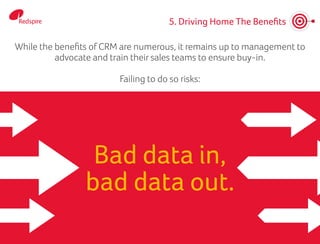
Bad data in,
bad data out.
While the benefits of CRM are numerous, it remains up to management to
advocate and train their sales teams to ensure buy-in.
Failing to do so risks:
5. Driving Home The Benefits
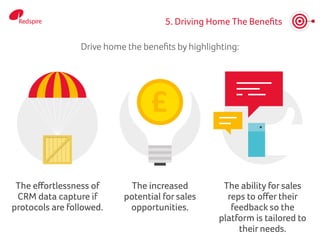
Drive home the benefits by highlighting:
The effortlessness of
CRM data capture if
protocols are followed.
The increased
potential for sales
opportunities.
The ability for sales
reps to offer their
feedback so the
platform is tailored to
their needs.
If you don’t have time to implement
a training programme, bring a third
party consultant on board to take Sales
representatives through the benefits of
CRM. It will transform theirwork lives
and increase their sales success stories.
Common errors in CRM
implementation have
traditionally crippled rollouts
but Redspire’s 2016 benchmark
report reveals that enterprises
are now successfully overcoming
them and reaping the rewards.
2016
Benchmark
Report:
Measuring
CRM Success
Choosing a partner is an important part
of assessing and choosing the right
CRM foryour business - find out more by
downloading:
Benchmark Report:
Measuring CRM Success
Download Now

CRM for Sales: 5 things yours should be doing

  • 1.
    CRM FOR SALES: 5 THINGSYOURS SHOULD BE DOING
  • 2.
    CRM adoption amongsalespeople is notoriously low. According to Gartner it is just under 50%
  • 3.
    The reasons? Sales seeCRM’s data entry and maintenance needs as a time- wasting bind. Sales complain that CRM isn’t tailored to their specific needs. Sales believe that CRM is too ‘scientific’; that sales is actually an art.
  • 4.
    These are misconceptions. Tocounter such false impressions, it’s essential to highlight the benefits of CRM to your teams.
  • 5.
    A good CRMsolution will help your team to: Increase automation
  • 6.
    A good CRMsolution will help your team to: Create better forecasting and reporting
  • 7.
    A good CRMsolution will help your team to: Boost alignment
  • 8.
    A good CRMsolution will help your team to: Go mobile
  • 9.
    A good CRMsolution will help your team to: Drive business benefits.
  • 10.
    1. Increasing automation Specificcriteria for lead scoring can be assigned from job roles and location, through to email activity and web behaviour. Scores can be applied to each and every lead generated by your CRM platform, with the best being prioritised automatically. CRM can judge which leads are ready to be exploited, routing them to the right sales representative so they can act immediately. Small but time-intensive tasks can be automated as well; for instance, saved call scripts can be sourced in seconds, allowing Sales to access the right script at the right time. CRM can automate tasks that normally damage Sales’ productivity and efficiency:
  • 11.
    Automation means sales teamsonly deal with the best leads, reducing cycle times and boosting conversion rates.
  • 12.
    2. Creating betterforecasting and reporting Banish inefficient report creation by exploiting CRM’s ability to generate pipeline reports on the fly. Deploy them to create accurate and up-to-date sales forecasts that are backed up by live data, not nebulous sales ‘gut instincts’. CRM can aid Sales’ understanding of the pipeline and potential sales opportunities:
  • 13.
    3. Boosting alignment increasein annual revenue growth for aligned companies decline in revenue for unaligned enterprise. 32% 7% CRM can align Sales and Marketing more closely, ripping down silos and boosting cross-departmental collaboration: vs
  • 14.
    CRM offers asuite of benefits to help achieve this alignment, including real-time virtual dashboards featuring charts, metrics and KPIs. Both departments can use these in real-time, monitoring each other’s progress and enabling them to offer feedback on performance. 3. Boosting alignment
  • 15.
    CRM helps theteams to share access to the same customer accounts or types so both departments are ‘singing from the same hymn sheet’, not pulling against one another. Leads can be judged as ‘qualified’ by CRM based on preset criteria, meaning there is no need for either Sales or Marketing to make judgement calls that the other may disagree with. 3. Boosting alignment
  • 16.
    Purchase histories canbe easily tracked, offering excellent opportunities for up- and cross-selling, thus maximising the potential of your existing client base. 3. Boosting alignment
  • 17.
    4. Going Mobile Accesslive data as and when needed from account histories to promotional materials. Enter data out in the field and synchronise it with the company CRM via the Cloud, instead of being required to return to the office. CRM allows sales reps out in the field to enjoy full access to all critical sales information via mobile or tablet. They can: Meanwhile, managers stay plugged in wherever their team are in the world, able to monitor theirwork in real-time.
  • 18.
    4. Going Mobile increasein sales productivity. 14.6% Implementing CRM mobile capabilities creates a £
  • 19.
    5. Driving HomeThe Benefits Bad data in, bad data out. While the benefits of CRM are numerous, it remains up to management to advocate and train their sales teams to ensure buy-in. Failing to do so risks:
  • 20.
    5. Driving HomeThe Benefits Drive home the benefits by highlighting: The effortlessness of CRM data capture if protocols are followed. The increased potential for sales opportunities. The ability for sales reps to offer their feedback so the platform is tailored to their needs.
  • 21.
    If you don’thave time to implement a training programme, bring a third party consultant on board to take Sales representatives through the benefits of CRM. It will transform theirwork lives and increase their sales success stories.
  • 22.
    Common errors inCRM implementation have traditionally crippled rollouts but Redspire’s 2016 benchmark report reveals that enterprises are now successfully overcoming them and reaping the rewards. 2016 Benchmark Report: Measuring CRM Success Choosing a partner is an important part of assessing and choosing the right CRM foryour business - find out more by downloading: Benchmark Report: Measuring CRM Success Download Now