SR TEXTILES
INTRODUCTION
India’s textiles sector is one of the oldest industries in indian economy
dating back several centuries. India's overall textile exports during FY
2017-18 stood at US$ 39.2 billion.
The Indian textiles industry is extremely varied, with the hand-spun and
hand-woven textiles sectors at one end of the spectrum, while the capital
intensive sophisticated mills sector at the other end of the spectrum. The
decentralised power looms/ hosiery and knitting sector form the largest
component of the textiles sector. The close linkage of the textile industry
to agriculture (for raw materials such as cotton) and the ancient culture
and traditions of the country in terms of textiles make the Indian textiles
sector unique in comparison to the industries of other countries. The
Indian textile industry has the capacity to produce a wide variety of
products suitable to different market segments, both within India and
across the world.
G A R MENTS I N D USTRY I S A
B O O M ING I N D USTRY
S P ECIAL LY F O R L A DIES
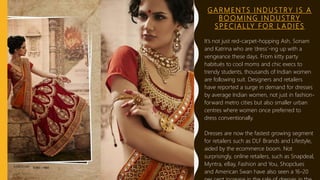
It’s not just red-carpet-hopping Ash, Sonam
and Katrina who are ‘dress’-ing up with a
vengeance these days. From kitty party
habitués to cool moms and chic execs to
trendy students, thousands of Indian women
are following suit. Designers and retailers
have reported a surge in demand for dresses
by average Indian women, not just in fashion-
forward metro cities but also smaller urban
centres where women once preferred to
dress conventionally.
Dresses are now the fastest growing segment
for retailers such as DLF Brands and Lifestyle,
aided by the ecommerce boom. Not
surprisingly, online retailers, such as Snapdeal,
Myntra, eBay, Fashion and You, Shopclues
and American Swan have also seen a 16-20
MARKET RESEARCH
– Market research should never be underestimated. Many successful new
businesses enjoy longevity because their owners conduct regular market
research to understand their target market, identify consumer problems and
pinpoint realistic competitors.
– It’s the simplest way for entrepreneurs to keep up with market trends and
maintain a competitive edge by sizing up your business opportunity.
– Market research can be carried out at various stages of a business life cycle,
from pre-launch and beyond. Having a greater understanding of your
marketplace from the very start will enable you to create a sound business
strategy to establish and grow your brand into one that’s better than the
competition.
E-COMMERCE
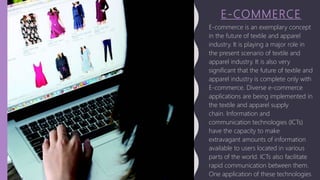
E-commerce is an exemplary concept
in the future of textile and apparel
industry. It is playing a major role in
the present scenario of textile and
apparel industry. It is also very
significant that the future of textile and
apparel industry is complete only with
E-commerce. Diverse e-commerce
applications are being implemented in
the textile and apparel supply
chain. Information and
communication technologies (ICTs)
have the capacity to make
extravagant amounts of information
available to users located in various
parts of the world. ICTs also facilitate
rapid communication between them.
One application of these technologies
ONLINE MARKET
RESEARCH
A recent study has revealed that over
120 million Indian consumers are
expected to shop online this year.
As per an ASSOCHAM-Resurgent joint
study, online shopping is expected to
clock annualised growth of 115 percent
this year, aided by fast-increasing data
consumption and improvement in
logistics, along with a number of offers
presented by e-commerce platforms.
PERCENTAGE OF
MEN’S PURCHASES
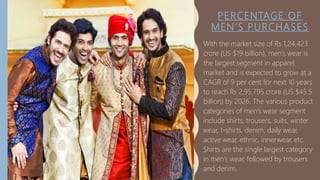
With the market size of Rs 1,24,423
crore (US $19 billion), men’s wear is
the largest segment in apparel
market and is expected to grow at a
CAGR of 9 per cent for next 10 years
to reach Rs 2,95,795 crore (US $45.5
billion) by 2026. The various product
categories of men’s wear segment
include shirts, trousers, suits, winter
wear, t-shirts, denim, daily wear,
active wear, ethnic, innerwear, etc.
Shirts are the single largest category
in men’s wear, followed by trousers
and denim.
PERCENTAGE OF
WOMEN’S PURCHASES
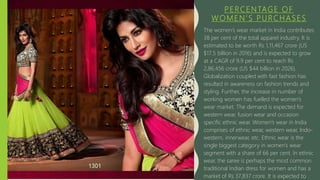
The women’s wear market in India contributes
38 per cent of the total apparel industry. It is
estimated to be worth Rs 1,11,467 crore (US
$17.5 billion in 2016) and is expected to grow
at a CAGR of 9.9 per cent to reach Rs
2,86,456 crore (US $44 billion in 2026).
Globalization coupled with fast fashion has
resulted in awareness on fashion trends and
styling. Further, the increase in number of
working women has fuelled the women’s
wear market. The demand is expected for
western wear, fusion wear and occasion
specific ethnic wear. Women’s wear in India
comprises of ethnic wear, western wear, Indo-
western, innerwear, etc. Ethnic wear is the
single biggest category in women’s wear
segment with a share of 66 per cent. In ethnic
wear, the saree is perhaps the most common
traditional Indian dress for women and has a
market of Rs 37,837 crore. It is expected to
WOMEN'S PREFER SHOPPING ONLINE
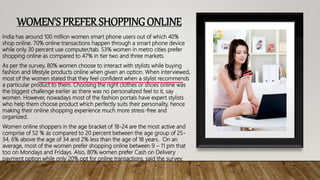
India has around 100 million women smart phone users out of which 40%
shop online. 70% online transactions happen through a smart phone device
while only 30 percent use computer/tab. 53% women in metro cities prefer
shopping online as compared to 47% in tier two and three markets.
As per the survey, 80% women choose to interact with stylists while buying
fashion and lifestyle products online when given an option. When interviewed,
most of the women stated that they feel confident when a stylist recommends
a particular product to them. Choosing the right clothes or shoes online was
the biggest challenge earlier as there was no personalized feel to it, say
women. However, nowadays most of the fashion portals have expert stylists
who help them choose product which perfectly suits their personality, hence
making their online shopping experience much more stress-free and
organized.
Women online shoppers in the age bracket of 18-24 are the most active and
comprise of 52 % as compared to 20 percent between the age group of 25-
34, 6% above the age of 34 and 2% less than the age of 18 years. On an
average, most of the women prefer shopping online between 9 – 11 pm that
too on Mondays and Fridays. Also, 80% women prefer Cash on Delivery
payment option while only 20% opt for online transactions, said the survey.
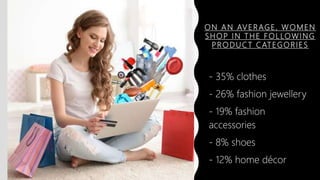
ON AN AVERAGE, WOMEN
SHOP IN THE FOLLOWING
PRODUCT CATEGORIES
- 35% clothes
- 26% fashion jewellery
- 19% fashion
accessories
- 8% shoes
- 12% home décor
E-COMMERCE SITES
- - Amazon
- - Flipkart
- - Snapdeal
- - Ebay
- - Jabong
- - Shopclues
- - Indiamart
- - Myntra
- - Infibean
- - Homeshop 18
- - Yehbhi
- - Paytm
MARKETING
STRATEGY
News paper inserting for
offline, retails, wholesale
business Mouth publicity
which is happening from
offline, retail, wholesale,
online business Pamphlets
distribution Selling stick in
camps in societies and
commercial offices Online
advertising like Instagram,
facebook, Lingdin, google,
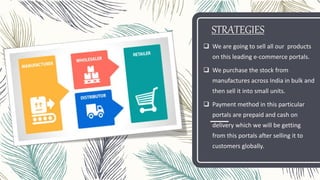
STRATEGIES
 We are going to sell all our products
on this leading e-commerce portals.
 We purchase the stock from
manufactures across India in bulk and
then sell it into small units.
 Payment method in this particular
portals are prepaid and cash on
delivery which we will be getting
from this portals after selling it to
customers globally.
RETAIL SALE
In Retails we will be selling the
stock to an individual customers
for which we are going to sell the
stock on exhibition, selling in
residence buildings, corporate
offices , industrial area etc.
WHOLESALE BUSINESS
In whole sale business we will be
selling the bulk stock to the
different kind of Retailers, bulk
stock to families who has
marriages and wants to gift to
their relatives or any other and
walking clients to store.
ROADAHEAD
The future for the Indian textile industry looks promising, buoyed by both
strong domestic consumption as well as export demand. With consumerism
and disposable income on the rise, the retail sector has experienced a rapid
growth in the past decade with the entry of several international players like
Marks & Spencer, Guess and Next into the Indian market.
High economic growth has resulted in higher disposable income. This has led
to rise in demand for products creating a huge domestic market.
Exchange Rate Used: INR 1 = US$ 0.0149 as of Q1 FY19.
THANK YOU
SR textiles

SR textiles

  • 1.
  • 2.
    INTRODUCTION India’s textiles sectoris one of the oldest industries in indian economy dating back several centuries. India's overall textile exports during FY 2017-18 stood at US$ 39.2 billion. The Indian textiles industry is extremely varied, with the hand-spun and hand-woven textiles sectors at one end of the spectrum, while the capital intensive sophisticated mills sector at the other end of the spectrum. The decentralised power looms/ hosiery and knitting sector form the largest component of the textiles sector. The close linkage of the textile industry to agriculture (for raw materials such as cotton) and the ancient culture and traditions of the country in terms of textiles make the Indian textiles sector unique in comparison to the industries of other countries. The Indian textile industry has the capacity to produce a wide variety of products suitable to different market segments, both within India and across the world.
  • 3.
    G A RMENTS I N D USTRY I S A B O O M ING I N D USTRY S P ECIAL LY F O R L A DIES It’s not just red-carpet-hopping Ash, Sonam and Katrina who are ‘dress’-ing up with a vengeance these days. From kitty party habitués to cool moms and chic execs to trendy students, thousands of Indian women are following suit. Designers and retailers have reported a surge in demand for dresses by average Indian women, not just in fashion- forward metro cities but also smaller urban centres where women once preferred to dress conventionally. Dresses are now the fastest growing segment for retailers such as DLF Brands and Lifestyle, aided by the ecommerce boom. Not surprisingly, online retailers, such as Snapdeal, Myntra, eBay, Fashion and You, Shopclues and American Swan have also seen a 16-20
  • 5.
    MARKET RESEARCH – Marketresearch should never be underestimated. Many successful new businesses enjoy longevity because their owners conduct regular market research to understand their target market, identify consumer problems and pinpoint realistic competitors. – It’s the simplest way for entrepreneurs to keep up with market trends and maintain a competitive edge by sizing up your business opportunity. – Market research can be carried out at various stages of a business life cycle, from pre-launch and beyond. Having a greater understanding of your marketplace from the very start will enable you to create a sound business strategy to establish and grow your brand into one that’s better than the competition.
  • 6.
    E-COMMERCE E-commerce is anexemplary concept in the future of textile and apparel industry. It is playing a major role in the present scenario of textile and apparel industry. It is also very significant that the future of textile and apparel industry is complete only with E-commerce. Diverse e-commerce applications are being implemented in the textile and apparel supply chain. Information and communication technologies (ICTs) have the capacity to make extravagant amounts of information available to users located in various parts of the world. ICTs also facilitate rapid communication between them. One application of these technologies
  • 7.
    ONLINE MARKET RESEARCH A recentstudy has revealed that over 120 million Indian consumers are expected to shop online this year. As per an ASSOCHAM-Resurgent joint study, online shopping is expected to clock annualised growth of 115 percent this year, aided by fast-increasing data consumption and improvement in logistics, along with a number of offers presented by e-commerce platforms.
  • 8.
    PERCENTAGE OF MEN’S PURCHASES Withthe market size of Rs 1,24,423 crore (US $19 billion), men’s wear is the largest segment in apparel market and is expected to grow at a CAGR of 9 per cent for next 10 years to reach Rs 2,95,795 crore (US $45.5 billion) by 2026. The various product categories of men’s wear segment include shirts, trousers, suits, winter wear, t-shirts, denim, daily wear, active wear, ethnic, innerwear, etc. Shirts are the single largest category in men’s wear, followed by trousers and denim.
  • 9.
    PERCENTAGE OF WOMEN’S PURCHASES Thewomen’s wear market in India contributes 38 per cent of the total apparel industry. It is estimated to be worth Rs 1,11,467 crore (US $17.5 billion in 2016) and is expected to grow at a CAGR of 9.9 per cent to reach Rs 2,86,456 crore (US $44 billion in 2026). Globalization coupled with fast fashion has resulted in awareness on fashion trends and styling. Further, the increase in number of working women has fuelled the women’s wear market. The demand is expected for western wear, fusion wear and occasion specific ethnic wear. Women’s wear in India comprises of ethnic wear, western wear, Indo- western, innerwear, etc. Ethnic wear is the single biggest category in women’s wear segment with a share of 66 per cent. In ethnic wear, the saree is perhaps the most common traditional Indian dress for women and has a market of Rs 37,837 crore. It is expected to
  • 11.
    WOMEN'S PREFER SHOPPINGONLINE India has around 100 million women smart phone users out of which 40% shop online. 70% online transactions happen through a smart phone device while only 30 percent use computer/tab. 53% women in metro cities prefer shopping online as compared to 47% in tier two and three markets. As per the survey, 80% women choose to interact with stylists while buying fashion and lifestyle products online when given an option. When interviewed, most of the women stated that they feel confident when a stylist recommends a particular product to them. Choosing the right clothes or shoes online was the biggest challenge earlier as there was no personalized feel to it, say women. However, nowadays most of the fashion portals have expert stylists who help them choose product which perfectly suits their personality, hence making their online shopping experience much more stress-free and organized. Women online shoppers in the age bracket of 18-24 are the most active and comprise of 52 % as compared to 20 percent between the age group of 25- 34, 6% above the age of 34 and 2% less than the age of 18 years. On an average, most of the women prefer shopping online between 9 – 11 pm that too on Mondays and Fridays. Also, 80% women prefer Cash on Delivery payment option while only 20% opt for online transactions, said the survey.
  • 12.
    ON AN AVERAGE,WOMEN SHOP IN THE FOLLOWING PRODUCT CATEGORIES - 35% clothes - 26% fashion jewellery - 19% fashion accessories - 8% shoes - 12% home décor
  • 13.
    E-COMMERCE SITES - -Amazon - - Flipkart - - Snapdeal - - Ebay - - Jabong - - Shopclues - - Indiamart - - Myntra - - Infibean - - Homeshop 18 - - Yehbhi - - Paytm
  • 14.
    MARKETING STRATEGY News paper insertingfor offline, retails, wholesale business Mouth publicity which is happening from offline, retail, wholesale, online business Pamphlets distribution Selling stick in camps in societies and commercial offices Online advertising like Instagram, facebook, Lingdin, google,
  • 15.
    STRATEGIES  We aregoing to sell all our products on this leading e-commerce portals.  We purchase the stock from manufactures across India in bulk and then sell it into small units.  Payment method in this particular portals are prepaid and cash on delivery which we will be getting from this portals after selling it to customers globally.
  • 16.
    RETAIL SALE In Retailswe will be selling the stock to an individual customers for which we are going to sell the stock on exhibition, selling in residence buildings, corporate offices , industrial area etc.
  • 17.
    WHOLESALE BUSINESS In wholesale business we will be selling the bulk stock to the different kind of Retailers, bulk stock to families who has marriages and wants to gift to their relatives or any other and walking clients to store.
  • 18.
    ROADAHEAD The future forthe Indian textile industry looks promising, buoyed by both strong domestic consumption as well as export demand. With consumerism and disposable income on the rise, the retail sector has experienced a rapid growth in the past decade with the entry of several international players like Marks & Spencer, Guess and Next into the Indian market. High economic growth has resulted in higher disposable income. This has led to rise in demand for products creating a huge domestic market. Exchange Rate Used: INR 1 = US$ 0.0149 as of Q1 FY19.
  • 19.