








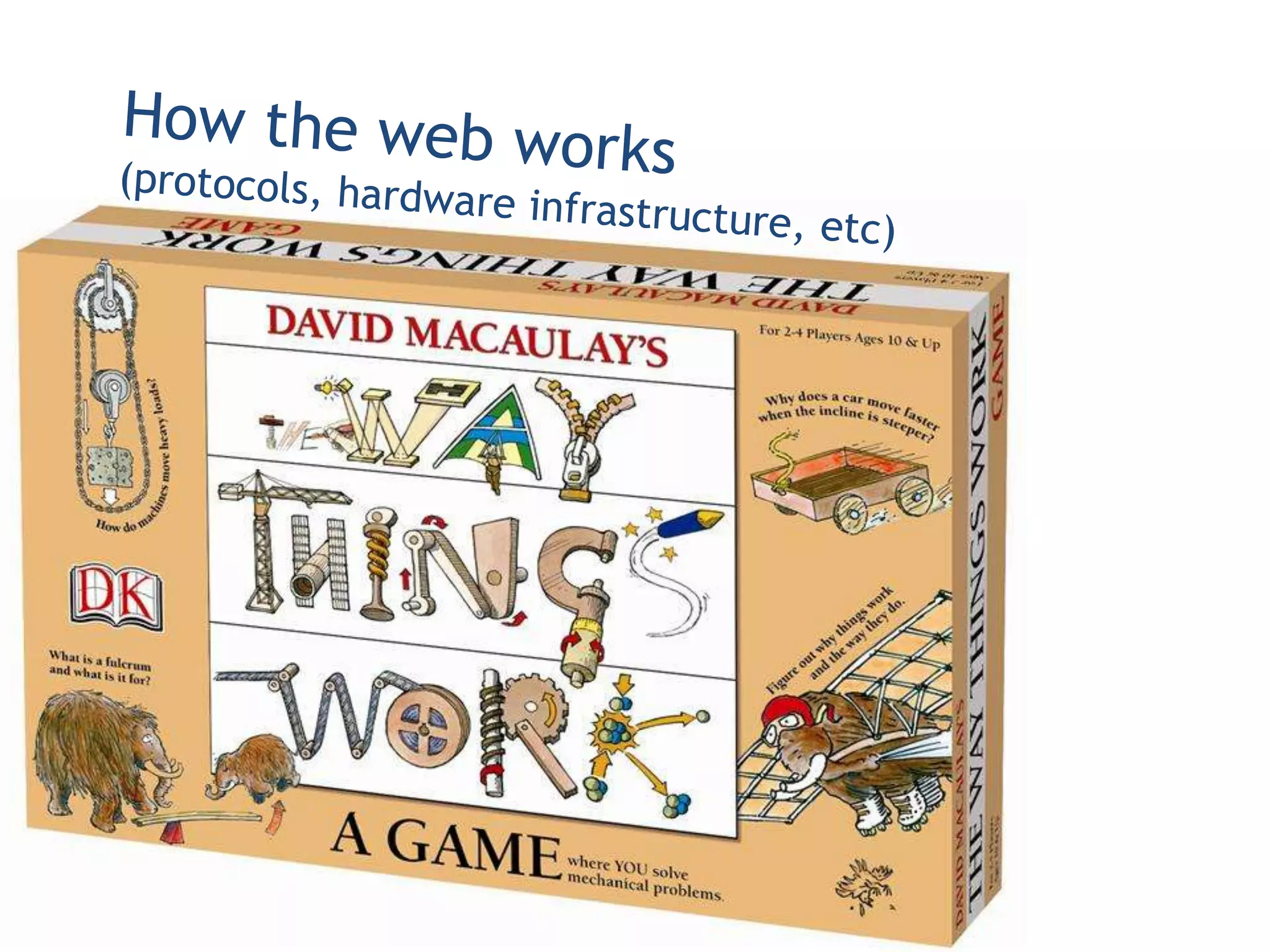















Criticizing and Modernizing
the Computing Curriculum
The Case of the
Web
and the
Social Issues Courses
Randy Connolly
Mount Royal University, Calgary
Computing education has faced
a variety of ongoing and critical
self-examinations of different
aspects of the curriculum over
the past 15 years.
Some computing topic areas
(e.g., first-year programming)
have been rigorously examined
in the education literature.
Other common topic areas have
not been as adequately
examined.
This paper provides a set of
critiques and alternative
teaching approaches for
two vital topic areas that have
been under-reported in the
computing education literature:
1
web development


2
ethics/social issues
This paper both restates and
provides a capsule summary of
this author’s more detailed
papers on these two subjects.
Teaching
the web
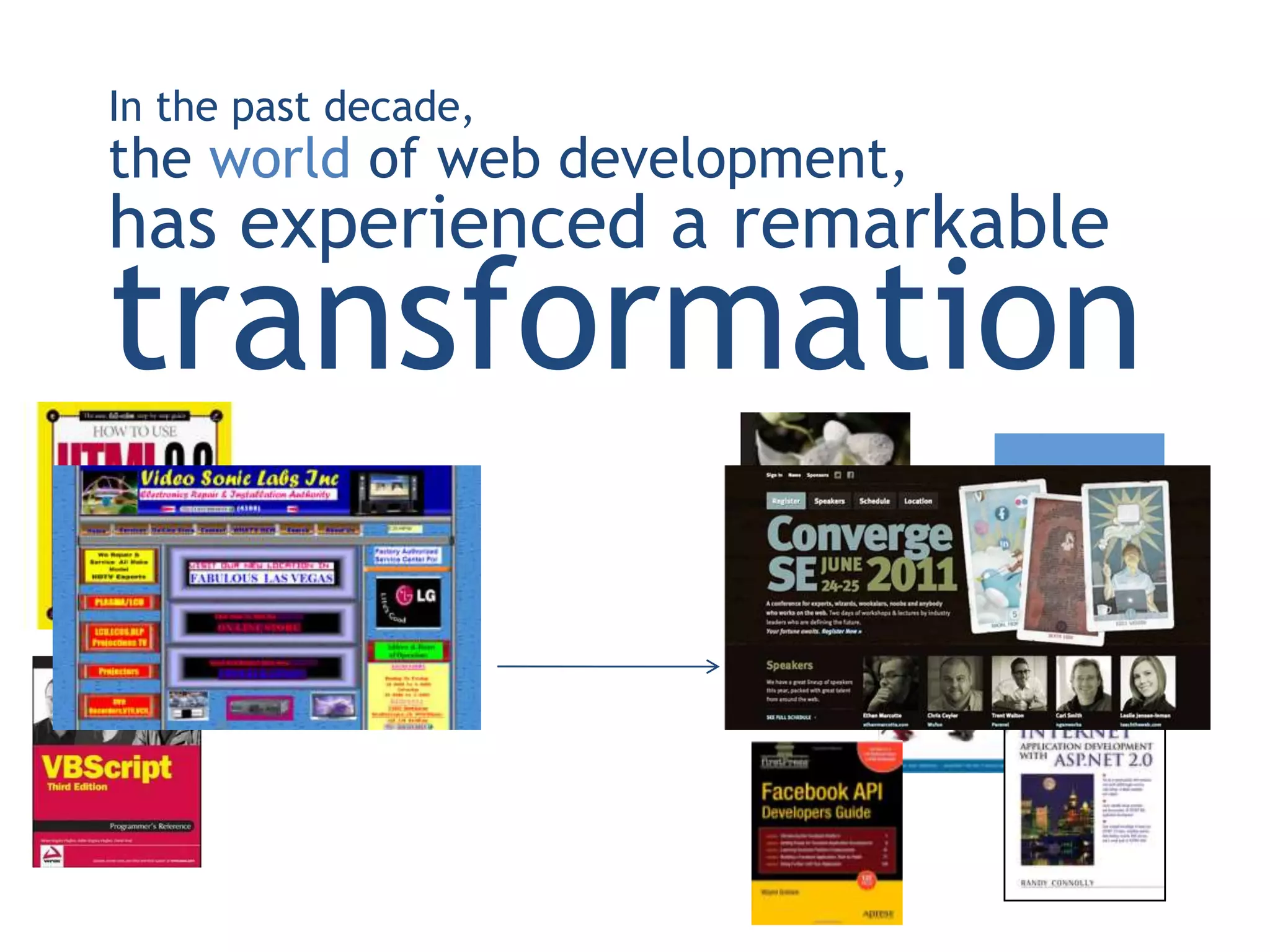
In the past decade,
the world of web development,
has experienced a remarkable
transformation
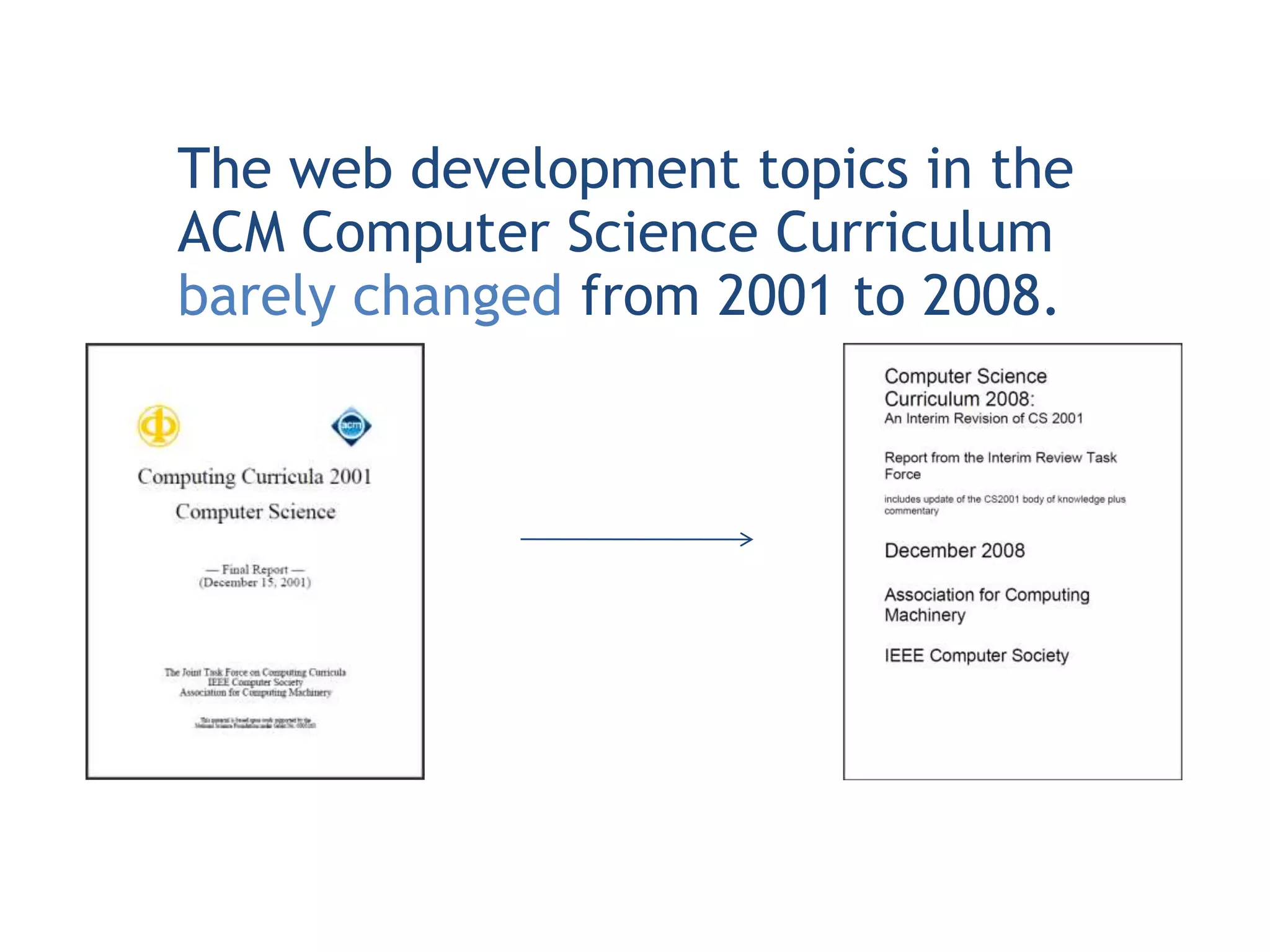
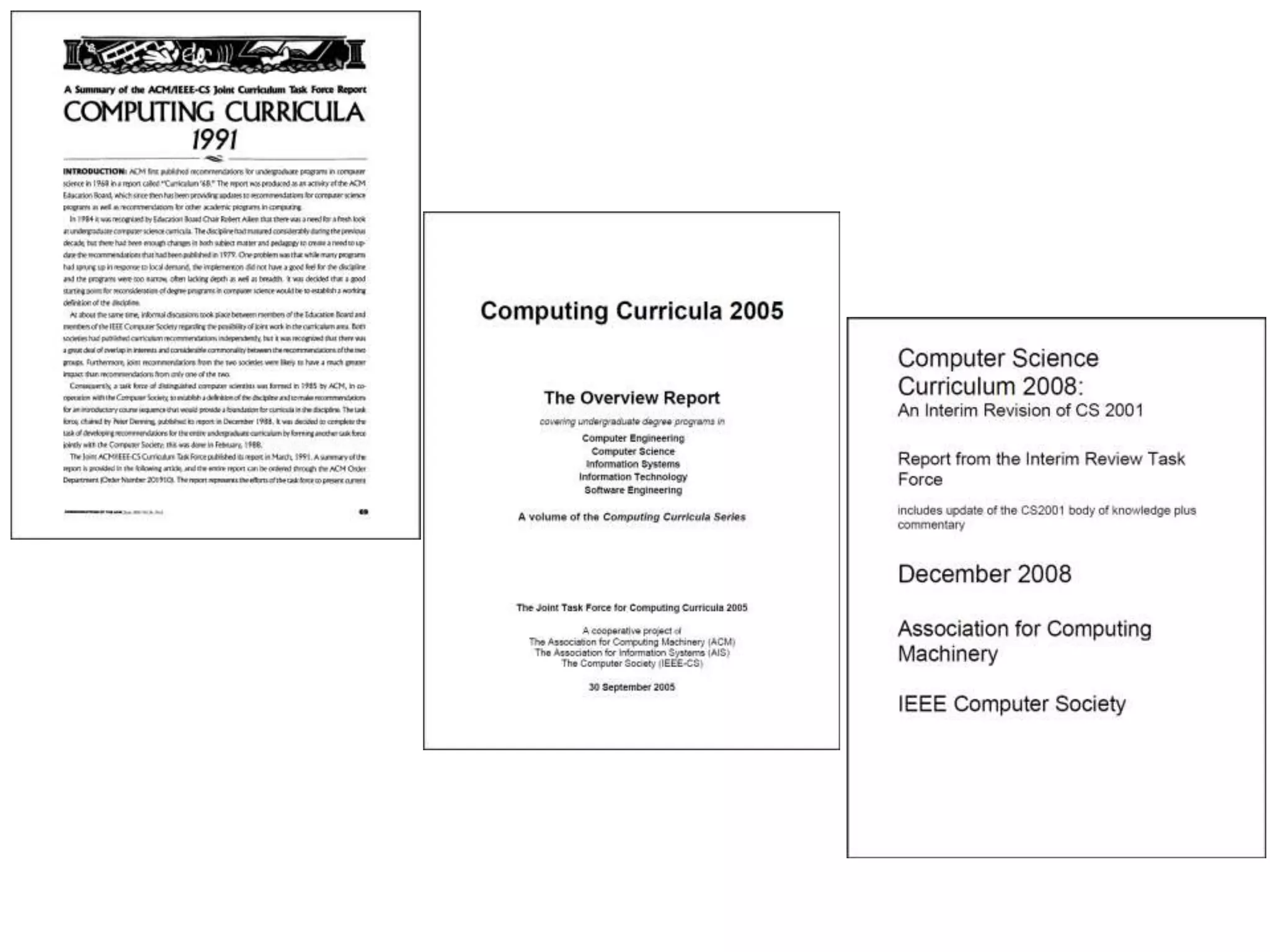
The web development topics in the
ACM Computer Science Curriculum
barely changed from 2001 to 2008.
FURTHERMORE
Almost all of the topics
recognizable as pertaining to
the field of web development
are marked as elective topics
in the CS 2008 (and 2013)
curriculum.
ALSO
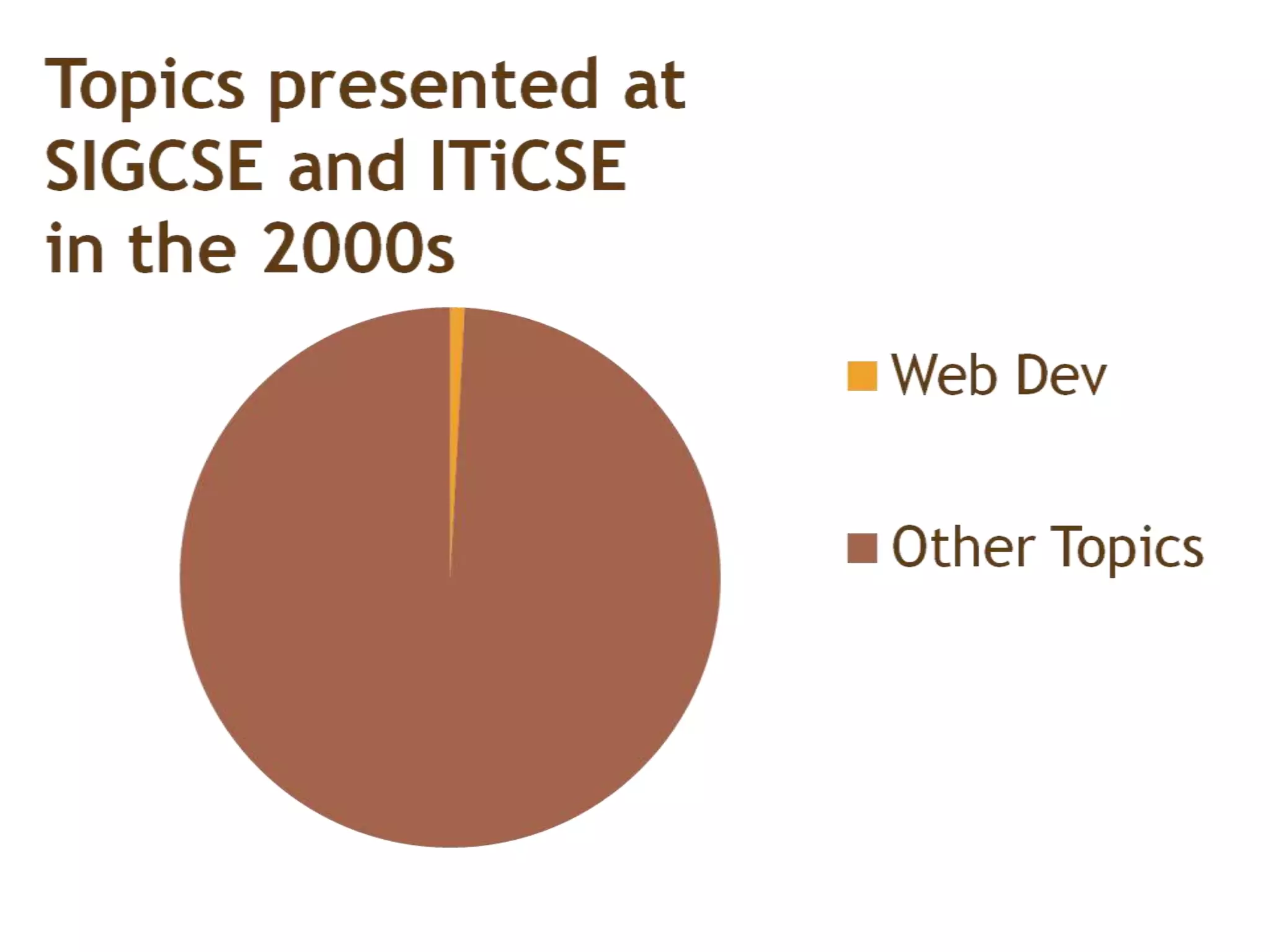
There has been a real dearth
of research on the teaching of
web topics.
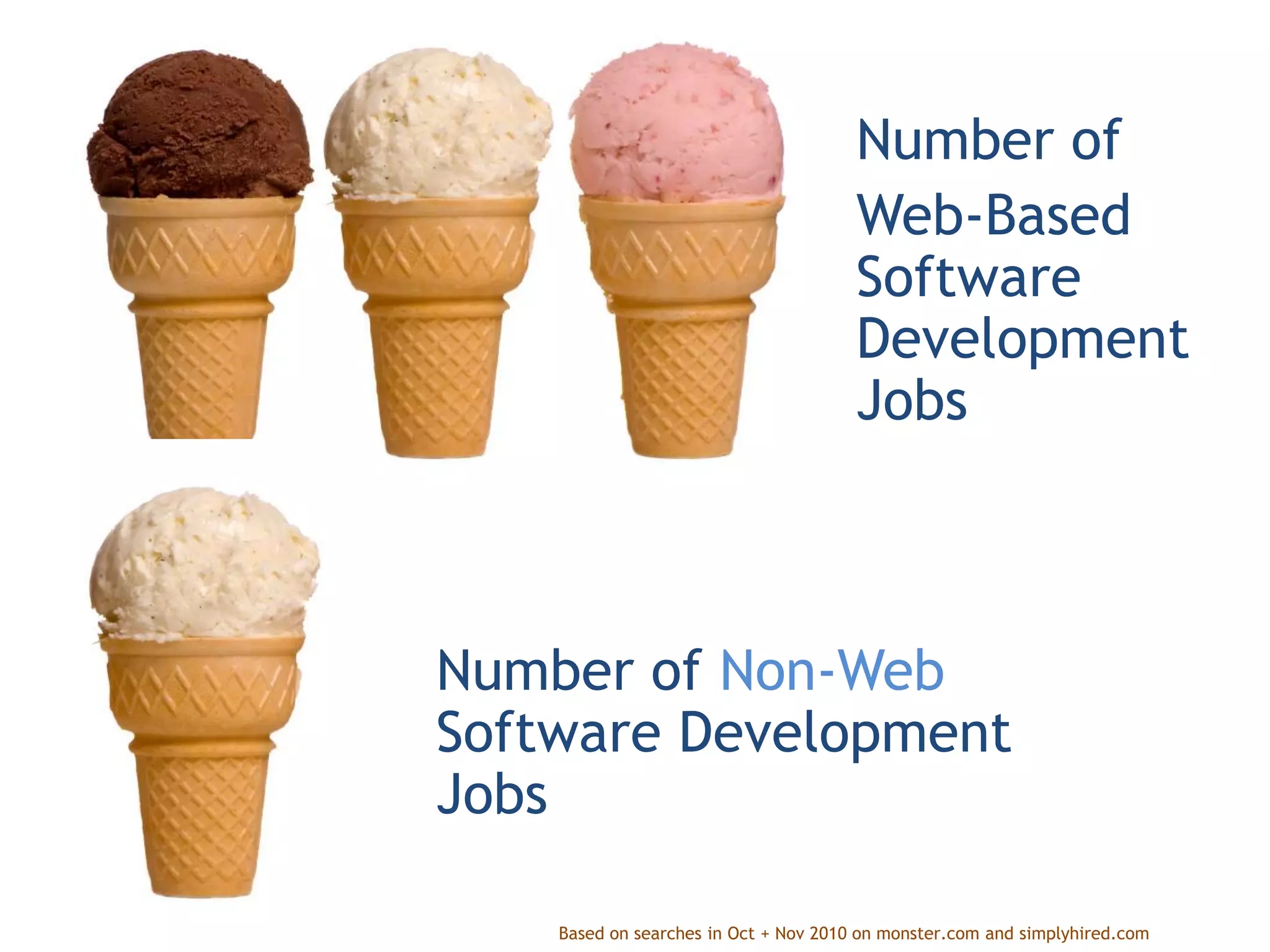
Given the importance of web technology
in the real world of software development,
This relative lack of interest
in the web by computer science


is somewhat surprising.
Number of
                                       Web-Based
                                       Software
                                       Development
                                       Jobs


Number of Non-Web
Software Development
Jobs

    Based on searches in Oct + Nov 2010 on monster.com and simplyhired.com
The papers that do exist
generally begin by stressing
the many difficulties
in teaching a web development course.
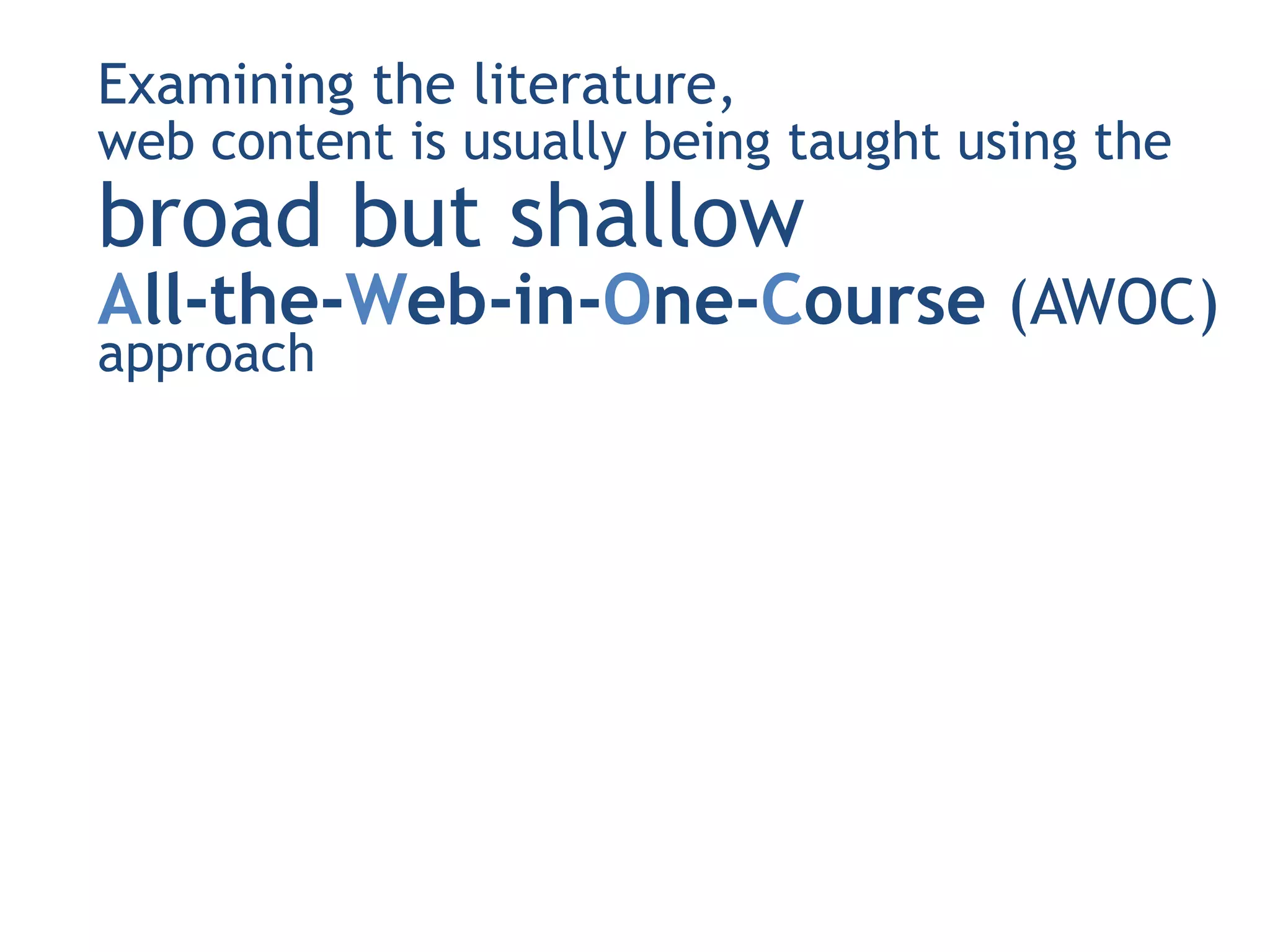
Examining the literature,
web content is usually being taught using the
broad but shallow
All-the-Web-in-One-Course (AWOC)
approach
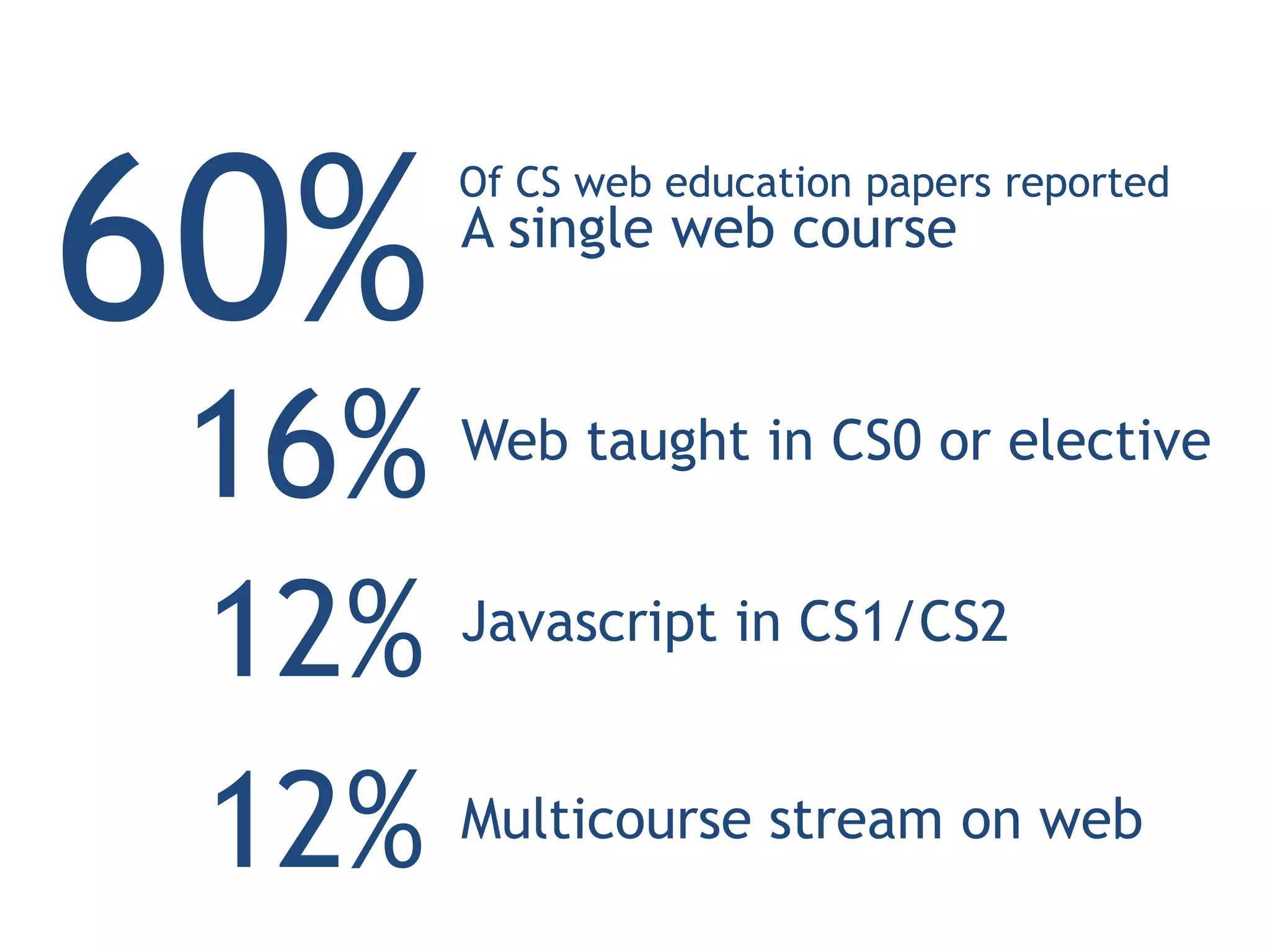
60%
        Of CS web education papers reported
        A single web course


 16%    Web taught in CS0 or elective


 12%    Javascript in CS1/CS2


 12% Multicourse stream on web
Given the importance of web systems,

the time has come for


             retiring the AWOC approach
Back in the early 1970s, a math program
might have had a single course in
programming in Fortran,
but eventually it was recognized that a body
of knowledge as complex as programming
requires multiple courses to teach the
material properly.


Web development
should be in a
similar state today
While the AWOC approach does give students
a sense of the big picture of web development,
it by no means provides the students
with anything approaching proficiency
in contemporary practice.
Why not?
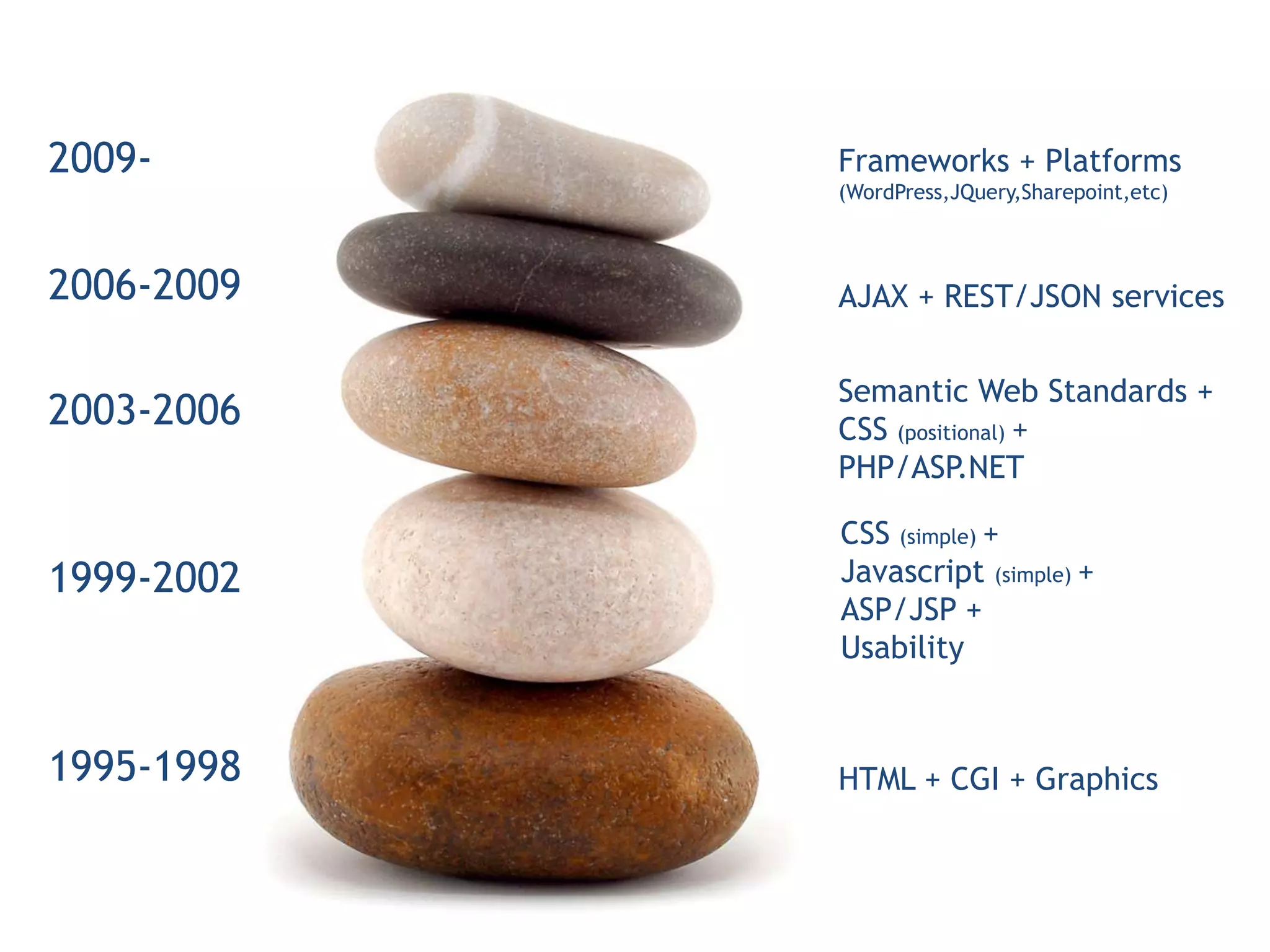
Because web development is
characterized by peculiar combination of

change
and
persistence
2009-       Frameworks + Platforms
            (WordPress,JQuery,Sharepoint,etc)


2006-2009   AJAX + REST/JSON services

            Semantic Web Standards +
2003-2006   CSS (positional) +
            PHP/ASP.NET

            CSS (simple) +
1999-2002   Javascript (simple) +
            ASP/JSP +
            Usability


1995-1998   HTML + CGI + Graphics
For those stuck with the AWOC approach
it will become increasingly
difficult to keep the course
comprehensive
and
relevant
Because of the time
limitations of the
AWOC approach, the
content in these
single web courses
increasingly seem
like they are …
partying
like it’s
1999
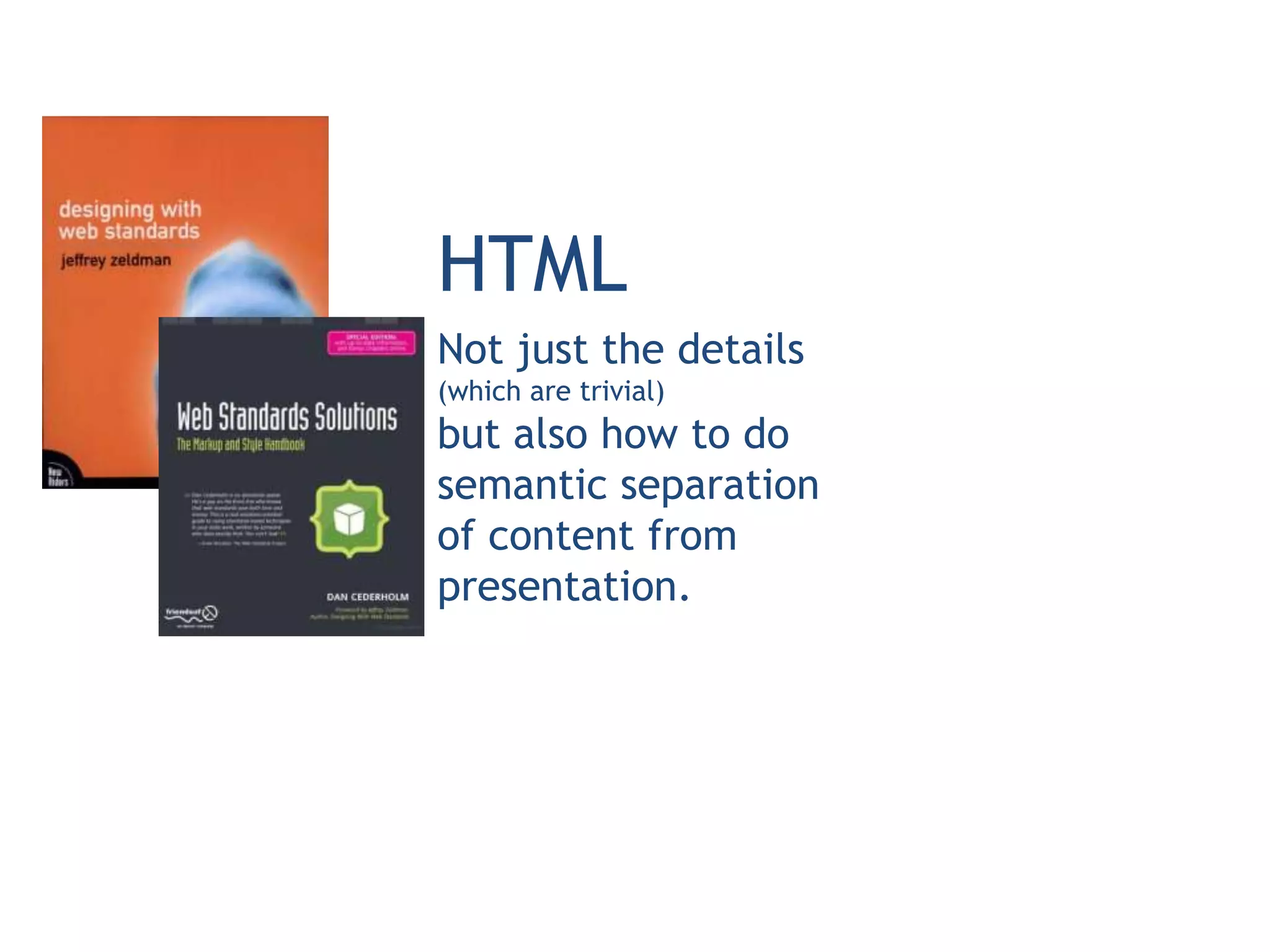
HTML
Not just the details
(which are trivial)
but also how to do
semantic separation
of content from
presentation.
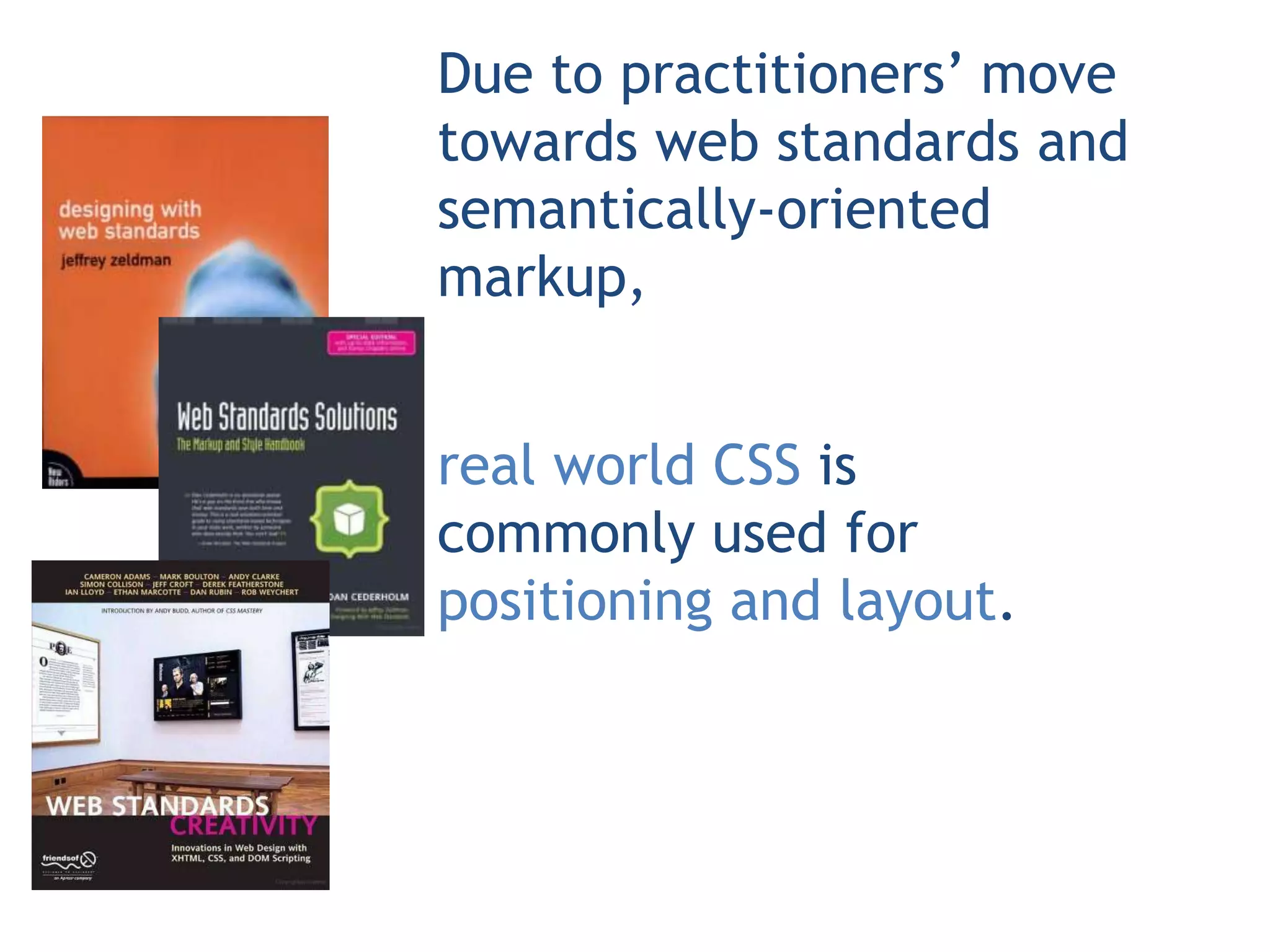
Due to practitioners’ move
towards web standards and
semantically-oriented
markup,


real world CSS is
commonly used for
positioning and layout.
This type of CSS is notoriously
difficult to master due to
browser bugs, incompatibilities, and non-obvious
CSS box model interactions.
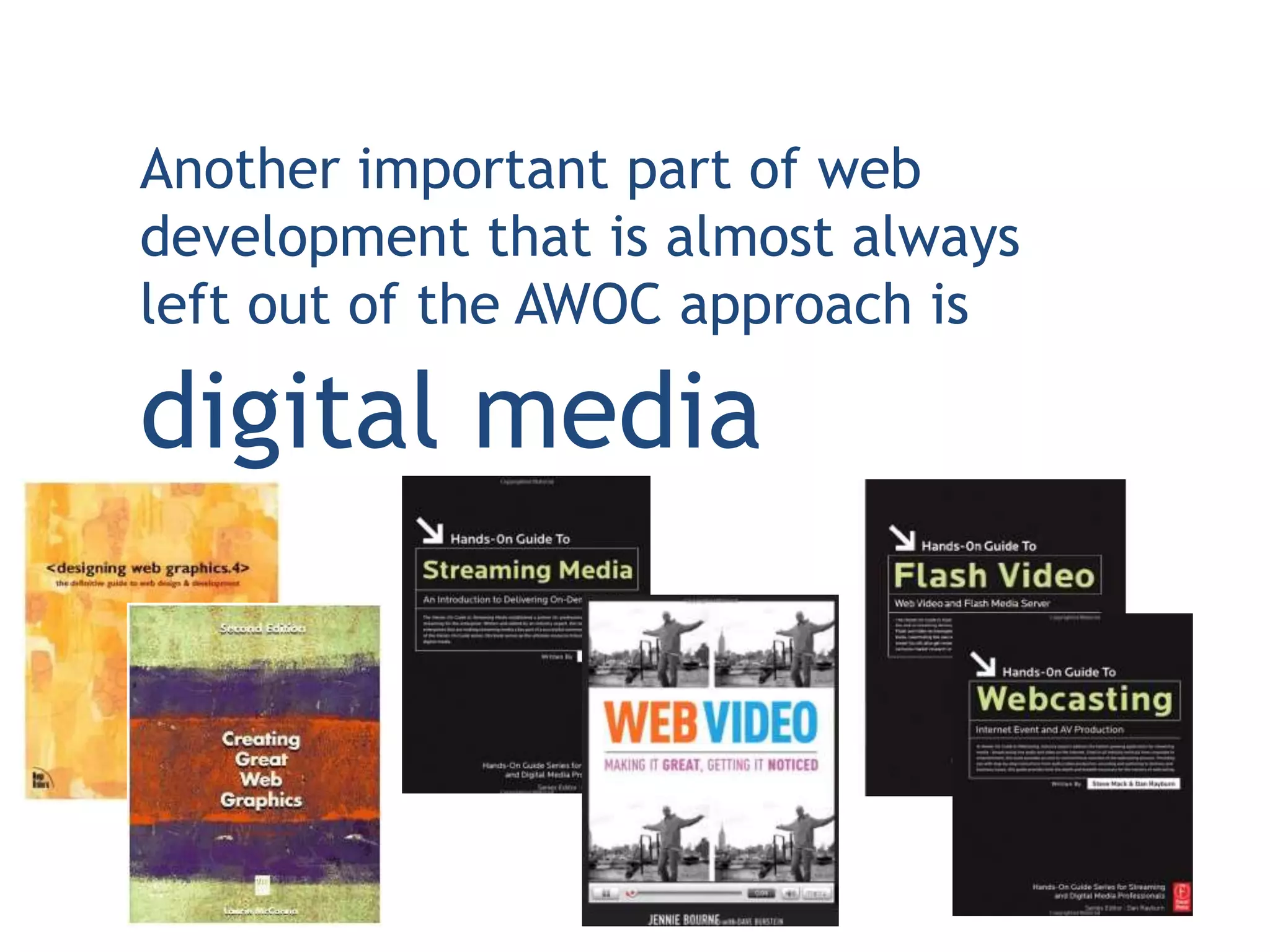
Another important part of web
development that is almost always
left out of the AWOC approach is

digital media
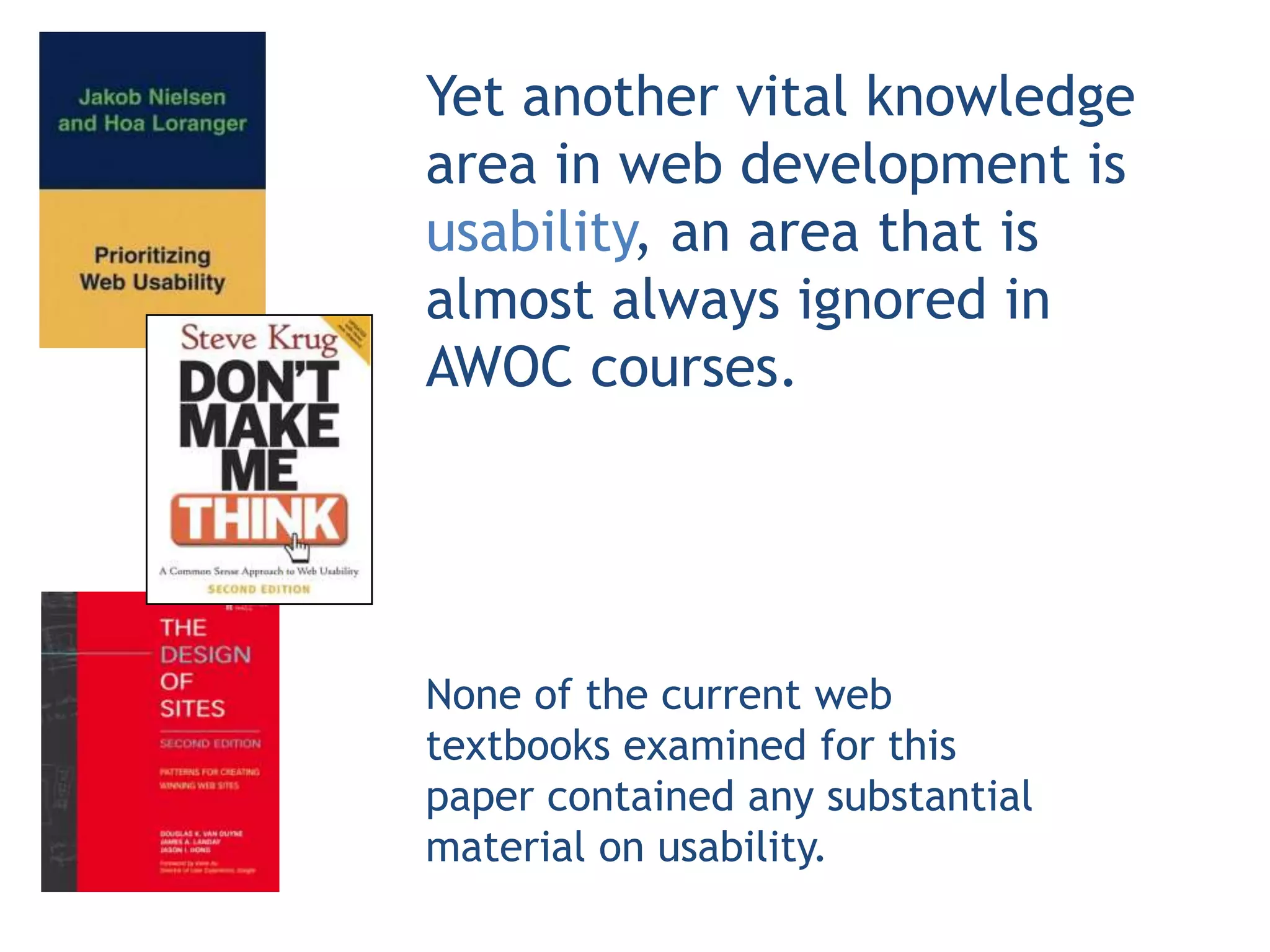
Yet another vital knowledge
area in web development is
usability, an area that is
almost always ignored in
AWOC courses.


None of the current web
textbooks examined for this
paper contained any substantial
material on usability.
Javascript has become too
complex to be covered in a
AWOC course.


The type of Javascript that can
be covered in one or two weeks
(rollovers, form data validation, browser sniffing)
was reasonably close to what
was needed professionally in the
late 1990s.
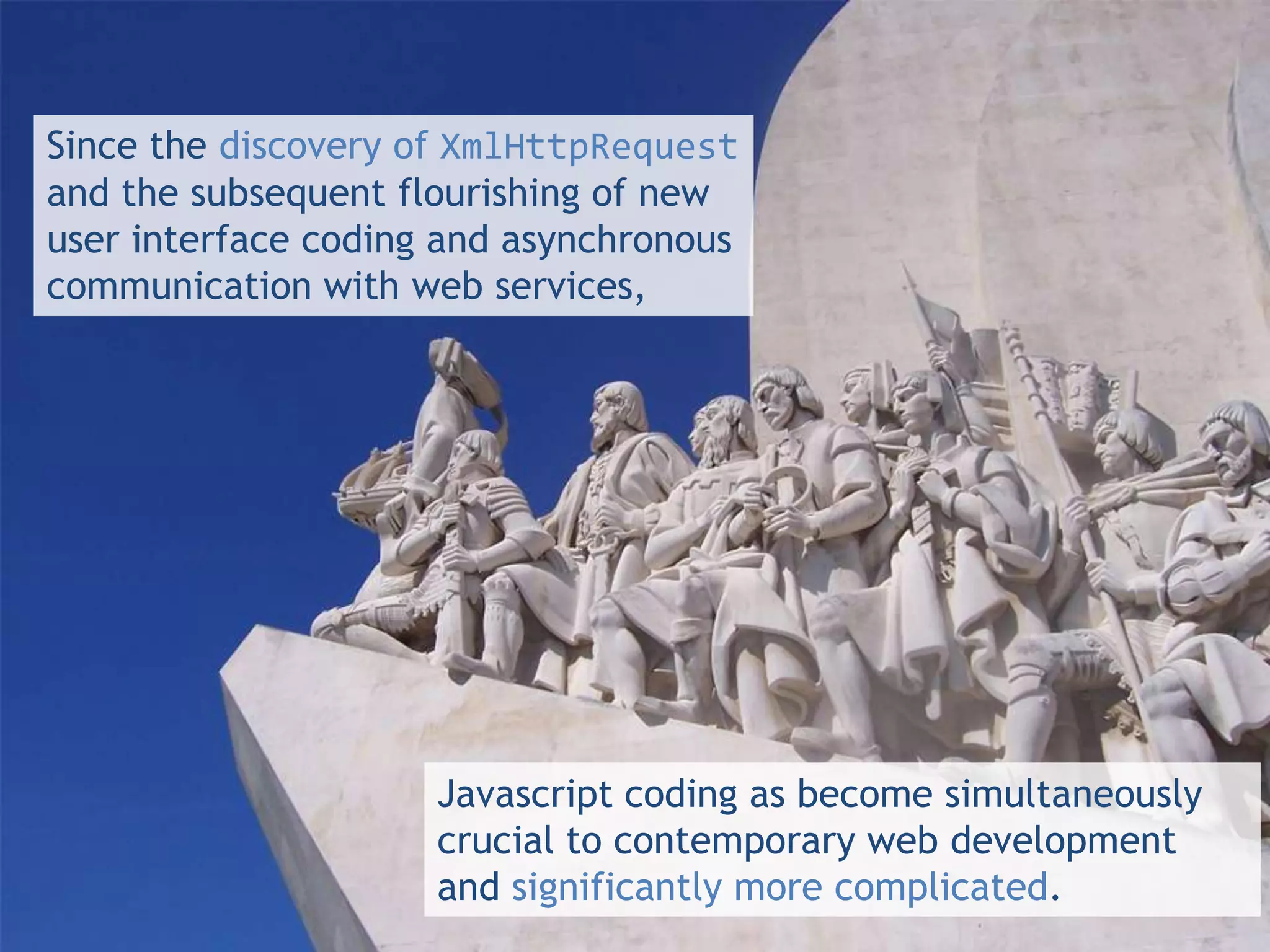
Since the discovery of XmlHttpRequest
and the subsequent flourishing of new
user interface coding and asynchronous
communication with web services,


                     Javascript coding as become simultaneously
                     crucial to contemporary web development
                     and significantly more complicated.
Analogous to the case with CSS,
this type of Javascript
programming
is very difficult to learn due to:
browser differences,

the untyped nature of the language,

the lack of a cross-browser debugging
environment,

general conceptual complexity of
working with callback functions
A key part of learning real-
world web development is
the server-side
environment.

Potentially this is a very
large topic, and has its own
difficulties from a teaching
perspective.
If students haven’t fully
mastered the ability to
implement a non-trivial design
in HTML, CSS, and Javascript,


the added indirection of
writing a program to generate
HTML, CSS, and Javascript can
be quite tricky conceptually
for a novice developer.
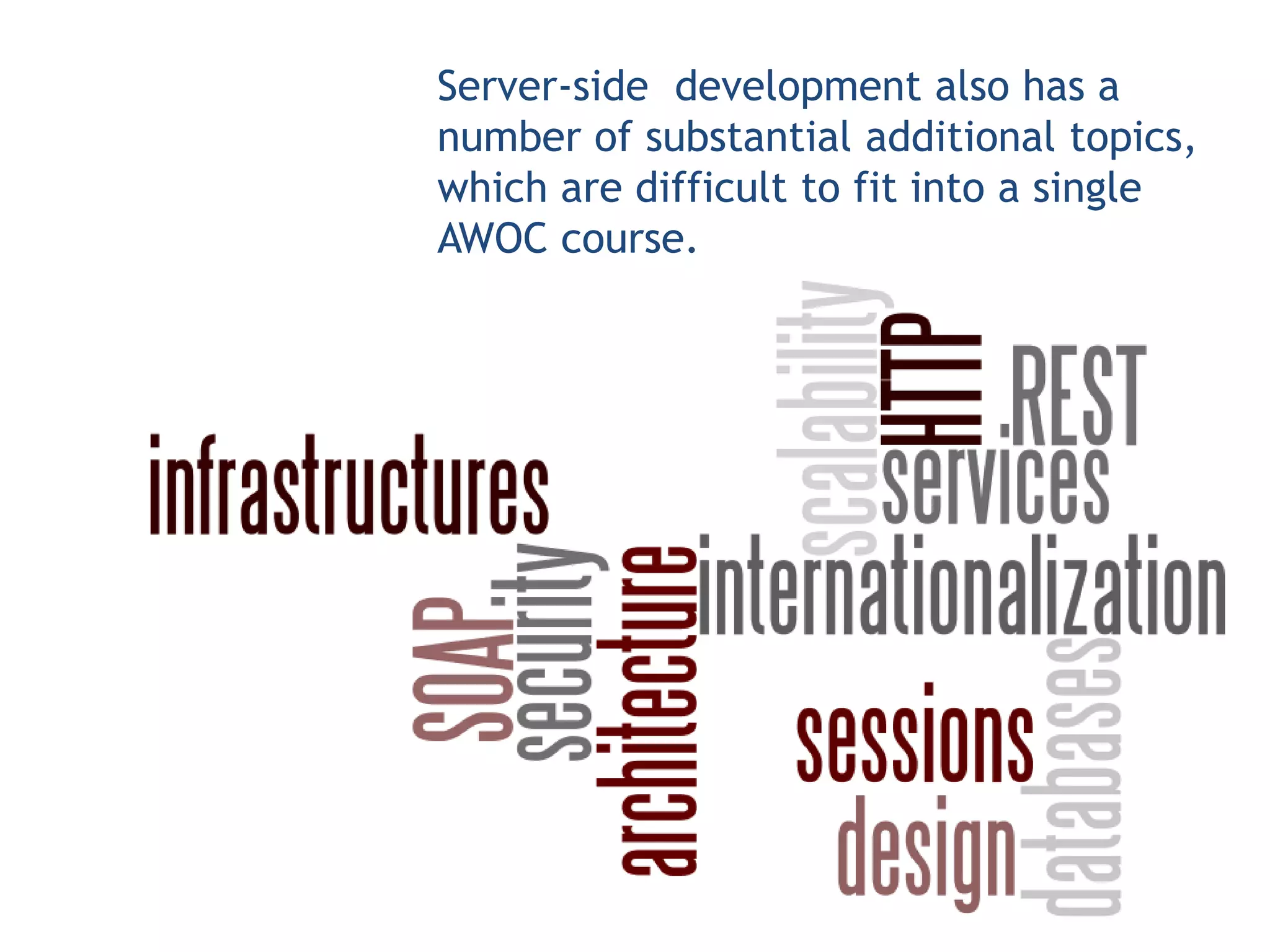
Server-side development also has a
number of substantial additional topics,
which are difficult to fit into a single
AWOC course.
Web-based APIs using
REST or SOAP services
are also an important
part of the web world
of 2008+
Web vulnerabilities/security
                   is another area that is
                   difficult to comprehensively
                   cover in the AWOC approach.


None of the current web
textbooks examined for this
paper contained any substantial
material on web security.
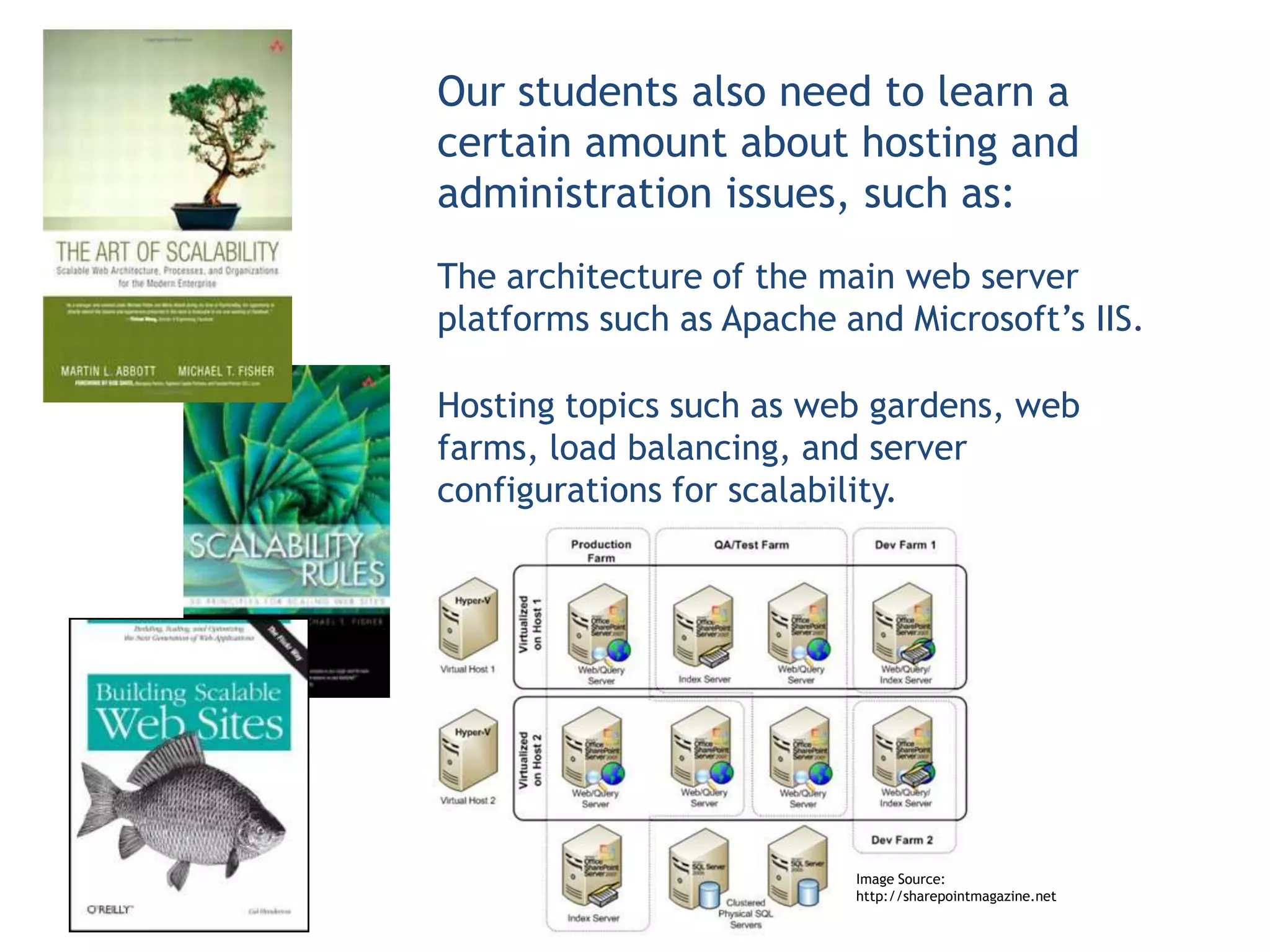
Our students also need to learn a
certain amount about hosting and
administration issues, such as:
The architecture of the main web server
platforms such as Apache and Microsoft’s IIS.

Hosting topics such as web gardens, web
farms, load balancing, and server
configurations for scalability.


                          Image Source:
                          http://sharepointmagazine.net
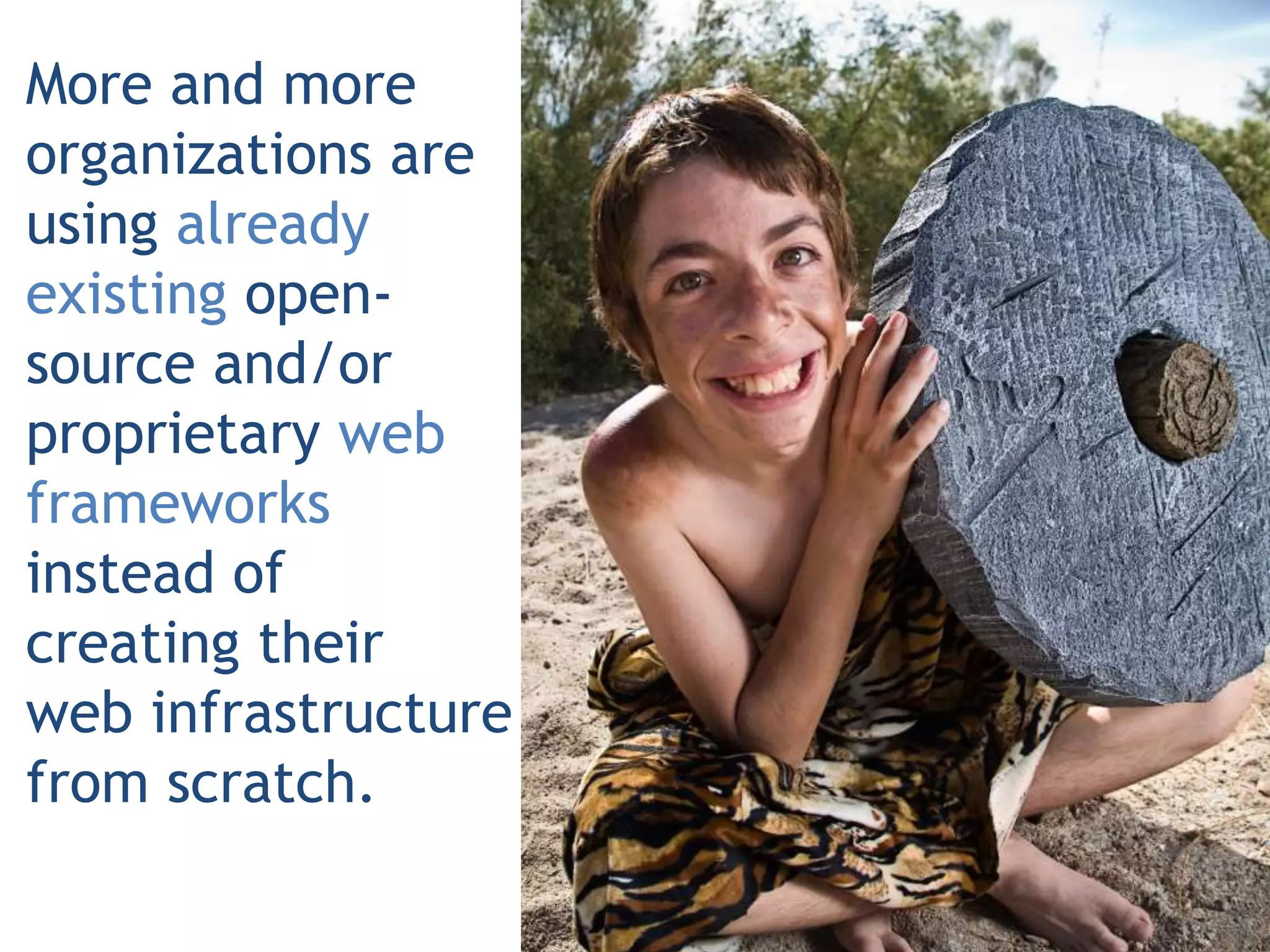
More and more
organizations are
using already
existing open-
source and/or
proprietary web
frameworks
instead of
creating their
web infrastructure
from scratch.
This is perhaps the
most substantial
revolution in web
development since
the mass adoption of
CSS in the early
2000s
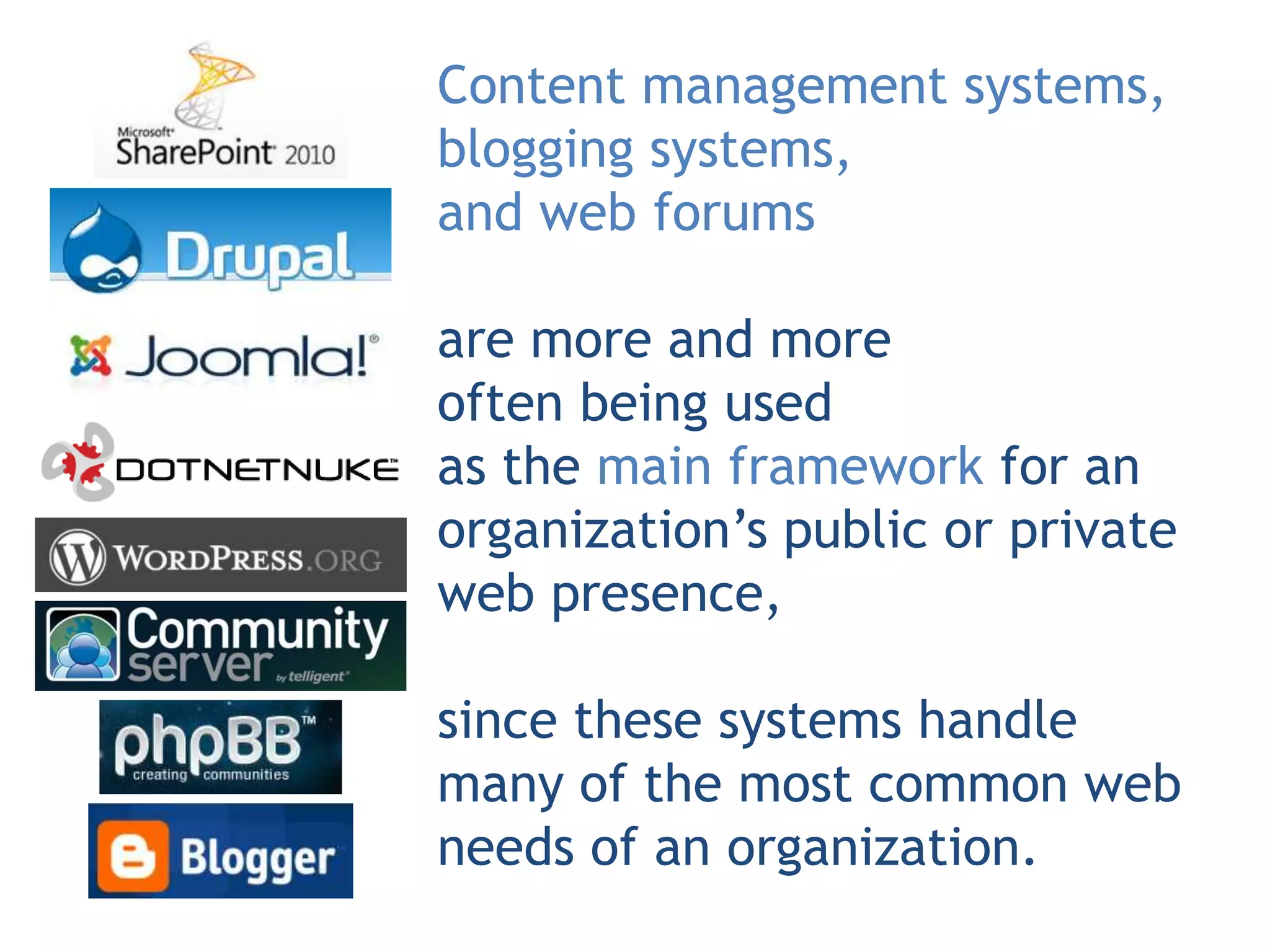
Content management systems,
blogging systems,
and web forums

are more and more
often being used
as the main framework for an
organization’s public or private
web presence,

since these systems handle
many of the most common web
needs of an organization.
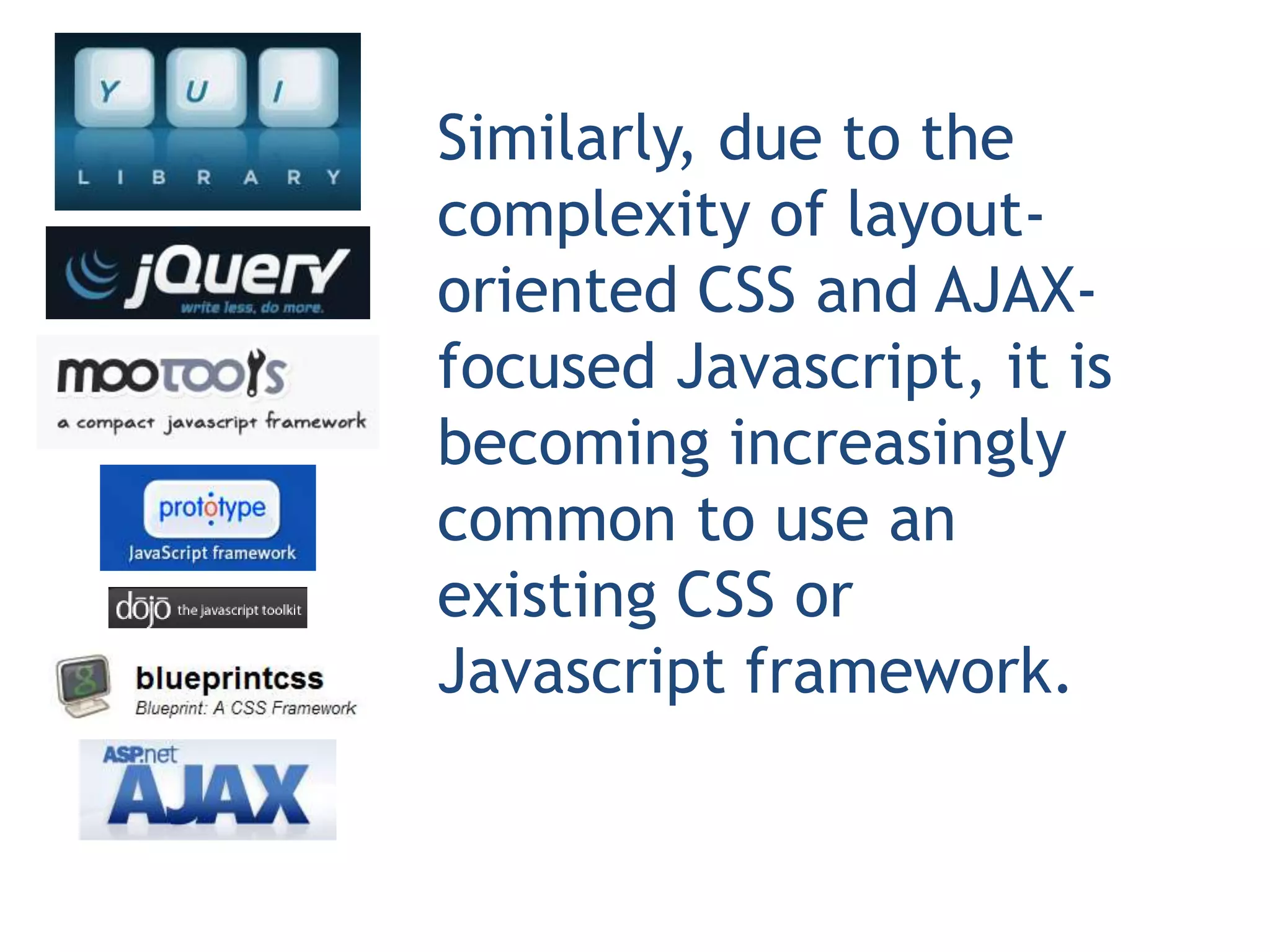
Similarly, due to the
complexity of layout-
oriented CSS and AJAX-
focused Javascript, it is
becoming increasingly
common to use an
existing CSS or
Javascript framework.
For the students, it is important to learn
about the existence of these existing
frameworks and templates because the future
of web systems will increasingly lie in their
use, integration, and customization.


               Sometimes multiple existing
               systems will be used by an
               organization and the key role of
               the web professional will be to
               get these systems to interoperate
               through their public APIs.
Teaching
ethics +
social issues
Students “need to understand the
basic cultural, social, legal, and
ethical issues inherent in the
discipline of computing.”
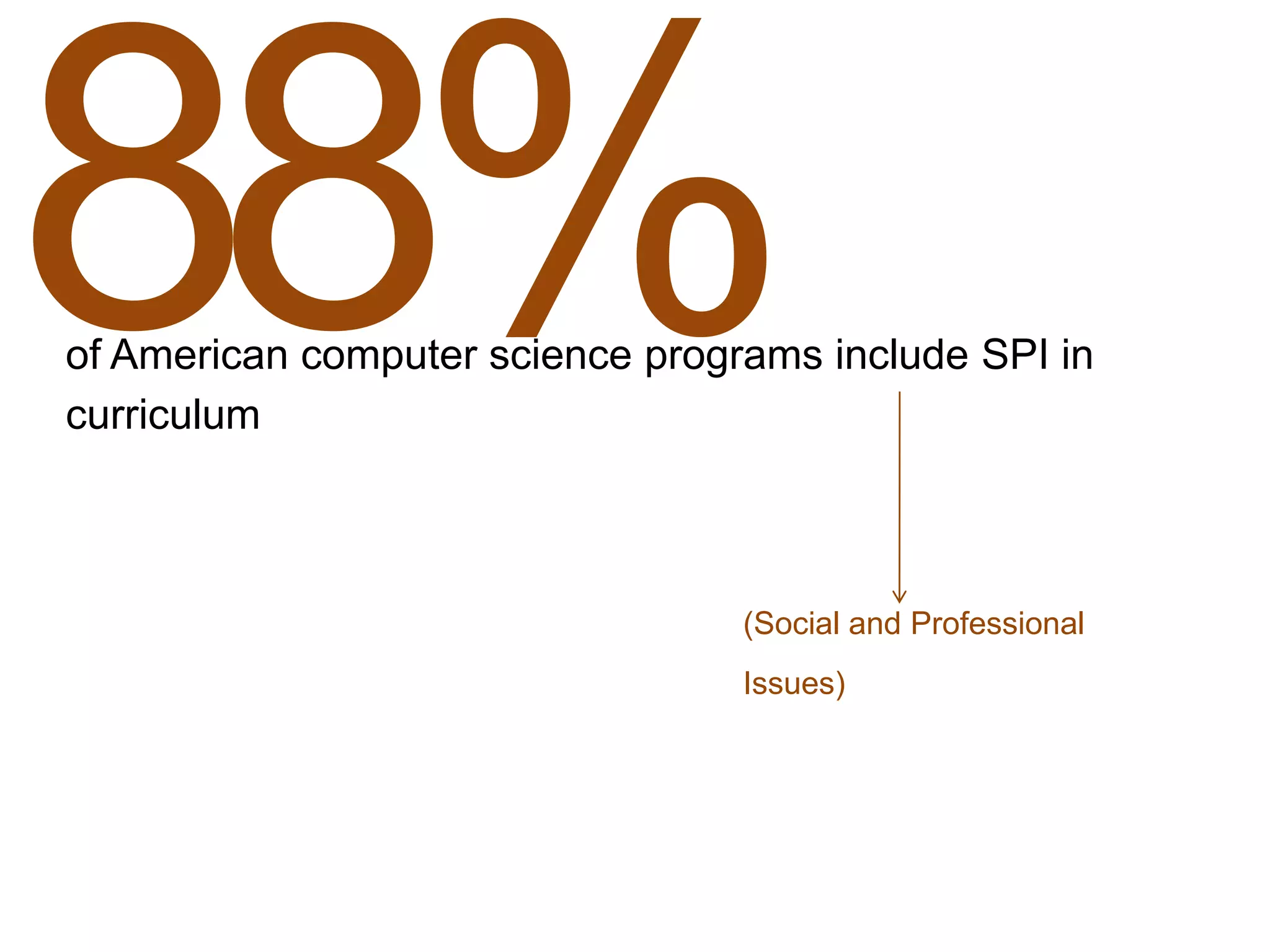
of American computer science programs include SPI in
curriculum


                                  (Social and Professional
                                  Issues)
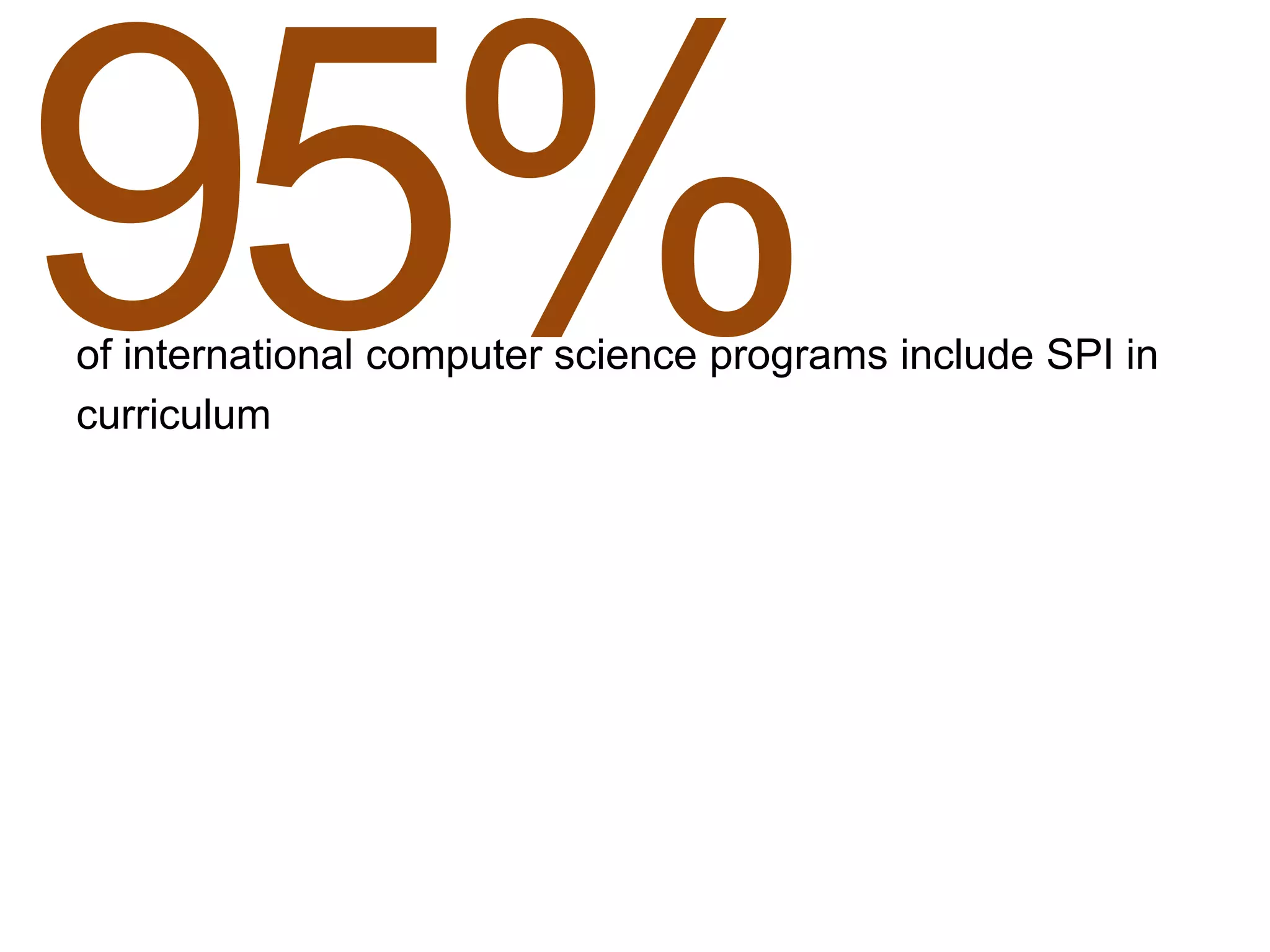
of international computer science programs include SPI in
curriculum
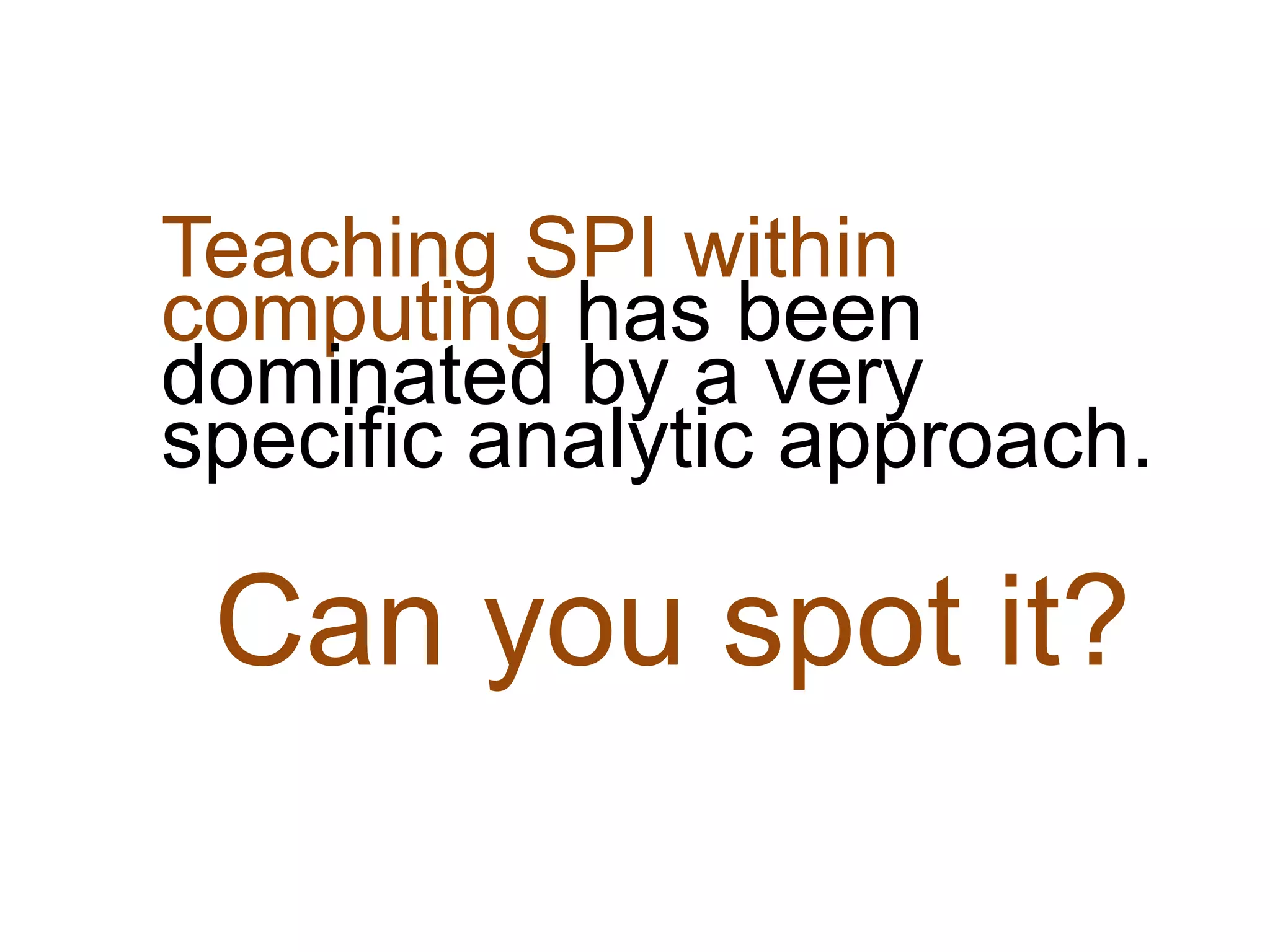
Teaching SPI within
computing has been
dominated by a very
specific analytic approach.

 Can you spot it?
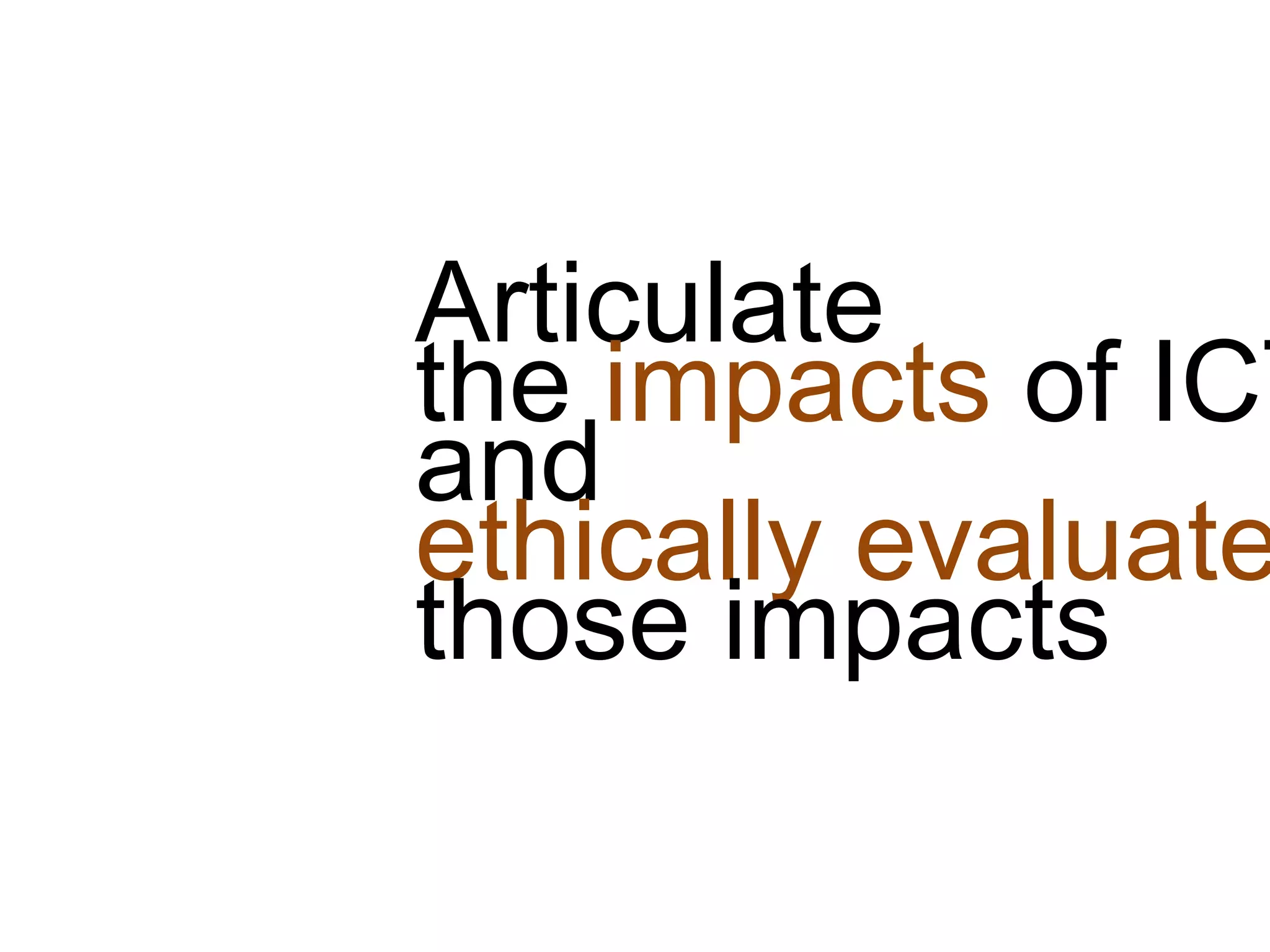
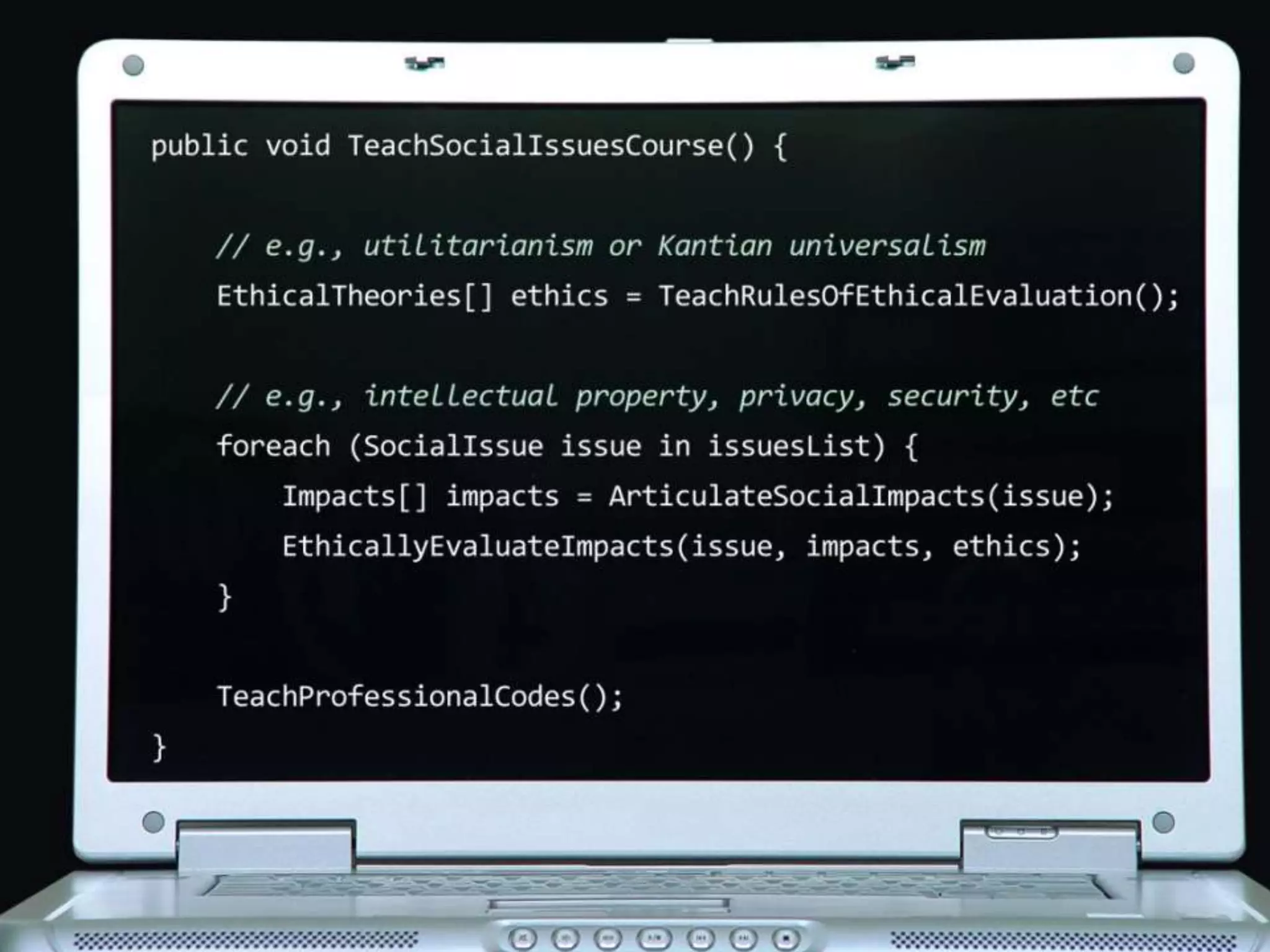
Articulate
the impacts of ICT
and
ethically evaluate
those impacts
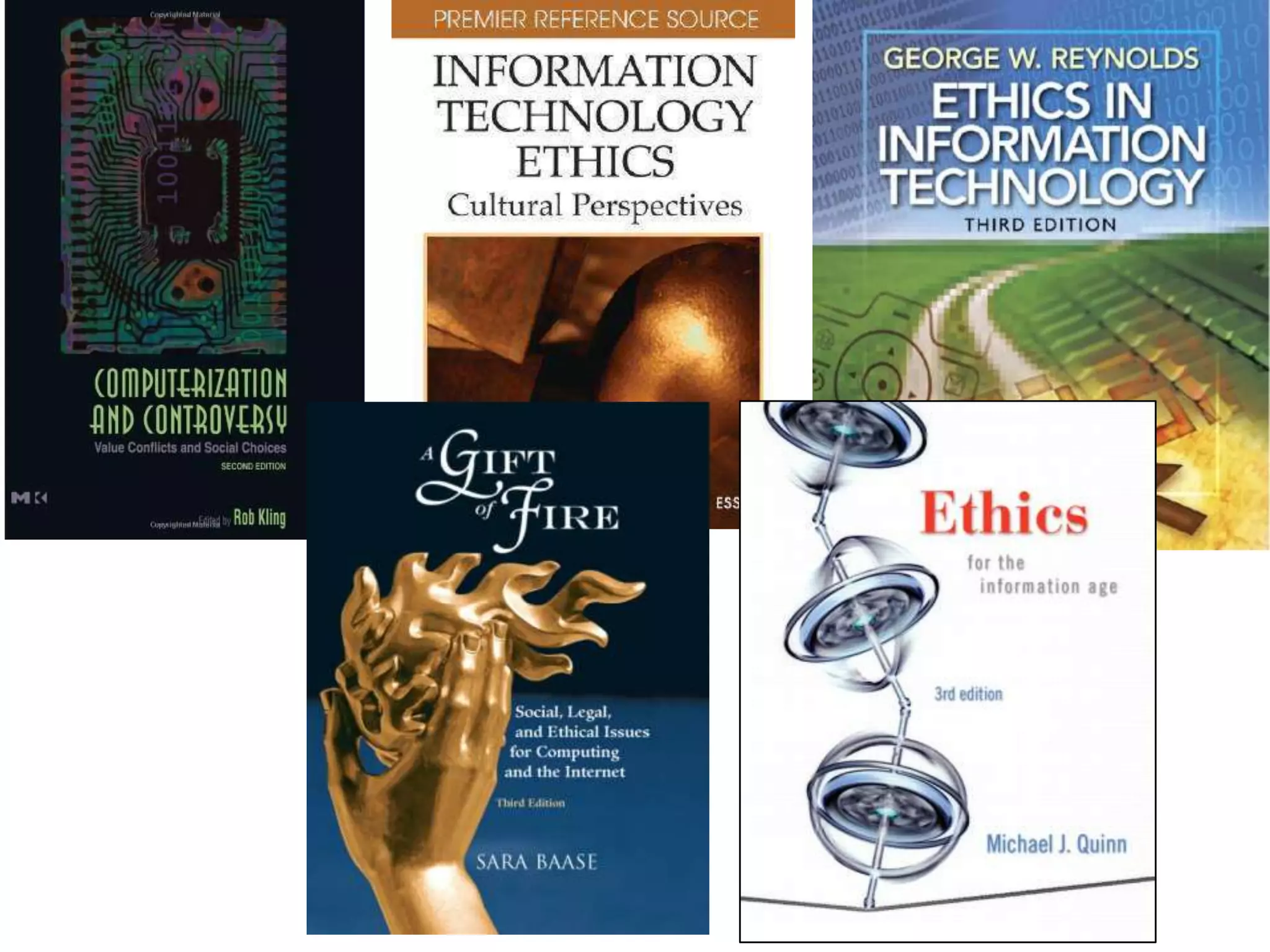
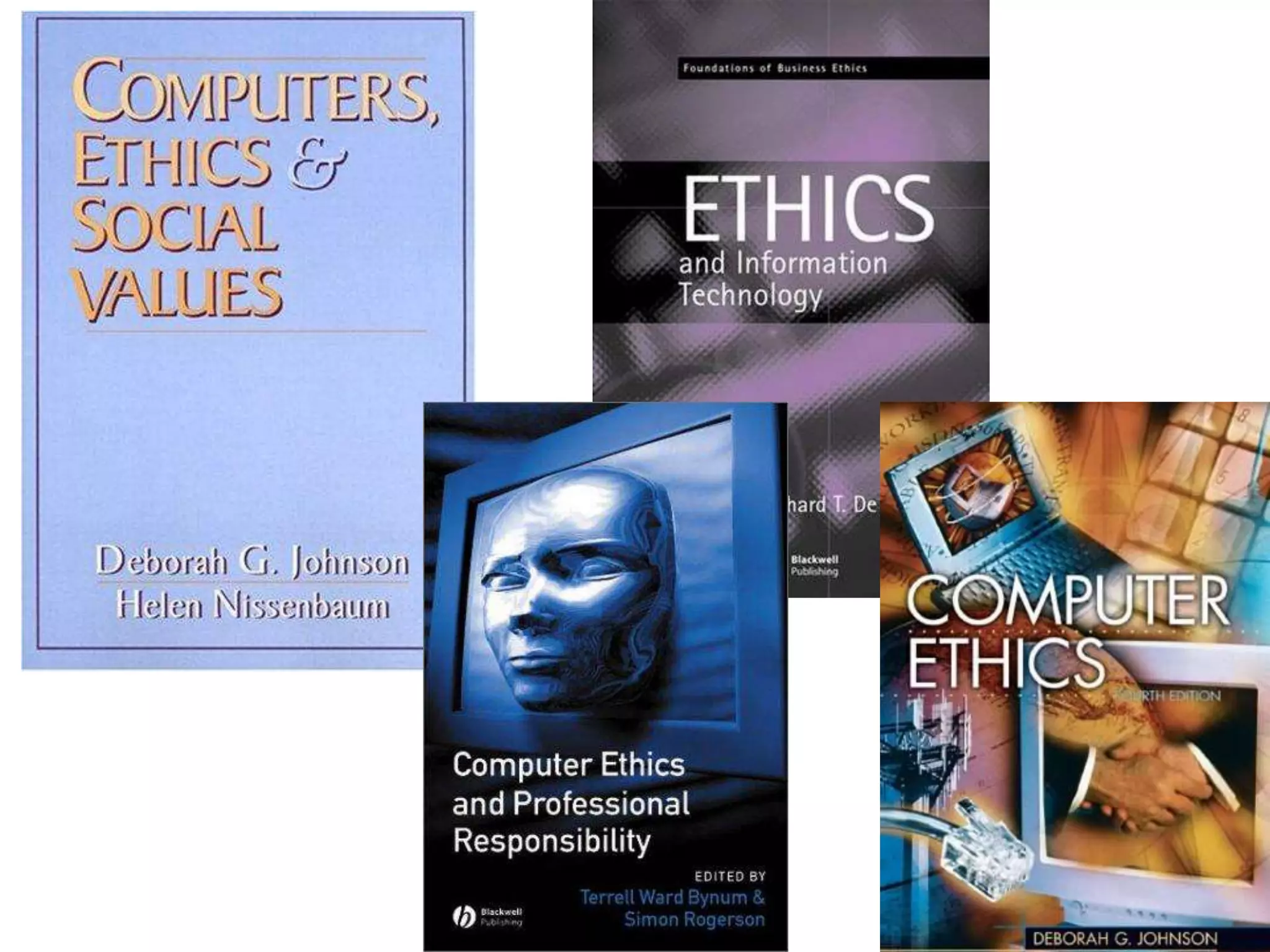
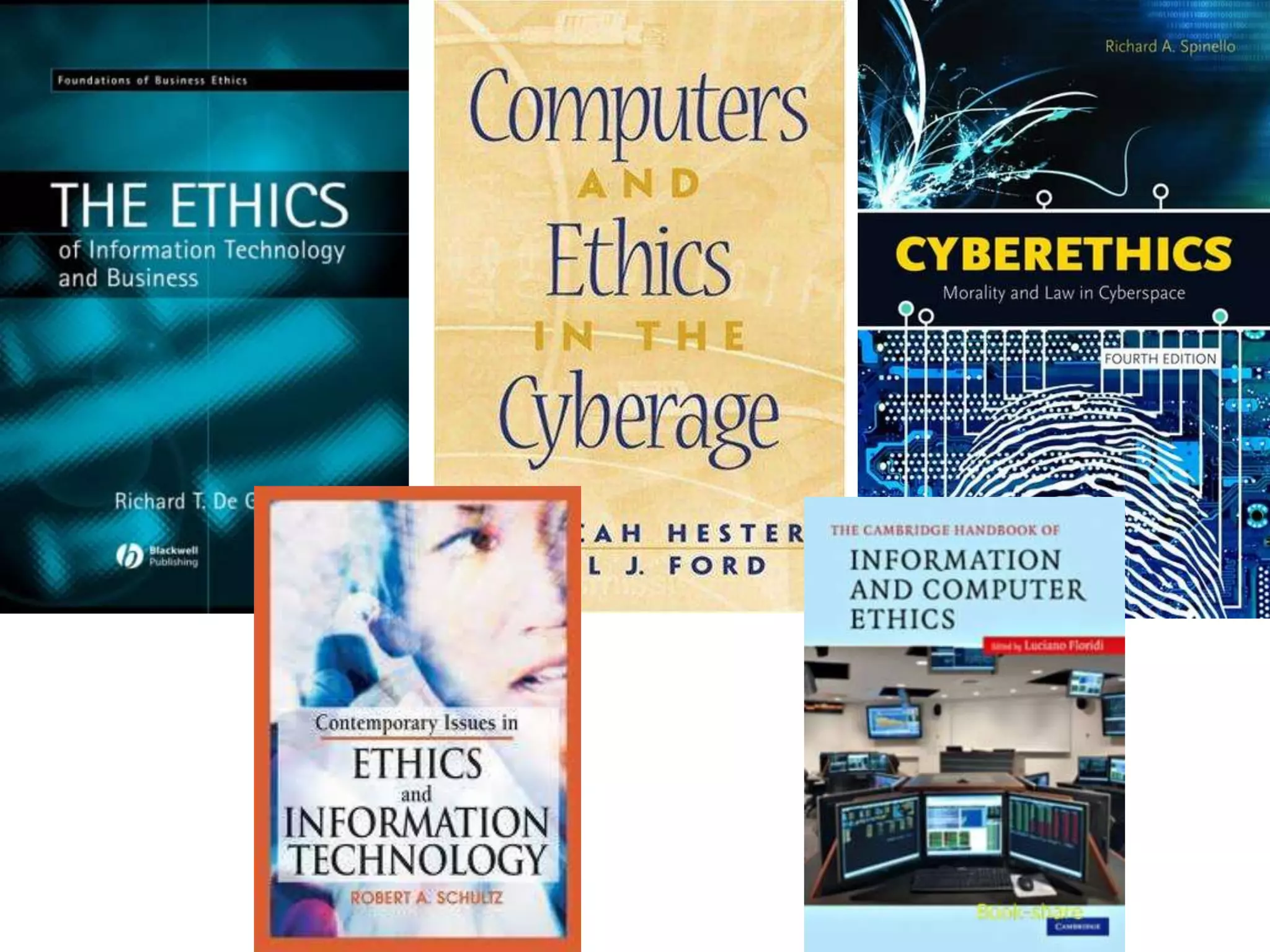
Almost all of
these books
follow a
similar
algorithmic
methodolog
y
It is not hard
to see
the attraction of
this approach
for us
computer
professors
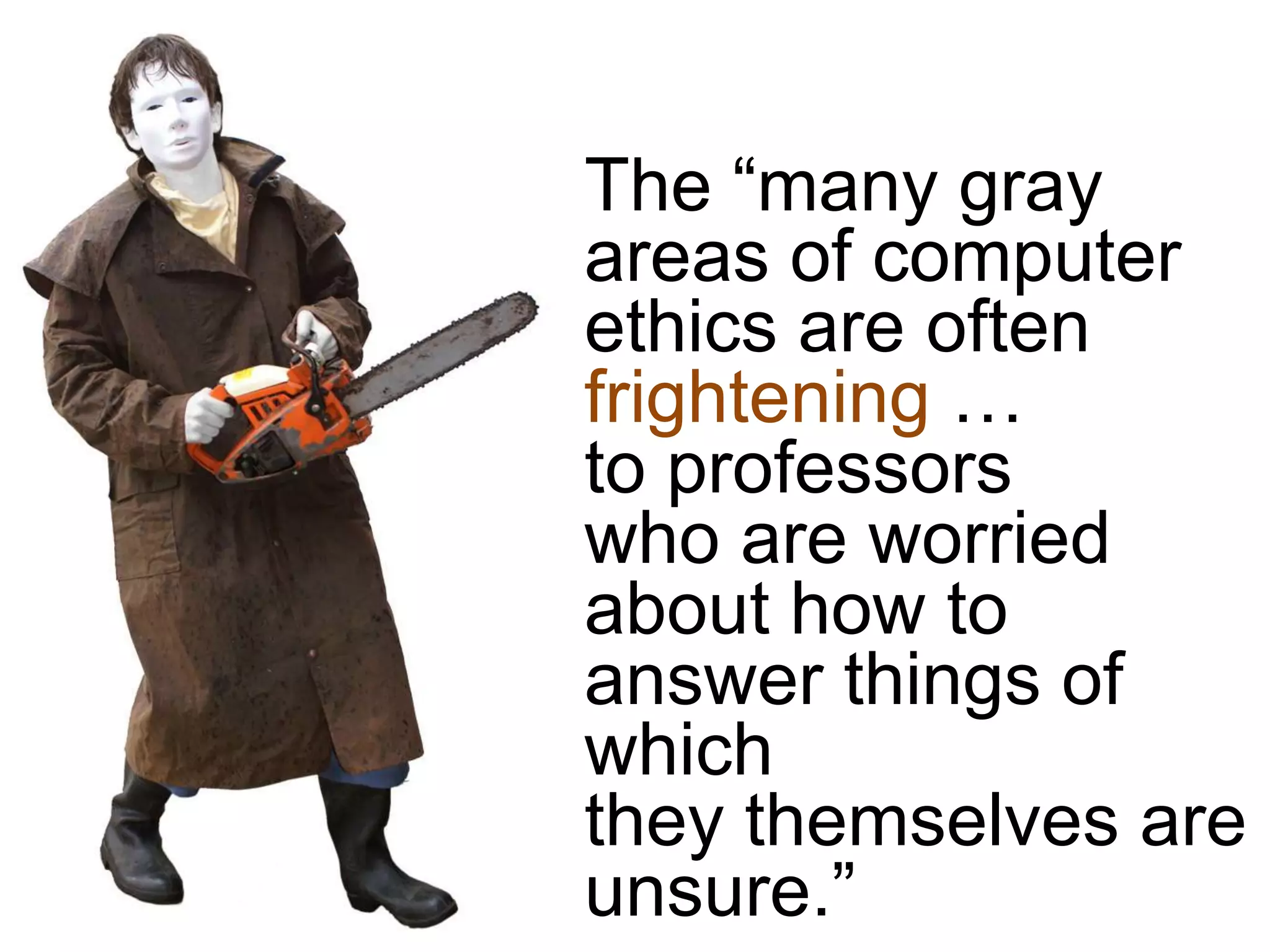
The “many gray
areas of computer
ethics are often
frightening …
to professors
who are worried
about how to
answer things of
which
they themselves are
unsure.”
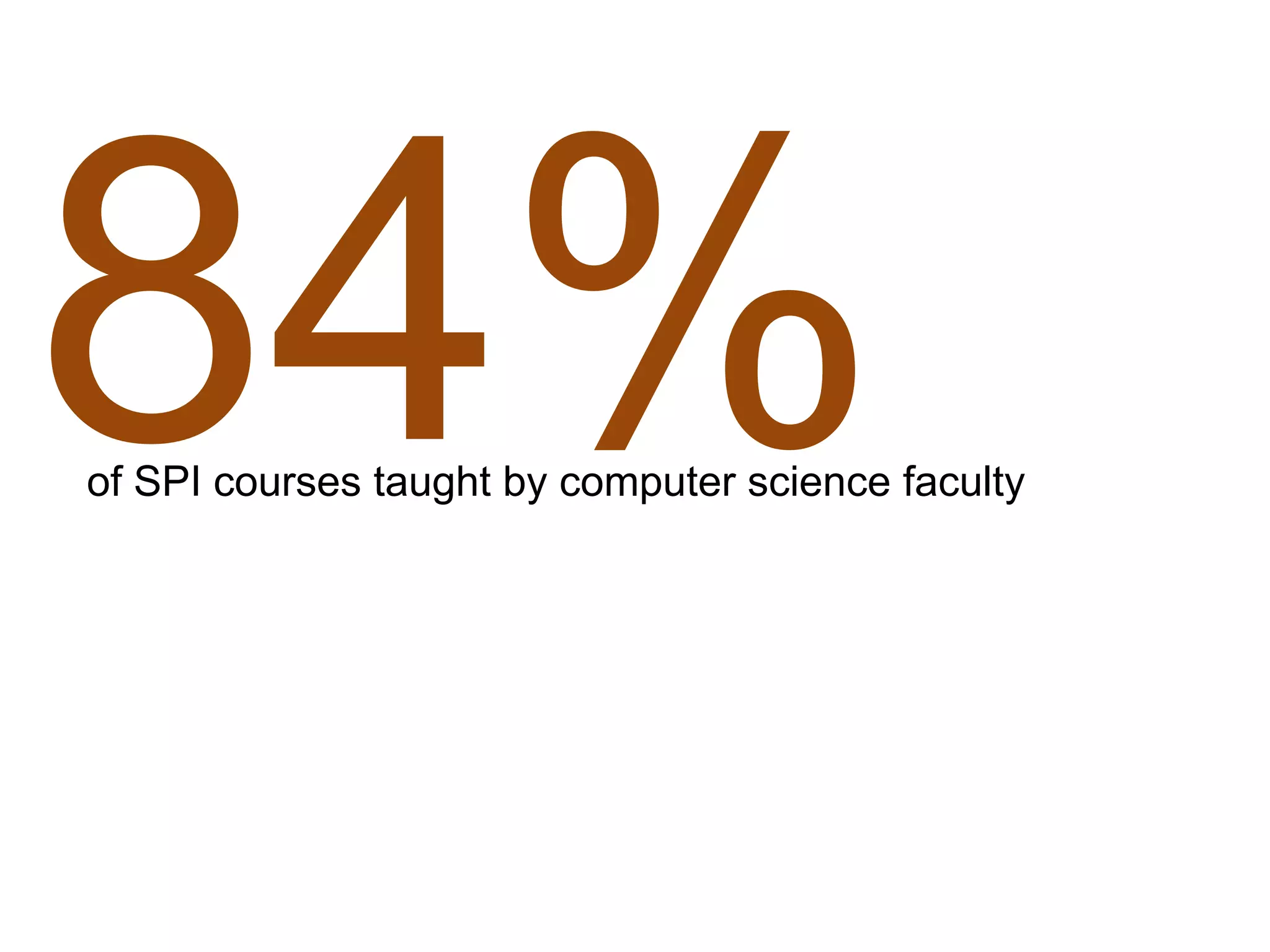
of SPI courses taught by computer science faculty
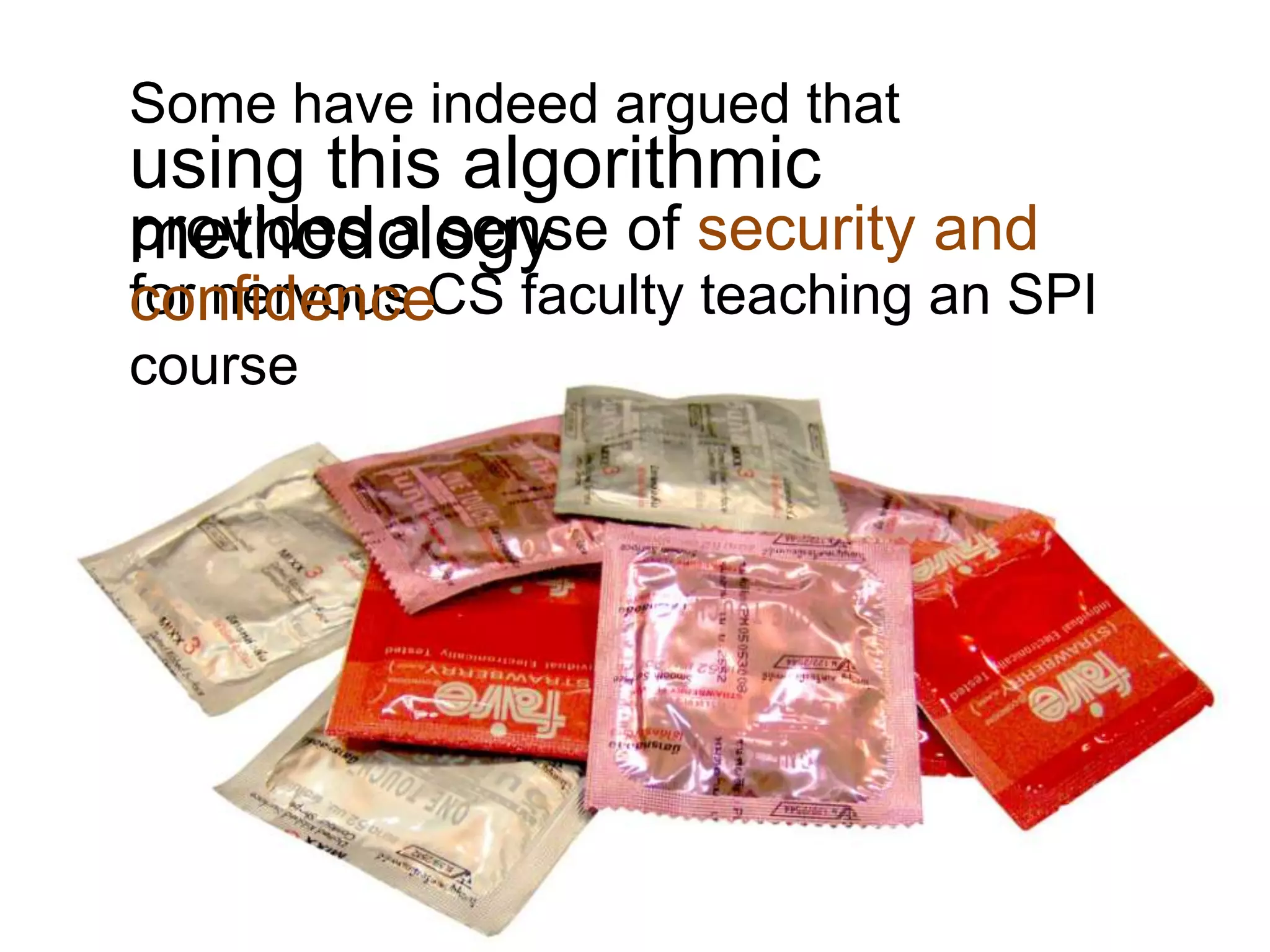
Some have indeed argued that
using this algorithmic
provides a sense of security and
methodology
for nervous CS faculty teaching an SPI
confidence
course
I am going to argue that both
this algorithmic methodology
and
the theoretical understanding of the relationship
between technology and society that it is based
upon
are deeply flawed.
I will try to convince you that
we need to move away from
the ethical evaluation of
impacts
and instead
emphasize
the social context of computing
In particular, the way we teach SPI material
needs to integrate the decades-old
of researchers in the philosophy, history, and sociology of
insights
that emphasizes a very different approach to
technology
SPI.
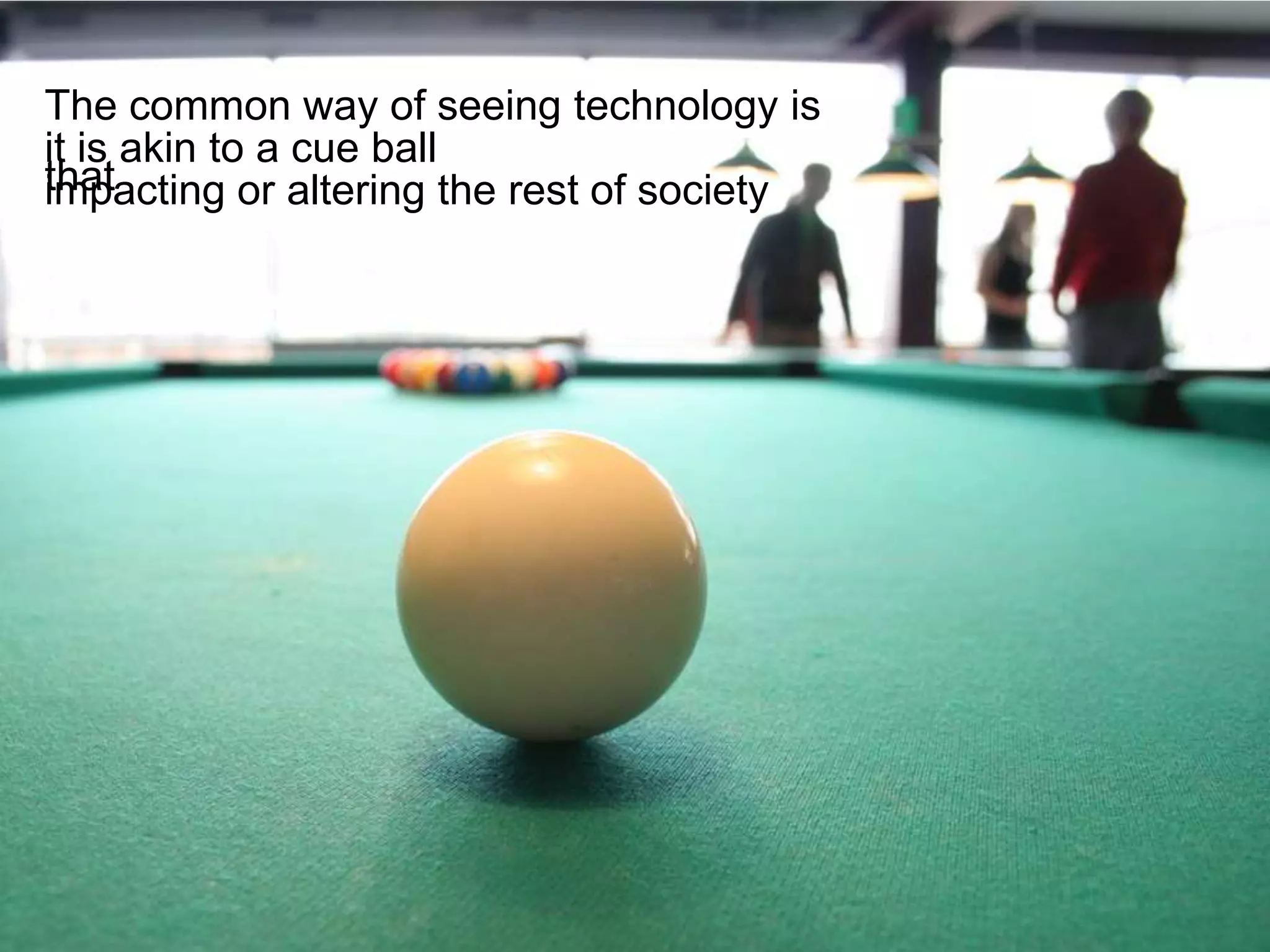
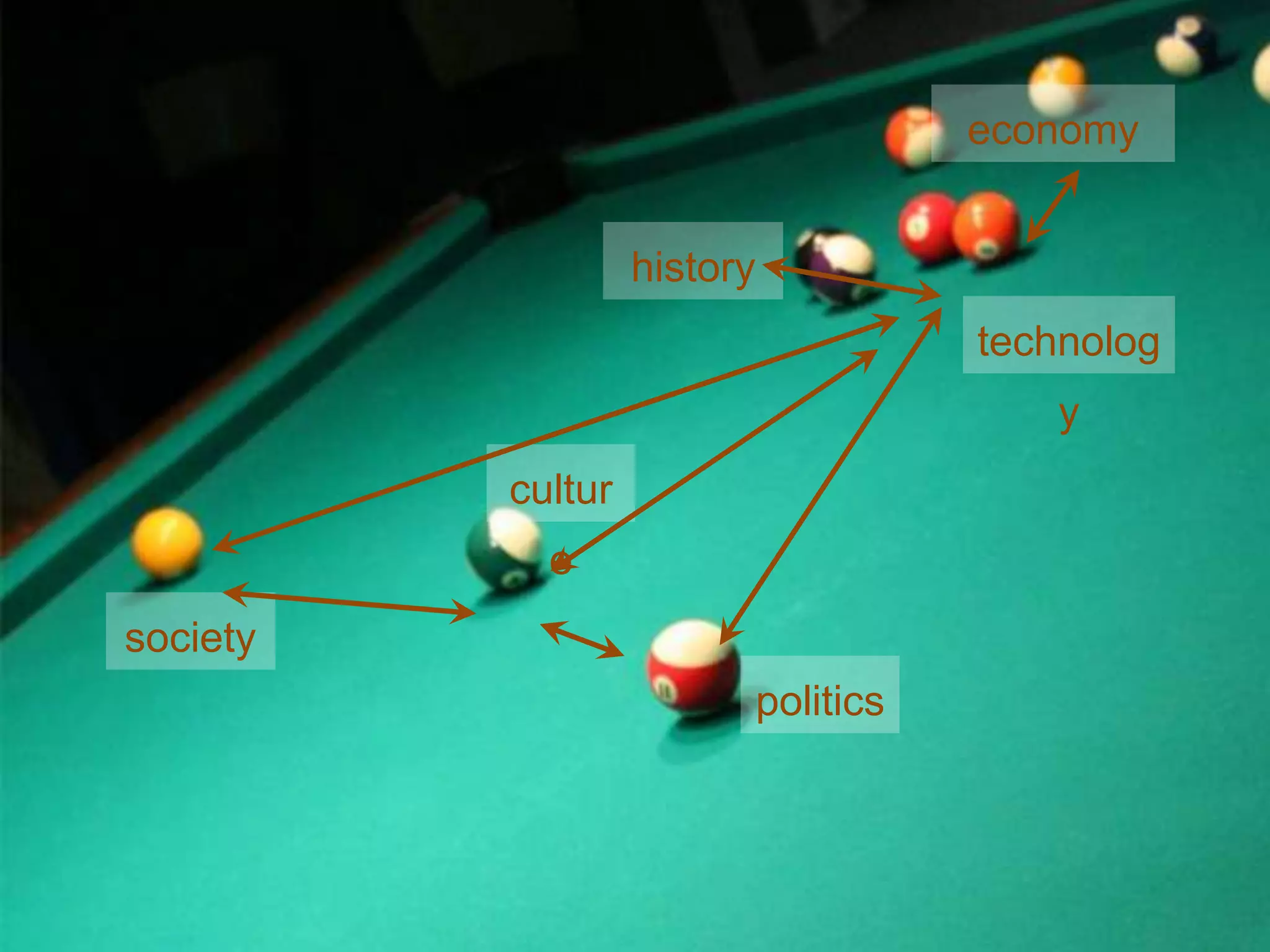
The common way of seeing technology is
it is akin to a cue ball
that
impacting or altering the rest of society
In this perspective
key technological inventions
have transformed the world.

Thus new technologies
need to be analyzed to understand
wide changes they will enact.
the
This approach to technology
is generally referred to as
Technological
Determinism
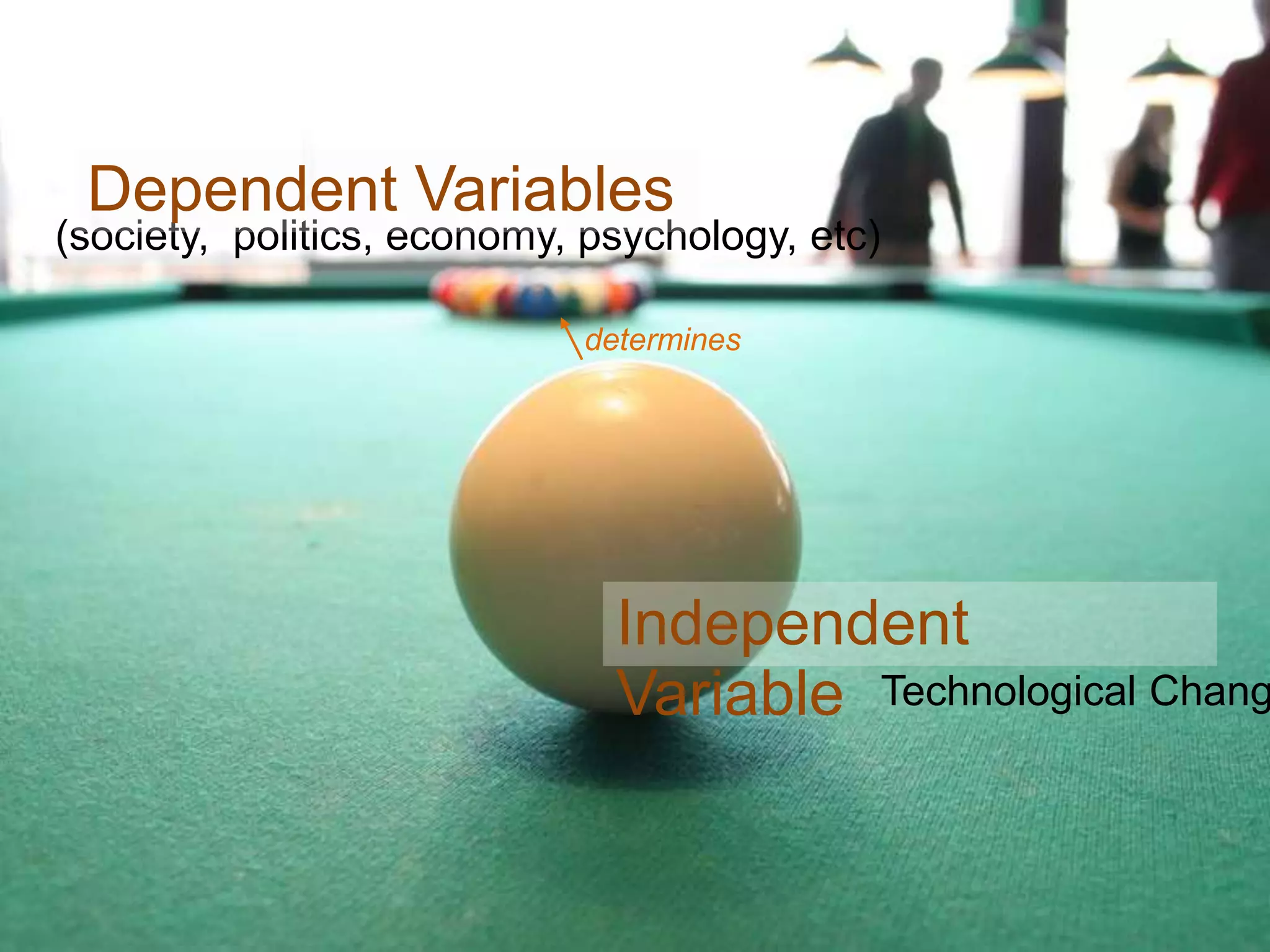
Dependent Variables
(society, politics, economy, psychology, etc)

                            determines


                              Independent
                              Variable Technological Chang
It is understandable
why computer professionals find
technological determinism
attractive. people helping to
We are the
invent new technologies
It feeds our   to be
clear          socially
desire         relevant
… and our
desire to believe
that we
computer geeks
are the driver of
social change,
and not
politicians,
business people,
or celebrities.
Most current historians and sociologists of
firmly reject technological
technology
determinism
because it is
theoretically inconsistent
and
empirically under-supported
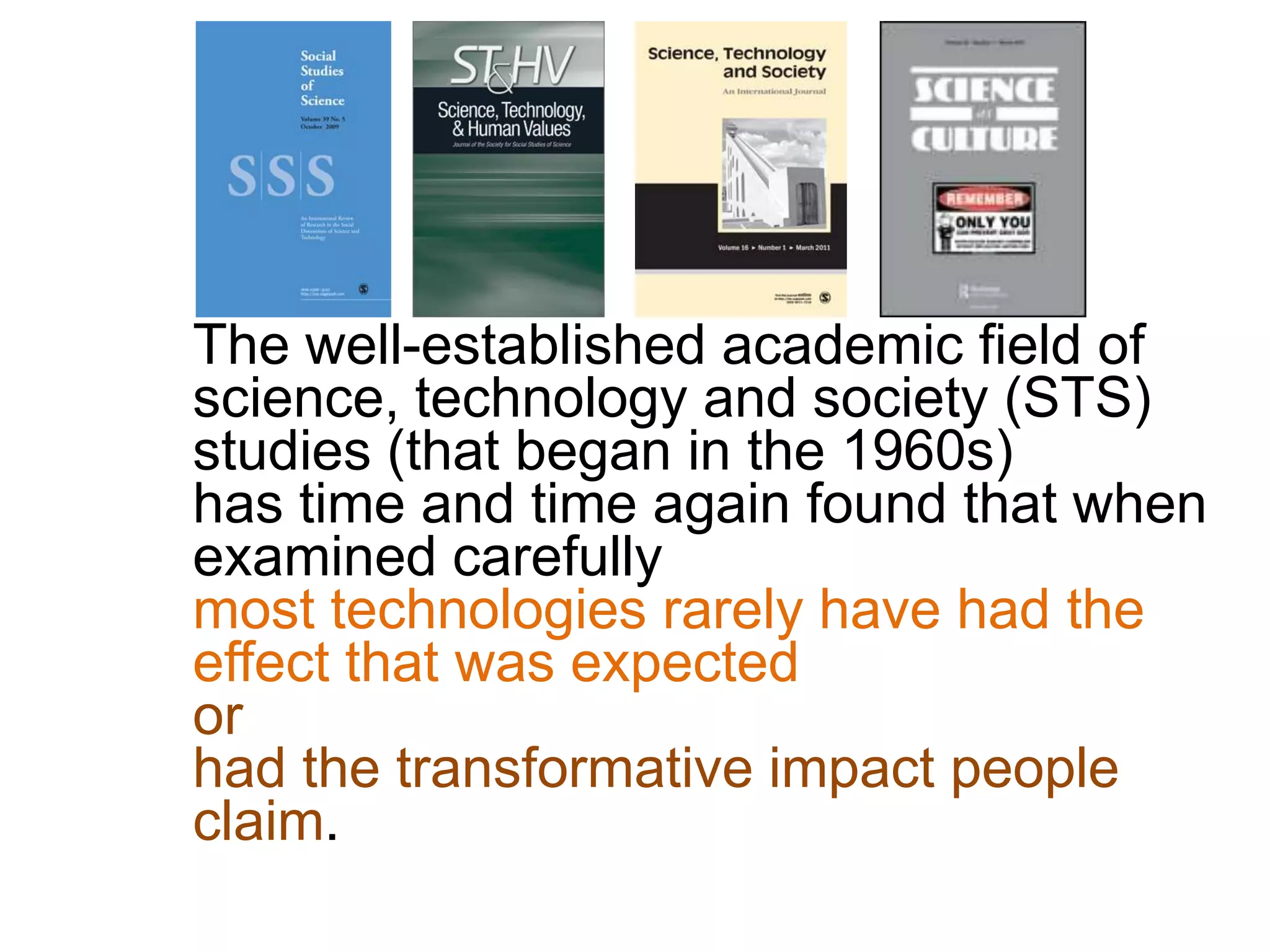
The well-established academic field of
science, technology and society (STS)
studies (that began in the 1960s)
has time and time again found that when
examined carefully
most technologies rarely have had the
effect that was expected
or
had the transformative impact people
claim.
economy


                   history
                                        technolog
                                           y
          cultur
            e
society
                             politics
1. Empirically false
2. Not used by STS research
community
3. Naively focused on functional capabilities
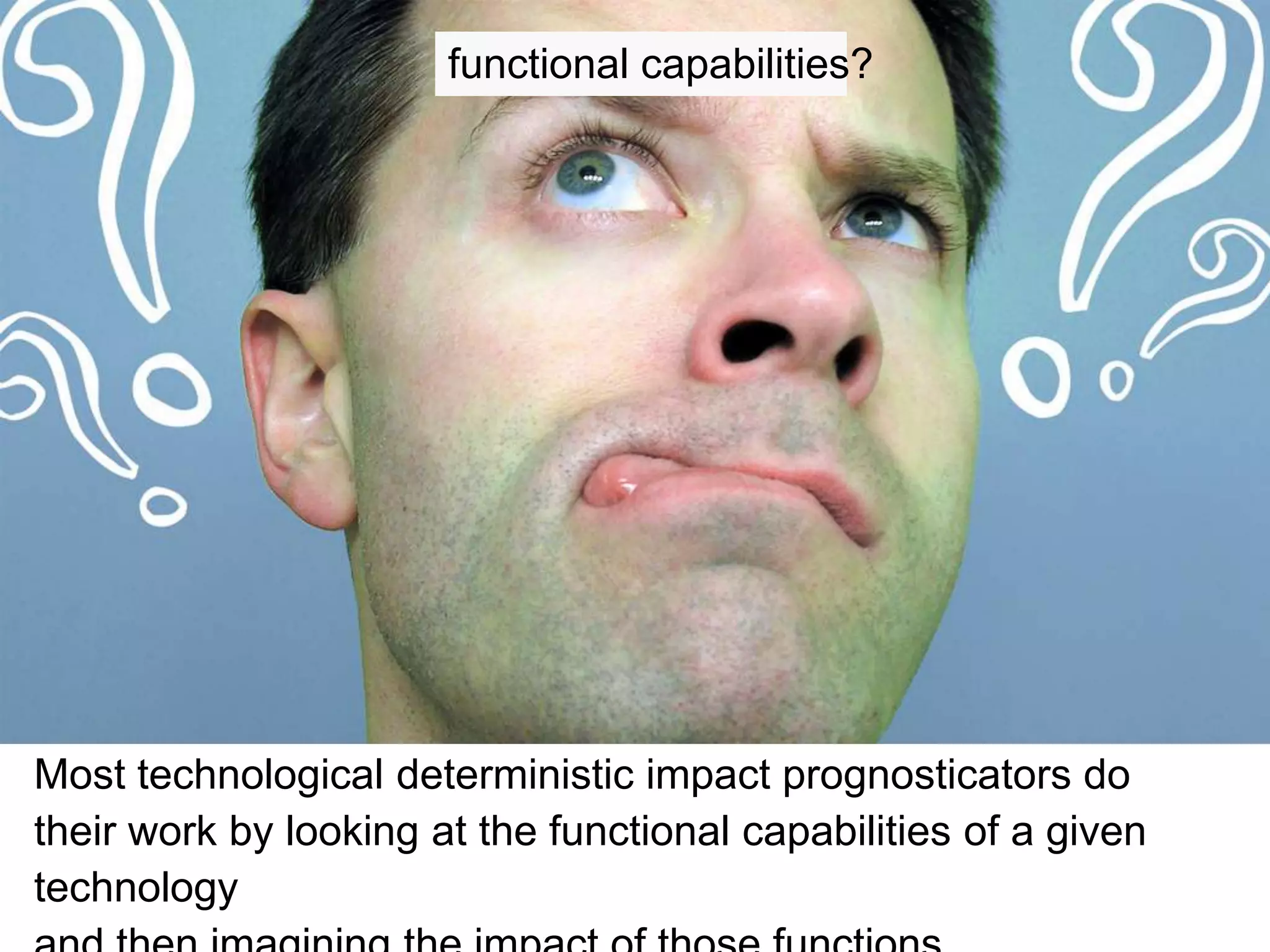
functional capabilities?


Most technological deterministic impact prognosticators do
their work by looking at the functional capabilities of a given
technology
In all these cases
 – and practically any other set of prognostications and
impact evaluations than begin from an unquestioned
belief that the functional capabilities of a technology
(i.e., the means) do what is promised (i.e., achieve their
ends) –

the expected social impacts
ended up being wildly wrong
because the prognosticators
believed in a
naïve technological
determinism.
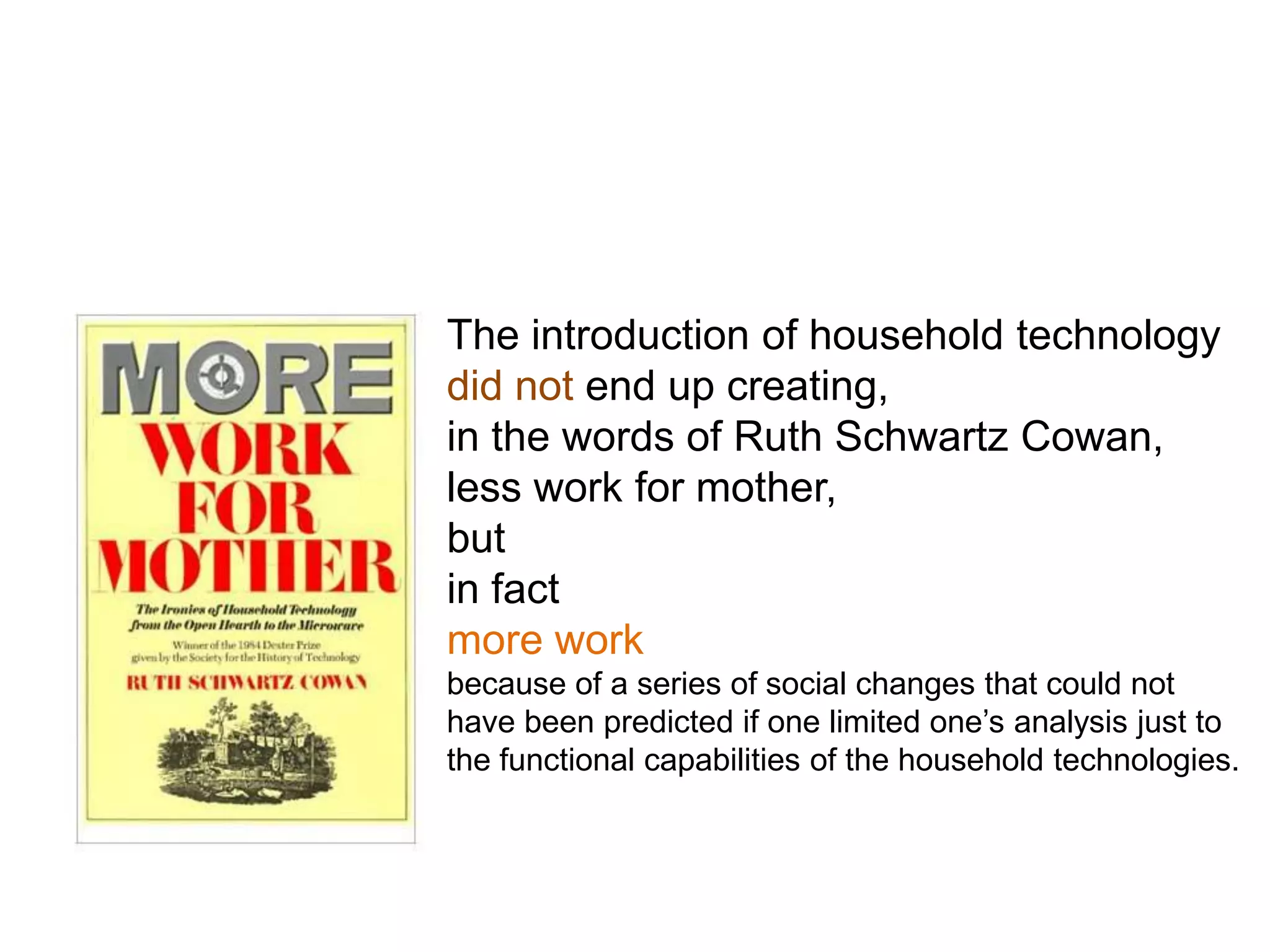
The introduction of household technology
did not end up creating,
in the words of Ruth Schwartz Cowan,
less work for mother,
but
in fact
more work
because of a series of social changes that could not
have been predicted if one limited one’s analysis just to
the functional capabilities of the household technologies.
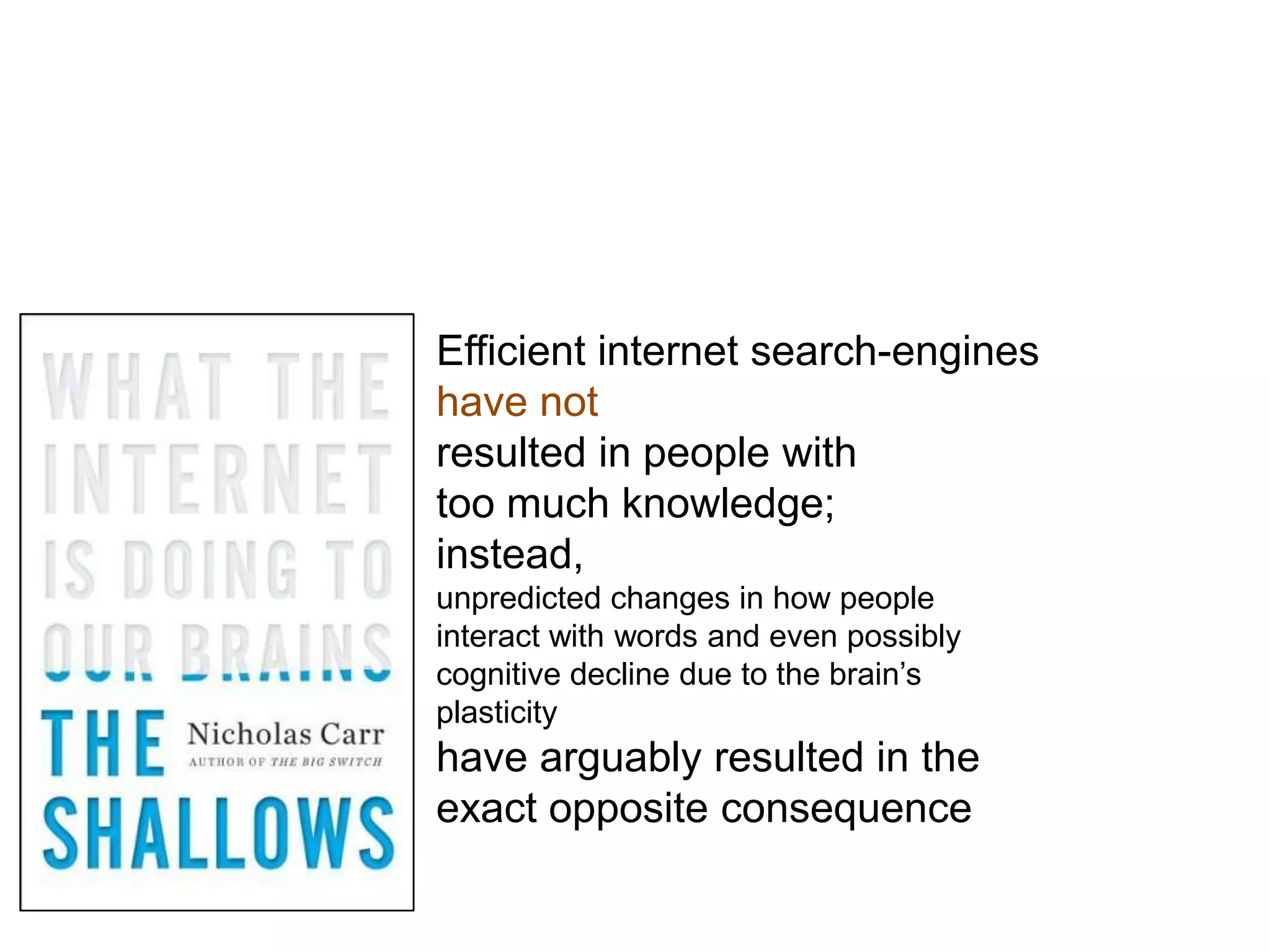
Efficient internet search-engines
have not
resulted in people with
too much knowledge;
instead,
unpredicted changes in how people
interact with words and even possibly
cognitive decline due to the brain’s
plasticity
have arguably resulted in the
exact opposite consequence
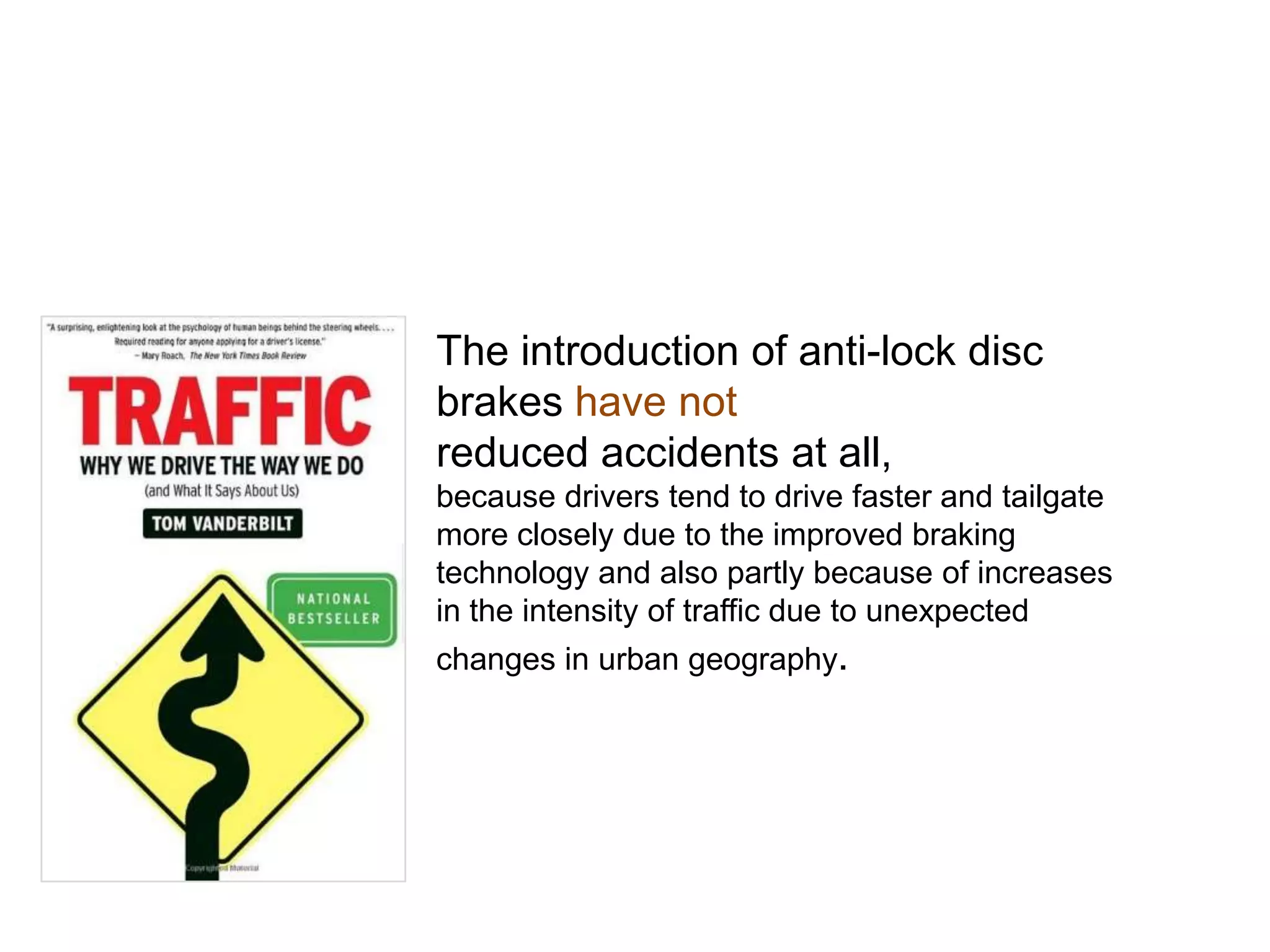
The introduction of anti-lock disc
brakes have not
reduced accidents at all,
because drivers tend to drive faster and tailgate
more closely due to the improved braking
technology and also partly because of increases
in the intensity of traffic due to unexpected
changes in urban geography.
The first step
Then we should take in our
Social and Professional Issues courses
is to communicate how rarely
technologies achieve their promise
and indeed,
how many do the opposite.
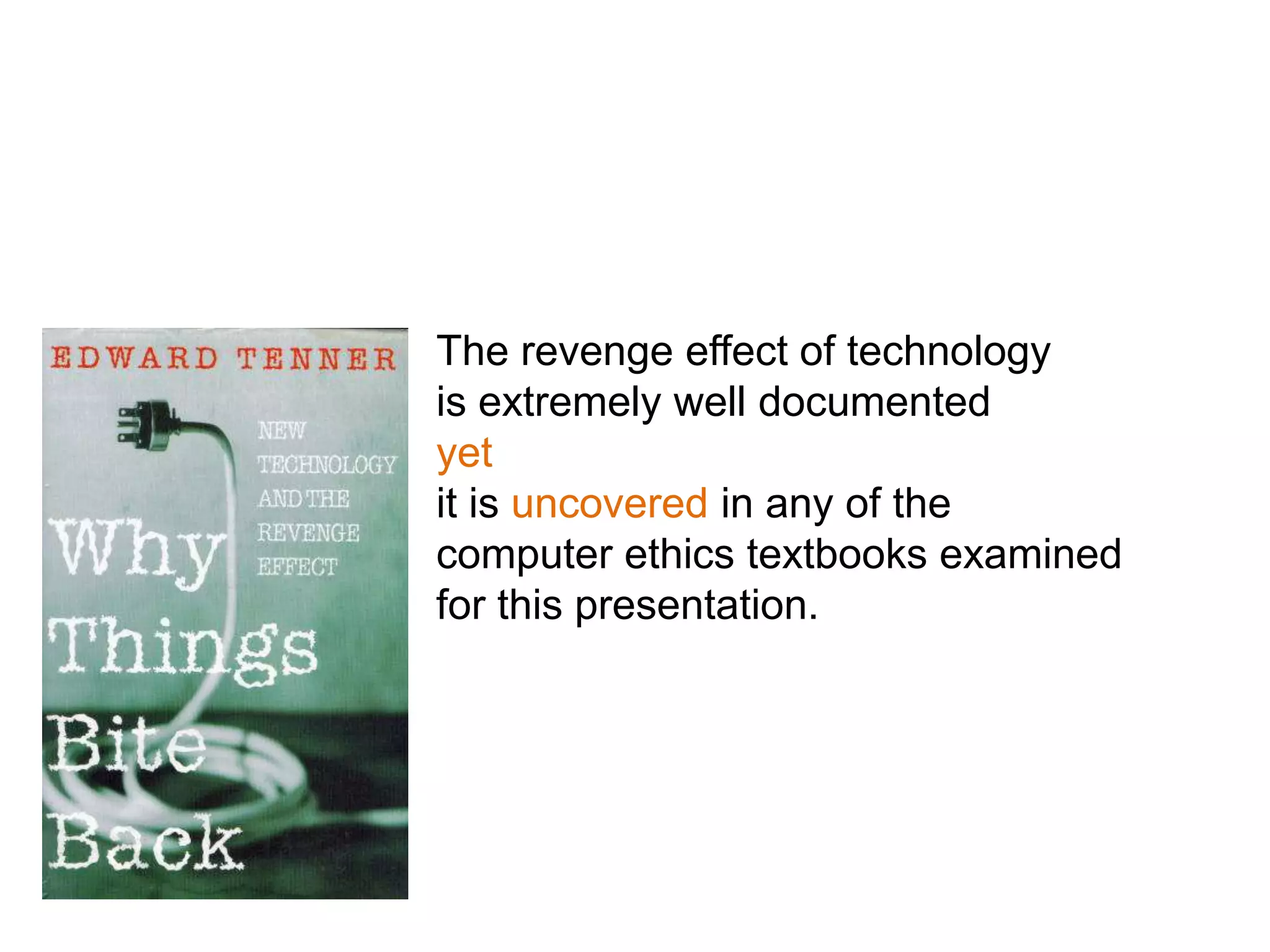
The revenge effect of technology
is extremely well documented
yet
it is uncovered in any of the
computer ethics textbooks examined
for this presentation.
One way to achieve this goal
would be by beginning the SPI course
with examples and readings
on how certain vital technologies had
little impact on some societies,
or
on how certain technologies were
strongly modified and differently
adapted in different cultures and
countries.
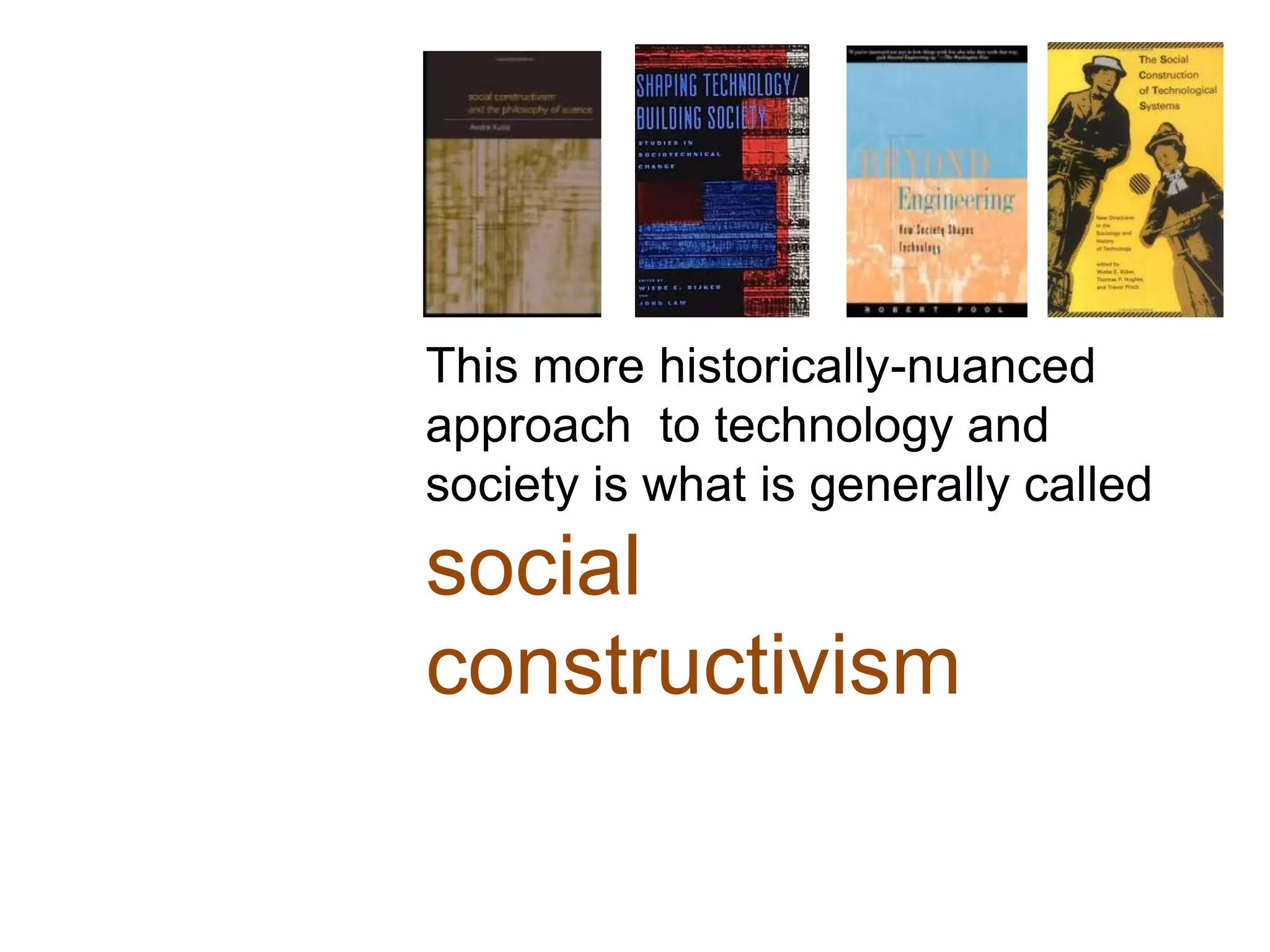
This more historically-nuanced
approach to technology and
society is what is generally called
social
constructivism
In this approach,
one looks at how technologies are
researched,
invented,
financed,
developed,
adopted,
marketed,
and propagated
within a very complex system
generally referred to as society.
In other words,
our SPI courses should
look more like a
historical sociology course
and a lot less
like a philosophic ethics
course.
CONCLUSION
It has been this paper’s
contention that both the web
and social issues courses need
to be modernized in terms of
their curricula.
These two sometimes-neglected
knowledge areas can also
provide students with
experience in working with
integration and complexity.
Randy Connolly
Dept. Computer Science & Information
Systems
Mount Royal University, Calgary, Canada
rconnolly@mtroyal.ca


Images from iStockPhoto and stock.xchng

Criticizing and Modernizing Computing Curriculum: The Case of the Web and the Social Issues Courses

  • 1.
    Criticizing and Modernizing theComputing Curriculum The Case of the Web and the Social Issues Courses Randy Connolly Mount Royal University, Calgary
  • 2.
    Computing education hasfaced a variety of ongoing and critical self-examinations of different aspects of the curriculum over the past 15 years.
  • 3.
    Some computing topicareas (e.g., first-year programming) have been rigorously examined in the education literature.
  • 4.
    Other common topicareas have not been as adequately examined.
  • 5.
    This paper providesa set of critiques and alternative teaching approaches for two vital topic areas that have been under-reported in the computing education literature:
  • 6.
  • 7.
    This paper bothrestates and provides a capsule summary of this author’s more detailed papers on these two subjects.
  • 8.
  • 9.
    In the pastdecade, the world of web development, has experienced a remarkable transformation
  • 11.
    The web developmenttopics in the ACM Computer Science Curriculum barely changed from 2001 to 2008.
  • 12.
  • 13.
    Almost all ofthe topics recognizable as pertaining to the field of web development are marked as elective topics in the CS 2008 (and 2013) curriculum.
  • 14.
  • 15.
    There has beena real dearth of research on the teaching of web topics.
  • 17.
    Given the importanceof web technology in the real world of software development, This relative lack of interest in the web by computer science is somewhat surprising.
  • 18.
    Number of Web-Based Software Development Jobs Number of Non-Web Software Development Jobs Based on searches in Oct + Nov 2010 on monster.com and simplyhired.com
  • 19.
    The papers thatdo exist generally begin by stressing the many difficulties in teaching a web development course.
  • 20.
    Examining the literature, webcontent is usually being taught using the broad but shallow All-the-Web-in-One-Course (AWOC) approach
  • 21.
    60% Of CS web education papers reported A single web course 16% Web taught in CS0 or elective 12% Javascript in CS1/CS2 12% Multicourse stream on web
  • 22.
    Given the importanceof web systems, the time has come for retiring the AWOC approach
  • 23.
    Back in theearly 1970s, a math program might have had a single course in programming in Fortran, but eventually it was recognized that a body of knowledge as complex as programming requires multiple courses to teach the material properly. Web development should be in a similar state today
  • 24.
    While the AWOCapproach does give students a sense of the big picture of web development, it by no means provides the students with anything approaching proficiency in contemporary practice.
  • 25.
  • 26.
    Because web developmentis characterized by peculiar combination of change and persistence
  • 27.
    2009- Frameworks + Platforms (WordPress,JQuery,Sharepoint,etc) 2006-2009 AJAX + REST/JSON services Semantic Web Standards + 2003-2006 CSS (positional) + PHP/ASP.NET CSS (simple) + 1999-2002 Javascript (simple) + ASP/JSP + Usability 1995-1998 HTML + CGI + Graphics
  • 28.
    For those stuckwith the AWOC approach it will become increasingly difficult to keep the course comprehensive and relevant
  • 29.
    Because of thetime limitations of the AWOC approach, the content in these single web courses increasingly seem like they are …
  • 30.
  • 33.
    HTML Not just thedetails (which are trivial) but also how to do semantic separation of content from presentation.
  • 34.
    Due to practitioners’move towards web standards and semantically-oriented markup, real world CSS is commonly used for positioning and layout.
  • 35.
    This type ofCSS is notoriously difficult to master due to browser bugs, incompatibilities, and non-obvious CSS box model interactions.
  • 36.
    Another important partof web development that is almost always left out of the AWOC approach is digital media
  • 37.
    Yet another vitalknowledge area in web development is usability, an area that is almost always ignored in AWOC courses. None of the current web textbooks examined for this paper contained any substantial material on usability.
  • 38.
    Javascript has becometoo complex to be covered in a AWOC course. The type of Javascript that can be covered in one or two weeks (rollovers, form data validation, browser sniffing) was reasonably close to what was needed professionally in the late 1990s.
  • 39.
    Since the discoveryof XmlHttpRequest and the subsequent flourishing of new user interface coding and asynchronous communication with web services, Javascript coding as become simultaneously crucial to contemporary web development and significantly more complicated.
  • 40.
    Analogous to thecase with CSS, this type of Javascript programming is very difficult to learn due to: browser differences, the untyped nature of the language, the lack of a cross-browser debugging environment, general conceptual complexity of working with callback functions
  • 41.
    A key partof learning real- world web development is the server-side environment. Potentially this is a very large topic, and has its own difficulties from a teaching perspective.
  • 42.
    If students haven’tfully mastered the ability to implement a non-trivial design in HTML, CSS, and Javascript, the added indirection of writing a program to generate HTML, CSS, and Javascript can be quite tricky conceptually for a novice developer.
  • 43.
    Server-side development alsohas a number of substantial additional topics, which are difficult to fit into a single AWOC course.
  • 44.
    Web-based APIs using RESTor SOAP services are also an important part of the web world of 2008+
  • 45.
    Web vulnerabilities/security is another area that is difficult to comprehensively cover in the AWOC approach. None of the current web textbooks examined for this paper contained any substantial material on web security.
  • 46.
    Our students alsoneed to learn a certain amount about hosting and administration issues, such as: The architecture of the main web server platforms such as Apache and Microsoft’s IIS. Hosting topics such as web gardens, web farms, load balancing, and server configurations for scalability. Image Source: http://sharepointmagazine.net
  • 47.
    More and more organizationsare using already existing open- source and/or proprietary web frameworks instead of creating their web infrastructure from scratch.
  • 48.
    This is perhapsthe most substantial revolution in web development since the mass adoption of CSS in the early 2000s
  • 49.
    Content management systems, bloggingsystems, and web forums are more and more often being used as the main framework for an organization’s public or private web presence, since these systems handle many of the most common web needs of an organization.
  • 50.
    Similarly, due tothe complexity of layout- oriented CSS and AJAX- focused Javascript, it is becoming increasingly common to use an existing CSS or Javascript framework.
  • 51.
    For the students,it is important to learn about the existence of these existing frameworks and templates because the future of web systems will increasingly lie in their use, integration, and customization. Sometimes multiple existing systems will be used by an organization and the key role of the web professional will be to get these systems to interoperate through their public APIs.
  • 52.
  • 55.
    Students “need tounderstand the basic cultural, social, legal, and ethical issues inherent in the discipline of computing.”
  • 56.
    of American computerscience programs include SPI in curriculum (Social and Professional Issues)
  • 57.
    of international computerscience programs include SPI in curriculum
  • 58.
    Teaching SPI within computinghas been dominated by a very specific analytic approach. Can you spot it?
  • 62.
    Articulate the impacts ofICT and ethically evaluate those impacts
  • 63.
    Almost all of thesebooks follow a similar algorithmic methodolog y
  • 65.
    It is nothard to see the attraction of this approach for us computer professors
  • 66.
    The “many gray areasof computer ethics are often frightening … to professors who are worried about how to answer things of which they themselves are unsure.”
  • 67.
    of SPI coursestaught by computer science faculty
  • 68.
    Some have indeedargued that using this algorithmic provides a sense of security and methodology for nervous CS faculty teaching an SPI confidence course
  • 69.
    I am goingto argue that both this algorithmic methodology and the theoretical understanding of the relationship between technology and society that it is based upon are deeply flawed.
  • 70.
    I will tryto convince you that we need to move away from the ethical evaluation of impacts and instead emphasize the social context of computing
  • 71.
    In particular, theway we teach SPI material needs to integrate the decades-old of researchers in the philosophy, history, and sociology of insights that emphasizes a very different approach to technology SPI.
  • 73.
    The common wayof seeing technology is it is akin to a cue ball that impacting or altering the rest of society
  • 74.
    In this perspective keytechnological inventions have transformed the world. Thus new technologies need to be analyzed to understand wide changes they will enact. the
  • 75.
    This approach totechnology is generally referred to as Technological Determinism
  • 76.
    Dependent Variables (society, politics,economy, psychology, etc) determines Independent Variable Technological Chang
  • 77.
    It is understandable whycomputer professionals find technological determinism attractive. people helping to We are the invent new technologies
  • 78.
    It feeds our to be clear socially desire relevant
  • 79.
    … and our desireto believe that we computer geeks are the driver of social change, and not politicians, business people, or celebrities.
  • 81.
    Most current historiansand sociologists of firmly reject technological technology determinism because it is theoretically inconsistent and empirically under-supported
  • 82.
    The well-established academicfield of science, technology and society (STS) studies (that began in the 1960s) has time and time again found that when examined carefully most technologies rarely have had the effect that was expected or had the transformative impact people claim.
  • 85.
    economy history technolog y cultur e society politics
  • 87.
    1. Empirically false 2.Not used by STS research community 3. Naively focused on functional capabilities
  • 88.
    functional capabilities? Most technologicaldeterministic impact prognosticators do their work by looking at the functional capabilities of a given technology
  • 93.
    In all thesecases – and practically any other set of prognostications and impact evaluations than begin from an unquestioned belief that the functional capabilities of a technology (i.e., the means) do what is promised (i.e., achieve their ends) – the expected social impacts ended up being wildly wrong because the prognosticators believed in a naïve technological determinism.
  • 95.
    The introduction ofhousehold technology did not end up creating, in the words of Ruth Schwartz Cowan, less work for mother, but in fact more work because of a series of social changes that could not have been predicted if one limited one’s analysis just to the functional capabilities of the household technologies.
  • 96.
    Efficient internet search-engines havenot resulted in people with too much knowledge; instead, unpredicted changes in how people interact with words and even possibly cognitive decline due to the brain’s plasticity have arguably resulted in the exact opposite consequence
  • 97.
    The introduction ofanti-lock disc brakes have not reduced accidents at all, because drivers tend to drive faster and tailgate more closely due to the improved braking technology and also partly because of increases in the intensity of traffic due to unexpected changes in urban geography.
  • 99.
    The first step Thenwe should take in our Social and Professional Issues courses is to communicate how rarely technologies achieve their promise and indeed, how many do the opposite.
  • 100.
    The revenge effectof technology is extremely well documented yet it is uncovered in any of the computer ethics textbooks examined for this presentation.
  • 101.
    One way toachieve this goal would be by beginning the SPI course with examples and readings on how certain vital technologies had little impact on some societies, or on how certain technologies were strongly modified and differently adapted in different cultures and countries.
  • 102.
    This more historically-nuanced approachto technology and society is what is generally called social constructivism
  • 103.
    In this approach, onelooks at how technologies are researched, invented, financed, developed, adopted, marketed, and propagated within a very complex system generally referred to as society.
  • 104.
    In other words, ourSPI courses should look more like a historical sociology course and a lot less like a philosophic ethics course.
  • 105.
  • 106.
    It has beenthis paper’s contention that both the web and social issues courses need to be modernized in terms of their curricula.
  • 107.
    These two sometimes-neglected knowledgeareas can also provide students with experience in working with integration and complexity.
  • 108.
    Randy Connolly Dept. ComputerScience & Information Systems Mount Royal University, Calgary, Canada rconnolly@mtroyal.ca Images from iStockPhoto and stock.xchng