Introduction to CriticalThinking
• Goal of Critical Thinking:
• To reason clearly and effectively to arrive at truth and avoid falsehoods.
• Critical thinking is not just about logic but also about being open to new ideas and
perspectives.
• Expanded Goals:
• Example: An architect must understand the load-bearing properties of materials to
design safe buildings.
• Importance of Truth:
• Regardless of the field, understanding truths about the world is essential for
effective reasoning and decision-making
3.
Metaphysical and ConceptualFramework
• Shared Reality:
• We all live in a shared reality populated by objects (the objective world).
• This shared reality is the foundation for all inquiry and reasoning.
• Subjects and Objects:
• As subjects, we experience the objective world, but our perspectives are limited and
fallible.
• Example: Our senses can deceive us, as when a stick appears bent in water.
• Fallibility:
• Our beliefs and impressions are prone to error, but we can improve reasoning by
sharing evidence and overcoming biases.
• Example: Confirmation bias leads us to notice evidence that supports our beliefs while
ignoring evidence that contradicts them.
4.
Subjectivity and Objectivity
•Subjective Realm:
• Includes thoughts, feelings, and beliefs—all dependent on the mind.
• Example: Your belief that chocolate ice cream is in the freezer is a subjective state.
• Objective Realm:
• Includes all aspects of shared reality, independent of the subject.
• Example: The actual contents of the freezer are part of the objective world.
• Beliefs and Truth:
• Beliefs aim to represent the objective world. A belief is true when it corresponds
to reality.
• Example: If there is chocolate ice cream in the freezer, your belief is true; if not, it
is false.
5.
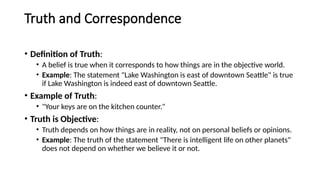
Truth and Correspondence
•Definition of Truth:
• A belief is true when it corresponds to how things are in the objective world.
• Example: The statement "Lake Washington is east of downtown Seattle" is true
if Lake Washington is indeed east of downtown Seattle.
• Example of Truth:
• "Your keys are on the kitchen counter."
• Truth is Objective:
• Truth depends on how things are in reality, not on personal beliefs or opinions.
• Example: The truth of the statement "There is intelligent life on other planets"
does not depend on whether we believe it or not.
6.
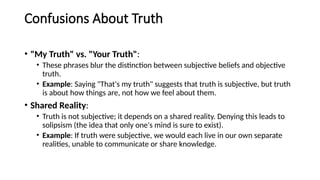
Confusions About Truth
•"My Truth" vs. "Your Truth":
• These phrases blur the distinction between subjective beliefs and objective
truth.
• Example: Saying "That's my truth" suggests that truth is subjective, but truth
is about how things are, not how we feel about them.
• Shared Reality:
• Truth is not subjective; it depends on a shared reality. Denying this leads to
solipsism (the idea that only one's mind is sure to exist).
• Example: If truth were subjective, we would each live in our own separate
realities, unable to communicate or share knowledge.
7.
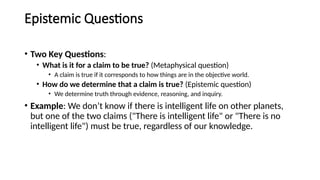
Epistemic Questions
• TwoKey Questions:
• What is it for a claim to be true? (Metaphysical question)
• A claim is true if it corresponds to how things are in the objective world.
• How do we determine that a claim is true? (Epistemic question)
• We determine truth through evidence, reasoning, and inquiry.
• Example: We don’t know if there is intelligent life on other planets,
but one of the two claims ("There is intelligent life" or "There is no
intelligent life") must be true, regardless of our knowledge.
8.
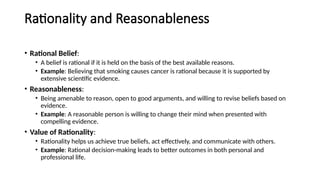
Rationality and Reasonableness
•Rational Belief:
• A belief is rational if it is held on the basis of the best available reasons.
• Example: Believing that smoking causes cancer is rational because it is supported by
extensive scientific evidence.
• Reasonableness:
• Being amenable to reason, open to good arguments, and willing to revise beliefs based on
evidence.
• Example: A reasonable person is willing to change their mind when presented with
compelling evidence.
• Value of Rationality:
• Rationality helps us achieve true beliefs, act effectively, and communicate with others.
• Example: Rational decision-making leads to better outcomes in both personal and
professional life.
9.
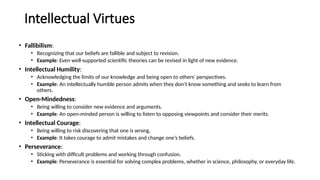
Intellectual Virtues
• Fallibilism:
•Recognizing that our beliefs are fallible and subject to revision.
• Example: Even well-supported scientific theories can be revised in light of new evidence.
• Intellectual Humility:
• Acknowledging the limits of our knowledge and being open to others' perspectives.
• Example: An intellectually humble person admits when they don’t know something and seeks to learn from
others.
• Open-Mindedness:
• Being willing to consider new evidence and arguments.
• Example: An open-minded person is willing to listen to opposing viewpoints and consider their merits.
• Intellectual Courage:
• Being willing to risk discovering that one is wrong.
• Example: It takes courage to admit mistakes and change one’s beliefs.
• Perseverance:
• Sticking with difficult problems and working through confusion.
• Example: Perseverance is essential for solving complex problems, whether in science, philosophy, or everyday life.
10.
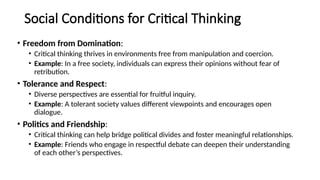
Social Conditions forCritical Thinking
• Freedom from Domination:
• Critical thinking thrives in environments free from manipulation and coercion.
• Example: In a free society, individuals can express their opinions without fear of
retribution.
• Tolerance and Respect:
• Diverse perspectives are essential for fruitful inquiry.
• Example: A tolerant society values different viewpoints and encourages open
dialogue.
• Politics and Friendship:
• Critical thinking can help bridge political divides and foster meaningful relationships.
• Example: Friends who engage in respectful debate can deepen their understanding
of each other’s perspectives.
11.
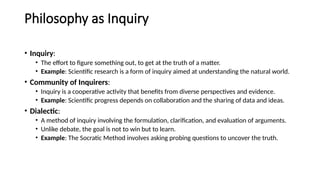
Philosophy as Inquiry
•Inquiry:
• The effort to figure something out, to get at the truth of a matter.
• Example: Scientific research is a form of inquiry aimed at understanding the natural world.
• Community of Inquirers:
• Inquiry is a cooperative activity that benefits from diverse perspectives and evidence.
• Example: Scientific progress depends on collaboration and the sharing of data and ideas.
• Dialectic:
• A method of inquiry involving the formulation, clarification, and evaluation of arguments.
• Unlike debate, the goal is not to win but to learn.
• Example: The Socratic Method involves asking probing questions to uncover the truth.
12.
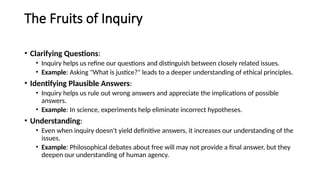
The Fruits ofInquiry
• Clarifying Questions:
• Inquiry helps us refine our questions and distinguish between closely related issues.
• Example: Asking "What is justice?" leads to a deeper understanding of ethical principles.
• Identifying Plausible Answers:
• Inquiry helps us rule out wrong answers and appreciate the implications of possible
answers.
• Example: In science, experiments help eliminate incorrect hypotheses.
• Understanding:
• Even when inquiry doesn’t yield definitive answers, it increases our understanding of the
issues.
• Example: Philosophical debates about free will may not provide a final answer, but they
deepen our understanding of human agency.
13.
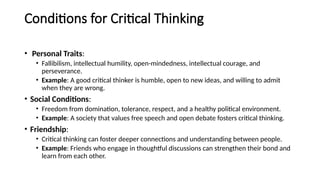
Conditions for CriticalThinking
• Personal Traits:
• Fallibilism, intellectual humility, open-mindedness, intellectual courage, and
perseverance.
• Example: A good critical thinker is humble, open to new ideas, and willing to admit
when they are wrong.
• Social Conditions:
• Freedom from domination, tolerance, respect, and a healthy political environment.
• Example: A society that values free speech and open debate fosters critical thinking.
• Friendship:
• Critical thinking can foster deeper connections and understanding between people.
• Example: Friends who engage in thoughtful discussions can strengthen their bond and
learn from each other.


![deLaplante, K. [Kevin deLaplante]. (2013, January 29). What is an .docx](https://cdn.slidesharecdn.com/ss_thumbnails/delaplantek-221112190526-dff1aa5c-thumbnail.jpg?width=640&height=640&fit=bounds)


