Collaboration, creativity, and connectedness:
Supporting professional agency in Australian and
Macedonian pre-service teachers
Elena Ončevska Ager, Ss Cyril and Methodius University, Skopje, North Macedonia
Loraine McKay, Griffith University, Queensland, Australia
All images borrowed from Unsplash
Agency broadly defined as ability
to initiate and guide one’s own
actions and interactions with
others (Bandura 2006)
Lipponen and Kumpulainen
(2011: 813) on relational agency:
agency is constructed,
contested, negotiated and re-
negotiated
Agency – key skill for teachers to
respond to global uncertainty by
supporting agentic development in
learners, while maintaining their
wellbeing
Agency very much learnable!
(Schoon, 2018)
Project: Australian and Macedonian pre-service teachers reflecting on teaching to further
their teacher knowledge and sense of identity – both feeding into agency
CONCEPTUAL FRAMEWORK INFORMED BY:
• Conway (2001) on anticipatory reflection
• Malderez andWedell (2007) on teacher knowledge
• Kagan (1992) on novice teacher development
• Markus and Nurius (1986) on possible selves
• Dörnyei and Kubanyiova (2014) on vision
• Seligman (2011) on wellbeing
METHODOLOGY
• Approach: arts-based reflection to promote deeper, more personal learning
• Task: (1) collaborative bird-eye perspective drawing of ideal classroom and (2)
collaborative collage on ideal teacher qualities, followed by individual written
reflection
• Participants: 8Australian and 9 Macedonian pre-service teachers
• Format: workshops
• Analysable data: student output, student presentations of output
• Data analysis: thematic, ensuring reflexivity by researchers working in tandem
PARTICIPANTS: SIMILARITIESAND DIFFERENCES
• All nearing BEd/BA graduation
• Mature age students, 20-38 (AUS) vs. students who joined programme directly
after high school, i.e. age 20 (MKD)
• Consistent prac experience across degree programme (AUS) vs. moderate prac
experience, in final year of studies
• Very experienced in reflection (AUS) vs. moderately experienced (MKD)
• Belonging to close-knit development group (AUS) vs. coming from various
student groups and in the process of getting to know one another (MKD)
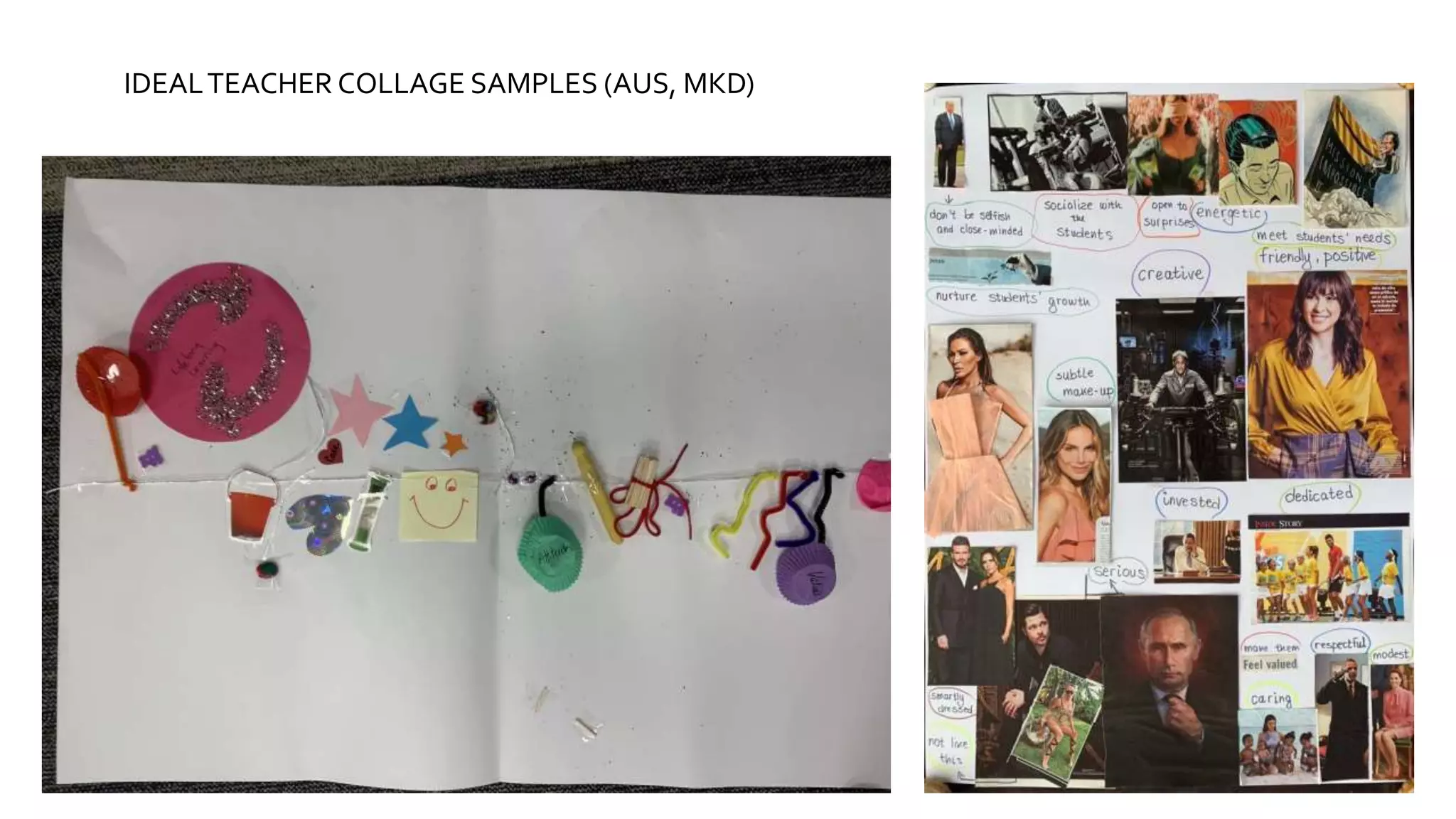
IDEALTEACHER COLLAGE SAMPLES (AUS, MKD)
IDEALTEACHER INDIVIDUAL REFLECTION EXCERPTS (AUS, MKD)
Quality: Adaptability through strength
[…]The wave is able to move and dance because it is supported by a body of water beneath
it. It is a part of something bigger than itself. I feel that my life experiences (specifically, all
the times I feel hugely out of my depth, but then manage to […] do what needs to be done
and do it well) have showed me that I have an inner strength that I am able to rely on when I
need it.Along with my experiences, my family, my dear friends, and, in fact, the entire
teaching profession, all act as my ocean in differing ways. My family hold and support me
and provide a place to disengage from the dramas of university and teaching. My friends
share my passion for children and provide space for me to dream and imagine where my life
could lead, and the teaching industry shows me that I am not alone in this passion to
empower the next generation. I am a wave, moving, dancing, exploring, but I am not alone.
Quality: Empathy
Understanding and sharing [in
teaching] are vital. […]The teacher
should be the primary [role model] for
[practicing] empathy, which is shown
by the way the teacher interacts with
the students. [I remember talking] to
[a student who was mocked for her
height] Jana’s friends during the
classroom observation [session]
[about] height not [being] the most
important thing in the world. […] [I
shared that] I was the same height as
her when I was her age and am now all
grown up.
FINDINGS
1. Clear articulation of ideal teacher qualities (AUS, MKD):
- Knowledge (world, subject-specific, curriculum, general pedagogical, e.g. giving clear instructions)
- General skills/traits/attitudes – e.g. kindness, creativity, flexibility, organisation, open-mindedness, approachability
- Pedagogical skills/traits/attitudes – e.g. meeting individual students’ needs, nurturing students’ growth, practising
inclusivity
2. Ability to identify factors supporting agency development through identity processes (AUS):
- Connectedness (e.g. with prior/current educators, in peer/professional networks, in the family)
- Self-care (incl. readiness to walk away from non-priority tasks, giving oneself time to process issues)
- Continuous development (lifelong learning)
- Room for authenticity and creativity in the profession (e.g. inquiry-based learning)
3. Ability to identify obstacles to agency development through identity processes (AUS):
- Social perceptions of teaching as a profession (the teacher as ”the unsung hero”): low salary, high stress
- Social inequalities (women expected to juggle their roles of students, wives, mothers… and the associated
mental/emotional load, which leads to guilt)
- Top-down educational structures
- Challenging student behaviours
- Insufficient opportunities to reflect (e.g. on one’s personal why-s and how-s)
CONCLUSIONS (1)
Crafting vision under way; articulated possible selves seem realistic and achievable (a
prerequisite for agency development), though room for further elaboration re:
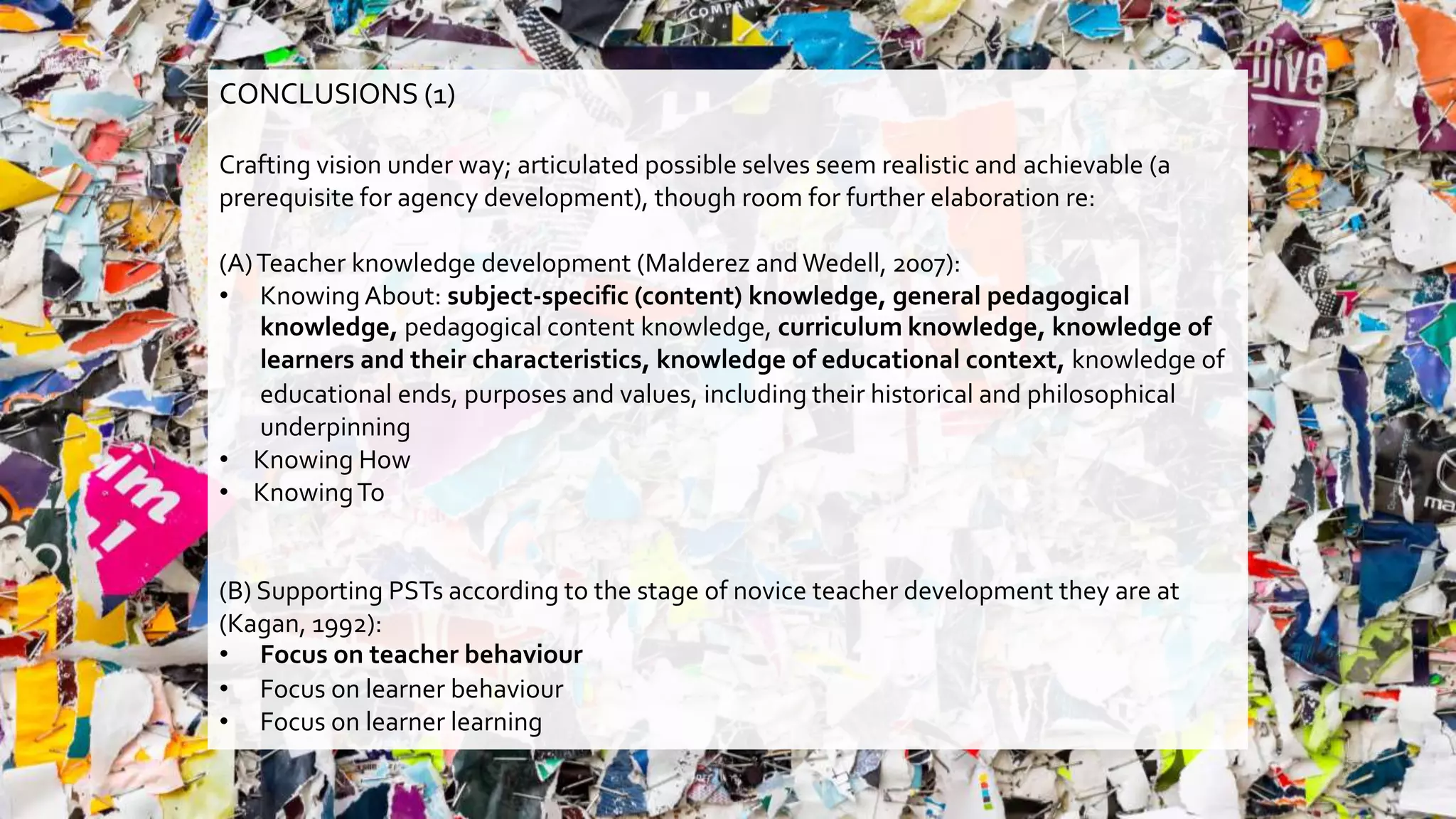
(A)Teacher knowledge development (Malderez and Wedell, 2007):
• Knowing About: subject-specific (content) knowledge, general pedagogical
knowledge, pedagogical content knowledge, curriculum knowledge, knowledge of
learners and their characteristics, knowledge of educational context, knowledge of
educational ends, purposes and values, including their historical and philosophical
underpinning
• Knowing How
• KnowingTo
(B) Supporting PSTs according to the stage of novice teacher development they are at
(Kagan, 1992):
• Focus on teacher behaviour
• Focus on learner behaviour
• Focus on learner learning
CONCLUSIONS (2)
Arts-based reflection worth considering onTE programmes for its potential to
promote the following prerequisites for agentic behaviour (McKay, 2021):
• Deep, personalised reflection to fuel knowledge/identity development processes
• Connectedness
• Wellbeing (e.g. reflecting on character strengths elicits positive emotions and
promotes engagement following Seligman’s PERMA model of wellbeing, 2011)
• Personal accountability: “Reflection was absolutely imperative when I was on
prac. It is so easy to blame the kids, or the weather, or anything else for a bad
lesson or a bad day but the buck stops with you and there's always something you
can do to improve. […] Reflecting on what went well and what didn't, then
actioning your reflections is the most effective way of improving your practice.”
Reflection, as our comparative data suggests, is learnable: its robustness improves
with practice.
References:
Bandura, A., (2006). Toward a psychology of human agency. Perspectives on Psychological Science. 1(2), 164-180.
Conway, P. F. (2001). Anticipatory reflection while learning to teach: From a temporally truncated to a temporally distributed model of reflection in teacher
education. Teaching and Teacher Education, 17(1), 89-106.
Dörnyei, Z. and Kubanyiova, M. (2014). Motivating Learners, Motivating Teachers: Building Vision in the Language Classroom. Cambridge: Cambridge
University Press.
Lipponen, L. and Kumpulainen, K., (2011). Acting as accountable authors: Creating interactional spaces for agency. Teaching and Teacher Education. 27:
819.
Malderez, A., and Wedell, M., (2007). Teaching teachers: Processes and practices. London: Continuum.
Markus, H., & Nurius, P. (1986). Possible selves. American Psychologist, 41(9), 954-.
McKay, L. (2021). Using arts-based reflection to explore preservice teacher identity development and its reciprocity with resilience and well-being during
the second year of university. Teaching and Teacher Education 105.
Kagan, D. (1992). Professional growth among pre-service and beginning teachers. Review of Educational Research, 62, 129-69.
Seligman, M. (2011) Flourish. London: Nicholas Brealey.
Schoon, I., (2018). Conceptualising learner agency: a socio-ecological developmental approach. Available at: https://www.oecd.org/education/2030-
project/contact/Draft_Papers_supporting_the_OECD_Learning_Framework_2030.pdf (Accessed: 28th January 2021).
Thank you!
elena.oncevska@flf.ukim.edu.mk
loraine.mckay@griffith.edu.au

Arts-based reflection

  • 1.
    Collaboration, creativity, andconnectedness: Supporting professional agency in Australian and Macedonian pre-service teachers Elena Ončevska Ager, Ss Cyril and Methodius University, Skopje, North Macedonia Loraine McKay, Griffith University, Queensland, Australia All images borrowed from Unsplash
  • 2.
    Agency broadly definedas ability to initiate and guide one’s own actions and interactions with others (Bandura 2006) Lipponen and Kumpulainen (2011: 813) on relational agency: agency is constructed, contested, negotiated and re- negotiated Agency – key skill for teachers to respond to global uncertainty by supporting agentic development in learners, while maintaining their wellbeing Agency very much learnable! (Schoon, 2018)
  • 3.
    Project: Australian andMacedonian pre-service teachers reflecting on teaching to further their teacher knowledge and sense of identity – both feeding into agency
  • 4.
    CONCEPTUAL FRAMEWORK INFORMEDBY: • Conway (2001) on anticipatory reflection • Malderez andWedell (2007) on teacher knowledge • Kagan (1992) on novice teacher development • Markus and Nurius (1986) on possible selves • Dörnyei and Kubanyiova (2014) on vision • Seligman (2011) on wellbeing
  • 5.
    METHODOLOGY • Approach: arts-basedreflection to promote deeper, more personal learning • Task: (1) collaborative bird-eye perspective drawing of ideal classroom and (2) collaborative collage on ideal teacher qualities, followed by individual written reflection • Participants: 8Australian and 9 Macedonian pre-service teachers • Format: workshops • Analysable data: student output, student presentations of output • Data analysis: thematic, ensuring reflexivity by researchers working in tandem
  • 6.
    PARTICIPANTS: SIMILARITIESAND DIFFERENCES •All nearing BEd/BA graduation • Mature age students, 20-38 (AUS) vs. students who joined programme directly after high school, i.e. age 20 (MKD) • Consistent prac experience across degree programme (AUS) vs. moderate prac experience, in final year of studies • Very experienced in reflection (AUS) vs. moderately experienced (MKD) • Belonging to close-knit development group (AUS) vs. coming from various student groups and in the process of getting to know one another (MKD)
  • 7.
  • 8.
    IDEALTEACHER INDIVIDUAL REFLECTIONEXCERPTS (AUS, MKD) Quality: Adaptability through strength […]The wave is able to move and dance because it is supported by a body of water beneath it. It is a part of something bigger than itself. I feel that my life experiences (specifically, all the times I feel hugely out of my depth, but then manage to […] do what needs to be done and do it well) have showed me that I have an inner strength that I am able to rely on when I need it.Along with my experiences, my family, my dear friends, and, in fact, the entire teaching profession, all act as my ocean in differing ways. My family hold and support me and provide a place to disengage from the dramas of university and teaching. My friends share my passion for children and provide space for me to dream and imagine where my life could lead, and the teaching industry shows me that I am not alone in this passion to empower the next generation. I am a wave, moving, dancing, exploring, but I am not alone. Quality: Empathy Understanding and sharing [in teaching] are vital. […]The teacher should be the primary [role model] for [practicing] empathy, which is shown by the way the teacher interacts with the students. [I remember talking] to [a student who was mocked for her height] Jana’s friends during the classroom observation [session] [about] height not [being] the most important thing in the world. […] [I shared that] I was the same height as her when I was her age and am now all grown up.
  • 9.
    FINDINGS 1. Clear articulationof ideal teacher qualities (AUS, MKD): - Knowledge (world, subject-specific, curriculum, general pedagogical, e.g. giving clear instructions) - General skills/traits/attitudes – e.g. kindness, creativity, flexibility, organisation, open-mindedness, approachability - Pedagogical skills/traits/attitudes – e.g. meeting individual students’ needs, nurturing students’ growth, practising inclusivity 2. Ability to identify factors supporting agency development through identity processes (AUS): - Connectedness (e.g. with prior/current educators, in peer/professional networks, in the family) - Self-care (incl. readiness to walk away from non-priority tasks, giving oneself time to process issues) - Continuous development (lifelong learning) - Room for authenticity and creativity in the profession (e.g. inquiry-based learning) 3. Ability to identify obstacles to agency development through identity processes (AUS): - Social perceptions of teaching as a profession (the teacher as ”the unsung hero”): low salary, high stress - Social inequalities (women expected to juggle their roles of students, wives, mothers… and the associated mental/emotional load, which leads to guilt) - Top-down educational structures - Challenging student behaviours - Insufficient opportunities to reflect (e.g. on one’s personal why-s and how-s)
  • 10.
    CONCLUSIONS (1) Crafting visionunder way; articulated possible selves seem realistic and achievable (a prerequisite for agency development), though room for further elaboration re: (A)Teacher knowledge development (Malderez and Wedell, 2007): • Knowing About: subject-specific (content) knowledge, general pedagogical knowledge, pedagogical content knowledge, curriculum knowledge, knowledge of learners and their characteristics, knowledge of educational context, knowledge of educational ends, purposes and values, including their historical and philosophical underpinning • Knowing How • KnowingTo (B) Supporting PSTs according to the stage of novice teacher development they are at (Kagan, 1992): • Focus on teacher behaviour • Focus on learner behaviour • Focus on learner learning
  • 11.
    CONCLUSIONS (2) Arts-based reflectionworth considering onTE programmes for its potential to promote the following prerequisites for agentic behaviour (McKay, 2021): • Deep, personalised reflection to fuel knowledge/identity development processes • Connectedness • Wellbeing (e.g. reflecting on character strengths elicits positive emotions and promotes engagement following Seligman’s PERMA model of wellbeing, 2011) • Personal accountability: “Reflection was absolutely imperative when I was on prac. It is so easy to blame the kids, or the weather, or anything else for a bad lesson or a bad day but the buck stops with you and there's always something you can do to improve. […] Reflecting on what went well and what didn't, then actioning your reflections is the most effective way of improving your practice.” Reflection, as our comparative data suggests, is learnable: its robustness improves with practice.
  • 12.
    References: Bandura, A., (2006).Toward a psychology of human agency. Perspectives on Psychological Science. 1(2), 164-180. Conway, P. F. (2001). Anticipatory reflection while learning to teach: From a temporally truncated to a temporally distributed model of reflection in teacher education. Teaching and Teacher Education, 17(1), 89-106. Dörnyei, Z. and Kubanyiova, M. (2014). Motivating Learners, Motivating Teachers: Building Vision in the Language Classroom. Cambridge: Cambridge University Press. Lipponen, L. and Kumpulainen, K., (2011). Acting as accountable authors: Creating interactional spaces for agency. Teaching and Teacher Education. 27: 819. Malderez, A., and Wedell, M., (2007). Teaching teachers: Processes and practices. London: Continuum. Markus, H., & Nurius, P. (1986). Possible selves. American Psychologist, 41(9), 954-. McKay, L. (2021). Using arts-based reflection to explore preservice teacher identity development and its reciprocity with resilience and well-being during the second year of university. Teaching and Teacher Education 105. Kagan, D. (1992). Professional growth among pre-service and beginning teachers. Review of Educational Research, 62, 129-69. Seligman, M. (2011) Flourish. London: Nicholas Brealey. Schoon, I., (2018). Conceptualising learner agency: a socio-ecological developmental approach. Available at: https://www.oecd.org/education/2030- project/contact/Draft_Papers_supporting_the_OECD_Learning_Framework_2030.pdf (Accessed: 28th January 2021).
  • 13.

Editor's Notes

  • #8 AUS students demonstrate more sophisticated/abstract reflection
  • #9 Same comment as in previous slide
  • #10 AUS students demonstrate richer reflection
  • #11 The items in bold are those areas that feature prominently in the data – the others would need TE support. Teacher knowledge gets only general treatment. What (else) constitutes teacher knowledge? See Additional lit review suggestions: Malderez and Wedell (2007). How to address these on TE programmes? Most content suggests a focus on teacher behaviour, less so on interactions with learners and learner learning. This reflects novice teachers’ development stages, with focus on self giving way to focus on learners and learning as teachers develop. See Additional lit review suggestions: Kagan (1992). Perhaps the nature of the task elicited this result – worth considering an additional reflective task: The ideal learner?