How does your media product
represent particular social groups?
Key Areas of Representation
    Within my two minute opening, only two characters appear – Sarah and Emma


                 The seven key
              representations are:
 Gender                                        Class and status
 Ethnicity                                     Regional Identity
 Age                                           Disability
 Sexuality

Within my two minute opening, I address three of these areas of
representation – Gender, Age and Regional Identity.
Stereotypes – Real Media Products
Teenagers are often shown as being aggressive, moody,
lazy, criminals and hate school. The media are brilliant
at stereotyping teenagers in this way. Many television
programmes and films feature teenagers who drink,
smoke and party and are either aggressive or moody or
crude. Examples of films that have tried to represent
the teenage demographic are films that are for the
teenage audience; such as ‘Fishtank’, ‘Mean Girls’,
‘Harry Potter’ and the ‘Twilight’ sagas. I will be
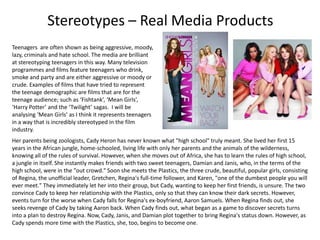
analysing ‘Mean Girls’ as I think it represents teenagers
in a way that is incredibly stereotyped in the film
industry.
Her parents being zoologists, Cady Heron has never known what "high school" truly meant. She lived her first 15
years in the African jungle, home-schooled, living life with only her parents and the animals of the wilderness,
knowing all of the rules of survival. However, when she moves out of Africa, she has to learn the rules of high school,
a jungle in itself. She instantly makes friends with two sweet teenagers, Damian and Janis, who, in the terms of the
high school, were in the "out crowd." Soon she meets the Plastics, the three crude, beautiful, popular girls, consisting
of Regina, the unofficial leader, Gretchen, Regina's full-time follower, and Karen, "one of the dumbest people you will
ever meet." They immediately let her into their group, but Cady, wanting to keep her first friends, is unsure. The two
convince Cady to keep her relationship with the Plastics, only so that they can know their dark secrets. However,
events turn for the worse when Cady falls for Regina's ex-boyfriend, Aaron Samuels. When Regina finds out, she
seeks revenge of Cady by taking Aaron back. When Cady finds out, what began as a game to discover secrets turns
into a plan to destroy Regina. Now, Cady, Janis, and Damian plot together to bring Regina's status down. However, as
Cady spends more time with the Plastics, she, too, begins to become one.
Stereotypes – My Product
For our own media product, we wanted to represent teenagers in a different light to how
they are overly stereotyped in the media, especially in ‘Mean Girls’. We still wanted our
audience to be female teenagers, yet we feel that more female teenagers are obsessed
with music and the internet rather than alcohol and sex in the environment we live in. We
also wanted our product to represent not just teenagers but also ourselves, which is where
we got the idea for our issue from. As we have been or still are obsessed with certain
bands, we wanted to show this in our own media product. We feel that it is an issue that
needs to be talked about as well as the obvious issues such as pregnancy and drug dealing
for teenagers. Furthermore, we have put our main characters ‘Sarah’ and ‘Emma’ into
school uniform (a green jumper, black polo shirt and black trousers/skirt), whilst in ‘Mean
Girls’ the characters wear skimpy clothes all the time – even in school! This creates a
further relation between the characters and our audience, which many teenage films do
not do. Also, the way in which the relationships are seen in both films could be seen as
similar in the fact that they are both taking revenge on one another – in ‘Mean Girls’, Cady
is taking revenge on Regina for getting back with her ex after Cady falls for him. In our
product, ‘Sarah’ is taking revenge on ‘Emma’ for being ‘obsessed’ with the band One
Direction.

Criteria 2

  • 1.
    How does yourmedia product represent particular social groups?
  • 2.
    Key Areas ofRepresentation Within my two minute opening, only two characters appear – Sarah and Emma The seven key representations are: Gender Class and status Ethnicity Regional Identity Age Disability Sexuality Within my two minute opening, I address three of these areas of representation – Gender, Age and Regional Identity.
  • 3.
    Stereotypes – RealMedia Products Teenagers are often shown as being aggressive, moody, lazy, criminals and hate school. The media are brilliant at stereotyping teenagers in this way. Many television programmes and films feature teenagers who drink, smoke and party and are either aggressive or moody or crude. Examples of films that have tried to represent the teenage demographic are films that are for the teenage audience; such as ‘Fishtank’, ‘Mean Girls’, ‘Harry Potter’ and the ‘Twilight’ sagas. I will be analysing ‘Mean Girls’ as I think it represents teenagers in a way that is incredibly stereotyped in the film industry. Her parents being zoologists, Cady Heron has never known what "high school" truly meant. She lived her first 15 years in the African jungle, home-schooled, living life with only her parents and the animals of the wilderness, knowing all of the rules of survival. However, when she moves out of Africa, she has to learn the rules of high school, a jungle in itself. She instantly makes friends with two sweet teenagers, Damian and Janis, who, in the terms of the high school, were in the "out crowd." Soon she meets the Plastics, the three crude, beautiful, popular girls, consisting of Regina, the unofficial leader, Gretchen, Regina's full-time follower, and Karen, "one of the dumbest people you will ever meet." They immediately let her into their group, but Cady, wanting to keep her first friends, is unsure. The two convince Cady to keep her relationship with the Plastics, only so that they can know their dark secrets. However, events turn for the worse when Cady falls for Regina's ex-boyfriend, Aaron Samuels. When Regina finds out, she seeks revenge of Cady by taking Aaron back. When Cady finds out, what began as a game to discover secrets turns into a plan to destroy Regina. Now, Cady, Janis, and Damian plot together to bring Regina's status down. However, as Cady spends more time with the Plastics, she, too, begins to become one.
  • 4.
    Stereotypes – MyProduct For our own media product, we wanted to represent teenagers in a different light to how they are overly stereotyped in the media, especially in ‘Mean Girls’. We still wanted our audience to be female teenagers, yet we feel that more female teenagers are obsessed with music and the internet rather than alcohol and sex in the environment we live in. We also wanted our product to represent not just teenagers but also ourselves, which is where we got the idea for our issue from. As we have been or still are obsessed with certain bands, we wanted to show this in our own media product. We feel that it is an issue that needs to be talked about as well as the obvious issues such as pregnancy and drug dealing for teenagers. Furthermore, we have put our main characters ‘Sarah’ and ‘Emma’ into school uniform (a green jumper, black polo shirt and black trousers/skirt), whilst in ‘Mean Girls’ the characters wear skimpy clothes all the time – even in school! This creates a further relation between the characters and our audience, which many teenage films do not do. Also, the way in which the relationships are seen in both films could be seen as similar in the fact that they are both taking revenge on one another – in ‘Mean Girls’, Cady is taking revenge on Regina for getting back with her ex after Cady falls for him. In our product, ‘Sarah’ is taking revenge on ‘Emma’ for being ‘obsessed’ with the band One Direction.