SILENT THINGS
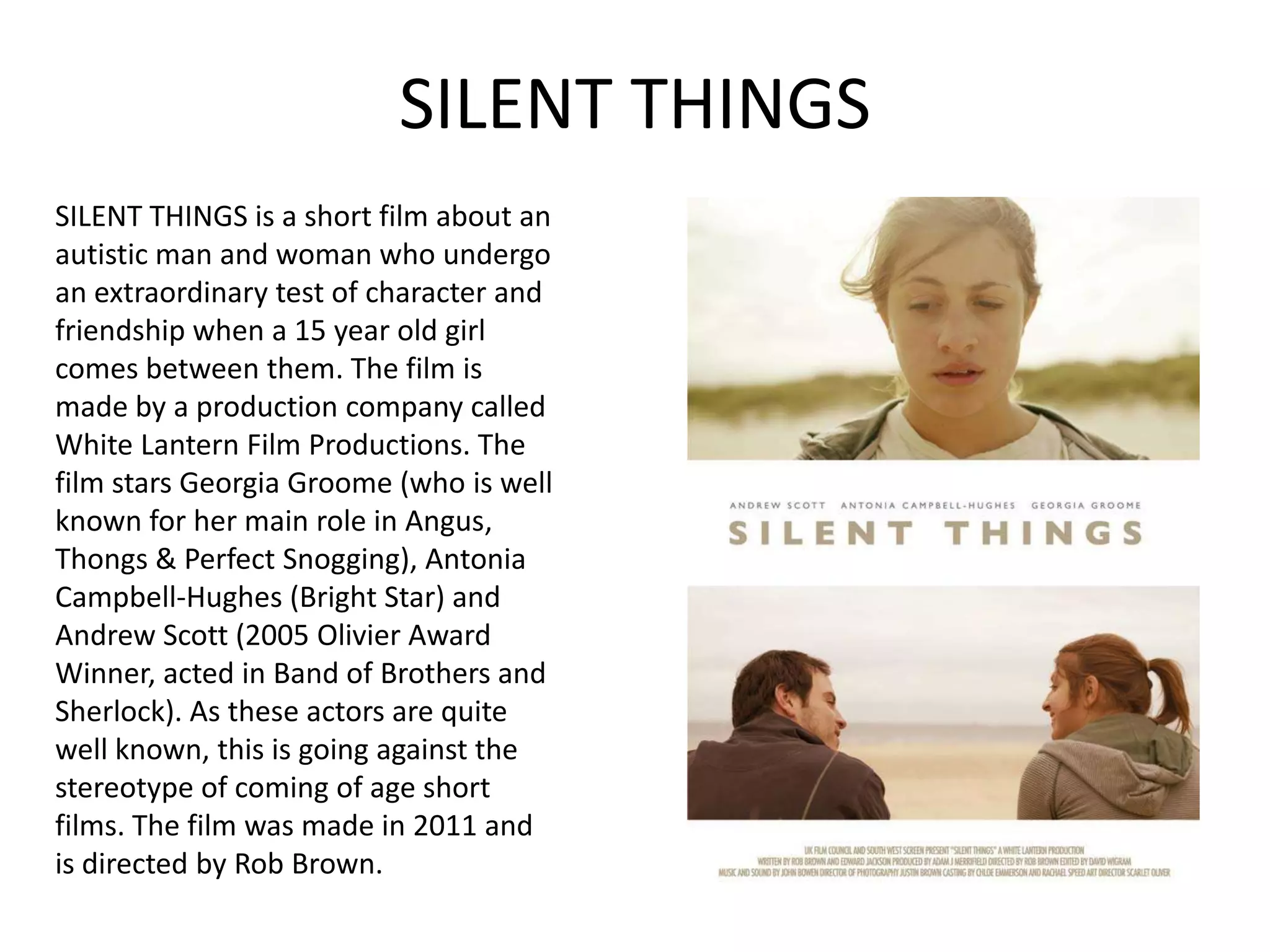
SILENT THINGS is a short film about an
autistic man and woman who undergo
an extraordinary test of character and
friendship when a 15 year old girl
comes between them. The film is
made by a production company called
White Lantern Film Productions. The
film stars Georgia Groome (who is well
known for her main role in Angus,
Thongs & Perfect Snogging), Antonia
Campbell-Hughes (Bright Star) and
Andrew Scott (2005 Olivier Award
Winner, acted in Band of Brothers and
Sherlock). As these actors are quite
well known, this is going against the
stereotype of coming of age short
films. The film was made in 2011 and
is directed by Rob Brown.
Camera work
Many different camera shots are used throughout the short film to create meanings and a
story to the film. The film begins with an establishing shot of a beach which is a stereotyped
way of starting any film. It shows the audience the setting of the film. After the credits, we
then get a mid shot and two shot of the two main characters of the film – Jake and Charlotte
who seen to both have autism. When they do something together, they copy each other;
whether just gazing at the kite or fixing the kite itself. Through the next batch of scenes, the
director uses close ups of the characters to show their expressions and feelings towards one
another. Charlotte watches with disgust as Jake and the third character Amy connect in
conversation – she sees it as unfair that another girl is trying to be in her place in a
relationship. During another scene, when Jake and Amy are sitting down, the director uses
an over the shoulder shot to show them in face to face conversation which could be seen as
a unusual thing for Jake. When the scene changes to the second setting (the ferry port), the
director uses a long shot to make the audience aware that the characters are in another
place. When the camera closes in on secondary characters around them, they are in mid
shots. As Jake and Amy are guided through the hallway by the authorities, the camera pans
sideways so that it follows them. When Jake gets taken to see a policeman, the scene
changes into a two shot. Charlotte watches on as Jake is sorted out by the police in an over
the shoulder shot. The scene then changes back to how it was a t the beginning and the
same types of shots – long shot of kite fixing, close up of faces and two shot of Jake and
Charlotte. Their relationship has gone back to how it was at the beginning of the film. This
turns the film in to having a three part structure.
Editing
Most of the film uses continuity editing to
show the narrative in a chronological order.
The editor also makes sure that the film
shows a point of view from each character.
The film’s title credits are in white text on a
black background to make them simple and
to not create more attention than the story.
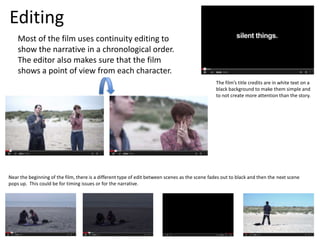
Near the beginning of the film, there is a different type of edit between scenes as the scene fades out to black and then the next scene
pops up. This could be for timing issues or for the narrative.
Sound
There is a lot of different sounds used in the short film, whether diegetic or non-diegetic.
Most of the sounds are diegetic as they are in the scene – dialogue and background
sounds. However, there is not much dialogue used as the director has managed to create
more of a narrative through the actions, body language and facial expressions of each of
the three characters. In all the scenes on the beach, there is the diegetic background noise
of the waves of the sea crashing over and over again. The scene in which the second
female character comes in has people talking in the background – people she knows
making fun of her and the male character. The characters start having conversations with
eac other – the film’s dialogue which is scripted. The most important piece of dialogue is
when the second female character tells the male character that he is ‘strange’. He then
tells her that he has Aspergers Syndrome. Another important piece is when the first female
character asks the male character ‘how can she be your friend? You can’t make friends that
quickly’. In some scenes, instrumental music starts to play softly in the background which
is the only non-diegetic sound of the film. The music then quickens up and becomes
louder in a scene where the man has a mental panic attack when he and the girl are at the
ferry port. The music further illustrates the feelings and thoughts of the scene and helps
the narrative to move along. When the second girl and the man are taken away, she points
out that ‘he’s just some guy who asked me to get on the ferry with him’. This could be seen
as more dangerous than it actually is by the authorities.

Silent things presentation

  • 1.
    SILENT THINGS SILENT THINGSis a short film about an autistic man and woman who undergo an extraordinary test of character and friendship when a 15 year old girl comes between them. The film is made by a production company called White Lantern Film Productions. The film stars Georgia Groome (who is well known for her main role in Angus, Thongs & Perfect Snogging), Antonia Campbell-Hughes (Bright Star) and Andrew Scott (2005 Olivier Award Winner, acted in Band of Brothers and Sherlock). As these actors are quite well known, this is going against the stereotype of coming of age short films. The film was made in 2011 and is directed by Rob Brown.
  • 2.
    Camera work Many differentcamera shots are used throughout the short film to create meanings and a story to the film. The film begins with an establishing shot of a beach which is a stereotyped way of starting any film. It shows the audience the setting of the film. After the credits, we then get a mid shot and two shot of the two main characters of the film – Jake and Charlotte who seen to both have autism. When they do something together, they copy each other; whether just gazing at the kite or fixing the kite itself. Through the next batch of scenes, the director uses close ups of the characters to show their expressions and feelings towards one another. Charlotte watches with disgust as Jake and the third character Amy connect in conversation – she sees it as unfair that another girl is trying to be in her place in a relationship. During another scene, when Jake and Amy are sitting down, the director uses an over the shoulder shot to show them in face to face conversation which could be seen as a unusual thing for Jake. When the scene changes to the second setting (the ferry port), the director uses a long shot to make the audience aware that the characters are in another place. When the camera closes in on secondary characters around them, they are in mid shots. As Jake and Amy are guided through the hallway by the authorities, the camera pans sideways so that it follows them. When Jake gets taken to see a policeman, the scene changes into a two shot. Charlotte watches on as Jake is sorted out by the police in an over the shoulder shot. The scene then changes back to how it was a t the beginning and the same types of shots – long shot of kite fixing, close up of faces and two shot of Jake and Charlotte. Their relationship has gone back to how it was at the beginning of the film. This turns the film in to having a three part structure.
  • 3.
    Editing Most of thefilm uses continuity editing to show the narrative in a chronological order. The editor also makes sure that the film shows a point of view from each character. The film’s title credits are in white text on a black background to make them simple and to not create more attention than the story. Near the beginning of the film, there is a different type of edit between scenes as the scene fades out to black and then the next scene pops up. This could be for timing issues or for the narrative.
  • 4.
    Sound There is alot of different sounds used in the short film, whether diegetic or non-diegetic. Most of the sounds are diegetic as they are in the scene – dialogue and background sounds. However, there is not much dialogue used as the director has managed to create more of a narrative through the actions, body language and facial expressions of each of the three characters. In all the scenes on the beach, there is the diegetic background noise of the waves of the sea crashing over and over again. The scene in which the second female character comes in has people talking in the background – people she knows making fun of her and the male character. The characters start having conversations with eac other – the film’s dialogue which is scripted. The most important piece of dialogue is when the second female character tells the male character that he is ‘strange’. He then tells her that he has Aspergers Syndrome. Another important piece is when the first female character asks the male character ‘how can she be your friend? You can’t make friends that quickly’. In some scenes, instrumental music starts to play softly in the background which is the only non-diegetic sound of the film. The music then quickens up and becomes louder in a scene where the man has a mental panic attack when he and the girl are at the ferry port. The music further illustrates the feelings and thoughts of the scene and helps the narrative to move along. When the second girl and the man are taken away, she points out that ‘he’s just some guy who asked me to get on the ferry with him’. This could be seen as more dangerous than it actually is by the authorities.