How does our media
product represent particular
social groups?
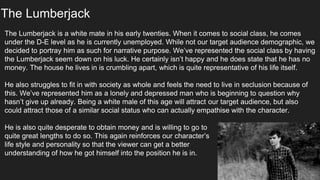
The Lumberjack
The Lumberjack is a white mate in his early twenties. When it comes to social class, he comes
under the D-E level as he is currently unemployed. While not our target audience demographic, we
decided to portray him as such for narrative purpose. We’ve represented the social class by having
the Lumberjack seem down on his luck. He certainly isn’t happy and he does state that he has no
money. The house he lives in is crumbling apart, which is quite representative of his life itself.
He also struggles to fit in with society as whole and feels the need to live in seclusion because of
this. We’ve represented him as a lonely and depressed man who is beginning to question why
hasn’t give up already. Being a white male of this age will attract our target audience, but also
could attract those of a similar social status who can actually empathise with the character.
He is also quite desperate to obtain money and is willing to go to
quite great lengths to do so. This again reinforces our character’s
life style and personality so that the viewer can get a better
understanding of how he got himself into the position he is in.
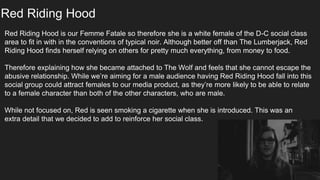
Red Riding Hood
Red Riding Hood is our Femme Fatale so therefore she is a white female of the D-C social class
area to fit in with in the conventions of typical noir. Although better off than The Lumberjack, Red
Riding Hood finds herself relying on others for pretty much everything, from money to food.
Therefore explaining how she became attached to The Wolf and feels that she cannot escape the
abusive relationship. While we’re aiming for a male audience having Red Riding Hood fall into this
social group could attract females to our media product, as they’re more likely to be able to relate
to a female character than both of the other characters, who are male.
While not focused on, Red is seen smoking a cigarette when she is introduced. This was an
extra detail that we decided to add to reinforce her social class.
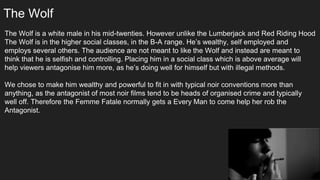
The Wolf
The Wolf is a white male in his mid-twenties. However unlike the Lumberjack and Red Riding Hood
The Wolf is in the higher social classes, in the B-A range. He’s wealthy, self employed and
employs several others. The audience are not meant to like the Wolf and instead are meant to
think that he is selfish and controlling. Placing him in a social class which is above average will
help viewers antagonise him more, as he’s doing well for himself but with illegal methods.
We chose to make him wealthy and powerful to fit in with typical noir conventions more than
anything, as the antagonist of most noir films tend to be heads of organised crime and typically
well off. Therefore the Femme Fatale normally gets a Every Man to come help her rob the
Antagonist.

Question two

  • 1.
    How does ourmedia product represent particular social groups?
  • 2.
    The Lumberjack The Lumberjackis a white mate in his early twenties. When it comes to social class, he comes under the D-E level as he is currently unemployed. While not our target audience demographic, we decided to portray him as such for narrative purpose. We’ve represented the social class by having the Lumberjack seem down on his luck. He certainly isn’t happy and he does state that he has no money. The house he lives in is crumbling apart, which is quite representative of his life itself. He also struggles to fit in with society as whole and feels the need to live in seclusion because of this. We’ve represented him as a lonely and depressed man who is beginning to question why hasn’t give up already. Being a white male of this age will attract our target audience, but also could attract those of a similar social status who can actually empathise with the character. He is also quite desperate to obtain money and is willing to go to quite great lengths to do so. This again reinforces our character’s life style and personality so that the viewer can get a better understanding of how he got himself into the position he is in.
  • 3.
    Red Riding Hood RedRiding Hood is our Femme Fatale so therefore she is a white female of the D-C social class area to fit in with in the conventions of typical noir. Although better off than The Lumberjack, Red Riding Hood finds herself relying on others for pretty much everything, from money to food. Therefore explaining how she became attached to The Wolf and feels that she cannot escape the abusive relationship. While we’re aiming for a male audience having Red Riding Hood fall into this social group could attract females to our media product, as they’re more likely to be able to relate to a female character than both of the other characters, who are male. While not focused on, Red is seen smoking a cigarette when she is introduced. This was an extra detail that we decided to add to reinforce her social class.
  • 4.
    The Wolf The Wolfis a white male in his mid-twenties. However unlike the Lumberjack and Red Riding Hood The Wolf is in the higher social classes, in the B-A range. He’s wealthy, self employed and employs several others. The audience are not meant to like the Wolf and instead are meant to think that he is selfish and controlling. Placing him in a social class which is above average will help viewers antagonise him more, as he’s doing well for himself but with illegal methods. We chose to make him wealthy and powerful to fit in with typical noir conventions more than anything, as the antagonist of most noir films tend to be heads of organised crime and typically well off. Therefore the Femme Fatale normally gets a Every Man to come help her rob the Antagonist.