CRIMINAL LAW II (BOOK 2)
CRIMINAL LAW JURISPRUDENCE
CRIMES AGAINST NATIONAL SECURITY (114‐123)
Q: What are the crimes against National Security?
1. Treason (Art.114)
2. Conspiracy and proposal to commit treason (Art.115)
3. Misprision of Treason (Art.116)
4. Espionage (Art.117)
5. Inciting to war and giving motives for reprisal (Art.118)
6. Violation of Neutrality (Art.119)
7. Correspondence with hostile country (Art.120)
8. Flight to enemy country (Art.121)
Q: What are the crimes against the law of nations?
1. Piracy and mutiny (Art.122)
2. Qualified Piracy and Mutiny
Q: When can the crime against national security be committed?
A: GR: All crimes against national security can only be committed in times of
war.
XPN:
1. Espionage
2. Inciting to war or giving motives for reprisal
3. Violation of neutrality
4. Mutiny and piracy. (Boado 2008 p.366)
Q: What are the two modes of committing treason?
1. Levying war against the government, or
2. Adhering to the enemies, giving them aid and comfort.
TREASON (Art. 114)
Q: What is the crime of treason?
A: It is a breach of allegiance to a government, committed by a person who owes allegiance to it.
Q: What is allegiance?
A: It is the obligation of fidelity and obedience, which one owes to the government under which he lives, in
return for the protection he receives.
Q: What are the elements of treason?
1. Offender is a Filipino citizen or an alien residing in the Philippines.
2. There is a war in which the Philippines is involved.
Note: Formal declaration of the existence of a state of war is not necessary.
3. Offender either –
a. Levies war against the government, or
b. Adheres to the enemies by giving them aid and comfort.
Note: Treason is a war crime. It can only be committed in times of war. There must be actual hostilities.
Note: Emotional or intellectual sympathy to the enemy, without giving the enemy aid or
comfort, is not treason.
Giving information to (People v. Paar, 86 Phil. 864) or commandeering foodstuffs (People v.
Mangahas, 93 Phil. 118) for enemy is evidence of both adherence and aid or comfort.
Q: Can treason be committed outside the Philippines?
A: It depends.
1. If the offender is a Filipino citizen, he can commit this crime even if he is
outside the Philippines.
2. Treason by an alien must be committed in the Philippines (EO 44) except
in case of conspiracy
Q: Is treason a continuing offense?
A: Yes. It can be committed by a single act or by series of acts. It can be committed in
one single or different time. In treason, there is only one criminal intent. A person who
commits treason is not criminally responsible for as many crimes of treason as the overt
acts as he has intentionally committed to give aid to the enemy.
Requirements of levying war
1. Actual assembling of men;
2. To execute a treasonable design by force;
3. Intent is to deliver the country in whole or in part to the enemy; and
4. Collaboration with foreign enemy or some foreign sovereign
Two ways of proving treason
1. Testimony of at least two witnesses to the same overt act; or
2. Confession of accused in open court.
Article 115. Conspiracy and Proposal to Commit Treason
Elements of conspiracy to commit treason
1. There is a war in which the Philippines is involved;
2. At least two persons come to an agreement to –
a. levy war against the government; or
b. adhere to the enemies, giving them aid or comfort;
3. They decide to commit it.
Elements of proposal to commit treason
1. There is a war in which the Philippines is involved;
2. At least one person decides to –
a. levy war against the government; or
b. adhere to the enemies, giving them aid or comfort;
3. He proposes its execution to some other persons.
Q: What is the crime of espionage?
A: Espionage is the offense of gathering, transmitting, or losing information respecting the
national defense with intent, or there is reason to believe that information is to be used to the
injury of the Republic of the Philippines or to the advantage of any foreign nation.
Note: Espionage is not conditioned on citizenship of the offender.
Q: What are the two modes of committing espionage?
1. First mode: By entering, without authority, a warship, fort or military or naval
establishments or reservation to obtain any information, plans or other data of confidential
nature relative to the defense of the Philippines.
2. Second mode: By disclosing to the representative of a foreign nation the contents of the
articles data or information referred to in par. No. 1 of
117 which he had in his possession by reason of the public office he holds.
Note: Being a public officer is a requirement in the second mode, while it is only aggravating in
the first.
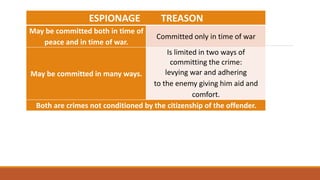
ESPIONAGE TREASON
May be committed both in time of
peace and in time of war.
Committed only in time of war
May be committed in many ways.
Is limited in two ways of
committing the crime:
levying war and adhering
to the enemy giving him aid and
comfort.
Both are crimes not conditioned by the citizenship of the offender.
Article 117. Espionage
Acts punished
1. By entering, without authority therefore, a warship, fort or naval or military establishment or reservation to
obtain any information, plans, photograph or other data of a confidential nature relative to the defense of the
Philippines;
Elements
1. Offender enters any of the places mentioned;
2. He has no authority therefore;
3. His purpose is to obtain information, plans, photographs or other data of a confidential nature relative to the
defense of the Philippines.
2. By disclosing to the representative of a foreign nation the contents of the articles, data or information referred
to in paragraph 1 of Article 117, which he had in his possession by reason of the public office he holds.
Elements
1. Offender is a public officer;
2. He has in his possession the articles, data or information referred to in paragraph 1 of Article 117, by reason of
the public office he holds;
3. He discloses their contents to a representative of a foreign nation.
CORRESPONDENCE WITH HOSTILE COUNTRY (Art. 120)
Q: What are the elements of this crime?
1. There is war in which the Philippines is involved
2. Offender makes correspondence with the enemy country or
territory occupied by enemy troops
3. Correspondence is either –
a. Prohibited by the Government
b. Carried on in ciphers or conventional signs
c. Containing notice or information which might be useful to
the enemy or intended by the offender to aid the enemy
Q: What are ciphers?
A: Secret message or code.
Article 118. Inciting to War or Giving Motives for Reprisals (Elements)
1. Offender performs unlawful or unauthorized acts;
2. The acts provoke or give occasion for –
a. a. war involving or liable to involve the Philippines; or
b. exposure of Filipino citizens to reprisals on their persons or property.
Article 119. Violation of Neutrality (Elements)
There is a war in which the Philippines is not involved;
There is a regulation issued by a competent authority to enforce neutrality;
3. Offender violates the regulation.
When we say national security, it should be interpreted as including rebellion, sedition and subversion. The
Revised Penal Code does not treat rebellion, sedition and subversion as crimes against national security, but more
of crimes against public order because during the time that the Penal Code was enacted, rebellion was carried out
only with bolos and spears; hence, national security was not really threatened. Now, the threat of rebellion or
internal wars is serious as a national threat.
Article 121.Flight to Enemy's Country
Elements
1. There is a war in which the Philippines is involved;
2. Offender must be owing allegiance to the government;
3. Offender attempts to flee or go to enemy country;
4. Going to the enemy country is prohibited by competent authority.
Article 122. Piracy in general and Mutiny on the High Seas or in Philippine Waters
Acts punished as piracy
1. Attacking or seizing a vessel on the high seas or in Philippine waters;
2. Seizing in the vessel while on the high seas or in Philippine waters the whole or part of its
cargo, its equipment or personal belongings of its complement or passengers.
Elements of piracy
1. The vessel is on the high seas or Philippine waters;
2. Offenders are neither members of its complement nor passengers of the vessel;
3. Offenders either –
a. attack or seize a vessel on the high seas or in Philippine waters; or
b. seize in the vessel while on the high seas or in Philippine waters the whole or part of its
cargo, its equipment or personal belongings of its complement or passengers;
4. There is intent to gain.
Could theft be committed on board a vessel?
Yes. The essence of piracy is one of robbery.
Elements of mutiny
1. The vessel is on the high seas or Philippine waters;
2. Offenders are either members of its complement, or passengers of the vessel;
3. Offenders either –
a. attack or seize the vessel; or
b. seize the whole or part of the cargo, its equipment, or personal belongings of the crew or passengers.
Mutiny is the unlawful resistance to a superior officer, or the raising of commotions and disturbances aboard a ship
against the authority of its commander.
Distinction between mutiny and piracy
(1) As to offenders
Mutiny is committed by members of the complement or the passengers of the vessel.
Piracy is committed by persons who are not members of the complement or the passengers of the vessel.
(2) As to criminal intent
In mutiny, there is no criminal intent. In piracy, the criminal intent is for gain.
PIRACY MUTINY
Offenders are strangers
to the vessel. Hence,
offenders are neither
passengers nor crew members.
Offenders are members of the
complement or the passengers of the
vessel.
Intent to gain is an element of
piracy.
Intent to gain is immaterial.
The offenders may only intend to ignore
the ship’s officer or they may be
prompted by a desire to commit plunder.
Attack from the outside. Attack from the inside.
Article 123. Qualified Piracy Elements
1. The vessel is on the high seas or Philippine waters:
2. Offenders may or may not be members of its complement, or passengers of the vessel;
3. Offenders either –
a. attack or seize the vessel; or
b. seize the whole or part of the cargo, its equipment., or personal belongings of the crew
or passengers;
4. The preceding were committed under any of the following circumstances:
a. whenever they have seized a vessel by boarding or firing upon the same;
b. whenever the pirates have abandoned their victims without means of saving
themselves; or
c. whenever the crime is accompanied by murder, homicide, physical injuries or rape.
Although in Article 123 merely refers to qualified piracy, there is also the crime
of qualified mutiny. Mutiny is qualified under the following circumstances:
(1) When the offenders abandoned the victims without means of saving
themselves; or
(2) When the mutiny is accompanied by rape, murder, homicide, or physical
injuries.
Note that the first circumstance which qualifies piracy does not apply to mutiny.
Republic Act No. 6235 (The Anti Hi-Jacking Law)Anti hi-jacking is another kind of
piracy which is committed in an aircraft. In other countries, this crime is known as
aircraft piracy.
TITLE II. CRIMES AGAINST THE FUNDAMENTAL LAWS OF THE STATE
Crimes against the fundamental laws of the State
1. Arbitrary detention (Art. 124);
2. Delay in the delivery of detained persons to the proper judicial authorities (Art. 125);
3. Delaying release (Art. 126);
4. Expulsion (Art. 127);
5. Violation of domicile (Art. 128);
6. Search warrants maliciously obtained and abuse in the service of those legally
obtained (Art. 129);
7. Searching domicile without witnesses (Art. 130);
8. Prohibition, interruption, and dissolution of peaceful meetings (Art. 131);
9. Interruption of religious worship (Art. 132); and
10. Offending the religious feelings (Art. 133);
Article 124. Arbitrary Detention (Elements)
1. Offender is a public officer or employee;
2. He detains a person;
3. The detention is without legal grounds.
The crime of arbitrary detention assumes several forms:
(1) Detaining a person without legal grounds under;
(2) Having arrested the offended party for legal grounds but without warrant
of arrest, and the public officer does not deliver the arrested person to the
proper judicial authority within the period of 12, 18, or 36 hours, as the case may
be; or
(3) Delaying release by competent authority with the same period mentioned
in number 2.
Q: Can a barangay chairman be guilty of this crime?
A: Yes. He has authority, in order to maintain peace and order, to cause the arrest and detention of a person.
(Boado, 2008)
Q: Can private individuals be held liable for arbitrary detention?
A: Yes, if they conspired with such public officers.
1. A janitor at the Quezon City Hall was assigned in cleaning the men’s room. One day, he noticed a
fellow urinating so carelessly that instead of urinating at the bowl, he was actually urinating partly on the
floor. The janitor resented this. He stepped out of the men’s room and locked the same. He left. The fellow
was able to come out only after several hours when people from the outside forcibly opened the door. Is the
janitor liable for arbitrary detention?
No. Even if he is a public officer, he is not permitted by his official function to arrest and detain persons.
Therefore, he is guilty only of illegal detention. While the offender is a public officer, his duty does not include
the authority to make arrest; hence, the crime committed is illegal detention.
2. A municipal treasurer has been courting his secretary. However, the latter always turned him down.
Thereafter, she tried to avoid him. One afternoon, the municipal treasurer locked the secretary inside their
office until she started crying. The treasurer opened the door and allowed her to go home. What crime was
committed?
Illegal detention. This is because the municipal treasurer has no authority to detain a person although he is a
public officer.
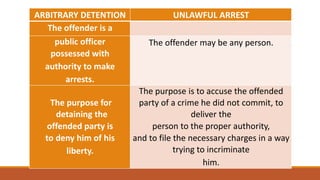
ARBITRARY DETENTION UNLAWFUL ARREST
The offender is a
public officer
possessed with
authority to make
arrests.
The offender may be any person.
The purpose for
detaining the
offended party is
to deny him of his
liberty.
The purpose is to accuse the offended
party of a crime he did not commit, to
deliver the
person to the proper authority,
and to file the necessary charges in a way
trying to incriminate
him.
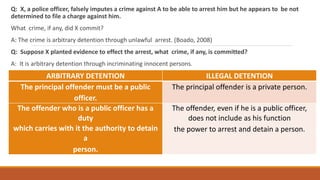
Q: X, a police officer, falsely imputes a crime against A to be able to arrest him but he appears to be not
determined to file a charge against him.
What crime, if any, did X commit?
A: The crime is arbitrary detention through unlawful arrest. (Boado, 2008)
Q: Suppose X planted evidence to effect the arrest, what crime, if any, is committed?
A: It is arbitrary detention through incriminating innocent persons.
ARBITRARY DETENTION ILLEGAL DETENTION
The principal offender must be a public
officer.
The principal offender is a private person.
The offender who is a public officer has a
duty
which carries with it the authority to detain
a
person.
The offender, even if he is a public officer,
does not include as his function
the power to arrest and detain a person.
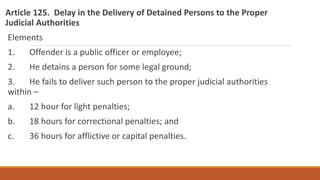
Article 125. Delay in the Delivery of Detained Persons to the Proper
Judicial Authorities
Elements
1. Offender is a public officer or employee;
2. He detains a person for some legal ground;
3. He fails to deliver such person to the proper judicial authorities
within –
a. 12 hour for light penalties;
b. 18 hours for correctional penalties; and
c. 36 hours for afflictive or capital penalties.
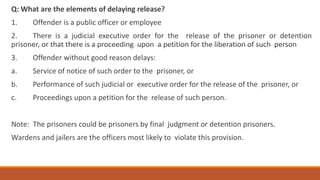
Q: What are the elements of delaying release?
1. Offender is a public officer or employee
2. There is a judicial executive order for the release of the prisoner or detention
prisoner, or that there is a proceeding upon a petition for the liberation of such person
3. Offender without good reason delays:
a. Service of notice of such order to the prisoner, or
b. Performance of such judicial or executive order for the release of the prisoner, or
c. Proceedings upon a petition for the release of such person.
Note: The prisoners could be prisoners by final judgment or detention prisoners.
Wardens and jailers are the officers most likely to violate this provision.
EXPULSION (Art. 127)
Q: What are the punishable acts?
GR:
1. Expelling a person from the Philippines
2. Compelling a person to change his residence.
XPN: In cases of ejectment, expropriation or when penalty imposed is destierro.
Q: What is the essence of the crime of expulsion?
A: The essence of this crime is coercion but it is specifically termed expulsion when committed by a public officer.
Q: If any of the punishable acts under Art. 127 is committed by a private person, what crime can he be made
responsible for?
A: Grave coercion
Article 128. Violation of Domicile
Acts punished
1. Entering any dwelling against the will of the owner thereof;
2. Searching papers or other effects found therein without the previous consent of such
owner; or
3. Refusing to leave the premises, after having surreptitiously entered said dwelling and
after having been required to leave the same
Common elements
1. Offender is a public officer or employee;
2. He is not authorized by judicial order to enter the dwelling or to make a search therein
for papers or other effects.
Circumstances qualifying the offense
1. If committed at nighttime; or
2. If any papers or effects not constituting evidence of a crime are not returned
immediately after the search made by offender.
Q: Suppose the public officer is not authorized to execute search warrants and
warrants of arrests, what crime can he be liable for?
A: Qualified trespass to dwelling (Art. 280, RPC).
Q: Suppose the punishable acts under Art. 128 are committed by a private
person, what crime did he commit?
A: Trespass to dwelling.
Q: If a public officer searches a person outside his dwelling, not armed with a
search warrant or a warrant of arrest, are the provisions of Art. 128
applicable?
A: No, because the papers and other effects mentioned in Art. 128 must be
found in dwelling. The crime committed is grave coercion, if violence and
intimidation are used (Art. 286), or unjust vexation, if there is no violence or
intimidation (Art. 287).
Article 129. Search Warrants Maliciously Obtained, and Abuse in the Service of Those Legally
Obtained
Acts punished
1. Procuring a search warrant without just cause;
Elements
1. Offender is a public officer or employee;
2. He procures a search warrant;
3. There is no just cause.
2. Exceeding his authority or by using unnecessary severity in executing a search warrant legally
procured.
Elements
1. Offender is a public officer or employee;
2. He has legally procured a search warrant;
3. He exceeds his authority or uses unnecessary severity in executing the same.
Article 130. Searching Domicile without Witnesses (Elements)
1. Offender is a public officer or employee;
2. He is armed with search warrant legally procured;
3. He searches the domicile, papers or other belongings of any person;
4. The owner, or any members of his family, or two witnesses residing in the
same locality are not present.
Q: What is the order of those who must witness the search?
1. Homeowner
2. Members of the family of sufficient age and discretion
3. Responsible members of the community
Article 131. Prohibition, Interruption, and Dissolution of Peaceful
Meetings
Elements
Offender is a public officer or employee;
He performs any of the following acts:
a. prohibiting or by interrupting, without legal ground, the holding of a
peaceful meeting, or by dissolving the same;
b. hindering any person from joining any lawful association, or
attending any of its meetings;
c. prohibiting or hindering any person from addressing, either alone or
together with others, any petition to the authorities for the correction of
abuses or redress of grievances.
Article 132. Interruption of Religious Worship
Elements
1. Offender is a public officer or employee;
2. Religious ceremonies or manifestations of any religious are about to take place or are
going on;
3. Offender prevents or disturbs the same.
Qualified if committed by violence or threat.
Article 133. Offending the Religious Feelings
Elements
1. Acts complained of were performed in a place devoted to religious worship, or during
the celebration of any religious ceremony;
2. The acts must be notoriously offensive to the feelings of the faithful.
There must be deliberate intent to hurt the feelings of the faithful.
TITLE III. CRIMES AGAINST PUBLIC ORDER
Crimes against public order
1. Rebellion or insurrection (Art. 134);
2. Conspiracy and proposal to commit rebellion (Art. 136);
3. Disloyalty to public officers or employees (Art. 137);
4. Inciting to rebellion (Art. 138);
5. Sedition (Art. 139);
6. Conspiracy to commit sedition (Art. 141);
7. Inciting to sedition (Art. 142);
8. Acts tending to prevent the meeting of Congress and similar bodies (Art. 143);
9. Disturbance of proceedings of Congress or similar bodies (Art. 144);
10. Violation of parliamentary immunity (Art. 145);
11. Illegal assemblies (Art. 146);
12. Illegal associations (Art. 147);
13. Direct assaults (Art. 148);
14. Indirect assaults (Art. 149
15. Disobedience to summons issued by Congress, its committees, etc., by the
constitutional commissions, its committees, etc. (Art. 150);
16. Resistance and disobedience to a person in authority or the agents of such person (Art.
151);
17. Tumults and other disturbances of public order (Art. 153);
18. Unlawful use of means of publication and unlawful utterances (Art. 154);
19. Alarms and scandals (Art. 155);
20. Delivering prisoners from jails (Art. 156);
21. Evasion of service of sentence (Art. 157);
22. Evasion on occasion of disorders (Art. 158);
23. Violation of conditional pardon (Art. 159); and
24. Commission of another crime during service of penalty imposed for another previous
offense (Art. 160).
Article 134. Rebellion or Insurrection
Elements
1. There is a public uprising and taking arms against the government;
2. The purpose of the uprising or movement is –
a. to remove from the allegiance to the government or its laws Philippine
territory or any part thereof, or any body of land, naval, or other armed
forces;
or
b. to deprive the Chief Executive or Congress, wholly or partially, of any of
their powers or prerogatives.
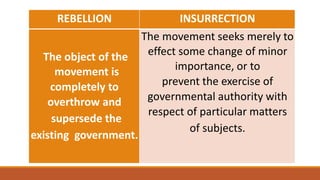
REBELLION INSURRECTION
The object of the
movement is
completely to
overthrow and
supersede the
existing government.
The movement seeks merely to
effect some change of minor
importance, or to
prevent the exercise of
governmental authority with
respect of particular matters
of subjects.
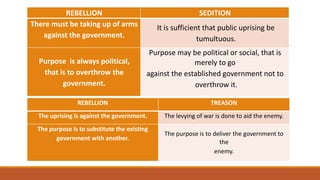
REBELLION SEDITION
There must be taking up of arms
against the government.
It is sufficient that public uprising be
tumultuous.
Purpose is always political,
that is to overthrow the
government.
Purpose may be political or social, that is
merely to go
against the established government not to
overthrow it.
REBELLION TREASON
The uprising is against the government. The levying of war is done to aid the enemy.
The purpose is to substitute the existing
government with another.
The purpose is to deliver the government to
the
enemy.
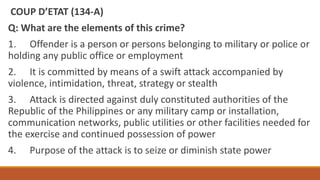
COUP D’ETAT (134‐A)
Q: What are the elements of this crime?
1. Offender is a person or persons belonging to military or police or
holding any public office or employment
2. It is committed by means of a swift attack accompanied by
violence, intimidation, threat, strategy or stealth
3. Attack is directed against duly constituted authorities of the
Republic of the Philippines or any military camp or installation,
communication networks, public utilities or other facilities needed for
the exercise and continued possession of power
4. Purpose of the attack is to seize or diminish state power
Article 136. Conspiracy and Proposal to Commit Coup d' etat, Rebellion or
Insurrection
Conspiracy and proposal to commit rebellion are two different crimes, namely:
1. Conspiracy to commit rebellion; and
2. Proposal to commit rebellion.
There is conspiracy to commit rebellion when two or more persons come to an
agreement to rise publicly and take arms against government for any of the
purposes of rebellion and decide to commit it.
There is proposal to commit rebellion when the person who has decided to rise
publicly and take arms against the government for any of the purposes of
rebellion proposes its execution to some other person or persons.
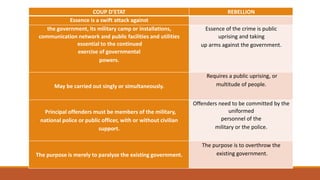
COUP D’ETAT REBELLION
Essence is a swift attack against
the government, its military camp or installations,
communication network and public facilities and utilities
essential to the continued
exercise of governmental
powers.
Essence of the crime is public
uprising and taking
up arms against the government.
May be carried out singly or simultaneously.
Requires a public uprising, or
multitude of people.
Principal offenders must be members of the military,
national police or public officer, with or without civilian
support.
Offenders need to be committed by the
uniformed
personnel of the
military or the police.
The purpose is merely to paralyze the existing government.
The purpose is to overthrow the
existing government.
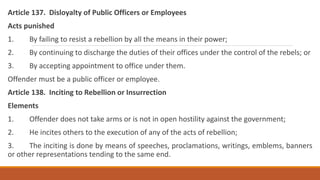
Article 137. Disloyalty of Public Officers or Employees
Acts punished
1. By failing to resist a rebellion by all the means in their power;
2. By continuing to discharge the duties of their offices under the control of the rebels; or
3. By accepting appointment to office under them.
Offender must be a public officer or employee.
Article 138. Inciting to Rebellion or Insurrection
Elements
1. Offender does not take arms or is not in open hostility against the government;
2. He incites others to the execution of any of the acts of rebellion;
3. The inciting is done by means of speeches, proclamations, writings, emblems, banners
or other representations tending to the same end.
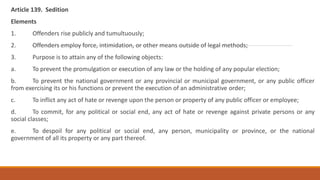
Article 139. Sedition
Elements
1. Offenders rise publicly and tumultuously;
2. Offenders employ force, intimidation, or other means outside of legal methods;
3. Purpose is to attain any of the following objects:
a. To prevent the promulgation or execution of any law or the holding of any popular election;
b. To prevent the national government or any provincial or municipal government, or any public officer
from exercising its or his functions or prevent the execution of an administrative order;
c. To inflict any act of hate or revenge upon the person or property of any public officer or employee;
d. To commit, for any political or social end, any act of hate or revenge against private persons or any
social classes;
e. To despoil for any political or social end, any person, municipality or province, or the national
government of all its property or any part thereof.
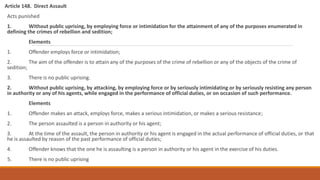
Article 148. Direct Assault
Acts punished
1. Without public uprising, by employing force or intimidation for the attainment of any of the purposes enumerated in
defining the crimes of rebellion and sedition;
Elements
1. Offender employs force or intimidation;
2. The aim of the offender is to attain any of the purposes of the crime of rebellion or any of the objects of the crime of
sedition;
3. There is no public uprising.
2. Without public uprising, by attacking, by employing force or by seriously intimidating or by seriously resisting any person
in authority or any of his agents, while engaged in the performance of official duties, or on occasion of such performance.
Elements
1. Offender makes an attack, employs force, makes a serious intimidation, or makes a serious resistance;
2. The person assaulted is a person in authority or his agent;
3. At the time of the assault, the person in authority or his agent is engaged in the actual performance of official duties, or that
he is assaulted by reason of the past performance of official duties;
4. Offender knows that the one he is assaulting is a person in authority or his agent in the exercise of his duties.
5. There is no public uprising
2. Without public uprising, by attacking, by employing force or by seriously
intimidating or by seriously resisting any person in authority or any of his agents, while
engaged in the performance of official duties, or on occasion of such performance.
Elements
1. Offender makes an attack, employs force, makes a serious intimidation, or makes a
serious resistance;
2. The person assaulted is a person in authority or his agent;
3. At the time of the assault, the person in authority or his agent is engaged in the actual
performance of official duties, or that he is assaulted by reason of the past performance of
official duties;
4. Offender knows that the one he is assaulting is a person in authority or his agent in the
exercise of his duties.
5. There is no public uprising
Q: When is direct assault qualified?
1. When the assault is committed with a weapon
2. When the offender is a public officer or employee
3. When the offender lays hand upon a person in authority
Q: Who is considered as an agent of a person in authority?
A: Any person who by direct provision of law or by election or by appointment
by competent authority, is charged with the maintenance of public order and
the protection and security of life and property, such as a barangay kagawad,
barangay tanod, barangay leader and any person who comes to the aid of a
person in authority.
Article 149. Indirect Assault
Elements
1. A person in authority or his agent is the victim of any of the forms of direct assault
defined in Article 148;
2. A person comes to the aid of such authority or his agent;
3. Offender makes use of force or intimidation upon such person coming to the aid of
the authority or his agent.
The victim in indirect assault should be a private person who comes in aid of an agent of a
person in authority. The assault is upon a person who comes in aid of the person in
authority. The victim cannot be the person in authority or his agent.
There is no indirect assault when there is no direct assault.
Examples of persons in authority
1. Municipal mayor;
2. Division superintendent of schools;
3. Public and private school teachers;
4. Teacher-nurse;
5. President of sanitary division;
6. Provincial fiscal;
7. Justice of the Peace;
8. Municipal councilor;
9. Barrio captain and barangay chairman.
Article 155. Alarms and Scandals
Acts punished
1. Discharging any firearm, rocket, firecracker, or other explosive within any
town or public place, calculated to cause (which produces) alarm of danger;
2. Instigating or taking an active part in any charivari or other disorderly
meeting offensive to another or prejudicial to public tranquility;
3. Disturbing the public peace while wandering about at night or while
engaged in any other nocturnal amusements;
4. Causing any disturbance or scandal in public places while intoxicated or
otherwise, provided Article 153 in not applicable.
Q: What is the essence of the crime of alarms and scandals?
A: The essence of the crime is disturbance of public tranquility and public peace.
Q: If a firearm is discharged, what are the crimes that may possibly arise?
1. Alarms and scandals – If the offender discharges a firearm in a public place but the
firearm is not pointed to a particular person when discharged.
2. Illegal discharge of firearm – If the firearm was directed to a particular person who was
not hit if intent to kill is not proved.
3. Attempted homicide or murder – If the person was hit, automatically, the crime is
attempted homicide or murder, if there is intent to kill.
Note: When a person uses lethal weapon against another, such as firearm, intent to kill is
inherent.
4. Physical injuries – If the person was hit and injured but there was no intent to kill.
5. Grave coercion – If the threat was directed, immediate and serious and the person is
compelled or prevented to do something against the will.
Article 156. Delivering Prisoners from Jail
Elements
1. There is a person confined in a jail or penal establishment;
2. Offender removes therefrom such person, or helps the escape of such
person.
Penalty of arresto mayor in its maximum period to prision correccional in its
minimum period is imposed if violence, intimidation or bribery is used.
Penalty of arresto mayor if other means are used.
Penalty decreased to the minimum period if the escape of the prisoner shall
take place outside of said establishments by taking the guards by surprise.
Article 157. Evasion of Service of Sentence
Elements
1. Offender is a convict by final judgment;
2. He is serving sentence which consists in the deprivation of liberty;
3. He evades service of his sentence by escaping during the term of his imprisonment.
Qualifying circumstances as to penalty imposed
If such evasion or escape takes place –
1. By means of unlawful entry (this should be “by scaling” - Reyes);
2. By breaking doors, windows, gates, walls, roofs or floors;
3. By using picklock, false keys, disguise, deceit, violence or intimidation; or
4. Through connivance with other convicts or employees of the penal institution
Article 158. Evasion of Service of Sentence on the Occasion of Disorders, Conflagrations, Earthquakes, or Other
Calamities
Elements
1. Offender is a convict by final judgment, who is confined in a penal institution;
2. There is disorder, resulting from –
a. conflagration;
b. earthquake;
c. explosion; or
d. similar catastrophe; or
e. mutiny in which he has not participated;
3. He evades the service of his sentence by leaving the penal institution where he is confined, on the
occasion of such disorder or during the mutiny;
4. He fails to give himself up to the authorities within 48 hours following the issuance of a proclamation by
the Chief Executive announcing the passing away of such calamity.
Commonwealth Act No. 142 (Regulating the Use of Aliases)
No person shall use any name different from the one with which he was registered at birth in the office of the
local civil registry, or with which he was registered in the bureau of immigration upon entry; or such substitute
name as may have been authorized by a competent court.
Exception: Pseudonym solely for literary, cinema, television, radio, or other entertainment and in athletic
events where the use of pseudonym is a normally accepted practice.
Article 179. Illegal Use of Uniforms or Insignia
Elements
1. Offender makes use of insignia, uniforms or dress;
2. The insignia, uniforms or dress pertains to an office not held by such person or a class of persons of
which he is not a member;
3. Said insignia, uniform or dress is used publicly and improperly.
Wearing the uniform of an imaginary office is not punishable
Article 180. False Testimony against A Defendant
Elements
1. There is a criminal proceeding;
2. Offender testifies falsely under oath against the defendant therein;
3. Offender who gives false testimony knows that it is false.
4. Defendant against whom the false testimony is given is either acquitted or convicted in a final judgment.
Three forms of false testimony
1. False testimony in criminal cases under Article 180 and 181;
2. False testimony in civil case under Article 182;
3. False testimony in other cases under Article 183.
Article 181. False Testimony Favorable to the Defendant
Elements
1. A person gives false testimony;
2. In favor of the defendant;
3. In a criminal case.
Article 183. False Testimony in Other Cases and Perjury in Solemn Affirmation
Acts punished
1. By falsely testifying under oath;
2. By making a false affidavit.
Elements of perjury
1. Offender makes a statement under oath or executes an affidavit upon a material matter;
2. The statement or affidavit is made before a competent officer, authorized to receive and administer
oaths;
3. Offender makes a willful and deliberate assertion of a falsehood in the statement or affidavit;
4. The sworn statement or affidavit containing the falsity is required by law, that is, it is made for a legal
purpose.
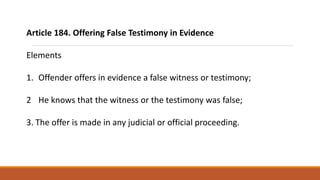
Article 184. Offering False Testimony in Evidence
Elements
1. Offender offers in evidence a false witness or testimony;
2 He knows that the witness or the testimony was false;
3. The offer is made in any judicial or official proceeding.
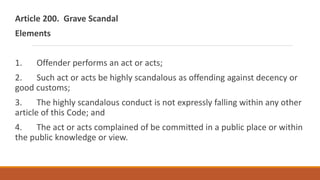
Article 200. Grave Scandal
Elements
1. Offender performs an act or acts;
2. Such act or acts be highly scandalous as offending against decency or
good customs;
3. The highly scandalous conduct is not expressly falling within any other
article of this Code; and
4. The act or acts complained of be committed in a public place or within
the public knowledge or view.
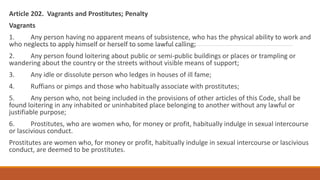
Article 202. Vagrants and Prostitutes; Penalty
Vagrants
1. Any person having no apparent means of subsistence, who has the physical ability to work and
who neglects to apply himself or herself to some lawful calling;
2. Any person found loitering about public or semi-public buildings or places or trampling or
wandering about the country or the streets without visible means of support;
3. Any idle or dissolute person who ledges in houses of ill fame;
4. Ruffians or pimps and those who habitually associate with prostitutes;
5. Any person who, not being included in the provisions of other articles of this Code, shall be
found loitering in any inhabited or uninhabited place belonging to another without any lawful or
justifiable purpose;
6. Prostitutes, who are women who, for money or profit, habitually indulge in sexual intercourse
or lascivious conduct.
Prostitutes are women who, for money or profit, habitually indulge in sexual intercourse or lascivious
conduct, are deemed to be prostitutes.
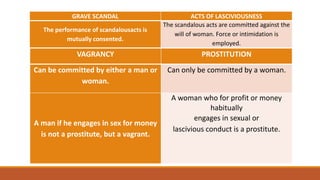
GRAVE SCANDAL ACTS OF LASCIVIOUSNESS
The performance of scandalousacts is
mutually consented.
The scandalous acts are committed against the
will of woman. Force or intimidation is
employed.
VAGRANCY PROSTITUTION
Can be committed by either a man or
woman.
Can only be committed by a woman.
A man if he engages in sex for money
is not a prostitute, but a vagrant.
A woman who for profit or money
habitually
engages in sexual or
lascivious conduct is a prostitute.
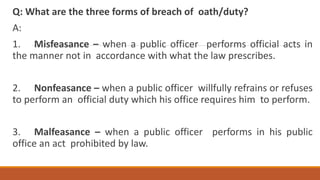
Q: What are the three forms of breach of oath/duty?
A:
1. Misfeasance – when a public officer performs official acts in
the manner not in accordance with what the law prescribes.
2. Nonfeasance – when a public officer willfully refrains or refuses
to perform an official duty which his office requires him to perform.
3. Malfeasance – when a public officer performs in his public
office an act prohibited by law.
CRIMINAL-LAW-II-BOOK-2.pptx

CRIMINAL-LAW-II-BOOK-2.pptx

  • 1.
    CRIMINAL LAW II(BOOK 2) CRIMINAL LAW JURISPRUDENCE
  • 2.
    CRIMES AGAINST NATIONALSECURITY (114‐123) Q: What are the crimes against National Security? 1. Treason (Art.114) 2. Conspiracy and proposal to commit treason (Art.115) 3. Misprision of Treason (Art.116) 4. Espionage (Art.117) 5. Inciting to war and giving motives for reprisal (Art.118) 6. Violation of Neutrality (Art.119) 7. Correspondence with hostile country (Art.120) 8. Flight to enemy country (Art.121) Q: What are the crimes against the law of nations? 1. Piracy and mutiny (Art.122) 2. Qualified Piracy and Mutiny
  • 3.
    Q: When canthe crime against national security be committed? A: GR: All crimes against national security can only be committed in times of war. XPN: 1. Espionage 2. Inciting to war or giving motives for reprisal 3. Violation of neutrality 4. Mutiny and piracy. (Boado 2008 p.366) Q: What are the two modes of committing treason? 1. Levying war against the government, or 2. Adhering to the enemies, giving them aid and comfort.
  • 4.
    TREASON (Art. 114) Q:What is the crime of treason? A: It is a breach of allegiance to a government, committed by a person who owes allegiance to it. Q: What is allegiance? A: It is the obligation of fidelity and obedience, which one owes to the government under which he lives, in return for the protection he receives. Q: What are the elements of treason? 1. Offender is a Filipino citizen or an alien residing in the Philippines. 2. There is a war in which the Philippines is involved. Note: Formal declaration of the existence of a state of war is not necessary. 3. Offender either – a. Levies war against the government, or b. Adheres to the enemies by giving them aid and comfort. Note: Treason is a war crime. It can only be committed in times of war. There must be actual hostilities.
  • 5.
    Note: Emotional orintellectual sympathy to the enemy, without giving the enemy aid or comfort, is not treason. Giving information to (People v. Paar, 86 Phil. 864) or commandeering foodstuffs (People v. Mangahas, 93 Phil. 118) for enemy is evidence of both adherence and aid or comfort. Q: Can treason be committed outside the Philippines? A: It depends. 1. If the offender is a Filipino citizen, he can commit this crime even if he is outside the Philippines. 2. Treason by an alien must be committed in the Philippines (EO 44) except in case of conspiracy
  • 6.
    Q: Is treasona continuing offense? A: Yes. It can be committed by a single act or by series of acts. It can be committed in one single or different time. In treason, there is only one criminal intent. A person who commits treason is not criminally responsible for as many crimes of treason as the overt acts as he has intentionally committed to give aid to the enemy. Requirements of levying war 1. Actual assembling of men; 2. To execute a treasonable design by force; 3. Intent is to deliver the country in whole or in part to the enemy; and 4. Collaboration with foreign enemy or some foreign sovereign Two ways of proving treason 1. Testimony of at least two witnesses to the same overt act; or 2. Confession of accused in open court.
  • 7.
    Article 115. Conspiracyand Proposal to Commit Treason Elements of conspiracy to commit treason 1. There is a war in which the Philippines is involved; 2. At least two persons come to an agreement to – a. levy war against the government; or b. adhere to the enemies, giving them aid or comfort; 3. They decide to commit it. Elements of proposal to commit treason 1. There is a war in which the Philippines is involved; 2. At least one person decides to – a. levy war against the government; or b. adhere to the enemies, giving them aid or comfort; 3. He proposes its execution to some other persons.
  • 8.
    Q: What isthe crime of espionage? A: Espionage is the offense of gathering, transmitting, or losing information respecting the national defense with intent, or there is reason to believe that information is to be used to the injury of the Republic of the Philippines or to the advantage of any foreign nation. Note: Espionage is not conditioned on citizenship of the offender. Q: What are the two modes of committing espionage? 1. First mode: By entering, without authority, a warship, fort or military or naval establishments or reservation to obtain any information, plans or other data of confidential nature relative to the defense of the Philippines. 2. Second mode: By disclosing to the representative of a foreign nation the contents of the articles data or information referred to in par. No. 1 of 117 which he had in his possession by reason of the public office he holds. Note: Being a public officer is a requirement in the second mode, while it is only aggravating in the first.
  • 9.
    ESPIONAGE TREASON May becommitted both in time of peace and in time of war. Committed only in time of war May be committed in many ways. Is limited in two ways of committing the crime: levying war and adhering to the enemy giving him aid and comfort. Both are crimes not conditioned by the citizenship of the offender.
  • 10.
    Article 117. Espionage Actspunished 1. By entering, without authority therefore, a warship, fort or naval or military establishment or reservation to obtain any information, plans, photograph or other data of a confidential nature relative to the defense of the Philippines; Elements 1. Offender enters any of the places mentioned; 2. He has no authority therefore; 3. His purpose is to obtain information, plans, photographs or other data of a confidential nature relative to the defense of the Philippines. 2. By disclosing to the representative of a foreign nation the contents of the articles, data or information referred to in paragraph 1 of Article 117, which he had in his possession by reason of the public office he holds. Elements 1. Offender is a public officer; 2. He has in his possession the articles, data or information referred to in paragraph 1 of Article 117, by reason of the public office he holds; 3. He discloses their contents to a representative of a foreign nation.
  • 11.
    CORRESPONDENCE WITH HOSTILECOUNTRY (Art. 120) Q: What are the elements of this crime? 1. There is war in which the Philippines is involved 2. Offender makes correspondence with the enemy country or territory occupied by enemy troops 3. Correspondence is either – a. Prohibited by the Government b. Carried on in ciphers or conventional signs c. Containing notice or information which might be useful to the enemy or intended by the offender to aid the enemy
  • 12.
    Q: What areciphers? A: Secret message or code. Article 118. Inciting to War or Giving Motives for Reprisals (Elements) 1. Offender performs unlawful or unauthorized acts; 2. The acts provoke or give occasion for – a. a. war involving or liable to involve the Philippines; or b. exposure of Filipino citizens to reprisals on their persons or property. Article 119. Violation of Neutrality (Elements) There is a war in which the Philippines is not involved; There is a regulation issued by a competent authority to enforce neutrality; 3. Offender violates the regulation. When we say national security, it should be interpreted as including rebellion, sedition and subversion. The Revised Penal Code does not treat rebellion, sedition and subversion as crimes against national security, but more of crimes against public order because during the time that the Penal Code was enacted, rebellion was carried out only with bolos and spears; hence, national security was not really threatened. Now, the threat of rebellion or internal wars is serious as a national threat.
  • 13.
    Article 121.Flight toEnemy's Country Elements 1. There is a war in which the Philippines is involved; 2. Offender must be owing allegiance to the government; 3. Offender attempts to flee or go to enemy country; 4. Going to the enemy country is prohibited by competent authority.
  • 14.
    Article 122. Piracyin general and Mutiny on the High Seas or in Philippine Waters Acts punished as piracy 1. Attacking or seizing a vessel on the high seas or in Philippine waters; 2. Seizing in the vessel while on the high seas or in Philippine waters the whole or part of its cargo, its equipment or personal belongings of its complement or passengers. Elements of piracy 1. The vessel is on the high seas or Philippine waters; 2. Offenders are neither members of its complement nor passengers of the vessel; 3. Offenders either – a. attack or seize a vessel on the high seas or in Philippine waters; or b. seize in the vessel while on the high seas or in Philippine waters the whole or part of its cargo, its equipment or personal belongings of its complement or passengers; 4. There is intent to gain.
  • 15.
    Could theft becommitted on board a vessel? Yes. The essence of piracy is one of robbery. Elements of mutiny 1. The vessel is on the high seas or Philippine waters; 2. Offenders are either members of its complement, or passengers of the vessel; 3. Offenders either – a. attack or seize the vessel; or b. seize the whole or part of the cargo, its equipment, or personal belongings of the crew or passengers. Mutiny is the unlawful resistance to a superior officer, or the raising of commotions and disturbances aboard a ship against the authority of its commander. Distinction between mutiny and piracy (1) As to offenders Mutiny is committed by members of the complement or the passengers of the vessel. Piracy is committed by persons who are not members of the complement or the passengers of the vessel. (2) As to criminal intent In mutiny, there is no criminal intent. In piracy, the criminal intent is for gain.
  • 16.
    PIRACY MUTINY Offenders arestrangers to the vessel. Hence, offenders are neither passengers nor crew members. Offenders are members of the complement or the passengers of the vessel. Intent to gain is an element of piracy. Intent to gain is immaterial. The offenders may only intend to ignore the ship’s officer or they may be prompted by a desire to commit plunder. Attack from the outside. Attack from the inside.
  • 17.
    Article 123. QualifiedPiracy Elements 1. The vessel is on the high seas or Philippine waters: 2. Offenders may or may not be members of its complement, or passengers of the vessel; 3. Offenders either – a. attack or seize the vessel; or b. seize the whole or part of the cargo, its equipment., or personal belongings of the crew or passengers; 4. The preceding were committed under any of the following circumstances: a. whenever they have seized a vessel by boarding or firing upon the same; b. whenever the pirates have abandoned their victims without means of saving themselves; or c. whenever the crime is accompanied by murder, homicide, physical injuries or rape.
  • 18.
    Although in Article123 merely refers to qualified piracy, there is also the crime of qualified mutiny. Mutiny is qualified under the following circumstances: (1) When the offenders abandoned the victims without means of saving themselves; or (2) When the mutiny is accompanied by rape, murder, homicide, or physical injuries. Note that the first circumstance which qualifies piracy does not apply to mutiny. Republic Act No. 6235 (The Anti Hi-Jacking Law)Anti hi-jacking is another kind of piracy which is committed in an aircraft. In other countries, this crime is known as aircraft piracy.
  • 19.
    TITLE II. CRIMESAGAINST THE FUNDAMENTAL LAWS OF THE STATE Crimes against the fundamental laws of the State 1. Arbitrary detention (Art. 124); 2. Delay in the delivery of detained persons to the proper judicial authorities (Art. 125); 3. Delaying release (Art. 126); 4. Expulsion (Art. 127); 5. Violation of domicile (Art. 128); 6. Search warrants maliciously obtained and abuse in the service of those legally obtained (Art. 129); 7. Searching domicile without witnesses (Art. 130); 8. Prohibition, interruption, and dissolution of peaceful meetings (Art. 131); 9. Interruption of religious worship (Art. 132); and 10. Offending the religious feelings (Art. 133);
  • 20.
    Article 124. ArbitraryDetention (Elements) 1. Offender is a public officer or employee; 2. He detains a person; 3. The detention is without legal grounds. The crime of arbitrary detention assumes several forms: (1) Detaining a person without legal grounds under; (2) Having arrested the offended party for legal grounds but without warrant of arrest, and the public officer does not deliver the arrested person to the proper judicial authority within the period of 12, 18, or 36 hours, as the case may be; or (3) Delaying release by competent authority with the same period mentioned in number 2.
  • 21.
    Q: Can abarangay chairman be guilty of this crime? A: Yes. He has authority, in order to maintain peace and order, to cause the arrest and detention of a person. (Boado, 2008) Q: Can private individuals be held liable for arbitrary detention? A: Yes, if they conspired with such public officers. 1. A janitor at the Quezon City Hall was assigned in cleaning the men’s room. One day, he noticed a fellow urinating so carelessly that instead of urinating at the bowl, he was actually urinating partly on the floor. The janitor resented this. He stepped out of the men’s room and locked the same. He left. The fellow was able to come out only after several hours when people from the outside forcibly opened the door. Is the janitor liable for arbitrary detention? No. Even if he is a public officer, he is not permitted by his official function to arrest and detain persons. Therefore, he is guilty only of illegal detention. While the offender is a public officer, his duty does not include the authority to make arrest; hence, the crime committed is illegal detention. 2. A municipal treasurer has been courting his secretary. However, the latter always turned him down. Thereafter, she tried to avoid him. One afternoon, the municipal treasurer locked the secretary inside their office until she started crying. The treasurer opened the door and allowed her to go home. What crime was committed? Illegal detention. This is because the municipal treasurer has no authority to detain a person although he is a public officer.
  • 22.
    ARBITRARY DETENTION UNLAWFULARREST The offender is a public officer possessed with authority to make arrests. The offender may be any person. The purpose for detaining the offended party is to deny him of his liberty. The purpose is to accuse the offended party of a crime he did not commit, to deliver the person to the proper authority, and to file the necessary charges in a way trying to incriminate him.
  • 23.
    Q: X, apolice officer, falsely imputes a crime against A to be able to arrest him but he appears to be not determined to file a charge against him. What crime, if any, did X commit? A: The crime is arbitrary detention through unlawful arrest. (Boado, 2008) Q: Suppose X planted evidence to effect the arrest, what crime, if any, is committed? A: It is arbitrary detention through incriminating innocent persons. ARBITRARY DETENTION ILLEGAL DETENTION The principal offender must be a public officer. The principal offender is a private person. The offender who is a public officer has a duty which carries with it the authority to detain a person. The offender, even if he is a public officer, does not include as his function the power to arrest and detain a person.
  • 24.
    Article 125. Delayin the Delivery of Detained Persons to the Proper Judicial Authorities Elements 1. Offender is a public officer or employee; 2. He detains a person for some legal ground; 3. He fails to deliver such person to the proper judicial authorities within – a. 12 hour for light penalties; b. 18 hours for correctional penalties; and c. 36 hours for afflictive or capital penalties.
  • 25.
    Q: What arethe elements of delaying release? 1. Offender is a public officer or employee 2. There is a judicial executive order for the release of the prisoner or detention prisoner, or that there is a proceeding upon a petition for the liberation of such person 3. Offender without good reason delays: a. Service of notice of such order to the prisoner, or b. Performance of such judicial or executive order for the release of the prisoner, or c. Proceedings upon a petition for the release of such person. Note: The prisoners could be prisoners by final judgment or detention prisoners. Wardens and jailers are the officers most likely to violate this provision.
  • 26.
    EXPULSION (Art. 127) Q:What are the punishable acts? GR: 1. Expelling a person from the Philippines 2. Compelling a person to change his residence. XPN: In cases of ejectment, expropriation or when penalty imposed is destierro. Q: What is the essence of the crime of expulsion? A: The essence of this crime is coercion but it is specifically termed expulsion when committed by a public officer. Q: If any of the punishable acts under Art. 127 is committed by a private person, what crime can he be made responsible for? A: Grave coercion
  • 27.
    Article 128. Violationof Domicile Acts punished 1. Entering any dwelling against the will of the owner thereof; 2. Searching papers or other effects found therein without the previous consent of such owner; or 3. Refusing to leave the premises, after having surreptitiously entered said dwelling and after having been required to leave the same Common elements 1. Offender is a public officer or employee; 2. He is not authorized by judicial order to enter the dwelling or to make a search therein for papers or other effects. Circumstances qualifying the offense 1. If committed at nighttime; or 2. If any papers or effects not constituting evidence of a crime are not returned immediately after the search made by offender.
  • 28.
    Q: Suppose thepublic officer is not authorized to execute search warrants and warrants of arrests, what crime can he be liable for? A: Qualified trespass to dwelling (Art. 280, RPC). Q: Suppose the punishable acts under Art. 128 are committed by a private person, what crime did he commit? A: Trespass to dwelling. Q: If a public officer searches a person outside his dwelling, not armed with a search warrant or a warrant of arrest, are the provisions of Art. 128 applicable? A: No, because the papers and other effects mentioned in Art. 128 must be found in dwelling. The crime committed is grave coercion, if violence and intimidation are used (Art. 286), or unjust vexation, if there is no violence or intimidation (Art. 287).
  • 29.
    Article 129. SearchWarrants Maliciously Obtained, and Abuse in the Service of Those Legally Obtained Acts punished 1. Procuring a search warrant without just cause; Elements 1. Offender is a public officer or employee; 2. He procures a search warrant; 3. There is no just cause. 2. Exceeding his authority or by using unnecessary severity in executing a search warrant legally procured. Elements 1. Offender is a public officer or employee; 2. He has legally procured a search warrant; 3. He exceeds his authority or uses unnecessary severity in executing the same.
  • 30.
    Article 130. SearchingDomicile without Witnesses (Elements) 1. Offender is a public officer or employee; 2. He is armed with search warrant legally procured; 3. He searches the domicile, papers or other belongings of any person; 4. The owner, or any members of his family, or two witnesses residing in the same locality are not present. Q: What is the order of those who must witness the search? 1. Homeowner 2. Members of the family of sufficient age and discretion 3. Responsible members of the community
  • 31.
    Article 131. Prohibition,Interruption, and Dissolution of Peaceful Meetings Elements Offender is a public officer or employee; He performs any of the following acts: a. prohibiting or by interrupting, without legal ground, the holding of a peaceful meeting, or by dissolving the same; b. hindering any person from joining any lawful association, or attending any of its meetings; c. prohibiting or hindering any person from addressing, either alone or together with others, any petition to the authorities for the correction of abuses or redress of grievances.
  • 32.
    Article 132. Interruptionof Religious Worship Elements 1. Offender is a public officer or employee; 2. Religious ceremonies or manifestations of any religious are about to take place or are going on; 3. Offender prevents or disturbs the same. Qualified if committed by violence or threat. Article 133. Offending the Religious Feelings Elements 1. Acts complained of were performed in a place devoted to religious worship, or during the celebration of any religious ceremony; 2. The acts must be notoriously offensive to the feelings of the faithful. There must be deliberate intent to hurt the feelings of the faithful.
  • 33.
    TITLE III. CRIMESAGAINST PUBLIC ORDER Crimes against public order 1. Rebellion or insurrection (Art. 134); 2. Conspiracy and proposal to commit rebellion (Art. 136); 3. Disloyalty to public officers or employees (Art. 137); 4. Inciting to rebellion (Art. 138); 5. Sedition (Art. 139); 6. Conspiracy to commit sedition (Art. 141); 7. Inciting to sedition (Art. 142); 8. Acts tending to prevent the meeting of Congress and similar bodies (Art. 143); 9. Disturbance of proceedings of Congress or similar bodies (Art. 144); 10. Violation of parliamentary immunity (Art. 145); 11. Illegal assemblies (Art. 146); 12. Illegal associations (Art. 147); 13. Direct assaults (Art. 148); 14. Indirect assaults (Art. 149
  • 34.
    15. Disobedience tosummons issued by Congress, its committees, etc., by the constitutional commissions, its committees, etc. (Art. 150); 16. Resistance and disobedience to a person in authority or the agents of such person (Art. 151); 17. Tumults and other disturbances of public order (Art. 153); 18. Unlawful use of means of publication and unlawful utterances (Art. 154); 19. Alarms and scandals (Art. 155); 20. Delivering prisoners from jails (Art. 156); 21. Evasion of service of sentence (Art. 157); 22. Evasion on occasion of disorders (Art. 158); 23. Violation of conditional pardon (Art. 159); and 24. Commission of another crime during service of penalty imposed for another previous offense (Art. 160).
  • 35.
    Article 134. Rebellionor Insurrection Elements 1. There is a public uprising and taking arms against the government; 2. The purpose of the uprising or movement is – a. to remove from the allegiance to the government or its laws Philippine territory or any part thereof, or any body of land, naval, or other armed forces; or b. to deprive the Chief Executive or Congress, wholly or partially, of any of their powers or prerogatives.
  • 36.
    REBELLION INSURRECTION The objectof the movement is completely to overthrow and supersede the existing government. The movement seeks merely to effect some change of minor importance, or to prevent the exercise of governmental authority with respect of particular matters of subjects.
  • 37.
    REBELLION SEDITION There mustbe taking up of arms against the government. It is sufficient that public uprising be tumultuous. Purpose is always political, that is to overthrow the government. Purpose may be political or social, that is merely to go against the established government not to overthrow it. REBELLION TREASON The uprising is against the government. The levying of war is done to aid the enemy. The purpose is to substitute the existing government with another. The purpose is to deliver the government to the enemy.
  • 38.
    COUP D’ETAT (134‐A) Q:What are the elements of this crime? 1. Offender is a person or persons belonging to military or police or holding any public office or employment 2. It is committed by means of a swift attack accompanied by violence, intimidation, threat, strategy or stealth 3. Attack is directed against duly constituted authorities of the Republic of the Philippines or any military camp or installation, communication networks, public utilities or other facilities needed for the exercise and continued possession of power 4. Purpose of the attack is to seize or diminish state power
  • 39.
    Article 136. Conspiracyand Proposal to Commit Coup d' etat, Rebellion or Insurrection Conspiracy and proposal to commit rebellion are two different crimes, namely: 1. Conspiracy to commit rebellion; and 2. Proposal to commit rebellion. There is conspiracy to commit rebellion when two or more persons come to an agreement to rise publicly and take arms against government for any of the purposes of rebellion and decide to commit it. There is proposal to commit rebellion when the person who has decided to rise publicly and take arms against the government for any of the purposes of rebellion proposes its execution to some other person or persons.
  • 40.
    COUP D’ETAT REBELLION Essenceis a swift attack against the government, its military camp or installations, communication network and public facilities and utilities essential to the continued exercise of governmental powers. Essence of the crime is public uprising and taking up arms against the government. May be carried out singly or simultaneously. Requires a public uprising, or multitude of people. Principal offenders must be members of the military, national police or public officer, with or without civilian support. Offenders need to be committed by the uniformed personnel of the military or the police. The purpose is merely to paralyze the existing government. The purpose is to overthrow the existing government.
  • 41.
    Article 137. Disloyaltyof Public Officers or Employees Acts punished 1. By failing to resist a rebellion by all the means in their power; 2. By continuing to discharge the duties of their offices under the control of the rebels; or 3. By accepting appointment to office under them. Offender must be a public officer or employee. Article 138. Inciting to Rebellion or Insurrection Elements 1. Offender does not take arms or is not in open hostility against the government; 2. He incites others to the execution of any of the acts of rebellion; 3. The inciting is done by means of speeches, proclamations, writings, emblems, banners or other representations tending to the same end.
  • 42.
    Article 139. Sedition Elements 1.Offenders rise publicly and tumultuously; 2. Offenders employ force, intimidation, or other means outside of legal methods; 3. Purpose is to attain any of the following objects: a. To prevent the promulgation or execution of any law or the holding of any popular election; b. To prevent the national government or any provincial or municipal government, or any public officer from exercising its or his functions or prevent the execution of an administrative order; c. To inflict any act of hate or revenge upon the person or property of any public officer or employee; d. To commit, for any political or social end, any act of hate or revenge against private persons or any social classes; e. To despoil for any political or social end, any person, municipality or province, or the national government of all its property or any part thereof.
  • 43.
    Article 148. DirectAssault Acts punished 1. Without public uprising, by employing force or intimidation for the attainment of any of the purposes enumerated in defining the crimes of rebellion and sedition; Elements 1. Offender employs force or intimidation; 2. The aim of the offender is to attain any of the purposes of the crime of rebellion or any of the objects of the crime of sedition; 3. There is no public uprising. 2. Without public uprising, by attacking, by employing force or by seriously intimidating or by seriously resisting any person in authority or any of his agents, while engaged in the performance of official duties, or on occasion of such performance. Elements 1. Offender makes an attack, employs force, makes a serious intimidation, or makes a serious resistance; 2. The person assaulted is a person in authority or his agent; 3. At the time of the assault, the person in authority or his agent is engaged in the actual performance of official duties, or that he is assaulted by reason of the past performance of official duties; 4. Offender knows that the one he is assaulting is a person in authority or his agent in the exercise of his duties. 5. There is no public uprising
  • 44.
    2. Without publicuprising, by attacking, by employing force or by seriously intimidating or by seriously resisting any person in authority or any of his agents, while engaged in the performance of official duties, or on occasion of such performance. Elements 1. Offender makes an attack, employs force, makes a serious intimidation, or makes a serious resistance; 2. The person assaulted is a person in authority or his agent; 3. At the time of the assault, the person in authority or his agent is engaged in the actual performance of official duties, or that he is assaulted by reason of the past performance of official duties; 4. Offender knows that the one he is assaulting is a person in authority or his agent in the exercise of his duties. 5. There is no public uprising
  • 45.
    Q: When isdirect assault qualified? 1. When the assault is committed with a weapon 2. When the offender is a public officer or employee 3. When the offender lays hand upon a person in authority Q: Who is considered as an agent of a person in authority? A: Any person who by direct provision of law or by election or by appointment by competent authority, is charged with the maintenance of public order and the protection and security of life and property, such as a barangay kagawad, barangay tanod, barangay leader and any person who comes to the aid of a person in authority.
  • 46.
    Article 149. IndirectAssault Elements 1. A person in authority or his agent is the victim of any of the forms of direct assault defined in Article 148; 2. A person comes to the aid of such authority or his agent; 3. Offender makes use of force or intimidation upon such person coming to the aid of the authority or his agent. The victim in indirect assault should be a private person who comes in aid of an agent of a person in authority. The assault is upon a person who comes in aid of the person in authority. The victim cannot be the person in authority or his agent. There is no indirect assault when there is no direct assault.
  • 47.
    Examples of personsin authority 1. Municipal mayor; 2. Division superintendent of schools; 3. Public and private school teachers; 4. Teacher-nurse; 5. President of sanitary division; 6. Provincial fiscal; 7. Justice of the Peace; 8. Municipal councilor; 9. Barrio captain and barangay chairman.
  • 48.
    Article 155. Alarmsand Scandals Acts punished 1. Discharging any firearm, rocket, firecracker, or other explosive within any town or public place, calculated to cause (which produces) alarm of danger; 2. Instigating or taking an active part in any charivari or other disorderly meeting offensive to another or prejudicial to public tranquility; 3. Disturbing the public peace while wandering about at night or while engaged in any other nocturnal amusements; 4. Causing any disturbance or scandal in public places while intoxicated or otherwise, provided Article 153 in not applicable.
  • 49.
    Q: What isthe essence of the crime of alarms and scandals? A: The essence of the crime is disturbance of public tranquility and public peace. Q: If a firearm is discharged, what are the crimes that may possibly arise? 1. Alarms and scandals – If the offender discharges a firearm in a public place but the firearm is not pointed to a particular person when discharged. 2. Illegal discharge of firearm – If the firearm was directed to a particular person who was not hit if intent to kill is not proved. 3. Attempted homicide or murder – If the person was hit, automatically, the crime is attempted homicide or murder, if there is intent to kill. Note: When a person uses lethal weapon against another, such as firearm, intent to kill is inherent. 4. Physical injuries – If the person was hit and injured but there was no intent to kill. 5. Grave coercion – If the threat was directed, immediate and serious and the person is compelled or prevented to do something against the will.
  • 50.
    Article 156. DeliveringPrisoners from Jail Elements 1. There is a person confined in a jail or penal establishment; 2. Offender removes therefrom such person, or helps the escape of such person. Penalty of arresto mayor in its maximum period to prision correccional in its minimum period is imposed if violence, intimidation or bribery is used. Penalty of arresto mayor if other means are used. Penalty decreased to the minimum period if the escape of the prisoner shall take place outside of said establishments by taking the guards by surprise.
  • 51.
    Article 157. Evasionof Service of Sentence Elements 1. Offender is a convict by final judgment; 2. He is serving sentence which consists in the deprivation of liberty; 3. He evades service of his sentence by escaping during the term of his imprisonment. Qualifying circumstances as to penalty imposed If such evasion or escape takes place – 1. By means of unlawful entry (this should be “by scaling” - Reyes); 2. By breaking doors, windows, gates, walls, roofs or floors; 3. By using picklock, false keys, disguise, deceit, violence or intimidation; or 4. Through connivance with other convicts or employees of the penal institution
  • 52.
    Article 158. Evasionof Service of Sentence on the Occasion of Disorders, Conflagrations, Earthquakes, or Other Calamities Elements 1. Offender is a convict by final judgment, who is confined in a penal institution; 2. There is disorder, resulting from – a. conflagration; b. earthquake; c. explosion; or d. similar catastrophe; or e. mutiny in which he has not participated; 3. He evades the service of his sentence by leaving the penal institution where he is confined, on the occasion of such disorder or during the mutiny; 4. He fails to give himself up to the authorities within 48 hours following the issuance of a proclamation by the Chief Executive announcing the passing away of such calamity.
  • 53.
    Commonwealth Act No.142 (Regulating the Use of Aliases) No person shall use any name different from the one with which he was registered at birth in the office of the local civil registry, or with which he was registered in the bureau of immigration upon entry; or such substitute name as may have been authorized by a competent court. Exception: Pseudonym solely for literary, cinema, television, radio, or other entertainment and in athletic events where the use of pseudonym is a normally accepted practice. Article 179. Illegal Use of Uniforms or Insignia Elements 1. Offender makes use of insignia, uniforms or dress; 2. The insignia, uniforms or dress pertains to an office not held by such person or a class of persons of which he is not a member; 3. Said insignia, uniform or dress is used publicly and improperly. Wearing the uniform of an imaginary office is not punishable
  • 54.
    Article 180. FalseTestimony against A Defendant Elements 1. There is a criminal proceeding; 2. Offender testifies falsely under oath against the defendant therein; 3. Offender who gives false testimony knows that it is false. 4. Defendant against whom the false testimony is given is either acquitted or convicted in a final judgment. Three forms of false testimony 1. False testimony in criminal cases under Article 180 and 181; 2. False testimony in civil case under Article 182; 3. False testimony in other cases under Article 183. Article 181. False Testimony Favorable to the Defendant Elements 1. A person gives false testimony; 2. In favor of the defendant; 3. In a criminal case.
  • 55.
    Article 183. FalseTestimony in Other Cases and Perjury in Solemn Affirmation Acts punished 1. By falsely testifying under oath; 2. By making a false affidavit. Elements of perjury 1. Offender makes a statement under oath or executes an affidavit upon a material matter; 2. The statement or affidavit is made before a competent officer, authorized to receive and administer oaths; 3. Offender makes a willful and deliberate assertion of a falsehood in the statement or affidavit; 4. The sworn statement or affidavit containing the falsity is required by law, that is, it is made for a legal purpose.
  • 56.
    Article 184. OfferingFalse Testimony in Evidence Elements 1. Offender offers in evidence a false witness or testimony; 2 He knows that the witness or the testimony was false; 3. The offer is made in any judicial or official proceeding.
  • 57.
    Article 200. GraveScandal Elements 1. Offender performs an act or acts; 2. Such act or acts be highly scandalous as offending against decency or good customs; 3. The highly scandalous conduct is not expressly falling within any other article of this Code; and 4. The act or acts complained of be committed in a public place or within the public knowledge or view.
  • 58.
    Article 202. Vagrantsand Prostitutes; Penalty Vagrants 1. Any person having no apparent means of subsistence, who has the physical ability to work and who neglects to apply himself or herself to some lawful calling; 2. Any person found loitering about public or semi-public buildings or places or trampling or wandering about the country or the streets without visible means of support; 3. Any idle or dissolute person who ledges in houses of ill fame; 4. Ruffians or pimps and those who habitually associate with prostitutes; 5. Any person who, not being included in the provisions of other articles of this Code, shall be found loitering in any inhabited or uninhabited place belonging to another without any lawful or justifiable purpose; 6. Prostitutes, who are women who, for money or profit, habitually indulge in sexual intercourse or lascivious conduct. Prostitutes are women who, for money or profit, habitually indulge in sexual intercourse or lascivious conduct, are deemed to be prostitutes.
  • 59.
    GRAVE SCANDAL ACTSOF LASCIVIOUSNESS The performance of scandalousacts is mutually consented. The scandalous acts are committed against the will of woman. Force or intimidation is employed. VAGRANCY PROSTITUTION Can be committed by either a man or woman. Can only be committed by a woman. A man if he engages in sex for money is not a prostitute, but a vagrant. A woman who for profit or money habitually engages in sexual or lascivious conduct is a prostitute.
  • 60.
    Q: What arethe three forms of breach of oath/duty? A: 1. Misfeasance – when a public officer performs official acts in the manner not in accordance with what the law prescribes. 2. Nonfeasance – when a public officer willfully refrains or refuses to perform an official duty which his office requires him to perform. 3. Malfeasance – when a public officer performs in his public office an act prohibited by law.