1
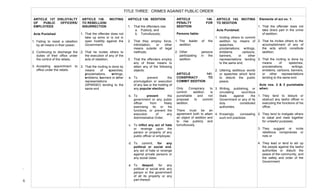
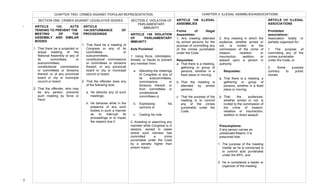
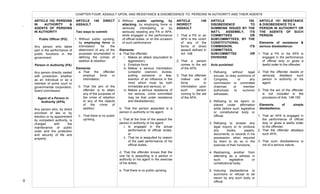
.
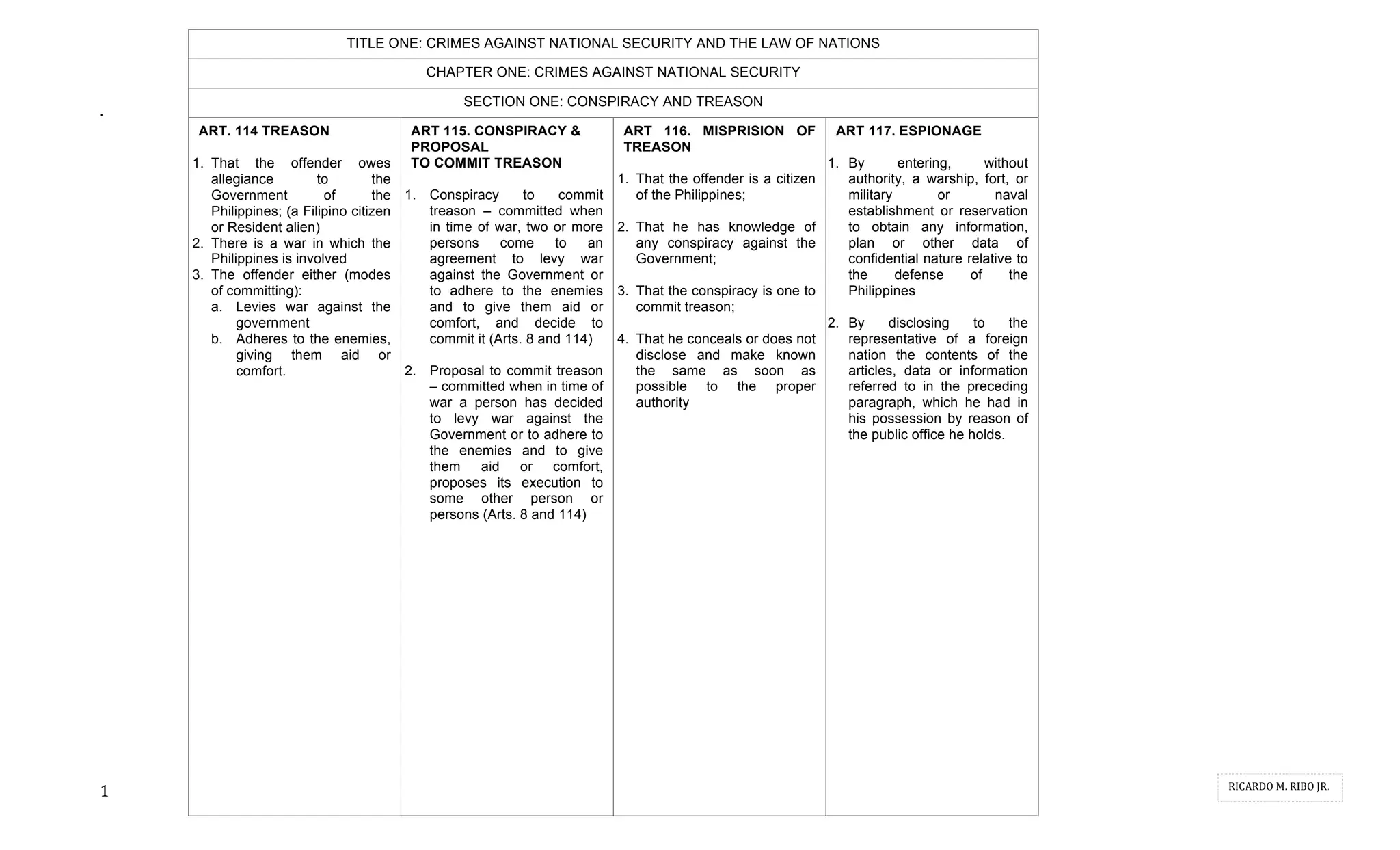
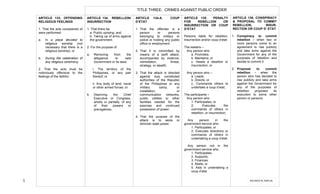
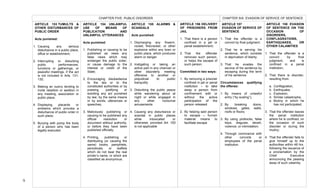
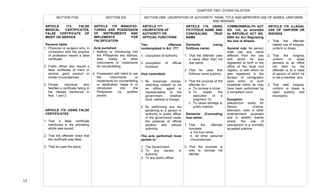
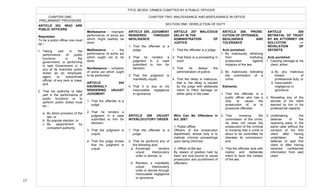
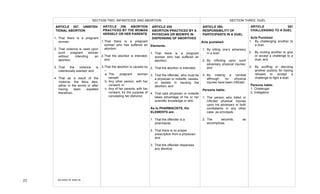
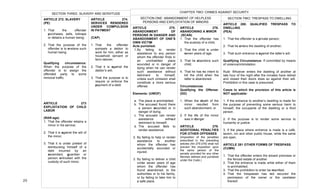
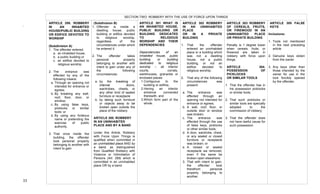
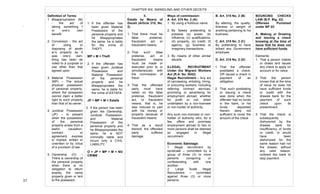
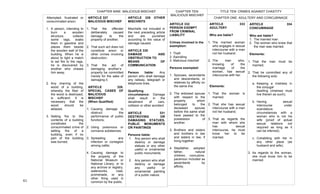
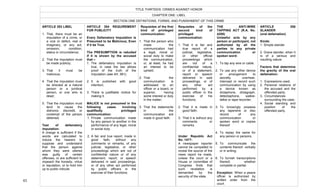
ART. 114 TREASON
1. That the offender owes
allegiance to the
Government of the
Philippines; (a Filipino citizen
or Resident alien)
2. There is a war in which the
Philippines is involved
3. The offender either (modes
of committing):
a. Levies war against the
government
b. Adheres to the enemies,
giving them aid or
comfort.
ART 115. CONSPIRACY &
PROPOSAL
TO COMMIT TREASON
1. Conspiracy to commit
treason – committed when
in time of war, two or more
persons come to an
agreement to levy war
against the Government or
to adhere to the enemies
and to give them aid or
comfort, and decide to
commit it (Arts. 8 and 114)
2. Proposal to commit treason
– committed when in time of
war a person has decided
to levy war against the
Government or to adhere to
the enemies and to give
them aid or comfort,
proposes its execution to
some other person or
persons (Arts. 8 and 114)
ART 116. MISPRISION OF
TREASON
1. That the offender is a citizen
of the Philippines;
2. That he has knowledge of
any conspiracy against the
Government;
3. That the conspiracy is one to
commit treason;
4. That he conceals or does not
disclose and make known
the same as soon as
possible to the proper
authority
ART 117. ESPIONAGE
1. By entering, without
authority, a warship, fort, or
military or naval
establishment or reservation
to obtain any information,
plan or other data of
confidential nature relative to
the defense of the
Philippines
2. By disclosing to the
representative of a foreign
nation the contents of the
articles, data or information
referred to in the preceding
paragraph, which he had in
his possession by reason of
the public office he holds.
SECTION ONE: CONSPIRACY AND TREASON
RICARDO
M.
RIBO
JR.
CHAPTER ONE: CRIMES AGAINST NATIONAL SECURITY
TITLE ONE: CRIMES AGAINST NATIONAL SECURITY AND THE LAW OF NATIONS
2.
2
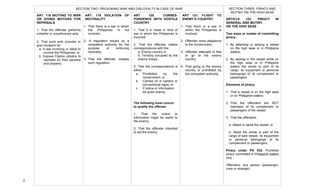
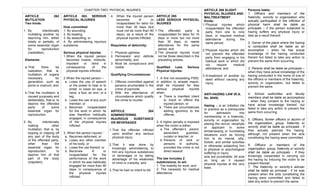
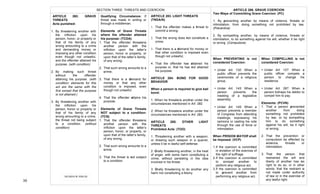
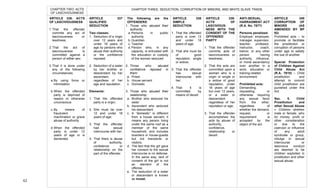
ART. 118 INCITING TO WAR
OR GIVING MOTIVES FOR
REPRISALS
1. That the offender performs
unlawful or unauthorized acts;
2. That such acts provoke or
give occasion for:
a. A war involving or liable to
involve the Philippines; or
b. Expose Filipino citizens to
reprisals on their persons
and property.
ART. 119 VIOLATION OF
NEUTRALITY
1. That there is a war in which
the Philippines is not
involved;
2. A regulation issued by a
competent authority for the
purpose of enforcing
neutrality;
3. That the offender violates
such regulation.
ART 120. CORRES-
PONDENCE WITH HOSTILE
COUNTRY
1. That it is made in time of
war in which the Philippines is
involved;
2. That the offender makes
correspondence with the:
a. Enemy country or
b. Territory occupied by the
enemy troops;
3. That the correspondence is
either:
a. Prohibited by the
Government; or
b. Carried on in ciphers or
conventional signs; or
c. If notice or information
be given enemy.
The following must concur
to qualify the offense:
1. That the notice or
information might be useful to
the enemy;
2. That the offender intended
to aid the enemy.
ART 121. FLIGHT TO
ENEMY’S COUNTRY
1. That there is a war in
which the Philippines is
involved;
2. Offender owes allegiance
to the Government;
3. Offender attempts to flee
or go to the enemy
country;
4. That going to the enemy
country is prohibited by
the competent authority.
SECTION TWO: PROVOKING WAR AND DISLOYALTY IN CASE OF WAR SECTION THREE: PIRACY AND
MUTINY ON THE HIGH SEAS
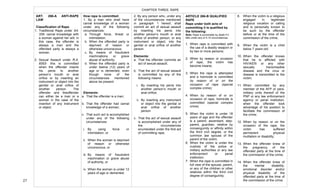
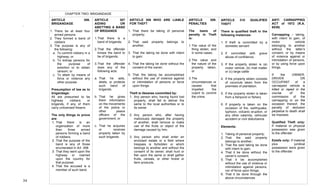
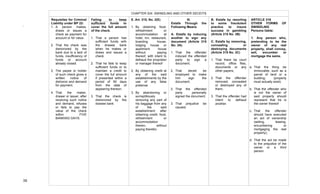
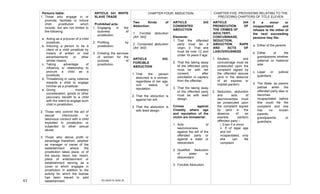
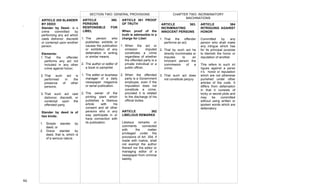
ARTICLE 122. PIRACY IN
GENERAL AND MUTINY
ON THE HIGH SEAS
Two ways or modes of committing
piracy:
1. By attacking or seizing a vessel
on the high seas or in Philippine
waters;
2. By seizing in the vessel while on
the high seas or in Philippine
waters the whole or part of its
cargo, its equipment or personal
belongings of its complement or
passengers.
Elements of piracy:
1. That a vessel is on the high seas
or on Philippine waters;
2. That the offenders are NOT
members of its complement or
passengers of the vessel;
3. That the offenders:
a. Attack or seize the vessel; or
b. Seize the whole or part of the
cargo of said vessel, its equipment
or personal belongings of its
complement or passengers.
Piracy under PD 532: Punishes
piracy committed in Philippine waters
only.
Offenders: any person (passenger,
crew or stranger)
3.
3
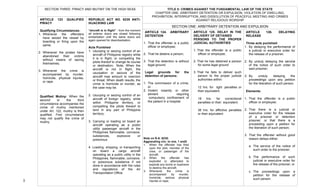
ARTICLE 123QUALIFIED
PIRACY
Qualifying Circumstances:
1. Whenever the offenders
have seized the vessel by
boarding or firing upon the
same;
2. Whenever the pirates have
abandoned their victims
without means of saving
themselves;
3. Whenever the crime is
accompanied by murder,
homicide, physical injuries,
or rape.
.
Qualified Mutiny: When the
second or the third
circumstance accompanies the
crime of mutiny mentioned
under Art. 122, mutiny is then
qualified. First circumstance
may not qualify the crime of
mutiny.
REPUBLIC ACT NO. 6235 ANTI-
HIJACKING LAW
“aircraft is in flight” - from the moment
all exterior doors are closed following
embarkation until the same doors are
again opened for disembarkation.
Acts Punished
1. Usurping or seizing control of an
aircraft of Philippine registry while
it is in flight; or compelling the
pilots thereof to change its course
or destination; Note: When the
aircraft is not in flight, the
usurpation or seizure of the
aircraft may amount to coercion
or threat. When death results, the
crime is homicide or murder, as
the case may be.
2. Usurping or seizing control of an
aircraft of foreign registry, while
within Philippine territory, or
compelling the pilots thereof to
land in any part of Philippine
territory;
3. Carrying or loading on board an
aircraft operating as a public
utility passenger aircraft in the
Philippines flammable, corrosive,
substances, explosive or
poisonous
4. Loading, shipping, or transporting
on board a cargo aircraft
operating as a public utility in the
Philippines, flammable, corrosive,
or poisonous substance if not
done in accordance with the rules
and regulations of the Air
Transportation Office.
TITLE II: CRIMES AGAINST THE FUNDAMENTAL LAW OF THE STATE
CHAPTER ONE: ARBITRARY DETENTION OR EXPULSION, VIOLATION OF DWELLING,
PROHIBITION, INTERRUPTION, AND DISSOLUTION OF PEACEFUL MEETING AND CRIMES
AGAINST RELIGIOUS WORSHIP
SECTION ONE: ARBITRARY DETENTION AND EXPULSION
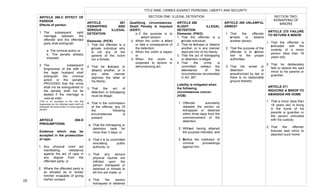
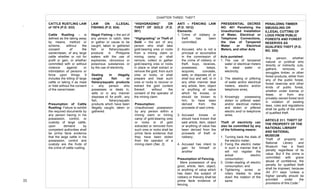
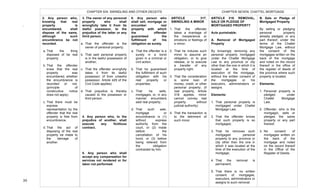
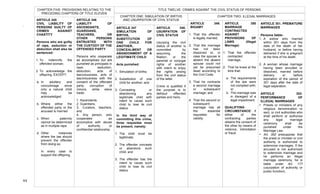
ARTICLE 124. ARBITRARY
DETENTION
1. That the offender is a public
officer or employee;
2. That he detains a person;
3. That the detention is without
legal ground.
Legal grounds for the
detention of persons:
1. The commission of a crime;
or
2. Violent insanity or other
ailment requiring
compulsory confinement of
the patient in a hospital
Note on R.A. 6235:
Aggravating circ. to nos. 1 and2
1. When the offender has fired
upon the pilot, member of the
crew, or passenger of the
aircraft;
2. When the offender has
exploded or attempted to
explode any bomb or explosive
to destroy the aircraft;
3. Whenever the crime is
accompanied by murder,
homicide, serious physical
injuries or rape;
ARTICLE 125. DELAY IN THE
DELIVERY OF DETAINED
PERSONS TO THE PROPER
JUDICIAL AUTHORITIES
1. That the offender is a public
officer or employee;
2. That he has detained a person
for some legal ground
3. That he fails to deliver such
person to the proper judicial
authorities within:
12 hrs. for light penalties or
their equivalent.
18 hrs. for correctional
penalties or their equivalent.
36 hrs. for afflictive penalties
or their equivalent
ARTICLE 126. DELAYING
RELEASE
Three acts punished:
1. By delaying the performance of
a judicial or executive order for
the release of a prisoner;
2. By unduly delaying the service
of the notice of such order to
said prisoner;
3. By unduly delaying the
proceedings upon any petition
for the liberation of such person.
Elements:
1. That the offender is a public
officer or employee;
2. That there is a judicial or
executive order for the release
of a prisoner or detention
prisoner, or that there is a
proceeding upon a petition for
the liberation of such person;
3. That the offender without good
reason delays either:
a. The service of the notice of
such order to the prisoner;
b. The performance of such
judicial or executive order for
the release of the prisoner; or
c. The proceedings upon a
petition for the release of
such person.
SECTION THREE: PIRACY AND MUTINY ON THE HIGH SEAS
4.
4
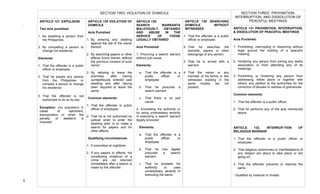
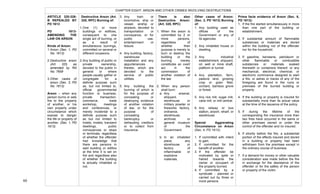
ARTICLE 127.EXPULSION
Two acts punished:
1. By expelling a person from
the Philippines;
2. By compelling a person to
change his residence.
Elements:
1. That the offender is a public
officer or employee;
2. That he expels any person
from the Philippines, or
compels a person to change
his residence;
3. That the offender is not
authorized to do so by law.
Exception: (no expulsion) in
cases of ejectment,
expropriation or when the
penalty of destierro is
imposed.
ARTICLE 128 VIOLATION OF
DOMICILE
Acts Punished
1. By entering any dwelling
against the will of the owner
thereof;
2. By searching papers or other
effects found therein without
the previous consent of such
owner;
3. By refusing to leave the
premises, after having
surreptitiously entered said
dwelling and after having
been required to leave the
same.
Common elements:
1. That the offender is public
officer or employee;
2. That he is not authorized by
judicial order to enter the
dwelling and/ or to make a
search for papers and for
other effects.
Qualifying circumstances:
1. If committed at nighttime;
2. If any papers or effects, not
constituting evidence of a
crime are not returned
immediately after a search is
made by the offender.
ARTICLE 129.
SEARCH WARRANTS
MALICIOUSLY OBTAINED
AND ABUSE IN THE
SERVICE OF THOSE
LEGALLY OBTAINED
Acts Punished:
1. Procuring a search warrant
without just cause
Elements:
a. That the offender is a
public officer or
employee;
b. That he procures a
search warrant;
c. That there is no just
cause.
2. Exceeding his authority or
by using unnecessary severity
in executing a search warrant
legally procured
Elements:
a. That the offender is a
public officer or
employee;
b. That he has legally
procured a search
warrant;
c. That he exceeds his
authority or uses
unnecessary severity in
executing the same.
ARTICLE 130 SEARCHING
DOMICILE WITHOUT
WITNESSES
1. That the offender is a public
officer or employee;
2. That he searches the
domicile, papers or other
belongings of any person;
3. That he is armed with a
warrant;
4. That the owner or any
member of his family or two
witnesses residing in the
same locality are not
present.
ARTICLE 131 PROHIBITION, INTERRUPTION,
& DISSOLUTION OF PEACEFUL MEETINGS
Acts Punished:
1. Prohibiting, interrupting or dissolving without
legal ground the holding of a peaceful
meeting;
2. Hindering any person from joining any lawful
association or from attending any of its
meetings;
3. Prohibiting or hindering any person from
addressing, either alone or together with
others, any petition to the authorities for the
correction of abuses or redress of grievances.
Common elements:
1. That the offender is a public officer;
2. That he performs any of the acts mentioned
above
ARTICLE 132. INTERRUP-TION OF
RELIGIOUS WORSHIP
1. That the offender is a public officer or
employee;
2. That religious ceremonies or manifestations of
any religion are about to take place or are
going on;
3. That the offender prevents or disturbs the
same
- Qualified by violence or threats
.
SECTION TWO: VIOLATION OF DOMICILE SECTION THREE: PROHIBITION,
INTERRUPTION, AND DISSOLUTION OF
PEACEFUL MEETINGS
5.
5
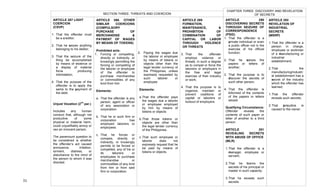
ARTICLE 133.OFFENDING
RELIGIOUS FEELINGS
1. That the acts complained of
were performed:
a. In a place devoted to
religious worship (not
necessary that there is a
religious worship); or
b. During the celebration of
any religious ceremony;
2. That the acts must be
notoriously offensive to the
feelings of the faithful.
ARTICLE 134. REBELLION/
INSURRECTION
1. That there be:
a. Public uprising; and
b. Taking up of arms against
the government.
2. For the purpose of:
a. Removing from the
allegiance to said
Government or its laws:
i. The territory of the
Philippines, or any part
thereof; or
ii. Any body of land, naval
or other armed forces; or
b. Depriving the Chief
Executive or Congress,
wholly or partially, of any
of their powers or
prerogatives.
ARTICLE 134-A. COUP
D’ETAT
1. That the offender is a
person or persons
belonging to military or
police or holding any public
office or employment;
2. That it is committed by
means of a swift attack,
accompanied by violence,
intimidation, threat,
strategy, or stealth;
3. That the attack is directed
against duly constituted
authorities of the Republic
of the Philippines or any
military camp, or
installation, or
communication networks,
public utilities or other
facilities needed for the
exercise and continued
possession of power;
4. That the purpose of the
attack is to seize or
diminish state power.
ARTICLE 135. PENALTY
FOR REBELLION OR
INSURRECTION OR COUP
D’ETAT
Persons liable for rebellion,
insurrection and/or coup d’etat:
The leaders –
Any person who
a. Promotes;
b. Maintains; or
c. Heads a rebellion or
insurrection; or
Any person who –
a. Leads;
b. Directs; or
c. Commands others to
undertake a coup d’etat;
The participants –
Any person who
1. Participates; or
2. Executes the
commands of others in
rebellion, or insurrection;
Any person in the
government service who
1. Participates; or
2. Executes directions or
commands of others in
undertaking a coup d’etat;
Any person not in the
government service who
1. Participates;
2. Supports;
3. Finances;
4. Abets; or
5. Aids in undertaking a
coup d’etat.
ARTICLE 136. CONSPIRACY
& PROPOSAL TO COMMIT
REBELLION, INSUR-
RECTION OR COUP D’ ETAT
1. Conspiracy to commit
rebellion – when two or
more persons come to an
agreement to rise publicly
and take arms against the
Government for any of the
purposes of rebellion and
decide to commit it
2. Proposal to commit
rebellion – when the
person who has decided to
rise publicly and take arms
against the Government for
any of the purposes of
rebellion proposes its
execution to some other
person or persons
TITLE THREE: CRIMES AGAINST PUBLIC ORDER
RICARDO
M.
RIBO
JR.
6.
6
.
TITLETHREE: CRIMES AGAINST PUBLIC ORDER
ARTICLE 137 DISLOYALTY
OF PUBLIC OFFICERS/
EMPLOYEES
Acts Punished
1. Failing to resist a rebellion
by all means in their power;
2. Continuing to discharge the
duties of their office under
the control of the rebels;
3. Accepting appointment to
office under the rebels.
ARTICLE 138. INCITING
TO REBELLION/
INSURRECTION
1. That the offender does not
take up arms or is not in
open hostility against the
Government;
2. That he incites others to
the execution of any of the
acts of rebellion;
3. That the inciting is done by
means of speeches,
proclamations, writings,
emblems, banners or other
representations
(SPWEBO) tending to the
same end
ARTICLE 139. SEDITION
1. That the offenders rise:
a. Publicly; and
b. Tumultuously;
2. That they employ force,
intimidation, or other
means outside of legal
methods;
3. That the offenders employ
any of those means to
attain any of the following
objects:
a. To prevent the
promulgation or execution
of any law or the holding of
any popular election;
b. To prevent the
government or any public
officer from freely
exercising its or his
functions, or prevent the
execution of any
Administrative Order;
c. To inflict any act of hate
or revenge upon the
person or property of any
public officer or employee;
d. To commit, for any
political or social end,
any act of hate or revenge
against private persons or
any social class;
e. To despoil, for any
political or social end, any
person or the government
of all its property or any
part thereof.
ARTICLE 140.
PENALTY FOR
SEDITION
Persons liable:
1. The leader of the
sedition;
2. Other persons
participating in the
sedition.
ARTICLE 141.
CONSPIRACY TO
COMMIT SEDITION
Only Conspiracy to
commit sedition is
punishable and not
proposal to commit
sedition.
There must be an
agreement both to attain
an object of sedition and
to rise publicly and
tumultuously.
ARTICLE 142. INCITING
TO SEDITION
Acts Punished:
1. Inciting others to commit
sedition by means of
speeches,
proclamations, writings,
emblems cartoons,
banners, or other
representations tending
to the same end;
2. Uttering seditious words
or speeches which tend
to disturb the public
peace;
3. Writing, publishing, or
circulating scurrilous
libels against the
Government or any of its
duly constituted
authorities.
4. Knowingly concealing
such evil practices.
Elements of act no. 1:
1. That the offender does not
take direct part in the crime
of sedition;
2. That he incites others to the
accomplishment of any of
the acts which constitute
sedition;
3. That the inciting is done by
means of speeches,
proclamations, writings,
emblems, cartoons, banners,
or other representations
tending to the same end.
Acts nos. 2 & 3 punishable
when:
1. They tend to disturb or
obstruct any lawful officer in
executing the functions of his
office;
2. They tend to instigate others
to cabal and meet together
for unlawful purposes;
3. They suggest or incite
rebellious conspiracies or
riots or
4. They lead or tend to stir up
the people against the lawful
authorities or disturb the
peace of the community, and
the safety and order of the
Government
7.
7
,
ARTICLE143. ACTS
TENDING TO PREVENT THE
MEETING OF THE
ASSEMBLY AND SIMILAR
BODIES
1. That there be a projected or
actual meeting of the
National Assembly or any of
its committees or
subcommittees,
constitutional commissions
or committees or divisions
thereof, or of any provincial
board or city or municipal
council or board;
2. That the offender, who may
be any person, prevents
such meeting by force or
fraud.
CHAPTER TWO: CRIMES AGAINST POPULAR REPRESENTATION
SECTION ONE: CRIMES AGAINST LEGISLATIVE BODIES
AND SIMILAR BODIES
ARTICLE
144.DISTURBANCE OF
PROCEEDINGS
1. That there be a meeting of
Congress or any of its
committees or
subcommittees,
constitutional commissions
or committees or divisions
thereof, or any provincial
board or city or municipal
council or board;
2. That the offender does any
of the following acts:
a. He disturbs any of such
meetings;
b. He behaves while in the
presence of any such
bodies in such a manner
as to interrupt its
proceedings or to impair
the respect due it.
SECTION 2: VIOLATION OF
PARLIAMENTARY
IMMUNITY
ARTICLE 145 VIOLATION
OF PARLIAMENTARY
IMMUNITY
Acts Punished
1. Using force, intimidation,
threats, or frauds to prevent
any member from:
a. Attending the meetings
of Congress or any of
its subcommittees,
commissions or
divisions thereof, or
from committees or
constitutional
committees or
b. Expressing his
opinions or
c. Casting his vote
2. Arresting or searching any
member while Congress is in
session, except in cases
where such member has
committed a crime
punishable under the Code
by a penalty higher than
prision mayor.
CHAPTER 3: ILLEGAL ASSMBLIES/ASSOCIATIONS
2. Any meeting in which the
audience, whether armed or
not, is incited to the
commission of the crime of
treason, rebellion or
insurrection, sedition, or
assault upon a person in
authority
Requisites:
a. That there is a meeting, a
gathering or group of
persons, whether in a fixed
place or moving;
b. That the audiences,
whether armed or not, is
incited to the commission of
the crime of treason,
rebellion or insurrection,
sedition or direct assault.
Presumptions:
If any person carries an
unlicensed firearm, it is
presumed that:
1. The purpose of the meeting
insofar as he is concerned is
to commit acts punishable
under the RPC, and
2. He is considered a leader or
organizer of the meeting
ARTICLE 147 ILLEGAL
ASSOCIATIONS
Prohibited
associations:
Association totally or
partially organized for:
1. The purpose of
committing any of the
crimes punishable
under the Code, or
2. Some purpose
contrary to public
morals.
RICARDO
M.
RIBO
JR.
ARTICLE 146 ILLEGAL
ASSEMBLIES
Forms of Illegal
Assemblies:
1. Any meeting attended
by armed persons for the
purpose of committing any
of the crimes punishable
under the Code
Requisites:
a. That there is a meeting,
gathering or group of
persons, whether in a
fixed place or moving;
b. That the meeting is
attended by armed
persons;
c. That the purpose of the
meeting is to commit
any of the crimes
punishable under the
Code.
8.
8
ARTICLE 152.PERSONS
IN AUTHORITY &
AGENTS OF PERSONS
IN AUTHORITY
Public Officer (PO)
Any person who takes
part in the performance of
public functions in the
government.
Person in Authority (PA)
Any person directly vested
with jurisdiction, whether
as an individual or as a
member of some court or
governmental corporation,
board commission.
Agent of a Person in
Authority (APA)
Any person who, by direct
provision of law or by
election or by appointment
by competent authority, is
charged with the
maintenance of public
order and the protection
and security of life and
property.
CHAPTER FOUR: ASSAULT UPON, AND RESISTANCE & DISOBEDIENCE TO, PERSONS IN AUTHORITY AND THEIR AGENTS
ARTICLE 148 DIRECT
ASSAULT
Two ways to commit:
1. Without public uprising,
by employing force or
intimidation for the
attainment of any of the
purposes enumerated in
defining the crimes of
sedition & rebellion
Elements:
a. That the offender
employs force or
intimidation;
b. That the aim of the
offender is to attain
any of the purposes of
the crime of rebellion
or any of the objects
of the crime of
sedition;
c. That there is no public
uprising.
2. Without public uprising, by
attacking, by employing force or
seriously intimidating or by
seriously resisting any PA or APA,
while engaged in the performance
of official duties, or on the occasion
of such performance
Elements:
a. That the offender:
i. Makes an attack (equivalent to
aggression),
ii. Employs force
iii. Makes a serious intimidation
(unlawful coercion, duress,
putting someone in fear,
exertion of an influence in the
mind which must be both
immediate and serious), or
iv. Makes a serious resistance (if
not serious, crime committed
may be that under resistance
and disobedience);
b. That the person assaulted is a
person in authority or his agent;
c. That at the time of the assault the
person in authority or his agent:
i. Is engaged in the actual
performance of official duties,
or
ii. That he is assaulted by reason
of the past performance of his
official duties;
d. That the offender knows that the
one he is assaulting is a person in
authority or his agent in the exercise
of his duties;
e. That there is no public uprising
ARTICLE 149
INDIRECT
ASSAULT
1. That a PA or an
APA is the victim
of any of the
forms of direct
assault defined in
Art. 148;
2. That a person
comes to the aid
of the APA;
3. That the offender
makes use of
force or
intimidation upon
such person
coming to the aid
of the APA.
ARTICLE 150.
DISOBEDIENCE TO
SUMMONS ISSUED BY THE
NAT’L ASSEMBLY, ITS
COMMITTEES OR
SUBCOMMITTEES, BY THE
CONSTITUTIONAL
COMMISSION, ITS
COMMITTEES,
SUBCOMMITTEE OR
DIVISIONS
Acts punished:
1. Refusing, without legal
excuse, to obey summons of
Congress, or any
commission or committee
chairman or member
authorized to summon
witnesses;
2. Refusing to be sworn or
placed under affirmation
while before such legislative
or constitutional body or
official;
3. Refusing to answer any
legal inquiry or to produce
any books, papers,
documents, or records in his
possession, when required
by them to do so in the
exercise of their functions;
4. Restraining another from
attending as a witness in
such legislative or
constitutional body;
5. Inducing disobedience to
summons or refusal to be
sworn by any such body or
official
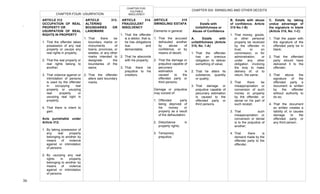
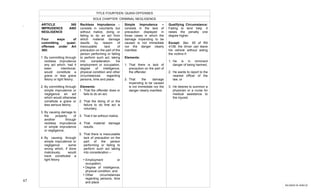
ARTICLE 151 RESISTANCE
& DISOBEDIENCE TO A
PERSON IN AUTHORITY OR
THE AGENTS OF SUCH
PERSON
Elements of resistance &
serious disobedience:
1. That a PA or his APA is
engaged in the performance
of official duty or gives a
lawful order to the offender;
2. That the offender resists or
seriously disobeys such
person in authority or his
agent;
3. That the act of the offender
is not included in the
provisions of Arts. 148-150.
Elements of simple
disobedience:
1. That an APA is engaged in
the performance of official
duty or gives a lawful order
to the offender;
2. That the offender disobeys
such APA;
3. That such disobedience is
not of a serious nature.
.
9.
9
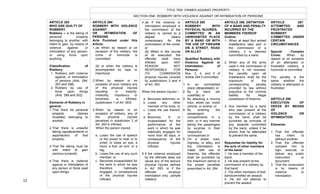
ARTICLE 153TUMULTS &
OTHER DISTURBANCES OF
PUBLIC ORDER
Acts punished:
1. Causing any serious
disturbance in a public place,
office or establishment;
2. Interrupting or disturbing
public performances,
functions or gatherings, or
peaceful meetings, if the act
is not included in Arts. 131-
132;
3. Making an outcry tending to
incite rebellion or sedition in
any meeting, association or
public place;
4. Displaying placards or
emblems which provoke a
disturbance of public order in
such place;
5. Burying with pomp the body
of a person who has been
legally executed.
CHAPTER FIVE: PUBLIC DISORDER
ARTICLE 154 UNLAWFUL
USE OF MEANS OF
PUBLICATION AND
UNLAWFUL UTTERANCES
Acts punished:
1. Publishing or causing to be
published as news any
false news which may
endanger the public order,
or cause damage to the
interest or credit of the
State;
2. Encouraging disobedience
to the law or to the
constituted authorities or by
praising, justifying or
extolling any act punished
by law, by the same means
or by words, utterances or
speeches;
3. Maliciously publishing or
causing to be published any
official resolution or
document without authority,
or before they have been
published officially;
4. Printing, publishing or
distributing (or causing the
same) books, pamphlets,
periodicals, or leaflets
which do not bear the real
printer’s name, or which are
classified as anonymous.
ARTICLE 155 ALARMS &
SCANDALS
Acts punished:
1. Discharging any firearm,
rocket, firecracker, or other
explosive within any town or
public place, which produces
alarm or danger
2. Instigating or taking an
active part in any charivari or
other disorderly meeting
offensive to another or
prejudicial to public
tranquility
3. Disturbing the public peace
while wandering about at
night or while engaged in
any other nocturnal
amusements
4. Causing any disturbance or
scandal in public places
while intoxicated or
otherwise, provided Art. 153
is not applicable
ARTICLE 156 DELIVERY
OF PRISONERS FROM
JAIL
1. That there is a person
confined in a jail or
penal establishment;
2. That the offender
removes such person,
or helps the escape of
such person.
Committed in two ways:
1. By removing a prisoner
confined in jail or penal
institution – to take
away a person from
confinement with or
without the active
participation of the
person released
2. By helping said person
to escape – furnish
material means to
facilitate escape
CHAPTER SIX: EVASION OF SERVICE OF SENTENCE
ARTICLE 157
EVASION OF SERVICE OF
SENTENCE
1. That the offender is a
convict by final judgment;
2. That he is serving his
sentence, which consists
in deprivation of liberty;
3. That he evades the
service of his sentence by
escaping during the term
of his sentence.
Circumstances qualifying
the offense:
1. By means of unlawful
entry (“by scaling”);
2. By breaking doors,
windows, gates, walls,
roofs or floors;
3. By using picklocks, false
keys, disguise, deceit,
violence, or intimidation;
4. Through connivance with
other convicts or
employees of the penal
institution.
ARTICLE 158 EVASION
OF SENTENCE ON THE
OCCASION OF
DISORDERS,
CONFLAGRATIONS,
EARTHQUAKES, OR
OTHER CALAMITIES
1. That the offender is a
convict by final
judgment, and is
confined in a penal
institution;
2. That there is disorder,
resulting from:
a. Conflagration,
b. Earthquake,
c. Explosion,
d. Similar catastrophe,
e. Mutiny in which he
has not participated;
3. That the offender leaves
the penal institution
where he is confined, on
the occasion of such
disorder or during the
mutiny;
4. That the offender fails to
give himself up to the
authorities within 48 hrs.
following the issuance of
a proclamation by the
Chief Executive
announcing the passing
away of such calamity.
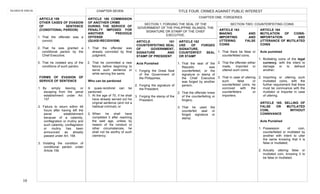
.C
10.
10
ARTICLE 159
OTHERCASES OF EVASION
OF SENTENCE
(CONDITIONAL PARDON)
1. That the offender was a
convict;
2. That he was granted a
conditional pardon by the
Chief Executive;
3. That he violated any of the
conditions of such pardon.
FORMS OF EVASION OF
SERVICE OF SENTENCE
1. By simply leaving or
escaping from the penal
establishment under Art.
157
2. Failure to return within 48
hours after having left the
penal establishment
because of a calamity,
conflagration or mutiny and
such calamity, conflagration
or mutiny has been
announced as already
passed under Art. 158.
3. Violating the condition of
conditional pardon under
Article 159.
CHAPTER SEVEN
ARTICLE 160 COMMISSION
OF ANOTHER CRIME
DURING THE SERVICE OF
PENALTY IMPOSED FOR
ANOTHER PREVIOUS
OFFENSE
(QUASI-RECIDIVISM)
1. That the offender was
already convicted by final
judgment;
2. That he committed a new
felony before beginning to
serve such sentence or
while serving the same.
Who can be pardoned
A quasi-recidivist can be
pardoned:
1. At the age of 70, if he shall
have already served out his
original sentence (and not a
habitual criminal); or
2. When he shall have
completed it after reaching
the said age, unless by
reason of his conduct or
other circumstances, he
shall not be worthy of such
clemency.
ARTICLE 161
COUNTERFEITING SEAL
OF GOVERNMENT,
SIGNATURE AND
STAMP OF PRESIDENT
Acts Punished
1. Forging the Great Seal
of the Government of
the Philippines;
2. Forging the signature of
the President;
3. Forging the stamp of the
President.
ARTICLE 162
USE OF FORGED
SIGNATURE,
COUNTERFEIT SEAL
OR STAMP
1. That the seal of the
Republic was
counterfeited, or the
signature or stamp of
the Chief Executive
was forged by another
person;
2. That the offender knew
of the counterfeiting or
forgery;
3. That he used the
counterfeit seal or
forged signature or
stamp.
ARTICLE 163
MAKING AND
IMPORTING AND
UTTERING FALSE
COINS
1. That there be false or
counterfeited coins;
2. That the offender either
made, imported or
uttered such coins;
3. That in case of uttering
such false or
counterfeited coins, he
connived with the
counterfeiters or
importers.
TITLE FOUR: CRIMES AGAINST PUBLIC INTEREST
CHAPTER ONE: FORGERIES
SECTION 1: FORGING THE SEAL OF THE
GOVERNMENT OF THE PHILIPPINE ISLANDS, THE
SIGNATURE OR STAMP OF THE CHIEF
EXECUTIVE.
SECTION TWO: COUNTERFEITING COINS
ARTICLE 164
MUTILATION OF COINS-
IMPORTATION AND
UTTERANCE OF MUTILATED
COINS
Acts punished
1. Mutilating coins of the legal
currency, with the intent to
damage or to defraud
another;
2. Importing or uttering such
mutilated coins, with the
further requirement that there
must be connivance with the
mutilator or importer in case
of uttering.
ARTICLE 165. SELLING OF
FALSE OR MUTILATED
COIN, WITHOUT
CONNIVANCE
Acts Punished
1. Possession of coin,
counterfeited or mutilated by
another with intent to utter
the same knowing that it is
false or mutilated;
2. Actually uttering false or
mutilated coin, knowing it to
be false or mutilated.
RICARDO
M.
RIBO
JR.
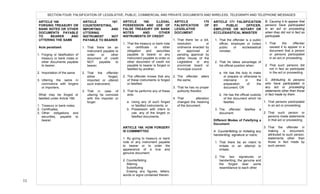
11.
11
ARTICLE 166
FORGINGTREASURY OR
BANK NOTES OR OTHER
DOCUMENTS PAYABLE
TO BEARER AND
UTTERING THE SAME
Acts penalized:
1. Forging or falsification of
treasury or bank notes or
other documents payable
to bearer;
2. Importation of the same
3. Uttering the same in
connivance with forgers
or importers;
What may be forged or
falsified under Article 166:
1. Treasury or bank notes;
2. Certificates;
3. Other obligations and
securities, payable to
bearer.
ARTICLE 167.
COUNTERFEITING,
IMPORTING AND
UTTERING
INSTRUMENT NOT
PAYABLE TO BEARER
1. That there be an
instrument payable to
order or other
document of credit
NOT payable to
bearer;
2. That the offender
either forged,
imported or uttered
such instrument;
3. That in case of
uttering he connived
with the importer or
forger.
ARTICLE 168. ILLEGAL
POSSESSION AND USE OF
FALSE TREASURY OR BANK
NOTES AND OTHER
INSTRUMENTS OF CREDIT
1. That the treasury or bank note
or certificate or other
obligation and securities
payable to bearer or any
instrument payable to order or
other document of credit not
payable to bearer is forged or
falsified by another;
2. The offender knows that any
of these instruments is forged
or falsified;
3. That he performs any of these
acts:
a. Using any of such forged
or falsified instruments; or
b. Possession with intent to
use, any of the forged or
falsified documents.
ARTICLE 169. HOW FORGERY
IS COMMMITTED
1. By giving to treasury or bank
note or any instrument payable
to bearer or to order the
appearance of a true and
genuine document;
2. Counterfeiting
Altering
Substituting
Erasing any figures, letters,
words or signs contained therein.
ARTICLE 170
FALSIFICATION OF
LEGISLATIVE
DOCUMENT
1. That there be a bill,
resolution or
ordinance enacted by
or approved or
pending approval by
either House of the
Legislative or any
provincial board or
municipal council;
2. The offender alters
the same;
3. That he has no proper
authority therefor;
4. That alteration
changed the meaning
of the document.
ARTICLE 171 FALSIFICATION
BY PUBLIC OFFICER,
EMPLOYEE OR NOTARY OR
ECCLESIASTICAL MINISTER
1. That the offender is a public
officer, employee or notary
public or ecclesiastical
minister;
2. That he takes advantage of
his official position when:
a. He has the duty to make
or prepare or otherwise to
intervene in the
preparation of the
document; OR
b. He has the official custody
of the document which he
falsifies
3. The offender falsifies a
document.
Different Modes of Falsifying a
Document:
A. Counterfeiting or imitating any
handwriting, signature or rubric.
1. That there be an intent to
imitate or an attempt to
imitate;
2. The two signatures or
handwriting, the genuine and
the forged bear some
resemblance to each other
B. Causing it to appear that
persons have participated
in an act or proceeding
when they did not in fact so
participate.
1. That the offender
caused it to appear in a
document that a person
or persons participated
in an act or proceeding;
2. That such persons did
not in fact so participate
in the act or proceeding.
C. Attributing to persons
who have participated in
any act or proceeding
statements other than those
in fact made by them.
1. That persons participated
in an act or proceeding;
2. That such person or
persons made statements
in that act or proceeding;
3. That the offender in
making a document,
attributed to such person,
statements other than
those in fact made by
such person.
SECTION FOUR: FALSIFICATION OF LEGISLATIVE, PUBLIC, COMMERCIAL AND PRIVATE DOCUMENTS AND WIRELESS, TELEGRAPH AND TELEPHONE MESSAGES
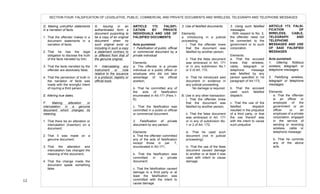
12.
12
D. Makinguntruthful statements
in a narration of facts.
1. That the offender makes in a
document statements in a
narration of facts;
2. That he has the legal
obligation to disclose the truth
of the facts narrated by him;
3. That the facts narrated by the
offender are absolutely false;
4. That the perversion of truth in
the narration of facts was
made with the wrongful intent
of injuring a third person.
E. Altering true dates.
F. Making alteration or
intercalation in a genuine
document which changes its
meaning.
1. That there be an alteration or
intercalation (insertion) on a
document;
2. That it was made on a
genuine document;
3. That the alteration and
intercalation has changed the
meaning of the document;
4. That the change made the
document speak something
false
G. Issuing in an
authenticated form a
document purporting to
be a copy of an original
document when no
such original exist or
including in such a copy
a statement contrary to
or different from that of
the genuine original.
H. Intercalating any
instrument or note
relative to the issuance
in a protocol, registry or
official book.
ARTICLE 172. FALSIFI-
CATION BY PRIVATE
INDIVIDUALS AND USE OF
FALSIFIED DOCUMENTS
Acts punished:
1. Falsification of public, official
or commercial document by a
private individual
Elements:
a. The offender is a private
individual or a public officer or
employee who did not take
advantage of his official
position;
b. That he committed any of
the acts of falsification
enumerated in Art.171 (Pars.1-
6);
c. That the falsification was
committed in a public or official
or commercial document.
2. Falsification of private
document by any person;
Elements:
a. That the offender committed
any of the acts of falsification
except those in par. 7,
enumerated in Art.171;
b. That the falsification was
committed in a private
document;
c. That the falsification caused
damage to a third party or at
least the falsification was
committed with the intent to
cause damage.
3. Use of falsified documents.
Elements:
a. Introducing in a judicial
proceeding:
i. That the offender knew
that the document was
falsified by another person;
ii. That the false document
was embraced in Art. 171
or in any subdivision No.1
or 2 of Art. 172;
iii. That he introduced said
document in evidence in
any judicial proceeding.
· No damage is required.
B. Use in any other transaction
i. That the offender knew
that the document was
falsified by another person;
ii. That the false document
was embraced in Art. 171
or in any of subdivision No.
1 or 2 of Art. 172;
iii. That he used such
document (not in judicial
proceeding);
iv. That the use of the false
document caused damage
to another or at least it was
used with intent to cause
damage.
ARTICLE 173. FALSI-
FICATION OF
WIRELESS, CABLE,
TELEGRAPH AND
TELEPHONE
MESSAGES AND USE
OF SAID FALSIFIED
MESSAGES
Acts punished:
1. Uttering fictitious
wireless, telegraph, or
telephone messages;
2. Falsifying wireless,
telegraph or telephone
messages.
Elements:
a. That the offender
is an officer or
employee of the
government or an
officer or an
employee of a private
corporation, engaged
in the service of
sending or receiving
wireless, cable or
telephone message;
b. That he commits
any of the above
acts.
3. Using such falsified
messages.
· With respect to No. 3,
the offender need not
be connected to the
government or to such
corporation.
Elements:
a. That the accused
knew that wireless,
cable, telegraph or
telephone message
was falsified by any
person specified in 1st
paragraph of Art.173;
b. That the accused
used such falsified
dispatch;
c. That the use of the
falsified dispatch
resulted in the prejudice
of a third party, or that
the use thereof was
with the intent to cause
such prejudice
SECTION FOUR: FALSIFICATION OF LEGISLATIVE, PUBLIC, COMMERCIAL AND PRIVATE DOCUMENTS AND WIRELESS, TELEGRAPH AND TELEPHONE MESSAGES
13.
13
SECTION FIVE
ARTICLE174. FALSE
MEDICAL CERTIFICATES,
FALSE CERTIFICATE OF
MERIT OR SERVICE
Persons liable:
1. Physician or surgeon who, in
connection with the practice
of profession issued a false
certificate;
2. Public officer who issued a
false certificate of merit or
service, good conduct or
similar circumstances;
3. Private individual who
falsified a certificate falling in
the classes mentioned in
Nos. 1 and 2.
ARTICLE 175. USING FALSE
CERTIFICATES
1. That a false certificate
mentioned in the preceding
article was issued;
2. That the offender knew that
the certificate was false;
3. That he used the same.
SECTION SIX
ARTICLE 176 MANUFAC-
TURING AND POSSESSION
OF INSTRUMENTS AND
IMPLEMENTS FOR
FALSIFICATION
Acts punished:
1. Making or introducing into
the Philippines any stamps,
dies, marks, or other
instruments or implements
for counterfeiting;
2. Possession with intent to use
the instruments or
implements for counterfeiting
or falsification made in or
introduced into the
Philippines by another
person.
CHAPTER TWO: OTHER FALSITIES
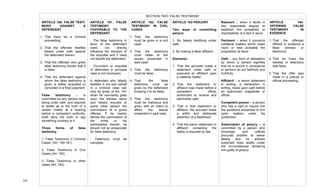
SECTION ONE: USURPATION OF AUTHORITY, RANK, TITLE AND IMPROPER USE OF NAMES, UNIFORMS
AND INSIGNIA
ARTICLE 177.
USURPATION OF
AUTHORITY OR
OFFICIAL FUNCTIONS
Two offenses
contemplated in Art. 177:
1. Usurpation of authority
2. Usurpation of official
functions
How committed:
1. By knowingly misrep-
resenting oneself to be
an officer, agent or
representative of the
government, whether
local, national or foreign;
2. By performing any act
pertaining to a person in
authority or public officer
of the government under
the pretense of official
position and without
authority.
The acts performed must
pertain to:
1. The Government
2. To any person in
authority
3. To any public officer
ARTICLE 178. USING
FICTITIOUS NAME AND
CONCEALING TRUE
NAME
Elements: (using
fictitious name)
1. That the offender uses
a name other than his
real name;
2. That he uses that
fictitious name publicly;
3. That the purpose of the
offender is—
a. To conceal a crime;
b. To evade the
execution of a
judgment; Or
c. To cause damage to
public interest.
Elements: (Concealing
true name)
1. That the offender
conceals:
a. his true name,
b. all other personal
circumstances;
2. That the purpose is
only to conceal his
identity.
COMMONWEALTH ACT
NO. 142, as amended
by REPUBLIC ACT NO.
6085 An Act Regulating
the Use of Aliases
General rule: No person
shall use any name
different from the one
with which he was
registered at birth in the
office of the local civil
registry, or with which he
was registered in the
Bureau of Immigration
upon entry, or such
substitute name as may
have been authorized by
a competent court.
Exception: As
pseudonym solely for
literary, cinema,
television, radio or other
entertainment purposes
and in athletic events
where the use of
pseudonym is a normally
accepted practice.
ARTICLE 179. ILLEGAL
USE OF UNIFORM OR
INSIGNIA
1. That the offender
makes use of insignia,
uniform or dress;
2. That the insignia,
uniform or dress
pertains to an office
not held by the
offender or to a class
of person of which he
is not a member; and
3. That said insignia,
uniform or dress is
used publicly and
improperly.
.
14.
14
SECTION TWO:FALSE TESTIMONY
ARTICLE 180. FALSE TESTI-
MONY AGAINST A
DEFENDANT
1. That there be a criminal
proceeding;
2. That the offender testifies
falsely under oath against
the defendant therein;
3. That the offender who gives
false testimony knows that it
is false;
4. That the defendant against
whom the false testimony is
given is either acquitted or
convicted in a final judgment.
False testimony – is
committed by any person who,
being under oath, and required
to testify as to the truth of a
certain matter at a hearing
before a competent authority,
shall deny the truth or say
something contrary to it.
Three forms of false
testimony
1. False Testimony in Criminal
Cases (Art. 180-181)
2. False Testimony in Civil
Cases (Art. 182)
3. False Testimony in other
cases (Art. 183)
ARTICLE 181. FALSE
TESTIMONY
FAVORABLE TO THE
DEFENDANT
· The false testimony in
favor of the defendant
need not directly
influence the decision of
the acquittal and it need
not benefit the defendant.
· Conviction or acquittal
of defendant in principal
case is not necessary.
A defendant who falsely
testifies in his own behalf
in a criminal case can
only be guilty of Art. 181
when he voluntarily goes
upon the witness stand
and falsely imputes to
some other person the
commission of a grave
offense. If he merely
denies the commission of
the crime or his
participation therein, he
should not be prosecuted
for false testimony.
· Testimony must be
complete.
ARTICLE 182. FALSE
TESTIMONY IN CIVIL
CASES
1. That the testimony
must be given in a civil
case;
2. That the testimony
must relate to the
issues presented in
said case;
3. That the testimony
must be false;
4. That the false
testimony must be
given by the defendant
knowing it to be false;
5. That the testimony
must be malicious and
given with an intent to
affect the issues
presented in said case.
ARTICLE 183 PERJURY
Two ways of committing
perjury:
1. By falsely testifying under
oath;
2. By making a false affidavit.
Elements:
1. That the accused made a
statement under oath or
executed an affidavit upon
a material matter;
2. That the statement or
affidavit was made before a
competent officer
authorized to receive and
administer oath;
3. That in that statement or
affidavit, the accused made
a willful and deliberate
assertion of a falsehood;
4. That the sworn statement or
affidavit containing the
falsity is required by law
Relevant – when it tends in
any reasonable degree to
establish the probability or
improbability of a fact in issue.
Pertinent – when it concerns
collateral matters which make
more or less probable the
proposition at issue.
Oath – any form of attestation
by which a person signifies
that he is bound in conscience
to perform an act faithfully and
truthfully.
Affidavit – a sworn statement
in writing; a declaration in
writing, made upon oath before
an authorized magistrate or
officer.
Competent person – a person
who has a right to inquire into
the questions presented to him
upon matters under his
jurisdiction
Subornation of perjury – is
committed by a person who
knowingly and willfully
procures another to swear
falsely and he witness
suborned does testify under
the circumstances rendering
him guilty of perjury.
ARTICLE 184.
OFFERING FALSE
TESTIMONY IN
EVIDENCE
1. That the offender
offered in evidence a
false witness or
testimony;
2. That he knew the
witness or testimony
was false;
3. That the offer was
made in a judicial or
official proceeding.
.
.
15.
15
ARTICLE 185.MACHI-NATIONS
IN PUBLIC AUCTIONS
Acts punishable:
1. Soliciting any gift or promise
as a consideration for
refraining from taking part in
the public auction;
a. That there be a public
auction;
b. That the accused solicited
any gift or a promise from
any of the bidders;
c. That such gift or promise
was the consideration for
his refraining from taking
part in that public auction.
d. That the accused had the
intent to cause the
reduction of the price of the
thing auctioned.
2. Attempting to cause bidders to
stay away from an auction by
threats, gifts, promises or any
artifice.
a. That there be a public
auction;
b. That the accused
attempted to cause the
buyers to stay away from
that public auction;
c. That it was done by
threats, gifts, promises or
any other artifice.
d. That the accused had the
intent to cause the
reduction of the price of the
thing.
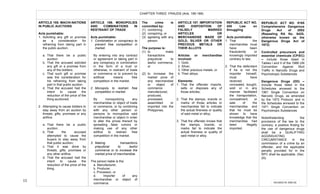
CHAPTER THREE: FRAUDS (Arts. 185-189)
ARTICLE 186. MONOPOLIES
AND COMBINATIONS IN
RESTRAINT OF TRADE
Acts punishable:
1. Combination or conspiracy to
prevent free competition in
market.
By entering into any contract
or agreement or taking part in
any conspiracy or combination
in the form of a trust or
otherwise, in restraint of trade
or commerce or to prevent by
artificial means free
competition in the market.
2. Monopoly to restrain free
competition in market.
By monopolizing any
merchandise or object of trade
or commerce, or by combining
with any other person or
persons to monopolize said
merchandise or object in order
to alter the prices thereof by
spreading false rumors or
making use of any other
artifice to restrain free
competition in the market.
3. Making transactions
prejudicial to lawful
commerce or to increase the
market price of merchandise.
The person liable is the:
a. Manufacturer,
b. Producer,
c. Processor, or
d. Importer of any
merchandise or object of
commerce.
The crime is
committed by:
(1) combining,
(2) conspiring, or
(3) agreeing with any
person.
The purpose is:
(1) to make
transactions
prejudicial to
lawful commerce,
or
(2) to increase the
market price of
any merchandise
or object of
commerce
manufactured,
produced,
processed,
assembled or
imported into the
Philippines.
ARTICLE 187. IMPORTATION
AND DISPOSITION OF
FALSELY MARKED
ARTICLES OR
MERCHANDISE MADE OF
GOLD, SILVER OR OTHER
PRECIOUS METALS OR
THEIR ALLOYS
Articles or merchandise
involved:
1. Gold,
2. Silver,
3. Other precious metals, or
4. Their alloys.
Elements:
1. That the offender imports,
sells or disposes any of
those articles;
2. That the stamps, brands or
marks of those articles or
merchandise fail to indicate
the actual fineness or quality
of said metal or alloy;
3. That the offender knows that
the stamps, brands, or
marks fail to indicate the
actual fineness or quality of
said metal or alloy.
REPUBLIC ACT NO.
455 Law on
Smuggling
Acts punishable:
1. That the
merchandise must
have been
fraudulently or
knowingly imported
contrary to law;
2. That the defendant
if he is not the
importer himself,
must have
received,
concealed, bought,
sold or in any
manner facilitated
the transportation,
concealment, or
sale of the
merchandise and
that he must be
shown to have
knowledge that the
merchandise had
been illegally
imported.
REPUBLIC ACT NO. 9165
Comprehensive Dangerous
Drugs Act of 2002
(Repealing RA No. 6425,
otherwise known as the
Dangerous Drugs Act of
1972)
Controlled precursors and
essential chemicals (CP/EC)
– include those listed in
Tables I and II of the 1988 UN
Convention Against Illicit
Traffic in Narcotic Drugs and
Psychotropic Substances
Dangerous Drugs (DD) –
include those listed in the
Schedules annexed to the
1961 Single Convention on
Narcotic Drugs, as amended
by the 1972 Protocol, and in
the Schedules annexed to the
1971 Single Convention on
Psychotropic Substances
Notwithstanding the
provisions of the law to the
contrary, a positive finding for
the use of dangerous drugs
shall be a QUALIFYING
AGGRAVATING
CIRCUMSTANCE in the
commission of a crime by an
offender, and the applicable
penalty provided for in the
RPC shall be applicable. (Sec.
25)
RICARDO
M.
RIBO
JR.
16.
16
(CHAPTER ONEREPEALED) CHAPTER TWO: OFFENSES AGAINST DECENCY AND GOOD CUSTOMS
ARTICLE 200 GRAVE
SCANDAL
1. That the offender performs
an act or acts.
2. That such act or acts be
highly scandalous as
offending against decency or
good customs.
3. That the highly scandalous
conduct is not expressly
falling within any article of
this Code.
4. That the act or acts
complained of be committed
in a public place or within the
public knowledge or view.
ARTICLE 201. IMMORAL
DOCTRINES, OBSCENE
PUBLICATIONS AND
EXHIBITIONS, AND INDECENT
SHOWS
Persons Liable:
1. Those who shall publicly expound
or proclaim doctrines openly and
contrary to public morals.
2. The authors of obscene literature,
published with their knowledge in
any form; the editors publishing
such literature; and the owners,
operating the establishment or
selling the same.
3. Those who, in theaters, fairs,
cinematographs or any other place,
exhibit indecent or immoral shows
which are proscribed or are
contrary to morals, good customs,
established policies, lawful orders,
decrees and edicts
4. Those who shall sell, give away or
exhibit films, prints, engravings,
sculpture or literature which are
offensive to morals
The Test of Obscenity
The test is whether the tendency of
the matter charged as obscene, is to
corrupt those whose minds are open
to such immoral influences, and into
whose hands such a publication may
fall and also whether or not such
publication or act shocks the ordinary
and common sense of men as an
indecency.
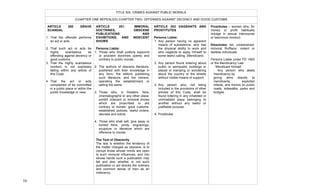
TITLE SIX: CRIMES AGAINST PUBLIC MORALS
ARTICLE 202 VAGRANTS AND
PROSTITUTES
Persons Liable:
1. Any person having no apparent
means of subsistence, who has
the physical ability to work and
who neglects to apply himself to
some lawful calling; (Mendicant)
2. Any person found loitering about
public or semipublic buildings or
places or tramping or wondering
about the country or the streets
without visible means of support;
3. Any person who, not being
included in the provisions of other
articles of this Code, shall be
found loitering in any inhabited or
uninhabited place belonging to
another without any lawful or
justifiable purpose.
4. Prostitutes
Prostitutes – women who, for
money or profit habitually
indulge in sexual intercourse
or lascivious conduct.
Dissolutes- lax, unrestrained,
immoral Ruffians- violent or
lawless individuals
Persons Liable under PD 1563
or the Mendicancy Law:
· Mendicant himself
· Any person who abets
mendicancy by
giving alms directly to
mendicants, exploited
infants, and minors on public
roads, sidewalks, parks and
bridges.
17.
17
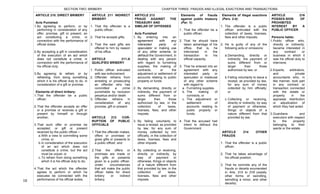
TITLE SEVEN:CRIMES COMITTED BY A PUBLIC OFFICER
CHAPTER ONE:
PRELIMINARY PROVISIONS
ARTICLE 203. WHO ARE
PUBLIC OFFICERS
Requisites:
To be a public officer one must
be –
1. Taking part in the
performance of public
functions in the
government, or performing
in said Government or in
any of its branches public
duties as an employee,
agent or subordinate
official, of any rank or class;
and
2. That his authority to take
part in the performance of
public functions or to
perform public duties must
be –
a. By direct provision of the
law, or
b. By popular election, or
c. By appointment by
competent authority
C CHAPTER TWO: MALFEASANCE AND MISFEASANCE IN OFFICE
Misfeasance – improper
performance of some act
which might lawfully be
done
Malfeasance – the
performance of some act
which ought not to be
done
Nonfeasance – omission
of some act which ought
to be performed
ARTICLE 204
KNOWINGLY
RENDERING UNJUST
JUDGMENT
1. That the offender is a
judge;
2. That he renders a
judgment in a case
submitted to him for
decision;
3. That the judgment is
unjust;
4. That the judge knows
that his judgment is
unjust.
SECTION ONE: DERELICTION OF DUTY
ARTICLE 205. JUDGMENT
RENDERED THROUGH
NEGLIGENCE
1. That the offender is a
judge;
2. That he renders a
judgment in a case
submitted to him for
decision;
3. That the judgment is
manifestly unjust;
4. That it is due to his
inexcusable negligence
or ignorance.
ARTICLE 206 UNJUST
INTERLOCUTORY ORDER
1. That the offender is a
judge;
2. That he performs any of
the following acts:
a. Knowingly renders
unjust interlocutory
order or decree, or
b. Renders a manifestly
unjust interlocutory
order or decree through
inexcusable negligence
or ignorance.
ARTICLE 207 MALICIOUS
DELAY IN THE
ADMINISTRATION OF
JUSTICE
1. That the offender is a judge;
2. That there is a proceeding in
court.
3. That he delays the
administration of justice;
4. That the delay is malicious,
that is, the delay is caused
by the judge with deliberate
intent to inflict damage on
either party in the case.
Who Can Be Offenders in
Art. 208?
1. Public officer
Officers of the prosecution
department, whose duty is to
institute criminal proceedings
upon being informed
2. Officer of the law
By reason of position held by
them are duty-bound to cause
prosecution and punishment of
offenders.
ARTICLE 208. PROSE-
CUTION OF OFFENSES;
NEGLIGENCE AND
TOLERANCE
Acts punished:
1. By maliciously refraining
from instituting
prosecution against
violators of the law;
2. By maliciously tolerating
the commission of a
crime.
Elements:
1. That the offender is a
public officer who has a
duty to cause the
prosecution of, or to
prosecute offenses;
2. That knowing the
commission of the crime,
he does not cause the
prosecution of the criminal
or knowing that a crime is
about to be committed he
tolerates its commission;
and
3. That the offender acts with
malice and deliberate
intent to favor the violator
of the law.
ARTICLE 209
BETRAYAL OF TRUST
BY AN ATTORNEY OR
SOLI-CITOR —
REVELATION OF
SECRETS
Acts punished:
1. Causing damage to his
client, either:
a. By any malicious
breach of
professional duty; or
b. Inexcusable
negligence or
ignorance
2. Revealing any of the
secrets of his client
learned by him in his
professional capacity
3. Undertaking the
defense of the
opposing party in the
same case without the
consent of his first
client after having
undertaken the
defense of said first
client or after having
received confidential
information from said
client
18.
18
SECTION TWO:BRIBERY
ARTICLE 210. DIRECT BRIBERY
Acts Punished
1.By agreeing to perform, or by
performing in consideration of any
offer, promise, gift or present, an
act constituting a crime, in
connection with the performance of
official duties.
2.By accepting a gift in consideration
of the execution of an act which
does not constitute a crime, in
connection with the performance of
his official duty.
3.By agreeing to refrain, or by
refraining, from doing something
which it is his official duty to do, in
consideration of a gift or promise.
Elements of direct bribery:
1.That the offender be a public
officer;
2.That the offender accepts an offer
or a promise or receives a gift or
present by himself or through
another;
3.That such offer or promise be
accepted, or gift or present
received by the public officer –
a.With a view to committing some
crime; or
b.In consideration of the execution
of an act which does not
constitute a crime, but the act
must be unjust; or
c.To refrain from doing something
which it is his official duty to do;
4.That the act which the offender
agrees to perform or which he
executes be connected with the
performance of his official duties.
ARTICLE 211 INDIRECT
BRIBERY
1. That the offender is a
public officer;
2. That he accepts gifts;
3. That the said gifts are
offered to him by reason
of his office.
ARTICLE 211-A
QUALIFIED BRIBERY
1. Public officer entrusted
with law enforcement
2. Offender refrains from
arresting or prosecuting
an offender who has
committed a crime
punishable by reclusion
perpetua and/or death
3. Offender refrains in
consideration of any
promise, gift or present
ARTICLE 212 COR-
RUPTION OF PUBLIC
OFFICIALS
1.That the offender makes,
offers or promises or
gives gifts or presents to
a public officer; and
2.That the offers or
promises are made or
the gifts or presents
given to a public officer,
under circumstances
that will make the public
officer liable for direct
bribery or indirect
bribery.
ARTICLE 213
FRAUD AGAINST THE
TREASURY AND
SIMILAR OF OFFENSES
Acts Punished
1. By entering into an
agreement with any
interested party or
speculator or making use
of any other scheme, to
defraud the Government, in
dealing with any person
with regard to furnishing
supplies, the making of
contracts, or the
adjustment or settlement of
accounts relating to public
property or funds
2. By demanding, directly or
indirectly, the payment of
sums different from or
larger than those
authorized by law, in the
collection of taxes,
licenses, fees, and other
imposts
3. By failing voluntarily to
issue a receipt, as provided
by law, for any sum of
money collected by him
officially, in the collection of
taxes, licenses, fees and
other imposts
4. By collecting or receiving,
directly or indirectly, by
way of payment or
otherwise, things or objects
of a nature different from
that provided by law, in the
collection of taxes,
licenses, fees and other
imposts
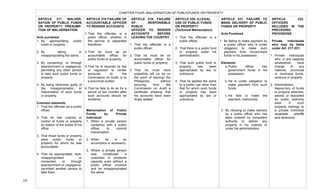
CHAPTER THREE: FRAUDS AND ILLEGAL EXACTIONS AND TRANSACTIONS
Elements of frauds
against public treasury
(Par. 1):
1. That the offender be a
public officer;
2. That he should have
taken advantage of his
office, that is, he
intervened in the
transaction in his
official capacity;
3. That he entered into an
agreement with any
interested party or
speculator or madeuse
of any other scheme
with regard to
a. Furnishing supplies
b. The making of
contracts, or
c. The adjustment or
settlement of
accounts relating to
public property or
funds;
4. That the accused had
intent to defraud the
Government
Elements of illegal exactions
(Pars. 2-4):
1. The offender is a public
officer entrusted with the
collection of taxes, licenses,
fees and other imposts;
2. He is guilty of any of the
following acts or omissions:
a.Demanding, directly or
indirectly, the payment of
sums different from or
larger than those
authorized by law; or
b.Failing voluntarily to issue a
receipt, as provided by law,
for any sum of money
collected by him officially;
or
c.Collecting or receiving,
directly or indirectly, by way
of payment or otherwise,
things or objects of a
nature different from that
provided by law.
ARTICLE 214 OTHER
FRAUDS
1. That the offender is a public
officer;
2. That he takes advantage of
his official position;
3. That he commits any of the
frauds or deceits enumerated
in Arts. 315 to 318 (estafa,
other forms of swindling,
swindling a minor, and other
deceits).
ARTICLE 216
POSSES-SION OF
PROHIBITED
INTEREST BY A
PUBLIC OFFICER
Persons liable:
1.Public officer who,
directly or indirectly,
became interested in
any contract or
business in which it
was his official duty to
intervene.
2.Experts, arbitrators,
and private
accountants who, in
like manner, took part
in any contract or
transaction connected
with the estate or
property in the
appraisal, distribution
or adjudication of
which they had acted.
3.Guardians and
executors with respect
to the property
belonging to their
wards or the estate.
19.
19
ARTICLE 217.MALVER-
SATION OF PUBLIC FUNDS
OR PROPERTY: PRESUMP-
TION OF MALVERSATION
Acts punished:
1. By appropriating public
funds or property.
2. By taking or
misappropriating the same.
3. By consenting, or through
abandonment or negligence,
permitting any other person
to take such public funds or
property.
4. By being otherwise guilty of
the misappropriation or
malversation of such funds
or property.
Common elements:
1. That the offender be a public
officer.
2. That he had custody or
control of funds or property
by reason of the duties of his
office
3. That those funds or property
were public funds or
property for which he was
accountable
4. That he appropriated, took,
misappropriated or
consented, or through
abandonment or negligence,
permitted another person to
take them.
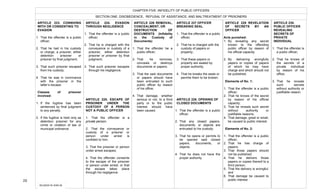
CHAPTER FOUR: MALVERSATION OF PUBLICFUNDS OR PROPERTY
ARTICLE 218 FAILURE OF
ACCOUNTABLE OFFICER
TO RENDER ACCOUNTS
1.That the offender is a
public officer, whether in
the service or separated
therefrom.
2.That he must be an
accountable officer for
public funds or property.
3.That he is required by law
or regulation to render
accounts to the
Commission on Audit, or to
a provincial auditor.
4.That he fails to do so for a
period of two months after
such accounts should be
rendered.
Malversation of Public
Funds by Private
Individual:
1. When a private person
conspired with a public
officer to commit
malversation.
2. When he is an
accomplice or accessory.
3. Where a private person
was constituted a
custodian in whatever
capacity even without a
public officer involved
and he misappropriated
the same.
ARTICLE 219. FAILURE
OF RESPONSIBLE
PUBLIC
OFFICER TO RENDER
ACCOUNTS BEFORE
LEAVING THE COUNTRY
1. That the offender is a
public officer;
2. That he must be an
accountable officer for
public funds or property;
3. That he must have
unlawfully left (or be on
the point of leaving) the
Philippines without
securing from the
Commission on Audit a
certificate showing that
his accounts have been
finally settled.
ARTICLE 220. ILLEGAL
USE OF PUBLIC FUNDS
OR PROPERTY
(Technical Malversation)
1. That the offender is a
public officer;
2. That there is a public fund
or property under his
administration;
3. That such public fund or
property has been
appropriated by law or
ordinance;
4. That he applies the same
to a public use other than
that for which such funds
or property has been
appropriated by law or
ordinance.
ARTICLE 221. FAILURE TO
MAKE DELIVERY OF PUBLIC
FUNDS OR PROPERTY
Acts Punished
1. By failing to make payment by
a public officer who is under
obligation to make such
payment from Government
funds in his possession.
Elements:
a. Public officer has
government funds in his
possession.
b. He is under obligation to
make payment from such
funds.
c. He fails to make the
payment, maliciously.
2. By refusing to make delivery
by a public officer who has
been ordered by competent
authority to deliver any
property in his custody or
under his administration
ARTICLE 222.
OFFICERS
INCLUDED IN THE
PRECEDING
PROVISIONS
Private individuals
who may be liable
under Art. 217-221:
1. Private individuals
who, in any capacity
whatsoever, have
charge of any
national, provincial
or municipal funds,
revenue or property
2. Administrator,
deposi-tory of funds
or property attached,
seized, or deposited
by public authority
even if such
property belongs to
a private individual
(example: sheriffs
and receivers)
20.
20
ARTICLE 223.CONNIVING
WITH OR CONSENTING TO
EVASION
1. That the offender is a public
officer;
2. That he had in his custody
or charge, a prisoner, either
detention prisoner or
prisoner by final judgment;
3. That such prisoner escaped
from his custody;
4. That he was in connivance
with the prisoner in the
latter’s escape.
Classes of prisoner
involved:
1. If the fugitive has been
sentenced by final judgment
to any penalty.
2. If the fugitive is held only as
detention prisoner for any
crime or violation of law or
municipal ordinance.
CHAPTER FIVE: INFIDELITY OF PUBLIC OFFICERS
SECTION ONE: DISOBEDIENCE, REFUSAL OF ASSISTANCE, AND MALTREATMENT OF PRISONERS
ARTICLE 224. EVASION
THROUGH NEGLIGENCE
1. That the offender is a public
officer;
2. That he is charged with the
conveyance or custody of a
prisoner, either detention
prisoner or prisoner by final
judgment;
3. That such prisoner escapes
through his negligence.
ARTICLE 225. ESCAPE OF
PRISONER UNDER THE
CUSTODY OF A PERSON
NOT A PUBLIC OFFICER
1. That the offender is a
private person;
2. That the conveyance or
custody of a prisoner or
person under arrest is
confided to him;
3. That the prisoner or person
under arrest escapes;
4. That the offender consents
to the escape of the prisoner
or person under arrest, or that
the escape takes place
through his negligence.
ARTICLE 226 REMOVAL,
CONCEALMENT, OR
DESTRUCTION OF
DOCUMENTS (Infidelity
in the Custody of
Documents)
1. That the offender be a
public officer;
2. That he removes,
conceals or destroys
documents or papers;
3. That the said documents
or papers should have
been entrusted to such
public officer by reason
of his office;
4. That damage, whether
serious or not, to a third
party or to the public
interest should have
been caused.
ARTICLE 229 REVELATION
OF SECRETS BY AN
OFFICER
Acts punished:
1. By revealing any secret
known to the offending
public officer by reason of
his official capacity.
2. By delivering wrongfully
papers or copies of papers
of which he may have
charge and which should not
be published.
Elements of No. 1:
1. That the offender is a public
officer;
2. That he knows of the secret
by reason of his official
capacity;
3. That he reveals such secret
without authority or
justifiable reasons;
4. That damage, great or small,
be caused to public interest.
Elements of No. 2:
1. That the offender is a public
officer;
2. That he has charge of
papers;
3. That those papers should
not be published;
4. That he delivers those
papers or copies thereof to a
third person;
5. That the delivery is wrongful;
and
6. That damage be caused to
public interest
ARTICLE 230.
PUBLIC OFFICER
REVEALING
SECRETS OF
PRIVATE
INDIVIDUAL
1. That the offender is
a public officer;
2. That he knows of
the secrets of a
private individual
by reason of his
office;
3. That he reveals
such secrets
without authority or
justifiable reason.
ARTICLE 227 OFFICER
BREAKING SEAL
1. That the offender is a public
officer;
2. That he is charged with the
custody of papers or
property;
3. That these papers or
property are sealed by
proper authority;
4. That he breaks the seals or
permits them to be broken.
ARTICLE 228. OPENING OF
CLOSED DOCUMENTS
1. That the offender is a public
officer.
2. That any closed papers,
documents, or objects are
entrusted to his custody.
3. That he opens or permits to
be opened said closed
papers, documents, or
objects.
4. That he does not have the
proper authority.
RICARDO
M.
RIBO
JR.
21.
21
ARTICLE 231OPEN
DISOBEDIENCE
1. That the offender is a
judicial or executive
officer;
2. That there is a
judgment, decision or
order of a superior
authority;
3. That such judgment,
decision or order was
made within the scope
of the jurisdiction of the
superior authority and
issued with all legal
formalities;
4. That the offender
without any legal
justification openly
refuses to execute said
judgment, decision or
order, which he is duty
bound to obey
CHAPTER SIX: OTHER OFFENSES OR IRREGULARITIES BY PUBLIC OFFICERS
SECTION ONE: DISOBEDIENCE, REFUSAL OF ASSISTANCE AND MALTREATMENT OF PRISONERS
OF ASSISTANCE AND MALTREATMENT OF PRISONERS
ARTICLE 232.
DISOBEDIENCE TO
ORDER OF SUPERIOR
OFFICER WHEN SAID
ORDER WAS SUSPENDED
BY INFERIOR OFFICER
1. That the offender is a
public officer;
2. That an order is issued
by his superior for
execution;
3. That he has for any
reason suspended the
execution of such order;
4. That his superior
disapproves the
suspension of the
execution of the order;
5. That the offender
disobeys his superior
despite the disapproval of
the suspension.
ARTICLE 233 REFUSAL OF
ASSISTANCE
1. That the offender is a public
officer.
2. That a competent authority
demands from the offender
that he lends his
cooperation towards the
administration of justice or
other public service.
3. That the offender fails to do
so maliciously.
ARTICLE 234. REFUSAL TO
DISCHARGE ELECTIVE
OFFICE
1. That the offender is elected
by popular election to a
public office;
2. That he refuses to be sworn
in or to discharge the duties
of said office; and
3. That there is no legal motive
for such refusal to be sworn
in or to discharge the duties
of said office.
ARTICLE 235.
MALTREATMENT OF
PRISONERS
1. That the offender is a public
officer or employee;
2. That he has under his
charge a prisoner convicted
by final judgment or a
detention prisoner;
3. That he maltreats such
prisoner in either of the
following manners:
a. By overdoing himself in
the correction handling of
a prisoner or detention
prisoner under his charge
either:
i. by the imposition of
punishments not
authorized by the
regulations, or
ii. by inflicting such
punishments (those
authorized) in a cruel
and humiliating
manner; or
b. By maltreating such
prisoner to extort a
confession or to obtain
some information from
the prisoner.
SECTION TWO: ANTICIPATION, PROLONGATION AND
ABANDONMENT OF THE DUTIES AND POWERS OF
PUBLIC OFFICE
ARTICLE 236.ANTICIPATION
OF DUTIES OF A PUBLIC
OFFICE
1. That the offender is entitled
to hold a public office or
employment, either by
election or appointment;
2. That the law requires that
he should first be sworn in
and/or should first give a
bond;
3. That he assumes the
performance of the duties
and powers of such office;
4. That he has not taken his
oath of office and/or given
the bond required by law.
ARTICLE 237. PROLONGING
PERFORMANCE OF DUTIES
AND POWERS
1. That the offender is holding
a public office;
2. That the period provided by
law, regulations or special
provisions for holding such
office, has already expired;
3. That he continues to
exercise the duties and
powers of such office.
ARTICLE 238
ABANDONMENT OF
OFFICE
1. That the offender is a
public officer;
2. That he formally
resigns from his
position; · There must
be written or formal
resignation
3. That his resignation
has not yet been
accepted;
4. That he abandons his
office to the detriment
of the public service.
Qualifying
circumstance – when
the abandonment of the
office has for its purpose
to evade the discharge of
the duties of preventing,
prosecuting or punishing
any of the crimes falling
within Title 1 and
Chapter 1 Title 3 of Book
2 of this Code
.
22.
22
ARTICLE 239.
USURPATIONOF
LEGISLATIVE POWER
1. That the offender is an
executive or judicial
officer;
2. That he:
a. Makes general rules or
regulations beyond the
scope of his authority
or
b. b. Attempts to repeal a
law or
c. Suspends the
execution thereof.
ARTICLE 240.
USURPATION OF
EXECUTIVE FUNCTIONS
1. That the offender is a
judge;
2. That he:
a. Assumes a power
pertaining to the
executive authorities; or
b. Obstructs the executive
authorities in the lawful
exercise of their powers
SECTION THREE: USURPATION OF POWERS AND UNLAWFUL APPOINTMENT
ARTICLE 241. USUR-
PATION OF JUDICIAL
FUNCTIONS
1. That the offender is an
officer of the executive
branch of the Government;
2. That he:
a. Assumes judicial powers;
or
b. Obstructs the execution
of any order or decision
rendered by any judge
within his jurisdiction.
ARTICLE 242. DIS-
OBEYING REQUEST FOR
DISQUALIFICATION
1. That the offender is a
public officer;
2. That a proceeding is
pending before such
public officer;
3. That there is a question
brought before the proper
authority regarding his
jurisdiction, which is not
yet decided;
4. That he has been lawfully
required to refrain from
continuing the proceeding;
5. That he continues the
proceeding.
ARTICLE 243. ORDERS
OR REQUESTS BY
EXECUTIVE OFFICERS TO
ANY JUDICIAL
AUTHORITY
1. That the offender is an
executive officer;
2. That he addresses any
order or suggestion to any
judicial authority;
3. That the order or
suggestion relates to any
case or business coming
within the exclusive
jurisdiction of the courts of
justice
ARTICLE 244 UNLAWFUL
APPOINTMENTS
1. That the offender is a
public officer;
2. That he nominates or
appoints a person to a
public office;
3. That such person lacks
the legal qualifications
therefor;
4. That the offender knows
that his nominee or
appointee lacks the
qualification at the time he
made the nomination or
appointment.
ARTICLE 245. ABUSES
AGAINST CHASTITY –
PENALTIES
Ways of committing
abuses against chastity:
1. By soliciting or making
immoral or indecent
advances to a woman
interested in the matters
pending before the
offending officer for
decision, or with respect to
which he is required to
submit a report to or
consult with a superior
officer.
2. By soliciting or making
immoral or indecent
advances to a woman
under the offender’s
custody.
3. By soliciting or making
immoral or indecent
advances to the wife,
daughter, sister or relative
within the same degree by
affinity of any person in
the custody of the
offending warden or
officer.
SECTION FOUR: ABUSES AGAINST CHASTITY
Elements:
1. That the offender is a
public officer;
2. That he solicits or makes
immoral or indecent
advances to a woman;
3. That such woman must
be:
a. Interested in matters
pending before the
offender for decision, or
with respect to which he
is required to submit a
report to or consult with a
superior officer; or
b. Under the custody of the
offender who is a warden
or other public officer
directly charged with the
care and custody of
prisoners or persons
under arrest; or
c. The wife, daughter, sister
or relative within the
same degree by affinity of
the person in the custody
of the offender.
.
23.
23
Elements:
1. Thata person was killed;
2. That the accused killed him;
3. That the killing was attended
by any of the qualifying
circumstances mentioned in
Art. 248; and
4. That the killing is not parricide
or infanticide.
Rules for the application of the
circumstances which qualify
the killing to murder:
1. That murder will exist with only
one of the circumstances
described in Art. 248.
2. Where there are more than
one qualifying circumstance
present, only one will qualify
the killing, with the rest to be
considered as generic
aggravating circumstances.
3. That when the other
circumstances are absorbed or
included in one qualifying
circumstance, they cannot be
considered as generic
aggravating.
4. That any of the qualifying
circumstances enumerated in
Art. 248 must be alleged in the
information.
TITLE EIGHT: CRIMES AGAINST PERSONS
ARTICLE 248. MURDER
Murder – unlawful killing of any
person which is not parricide or
infanticide, provided that any
of the following circumstances is
present:
1. With treachery, taking
advantage of superior
strength, with the aid of armed
men, or employs means to
weaken the defense, or of
means or persons to insure or
afford impunity;
2. In consideration of a price,
reward or promise;
3. By means of inundation, fire,
poison, shipwreck, stranding of
a vessel, derailment or assault
upon a railroad, fall of an
airship, by means of motor
vehicles, or with the use of any
other means involving great
waste and ruin;
4. On occasion of any calamities
enumerated in the preceding
paragraph, or of an
earthquake, eruption of a
volcano, destructive cyclone,
epidemic, or any other public
calamity;
5. With evident premeditation; or
6. With cruelty, by deliberately
and Inhumanly augmenting the
suffering of the victim, or
outraging or scoffing at his
person or corpse. (As
amended by RA No. 7659)
ARTICLE 247.
DEATH OR PHYSICAL
INJURIES INFLICTED
UNDER EXCEPTIONAL
CIRCUMSTANCES
1. That a legally married
person or a parent surprises
his spouse or his daughter,
the latter under 18 years of
age and living with him, in
the act of committing sexual
intercourse with another
person;
2. That he or she kills any or
both of them, or inflicts upon
any or both of them any
serious physical injury, in the
act or immediately
thereafter; and
3. That he has not promoted or
facilitated the prostitution of
his wife or daughter, or that
he or she has not consented
to the infidelity of others.
ARTICLE 246. PARRICIDE
1. That a person is killed;
2. That the deceased is killed by
the accused; and
3. That the deceased is the
father, mother, or child,
whether legitimate or
illegitimate, or a legitimate
other ascendant or other
descendant, or the legitimate
spouse, of the accused.
Cases of parricide when the
penalty shall NOT be reclusion
perpetua to death:
• Parricide through negligence
(Art. 365).
• Parricide by mistake (Art. 249).
• Parricide under exceptional
circumstances (Art. 247).
• The child should not be less
than 3 days old; otherwise the
crime is infanticide (Art. 255)
SECTION ONE: PARRICIDE, MURDER, HOMICIDE
ARTICLE 249. HOMICIDE
Elements:
1. That a person was killed;
2. That the accused killed him
without any justifying
circumstance;
3. That the accused had the
intention to kill, which is
presumed; and
4. That the killing was not
attended by any of the
qualifying circumstances of
murder, or by that of
parricide or infanticide.
24.
24
ARTICLE 252.PHYSICAL
INJURIES INFLICTED IN A
TUMULTUOUS AFFRAY
1. That there is a tumultuous
affray as referred to in Art.
251;
2. That a participant or some
participants thereof suffer
serious physical injuries or
physical injuries of a less
serious nature only;
3. That the person
responsible therefor
cannot be identified; and
4. That all those who appear
to have used violence
upon the person of the
offended party are known.
ARTICLE 253. GIVING
ASSISTANCE TO SUICIDE
Acts punished:
1. By assisting another to
commit suicide, whether
the suicide is
consummated or not;
2. By lending his assistance
to another to commit
suicide to the extent of
doing the killing himself.
ARTICLE 251. DEATH
CAUSED IN A
TUMULTUOUS AFFRAY
1. That there be several
persons;
2. That they did not compose
groups organized for the
common purpose of
assaulting and attacking
each other reciprocally,
otherwise, they may be held
liable as co-conspirators;
3. That these several persons
quarreled and assaulted
one another in a confused
and tumultuous manner;
4. That someone was killed in
the course of the affray;
5. That it cannot be
ascertained who actually
killed the deceased; and
6. That the person or persons
who inflicted serious
physical injuries or who
used violence can be
identified.
Persons liable:
1.The person or persons who
inflicted the serious physical
injuries are liable.
2.If it is not known who
inflicted the serious physical
injuries on the deceased –
ALL the persons who used
violence upon the person of
the victim are liable, but
with lesser liability.
ARTICLE 250.
PENALTY FOR
FRUSTRATED
PARRICIDE, MURDER,
OR HOMICIDE
• Courts may impose a
penalty two degrees
lower for frustrated
parricide, murder or
homicide.
• Courts may impose a
penalty three degrees
lower for attempted
parricide, murder or
homicide.
• This provision is
permissive NOT
MANDATORY.
SECTION ONE: PARRICIDE, MURDER, HOMICIDE
ARTICLE 254
DISCHARGE OF
FIREARMS
1. That the offender
discharges a
firearm against or
at another person;
and
2. That the offender
has no intention to
kill that person.
ARTICLE 255
INFANTICIDE
Elements:
1.That a child was killed;
2.That the deceased child
was less than three days
(72 hours) of age; and
3.That the accused killed
the said child.
Person liable in
Intentional Abortion:
1. The person who
intentionally caused the
abortion under Art. 256;
2. The pregnant woman if
she consented under
Art. 258.
SECTION TWO: INFANTICIDE AND ABORTION
ARTICLE 256
INTENTIONAL ABORTION
Ways of Committing Intentional
Abortion:
1. By using any violence upon the
person of the pregnant woman;
2. By acting, without using
violence and without the
consent of the woman (by
administering drugs or
beverages upon such pregnant
woman without her consent;
and
3. By acting, with the consent of
the pregnant woman, by
administering drugs or
beverages.
Elements:
1. That there is a pregnant
woman;
2. That violence is exerted, or
drugs or beverages
administered, or that the
accused otherwise acts upon
such pregnant woman;
3. That as a result of the use of
violence or drugs or beverages
upon her, or any other act of the
accused, the fetus dies, either in
the womb or after having been
expelled therefrom; and
4. That the abortion is intended.
25.
25
ARTICLE 258.ABORTION
PRACTICED BY THE WOMAN
HERSELF OR HER PARENTS
1.That there is a pregnant
woman who has suffered an
abortion;
2.That the abortion is intended;
and
3.That the abortion is caused by
–
a. The pregnant woman
herself;
b. Any other person, with her
consent; or
c. Any of her parents, with her
consent, for the purpose of
concealing her dishonor.
SECTION THREE: DUEL
ARTICLE 257. UNINTEN-
TIONAL ABORTION
1. That there is a pregnant
woman;
2. That violence is used upon
such pregnant woman
without intending an
abortion;
3. That the violence is
intentionally exerted; and
4. That as a result of the
violence, the fetus dies,
either in the womb or after
having been expelled
therefrom.
ARTICLE 259.
ABORTION PRACTICED BY A
PHYSICIAN OR MIDWIFE IN
DISPENSING OF ABORTIVES
Elements:
1. That there is a pregnant
woman who has suffered an
abortion;
2. That the abortion is intended;
3. That the offender, who must be
a physician or midwife, causes,
or assists in causing the
abortion; and
4. That said physician or midwife
takes advantage of his or her
scientific knowledge or skill.
As to PHARMACISTS, the
ELEMENTS are:
1. That the offender is a
pharmacist;
2. That there is no proper
prescription from a physician;
and
3. That the offender dispenses
any abortive.
ARTICLE 260.
RESPONSIBILITY OF
PARTICIPANTS IN A DUEL
Acts punished:
1. By killing one’s adversary
in a duel;
2. By inflicting upon such
adversary physical injuries;
and
3. By making a combat
although no physical
injuries have been inflicted.
Persons liable:
1. The person who killed or
inflicted physical injuries
upon his adversary or both
combatants in any other
case, as principals.
2. The seconds, as
accomplices.
SECTION TWO: INFANTICIDE AND ABORTION
ARTICLE 261
CHALLENGING TO A DUEL
Acts Punished
1. By challenging another to
a duel;
2. By inciting another to give
or accept a challenge to a
duel; and
3. By scoffing or decrying
another publicly for having
refused to accept a
challenge to fight a duel.
Persons liable:
1. Challenger
2. Instigators
RICARDO
M.
RIBO
JR.
26.
26
ARTICLE 262
MUTILATION
Twokinds:
1. By intentionally
mutilating another by
depriving him, either
totally or partially, of
some essential organ
for reproduction
(castration).
Elements:
a.That there be
castration, that is,
mutilation of organs
necessary for
generation, such as
penis or ovarium; and
b.That the mutilation is
caused purposely and
deliberately, that is, to
deprive the offended
party of some
essential organ for
reproduction.
2. By intentionally
making other
mutilation, that is, by
lopping or clipping off
any part of the body
of the offended party,
other than the
essential organ for
reproduction, to
deprive him of that
part of the body
(mayhem).
CHAPTER TWO: PHYSICAL INJURIES
ARTICLE 263. SERIOUS
PHYSICAL INJURIES
How committed:
1. By wounding;
2. By beating;
3. By assaulting; or
4. By administering injurious
substance.
Serious physical injuries
1.When the injured person
becomes insane, imbecile,
impotent or blind in
consequence of the
physical injuries inflicted;
2.When the injured person –
a. Loses the use of speech
or the power to hear or to
smell, or loses an eye, a
hand, a foot, an arm, or a
leg;
b. Loses the use of any such
member; or
c. Becomes incapacitated
for the work in which he
was therefore habitually
engaged, in consequence
of the physical injuries
inflicted.
3. When the person injured -
a. Becomes deformed, or
b. Loses any other member
of his body, or
c. Loses the use thereof, or
d. Becomes ill or
incapacitated for the
performance of the work
in which he was habitually
engaged for more than 90
days, in consequence of
the physical injuries
inflicted.
4. When the injured person
becomes ill or
incapacitated for labor for
more than 30 days (but
must not be more than 90
days), as a result of the
physical injuries inflicted.
Requisites of deformity:
1. Physical ugliness;
2. Permanent and definite
abnormality; and
3. Must be conspicuous and
visible.
Qualifying Circumstances:
1. Offense committed against
persons enumerated in the
crime of parricide.
2. With the attendance of
circumstance which qualify
the crime to murder.
ARTICLE 264
ADMINISTERING
INJURIOUS SUBSTANCE
OR BEVERAGES
1.That the offender inflicted
upon another any serious
physical injury;
2.That it was done by
knowingly administering to
him any injurious substances
or beverages or by taking
advantage of his weakness
of mind or credulity; and
3.That he had no intent to kill.
ARTICLE 265
LESS SERIOUS PHYSICAL
INJURIES
1.The offended party is
incapacitated for labor for 10
days or more but not more
than 30 days, or needs
attendance for the same
period; and
2.The physical injuries must
not be those described in the
preceding articles.
Qualified Less Serious
Physical Injuries:
1. A fine not exceeding P500,
in addition to arresto mayor,
shall be imposed for less
serious physical injuries
when:
a. There is manifest intent
to insult or offend the
injured person; or
b. There are circumstances
adding ignominy to the
offense.
2. A higher penalty is imposed
when the victim is either:
a. The offender’s parent,
ascendant, guardian,
curator or teacher; or
b. Persons of rank or
persons in authority,
provided the crime is not
direct assault.
The law includes 2
subdivisions, to wit:
1. The inability for work; and
2. The necessity for medical
attendance
ARTICLE 266 SLIGHT
PHYSICAL INJURIES AND
MALTREATMENT
Kinds:
1.Physical injuries which
incapacitated the offended
party from one to nine
days, or required medical
attendance during the
same period;
2.Physical injuries which did
not prevent the offended
party from engaging in his
habitual work or which did
not require medical
attendance; and
3.Ill-treatment of another by
deed without causing any
injury.
ANTI-HAZING LAW (R.A.
No. 8049)
Hazing – is an initiation rite
or practice as a prerequisite
for admission into
membership in a fraternity,
sorority or organization by
placing the recruit, neophyte
or applicant in some
embarrassing or humiliating
situations such as forcing
him to do menial, silly,
foolish, and similar activities
or otherwise subjecting him
to physical or psychological
suffering or injury.
acts are punishable: All acts
so long as it caused
physical injuries at the very
least.
Persons liable:
1. Officers and members of the
fraternity, sorority or organization who
actually participated in the infliction of
physical harm shall be liable as
principals – if the person subjected to
hazing suffers any physical injury or
dies as a result thereof.
2. Owner of the place where the hazing
is
conducted shall be liable as an
accomplice – when he has actual
knowledge of the hazing conducted
therein but failed to take any action to
prevent the same from occurring.
3. Parents shall be liable as principals –
when they have actual knowledge of the
hazing conducted in the home of one of
the officers or members of the fraternity,
sorority or organization, but failed to
prevent the same.
4. School authorities and faculty
members shall be liable as accomplices
- when they consent to the hazing or
have actual knowledge thereof, but
failed to take any action to prevent the
same from occurring.
5. Officers, former officers or alumni of
the organization, group, fraternity or
sorority shall be liable as principals - if
they actually planned the hazing,
although not present when the acts
constituting the hazing were committed.
6. Officers or members of the
organization, group, fraternity or sorority
shall be liable as principals - if they
knowingly cooperated in carrying out
the hazing by inducing the victim to be
present thereat.
7. The fraternity or sorority’s adviser
shall be liable as principal - if he was
present when the acts constituting the
hazing were committed and failed to
take any action to prevent the same.
.
27.
27
ARTICLE 266-BQUALIFIED
RAPE
Rape under both acts of
committing it is qualified by
the following:
Note: Rape is punishable by death if it
falls under any of 4-14 circumstances.
1. When rape is committed with
the use of a deadly weapon or
by two or more persons;
2. When by reason or occasion
of rape, the victim has
become insane;
3. When the rape is attempted
and a homicide is committed
by reason of or on the
occasion of rape (special
complex crime);
4. When by reason of or on
occasion of rape, homicide is
committed (special complex
crime)
5. When the victim is under 18
years of age and the offender
is a parent, ascendant, step-
parent, guardian, relative by
consanguinity or affinity within
the third civil degree, or the
common law spouse of the
parent of the victim;
6. When the victim is under the
custody of the police or
military authorities or any law
enforcement or penal
institution;
7. When the rape is committed in
full view of the spouse, parent,
or any of the children or other
relatives within the third civil
degree of consanguinity;
CHAPTER THREE: RAPE
2. By any person who, under any
of the circumstances mentioned
in paragraph 1 hereof, shall
commit an act of sexual assault
by inserting his penis into
another person’s mouth or anal
orifice of another person, or any
instrument or object, into the
genital or anal orifice of another
person.
Elements:
a. That the offender commits an
act of sexual assault;
b. That the act of sexual assault
is committed by any of the
following means:
i. By inserting his penis into
another person’s mouth or
anal orifice;
ii. By inserting any instrument
or object into the genital or
anal orifice of another
person
c. That the act of sexual assault
is accomplished under any of
the circumstances
enumerated under the first act
of committing rape.
How rape is committed:
1. By a man who shall have
carnal knowledge of a woman
under any of the following
circumstances:
a. Through force, threat or
intimidation;
b. When the offended party is
deprived of reason or
otherwise unconscious;
c. By means of fraudulent
machinations or grave
abuse of authority;
d. When the offended party is
under twelve (12) years of
age or is demented, even
though none of the
circumstances mentioned
above be present.
Elements:
a. That the offender is a man;
b. That the offender had carnal
knowledge of a woman;
c. That such act is accomplished
under any of the following
circumstances:
i. By using force or
intimidation, or
ii. When the woman is deprived
of reason or otherwise
unconscious, or
iii. By means of fraudulent
machination or grave abuse
of authority, or
iv. When the woman is under 12
years of age or demented.
ART. 266-A ANTI-RAPE
LAW
Classification of Rape
1. Traditional Rape under Art.
335- carnal knowledge with
a woman against her will; in
this case, the offender is
always a man and the
offended party is always a
woman.
2. Sexual Assault under R.A.
8353- this is committed
when the offender inserts
his penis to another
person’s mouth or anal
orifice or by inserting an
instrument or object into the
genital or anal orifice of
another person. The
offender and theoffender
can either be a man or a
woman in the case of the
insertion of any instrument
or object.
8. When the victim is a religious
engaged in legitimate
religious vocation or calling
and is personally known to
be such by the offender
before or at the time of the
commission of the crime;
9. When the victim is a child
below 7 years old;
10. When the offender knows
that he is afflicted with
HIV/AIDS or any other
sexually transmissible
disease and the virus or
disease is transmitted to the
victim;
11. When committed by any
member of the AFP or para-
military units thereof of the
PNP or any law enforcement
agency or penal institution,
when the offender took
advantage of his position to
facilitate the commission of
the crime;
12. When by reason or on the
occasion of the rape, the
victim has suffered
permanent physical
mutilation or disability;
13. When the offender knew of
the pregnancy of the
offended party at the time of
the commission of the crime;
14. When the offender knew of
the mental disability,
emotional disorder and/or
physical disability of the
offended party at the time of
the commission of the crime.
28.
28
TITLE NINE:CRIMES AGAINST PERSONAL LIBERTY AND SECURITY
SECTION ONE: ILLEGAL DETENTION
Qualifying circumstances:
Death Penalty is imposed
(KERT)
a. If the purpose is to
extort ransom
b. When the victim is killed
or dies a consequence of
the detention;
c. When the victim is raped;
or
d. When the victim is
subjected to torture or
dehumanizing act.
ARTICLE 267
KIDNAPPING AND
SERIOUS ILLEGAL
DETENTION
Elements: (PICK)
1. That the offender is a
private individual who
is not any of the
parents of the victim
nor a female;
2. That he kidnaps or
detains another, or in
any other manner
deprives the latter of
his liberty;
3. That the act of
detention or kidnapping
must be illegal;
4. That in the commission
of the offense, any Of
the following
circumstances is
present:
a. That the kidnapping or
detention lasts for
more than 3 days; or
b. That it is by committed
simulating public
authority; or
c. That any serious
physical injuries are
inflicted upon the
person kidnapped or
detained or threats to
kill him are made; or
d. That the person
kidnapped or detained
is a minor, female, or
a public officer
ARTICLE 268
SLIGHT ILLEGAL
DETENTION
Elements: (PIKO)
1. That the offender is a
private individual;
2. That he kidnaps or detains
another, or in any manner
deprives him of his liberty;
3. That the act of kidnapping
or detention is illegal;
4. That the crime is
committed without the
attendance of the
circumstances enumerated
in Art. 267.
Liability is mitigated when
the following
circumstances concur:
(VOB)
1. Offender voluntarily
releases the person so
kidnapped or detained
within three days from the
commencement of the
detention.
2. Without having attained
the purpose intended; and
3. Before the institution of
criminal proceedings
against him.
ARTICLE 269 UNLAWFUL
ARREST
1. That the offender
arrests or detains
another person
2. That the purpose of the
offender is to deliver
him to the proper
authorities
3. That the arrest or
detention is
unauthorized by law or
there is no reasonable
ground therefor.
ARTICLE 270 FAILURE
TO RETURN A MINOR
1. That the offender is
entrusted with the
custody of a minor
person (less than 18
years old);
2. That he deliberately
fails to restore the said
minor to his parents or
guardian
ARTICLE 271
INDUCING A MINOR TO
ABANDON HIS HOME
1. That a minor (less than
18 years old) is living
in the home of his
parents or guardian or
the person entrusted
with his custody;
2. That the offender
induces said minor to
abandon such home
SECTION TWO:
KIDNAPPING OF
MINORS
ARTICLE 266-C EFFECT OF
PARDON
Effects of pardon:
1. The subsequent valid
marriage between the
offender and the offended
party shall extinguish:
a. The criminal action or
b. The penalty already
imposed.
2. The subsequent
forgiveness of the wife to
the legal husband shall
extinguish the criminal
action or the penalty,
PROVIDED that the crime
shall not be extinguished or
the penalty shall not be
abated if the marriage is
void ab initio.
(This is an exception to the rule that
forgiveness by the offended party shall not
extinguish the penal action in crimes against
person)
ARTICLE 266-D
PRESUMPTIONS
Evidence which may be
accepted in the prosecution
of rape:
1. Any physical overt act
manifesting resistance
against the act of rape in
any degree from the
offended party; or
2. Where the offended party is
so situated as to render
him/her incapable of giving
his/her consent
29.
29
ARTICLE 272.SLAVERY
(PE)
1. That the offender
purchases, sells, kidnaps
or detains a human being;
2. That the purpose of the
offender is to enslave such
human being.
Qualifying circumstance:
When the purpose of the
offender is to assign the
offended party to some
immoral traffic.
ARTICLE 273
EXPLOITATION OF CHILD
LABOR
(RAR-age)
1. That the offender retains a
minor in his service;
2. That it is against the will of
the minor;
3. That it is under pretext of
reimbursing himself of a
debt incurred by an
ascendant, guardian or
person entrusted with the
custody of such minor.
SECTION THREE: SLAVERY AND SERVITUDE
ARTICLE 274.
SERVICES RENDERED
UNDER COMPULSION
IN PAYMENT
(CAP)
1. That the offender
compels a debtor to
work for him, either as
household servant or
farm laborer;
2. That it is against the
debtor’s will;
3. That the purpose is to
require or enforce the
payment of a debt.
CHAPTER TWO: CRIMES AGAINST SECUIRTY
SECTION ONE: ABANDONMENT OF HELPLESS
PERSONS AND EXPLOITATION OF MINORS
ARTICLE 275.
ABANDONMENT OF
PERSONS IN DANGER AND
ABANDONMENT OF ONE’S
OWN VICTIM
Acts punished:
1.By failing to render
assistance to any person
whom the offender finds in
an uninhabited place
wounded or in danger of
dying when he can render
such assistance without
detriment to himself,
unless such omission shall
constitute a more serious
offense.
Elements: (UWOF)
a. The place is uninhabited;
b. The accused found there
a person wounded or in
danger of dying;
c. The accused can render
assistance without
detriment to himself;
d. The accused fails to
render assistance.
2. By failing to help or render
assistance to another
whom the offender has
accidentally wounded or
injured.
3. By failing to deliver a child
under seven years of age
whom the offender has
found abandoned, to the
authorities or to his family,
or by failing to take him to
a safe place.
ARTICLE 276.
ABANDONING A MINOR
(SCAN)
1. That the offender has
the custody of a child;
2. That the child is under
seven years of age.
3. That he abandons such
child;
4. That he has no intent to
kill the child when the
latter is abandoned.
Circumstances
Qualifying the Offense:
(DD)
1. When the death of the
minor resulted from
such abandonment; or
2. If the life of the minor
was in danger
ARTICLE 279.
ADDITIONAL PENALTIES
FOR OTHER OFFENSES
(Imposition of the penalties
prescribed in the preceding
articles (Art 275-278) shall not
prevent the imposition upon
the same person of the
penalty provided for any other
felonies defined and punished
under the Code.)
ARTICLE 280. QUALIFIED TRESPASS TO
DWELLING
(PEA)
1. That the offender is a private person;
2. That he enters the dwelling of another;
3. That such entrance is against the latter’s will.
Qualifying Circumstance: If committed by means
of violence/intimidation.
Rule: Whoever enters the dwelling of another at
late hour of the night after the inmates have retired
and closed their doors does so against their will.
Prohibition in this case is presumed.
Cases to which the provision of this article is
NOT applicable:
1. If the entrance to another’s dwelling is made for
the purpose of preventing some serious harm to
himself, the occupants of the dwelling or a third
person.
2. If the purpose is to render some service to
humanity or justice.
3. If the place where entrance is made is a café,
tavern, inn and other public house, while the same
are open.
ARTICLE 281 OTHER FORMS OF TRESPASS
(CUMN)
1. That the offender enters the closed premises or
the fenced estate of another
2. That the entrance is made while either of them
is uninhabited;
3. That the prohibition to enter be manifest;
4. That the trespasser has not secured the
permission of the owner or the caretaker
thereof.
SECTION TWO: TRESPASS TO DWELLING
.
30.
30
ARTICLE 282.GRAVE
THREATS
Acts punished:
1. By threatening another with
the infliction upon his
person, honor, or property or
that of his family of any
wrong amounting to a crime
and demanding money or
imposing any other condition
even though not unlawful,
and the offender attained his
purpose. (with condition)
2. By making such threat
without the offender
attaining his purpose. (with
condition; elements for this
act are the same with the
first except that the purpose
is not attained.)
3. By threatening another with
the infliction upon his
person, honor or property or
that of his family of any
wrong amounting to a crime,
the threat not being subject
to a condition. (without
condition)
SECTION THREE: THREATS AND COERCION
Qualifying Circumstance: If
threat was made in writing or
through a middleman.
Elements of Grave Threats
where the offender attained
his purpose: (TCDA)
1. That the offender threatens
another person with the
infliction upon the latter’s
person, honor or property, or
upon that of the latter’s family,
of any wrong;
2. That such wrong amounts to a
crime;
3. That there is a demand for
money or that any other
condition is imposed, even
though not unlawful;
4. That the offender attains his
purpose.
Elements of Grave Threats
NOT subject to a condition:
(TCN)
1. That the offender threatens
another person with the
infliction upon the latter’s
person, honor, or property, or
upon that of the latter’s family,
of any wrong.
2. That such wrong amounts to a
crime.
3. That the threat is not subject
to a condition.
ARTICLE 283. LIGHT THREATS
(TNDA/N)
1. That the offender makes a threat to
commit a wrong;
2. That the wrong does not constitute a
crime;
3. That there is a demand for money or
that other condition is imposed even
though not unlawful;
4. That the offender has attained his
purpose or, that he has not attained
his purpose.
ARTICLE 284. BOND FOR GOOD
BEHAVIOR
When a person is required to give bail
bond:
1. When he threatens another under the
circumstances mentioned in Art. 282.
2. When he threatens another under the
circumstances mentioned in Art. 283.
ARTICLE 285. OTHER LIGHT
THREATS
Prohibited Acts: (TOO)
1. Threatening another with a weapon,
or drawing such weapon in a quarrel,
unless it be in lawful self-defense.
2. Orally threatening another, in the heat
of anger, with some harm constituting a
crime, without persisting in the idea
involved in his threat.
3. Orally threatening to do another any
harm not constituting a felony.
ARTICLE 286. GRAVE COERCION
Two Ways of Committing Grave Coercion: (PC)
1. By preventing another by means of violence, threats or
intimidation, from doing something not prohibited by law.
(Preventive)
2. By compelling another, by means of violence, threats or
intimidation, to do something against his will, whether it be right
or wrong. (Compulsive)
When PREVENTING is not
considered Coercion:
• Under Art. 132: When a
public officer prevents the
ceremonies of a religious
group.
• Under Art. 143: When a
person prevents the
meeting of a legislative
assembly.
• Under Art. 145: When a
person prevents a member
of Congress from attending
meetings, expressing his
opinions or casting his vote
through the use of force or
intimidation.
When PRISION MAYOR shall
be imposed: (VCP)
1.If the coercion is committed
in violation of the exercise of
the right of suffrage.
2.If the coercion is committed
to compel another to
perform any religious act.
3.If the coercion is committed
to prevent another from
performing any religious act.
When COMPELLING is not
considered Coercion:
• Under Art. 127: When a
public officer compels a
person to change his
residence.
• Under Art. 267: When a
person kidnaps his debtor to
compel him to pay.
Elements: (PCVN)
1. That a person prevented
another from doing
something not prohibited
by law, or by compelling
him to do something
against his will, be it right
or wrong;
2. That the prevention or
compulsion be effected by
violence, threats or
intimidation.
3. That the person that
restrained the will and
liberty of another has no
right to do so, or in other
words, that the restraint is
not made under authority
of law or in the exercise of
any lawful right.
RICARDO
M.
RIBO
JR.
31.
31
ARTICLE 287LIGHT
COERCION
(CSVP)
1. That the offender must
be a creditor;
2. That he seizes anything
belonging to his debtor;
3. That the seizure of the
thing be accomplished
by means of violence or
a display of material
force producing
intimidation;
4. That the purpose of the
offender is to apply the
same to the payment of
the debt.
Unjust Vexation (2
nd
par.)
Includes any human
conduct that, although not
productive of some
physical or material harm,
could unjustifiably annoy or
vex an innocent person.
The paramount question to
be considered is whether
the offender’s act caused
annoyance, irritation,
torment, distress, or
disturbance to the mind of
the person to whom it was
directed.
SECTION THREE: THREATS AND COERCION
ARTICLE 288. OTHER
SIMILAR COERCIONS
(COMPULSORY
PURCHASE OF
MERCHANDISE &
PAYMENT OF WAGES
BY MEANS OF TOKENS)
Prohibited acts:
1. Forcing or compelling,
directly or indirectly, or
knowingly permitting the
forcing or compelling of
the laborer or employee
of the offender to
purchase merchandise
or commodities of any
kind from him
Elements:
a. That the offender is any
person, agent or officer
of any association or
corporation.
b. That he or such firm or
corporation has
employed laborers or
employees
c. That he forces or
compels, directly or
indirectly, or knowingly
permits to be forced or
compelled, any of his or
its laborers or
employees to purchase
merchandise or
commodities of any kind
from him or from said
firm or corporation.
2. Paying the wages due
his laborer or employee
by means of tokens or
objects other than the
legal tender currency of
the Philippines, unless
expressly requested by
such laborer or
employee
Elements:
a.That the offender pays
the wages due a laborer
or employee employed
by him by means of
tokens or objects
b.That those tokens or
objects are other than
the legal tender currency
of the Philippines.
c.That such employee or
laborer does not
expressly request that he
be paid by means of
tokens or objects.
ARTICLE 289
FORMATION,
MAINTENANCE, &
PROHIBITION OF
COMBINATION OF
CAPITAL OR LABOR
THROUGH VIOLENCE
OR THREATS
3. That the offender
employs violence or
threats, in such a degree
as to compel or force the
laborers or employers in
the free and legal
exercise of their industry
or work;
4. That the purpose is to
organize, maintain or
prevent coalitions of
capital or laborers or
lockout of employers.
ARTICLE 290
DISCOVERING SECRETS
THROUGH SEIZURE OF
CORRESPONDENCE
(PSID)
1. That the offender is a
private individual or even
a public officer not in the
exercise of his official
function;
2. That he seizes the
papers or letters of
another;
3. That the purpose is to
discover the secrets of
such other person;
4. That the offender is
informed of the contents
of the papers or letters
seized.
Qualifying Circumstance:
Offender reveals the
contents of such paper or
letter of another to a third
person.
ARTICLE 291
REVEALING SECRETS
WITH ABUSE OF OFFICE
(MLR)
1.That the offender is a
manager, employee or
servant;
2.That he learns the
secrets of his principal or
master in such capacity;
3.That he reveals such
secrets.
ARTICLE 292
REVELATION OF
INDUSTRIAL
SECRETS
(MSRP)
1.That the offender is a
person in charge,
employee or workman
of a manufacturing or
industrial
establishment;
2.That the
manufacturing/industri
al establishment has a
secret of the industry
which the offender has
learned;
1.That the offender
reveals such secrets;
2.That prejudice is
caused to the owner.
CHAPTER THREE: DISCOVERY AND REVELATION
OF SECRETS
32.
32
ARTICLE 293
WHOARE GUILTY OF
ROBBERY
Robbery – is the taking of
personal property
belonging to another, with
intent to gain, by means of
violence against, or
intimidation of any person,
or using force upon
anything.
Classification of
Robbery:
1. Robbery with violence
against, or intimidation
of persons (Arts. 294,
297 and 298).
2. Robbery by use of
force upon things
(Arts. 299 and 302).
Elements of Robbery in
general:
1.That there be personal
property (bienes
muebles) belonging to
another;
2.That there is unlawful
taking (apoderamiento or
asportacion) of that
property;
3.That the taking must be
with intent to gain
(animus lucrandi);
4.That there is violence
against or intimidation of
any person or force used
upon things.
TITLE TEN: CRIMES AGAINST PROPERTY
ARTICLE 294
ROBBERY WITH VIOLENCE
AGAINST
OR INTIMIDATION OF
PERSONS
Acts Punished under this
Article:
1.(a) When by reason or on
occasion of the robbery, the
crime of homicide is
committed;
(b) or when the robbery is
accompanied by rape or
intentional
2.When by reason or on
occasion of such robbery any
of the physical injuries
resulting in insanity,
imbecility, impotency or
blindness is inflicted.
(subdivision 1 of Art. 263)
3.When by reason or on
occasion of robbery, any of
the physical injuries
penalized in subdivision 2 of
Art. 263 is inflicted.
When the person injured
a. Loses the use of speech
or the power to hear or to
smell, or loses an eye, a
hand, a foot, an arm, or a
leg;
b. Loses the use of any such
member; or
c. Becomes incapacitated for
the work in which he was
therefore habitually
engaged, in consequence
of the physical injuries
inflicted;
SECTION ONE: ROBBERY WITH VIOLENCE AGAINST OR INTIMIDATION OF PERSONS
4.(a) If the violence or
intimidation employed in
the commission of the
robbery is carried to a
degree clearly
unnecessary for the
commission of the crime;
or
(b) When in the course
of its execution, the
offender shall have
inflicted upon ANY
PERSON NOT
RESPONSIBLE FOR
ITS COMMISSION
physical injuries covered
by subdivisions 3 and 4
of Art. 263.
When the person injured –
a. Becomes deformed, or
b. Loses any other
member of his body, or
c. Loses the use thereof,
or
d. Becomes ill or
incapacitated for the
performance of the
work in which he was
habitually engaged for
more than 90 days, in
consequence of the
physical injuries
inflicted.
5.If the violence employed
by the offender does not
cause any of the serious
physical injuries defined
in Art. 263, or if the
offender employs
intimidation only. (simple
robbery)
ARTICLE 295
ROBBERY WITH
PHYSICAL INJURIES,
COMMITTED IN AN
UNINHABITED PLACE
BY A BAND OR WITH
THE USE OF FIREARM
ON A STREET, ROAD
OR ALLEY
Qualified Robbery with
Violence Against or
Intimidation of
Persons:
Nos. 3, 4, and 5 of
Article 294 if committed:
1. In an uninhabited
place (despoblado); or
2. By a band (en
cuadrilla); or
3. By attacking a moving
train, street car, motor
vehicle, or airship; or
4. By entering the
passengers’
compartments in a
train, or in any manner
taking the passengers
by surprise in their
respective
conveyances or
5. On a street, road,
highway, or alley, and
the intimidation is
made with use of
firearms, the offender
shall be punished by
the maximum period or
the proper penalties
prescribed in Art. 294.
ARTICLE 296. DEFINITION
OF A BAND AND PENALTY
INCURRED BY THE
MEMBERS THEREOF
Outline:
1. When at least four armed
malefactors take part in
the commission of a
robbery, it is deemed
committed by a band.
2. When any of the arms
used in the commission of
robbery is not licensed,
the penalty upon all
malefactors shall be the
maximum of the
corresponding penalty
provided by law without
prejudice to the criminal
liability for illegal
possession of firearms.
3. Any member by a band
who was present at the
commission of a robbery
by the band, shall be
punished as principal of
any assaults committed
by the band, unless it be
shown that he attempted
to prevent the same.
Requisites for liability for
the acts of other members
of the band:
1. He was a member of the
band;
2. He was present at the
commission of a robbery by
that band;
3. The other members of that
bandcommitted an assault;
4. He did not attempt to
prevent the assault.
ARTICLE 297.
ATTEMPTED AND
FRUSTRATED
ROBBERY
COMMITTED UNDER
CERTAIN
CIRCUMSTANCES
Special Complex
Crime: When by
reason or on occasion
of an attempted or
frustrated robbery, a
homicide is committed.
The penalty is the
same whether the
robbery is attempted or
frustrated.
ARTICLE 298
EXECUTION OF
DEEDS BY MEANS
OF
VIOLENCE OR
INTIMIDATION
Elements:
1. That the offender
has intent to
defraud another;
2. That the offender
compels him to
sign, execute, or
deliver any public
instrument or
document;
3. That the compulsion
is by means of
violence or
intimidation.
33.
33
ARTICLE 299.ROBBERY
IN AN INHABITED
HOUSE/PUBLIC BUILDING
OR EDIFICE DEVOTED TO
WORSHIP
(Subdivision A)
1. The offender entered:
a. an inhabited house,
b. a public building or
c. an edifice devoted to
religious worship
2. The entrance was
effected by any of the
following means:
a. Through an opening not
intended for entrance or
egress;
b. By breaking any wall,
roof, floor, door, or
window;
c. By using false keys,
picklocks or similar
tools; or
d. By using any fictitious
name or pretending the
exercise of public
authority.
3. That once inside the
building, the offender
took personal property
belonging to another with
intent to gain
SECTION TWO: ROBBERY WITH THE USE OF FORCE UPON THINGS
(Subdivision B)
1. Offender is inside a
dwelling house, public
building or edifice devoted
to religious worship,
regardless of the
circumstances under which
he entered it.
2. The offender takes
personal property
belonging to another with
intent to gain under any of
the following
circumstances:
a. by the breaking of
internal doors,
wardrobes, chests, or
any other kind of sealed
furniture or receptacle
b. by taking such furniture
or objects away to be
broken open outside the
place of the robbery
ARTICLE 300. ROBBERY
IN AN UNINHABITED
PLACE AND BY A BAND
Under this Article, Robbery
with Force Upon Things is
qualified when committed in
an uninhabited place AND by
a band, as distinguished
from Qualified Robbery with
Violence or Intimidation of
Persons (Art. 295) which is
committed in an uninhabited
place OR by a band.
ARTICLE 301 WHAT IS
AN INHABITED HOUSE,
PUBLIC BUILDING OR
BUILDING DEDICATED
TO RELIGIOUS
WORSHIP AND THEIR
DEPENDENCIES
Dependencies of an
inhabited house, public
building or building
dedicated to religious
worship – all interior
courts, corrals,
warehouses, granaries or
enclosed places
1.Contiguous to the
building or edifice,
2.Having an interior
entrance connected
therewith, and
3.Which form part of the
whole.
ARTICLE 302 ROBBERY
IN AN UNINHABITED
PLACE
OR IN A PRIVATE
BUILDING
1. That the offender
entered an uninhabited
place or a building which
was not a dwelling
house, not a public
building, or not an
edifice devoted to
religious worship;
2. That any of the following
circumstances was
present:
a. The entrance was
effected through an
opening not intended for
entrance or egress;
b. A wall, roof, floor, or
outside door or window
was broken;
c. The entrance was
effected through the use
of false keys, picklocks
or other similar tools;
d. A door, wardrobe, chest,
or any sealed or closed
furniture or receptacle
was broken; or
e. A closed or sealed
receptacle wa removed,
even if the same be
broken open elsewhere;
3. That with intent to gain,
the offender took
therefrom personal
property belonging to
another.
ARTICLE 303 ROBBERY
OF CEREALS, FRUITS,
OR FIREWOOD IN AN
UNINHABITED PLACE
OR PRIVATE BUILDING
Penalty is 1 degree lower
when cereals, fruits, or
firewood are taken in
robbery with force upon
things.
ARTICLE 304.
POSSESSION OF
PICKLOCKS
OR SIMILAR TOOLS
1. That the offender has in
his possession picklocks
or similar tools;
2. That such picklocks or
similar tools are specially
adopted to the
commission of robbery;
3. That the offender does
not have lawful cause for
such possession.
ARTICLE 305 FALSE
KEYS
Inclusions:
1. Tools not mentioned
in the next preceding
article
2. Genuine keys stolen
from the owner
3. Any keys other than
those intended by the
owner for use in the
lock forcibly opened
by the offender.
.
34.
34
ARTICLE 306.
BRIGANDAGE
1.There be at least four
armed persons
2. They formed a band of
robbers
3. The purpose is any of
the following:
a. To commit robbery in a
highway; or
b. To kidnap persons for
the purpose of
extortion or to obtain
ransom; or
c. To attain by means of
force or violence any
other purpose
Presumption of law as to
brigandage:
All are presumed to be
highway robbers or
brigands, if any of them
carry unlicensed firearm.
The only things to prove
are:
1. That there is an
organization of more
than three armed
persons forming a band
of robbers;
2. That the purpose of the
band is any of those
enumerated in Art. 306;
3. That they went upon the
highway or roamed
upon the country for
that purpose;
4. That the accused is a
member of such band.
CHAPTER TWO: BRIGANDAGE
ARTICLE 307
AIDING OR
ABETTING A BAND
OF BRIGANDS
1.That there is a
band of brigands;
2.That the offender
knows the band to
be of brigands;
3.That the offender
does any of the
following acts:
a. That he aids,
abets, or protects
such band of
brigands;
b. That he gives
them information
on the movements
of the police or
other peace
officers of the
government; or
c. That he acquires
or receives
property taken by
such brigands.
ARTICLE 308 WHO ARE LIABLE
FOR THEFT
1. That there be taking of personal
property;
2. That said property belongs to
another;
3. That the taking be done with intent
to gain;
4. That the taking be done without the
consent of the owner;
5. That the taking be accomplished
without the use of violence against
or intimidation of persons or force
upon things.
Theft is likewise committed by:
1. Any person who, having found lost
property, shall fail to deliver the
same to the local authorities or to
its owner
2. Any person who, after having
maliciously damaged the property
of another, shall remove or make
use of the fruits or object of the
damage caused by him;
3. Any person who shall enter an
enclosed estate or a field where
trespass is forbidden or which
belongs to another and without the
consent of its owner; shall hunt or
fish upon the same or shall gather
fruits, cereals, or other forest or
farm products.
ARTICLE 309.
PENALTIES
The basis of
penalty in Theft
is:
1.The value of the
thing stolen, and
in some cases,
2.The value and
the nature of the
property taken,
or
3.The
circumstances or
causes that
impelled the
culprit to commit
the crime
ARTICLE 310 QUALIFIED
THEFT
There is qualified theft in the
following instances:
1. If theft is committed by a
domestic servant
2. If committed with grave
abuse of confidence
3. If the property stolen is (a)
motor vehicle, (b) mail matter
or (c) large cattle
4. If the property stolen consists
of coconuts taken from the
premises of plantation.
5. If the property stolen is taken
from a fishpond or fishery
6. If property is taken on the
occasion of fire, earthquake,
typhoon, volcanic eruption, or
any other calamity, vehicular
accident or civil disturbance
Elements:
1. Taking of personal property;
2. That the said property
belongs to another;
3. That the said taking be done
with intent to gain;
4. That it be done without the
owner’s consent;
5. That it be accomplished
without the use of violence or
intimidation against persons,
nor of force upon things;
6. That it be done through the
above circumstances
ANTI CARNAPPING
ACT of 1972 (R.A.
6539)
Carnapping - taking,
with intent to gain, of
motor vehicle
belonging to another
without the latter’s
consent, or by means
of violence against or
intimidation of persons,
or by using force upon
things.
If the OWNER,
DRIVER OR
OCCUPANT of a
carnapped vehicle is
killed or raped in the
course of the
commission of the
carnapping or on the
occasion thereof, the
penalty of reclusion
perpetua to death shall
be imposed.
Qualified Theft only:
If material or physical
possession was given
to the offender
Estafa only: If material
plus juridical
possession were given
to the offender
.
35.
35
CHAPTER THREE:THEFT
CATTLE RUSTLING LAW
of 1974 (P.D. 533)
Cattle Rustling – is
defined as the taking away
by means, method or
scheme, without the
consent of the
owner/raiser, of any large
cattle whether or not for
profit or gain, or whether
committed with or without
violence against or
intimidation of persons or
force upon things. It
includes the killing of large
cattle or taking it as meat
or hide without the consent
of the owner/raiser.
Presumption of Cattle
Rustling: Failure to exhibit
the required documents by
any person having in his
possession, control, or
custody of large cattle,
upon demand by
competent authorities shall
be prima facie evidence
that the large cattle in his
possession, control and
custody are the fruits of
the crime of cattle rustling.
LAW ON ILLEGAL
FISHING (P.D. 534)
Illegal Fishing – the act of
any person to catch, take
or gather or cause to be
caught, taken or gathered
fish or fishery/aquatic
products in Philippine
waters with the use of
explosives, obnoxious or
poisonous substances or
by the use of electricity.
Dealing in illegally
caught fish or
fishery/aquatic products
– any person who
possesses or deals in,
sells or in any manner
disposes of, for profit , any
fish, fishery/aquatic
products which have been
illegally caught, taken or
gathered.
“HIGHGRADING” OR
THEFT OF GOLD (P.D.
581)
“Highgrading” or Theft of
Gold – the act of any
person who shall take
gold-bearing ores or rocks
from a mining claim or
mining camp or shall
remove, collect or gather
gold-bearing ores or rocks
in place or shall extract or
remove the gold; from such
ores or rocks, or shall
prepare and treat such
ores or rocks to recover or
extract the gold content
thereof, without the
consent of the operator of
the mining claim.
Presumption:
Unauthorized possession
by any person within a
mining claim or mining
camp of gold-bearing ores
or rocks or of gold
extracted or removed from
such ores or rocks shall be
prima facie evidence that
they have been stolen
from the operator of a
mining claim (Sec. 2).
ANTI – FENCING LAW
(P.D. 1612)
Elements:
1. Crime of robbery or
theft has been
committed;
2. Accused, who is not a
principal or accomplice
in the commission of
the crime of robbery or
theft, buys, receives,
possesses, keeps,
acquires, conceals,
sells, or disposes of, or
shall buy and sell, or in
any other manner deal
any article, item, object
or anything of value
which he knows, or
should be known to
him, to have been
derived from the
proceeds of said crime;
3. Accused knows or
should have known that
said article, item, object
or anything of value has
been derived from the
proceeds of theft or
robbery;
4. Accused has intent to
gain for himself or
another
Presumption of Fencing.
· Mere possession of any
good, article, item, object,
or anything of value which
has been the subject of
robbery or thievery shall be
prima facie evidence of
fencing.
PRESIDENTIAL DECREE
NO. 401 Penalizing the
Unauthorized Installation
of Water, Electrical or
Telephone Connections,
the Use of Tampered
Water or Electrical
Meters, and other Acts
Acts punished:
1. The use of tampered
water or electrical meters
to steal water or
electricity;
2. The stealing or pilfering
of water and/or electrical
meters, electric and/or
telephone wires;
3. Knowingly possessing
stolen or pilfered water
and/or electrical meters
and stolen or pilfered
electric and/ or telephone
wires.
Theft of electricity can
also be committed by any
of the following means:
1. Turning back the dials of
the electric meter;
2. Fixing the electric meter
in such a manner that it
will not register the
actual electric
consumption;
3. Under-reading of electric
consumption; and
4. Tightening screw or
rotary blades to slow
down the rotation of the
same
PENALIZING TIMBER
SMUGGLING OR
ILLEGAL CUTTING OF
LOGS FROM PUBLIC
FORESTS AND FOREST
RESERVES AS
QUALIFIED THEFT (P.D.
NO. 330)
Any person, whether
natural or juridical who
directly or indirectly cuts,
gathers, removes, or
smuggles timber, or other
forest products, either from
any of the public forest,
forest reserves and other
kinds of public forest,
whether under license or
lease, or from any
privately owned forest land
in violation of existing
laws, rules and regulations
shall be guilty of the crime
of qualified theft.
ARTICLE 311. THEFT OF
THE PROPERTY OF THE
NATIONAL LIBRARY
AND NATIONAL
MUSEUM
Theft of property on
National Library and
Museum has a fixed
penalty regardless of its
value. But if the crime is
committed with grave
abuse of confidence, the
penalty for qualified theft
shall be imposed, because
Art 311 says “unless a
higher penalty should be
provided under the
provisions of this Code.”
CHAPTER THREE: THEFT
.
36.
36
ARTICLE 312
OCCUPATIONOF REAL
PROPERTY OR
USURPATION OF REAL
RIGHTS IN PROPERTY
1. That the offender takes
possession of any real
property or usurps any
real rights in property;
2. That the real property or
real rights belong to
another;
3. That violence against or
intimidation of persons
is used by the offender
in occupying real
property or usurping
real property or
usurping real right in
property;
4. That there is intent to
gain.
Acts punishable under
Article 312:
1. By taking possession of
any real property
belonging to another by
means of violence
against or intimidation
of persons.
2. By usurping any real
rights in property
belonging to another by
means of violence
against or intimidation
of persons.
CHAPTER FOUR: USURPATION
ARTICLE 313.
ALTERING
BOUNDARIES OR
LANDMARK
1. That there be
boundary marks or
monuments of
towns, provinces, or
estates, or any other
marks intended to
designate the
boundaries of the
same;
2. That the offender
alters said boundary
marks.
CHAPTER FIVE:
CULPABLE
INSOLVENCY
CHAPTER SIX: SWINDLING AND OTHER DECEITS
I.
Estafa with
Unfaithfulness or
Abuse of Confidence
A. Estafa with
unfaithfulness (Article
315, No. 1-A)
1. That the offender
has an onerous
obligation to deliver
something of value;
2. That he alters its
substance, quantity
or quality;
3. That damage or
prejudice capable of
pecuniary estimation
is caused to the
offended party or
third persons.
B. Estafa with abuse
of confidence. Article
315 No.1-B)
1. That money, goods,
or other personal
property be received
by the offender in
trust, or on
commission, or for
administration, or
under any other
obligation involving
the duty to make
delivery of, or to
return, the same;
2. That there be
misappropriation or
conversion of such
money or property
by the offender, or
denial on his part of
such receipt;
3. That such
misappropriation or
conversion or denial
is to the prejudice of
another;
4. That there is
demand made by the
offender party to the
offender.
C. Estafa by taking
undue advantage of
the signature in blank
(Article 315, No. 1-C)
1. That the paper with
the signature of the
offended party be in
blank;
2. That the offended
party should have
delivered it to the
offender;
3. That above the
signature of the
offended party a
document is written
by the offender
without authority to
do so;
4. That the document
so written creates a
liability of, or causes
damage to the
offended party or
any third person.
ARTICLE 315
SWINDLING/ ESTAFA
Elements in general:
1. That the accused
defrauded another
by abuse of
confidence, or by
means of deceit;
2. That the damage or
prejudice capable of
pecuniary
estimation is
caused to the
offended party or
third persons.
Damage or prejudice
may consist of:
1. Offended party
being deprived of
his money or
property as a result
of the defraudation;
2. Disturbance in
property rights;
3. Temporary
prejudice.
ARTICLE 314.
FRAUDULENT
INSOLVENCY
1. That the offender
is a debtor, that is,
he has obligations
due and
demandable;
2. That he absconds
with his property;
3. That there be
prejudice to his
creditors.
.
37.
37
Definition ofTerms
1. Misappropriation (M)
- the act of
taking something f
or one’s own
benefit
2. Conversion - the act
of using or
disposing of anoth
er’s property as it
was one’s own;
thing has been de
voted to a purpose or
use other than that
agreed upon.
3. Material Possession
(MP) – The actual
physical possession
of personal property,
where the possessor
cannot claim a better
right to such property
than that of its owner.
4. Juridical Possession
(JP) – Is present
when the possession
of the personal
property arises from a
lawful causation,
contract or
agreement, express
or implied, written or
unwritten or by virtue
of a provision of law.
5. Ownership (O) –
There is ownership of
the personal property
when there is no
obligation to return
exactly the same
property given or lent
to the possessor.
CHAPTER SIX: SWINDLING AND OTHER DECEITS
1. If the offender has
been given Material
Possession of the
personal property and
he Misappropriates
the same, he is liable
for the crime of
THEFT.
MP + M = Theft
2. If the offender has
been given Juridical
Possession and
Material Possession
of the personal
property and he
Misappropriates the
same, he is liable for
the crime of ESTAFA.
JP + MP + M = Estafa
3. If the person has been
given the Ownership,
Juridical Possession,
and Material
Possession of the
personal property and
he Misappropriates the
same, he is NOT
criminally liable and
incurs only a CIVIL
LIABILITY.
O + JP + MP + M = NO
CRIME
II.
Estafa by Means of
Deceit (Article 315, No.
2)
1. That there must be
false pretense,
fraudulent act or
fraudulent means;
2. That such false
pretense, act or
fraudulent means
must be made or
executed prior to or
simultaneously with
the commission of
fraud.
3. That the offended
party must have
relied on the false
pretense, fraudulent
act, or fraudulent
means, that is, he
was induced to part
with his money or
property because of
fraudulent means;
4. That as a result
thereof, the offended
party suffered
damage.
Ways of commission:
A. Art. 315 No. 2 (A):
1. By using a fictitious name.
2. By falsely pretending to
possess (a) power, (b)
influence, (c) qualifications,
(d) property, (e) credit, (f)
agency, (g) business or
imaginary transactions.
3. By means of other similar
deceits.
ILLEGAL RECRUITMENT
Under the Migrant Workers
Act (R.A. No. 8042)
Illegal Recruitment – Any act
of canvassing, enlisting, hiring,
or procuring workers, including
referring contract services,
promising or advertising for
employment abroad, whether
for profit or not, when
undertaken by a non-licensee
or non-holder of authority.
Any such non-licensee or non-
holder of authority who, for a
fee, offers and promises
employment abroad to two or
more persons shall be deemed
so engaged in illegal
recruitment.
Economic Sabotage:
1. Illegal recruitment by
syndicate – committed by a
group of three (3) or more
persons conspiring or
confederating with one
another.
2. Large Scale Illegal
Recruitment – committed
against three (3) or more
persons.
B. Art. 315 No. 2 (B)
By altering, the quality,
fineness or weight of
anything pertaining to his
business
C. Art. 315 No. 2 (C)
By pretending to have
bribed any Government
employee
D. Art. 315 No. 2 (D)
1. That the offender
postdated a check,
OR issued a check in
payment of an
obligation
2. That such postdating
or issuing a check
was done when the
offender had no funds
in the bank, or his
funds deposited
therein were not
sufficient to cover the
amount of the check
BOUNCING CHECKS
LAW (B.P. Blg. 22)
Offenses Punished
under BP 22:
A. Making or Drawing
and issuing a check
knowing at the time of
issue that he does not
have sufficient funds.
Elements:
1. That a person makes
or draws and issues
any check to apply on
account or for value.
2. That the person
knows that at the time
of issue he does not
have sufficient funds
or credit with the
drawee bank for the
payment of such
check upon its
presentment
3. That the check is
subsequently
dishonored by the
drawee bank for
insufficiency of funds
or credit, or would
have been
dishonored for the
same reason had not
the drawer, without
any valid reason,
ordered the bank to
stop payment.
.
38.
38
Failing tokeep
sufficient funds to
cover the full amount
of the check.
1. That a person has
sufficient funds with
the drawee bank
when he makes or
draws and issues a
check
2. That he fails to keep
sufficient funds or to
maintain a credit to
cover the full amount
if presented within a
period of 90 days
from the date of
appearing thereon.
3. That the check is
dishonored by the
drawee bank
CHAPTER SIX: SWINDLING AND OTHER DECEITS
Requisites for Criminal
Liability under BP 22:
1. A person makes,
draws or issues a
check as payment for
account or for value.
2. That the check was
dishonored by the
bank due to a lack of
funds, insufficiency of
funds or account
already closed.
3. The payee or holder
of such check gives a
written notice of
dishonor and demand
for payment.
4. That the maker,
drawer or issuer, after
receiving such notice
and demand, refuses
or fails to pay the
value of the check
within FIVE
BANKING DAYS.
E. Art. 315, No. 2(E)
1. By obtaining food,
refreshment or
accommodation at
hotel, inn, restaurant,
boarding house,
lodging house or
apartment house
without paying
thereof, with intent to
defraud the proprietor
or manager thereof
2. By obtaining credit at
any of the said
establishments by the
use of any false
pretense
3. By abandoning or
surreptitiously
removing any part of
his baggage from any
of the said
establishment after
obtaining credit, food,
refreshment or
accommodation
therein, without
paying therefor.
III.
Estafa Through the
Following Means
A. Estafa by inducing
another to sign any
document (Article 315
No. 3A)
1. That the offender
induced the offended
party to sign a
document;
2. That deceit be
employed to make
him sign the
document;
2. That the offended
party personally
signed the document;
3. That prejudice be
caused.
B. Estafa by resorting
to some fraudulent
practice to insure
success in gambling
(Article 315 No. 3B)
C. Estafa by removing,
concealing or
destroying documents
(Article 315 No. 3C)
1. That there be court
record, office files,
documents or any
other papers;
2. That the offender
removed, concealed
or destroyed any of
them;
3. That the offender had
intent to defraud
another.
ARTICLE 316
OTHER FORMS OF
SWINDLING
Persons liable:
1. Any person who,
pretending to be the
owner of any real
property, shall convey,
sell, encumber or
mortgage the same.
a. That the thing be
immovable, such as a
parcel of land or a
building; (property
must actually exist)
b. That the offender who
is not the owner of
said property should
represent that he is
the owner thereof
c. That the offender
should have executed
an act of ownership
(selling, leasing,
encumbering or
mortgaging the real
property);
d. That the act be made
to the prejudice of the
owner or a third
person
.
39.
39
2. Anyperson who,
knowing that real
property is
encumbered, shall
dispose of the same,
although such
encumbrance be not
recorded.
a. That the thing
disposed of be real
property.
b. That the offender
knew that the real
property was
encumbered, whether
the encumbrance is
recorded or not.
(principle of
constructive notice
does not apply)
c. That there must be
express
representation by the
offender that the real
property is free from
encumbrance.
d. That the act of
disposing of the real
property be made to
the damage of
another.
CHAPTER SIX: SWINDLING AND OTHER DECEITS
3. The owner of any personal
property who shall
wrongfully take it from its
lawful possessor, to the
prejudice of the latter or any
third person.
a. That the offender is the
owner of personal property;
b. That said personal property
is in the lawful possession of
another;
c. That the offender wrongfully
takes it from its lawful
possessor; (if from unlawful
possessor, Article 429 of the
Civil Code applies)
d. That prejudice is thereby
caused to the possessor or
third person.
4. Any person who, to the
prejudice of another, shall
execute any fictitious
contract.
5. Any person who shall
accept any compensation for
services not rendered or for
labor not performed.
6. Any person who
shall sell, mortgage or
encumber real
property with which
the offender
guaranteed the
fulfillment of his
obligation as surety.
a. That the offender is a
surety in a bond
given in a criminal or
civil action;
b. That he guaranteed
the fulfillment of such
obligation with his
real property or
properties;
c. That he sells,
mortgages, or, in any
manner encumbers
said real property;
d. That such sale,
mortgage or
encumbrance is (1)
without express
authority from the
court, or (2) made
before the
cancellation of his
bond, or (3) before
being relieved from
the obligation
contracted by him.
ARTICLE 317.
SWINDLING A MINOR
1. That the offender
takes a dvantage of
the inexperience or
emotions or feelings of
a minor;
2. That he induces such
minor to assume an
obligation, or to give
release, or to execute
a transfer of any
property right;
3. That the consideration
is some loan of
money, credit, or other
personal property; (if
real property, Article
318 applies; minor
cannot convey real
property without
judicial authority)
4. That the transaction is
to the detriment of
such minor
CHAPTER SEVEN: CHATTEL MORTGAGE
ARTICLE 319. REMOVAL,
SALE OR PLEDGE OF
MORTGAGED PROPERTY
Acts punishable:
A. Removal of Mortgaged
Property
By knowingly removing any
personal property mortgaged
under the Chattel Mortgage
Law to any province or city
other than the one in which it is
located at the time of
execution of the mortgage,
without the written consent of
the mortgagee or his
executors, administrators or
assigns.
Elements:
1. That personal property is
mortgaged under Chattel
Mortgage Law;
2. That the offender knows
that such property is so
mortgaged;
3. That he removes such
mortgaged personal
property to any province or
city other than the one in
which it was located at the
time of the execution of the
mortgage;
4. That the removal is
permanent;
5. That there is no written
consent of mortgagee,
executors, administrators or
assigns to such removal.
B. Sale or Pledge of
Mortgaged Property
By selling or pledging
personal property
already pledged, or any
part thereof, under the
terms of the Chattel
Mortgage Law, without
the consent of the
mortgagee written on the
back of the mortgage
and noted on the record
thereof in the office of
the register of deeds of
the province where such
property is located.
Elements:
1. Personal property is
pledged under
Chattel Mortgage
Law;
2. Offender, who is the
mortgagor, sells or
pledges the same
property or any part
thereof;
3. No consent of
mortgagee written on
the back of the
mortgage and noted
on the record thereof
in the Office of the
Register of Deeds.
.
40.
40
ARTICLE 320-326-
BREPEALED BY
PD 1613
PD 1613-
AMENDING THE
LAW ON ARSON
Kinds of Arson:
1.Arson (Sec. 1, PD
No. 1613)
2.Destructive arson
(Art. 320, as
amended by RA
No. 7659
3.Other cases of
arson (Sec. 3, PD
No. 1613)
Arson – when any
person burns or sets
fire to the property
of another, or his
own property under
circumstance which
expose to danger
the life or property of
another. (Sec. 1, PD
1613)
CHAPTER EIGHT: ARSON AND OTHER CRIMES INVOLVING DESTRUCTIONS
Destructive Arson (Art.
320, RPC) Burning of:
1.One (1) or more
buildings or edifices,
consequent to one
single act of burning, or
as a result of
simultaneous burnings,
committed on several or
different occasions.
2.Any building of public or
private ownership,
devoted to the public in
general or where
people usually gather or
congregate for a
definite purpose such
as, but not limited to,
official governmental
function or business,
private transaction,
commerce, trade
workshop, meetings
and conferences, or
merely incidental to a
definite purpose such
as but not limited to
hotels, motels, transient
dwellings, public
conveyances or stops
or terminals, regardless
of whether the offender
had knowledge that
there are persons in
said building or edifice
at the time it is set on
fire and regardless also
of whether the building
is actually inhabited or
not.
3. Any train or
locomotive, ship or
vessel, airship or
airplane, devoted to
transportation or
conveyance, or for
public use,
entertainment or
leisure.
4. Any building, factory,
warehouse
installation and any
appurtenances
thereto, which are
devoted to the
service of public
utilities.
5. Any building the
burning of which is
for the purpose of
concealing or
destroying evidence
of another violation
of law, or for the
purpose of
concealing
bankruptcy or
defrauding creditors
or to collect from
insurance.
There is also
Destructive Arson:
(Art. 320, RPC)
1. When the arson is
committed by 2 or
more persons,
regardless of
whether their
purpose is merely to
burn or destroy the
building or the
burning merely
constitutes an overt
act in the
commission of
another violation of
the law
2. When any person
shall burn:
a. Any arsenal,
shipyard,
storehouse or
military powder or
fireworks factory,
ordnance,
storehouse,
archives or
general museum
of the
Government.
b. In an inhabited
place, any
storehouse or
factory of
inflammable or
explosive
materials.
Other cases of Arson:
(Sec. 3, PD 1613) Burning
of:
1. Any building used as
offices of the
Government or any of
its agencies.
2. Any inhabited house or
dwelling.
3. Any industrial
establishment, shipyard,
oil, well or mine shaft,
platform or tunnel.
4. Any plantation, farm,
pasture land, growing
crop or grain field,
orchard, bamboo grove
or forest.
5. Any rice mill, sugar mill,
cane mill, or mill central.
6. Any railway or bus
station, airport, wharf, or
warehouse.
Special Aggravating
Circumstance on Arson
(Sec. 4, PD 1613):
1. If committed with intent
to gain.
2. If committed for the
benefit of another.
3. If the offender be
motivated by spite or
hatred towards the
owner or occupant of
the property burned.
4. If committed by a
syndicate - planned or
carried out by three or
more persons
Prima facie evidence of Arson (Sec. 6,
PD 1613):
1. If the fire started simultaneously in more
than one part of the building or
establishment.
2. If substantial amount of flammable
substances or materials are stored
within the building not of the offender
nor for the household.
3. If gasoline, kerosene, petroleum or
other flammable or combustible
substances or materials soaked
therewith or containers thereof, or any
mechanical, electrical, chemical, or
electronic contrivance designed to start
a fire, or ashes or traces of any of the
foregoing are found in the ruins or
premises of the burned building or
property.
4. If the building or property is insured for
substantially more than its actual value
at the time of the issuance of the policy.
5. If during the lifetime of the
corresponding fire insurance more than
two fires have occurred in the same or
other premises owned or under the
control of the offender and /or insured.
6. If shortly before the fire, a substantial
portion of the effects insured and stored
in a building or property had been
withdrawn from the premises except in
the ordinary course of business.
7. If a demand for money or other valuable
consideration was made before the fire
in exchange for the desistance of the
offender or for the safety of the person
or property of the victim.
41.
41
Attempted, frustratedor
consummated arson:
1. A person, intending to
burn a wooden
structure, collects
some rags, soaks
them in gasoline and
places them beside
the wooden wall of the
building. When he is
about to light a match
to set fire to the rags,
he is discovered by
another who chases
him away.
2. Any charring of the
wood of a building,
whereby the fiber of
the wood is destroyed,
is sufficient. It is
necessary that the
wood should be
ablazed.
3. Setting fire to the
contents of a building
constitutes the
consummated crime of
setting fire of a
building, even if no
part of the building
was burned.
CHAPTER NINE: MALICIOUS MISCHIEF
ARTICLE 327
MALICIOUS MISCHIEF
1. That the offender
deliberately caused
damage to the
property of another;
2. That such act does not
constitute arson or
other crimes involving
destruction;
3. That the act of
damaging another’s
property be committed
merely for the sake of
damaging it.
ARTICLE 328.
SPECIAL CASES OF
MALICIOUS
MISCHIEF
(When Qualified)
1. Causing damage to
obstruct the
performance of public
functions;
2. Using poisonous or
corrosive substances;
3. Spreading any
infection or contagion
among cattle;
4. Causing damage to
the property of the
National Museum or
National Library, or to
any archive or registry,
waterworks, road,
promenade, or any
other thing used in
common by the public.
ARTICLE 329 OTHER
MISCHIEFS
Mischiefs not included in
the next preceding article
and are punished
according to the value of
damage caused.
ARTICLE 330
DAMAGE AND
OBSTRUCTION TO
MEANS OF
COMMUNICATION
Person liable: Any
person who shall damage
any railway, telegraph or
telephone lines.
Qualifying
circumstance: Damage
shall result in the
derailment of cars,
collision or other accident
ARTICLE 331
DESTROYING OR
DAMAGING STATUES,
PUBLIC MONUMENTS
OR PAINTINGS
Persons liable:
1. Any person who shall
destroy or damage
statues or any other
useful or ornamental
public monuments.
2. Any person who shall
destroy or damage
any useful or
ornamental painting
of a public nature.
ARTICLE 332
PERSON EXEMPT
FROM CRIMINAL
LIABILITY
Crimes involved in the
exemption:
1. Theft
2. Swindling
3. Malicious mischief
Persons exempted:
1. Spouses, ascendants
and descendants, or
relatives by affinity on
the same line.
2. The widowed spouse
with respect to the
property which
belonged to the
deceased spouse
before the same shall
have passed to the
possession of
another.
3. Brothers and sisters
and brothers in law
and sisters in law, if
living together.
4. Stepfather, adopted
father, natural
children, concubine,
paramour included as
ascendants by
affinity.
CHAPTER TEN:
MALICIOUS MISCHIEF
TITLE TEN: CRIMES AGAINST CHASTITY
CHAPTER ONE: ADULTERY AND CONCUBINAGE
ARTICLE 333
ADULTERY
Who are liable?
1. The married woman
who engages in sexual
intercourse with a man
not her husband.
2. The man who,
knowing of the
marriage of the
woman, has sexual
intercourse with her.
Elements:
1. That the woman is
married;
2. That she has sexual
intercourse with a man
not her husband;
3. That as regards the
man with whom she
has sexual
intercourse, he must
know her to be
married.
1
ARTICLE 334
CONCUBINAGE
Who are liable?
1. The married man
2. The woman who knew that
the man was married.
Elements:
1. That the man must be
married;
2. That he committed any of
the following acts:
a. Keeping a mistress in
the conjugal
dwelling (mistress must
live therein as such);
b. Having sexual
intercourse under
scandalous
circumstances with a
woman who is not his
wife (proof of actual
sexual relations not
required as long as it
can be inferred);
c. Cohabiting with her in
any other place (as
husband and wife);
3. As regards to the woman,
she must know him to be
married.
2
42.
42
ARTICLE 336.ACTS
OF LASCIVIOUSNESS
1. That the offender
commits any act of
lasciviousness or
lewdness;
2. That the act of
lasciviousness is
committed against a
person of either sex;
3. That it is done under
any of the following
circumstances:
a.By using force or
intimidation
b.When the offended
party is deprived of
reason or otherwise
unconscious
c.By means of
fraudulent
machination or grave
abuse of authority
d.When the offended
party is under 12
years of age or is
demented.
CHAPTER TWO: ACTS
OF LASCIVIOUSNESS
CHAPTER THREE: SEDUCTION, CORRUPTION OF MINORS, AND WHITE SLAVE TRADE
ARTICLE 337
QUALIFIED
SEDUCTION
Two classes:
1. Seduction of a virgin
over 12 years and
under 18 years of
age by persons who
abuse their authority
or the confidence
reposed.
2. Seduction of a sister
by her brother or
descendant by her
ascendant,
regardless of her
age and reputation.
Elements:
1. That the offended
party is a virgin;
2. She must be over
12 and under 18
years of age;
3. That the offender
had sexual
intercourse with her;
4. That there is abuse
of authority,
confidence or
relationship on the
part of the offender.
The following are the
OFFENDERS:
1. Those who abused their
authority:
a. Persons in public
authority
b. Guardian
c. Teacher
d. Person who, in any
capacity, is entrusted with
the education or custody
of the woman seduced
2. Those who abused
confidence reposed in
them:
a. Priest
b. House servant
c. Domestic
3. Those who abused their
relationship:
a. Brother who seduced his
sister
b. Ascendant who seduced
his descendant
c. A “domestic” is different
from a house servant, it
means any person living
under the same roof as a
member of the same
household, and includes
boarders or house-guests
but not transients or
visitors.
d. The fact that the girl gave
her consent to the sexual
intercourse is no defense.
In the same way, lack of
consent of the girl is not
an element of the
offense.
e. The seduction of a sister
or descendant is known
as incest.
ARTICLE 338
SIMPLE
SEDUCTION
1. That the offended
party is over 12
and under 18
years of age;
2. That she must be
of good
reputation, single
or widow;
3. That the offender
has sexual
intercourse with
her;
4. That it is
committed by
means of deceit.
ARTICLE 339.
ACTS OF
LASCIVIOUS-
NESS WITH THE
CONSENT OF THE
OFFENDED
PARTY
1. That the offender
commits acts of
lasciviousness or
lewdness;
2. That the acts are
committed upon a
woman who is a
virgin or single or
a widow of good
reputation, under
18 years of age
but over 12 years,
or a sister or
descendant
regardless of her
reputation or age;
3. That the offender
accomplishes the
acts by abuse of
authority,
confidence,
relationship or
deceit.
ANTI-SEXUAL
HARRASMENT ACT
(R.A. No. 7877)
Persons penalized:
Employer, employee,
manager, supervisor,
teacher, professor,
instructor, coach,
trainor, or any other
person having
authority, influence,
or moral ascendancy
over another in a
work, education or
training-related
environment.
Prohibited acts:
Demanding,
requesting, or
otherwise requiring
any sexual favor
from the other,
regardless of
whether the demand,
request, or
requirement is
accepted by the
object of the act.
ARTICLE 340
CORRUPTION OF
MINORS (AS
AMENDED BY BP
92)
Prohibited acts – to
promote or facilitate
the prostitution or
corruption of persons
under age to satisfy
the lust of another.
Special Protection
of Children Against
Child Abuse Act
(R.A. 7610) – Child
prostitution and
attempt to commit
child prostitution are
punished under this
Act.
Sec. 5. Child
Prostitution and
other Sexual Abuse
– Children whether
male or female, who
for money, profit or
other consideration
or due to the
coercion or influence
of any adult
syndicate or group,
indulge in sexual
intercourse or
lascivious conduct
are deemed to be
children exploited in
prostitution and other
sexual abuse.
43.
43
Persons liable:
1.Those who engage in or
promote, facilitate or induce
child prostitution which
include, but are not limited to
the following:
a. Acting as a procurer of a child
prostitute;
b. Inducing a person to be a
client of a child prostitute by
means of written or oral
advertisements or other
similar means;
c. Taking advantage of
influence or relationship to
procure a child as a
prostitute;
d. Threatening or using violence
towards a child to engage
him/her as a prostitute;
e. Giving monetary
consideration, goods or other
pecuniary benefit to a child
with the intent to engage such
child in prostitution.
2. Those who commit the act of
sexual intercourse or
lascivious conduct with a child
exploited in prostitution or
subjected to other sexual
abuse.
3. Those who derive profit or
advantage therefrom, whether
as manager or owner of the
establishment where the
prostitution takes place, or of
the sauna, disco, bar, resort,
place of entertainment or
establishment serving as a
cover or which engages in
prostitution in addition to the
activity for which the license
has been issued to said
establishment.
ARTICLE 341 WHITE
SLAVE TRADE
Prohibited acts:
1. Engaging in the
business of
prostitution;
2. Profiting by
prostitution;
3. Enlisting the services
of women for the
purpose of
prostitution.
CHAPTER FOUR: ABDUCTION
Two Kinds of
Abduction:
1. Forcible abduction
(Art. 342)
2. Consented abduction
(Art. 343)
ARTICLE 342.
FORCIBLE
ABDUCTION
1. That the person
abducted is a woman;
regardless of her age,
civil status, or
reputation;
2. That the abduction is
against her will;
3. That the abduction is
with lewd design.
ARTICLE 343
CONSENTED
ABDUCTION
Elements:
1. That the offended
party must be a
virgin; 2. That she
must be over 12 and
under 18 years if age;
2. That the taking away
of the offended party
must be with her
consent, after
solicitation or cajolery
from the offender;
3. That the taking away
of the offended party
must be with lewd
design.
Crimes against
Chastity where age
and reputation of the
victim are immaterial:
1. Acts of
lasciviousness
against the will of the
offended party or
against a sister or
descendant.
2. Qualified Seduction
of sister or
descendant.
3. Forcible Abduction.
ARTICLE 344
PROSECUTION OF
THE CRIMES OF
ADULTERY,
CONCUBINAGE,
SEDUCTION,
ABDUCTION, RAPE
AND ACTS OF
LASCIVIOUSNESS
1. Adultery and
concubinage must be
prosecuted upon the
complaint signed by
the offended spouse
(and in the absence
of an express or
implied pardon).
2. Seduction, abduction
and acts of
lasciviousness must
be prosecuted upon
the complaint signed
by (and in the
absence of an
express pardon)
offended party –
i. Even if a minor
ii. If of legal age
and not
incapacitated, only
she can file
complaint
CHAPTER FIVE: PROVISIONS RELATING TO THE
PRECEDING CHAPTERS OF TITLE ELEVEN
OF TITLE ELEVEN
If a minor or
incapacitated and
refuses to file either of
the next succeeding
persons may file:
a. Either of the parents
b. Either of the
grandparents whether
paternal or maternal
side
c. Legal or judicial
guardians
d. The State, as parens
patriae when the
offended party dies or
becomes
incapacitated before
she could file the
complaint and she
has no known
parents,
grandparents or
guardians.
RICARDO
M.
RIBO
JR.
44.
44
ARTICLE 315
SWINDLING/
ESTAFA
Elementsin general:
1. That the accused
defrauded
another by abuse
of confidence, or
by means of
deceit;
2. That the damage
or prejudice
capable of
pecuniary
estimation is
caused to the
offended party or
third persons.
Damage or prejudice
may consist of:
1. Offended party
being deprived of
his money or
property as a
result of the
defraudation;
2. Disturbance in
property rights;
3. Temporary
prejudice.
ARTICLE 345
CIVIL LIABILITY OF
PERSONS GUILTY OF
CRIMES AGAINST
CHASTITY
Persons who are guilty
of rape, seduction or
abduction shall also be
sentenced:
1. To indemnify the
offended woman;
2. To acknowledge the
offspring, EXCEPT:
a. In adultery and
concubinage since
only a natural child
may be
acknowledged
b. Where either the
offended party or the
accused is married
c. When paternity
cannot be determined
as in multiple rape
d. Other instances
where the law should
prevent the offender
from doing so;
In every case to
support the offspring.
CHAPTER FIVE: PROVISIONS RELATING TO THE
PRECEDING CHAPTERS OF TITLE ELEVEN
OF TITLE ELEVEN
ARTICLE 346
LIABILITY OF
ASCENDANTS,
GUARDIANS,
TEACHERS, OR
OTHER PERSONS
ENTRUSTED WITH
THE CUSTODY OF THE
OFFENDED PARTY
Persons who cooperate
as accomplices but are
punished as principals in
rape, seduction,
abduction, acts of
lasciviousness, acts of
lasciviousness with the
consent of the offended
party, corruption of
minors, white slave
trade:
1. Ascendants,
2. Guardians,
3. Curators, teachers,
and
4. Any person, who
cooperates as
accomplice with abuse
of authority or
confidential relationship.
TITLE TWELVE: CRIMES AGAISNT THE CIVIL STATUS OF PERSONS
CHAPTER ONE: SIMULATION OF BIRTHS
AND USURPATION OF CIVIL STATUS
ARTICLE 347
SIMULATION OF
BIRTHS,
SUBSTITUTION OF
ONE CHILD FOR
ANOTHER,
CONCEALMENT OR
ABANDONMENT OF A
LEGITIMATE CHILD
Acts punished:
1. Simulation of births;
2. Substitution of one
child for another; and
3. Concealing or
abandoning any
legitimate child with
intent to cause such
child to lose its civil
status.
In the third way of
committing this crime,
three requisites must
be present, namely:
1. The child must be
legitimate;
2. The offender conceals
or abandons such
child; and
3. The offender has the
intent to cause such
child to lose its civil
status.
ARTICLE 348.
USURPATION OF
CIVIL STATUS
Usurping the civil
status of another is
committed by
assuming the
filiation, or the
parental or conjugal
rights of another
with intent to enjoy
the rights arising
from the civil status
of the latter.
Crime is qualified if
the purpose is to
defraud offended
parties and heirs.
CHAPTER TWO: ILLEGAL MARRIAGES
ARTICLE 349.
BIGAMY
1. That the offender
is legally married;
2. That the marriage
has not been
dissolved or, in
case the spouse is
absent the absent
spouse could not
yet be presumed
dead according to
the Civil Code;
3. That he contracts
a second marriage
or subsequent
marriage; and
4. That the second or
subsequent
marriage has all
the essential
requisites for
validity.
ARTICLE 350
MARRIAGE
CONTRACTED
AGAINST
PROVISIONS OF
LAWS (Illegal
Marriage)
1. That the offender
contracted
marriage;
2. That he knew at the
time that:
a. The requirements
of the law were
not complied with;
or
b. The marriage was
in disregard of a
legal impediment.
QUALIFYING
CIRCUMSTANCE: if
either of the
contracting parties
obtains the consent of
the other by means of
violence, intimidation
or fraud.
ARTICLE 351. PREMATURE
MARRIAGES
Persons liable:
1. A widow who married
within 301 days from the
date of the death of her
husband, or before having
delivered if she is pregnant
at the time of his death.
2. A woman whose marriage
having been annulled or
dissolved, married before
delivery or before
expiration of the period of
301 days after the date of
legal separation.
ARTICLE 352.
PERFORMANCE OF
ILLEGAL MARRIAGES
• Priests or ministers of any
religious denomination or
sect, or civil authorities who
shall perform or authorize
any legal marriage
ceremony shall be
punished under the
Marriage Law.
• Art. 352 presuppose that
the priest or minister or civil
authority is authorized to
solemnize marriages. If the
accused is not authorized
to solemnize marriage and
he performs an illegal
marriage ceremony, he is
liable under Art. 177
(usurpation of authority or
public function).
.
45.
45
ARTICLE 353LIBEL
1. That, there must be an
imputation of a crime, or
a vice or defect, real or
imaginary, or any act,
omission, condition,
status or circumstance;
2. That the imputation must
be made publicly;
3. That it must be
malicious;
4. That the imputation must
be directed at a natural
person or a juridical
person, or one who is
dead;
5. That the imputation must
tend to cause the
dishonor, discredit, or
contempt of the person
defamed.
Test of defamatory
imputation:
A charge is sufficient if the
words are calculated to
induce the hearers to
suppose and understand
that the person against
whom they were uttered
was guilty of certain
offenses, or are sufficient to
impeach the honesty, virtue
or reputation, or to hold him
up to public ridicule.
TITLE THIRTEEN: CRIMES AGAINST HONOR
CHAPTER ONE: LIBEL
SECTION ONE DEFINITIONS, FORMS, AND PUNISHMENT OF THIS CRIME
ARTICLE 354 REQUIREMENT
FOR PUBLICITY
Every Defamatory Imputation is
Presumed to be Malicious, Even
if it be True.
The PRESUMPTION is rebutted
if it is shown by the accused
that –
1. The defamatory imputation is
true, in case the law allows
proof of the truth of the
imputation (see Art. 361);
2. It is published with good
intention;
3. There is justifiable motive for
making it.
MALICE is not presumed in the
following cases involving
qualifiedly privileged
communication:
1. Private communication made
by any person to another in the
performance of any legal, moral
or social duty.
2. A fair and true report, made in
good faith, without any
comments or remarks, of any
judicial, legislative, or other
proceedings which are not of
confidential nature or of any
statement, report, or speech
delivered in said proceedings,
or of any other act performed
by public officers in the
exercise of their functions.
Requisites of the first
kind of privileged
communication:
1. That the person who
made the
communication had
a legal, moral or
social duty to make
the communication,
or, at least, he had
an interest to be
upheld;
2. That the
communication is
addressed to an
officer or a board, or
superior, having
some interest or duty
in the matter;
3. That the statements
in the
communication are
made in good faith.
Requisites of the
second kind of
privileged
communication:
1. That it is fair and
true report of a
judicial, legislative,
or other official
proceedings which
are not of a
confidential nature,
or of a statement,
report or speech
delivered in said
proceedings, or of
any other act
performed by a
public officer in the
exercise of his
functions;
2. That it is made in
good faith;
3. That it is without any
comments or
remarks.
Under Republic Act
No. 1477:
A newspaper reporter
cannot be compelled to
reveal the source of the
news report he made,
unless the court or a
House or committee of
Congress finds that
such revelation is
demanded by the
security of the state.
THE ANTI-WIRE
TAPPING ACT (R.A. No.
4200)
Unlawful acts by any
person or participant, not
authorized by all the
parties to any private
communication or
spoken word:
1. To tap any wire or cable.
2. To use any other device
or arrangement to
secretly overhear,
intercept or record such
communication by using
a device known as
dictaphone, dictagraph,
detectaphone, walkie-
talkie or tape-recorder.
3. To knowingly possess
any tape/wire or disc
record of any
communication or
spoken word or copies
thereof.
4. To replay the same for
any person or persons.
5. To communicate the
contents thereof, verbally
or in writing.
6. To furnish transcriptions
thereof, whether
complete or partial.
Exception: When a peace
officer is authorized by
written order from the
court.
ARTICLE 358
SLANDER
(oral defamation)
Kinds:
1. Simple slander
2. Grave slander, when it
is of a serious and
insulting nature
Factors that determine
the gravity of the oral
defamation:
1. Expressions used;
2. Personal relations of
the accused and the
offended party;
3. Circumstances
surrounding the case;
4. Social standing and
position of the
offended party.
46.
46
SECTION TWO:GENERAL PROVISIONS
ARTICLE 359 SLANDER
BY DEED
Slander by Deed– is a
crime committed by
performing any act which
casts dishonor, discredit
or contempt upon another
person.
Elements:
1. That the offender
performs any act not
included in any other
crime against honor;
2. That such act is
performed in the
presence of other
persons;
3. That such act cast
dishonor, discredit, or
contempt upon the
offended party.
Slander by deed is of
two kinds:
1. Simple slander by
deed; or
2. Grave slander by
deed, that is, which is
of a serious nature.
ARTICLE 360.
PERSONS
RESPONSIBLE FOR
LIBEL
1. The person who
publishes, exhibits or
causes the publication
or exhibition of any
defamation in writing
or similar means.
2. The author or editor of
a book or pamphlet.
1. The editor or business
manager of a daily
newspaper magazine
or serial publication.
2. The owner of the
printing plant which
publishes a libelous
article with his
consent and all other
persons who in any
way participate in or
have connection with
its publication.
ARTICLE 361 PROOF
OF TRUTH
When proof of the
truth is admissible in a
charge for Libel:
1. When the act or
omission imputed
constitutes a crime
regardless of whether
the offended party is a
private individual or a
public officer.
2. When the offended
party is a Government
employee, even if the
imputation does not
constitute a crime,
provided it is related
to the discharge of his
official duties.
ARTICLE 362
LIBELOUS REMARKS
Libelous remarks or
comments connected
with the matter
privileged under the
provisions of Art. 354, if
made with malice, shall
not exempt the author
thereof nor the editor or
managing editor of a
newspaper from criminal
liability
ARTICLE 363.
INCRIMINATING
INNOCENT PERSONS
1. That the offender
performs an act;
2. That by such act he
directly incriminates or
imputes to an
innocent person the
commission of a
crime;
3. That such act does
not constitute perjury
CHAPTER TWO: INCRIMINATORY
MACHINATIONS
ARTICLE 364
INTRIGUING AGAINST
HONOR
Committed by any
person who shall make
any intrigue which has
for its principal purpose
to blemish the honor or
reputation of another.
This refers to such int
rigues against a perso
n’s honor or reputation
which are not otherwise
punished under other
articles of the code. It
differs from defamation
in that it consists of
tricky or secret plots and
may be committed
without using written or
spoken words which are
defamatory
.
47.
47
ARTICLE 365
IMPRUDENCEAND
NEGLIGENCE
Four ways of
committing quasi-
offenses under Art
365:
1. By committing through
reckless imprudence
any act which, had it
been intentional,
would constitute a
grave or less grave
felony or light felony;
2. By committing through
simple imprudence or
negligence an act
which would otherwise
constitute a grave or
less serious felony;
3. By causing damage to
the property of
another through
reckless imprudence
or simple imprudence
or negligence;
4. By causing through
simple imprudence or
negligence some
wrong which, if done
maliciously, would
have constituted a
light felony
TITLE FOURTEEN: QUASI-OFFENSES
SOLE CHAPTER: CRIMINAL NEGLIGENCE
Reckless Imprudence –
consists in voluntarily but
without malice, doing or
failing to do an act from
which material damage
results by reason of
inexcusable lack of
precaution on the part of the
person performing or failing
to perform such act, taking
into consideration his
employment or occupation,
degree of intelligence,
physical condition and other
circumstances regarding
persons, time and place.
Elements:
1. That the offender does or
fails to do an act.
2. That the doing of or the
failure to do that act is
voluntary.
3. That it be without malice.
4. That material damage
results.
5. That there is inexcusable
lack of precaution on the
part of the person
performing or failing to
perform such act taking
into consideration –
• Employment or
occupation.
• Degree of intelligence,
physical condition, and
• Other circumstances
regarding persons, time
and place
Simple Imprudence –
consists in the lack of
precaution displayed in
those cases in which the
damage impending to be
caused is not immediate
nor the danger clearly
manifest.
Elements:
1. That there is lack of
precaution on the part of
the offender.
2. That the damage
impending to be caused
is not immediate nor the
danger clearly manifest.
Qualifying Circumstance:
Failing to lend help. It
raises the penalty one
degree higher.
Except: Sec. 55 of RA
4136, the driver can leave
his vehicle without aiding
the victims if:
1. He is in imminent
danger of being harmed,
2. He wants to report to the
nearest officer of the
law, or
3. He desires to summon a
physician or a nurse for
medical assistance to
the injured.
.
RICARDO
M.
RIBO
JR.