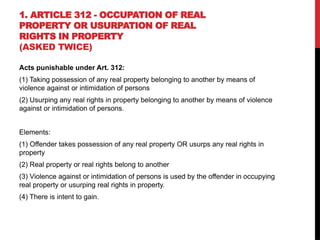
BOOK 2
I. Crimesagainst National Security
II. Crimes against Fundamental Laws of the State
III. Crimes against Public Order
IV. Crimes against Public Interest
V. Crimes relative to Opium and other Prohibited Drugs
VI. Crimes against Public Morals
VII. Crimes committed by Public Officers
VIII. Crimes against Persons
IX. Crimes against Personal Liberty and Security
X. Crimes against Property
XI. Crimes against Chastity
XII. Crimes against Civil Status
XIII. Crimes against Honor
XIV. Criminal Negligence
3.
TITLE I. CRIMESAGAINST
NATIONAL SECURITY AND THE
LAW OF NATIONS
CRIMES AGAINST SECURITY:
(1) Art. 114: Treason
(2) Art. 115: Conspiracy and Proposal to Commit Treason
(3) Art. 116: Misprision of Treason
(4) Art. 117: Espionage
CRIMES AGAINST THE LAW OF NATIONS
(1) Art. 118: Inciting to War or Giving Motives for Reprisals
(2) Art. 119: Violation of Neutrality
(3) Art. 120: Correspondence with Hostile Country
(4) Art. 121: Flight to Enemy‘s Country
(5) Art. 122: Piracy in General and Mutiny on the High Seas or in Philippine Waters
(6) Art. 123: Qualified Piracy
4.
TITLE I. CRIMESAGAINST NATIONAL
SECURITY AND THE LAW OF NATIONS
A. CRIMES AGAINST SECURITY
5.
A. CRIMES AGAINSTSECURITY
1. ARTICLE 114 – TREASON
MODE 1: Levying War Elements:
(1) The offender is a Filipino or resident alien
(2) There is a war in which the Philippines is involved
(3) The offender levies war against the government
MODE 2: Adherence to the Enemies Elements:
(1) The offender is a Filipino or resident alien
(2) There is a war in which the Philippines is involved
(3) That the offender adheres to the enemies, giving them aid
or comfort
6.
A. CRIMES AGAINSTSECURITY
2. ARTICLE 115 - CONSPIRACY AND PROPOSAL TO
COMMIT TREASON
Elements of conspiracy to commit treason:
(1) There is a war in which the Philippines is involved
(2) At least two persons come to an agreement to –
(a) Levy war against the government; or
(b) Adhere to the enemies, giving them aid or comfort
(3) That person proposes its execution to other persons
(4) They decide to commit it
Elements of proposal to commit treason
(1) There is a war in which the Philippines is involved
(2) At least one person decides to –
(a) Levy war against the government; or
(b) Adhere to the enemies, giving them aid or comfort
7.
A. CRIMES AGAINSTSECURITY
3. ARTICLE 116 - MISPRISION OF TREASON
(ASKED ONCE DURING 1994-96)
Elements:
(1) Offender owes allegiance to the government, and is not a
foreigner
(2) He has knowledge of conspiracy to commit treason against
the government
(3) He conceals or does not disclose and make known the same
as soon as possible to the governor or fiscal of the province in
which he resides, or the mayor or fiscal of the city in which he
resides
8.
A. CRIMES AGAINSTSECURITY
4. ARTICLE 117 – ESPIONAGE
MODE 1: By a private individual
Elements:
(1) That the offender enters a warship, fort, or naval or military
establishment or reservation
(2) That he has no authority therefor
(3) That his purpose is to obtain information, plans, photographs or
other data of a confidential nature relative to the defense of the Philippines
MODE 2: By a public officer
Elements:
(1) That the offender is a public officer
(2) That he has in his possession the articles, data or information
of a confidential nature relative to the defense of the Philippines, by
reason of the public office he holds
(3) That he discloses their contents to a representative of a foreign
nation
9.
TITLE I. CRIMESAGAINST NATIONAL
SECURITY AND THE LAW OF NATIONS
B. CRIMES AGAINST THE LAW OF
NATIONS
10.
A. CRIMES AGAINSTTHE LAW OF NATIONS
1. ARTICLE 118 - INCITING TO WAR OR GIVING
MOTIVES FOR REPRISALS
Elements:
(1) Offender performs unlawful or unauthorized acts
(2) The acts provoke or give occasion for :
(a) A war involving or liable to involve the Philippines; or
(b) Exposure of Filipino citizens to reprisals on their persons
or property
11.
A. CRIMES AGAINSTTHE LAW OF NATIONS
2. ARTICLE 119 - VIOLATION OF NEUTRALITY
Elements
(1) There is a war in which the Philippines is not involved
(2) There is a regulation issued by a competent authority to enforce
neutrality
(3) Offender violates the regulation
12.
A. CRIMES AGAINSTTHE LAW OF NATIONS
3. ARTICLE 120 - CORRESPONDENCE
WITH HOSTILE COUNTRY
Elements:
(1) It is in time of war in which the Philippines is involved
(2) Offender makes correspondence with an enemy country or territory
occupied by enemy troops
(3) The correspondence is either –
(a) Prohibited by the government
(b) Carried on in ciphers or conventional signs; or
(c) Containing notice or information which might be useful to the
enemy
13.
A. CRIMES AGAINSTTHE LAW OF NATIONS
4. ARTICLE 121 - FLIGHT TO ENEMY'S COUNTRY
Elements:
(1) There is a war in which the Philippines is involved
(2) Offender must be owing allegiance to the government
(3) Offender attempts to flee or go to enemy country
(4) Going to the enemy country is prohibited by competent authority
14.
A. CRIMES AGAINSTTHE LAW OF NATIONS
5. ARTICLE 122 - PIRACY IN GENERAL AND MUTINY ON
THE HIGH SEAS OR IN PHILIPPINE WATERS
Elements:
(1) The vessel is on the high seas or Philippine waters
(2) Offenders are neither members of its complement nor
passengers of the vessel
(3) Offenders either –
(a) Attack or seize that vessel; or
(b) Seize the whole or part of its cargo, its equipment or
personal belongings of its complement or passengers
(4) There is intent to gain
15.
A. CRIMES AGAINSTTHE LAW OF NATIONS
6. ARTICLE 123 - QUALIFIED PIRACY
(ASKED TWICE 1983-90; ONCE 2000-06)
Elements:
(1) The vessel is on the high seas or Philippine waters
(2) Offenders may or may not be members of its complement, or passengers
of the vessel
(3) Offenders either –
(a) Attack or seize the vessel; or
(b) Seize the whole or part of its cargo, its equipment, or
personal belongings of its crew or passengers
(4) The preceding were committed under any of the following
circumstances:
(a) Whenever they have seized a vessel by boarding or firing
upon the same;
(b) Whenever the pirates have abandoned their victims without
means of saving themselves; or
(c) Whenever the crime is accompanied by murder, homicide,
physical injuries or rape
TITLE II. CRIMESAGAINST
FUNDAMENTAL LAWS OF THE
STATE
(1) Art. 124: Arbitrary Detention
(2) Art. 125: Delay in the Delivery Of Detained Persons to the Proper Judicial
Authorities
(3) Art. 126: Delaying Release
(4) Art. 127: Expulsion
(5) Art. 128: Violation of Domicile
(6) Art.129: Search Warrants Maliciously Obtained and Abuse in the Service
of those Legally Obtained
(7) Art. 130: Searching Domicile Without Witnesses
(8) Art. 131: Prohibition, Interruption and Dissolution of Peaceful Meetings
(9) Art. 132: Interruption of Religious Worship
(10) Art. 133: Offending the Religious Feelings
18.
CRIMES AGAINST FUNDAMENTALLAWS OF THE STATE
1. ARTICLE 124 - ARBITRARY DETENTION
(ASKED TWICE 1975-82; ONCE 1991-93; ONCE 2000-06)
Elements:
(1) That the offender is a public officer or employee
(2) That he detains a person
(3) That the detention is without a legal ground
19.
CRIMES AGAINST FUNDAMENTALLAWS OF THE STATE
2. ARTICLE 125 - DELAY IN THE DELIVERY OF
DETAINED PERSONS TO THE PROPER JUDICIAL
AUTHORITIES
Elements:
(1) Offender is a public officer or employee
(2) He detains a person for some legal ground
(3) He fails to deliver such person to the proper judicial authorities
within –
(a) 12 hours for light penalties
(b) 18 hours for correctional penalties
(c) 36 hours for afflictive or capital
penalties
20.
CRIMES AGAINST FUNDAMENTALLAWS OF THE STATE
3. ARTICLE 126 - DELAYING RELEASE
Elements:
(1) Offender is a public officer or employee
(2) There is a:
(a) Judicial or executive order for the release of a prisoner
or detention prisoner, OR
(b) A proceeding upon a petition for the liberation of such
person
(3) Offender without good reason delays –
(a) The service of the notice of such order
to the prisoner
(b) The performance of such judicial or executive order
for the release of the prisoner; OR
(c) The proceedings upon a petition for the release of
such person
21.
Elements:
(1) Offender isa public officer or employee
(2) He either –
(a) Expels any person from the Philippines; OR
(b) Compels a person to change residence
(3) Offender is not authorized to do so by law
CRIMES AGAINST FUNDAMENTAL LAWS OF THE STATE
3. ARTICLE 127 - EXPULSION
22.
Acts punished:
(1) Enteringany dwelling against the will of the owner thereof
(2) Searching papers or other effects found therein without the previous consent of such owner, OR
(3) Refusing to leave the premises, after having surreptitiously entered said dwelling and after
having been required to leave the same
Elements COMMON to the three acts:
(1) Offender is a public officer or employee
(2) He is not authorized by judicial order –
(a) To enter the dwelling;
(b) To make a search therein for papers or other effects; or
(c) He refuses to leave, after having surreptitiously entered such dwelling and been
required to leave the same
Qualifying circumstances:
(1) Night time
(2) Papers or effects not constituting evidence of a crime are not returned immediately after
the search made by the offender
CRIMES AGAINST FUNDAMENTAL LAWS OF THE STATE
3. ARTICLE 128 – VIOLATION OF DOMICILE
23.
CRIMES AGAINST FUNDAMENTALLAWS OF THE STATE
6. ARTICLE 129 - SEARCH WARRANTS MALICIOUSLY
OBTAINED, AND ABUSE IN THE SERVICE OF THOSE
LEGALLY OBTAINED
Elements of procuring a search warrant without just cause:
(1) Offender is a public officer or employee
(2) He procures a search warrant
(3) There is no just cause
Elements of exceeding authority or using unnecessary
severity in executing a search warrant legally procured:
(1) Offender is a public officer or employee
(2) He has legally procured a search warrant
(3) He exceeds his authority or uses unnecessary severity in
executing the same
24.
CRIMES AGAINST FUNDAMENTALLAWS OF THE STATE
7. ARTICLE 130 - SEARCHING DOMICILE
WITHOUT WITNESSES
Elements:
(1) Offender is a public officer or employee
(2) He is armed with search warrant legally procured
(3) He searches the domicile, papers or other belongings of
any person
(4) The owner, or any members of his family, or two
witnesses residing in the same locality are not present
25.
CRIMES AGAINST FUNDAMENTALLAWS OF THE STATE
8. ARTICLE 131 - PROHIBITION,
INTERRUPTION AND DISSOLUTION
OF PEACEFUL MEETINGS
Elements:
(1) Offender is a public officer or employee
(2) He performs any of the following acts:
(a) Prohibiting or interrupting, without legal ground, the
holding of a peaceful meeting, or by dissolving the same
(b) Hindering any person from joining any lawful
association, or from attending any of its meetings
(c) Prohibiting or hindering any person from
addressing, either alone or together with others, any
petition to the authorities for the correction of abuses or
redress of grievances
26.
CRIMES AGAINST FUNDAMENTALLAWS OF THE STATE
9. ARTICLE 132 – INTERRUPTION
OF RELIGIOUS WORSHIP
Elements:
(1) Offender is a public officer or employee
(2) Religious ceremonies or manifestations of any religion
are about to take place or are going on
(3) Offender prevents or disturbs the same
27.
CRIMES AGAINST FUNDAMENTALLAWS OF THE STATE
10. ARTICLE 133 - OFFENDING THE
RELIGIOUS FEELINGS
Elements:
(1) Acts complained of were performed in a place devoted to
religious worship, OR during the celebration of any religious
ceremony
(2) The acts must be notoriously offensive to the feelings of
the faithful
28.
TITLE III. CRIMESAGAINST PUBLIC ORDER
(1) Article 134 - Rebellion/Insurrection
(2) Article 134-A - Coup d‘ État
(3) Article 135 - Penalty for Rebellion, Insurrection or Coup d‘ État
(4) Article 136 - Conspiracy and Proposal to Commit Coup d‘ État, Rebellion or Insurrection
(5) Article 137 - Disloyalty of Public Officers or Employees
(6) Article 138 - Inciting to Rebellion or Insurrection
(7) Article 139 – Sedition
(8) Article 141 - Conspiracy to Commit Sedition
(9) Article 142 – Inciting to Sedition
(10) Article 140 - Persons Liable for Sedition
(11) Article 143 - Acts Tending to Prevent the Meeting of the Congress of the Philippines and Similar Bodies
(12) Article 144 - Disturbance of Proceedings
(13) Article 145 - Violation of Parliamentary Immunity
(14) Article 146 - Illegal Assemblies
(15) Article 147 - Illegal Associations
(16) Article 148 - Direct Assault
(17) Article 149 - Indirect Assault
8) Article 150 - Disobedience to Summons Issued by Congress, Its Committees or Subcommittees, by the Constitutional Commissions, ItsCommittees,
Subcommittees or Divisions
(19) Article 153 - Tumults and Other Disturbances of Public Order
(20) Article 151 - Resistance and Disobedience to a Person in Authority or the Agents of Such Persons
(21) Article 154 - Unlawful Use of Means of Publication and Unlawful Utterances
(22) Article 156 - Delivering Persons from Jail
(23) Article 155 - Alarms and Scandals
(24) Article 157 - Evasion of Service of Sentence
(25) Article 159 - Other Cases of Evasion of Service of Sentence
(26) Article 158 - Evasion of Service of Sentence on the Occasion of Disorders, Conflagrations, Earthquakes, or Other Calamities
(27) Article 160 - Quasi Recidivism
29.
TITLE III. Crimesagainst
Public Order
A. Chapter I – Rebellion, Coup
d’etat, Sedition and Disloyalty
30.
CRIMES AGAINST PUBLICORDER
1. ARTICLE 134 - RÉBELLION /INSURRECTION
Elements:
(1) There is a public uprising and taking arms against the
government;
(2) The purpose of the uprising or movement is:
(a) To remove from the allegiance to the government or its
laws the Philippine territory or any part thereof, or any
body of land, naval, or other armed forces; or
(b) To deprive the Chief Executive or Congress, wholly
or partially, of any of their powers or prerogatives.
31.
REBELLION VS.
TREASON
Rebellion Treason
Thelevying of war against the
government during peace time for
any purpose mentioned in Art. 134
The levying of war against the
government would constitute
treason when performed to aid the
enemy; it would also constitute
adherence to the enemy, giving him
aid and comfort
Always involves taking up arms
against the government.
Mere adherence to the enemy
giving him aid and comfort
32.
REBELLION VS.
SUBVERSION
Rebellion Subversion
Crimeagainst pubic order Crime against national security
There must be public uprising to
overthrow the government
Being officers and ranking
members of subversive groups
constitute subversion
33.
REBELLION VS.
SEDITION
Rebellion Sedition
Theremust be taking up of arms
against the government.
It is sufficient that the public uprising
be tumultuous.
The purpose is always political. The purpose may be political or social.
34.
CRIMES AGAINST PUBLICORDER
2. ARTICLE 134-A - COUP D’ ÉTAT
(ASKED TWICE 1991-93 ; FOUR TIMES
1997-06)
Elements:
1. Offender is a person or persons belonging to the military
or police or holding any public office or employment;
2. It is committed by means of a swift attack accompanied
by violence, intimidation, threat, strategy or stealth;
3. The attack is directed against the duly constituted
authorities of the Republic of the Philippines, or any
military camp or installation, communication networks,
public utilities or other facilities needed for the exercise
and continued possession of power;
4. The purpose of the attack is to seize or diminish state
power.
35.
CRIMES AGAINST PUBLICORDER
3. ARTICLE 135 - PENALTY FOR REBELLION,
INSURRECTION OR COUP D’ ÉTAT
Persons liable for rebellion, insurrection or coup d'etat
1. The leaders:
a. Any person who promotes, maintains or heads a rebellion or insurrection; or
b. Any person who leads, directs or commands others to undertake a coup d'etat;
2. The participants:
(a) Any person who participates or executes the commands of others in rebellion or
insurrection;
(b) Any person in the government service who participates or executes directions
or commands of others in undertaking a coup d‘etat;
(c) Any person not in the government service who participates, supports, finances,
abets or aids in undertaking a coup d'etat.
If under the command of unknown leaders, any person who directed the others, spoke for
them, signed receipts and other documents issued in their name on behalf of the rebels shall
be deemed a leader.
36.
CRIMES AGAINST PUBLICORDER
4. ARTICLE 136 - CONSPIRACY AND
PROPOSAL TO COMMIT COUP D’
ÉTAT, REBELLION OR INSURRECTION
Mode 1: Conspiracy to commit coup d’état, rebellion or insurrection
Elements:
(1) Two or more persons come to an agreement to swiftly
attack or to rise publicly and take arms against the
Government for any of the purposes of rebellion or insurrection;
(2) They decide to commit it.
Mode 2: Proposal to commit coup d’état, rebellion or insurrection
Elements:
(1) A person has decided to swiftly attack or to rise publicly
and take arms against the Government for any of the
purposes of rebellion or insurrection;
(2) Such person proposes its execution to some other
person or persons.
37.
CRIMES AGAINST PUBLICORDER
5. ARTICLE 137 - DISLOYALTY OF
PUBLIC OFFICERS OR EMPLOYEES
Elements:
(1) Offender is a public officer or employee;
(2) Offender commits any of the following acts:
(a) Failing to resist a rebellion by all the means in their power;
(b) Continuing to discharge the duties of
their offices under the control of the rebels
(c) Accepting appointment to office under them.
38.
CRIMES AGAINST PUBLICORDER
6. ARTICLE 138 - INCITING TO
REBELLION OR INSURRECTION
Elements:
(1) Offender does not take arms or is not in open hostility
against the government;
(2) He incites others to the execution of any of the acts of
rebellion;
(3) The inciting is done by means of speeches,
proclamations, writings, emblems, banners or other
representations tending to the same end.
39.
INCITING TO REBELLIONVS.
PROPOSAL TO COMMIT
REBELLION
Proposal to Commit Rebellion Inciting to Rebellion
The offender induces another to
commit rebellion. Rebellion should
not be actually committed by the
persons to whom it is proposed or
who are incited. [Otherwise, they
become principals by inducement in
the crime of rebellion.]
The offender induces another to
commit rebellion. Rebellion should
not be actually committed by the
persons to whom it is proposed or
who are incited. [Otherwise, they
become principals by inducement in
the crime of rebellion.]
The person who proposes has
decided to commit rebellion.
There is no need that the offender
has decided to commit rebellion.
The person who proposes the
execution of the crime uses secret
means.
The act of inciting is done publicly.
40.
CRIMES AGAINST PUBLICORDER
7. ARTICLE 139 - SEDITION
(ASKED ONCE)
Elements:
(1) Offenders rise publicly and tumultuously;
(2) Offenders employ force, intimidation, or other means outside of legal
methods;
(3) Purpose is to attain any of the following objects:
(a) To prevent the promulgation or execution of any law or the holding of
any popular election;
(b) To prevent the national government or any provincial or municipal
government or any public officer from exercising its or his functions, or
prevent the execution of an administrative order;
(c) To inflict any act of hate or revenge upon the person or property of
any public officer or employee;
(d) To commit, for any political or social end, any act of hate or revenge
against private persons or any social classes;
(e) To despoil for any political or social end, any person, municipality or
province, or the national government of all its property or any part
thereof.
41.
SEDITION VS. COUP
D’ETAT
SeditionCoup d’etat
There is no distinction as to who
may commit; a private individual
may commit the offense
Offender belongs to the military or
police or holding any public office or
employment
Primary purpose is to disturb public
peace
To seize or to diminish state power
42.
SEDITION VS.
TREASON
Sedition Treason
Itis the raising of commotions or
disturbances in the State.
It is the violation by a subject of his
allegiance to his sovereign.
43.
CRIMES AGAINST PUBLICORDER
8. ARTICLE 140 - PERSONS LIABLE FOR SÉDITION
(1) The leader of the sedition;
(2) Other person participating in the sedition.
44.
CRIMES AGAINST PUBLICORDER
9. ARTICLE 141 - CONSPIRACY TO
COMMIT SEDITION
Elements:
(1) Two or more persons come to an agreement and a
decision to rise publicly and tumultuously to attain any of the
objects of sedition;
(2) They decide to commit it.
45.
CRIMES AGAINST PUBLICORDER
10. ARTICLE 142 – INCITING TO SEDITION
Mode 1. Inciting others to the accomplishment of any of the acts which constitute sedition by
means of speeches, proclamations, writings, emblems, etc. Elements:
(1) Offender does not take direct part in the crime of sedition;
(2) He incites others to the accomplishment of any of the acts which constitute sedition by means
of speeches, proclamations, writings, emblems, cartoons, banners, or other representations
tending towards the same end.
Mode 2. Uttering seditious words or speeches which tend to disturb the public peace; Mode 3.
Writing, publishing, or circulating scurrilous libels against the government or any of the duly
constituted authorities thereof, which tend to disturb the public peace.
Elements:
(1) Offender does not take part in the crime of sedition.
(2) He uttered words or speeches and writing, publishing or circulating scurrilous libels and that
(a) Tend to disturb or obstruct any lawful officer in conducting the functions of his office;
(b) Tend to instigate others to cabal and meet together for unlawful purposes;
(c) Suggest or incite rebellious conspiracies or riots; OR
(d) Lead or tend to stir up the people against the lawful authorities or to disturb the peace of the
community, the safety and order of the government
46.
TITLE III. Crimesagainst Public Order
B. CHAPTER II - CRIMES AGAINST POPULAR REPRESENTATION
47.
Crimes against PopularRepresentation
1. ARTICLE 143 - ACTS TENDING TO PREVENT THE
MEETING OF THE CONGRESS OF THE PHILIPPINES
AND SIMILAR BODIES
Elements:
(1) There is a projected or actual meeting of Congress or
any of its committees or subcommittees, constitutional
committees or divisions thereof, or of any provincial
board or city or municipal council or board;
(2) Offender, who may be any person, prevents such
meetings by force or fraud.
48.
Crimes against PopularRepresentation
2. ARTICLE 144 - DISTURBANCE OF
PROCEEDINGS
Elements:
(1) There is a meeting of Congress or any of its committees or
subcommittees, constitutional commissions or committees or
divisions thereof, or of any provincial board or city or municipal
council or board;
(2) Offender does any of the following acts:
(a) He disturbs any of such meetings;
(b) He behaves while in the presence of any such bodies in such a
manner as to interrupt its proceedings or to impair the respect due it.
49.
Crimes against PopularRepresentation
3. ARTICLE 145 - VIOLATION OF
PARLIAMENTARY IMMUNITY
Mode 1: Using force, intimidation, threats, or frauds to prevent any member of Congress from attending the meetings of
Congress or of any of its committees or subcommittees, constitutional commissions or committees or divisions thereof, or from
expressing his opinion or casting his vote;
Elements:
(1) Offender uses force, intimidation, threats or fraud;
(2) The purpose of the offender is to prevent any member of Congress from:
(a) Attending the meetings of the Congress or of any of its committees or constitutional commissions;
(b) Expressing his opinion; OR
(c) Casting his vote.
Note: Offender in mode 1 is any person
Mode 2: Arresting or searching any member thereof while Congress is in regular or special session, except in case such member
has committed a crime punishable under the Code by a penalty higher than prision mayor.
Elements:
(1) Offender is a public officer of employee;
(2) He arrests or searches any member of Congress;
(3) Congress, at the time of arrest or search, is in regular or special session;
(4) The member arrested or searched has not committed a crime punishable under the Code by a penalty higher than prision
mayor.
50.
TITLE III. Crimesagainst Public Order
C. CHAPTER III – ILLEGAL ASSEMBLIES AND ASSOCIATIONS
51.
ILLEGAL ASSEMBLIES ANDASSOCIATIONS
1. ARTICLE 146 - ILLÉGAL ASSEMBLIES
(ASKED ONCE 1983-86) (SEE RA 8294)
Mode 1: Any meeting attended by armed persons for the purpose of committing
any of the crimes punishable under the Code;
Elements:
(1) There is a meeting, a gathering or group of persons, whether in a fixed place or
moving;
(2) The meeting is attended by armed persons;
(3) The purpose of the meeting is to commit any of the crimes punishable under
the Code.
Mode 2: Any meeting in which the audience, whether armed or not, is incited to the
commission of the crime of treason, rebellion or insurrection, sedition, or assault
upon person in authority or his agents.
Elements:
(1) There is a meeting, a gathering or group of persons, whether in a fixed place or
moving;
(2) The audience, whether armed or not, is incited to the commission of the crime
52.
ILLEGAL ASSEMBLIES ANDASSOCIATIONS
2. ARTICLE 147 - ILLEGAL
ASSOCIATIONS
(1) Associations totally or partially organized for the
purpose of committing any of the crimes punishable
under the Code;
(2) Associations totally or partially organized for some
purpose contrary to public morals.
53.
ILLEGAL ASSEMBLIES VS.
ILLEGALASSOCIATIONS
Illegal Assembly Illegal Association
There must be an actual meeting or
assembly
Actual meeting not necessary
What is punished are the meeting
and the attendance therein
What is punished is the act of
forming or organizing the
association
Persons liable:
(1) Organizers or leaders of the
meeting
(2) Persons present at the meeting
Persons liable:
(1) Founders, directors, president
(2) The members
54.
TITLE III. Crimesagainst Public Order
D. CHAPTER IV - ASSAULT UPON AND
RESISTANCE AND DISOBEDIENCE TO,
PERSONS IN AUTHORITY AND THEIR AGENTS
55.
ASSAULT UPON ANDRESISTANCE AND DISOBEDIENCE TO, PERSONS IN
AUTHORITY AND THEIR AGENTS
1. ARTICLE 148 - DIRECT ASSAULT
(ASKED TWICE 1975-79; ONCE 1987-89; ONCE 2000-06)
Mode 1. Without public uprising, by employing force or intimidation for the attainment of any of the
purposes enumerated in defining the crimes of rebellion and sedition;
Elements:
(1) Offender employs force or intimidation;
(2) The aim of the offender is to attain any of the purposes of the crime of rebellion or any of the objects of
the crime of sedition;
(3) There is no public uprising.
Mode 2. Without public uprising, by attacking, by employing force or by seriously intimidating or by seriously
resisting any person in authority or any of his agents, while engaged in the performance of official duties, or
on occasion of such performance.
Elements:
(1) Offender makes an attack, employs force, makes a serious intimidation, or makes a serious resistance;
(2) The person assaulted is a person in authority or his agent;
(3) At the time of the assault, the person in authority or his agent is engaged in the actual performance of
official duties, OR that he is assaulted by reason of the past performance of official duties;
(4) Offender knows that the one he is assaulting is a person in authority or his agent in the exercise of his
duties.
(5) There is no public uprising.
56.
ASSAULT UPON ANDRESISTANCE AND DISOBEDIENCE TO, PERSONS IN
AUTHORITY AND THEIR AGENTS
2. ARTICLE 152 - PERSONS IN AUTHORITY AND
AGENTS OF PERSONS IN AUTHORITY
Public Officer
(Art. 207)
Persons in Authority
(Art. 152)
Agents of a Person in
Authority
(Art. 152)
Any person who takes
part in the performance
of public functions in
the government.
Any person directly
vested with jurisdiction,
whether as an
individual or as a
member of some court
or governmental
corporation, board or
commission.
Any person who, by
direct provision of law
or by election or by
appointment by
competent authority, is
charged with the
maintenance of public
order and the
protection and security
of life and property.
57.
ASSAULT UPON ANDRESISTANCE AND DISOBEDIENCE
TO, PERSONS IN AUTHORITY AND THEIR AGENTS
3. ARTICLE 149 - INDIRECT ASSAULT
Elements:
(1) A person in authority or his agent is the victim of any of
the forms of direct assault defined in Article 148;
(2) A person comes to the aid of such authority or his agent;
(3) Offender makes use of force or intimidation upon such
person coming to the aid of the authority or his agent.
58.
ASSAULT UPON ANDRESISTANCE AND DISOBEDIENCE TO, PERSONS IN AUTHORITY AND THEIR
AGENTS
4. ARTICLE 150 - DISOBEDIENCE TO SUMMONS ISSUED BY CONGRESS, ITS
COMMITTEES OR SUBCOMMITTEES, BY THE CONSTITUTIONAL COMMISSIONS,
ITS COMMITTEES, SUBCOMMITTEES OR DIVISIONS
Mode 1. By refusing, without legal excuse, to obey summons of Congress, its special or
standing committees and subcommittees, the Constitutional Commissions and its committees,
subcommittees or divisions, or by any commission or committee chairman or member
authorized to summon witnesses;
Mode 2. By refusing to be sworn or placed under affirmation while being before such legislative
or constitutional body or official;
Mode 3. By refusing to answer any legal inquiry or to produce any books, papers, documents, or
records in his possession, when required by them to do so in the exercise of their functions;
Mode 4. By restraining another from attending as a witness in such legislative or constitutional
body;
Mode 5. By inducing disobedience to a summons or refusal to be sworn by any such body or
official.
59.
ASSAULT UPON ANDRESISTANCE AND DISOBEDIENCE TO, PERSONS IN AUTHORITY AND THEIR
AGENTS
5. ARTICLE 151 - RESISTANCE AND DISOBEDIENCE TO A
PERSON IN AUTHORITY OR THE AGENTS OF SUCH PERSONS
(ASKED ONCE 1979-82; TWICE 2000-06)
Mode 1: Resistance and serious disobedience
Elements:
(1) A person in authority or his agent is engaged in the performance of official duty or gives
a lawful order to the offender;
(2) Offender resists or seriously disobeys such person in authority or his agent;
(3) The act of the offender is not included in the provision of Articles 148, 149 and 150.
Mode 2: Simple disobedience
Elements:
(1) An agent of a person in authority is engaged in the performance of official duty or gives
a lawful order to the offender;
(2) Offender disobeys such agent of a person in authority;
(3) Such disobedience is not of a serious nature.
60.
SERIOUS DISOBEDIENCE
VS. DIRECTASSAULT
Serious Disobedience Direct Assault
Person in authority or his agent
must be in actual performance of
his duties
The person in authority or his agent
must be engaged in the
performance of official duties or that
he is assaulted
Committed only by resisting or
seriously disobeying a person in
authority or his agent
Committed in four ways (see Art.
148, Mode 2 above)
Use of force is not so serious There is force employed
61.
TITLE III. Crimesagainst Public Order
E. CHAPTER V - PUBLIC DISORDERS
62.
Public Disorders
1. ARTICLE153 - TUMULTS AND OTHER DISTURBANCES
OF PUBLIC ORDER
Mode 1: Causing any serious disturbance in a public place, office or
establishment;
Mode 2: Interrupting or disturbing performances, functions or gatherings,
or peaceful meetings, if the act is not included in Arts. 131 and 132;
Mode 3: Making any outcry tending to incite rebellion or sedition in any
meeting, association or public place;
Mode 4: Displaying placards or emblems which provoke a disturbance of
public order in such place;
Mode 5: Burying with pomp the body of a person who has been legally
executed.
63.
Public Disorders
2. ARTICLE154 - UNLAWFUL USE OF
MEANS OF PUBLICATION AND
UNLAWFUL UTTERANCES
Mode 1. Publishing or causing to be published, by means of printing, lithography
or any other means of publication, as news any false news which may endanger
the public order, or cause damage to the interest or credit of the State.
Mode 2. Encouraging disobedience to the law or to the constituted authorities or
praising, justifying or extolling any act punished by law, by the same means or by
words, utterances or speeches;
Mode 3: Maliciously publishing or causing to be published any official document or
resolution without proper authority, or before they have been published officially
Mode 4: Printing, publishing or distributing (or causing the same) books,
pamphlets, periodicals, or leaflets which do not bear the real printer’s name, or
which are classified as anonymous.
64.
Public Disorders
3. ARTICLE155 - ALARMS AND
SCANDALS
Mode 1: Discharging any firearm, rocket, firecracker, or other explosive
within any town or public place, calculated to cause (which produces)
alarm or danger;
Mode 2: Instigating or taking an active part in any charivari or other
disorderly meeting offensive to another or prejudicial to public tranquillity;
Mode 3: Disturbing the public peace while wandering about at night or
while engaged in any other nocturnal amusements;
Mode 4: Causing any disturbances or scandal in public places while
intoxicated or otherwise, provided Art. 153 is not applicable.
65.
Public Disorders
4. ARTICLE156 - DELIVERING
PERSONS FROM JAIL
(ASKED ONCE 1987-89; ONCE 2000-06)
Elements:
(1) There is a person confined in a jail or penal
establishment;
(2) Offender removes therefrom such person, or helps the
escape of such person.
66.
TITLE III. Crimesagainst Public Order
F. CHAPTER VI - EVASION OF SERVICE OF SENTENCE
67.
Evasion of Serviceof Sentence
1. ARTICLE 157 - EVASION OF
SERVICE OF SENTENCE
(ASKED ONCE 1975-79; ONCE 1987-90)
Elements:
(1) Offender is a convict by final judgment;
(2) He is serving sentence which consists in the deprivation of
liberty;
(3) He evades service of his sentence by escaping during the term
of his imprisonment.
68.
Evasion of Serviceof Sentence
2. ARTICLE 158 - EVASION OF SERVICE OF SENTENCE
ON THE OCCASION OF DISORDERS,
CONFLAGRATIONS, EARTHQUAKES, OR OTHER
CALAMITIES
Elements:
(1) Offender is a convict by final judgment, who is confined in a penal institution;
(2) There is disorder, resulting from –
(a) conflagration;
(b) earthquake;
(c) explosion;
(d) similar catastrophe; or
(e) mutiny in which he has not participated;
(3) He evades the service of his sentence by leaving the penal institution where he is
confined, on the occasion of such disorder or during the mutiny;
(4) He fails to give himself up to the authorities within 48 hours following the issuance of
a proclamation by the Chief Executive announcing the passing away of such calamity.
69.
Evasion of Serviceof Sentence
3. ARTICLE 159 - OTHER CASES OF
EVASION OF SERVICE OF SENTENCE
Elements:
(1) Offender was a convict;
(2) He was granted a conditional pardon by the Chief
Executive;
(3) He violated any of the conditions of such pardon.
70.
VIOLATION OF CONDITIONALPARDON VS.
EVASION OF SERVICE OF SENTENCE BY
ESCAPING
Violation of Conditional
Pardon
Evasion of Service of
Sentence
Does not cause harm or injury
to the right of another person
nor does it disturb the public
order; merely an infringement of
the stipulated terms in
conditional pardon
An attempt at least to evade the
penalty inflicted by the courts
upon criminals and thus defeat
the purpose of the law of either
reforming or punishing them for
having disturbed the public
order.
71.
TITLE III. Crimesagainst Public Order
G. CHAPTER VII - COMMISSION OF ANOTHER
CRIME DURING SERVICE OF PENALTY
IMPOSED FOR ANOTHER PREVIOUS OFFENSE
72.
COMMISSION OF ANOTHERCRIME DURING
SERVICE OF PENALTY IMPOSED FOR ANOTHER
PREVIOUS OFFENSE
1. ARTICLE 160 - QUASI RECIDIVISM
Elements:
(1) Offender was already convicted by final judgment of one
offense;
(2) He committed a new felony before beginning to serve
such sentence or while serving the same.
Acts of Counterfeiting
(1)Article 162 - Using Forged Signature or Counterfeit Seal or Stamp
(2) Article 161 - Counterfeiting the Great Seal of the Government of the Philippine Islands, Forging the Signature or Stamp of the Chief Executive
(3) Article 164 - Mutilation of Coins
(4) Article 163 - Making and Importing and Uttering False Coins
(5) Article 165 - Selling of False or Mutilated Coin, Without Connivance
(6) Article 167 - Counterfeiting, Importing, and Uttering Instruments Not Payable to Bearer
(7) Article 166 - Forging Treasury or Bank Notes or Other Documents Payable to Bearer; Importing and Uttering Such False or Forged Notes and Documents
Acts of Forgery
(1) Article 168 - Illegal Possession and Use of False Treasury or Bank Notes and Other Instruments of Credit
(2) Article 169 - How Forgery is Committed
Acts of Falsification
(1) Article 170 - Falsification of Legislative Documents
(2) Article 171 - Falsification by Public Officer, Employee or Notary or Ecclesiastical Minister
(3) Article 172 - Falsification by Private Individual and Use of Falsified Documents
(4) Article 173 - Falsification of Wireless, Cable, Telegraph and Telephone Messages, and Use of Said Falsified Messages
(5) Article 175 - Using False Certificates
(6) Article 174 - False Medical Certificates, False Certificates of Merits or Service, etc.
(7) Article 176 - Manufacturing and Possession of Instruments or Implements for Falsification
Other Falsities
(1) Article 177 - Usurpation of Authority or Official Functions
(2) Article 179 - Illegal Use of Uniforms and Insignia
(3) Article 178 - Using Fictitious and Concealing True Name
(4) Article 180 - False Testimony Against a Defendant
(5) Article 181 - False Testimony Favorable to the Defendant
(6) Article 182 - False Testimony in Civil Cases
(7) Article 184 - Offering False Testimony in Evidence
(8) Article 183 - False Testimony in Other Cases and Perjury in Solemn Affirmation
(9) Article 185 - Machinations in Public Auctions
1. ARTICLE 161- COUNTERFEITING THE
GREAT SEAL OF THE GOVERNMENT OF
THE PHILIPPINE ISLANDS, FORGING THE
SIGNATURE OR STAMP OF THE CHIEF
EXECUTIVE
Acts punished: Forging the
(1) Great Seal of the Government of the Philippines;
(2) Signature of the President;
(3) Stamp of the President.
77.
2. ARTICLE 162- USING
FORGED SIGNATURE OR
COUNTERFEIT SEAL OR STAMP
Elements:
(1) The great Seal of the Republic was counterfeited OR the
Signature or stamp of the Chief Executive was forged by
another person;
(2) Offender Knew of the counterfeiting or forgery;
(3) He Used the counterfeit seal or forged signature or stamp.
78.
3. ARTICLE 163- MAKING
AND IMPORTING AND
UTTERING FALSE COINS
Elements:
(1) There be False or counterfeited coins;
(2) Offender either Made, imported or uttered such coins;
(3) In case of uttering such false or counterfeited coins, he
Connived with the counterfeiters or importers.
79.
4. ARTICLE 164-
MUTILATION OF COINS
Acts punished
(1) Mutilating coins of the legal currency, with the further
requirement that there be intent to damage or to defraud
another;
(2) Importing or uttering such mutilated coins, with the
further requirement that there must be connivance with the
mutilator or importer in case of uttering.
80.
5. ARTICLE 165- SELLING OF
FALSE OR MUTILATED COIN,
WITHOUT CONNIVANCE
Mode 1: Possession of coin, counterfeited or mutilated by another
person, with intent to utter the same, knowing that it is false or
mutilated; Elements:
(1) Possession;
(2) With Intent to utter; and
(3) Knowledge.
Mode 2: Actually uttering such false or mutilated coin, knowing the
same to be false or mutilated. Elements:
(1) Actually uttering; and
(2) Knowledge.
81.
TO BEARER; IMPORTINGAND
UTTERING SUCH FALSE OR
FORGED NOTES AND
DOCUMENTS
Acts punished
(1) Forging or falsification of treasury or bank notes or other
documents payable to bearer;
(2) Importation of such false or forged obligations or notes;
(3) Uttering of such false or forged obligations or notes in
connivance with the forgers or importers.
82.
7. ARTICLE 167- COUNTERFEITING,
IMPORTING, AND UTTERING
INSTRUMENTS NOT PAYABLE TO
BEARER
Elements:
(1) There is an Instrument payable to order or other
document of credit not payable to bearer;
(2) Offender either Forged, imported or uttered such
instrument;
(3) In case of uttering, he Connived with the forger or
importer.
POSSESSION AND USEOF
FALSE TREASURY OR
BANK NOTES AND OTHER
INSTRUMENTS OF CREDIT
Elements:
(1) Any treasury or bank note or certificate or other obligation and
security:
(a) Payable to bearer, or any instrument payable to
order or other document of credit not payable to bearer is
(b) Forged or falsified by another person;
(2) Offender Knows that any of those instruments is forged or falsified;
(3) He either –
(a) Uses any of such forged or falsified instruments; or
(b) Possesses with intent to use any
85.
2. ARTICLE 169- HOW
FORGERY IS COMMITTED
(1) By Giving to a treasury or bank note or any instrument
payable to bearer or to order mentioned therein, the
appearance of a true and genuine document;
(2) By Erasing, substituting, counterfeiting, or altering by any
means the figures, letters, words, or sign contained therein.
1. ARTICLE 170-
FALSIFICATION OF
LEGISLATIVE DOCUMENTS
Elements:
(1) There is a Bill, resolution or ordinance enacted or
approved or pending approval by either House of the
Legislature or any provincial board or municipal council;
(2) Offender Alters the same;
(3) He has No proper authority therefor;
(4) The alteration has Changed the meaning of the
documents.
88.
DISTINCTION BETWEEN
FALSIFICATION AND
FORGERY:
FALSIFICATIONFORGERY
Commission of any of the 8 acts
mentioned in Art 171 on legislative
(only alteration), public or official
commercial, or private documents,
or wireless,
Refers to the falsification and
counterfeiting of treasury or bank
notes, or any instruments payable,
or to order
Crimes under Forgeries. Crimes under Forgeries.
89.
2. ARTICLE 171- FALSIFICATION BY
PUBLIC OFFICER, EMPLOYEE OR NOTARY
OR ECCLESIASTICAL MINISTER
(ASKED 8 TIMES)
Elements:
(1) Offender is a Public officer, employee, or notary public;
(2) He Takes advantage of his official position;
(3) He falsifies a document by committing any of the following acts:
(a) Counterfeiting or imitating any handwriting, signature or rubric;
(b) Causing it to appear that persons have participated in any act or proceeding when they did not
in fact so participate;
(c) Attributing to persons who have participated in an act or proceeding statements other than
those in fact made by them;
(d) Making untruthful statements in a narration of facts;
(e) Altering true dates;
(f) Making any alteration or intercalation in a genuine document which changes its meaning;
(g) Issuing in an authenticated form:
(i) A document purporting to be a copy of an original document
(ii) When no such original exists, or
(iii) Including in such a copy a statement contrary to, or different from, that of the genuine original;
(h) Intercalating any instrument or note relative to the issuance thereof in a protocol, registry, or
official book.
90.
PAR 1 PAR2 PAR 3 PAR 4
May be a genuine
(later falsified) or
an entirely
fabricated
document
May be a genuine
(later falsified) or
an entirely
fabricated
document
May be a genuine
(later falsified) or
an entirely
fabricated
document
May be a genuine
(later falsified) or
an entirely
fabricated
document
91.
3. ARTICLE 172- FALSIFICATION BY PRIVATE INDIVIDUAL
AND USE OF FALSIFIED DOCUMENTS
(ASKED 6 TIMES)
Mode 1: Falsification of public, official or commercial document by a private individual;
Elements:
(1) Offender is a Private individual OR Public officer or employee who did not take advantage of his official position;
(2) He committed any act of Falsification (Art. 171);
(3) The falsification was committed in a public, official, or commercial Document or letter of exchange.
Mode 2: Falsification of private document by any person;
Elements:
(1) Offender committed any of the acts of Falsification except Article 171(7), that is,
(a) Issuing in an authenticated form a document purporting to be a copy of an original document when no such original exists, or
(b) Including in such a copy a statement contrary to, or different from, that of the genuine original;
(2) Falsification was committed in any Private document;
(3) Falsification causes Damage to a third party or at least the falsification was committed with intent to cause such damage.
Mode 3: Use of falsified document.
Elements in introducing in a judicial proceeding
(1) Offender Knew that the document was falsified by another person;
(2) The False document is in Articles 171 or 172 (1 or 2);
(3) He Introduced said document in evidence in any judicial proceeding.
Elements in use in any other transaction –
(1) Offender Knew that a document was falsified by another person;
(2) The False document is embraced in Articles 171 or 172 (1 or 2);
(3) He Used such document;
92.
4. ARTICLE 173- FALSIFICATION OF
WIRELESS, CABLE, TELEGRAPH AND
TELEPHONE MESSAGES, AND USE OF
SAID FALSIFIED MESSAGES
Mode 1: Uttering fictitious wireless, telegraph or telephone message;
Elements:
(1) Offender is an officer or employee of the government or an officer or employee of a private corporation,
engaged in the service of sending or receiving wireless, cable or telephone message;
(2) He utters fictitious wireless, cable, telegraph or telephone message.
Mode 2: Falsifying wireless, telegraph or telephone message;
Elements:
(1) Offender is an officer or employee of the government or an officer or employee of a private corporation,
engaged in the service of sending or receiving wireless, cable or telephone message;
(2) He falsifies wireless, cable, telegraph or telephone message.
Mode 3: Using such falsified message.
Elements:
(1) Offender knew that wireless, cable, telegraph, or telephone message
(a) Was falsified by an officer or employee of the government or an officer or employee of a private corporation,
(b) Engaged in the service of sending or receiving wireless, cable or telephone message;
(2) He used such falsified dispatch;
(3) The use resulted in the prejudice of a third party or at least there was intent to cause such prejudice.
93.
5. ARTICLE 174- FALSE MEDICAL
CERTIFICATES, FALSE CERTIFICATES
OF MERITS OR SERVICE, ETC.
Persons liable
(1) Physician or surgeon who, in connection with the practice of his profession, issues a false
certificate (it must refer to the illness or injury of a person);
Note: The crime here is false medical certificate by a physician.
(2) Public officer who issues a false certificate of merit of service, good conduct or similar
circumstances;
Note: The crime here is false certificate of merit or service by a public officer.
(3) Private person who falsifies a certificate falling within the classes mentioned in the two
preceding subdivisions.
Note: The crime here is false medical certificate by a private individual or false certificate of merit
or service by a private individual.
94.
6. ARTICLE 175- USING
FALSE CERTIFICATES
Elements:
(1) The following Issues a false certificate:
(a) Physician or surgeon, in connection with the practice of his profession,
issues a false Medical certificate;
(b) Public officer issues a false certificate of Merit of service, good conduct or
similar circumstances;
(c) Private Person falsifies a certificate falling within the 2 preceding
subdivisions.
(2) Offender Knows that the certificate was false;
(3) He Uses the same.
95.
7. ARTICLE 176- MANUFACTURING AND
POSSESSION OF INSTRUMENTS OR
IMPLEMENTS FOR FALSIFICATION
Acts punished:
(1) Making or introducing into the Philippines any stamps,
dies, marks, or other instruments or implements for
counterfeiting or falsification;
(2) Possession with intent to use the instruments or
implements for counterfeiting or falsification made in or
introduced into the Philippines by another person.
1. ARTICLE 177- USURPATION OF
AUTHORITY OR OFFICIAL
FUNCTIONS
Mode 1: Usurpation of authority. (no connection with the office represented) The mere act of knowingly
and falsely representing oneself to be an officer is sufficient. It is not necessary that he perform an act
pertaining to a public officer.
Elements:
(1) Offender knowingly and falsely Represents himself;
(2) As an Officer, agent or representative of any department or agency of the Philippine government or of
any foreign government.
Mode 2: Usurpation of official functions. (excess of authority) In usurpation of official functions, it is
essential that the offender should have performed an act pertaining to a person in authority or public
officer, in addition to other requirements.
Elements
(1) Offender Performs any act;
(2) Pertaining to any person in authority or public officer of the Philippine government or any foreign
government, or any agency thereof;
(3) Under Pretense of official position;
(4) Without being lawfully entitled to do so.
98.
2. ARTICLE 178- USING FICTITIOUS
AND CONCEALING TRUE NAME
Mode 1: Using fictitious name
Elements:
(1) Offender uses a name other than his real name;
(2) He uses the fictitious name publicly;
(3) Purpose of use is to conceal a crime, to evade the execution of a
judgment or to cause damage [to public interest – Reyes].
Mode 2: Concealing true name
Elements:
(1) Offender conceals his true name and other personal circumstances;
(2) Purpose is only to conceal his identity.
99.
Fictitious Name ConcealingTrue Name
Element of Publicity Publicity not necessary
Purpose is to conceal a crime,
evade execution of judgment,
cause damage)
Merely to conceal identity.
100.
3. ARTICLE 179- ILLEGAL USE
OF UNIFORMS AND INSIGNIA
Elements:
(1) Offender makes Use of insignia, uniforms or dress;
(2) The insignia, uniforms or dress pertains to an Office not
held by such person or a class of persons of which he is not a
member;
(3) Said insignia, uniform or dress is Used publicly and
improperly.
101.
4. ARTICLE 180- FALSE
TESTIMONY AGAINST A
DEFENDANT
Elements:
(1) There is a Criminal proceeding;
(2) Offender Testifies falsely under oath against the
defendant therein;
(3) Offender who gives false testimony Knows that it is false.
(4) Defendant against whom the false testimony is given is
either acquitted or convicted in a Final judgment.
102.
5. ARTICLE 181- FALSE TESTIMONY
FAVORABLE TO THE DEFENDANT
Elements:
(1) A person Gives false testimony;
(2) In Favor of the defendant;
(3) In a Criminal case.
103.
6. ARTICLE 182- FALSE
TESTIMONY IN CIVIL CASES
Elements:
(1) Testimony Given in a civil case;
(2) Testimony Relates to the issues presented in said case;
(3) Testimony is False;
(4) Offender Knows that testimony is false;
(5) Testimony is Malicious
(6) And given with an intent to affect the issues presented in
said case.
104.
7. ARTICLE 183- FALSE TESTIMONY
IN OTHER CASES AND PERJURY IN
SOLEMN AFFIRMATION
Acts Punished
(1) By falsely Testifying under oath;
(2) By Making a false affidavit.
105.
“Material” “Relevant” “Pertinent”
Directedto prove a fact
in issue
Tends in any reasonable
degree to establish
probability or
improbability of a fact in
issue
Concerns collateral
matters which make
more or less probable
the proposition at issue
106.
8. ARTICLE 184- OFFERING
FALSE TESTIMONY IN
EVIDENCE
Elements:
(1) Offender Offers in evidence a false witness or testimony;
(2) He Knows that the witness or the testimony was false;
(3) The offer is made in any Judicial OR Official proceeding.
107.
9. ARTICLE 185- MACHINATIONS
IN PUBLIC AUCTIONS
Mode 1: Soliciting any gift or promise as a consideration for refraining from taking part in any public
auction;
Elements:
(1) There is a Public auction;
(2) Offender Solicits any gift or a promise from any of the bidders;
(3) Such gift or promise is the Consideration for his refraining from taking part in that public
auction;
(4) Offender has the Intent to cause the reduction of the price of the thing auctioned.
Mode 2: Attempting to cause bidders to stay away from an auction by threats, gifts, promises or any
other artifice.
Elements:
(1) There is a Public auction;
(2) Offender Attempts to cause the bidders to stay away from that public auction;
(3) It is Done by threats, gifts, promises or any other artifice;
(4) Offender had the Intent to cause the reduction of the price of the thing auctioned.
108.
10. ARTICLE 186– MONOPOLIES
AND COMBINATIONS IN RESTRAINT
OF TRADE
Mode 1: Combination to prevent free competition in the market
Elements:
(1) Entering into any contract or agreement; OR taking part in any conspiracy or combination in the form of a trust or
otherwise;
(2) In restraint of trade or commerce or to prevent by artificial means free competition in the market
Mode 2: Monopoly to restrain free competition in the market Elements:
(1) Monopolizing any merchandise or object of trade or commerce; OR
(2) Combining with any other person or persons to monopolize said merchandise or object in order to alter the prices
thereof by spreading false rumors or making use of any other artifice to restrain free competition in the market
Mode 3: Manufacturer, producer, or processor or importer combining, conspiring or agreeing with any person to
make transactions prejudicial to lawful commerce or to increase the market price of merchandise
Elements:
(1) Person liable: (1) manufacturer, (2) producer, (3) processor, or (4) importer of any merchandise or object of
commerce
(2) Crime committed by: (1) combining, (2) conspiring, or (3) agreeing with any person
(3) Purpose: (1) to make transactions prejudicial to lawful commerce, or (2) to increase the market price of any
merchandise or object of commerce manufactured, produced, processed, assembled, or imported into the
Philippines
109.
11. ARTICLE 187– IMPORTATION AND DISPOSITION
OF FALSELY MARKED ARTICLES OR MERCHANDISE
MADE OF GOLD, SILVER, OR OTHER PRECIOUS
METALS OR THEIR ALLOYS
Elements:
(1) Offender imports, sells or disposes of any of those articles
or merchandise (i.e. gold, silver, other precious metals or
their alloys)
(2) The stamps, brands, or marks of those articles of
merchandise fail to indicate the actual fineness or quality of
said metals or alloys
(3) Offender knows that the stamps, brands, or marks fail to
indicate the actual fineness or quality of the metals or alloys
110.
TITLE V.
CRIMES RELATIVETO OPIUM AND
OTHER PROHIBITED DRUGS
NOTE: ART 190-194 WERE REPEALED BY
RA 6425, KNOWN AS THE ―DANGEROUS
DRUG ACT OF 1972.‖ RA NO. 9165,
KNOWN AS THE ―COMPREHENSIVE
DANGEROUS DRUG ACT OF 2002 IN
‖
TURN REPEALED RA NO. 6425.
111.
A. ACTS PUNISHED
(1)Importation of Dangerous Drugs and/or Controlled Precursors and Essential
Chemical (Sec. 4)
(
2) Sale, Trading, Administration, Dispensation, Delivery, Distribution and Transportation
of Dangerous Drugs and/or Controlled Precursors and Essential Chemicals (Sec. 5)
(3) Maintenance of a Den, Dive or Resort. (Sec. 6)
(4) Employees and Visitors of a Den, Dive or Resort (Sec. 7)
(5) Manufacture of Dangerous Drugs and/or Controlled Precursors and Essential
Chemicals (Sec. 8)
(6) Illegal Chemical Diversion of Controlled Precursors and Essential Chemicals. (Sec. 9)
(7) Manufacture or Delivery of Equipment, Instrument, Apparatus, and Other
Paraphernalia for Dangerous Drugs and/or Controlled Precursors and Essential
Chemicals. (Sec. 10)
112.
A. ACTS PUNISHED
(8)Possession of Dangerous Drugs (Sec. 11)
9) Possession of Equipment, Instrument, Apparatus and Other Paraphernalia for Dangerous Drugs
(Sec. 12)
(10) Possession of Dangerous Drugs During Parties, Social Gatherings or Meetings (Sec. 13)
(11) Possession of Equipment, Instrument, Apparatus and Other Paraphernalia for Dangerous Drugs
During Parties, Social Gatherings or Meetings (Sec. 14)
(12) Use of Dangerous Drugs (Sec. 15)
(13) Cultivation or Culture of Plants Classified as Dangerous Drugs or are Sources Thereof. (Sec. 16)
(14) Maintenance and Keeping of Original Records of Transactions on Dangerous Drugs and/or
Controlled Precursors and Essential Chemicals (Sec. 17)
(15) Unnecessary Prescription of Dangerous Drugs (Sec. 18)
113.
B. PENALTIES FOR
UNLAWFULACTS
(1) The penalty of life imprisonment to death and a fine ranging from
Five hundred thousand pesos (P500,000.00) to Ten million pesos
(P10,000,000.00) - Those acts which include or involve any dangerous
drugs (Sections 4, 5, 6, 8, 11, 16 and 19)
(2) The penalty of twelve (12) years and one (1) day to twenty (20) years
of imprisonment and a fine ranging from One hundred thousand pesos
(P100,000.00) to Five hundred thousand pesos (P500,000.00)
(a) Those acts which involve any controlled precursor and essential
chemical (Sections 4, 5, 6, 8, 9 and 10)
(b) Anyone who acts as a "protector/coddler" of any violator of the
provisions under sections 4, 5, 6, 8 and 16
(c) Sections 7, 10, 16, 17.
114.
B. PENALTIES FOR
UNLAWFULACTS
(3) The maximum penalty provided for under sections 4, 5, 6,
8 and 16 shall be imposed upon any person, who organizes,
manages or acts as a "financier" of any of the illegal
activities prescribed in those sections.
(4) Any person charged under any provision of this Act
regardless of the imposable penalty shall not be allowed to
avail of the provision on plea-bargaining. Section 23, Article
II, RA 9165
115.
C. DEFINITION OF
IMPORTANTTERMS
Dangerous drugs: include those listed
(1) in the Schedules annexed to the 1961 Single Convention
on Narcotic Drugs, as amended by the 1972 Protocol, and
(2) in the Schedules annexed to the 1971 Single Convention
on Psychotropic Substances as enumerated in the attached
annex which is an integral part of this Act. [Section 3 (j), RA
9165]
116.
C. DEFINITION OF
IMPORTANTTERMS
Chemical Diversion: The sale, distribution, supply or
transport of legitimately imported, in-transit, manufactured or
procured controlled precursors and essential chemicals, in
diluted, mixtures, or in concentrated form, to any person or
entity engaged in the manufactured of any dangerous drugs,
and shall include packaging, labelling, or concealment of
such transaction.
Controlled Precursors and Essential Chemicals: Include
those listed in Tables I and II of the 188 UN Convention
Against Illicit traffic in Narcotics Drugs and Psychotropic
Substances.
117.
D. OTHER IMPORTANT
POINTS
Maya drug dependent who is found guilty of the use of dangerous drugs
voluntarily submit himself for treatment and rehabilitation? Yes. The drug
dependent may, by himself/herself or through his/her parent, spouse,
guardian or relative within the fourth degree of consanguinity or affinity,
apply to the Board or its duly recognized representative, for treatment and
rehabilitation of the drug dependency. Upon such application, the Board
shall bring forth the matter to the Court which shall order that the applicant
be examined for drug dependency (Section 54, Article VIII, RA 9165).
Is there also compulsory confinement? Yes. Notwithstanding any law, rule
and regulation to the contrary, any person determined and found to be
dependent on dangerous drugs shall, upon petition by the Board or any of
its authorized representative, be confined for treatment and rehabilitation
in any Center duly designated or accredited for the purpose.
A petition for the confinement of a person alleged to be dependent on
dangerous drugs to a Center may be filed by any person authorized by the
Board with the Regional Trial Court of the province or city where such
person is found. (Section 61, Article VIII, RA 9165).
118.
D. OTHER IMPORTANTPOINTS
How long will the drug dependent be confined for treatment and
rehabilitation? Confinement in a Center for treatment and rehabilitation
shall not exceed one (1) year, after which time the Court, as well as
the Board, shall be apprised by the head of the treatment and
rehabilitation center of the status of said drug dependent and
determine whether further confinement will be for the welfare of the
drug dependent and his/her family or the community (Section 54,
Article VIII, RA 9165).
How will a drug dependent who is under the voluntary submission
program and is finally discharged from confinement in the Center be
exempt from criminal liability?
(1) He/she has complied with the rules and regulations of the center,
the applicable rules and regulations of the Board, including the after-
care and follow-up program for at least eighteen (18) months following
temporary discharge from confinement in the Center
(2) He/she has never been charged or convicted of any offense
punishable under this Act, the Dangerous Drugs Act of 1972 or
Republic Act No. 6425, as amended; the Revised Penal Code, as
amended; or any special penal laws
(3) He/she has no record of escape from a Center
(4) He/she poses no serious danger to himself/herself, his/her family
119.
D. OTHER IMPORTANT
POINTS
Whatare the functions of the Dangerous Drugs Board?
(1) Be the policy-making and strategy-formulating body in the planning
and formulation of policies and programs on drug prevention and
control.
(2) Develop and adopt a comprehensive, integrated, unified and
balanced national drug abuse prevention and control strategy.
(3) Be under the Office of the President. (Section 77, Article IX, RA 9165)
What is the PDEA? The PDEA is the Philippine Drug Enforcement
Agency. It serves as the implementing arm of the Dangerous Drugs
Board. It shall be responsible for the efficient and effective law
enforcement of all the provisions on any dangerous drug and/or
controlled precursor and essential chemical as provided in this Act.
(Section 82, Article IX, RA 916)
1. ARTICLE 195- WHAT ACTS ARE PUNISHABLE IN
GAMBLING
Acts punished:
(1) Taking part directly or indirectly in –
(a) any game of monte, jueteng, or any other form of lottery, policy, banking, or
percentage game, dog races, or any other game or scheme the results of which depend
wholly or chiefly upon chance or hazard; or wherein wagers consisting of money, articles
of value, or representative of value are made; or
(b) the exploitation or use of any other mechanical invention or contrivance to determine
by chance the loser or winner of money or any object or representative of value;
(2) Knowingly permitting any form of gambling to be carried on in any place owned or
controlled by the offender;
(3) Being maintainer, conductor, or banker in a game of jueteng or similar game;
(4) Knowingly and without lawful purpose possessing lottery list, paper, or other matter
containing letters, figures, signs or symbol which pertain to or are in any manner used in
the game of jueteng or any similar game.
124.
IMPORTATION, SALE AND
POSSESSIONOF LOTTERY
TICKETS OR
ADVERTISEMENTS
Acts punished:
(1) Importing into the Philippines from any foreign place or
port any lottery ticket or advertisement; or
(2) Selling or distributing the same in connivance with the
importer;
(3) Possessing, knowingly and with intent to use them,
lottery tickets or advertisements; or
(4) Selling or distributing the same without connivance with
the importer of the same.
125.
3. ARTICLE 197– BETTING
IN SPORTS CONTENTS
This article (Art. 197) has been repealed by Presidential
Decree No. 483 (Betting, Game-fixing or Point-shaving and
Machinations in Sport Contests)
Sec 2. Betting, game-fixing, point-shaving or game
machination unlawful. – Game-fixing, point-shaving, game
machination, as defined in the preceding section, in
connection with the games of basketball, volleyball, softball,
baseball; chess, boxing bouts, jai-alia, sipa, pelota and all
other sports contests, games or races; as well as betting
therein except as may be authorized by law, is hereby
declared unlawful.
126.
4. ARTICLE 198- ILLEGAL
BETTING ON HORSE RACE
Acts punished:
(1) Betting on horse races during periods not allowed by law;
(2) Maintaining or employing a totalizer or other device or
scheme for betting on races or realizing profit therefrom
during the periods not allowed by law.
127.
5. ARTICLE 199(AS
AMENDED BY PD 449)
Acts Punished:
(1) Any person who, directly or indirectly, participates in cockfights
by betting money or other valuable things in a day other than those
permitted by law.
(2) Any person, who, directly or indirectly, organizes cockfights at
which bets are made in a day other than those permitted by law.
(3) Any person, directly or indirectly, participates in cockfights, by
betting money or other valuable things at a place other than a
licensed cockpit.
(4) Any person, who, directly or indirectly, organizes cockfights at
which bets are made at a place other than a licensed cockpit.
(5) Owner, manager, or lessee of the cockpit who shall permit
gambling of any kind on the premises of the cockpit or place of
cockfighting during cockfights.
1. ARTICLE 200-
GRAVE SCANDAL
Elements:
(1) Offender performs an act or acts;
(2) Such act or acts be highly scandalous as offending
against decency or good customs;
(3) The highly scandalous conduct is not expressly falling
within any other article of this Code; and
(4) The act or acts complained of be committed in a public
place or within the public knowledge or view.
130.
2. ARTICLE 201- IMMORAL DOCTRINES, OBSCENE
PUBLICATIONS AND EXHIBITIONS AND INDECENT
SHOWS
Acts punished (as amended by PD No. 960, 969)
(1) Those who shall publicly expound or proclaim doctrines openly contrary to public morals;
(2) The authors of obscene literature, published with their knowledge in any form,
(3) The editors publishing such literature;
(4) The owners/operators of the establishment selling the same;
(5) Those who, in theatres, fairs, cinematographs, or any other place, exhibit indecent or
immoral plays, scenes, acts, or shows,
6) Those who shall sell, give away or exhibit films, prints, engravings, sculpture or literature
which are offensive to morals.
it being understood that the obscene literature or indecent or immoral plays, scenes, acts or
shows, whether live or in film, which are proscribed by virtue hereof, shall include those which:
(a) glorify criminals or condone crimes;
(b) serve no other purpose but to satisfy the market for violence, lust or pornography;
(c) offend any race, or religion;
(d) tend to abet traffic in and use of prohibited drugs; and
(e) are contrary to law, public order, morals, good customs, established policies, lawful orders,
decrees and edicts
(
131.
3. ARTICLE 202- VAGRANCY
AND PROSTITUTION
Persons Liable:
(1) Any person having no apparent means of subsistence, who has the
physical ability to work and who neglects to apply himself or herself to
some lawful calling;
(2) Any person found loitering about public or semi-public buildings or
places or trampling or wandering about the country or the streets
without visible means of support;
(3) Any idle or dissolute person who lodges in houses of ill fame;
ruffians or pimps and those who habitually associate with prostitutes;
(4) Any person who, not being included in the provisions of other
articles of this Code, shall be found loitering in any inhabited or
uninhabited place belonging to another without any lawful or
justifiable purpose; and
(5) Prostitutes
Chapter 1: PreliminaryProvisions
(1) Article 203 - Who Are Public Officers
Chapter 2: Malfeasance and Misfeasance in Office
(1) Article 204 - Knowingly Rendering Unjust Judgment
(2) Article 205 - Judgment Rendered Through Negligence
(3) Article 206 - Unjust Interlocutory Order
(4) Article 207 - Malicious Delay in the Administration of Justice
(5) Article 208 - Prosecution of Offenses; Negligence and Tolerance
(6) Article 209 - Betrayal of Trust by an Attorney or a Solicitor -
Revelation of Secrets
(7) Article 210 - Direct Bribery
(8) Article 211 - Indirect Bribery
(9) Article 211-A - Qualified Bribery
(10) Article 212 - Corruption of Public Officials
(11) Article 214 - Other Frauds
134.
Chapter 3: Fraudsand Illegal Exactions and Transactions
(1) Article 213 - Fraud against the Public Treasury and Similar Offenses
(2) Article 215 - Prohibited Transactions
(3) Article 216 - Possession of Prohibited Interest by a Public Officer
Chapter 4: Malversation of Public Funds and Properties
(1) Article 217 - Malversation of Public Funds or Property - Presumption of Malversation
(2) Article 218 - Failure of Accountable Officer to Render Accounts
(3) Article 219 - Failure of a Responsible Public Officer to Render Accounts Before
Leaving the Country
(4) Article 220 - Illegal Use of Public Funds or Property
(5) Article 221 - Failure to Make Delivery of Public Funds or Property
(6) Article 222 - Officers Included in the Preceding Provisions
Chapter 5: Infidelity of Public Officers
(1) Article 223 - Conniving With or Consenting to Evasion
(2) Article 224 - Evasion through Negligence
(3) Article 225 - Escape of Prisoner under the Custody of a Person Not a Public Officer
135.
Chapter 6: OtherOffenses and Irregularities by Public Officers
(1) Article 231 - Open Disobedience
(2) Article 232 - Disobedience to the Order of Superior Officer When Said Order Was
Suspended by Inferior Officer
(3) Article 233 - Refusal of Assistance
(4) Article 234 - Refusal to Discharge Elective Office
(5) Article 235 - Maltreatment of Prisoners
(6) Article 236 - Anticipation of Duties of a Public Officer
(7) Article 237 - Prolonging Performance of Duties and Powers
(8) Article 238 - Abandonment of Office or Position
(9) Article 239 - Usurpation of Legislative Powers
(10) Article 240 - Usurpation of Executive Functions
(11) Article 241 - Usurpation of Judicial Functions
(12) Article 242 - Disobeying Request for Disqualification
(13) Article 243 - Orders or Request by Executive Officer to Any Judicial Authority
(14) Article 244 - Unlawful Appointments
(15) Article 245 - Abuses against Chastity
136.
CHAPTER I: PRELIMINARY
PROVISIONS
Article203 - Who Are Public Officers
Requisites:
(1) Taking part in the performance of public functions in the
government;
(2) Performing in said government or in any of its branches public
duties as an employee, agent or subordinate official, or any rank or
class;
(3) His authority to take part in the performance of public functions or
to perform public duties must be –
(a) By direct provision of the law;
(b) By popular election; or
(c) By appointment by competent authority.
137.
CHAPTER II: MALFEASANCE
ANDMISFEASANCE IN
OFFICE
Malfeasance (see Arts 210 and 211) Doing of an act which a
public officer should not have done
Misfeasance (see Arts 204 to 207) Improper doing of an
act which a person might lawfully do
Nonfeasance (see Art 208) Failure of an agent to perform
his undertaking for the principal
138.
1. ARTICLE 204- KNOWINGLY
RENDERING UNJUST JUDGMENT
Elements:
(1) Offender is a judge;
(2) He renders a judgment in a case submitted to him for
decision;
(3) Judgment is unjust;
(4) The judge knows that his judgment is unjust.
139.
2. ARTICLE 205- JUDGMENT
RENDERED THROUGH
NEGLIGENCE
Elements:
(1) Offender is a judge;
(2) He renders a judgment in a case submitted to him for
decision;
(3) The judgment is manifestly unjust;
(4) It is due to his inexcusable negligence or ignorance.
140.
3. ARTICLE 206- UNJUST
INTERLOCUTORY ORDER
Elements:
(1) Offender is a judge;
(2) He performs any of the following acts:
(a) Knowingly rendering an unjust interlocutory
order or decree; or
(b) Rendering a manifestly unjust interlocutory
order or decree through inexcusable negligence or
ignorance.
141.
4. ARTICLE 207- MALICIOUS
DELAY IN THE
ADMINISTRATION OF JUSTICE
Elements:
(1) Offender is a judge;
(2) There is a proceeding in his court;
(3) He delays in the administration of justice;
(4) The delay is malicious, that is, with deliberate intent to
inflict damage on either party in the case.
142.
5. ARTICLE 208- PROSECUTION
OF OFFENSES; NEGLIGENCE
AND TOLERANCE
Mode 1. Maliciously refraining from instituting prosecution against
violators of the law;
Mode 2. Maliciously tolerating the commission of offenses.
Elements:
(1) Offender is a public officer or officer of the law who has a duty to
cause the prosecution of, or to prosecute, offenses;
(2) There is a dereliction of the duties of his office, that is, knowing the
commission of the crime, he does not cause the prosecution of the
criminal, or knowing that a crime is about to be committed, he tolerates
its commission;
(3) Offender acts with malice and deliberate intent to favor the violator
of the law.
143.
BETRAYAL OF TRUSTBY
AN ATTORNEY OR A
SOLICITOR – REVELATION
OF SECRETS
Elements:
(1) Causing damage to his client, either—
(a) By any malicious breach of professional duty;
(b) By inexcusable negligence or ignorance.
(2) Revealing any of the secrets of his client learned by him in his
professional capacity (damage is not necessary);
(3) Undertaking the defense of the opposing party in the same
case, without the consent of his first client,
(a) after having undertaken the defense of said first client,
or
(b) after having received confidential information from
said client.
144.
7. ARTICLE 210- DIRECT BRIBERY
(ASKED 6 TIMES)
Mode 1. Agreeing to perform, or performing, in consideration of any offer, promise,
gift or present; an act constituting a crime, in connection with the performance of
his official duties;
Mode 2. Accepting a gift in consideration of the execution of an act which does not
constitute a crime, in connection with the performance of his official duty;
Mode 3. Agreeing to refrain, or by refraining, from doing something which is his
official duty to do, in consideration of gift or promise.
Elements:
(1) Offender is a public officer within the scope of Article 203;
(2) Offender accepts an offer or a promise or receives a gift or present by himself or
through another;
(3) Such offer or promise be accepted, or gift or present received by the public
officer
(a) With a view to committing some crime; or
(b) In consideration of the execution of an act which does not
constitute a crime, but the act must be unjust; or
(c) To refrain from doing something which it is his official duty to do.
(4) The act which offender agrees to perform or which he executes be connected
with the performance of his official duties.
145.
8. ARTICLE 211- INDIRECT
BRIBERY
(ASKED TWICE)
Elements:
(1) Offender is a public officer;
(2) He accepts gifts;
(3) The gifts are offered to him by reason of his office.
146.
9. ARTICLE 211-A-
QUALIFIED BRIBERY
Elements:
(1) Offender is a public officer entrusted with law
enforcement;
(2) He refrains from arresting or prosecuting an offender who
has committed a crime punishable by reclusion perpetua
and/or death;
(3) Offender refrains from arresting or prosecuting in
consideration of any offer, promise, gift, or present.
147.
10. ARTICLE 212- CORRUPTION
OF PUBLIC OFFICIALS
(ASKED 4 TIMES)
Elements:
(1) Offender makes offers or promises or gives gifts or
presents to a public officer;
(2) The offers or promises are made or the gifts or presents
given to a public officer, under circumstances that will make
the public officer liable for direct bribery or indirect bribery.
148.
C. CHAPTER III:FRAUDS AND ILLEGAL
EXACTIONS AND TRANSACTIONS
149.
AGAINST THE PUBLIC
TREASURYAND SIMILAR
OFFENSES
(ASKED TWICE)
Mode 1 Entering into an agreement with any interested party or speculator or
making use of any other scheme, to defraud the government, in dealing with
any person with regard to furnishing supplies, the making of contracts, or the
adjustment or settlement of accounts relating to public property or funds;
Mode 2 Demanding, directly or indirectly, the payment of sums different from
or larger than those authorized by law, in collection of taxes, licenses, fees,
and other imposts;
Mode 3 Failing voluntarily to issue a receipt, as provided by law, for any sum
of money collected by him officially, in the collection of taxes, licenses, fees
and other imposts;
Mode 4 Collecting or receiving, directly or indirectly, by way of payment or
otherwise, things or objects of a nature different from that provided by law, in
the collection of taxes, licenses, fees and other imposts.
150.
1. ARTICLE 213- FRAUD AGAINST
THE PUBLIC TREASURY AND
SIMILAR OFFENSES
Elements of Fraud against Public Treasury (par.1):
(1) That the offender is a public officer
(2) That he should have taken advantage of his public office,
that is, he intervened in the transaction in his official capacity
(3) That he entered into an agreement with any interested party
or speculator or made use of any other scheme with regard to:
(a) Furnishing supplies
(b) The making of contracts
(c) The adjustment or settlement of accounts relating
to public property or funds
151.
1. ARTICLE 213- FRAUD AGAINST
THE PUBLIC TREASURY AND
SIMILAR OFFENSES
Elements of Illegal Exactions (par.2.):
(1) That the offender is a public officer entrusted with the collection
of taxes, licenses, fees and other imports;
(2) He is guilty of the following acts or omissions:
(a) Demanding directly or indirectly, the payment of sums
of different from or larger than those authorized by law;
(b) Failing voluntarily to issue a receipt as provided by law,
for ay sum of money collected by him officially; or
(c) Collecting or receiving, directly or indirectly, by way of
payment or otherwise, things or object of a nature different from
that provided by law
152.
2. ARTICLE 214-
OTHER FRAUDS
Elements:
(1) Offender is a public officer;
(2) He takes advantage of his official position;
(3) He commits any of the frauds or deceits enumerated in
Article 315 to 318 (estafa, other forms of swindling, swindling
a minor, other deceits).
153.
3. ARTICLE 215-
PROHIBITED TRANSACTIONS
Elements:
(1) Offender is an appointive public officer;
(2) He becomes interested, directly or indirectly, in any transaction
of exchange or speculation;
(3) The transaction takes place within the territory subject to his
jurisdiction;
(4) He becomes interested in the transaction during his
incumbency.
154.
4. ARTICLE 216- POSSESSION
OF PROHIBITED INTEREST BY
A PUBLIC OFFICER
Persons liable:
(1) Public officer who, directly or indirectly, became interested in any
contract or business in which it was his official duty to intervene;
(2) Experts, arbitrators, and private accountants who, in like manner,
took part in any contract or transaction connected with the estate or
property in the appraisal, distribution or adjudication of which they
had acted;
(3) Guardians and executors with respect to the property belonging
to their wards or the estate.
OF PUBLIC FUNDSOR
PROPERTY - PRESUMPTION OF
MALVERSATION
(ASKED 14 TIMES)
Mode 1. Appropriating public funds or property;
Mode 2. Taking or misappropriating the same;
Mode 3. Consenting, or through abandonment or negligence,
permitting any other person to take such public funds or
property; and
Mode 4. Being otherwise guilty of the misappropriation or
malversation of such funds or property.
157.
1. ARTICLE 217- MALVERSATION OF
PUBLIC FUNDS OR PROPERTY -
PRESUMPTION OF MALVERSATION
Elements common to all modes:
(1) Offender is a public officer;
(2) He had the custody or control of funds or property by reason of
the duties of his office;
(3) Those funds or property were public funds or property for which
he was accountable;
(4) He appropriated, took, misappropriated or consented or, through
abandonment or negligence, permitted another person to take them.
158.
Malversation (Art. 217)Estafa with Abuse of Confidence (Art.
315)
1. Funds or property usually public 1. Funds/property are always private
2. Offender is usually a public officer
who is accountable for the public
funds/property
2. Offender is a private individual or
even a public officer who is not
accountable for public funds/property
3. Crime is committed by
appropriating, taking, or
misappropriating/consenting or
through abandonment or negligence,
permitting any other person to take the
public funds/property
3. Crime is committed by
misappropriating, converting, or
denying having received money,
goods or other personal property
4. No element of damage. 4. There is damage.
5. Demand not necessary. 5. There is a need for prior demand.
159.
2. ARTICLE 218- FAILURE OF
ACCOUNTABLE OFFICER TO
RENDER ACCOUNTS
Elements:
(1) Offender is public officer, whether in the service or separated
therefrom by resignation or any other cause;
(2) He is an accountable officer for public funds or property;
(3) He is required by law or regulation to render account to the
Commission on Audit, or to a provincial auditor;
(4) He fails to do so for a period of two months after such accounts
should be rendered.
160.
PUBLIC OFFICER TO
RENDERACCOUNTS
BEFORE LEAVING THE
COUNTRY
Elements:
(1) Offender is a public officer;
(2) He is an accountable officer for public funds or property;
(3) He unlawfully leaves or attempts to leave the Philippine
Islands without securing a certificate from the Commission
on Audit showing that his accounts have been finally settled.
161.
4. ARTICLE 220- ILLEGAL
USE OF PUBLIC FUNDS OR
PROPERTY
Elements:
(1) Offender is a public officer;
(2) There are public funds or property under his
administration;
(3) Such fund or property were appropriated by law or
ordinance;
(4) He applies such public fund or property to any public use
other than for which it was appropriated for.
162.
Malversation
(Art. 217)
Technical
malversation (Art.
220)
Theoffender
misappropriates public funds
or property for his own
personal use, or allows any
other person to take such
funds or property for the
latter‘s own personal use.
The public officer applies the
public funds or property
under his administration to
another public use different
from that for which the
public fund was
appropriated by law or
ordinance.
163.
5. ARTICLE 221- FAILURE TO
MAKE DELIVERY OF PUBLIC
FUNDS OR PROPERTY
Mode 1. Failing to make payment by a public officer
who is under obligation to make such payment
from government funds in his possession;
Mode 2. Refusing to make delivery by a public
officer who has been ordered by
competent authority to deliver any property in his
custody or under his administration.
164.
5. ARTICLE 221- FAILURE TO
MAKE DELIVERY OF PUBLIC
FUNDS OR PROPERTY
Elements:
(1) Public officer has government funds in his possession;
(2) He is under obligation to either:
(a) make payment from such funds;
(b) to deliver any property in his custody or under
his administration
(3) He maliciously fails to make the payment or refuses to
make delivery.
(4) He maliciously fails to make the payment.
165.
6. ARTICLE 222- OFFICERS
INCLUDED IN THE
PRECEDING PROVISIONS
(1) Private individual who, in any capacity, have charge of
any national, provincial or municipal funds, revenue, or
property
(2) Administrator or depositary of funds or property that has
been attached, seized or deposited by public authority, even
if owned by a private individual.
1. ARTICLE 223- CONNIVING
WITH OR CONSENTING TO
EVASION
Elements:
(1) Offender is a public officer;
(2) He had in his custody or charge a prisoner, either
detention prisoner or prisoner by final judgment;
(3) Such prisoner escaped from his custody;
168.
4. ARTICLE 226- REMOVAL,
CONCEALMENT, OR
DESTRUCTION OF DOCUMENTS
Elements:
(1) Offender is a public officer;
(2) He abstracts, destroys or conceals a document or papers;
(3) Said document or papers should have been entrusted to
such public officer by reason of his office;
(4) Damage, whether serious or not, to a third party or to the
public interest has been caused.
169.
5. ARTICLE 227- OFFICER
BREAKING SEAL
Elements:
(1) Offender is a public officer;
(2) He is charged with the custody of papers or property;
(3) These papers or property are sealed by proper authority;
(4) He breaks the seal or permits them to be broken.
170.
6. ARTICLE 228- OPENING
OF CLOSED DOCUMENTS
Elements:
(1) Offender is a public officer;
(2) Any closed papers, documents, or objects are entrusted
to his custody;
(3) He opens or permits to be opened said closed papers,
documents or objects;
(4) He does not have proper authority.
171.
7. ARTICLE 229- REVELATION
OF SECRETS BY AN OFFICER
Mode 1. Revealing any secrets known to the offending public
officer by reason of his official capacity;
Elements:
(1) Offender is a public officer;
(2) He knows of a secret by reason of his official capacity;
(3) He reveals such secret without authority or justifiable
reasons;
(4) Damage, great or small, is caused to the public interest.
172.
7. ARTICLE 229- REVELATION
OF SECRETS BY AN OFFICER
Mode 2. Wrongfully delivering papers or copies of papers of
which he may have charge and which should not be published.
Elements:
(1) Offender is a public officer;
(2) He has charge of papers;
(3) Those papers should not be published;
(4) He delivers those papers or copies thereof to a third person;
(5) The delivery is wrongful;
(6) Damage is caused to public interest.
173.
Revelation Of
Secrets ByAn Officer
(Art. 229)
Removal,
Concealment or
Destruction of
Documents
(Art. 226)
The papers contain secrets
and therefore should not be
published, and the public
officer having charge
thereof removes and
delivers them wrongfully to
a third person.
The papers do not contain
secrets but their removal is
for an illicit purpose.
174.
8. ARTICLE 230- PUBLIC
OFFICERS REVEALING SECRETS
OF PRIVATE INDIVIDUALS
Elements:
(1) Offender is a public officer;
(2) He knows of the secrets of a private individual by reason
of his office;
(3) He reveals such secrets without authority or justifiable
reason.
1. ARTICLE 231- OPEN
DISOBEDIENCE
Elements:
(1) Officer is a judicial or executive officer;
(2) There is a judgment, decision or order of a superior authority;
(3) Such judgment, decision or order was made within the scope of
the jurisdiction of the superior authority and issued with all the
legal formalities;
(4) He, without any legal justification, openly refuses to execute
the said judgment, decision or order, which he is duty bound to
obey.
177.
2. ARTICLE 232- DISOBEDIENCE TO
THE ORDER OF SUPERIOR OFFICER
WHEN SAID ORDER WAS SUSPENDED
BY INFERIOR OFFICER
Elements:
(1) Offender is a public officer;
(2) An order is issued by his superior for execution;
(3) He has for any reason suspended the execution of such
order;
(4) His superior disapproves the suspension of the execution
of the order;
(5) Offender disobeys his superior despite the disapproval of
the suspension.
178.
3. ARTICLE 233- REFUSAL
OF ASSISTANCE
Elements:
(1) Offender is a public officer;
(2) A competent authority demands from the offender that he
lend his cooperation towards the administration of justice or
other public service;
(3) Offender maliciously fails to do so.
179.
4. ARTICLE 234- REFUSAL TO
DISCHARGE ELECTIVE
OFFICE
Elements:
(1) Offender is elected by popular election to a public office;
(2) He refuses to be sworn in or to discharge the duties of
said office;
(3) There is no legal motive for such refusal to be sworn in or
to discharge the duties of said office.
180.
5. ARTICLE 235-
MALTREATMENT OF
PRISONERS
Elements:
(1) Offender is a public officer or employee;
(2) He has under his charge a prisoner or detention prisoner;
(3) He maltreats such prisoner in either of the following manners:
(a) By overdoing himself in the correction or handling
of a prisoner or detention prisoner under his charge either
i. By the imposition of punishment not
authorized by the regulations;
ii. By inflicting such punishments (those
authorized) in a cruel and humiliating manner;
(b) By maltreating such prisoners to extort a confession
or to obtain some information from the prisoner.
181.
6. ARTICLE 236-
ANTICIPATION OF DUTIES OF
A PUBLIC OFFICER
Elements:
(1) Offender is entitled to hold a public office or employment,
either by election or appointment;
(2) The law requires that he should first be sworn in and/or
should first give a bond;
(3) He assumes the performance of the duties and powers of
such office;
(4) He has not taken his oath of office and/or given the bond
required by law.
182.
7. ARTICLE 237-
PROLONGING PERFORMANCE
OF DUTIES AND POWERS
Elements:
(1) Offender is holding a public office;
(2) The period provided by law, regulations or special
provision for holding such office, has already expired;
(3) He continues to exercise the duties and powers of such
office.
183.
8. ARTICLE 238-
ABANDONMENT OF OFFICE
OR POSITION
Elements:
(1) Offender is a public officer;
(2) He formally resigns from his position;
(3) His resignation has not yet been accepted;
(4) He abandons his office to the detriment of the public
service.
184.
Abandonment of Officeor
Position (Art. 238)
Dereliction of Duty
(Art. 208)
Committed by any public
officer
Committed only by public
officers who have the duty
to institute prosecution for
the punishment of
violations of the law
There is actual
abandonment through
resignation to evade the
discharge of duties.
Public officer does not
abandon his office but
merely fails to prosecute a
violation of the law.
185.
9. ARTICLE 239-
USURPATION OF
LEGISLATIVE POWERS
Elements:
(1) Offender is an executive or judicial officer;
(2) That he:
(a) makes general rules or regulations beyond the scope of
his authority; or
(b) attempts to repeal a law; or
(c) suspends the execution thereof.
186.
10. ARTICLE 240-
USURPATION OF EXECUTIVE
FUNCTIONS
Elements:
(1) Offender is a judge;
(2) That he:
(a) assumes a power pertaining to the
executive authorities, or
(b) obstructs the executive authorities in the
lawful exercise of their powers.
187.
11. ARTICLE 241-
USURPATION OF JUDICIAL
FUNCTIONS
Elements:
(1) Offender is an officer of the executive branch of the
government;
(2) That he:
(a) assumes judicial powers, or
(b) obstructs the execution of any order or decision rendered
by any judge within his jurisdiction.
188.
12. ARTICLE 242-
DISOBEYING REQUEST FOR
DISQUALIFICATION
Elements:
(1) Offender is a public officer;
(2) A proceeding is pending before such public officer;
(3) There is a question brought before the proper authority
regarding his jurisdiction, which is not yet decided;
(4) He has been lawfully required to refrain from continuing
the proceeding;
(5) He continues the proceeding.
189.
13. ARTICLE 243- ORDERS OR
REQUEST BY EXECUTIVE OFFICER
TO ANY JUDICIAL AUTHORITY
Elements:
(1) Offender is an executive officer;
(2) He addresses any order or suggestion to any judicial
authority;
(3) The order or suggestion relates to any case or business
coming within the exclusive jurisdiction of the courts of
justice.
190.
14. ARTICLE 244-
UNLAWFUL APPOINTMENTS
Elements:
(1) Offender is a public officer;
(2) He nominates or appoints a person to a public office;
(3) Such person lacks the legal qualifications therefore;
(4) Offender knows that his nominee or appointee lacks the
qualification at the time he made the nomination or
appointment.
191.
15. ARTICLE 245- ABUSES
AGAINST CHASTITY
Mode 1. Soliciting or making immoral or indecent advances to
a woman interested in matters pending before
the offending officer for decision, or with
respect to which he is required to submit a
report to or consult with a superior officer;
Mode 2. Soliciting or making immoral or indecent advances to
a woman under the offender’s custody;
Mode 3. Soliciting or making immoral or indecent advances
to the wife, daughter, sister or relative within
the same degree by affinity of any person in the
custody of the offending warden or officer.
192.
15. ARTICLE 245- ABUSES
AGAINST CHASTITY
Elements:
(1) Offender is a public officer;
(2) He solicits or makes immoral or indecent advances to a woman;
(3) Such woman is –
(a) interested in matters pending before the offender
for decision, or with respect to which he is required to submit a
report to or consult with a superior officer; or
(b) under the custody of the offender who is a warden
or other public officer directly charged with the care and custody of
prisoners or persons under arrest; or
(c) the wife, daughter, sister or relative within the same
degree by affinity of the person in the custody of the offender.
1. ARTICLE 246- PARRICIDE
(ASKED 10 TIMES)
Elements:
(1) Person is killed;
(2) Deceased is killed by the accused;
(3) Deceased is the
(a) legitimate/illegitimate father
(b) legitimate/illegitimate mother
(c) legitimate/illegitimate child
* should not be less than 3 days old, otherwise crime is
infanticide
(d) other legitimate ascendant
(e) other legitimate descendant
(F) legitimate spouse
198.
2. ARTICLE 247- DEATH OR
PHYSICAL INJURIES UNDER
EXCEPTIONAL CIRCUMSTANCES
(ASKED 8 TIMES)
Elements:
(1) A legally married person, or a parent, surprises his
spouse or his daughter, the latter under 18 years of age
and living with him, in the act of sexual intercourse with
another person;
(2) He or she kills any or both of them, or inflicts upon
any or both of them any serious physical injury in the act
or immediately thereafter;
(3) He has not promoted or facilitated the prostitution of his
wife or daughter, or that she has not consented to the
infidelity of the other spouse.
199.
3. ARTICLE 248- MURDER
(ASKED 20 TIMES)
Elements:
(1) Person was killed;
(2) Accused killed him;
(3) Killing attended by any of the following qualifying circumstances –
(a) with treachery, taking advantage of superior strength, with the aid of armed
men, or employing means to weaken the defense, or of means or persons to
insure or afford impunity;
(b) in consideration of a price, reward or promise;
(c) by means of inundation, fire, poison, explosion, shipwreck, stranding of a
vessel, derailment or assault upon a railroad, fall of an airship, by means of motor
vehicles, or with the use of any other means involving great waste and ruin;
(d) on occasion of any of the calamities enumerated in the preceding
paragraph, or of an earthquake, eruption of a volcano, destructive cyclone,
epidemic, or any other public calamity;
(e) with evident premeditation;
(f) with cruelty, by deliberately and inhumanly augmenting the suffering of the
victim, or outraging or scoffing at his person or corpse.
(4) The killing is not parricide or infanticide.
200.
4. ARTICLE 249- HOMICIDE
(ASKED 16 TIMES)
Elements:
(1) Person was killed;
(2) Offender killed him without any justifying circumstances;
(3) Offender had the intention to kill, which is presumed;
(4) Killing was not attended by any of the qualifying
circumstances of murder, or by that of parricide or
infanticide
201.
5. ARTICLE 250- PENALTY FOR
FRUSTRATED PARRICIDE, MURDER OR
HOMICIDE
Courts may impose a penalty:
(1) 2 degrees lower for frustrated parricide, murder, or
homicide
(2) 3 degrees lower for attempted parricide, murder, or
homicide.
202.
6. ARTICLE 251- DEATH
CAUSED IN TUMULTUOUS
AFFRAY
Elements:
(1) There are several persons;
(2) They do not compose groups organized for the common
purpose of assaulting and attacking each other reciprocally;
(3) These several persons quarrelled and assaulted one another in
a confused and tumultuous manner;
(4) Someone was killed in the course of the affray;
(5) It cannot be ascertained who actually killed the deceased;
(6) The person or persons who inflicted serious physical injuries
or who used violence can be identified.
203.
7. ARTICLE 252- PHYSICAL
INJURIES CAUSED IN
TUMULTUOUS AFFRAY
Elements:
(1) There is a tumultuous affray;
(2) A participant or some participants thereof suffered
serious physical injuries or physical injuries of a less serious
nature only;
(3) The person responsible thereof cannot be identified;
(4) All those who appear to have used violence upon the
person of the offended party are known.
204.
8. ARTICLE 253- GIVING
ASSISTANCE TO SUICIDE
Mode 1: Assisting another to commit suicide,
whether the suicide is consummated or not;
Mode 2: Lending his assistance to another to
commit suicide to the extent of doing the
killing himself.
205.
9. ARTICLE 254-
DISCHARGE OF FIREARMS
Elements:
(1) Offender discharges a firearm against or at another person.
(2) Offender has no intention to kill that person.
206.
10. ARTICLE 255-
INFANTICIDE
Elements:
(1) A child was killed by the accused;
(2) The deceased child was less than 3 days old
207.
11. ARTICLE 256-
INTENTIONAL ABORTION
Elements:
(1) There is a pregnant woman;
(2) Violence is exerted, or drugs or beverages administered,
or that the accused otherwise acts upon such pregnant
woman;
(3) As a result of the use of violence or drugs or beverages
upon her, or any other act of the accused, the fetus dies,
either in the womb or after having been expelled therefrom;
(4) The abortion is intended.
208.
ABORTION INFANTICIDE
Fetus couldnot sustain
independent life. No legal
viability.
Fetus could not sustain
independent life. No legal
viability.
209.
12. ARTICLE 257-
UNINTENTIONAL ABORTION
(ASKED 3 TIMES)
Elements:
(1) There is a pregnant woman;
(2) Violence is used upon such pregnant woman without
intending an abortion;
(3) The violence is intentionally exerted;
(4) Result of violence – fetus dies, either in the womb or
expelled therefrom
210.
13. ARTICLE 258- ABORTION PRACTICED
BY THE WOMAN HERSELF OR BY
PARENTS
Elements:
(1) There is a pregnant woman who has suffered an abortion;
(2) Abortion is intended;
(3) Abortion is caused by –
(a) The pregnant woman herself;
(b) Any other person, with her consent; or
(c) Any of her parents, with her consent for the purpose of
concealing her dishonour.
211.
14. ARTICLE 259- ABORTION BY
A PHYSICIAN OR MIDWIFE AND
DISPENSING OF ABORTIVES
Elements:
(1) There is a pregnant woman who has suffered an abortion;
(2) The abortion is intended;
(3) Offender, who must be a physician or midwife, caused or
assisted in causing the abortion;
(4) Said physician or midwife took advantage of his or her
scientific knowledge or skill.
212.
15. ARTICLE 260-
RESPONSIBILITY OF
PARTICIPANTS IN A DUEL
Mode 1: Killing one’s adversary in a duel;
Mode 2: Inflicting upon such adversary physical injuries;
Mode 3: Making a combat although no physical injuries
have been inflicted.
Persons liable
(1) The person who killed or inflicted physical injuries upon
his adversary, or both combatants in any other case, as
principals.
(2) The seconds, as accomplices.
213.
16. ARTICLE 261-
CHALLENGING TO A DUEL
Mode 1. Challenging another to a duel;
Mode 2. Inciting another to give or accept a
challenge to a duel;
Mode 3. Scoffing at or decrying another publicly
for having refused to
1. ARTICLE 262-
MUTILATION
Mode 1. Intentionally mutilating another by depriving him,
either totally or partially, of some essential organ for
reproduction; (Mutilation)
Elements:
(1) There be a castration, that is, mutilation of organs
necessary for generation, such as the penis or ovarium;
(2) The mutilation is caused purposely and deliberately
Mode 2. Intentionally making other mutilation, that is, by
lopping or clipping off any part of the body of the offended
party, other than the essential organ for reproduction, to
deprive him of that part of his body. (Mayhem)
216.
2. ARTICLE 263- SERIOUS PHYSICAL INJURIES
(ASKED 6 TIMES)
Modes of Commission:
(1) By wounding;
(2) By beating;
(3) By assaulting; or
(4) By administering injurious substance. (Art. 264)
Levels of Penalty: When the injured person, in consequence of the physical injuries inflicted—
(1) becomes insane, imbecilic, impotent or blind
(2) loses the use of speech or the power to hear or to smell, or loses an eye, a hand, afoot, an arm, or a
leg;
(3) loses the use of any such member;
(4) becomes incapacitated for the work in which he was theretofore habitually engaged, in consequence
of the physical injuries inflicted;
(5) becomes deformed; or
(6) loses any other member of his body;
(7) loses the use thereof; or
(8) becomes ill or incapacitated for the performance of the work in which he was habitually engaged for
more
than 90 days in consequence of the physical injuries inflicted;
(9) becomes ill or incapacitated for labor for more than 30 days (but must not be more than 90 days), as a
217.
3. ARTICLE 264-
ADMINISTERING INJURIOUS
SUBSTANCES OR BEVERAGES
Elements:
(1) Offender inflicted upon another any serious physical
injury;
(2) It was done by knowingly administering to him any
injurious substance or beverages or by taking advantage of
his weakness of mind or credulity;
(3) He had no intent to kill.
218.
Physical Injuries Attemptedor Frustrated
homicide
The offender inflicts
physical injuries.
Attempted homicide may
be committed, even if no
physical injuries are
inflicted.
Offender has no intent to
kill the offended party
The offender has an intent
to kill the offended party.
219.
4. ARTICLE 265- LESS SERIOUS PHYSICAL
INJURIES
Elements:
(1) Offended party is incapacitated for labor for 10 days or more (but not more
than 30 days), or needs medical attendance for the same period of time;
(2) The physical injuries must not be those described in the preceding
articles.
Qualified as to penalty
(1) A fine not exceeding P 500.00, in addition to arresto mayor, when
(a) There is a manifest intent to insult or offend the injured person;
or
(b) There are circumstances adding ignominy to the offense.
(2) A higher penalty is imposed when the victim is either –
(a) The offender‘s parents, ascendants, guardians, curators or
teachers; or
(b) Persons of rank or person in authority, provided the crime is
not direct assault.
220.
5. ARTICLE 266- SLIGHT
PHYSICAL INJURIES AND
MALTREATMENT
Mode 1. Physical injuries incapacitated the
offended party for labor from 1-9 days, OR
required medical attendance during the
same period;
Mode 2. Physical injuries which did not prevent the
offended party from engaging in his habitual
work or which did not require medical
attendance;
Mode 3. Ill-treatment of another by deed without causing
any injury.
221.
6. ARTICLE 266-A- RAPE
(AMENDED BY RA 8353)
(ASKED: 10X)
Mode 1: Rape through sexual intercourse without consent of the
woman: (Traditional Rape)
Elements:
(1) Offender is a man;
(2) Offender had carnal knowledge of a woman;
(3) Such act is accomplished under any of the following circumstances:
(a) By using force, threat or intimidation;
(b) When the woman is deprived of reason or is otherwise
unconscious;
(c) By means of fraudulent machination or grave abuse of
authority;
(d) When the woman is under 12 years of age (Statutory Rape)
or is demented.
222.
6. ARTICLE 266-A- RAPE
(AMENDED BY RA 8353)
Mode 2: Rape Through Sexual Assault Elements:
(1) Offender commits an act of sexual assault;
(2) The act of sexual assault is committed by any of the following means:
(a) By inserting his penis into another person's mouth or
anal orifice; or
(b) By inserting any instrument or object into the genital or anal
orifice of another person;
(3) The act of sexual assault is accomplished under any of the following
circumstances:
(a) By using force or intimidation; or
(b) When the woman is deprived of reason or otherwise
unconscious; or
(c) By means of fraudulent machination or grave abuse of
authority; or
(d) When the woman is under 12 years of age or demented.
223.
PENALTIES
Traditional Rape SexualAssault
In general: Reclusion Perpetua In general: Prision mayor
A. Committed: 1) with the use of a deadly weapon; or 2) by 2 or more persons
Reclusion Perpetua to death Prision mayor to reclusion temporal
B. Victim becomes insane by reason or on the occasion of rape
Reclusion Perpetua to death Reclusion temporal
C. Rape is attempted & homicide is committed by reason or on the
occasion thereof
Reclusion Perpetua to death Reclusion temporal to reclusion
perpetua
D. Rape is consummated & homicide is committed by reason or on the
occasion thereof (a special complex crime)
Death Reclusion Perpetua
224.
E. COMMITTED WITHANY OF THE FF.
AGGRAVATING CIRCUMSTANCES:
(1) On the VICTIM:
(a) victim is under 18 yrs. old, & the offender is a parent, ascendant,
step-parent, guardian, relative by consanguinity or affinity w/in the
3rd civil degree, or the common law spouse of the parent of the
victim
(b) victim is under the custody of the police / military authorities / law
enforcement agency
(c) victim is a religious and such legitimate vocation is known by the
offender before or at the time of rape
(d) victim is a child below 7 yrs. old
(e) victim suffered permanent or physical mutilation or disability by
reason or on the occasion of rape
225.
E. COMMITTED WITHANY OF THE FF.
AGGRAVATING CIRCUMSTANCES:
(2) On the OFFENDER:
(a) Offender is afflicted with a sexually transmissible disease &
the virus / disease is transmitted to the victim
(b) Offender is a member of the AFP / PNP / any law enforcement
agency / penal institution, & took advantage of his position
(c) Offender knew of the pregnancy of the offended party at the
time of the commission of rape
(d) Offender knew of the mental disability, emotional disorder, & /
or physical handicap of the offended party at the time of the
commission of rape
226.
E. COMMITTED WITHANY OF THE FF.
AGGRAVATING CIRCUMSTANCES:
(3) On 3RD PERSONS:
Rape is committed in full view of the of the spouse, parent, any of
the children, or other relatives w/in the 3rd civil degree of
consanguinity
227.
OLD ANTI-RAPE LAWVS. RA 8353
Old Anti-Rape Law RA 8353
Crime against chastity Crime against persons
May be committed by a man against
a woman only
Under the 2nd type, sexual assault
may be committed by ANY
PERSON against ANY PERSON
PRIVATE CRIME – Complaint must
be filed by the woman or her
parents, grandparents or guardian if
the woman was a minor or
incapacitated
May be prosecuted even if the
woman does not file a complaint
Marriage of the victim w/ one of the
offenders benefits not only the
principal but also the accomplices
and accessories
Marriage extinguishes the penal
action only as to the principal (the
person who married the victim), and
cannot be extended to co-principals
in case of MULTIPLE RAPE
Marital rape NOT RECOGNIZED Marital rape recognized
228.
EFFECT OF PARDON
(1)Subsequent valid marriage between the offender and the
offended party shall extinguish the criminal action or the
penalty imposed.
(2) When the legal husband is the offender, the subsequent
forgiveness by the wife as the offended party shall extinguish
the criminal action or the penalty, provided that their marriage
is NOT VOID ab initio.
229.
JURISPRUDENCE ON
TITLE EIGHT:
FrustratedHomicide By invoking self-defense, accused, in fact, admitted that he
inflicted injuries on the victim. The burden of proving with clear and convincing
evidence the justifying circumstances to exculpate him from criminal liability was
thereby shifted to him. [De Leon v. People (2007)]
Homicide Direct evidence of the crime is not the only matrix wherefrom a trial court
may draw its conclusion and finding of guilt. The rules of evidence allow a trial court
to rely on circumstantial evidence to support its conclusion of guilt.
Circumstantial evidence is that evidence which proves a fact or series of facts from
which the facts in issue may be established by inference. At times, resort to
circumstantial evidence is imperative since to insist on direct testimony would, in
many cases, result in setting felons free and deny proper protection to the community.
All the circumstances must be consistent with one another, consistent with the
hypothesis that the accused is guilty, and at the same time inconsistent with the
hypothesis that he is innocent.
Thus, conviction based on circumstantial evidence can be upheld, provided that the
circumstances proven constitute an unbroken chain which leads to one fair and
reasonable conclusion that points to the accused, to the exclusion of all others, as the
guilty person. [Salvador v. People (2008)]
230.
JURISPRUDENCE ON TITLEEIGHT:
Murder Murder is committed by any person who, not falling within the
provisions of Article 246 of the Revised Penal Code (RPC), kills another, if
the killing is committed with treachery. The essence of treachery is the
sudden and unexpected attack by an aggressor on an unsuspecting victim,
depriving the latter of any real chance to defend himself and thereby
ensuring its commission without risk to himself. The killing occurred at
around two o‘clock in the morning, an hour when generally people are
asleep and the victim was shot at the back. [People v. Bohol (2008)]
Qualified Rape There is qualified rape when the facts alleged in the
Information and the facts proven in court establish the qualifying
circumstances of minority and relationship. [People v. Abellano (2007)]
A stepfather, who exercises moral and physical ascendancy over his
stepdaughter, need not make any threat against her because the latter is
cowed into submission when gripped with the fear of refusing the advances
of a person she customarily obeys.
Rape may, likewise, be committed in a room adjacent to where the victim's
family is sleeping, or even in a room shared with other people. There is no
rule that rape can only be committed in seclusion. [People v. Glivano (2008)]
231.
JURISPRUDENCE ON TITLEEIGHT:
Rape Physical resistance need not be established in rape when intimidation is exercised
upon the victim who submits against her will to the rapist‘s lust because of fear for her life or
personal safety. The force, violence or intimidation in rape is a relative term, depending not
only on the age, size, and strength of the parties but also on their relationship with each other.
Because of the victim‘s youthfulness, coupled with the fact that the assailant is her stepfather,
it was easy for her to believe that appellant would make good his threat to kill her should she
resist. [People v. Tuazon (2007)]
Rape An information is valid as long as it distinctly states the elements of the offense and the
acts or omissions constitutive thereof. The precise time or date of the commission of an
offense need not be alleged in the complaint or information, unless it is an essential element
of the crime charged. In rape, it is not. The gravamen of rape is carnal knowledge of a woman
through force and intimidation. In fact, the precise time when the rape takes place has no
substantial bearing on its commission. As such, the date or time need not be stated with
absolute accuracy. It is sufficient that the complaint or information states that the crime has
been committed at any time as near as possible to the date of its actual commission. [People
v. Domingo (2007)]
Rape BY a Minor The accused at the time of the commission of the offense was only 13
years old and it occurred prior to RA 9344 or the Juvenile Justice and Welfare Act of 2006.
The subsequently enacted law should be construed to retroact in favor of the accused. While
the latter is now 25 years old as of this decision, he is still exculpated from criminal liability.
However,
RA 9344 does not relieve the minor of civil liability arising from the offense. [Ortega v. People
(2008)]
232.
OTHERS
See Also:
(1) RA9262: Anti-Violence against Women and their Children
(2) RA 9775: Anti-Child Pornography Law
(3) RA 8049: Anti-Hazing Law
(4) RA 7610: Special Protection of Children Against Child Abuse
(5) RA 9344: Juvenile Justice and Welfare act
(6) PD 603: Child and Youth Welfare Code
(7) RA 9372: Human Security Act
Chapter I: Crimesagainst Liberty
(1) Article 267 - Kidnapping and Serious Illegal Detention
(2) Article 268 - Slight Illegal Detention
(3) Article 269 - Unlawful Arrest
(4) Article 270 - Kidnapping and Failure to Return a Minor
(5) Article 271 - Inducing a Minor to Abandon His Home
(6) Article 272 – Slavery
(7) Article 273 - Exploitation of Child Labor
(8) Article 274 - Services Rendered Under Compulsion in Payment of Debt
Chapter II: Crimes against Security
(1) Article 275 - Abandonment of Persons in Danger and Abandonment of Own Victim
(2) Article 276 - Abandoning a Minor
(3) Article 277 - Abandonment of Minor by Person Entrusted With Custody; Indifference of Parents
(4) Article 278 - Exploitation of Minors
(5) Article 280 - Qualified Trespass to Dwelling
(6) Article 281 - Other Forms of Trespass
(7) Article 282 - Grave Threats
(8) Article 283 - Light Threats
(9) Article 284 - Bond for Good Behavior
(10) Article 285 - Other Light Threats
(11) Article 286 - Grave Coercions
(12) Article 287 - Light Coercions
(13) Article 288 - Other Similar Coercions
(14) Article 289 - Formation, Maintenance, and Prohibition of Combination of Capital or Labor through Violence or Threats
Chapter III: Discovery and Revelation of Secrets
(1) Article 290 - Discovering Secrets through Seizure of Correspondence
(2) Article 291 - Revealing Secrets with Abuse of Office
(3) Article 292 - Revelation of Industrial Secrets
235.
Elements: (PICK)
(1) Offenderis a private individual;
(2) He kidnaps or detains another, or in any other manner deprives the
latter of his liberty;
(3) The act of detention or kidnapping must be illegal;
(4) In the commission of the offense, any of the following circumstances is
present:
(a) The kidnapping lasts for more than 3 days;
(b) it is committed simulating public authority;
(c) Any serious physical injuries are inflicted upon the person
kidnapped or detained or threats to kill him are made; or
(d) The person kidnapped or detained is a minor, female, or a
public officer.
A. CHAPTER I: CRIMES AGAINST LIBERTY
1. Article 267 - Kidnapping and Serious Illegal Detention
(asked 7 times)
236.
Qualifying Circumstances: (r2kt)
(1)Purpose is to extort ransom.
(2) When the victim is killed or dies as a consequence of the
detention.
(3) When the victim is raped.
(4) When victim is subjected to torture or dehumanizing acts.
A. CHAPTER I: CRIMES AGAINST LIBERTY
1. Article 267 - Kidnapping and Serious Illegal Detention
(asked 7 times)
237.
Illegal Detention ArbitraryDetention
Committed by a private individual
who unlawfully deprives a person of
his liberty
Committed by public officer or
employee who detains a person
without legal ground
Crime against personal liberty Crime against the fundamental laws
of the State
A. CHAPTER I: CRIMES AGAINST LIBERTY
1. Article 267 - Kidnapping and Serious Illegal Detention
(asked 7 times)
238.
Article 267 hasbeen modified by Republic Act No. 7659 (AN ACT TO IMPOSE THE
DEATH PENALTY ON CERTAIN HEINOUS CRIMES, AMENDING FOR THAT PURPOSE THE
REVISED PENAL LAWS, AS AMENDED, OTHER SPECIAL PENAL LAWS, AND FOR OTHER
PURPOSES) in the following respects:
(1) Illegal detention becomes serious when it shall have lasted for more than three
days, instead of five days as originally provided;
(2) In paragraph 4, if the person kidnapped or detained was a minor and the offender
was anyone of the parents, the latter has been expressly excluded from the provision.
The liability of the parent is provided for in the last paragraph of Article 271;
(3) A paragraph was added to Article 267, which states: When the victim is killed or
dies as a consequence of the detention or is raped, or is subjected to torture, or
dehumanizing acts, the maximum penalty shall be imposed.
(4) The amendment introduced in our criminal statutes the concept of "special
complex crime" of kidnapping with murder or homicide.
(5) It eliminated the distinction drawn by the courts between those cases where the
killing of the kidnapped victim was purposely sought by the accused, and those where
the killing of the victim was not deliberately resorted to but was merely an
afterthought.
A. CHAPTER I: CRIMES AGAINST LIBERTY
1. Article 267 - Kidnapping and Serious Illegal Detention
(asked 7 times)
239.
2. ARTICLE 268- SLIGHT
ILLEGAL DETENTION
Elements: (PrIKO)
(1) Offender is a private individual;
(2) He kidnaps or detains another, or in any other manner
deprives him of his liberty.
(3) The act of kidnapping or detention is illegal;
(4) The crime is committed without the attendance of any of the
circumstances enumerated in Article 267.
240.
3. ARTICLE 269-
UNLAWFUL ARREST
Elements: (ADU)
(1) Offender arrests or detains another person;
(2) The purpose of the offender is to deliver him to the proper
authorities;
(3) The arrest or detention is not authorized by law or there is no
reasonable ground therefor. (unauthorized)
241.
UNLAWFUL ARREST VS.
DELAYIN THE DELIVERY OF
DETAINED PERSONS
DELAY IN THE DELIVERY OF
DETAINED PERSONS (Art. 125)
UNLAWFUL ARREST (Art. 269)
Detention is for some legal ground. Detention is not authorized by law.
Crime is committed by failing to
deliver such person to the proper
judicial authority within a certain
period.
Committed by making an arrest not
authorized by law
242.
4. ARTICLE 270- KIDNAPPING AND
FAILURE TO RETURN A MINOR
(ASKED TWICE)
Elements: (EF)
(1) Offender is entrusted with the custody of a minor person
(whether over or under seven years but less than 18 years of
age)
(2) He deliberately fails to restore the said minor to his parents or
guardians
243.
5. ARTICLE 271- INDUCING A
MINOR TO ABANDON HIS HOME
(ASKED TWICE)
Elements: (LI)
(1) A minor (whether over or under seven years of age) is living in
the home of his parents or guardians or the person entrusted with
his custody;
(2) Offender induces said minor to abandon such home.
244.
6. ARTICLE 272- SLAVERY
(ASKED ONCE)
Elements: (PE)
(1) Offender purchases, sells, kidnaps or detains a human being;
(2) The purpose of the offender is to enslave such human being.
245.
7. ARTICLE 273- EXPLOITATION
OF CHILD LABOR
(ASKED ONCE)
Elements: (RARage)
(1) Offender retains a minor in his services;
(2) It is against the will of the minor;
(3) It is under the pretext of reimbursing himself of a debt incurred
by an ascendant, guardian or person entrusted with the custody
of such minor.
246.
8. ARTICLE 274- SERVICES RENDERED
UNDER COMPULSION IN PAYMENT OF
DEBT
(ASKED ONCE)
Elements: (CAP)
(1) Offender compels a debtor to work for him, either as a
household servant or farm laborer;
(2) It is against the debtor‘s will;
(3) The purpose is to
1. ARTICLE 275- ABANDONMENT OF
PERSONS IN DANGER AND
ABANDONMENT OF OWN VICTIM
(ASKED ONCE)
MODE 1: Failing to render assistance to any person whom the offender
finds in an uninhabited place, wounded or in danger of dying when he
can render such assistance without detriment to himself, unless such
omission shall constitute a more serious offense. Elements: (UWOF)
(1) The place is not inhabited;
(2) Accused found there a person wounded or in danger of dying;
(3) Accused can render assistance without detriment to himself;
(4) Accused fails to render assistance.
MODE 2: Failing to help or render assistance to another whom the
offender has accidentally wounded or injured; (FA) MODE 3: By failing to
deliver a child, under seven years of age, whom the offender has found
abandoned, to the authorities or to his family, or by failing to deliver him
to a safe place. (SAD)
249.
2. ARTICLE 276-
ABANDONING A MINOR
Elements: (SCAN)
(1) Offender has the custody of a child;
(2) The child is under seven years of age;
(3) He abandons such child;
(4) He has no intent to kill the child when the latter is abandoned.
250.
3. ARTICLE 277- ABANDONMENT OF
MINOR BY PERSON ENTRUSTED WITH
CUSTODY; INDIFFERENCE OF PARENTS
MODE 1: Delivering a minor to a public institution or other persons without the
consent of the one who entrusted such minor to the care of the offender or, in
the absence of that one, without the consent of the proper authorities; Elements:
(1) Offender has charge of the rearing or education of a minor;
(2) He delivers said minor to a public institution or other persons;
(3) The one who entrusted such child to the offender has not consented to such act; or
if the one who entrusted such child to the offender is absent, the proper authorities
have not consented to it.
MODE 2. Neglecting his (offender’s) children by not giving them the education
which their station in life requires and financial condition permits. Elements:
(1) Offender is a parent;
(2) He neglects his children by not giving them education;
(3) His station in life requires such education and his financial condition permits it.
251.
ABANDONMENT OF MINORBY
PERSONS ENTRUSTED WITH
CUSTODY (ART. 277)
ABANDONMENT OF MINOR
(ART. 276)
The custody of the offender is
specific, that is, the custody for the
rearing or education of the minor
The custody of the offender is
stated in general
Minor is under 18 yrs. of age Minor is under 7 years of age
Minor is delivered to a public
institution or other person
Minor is abandoned in such a way
as to deprive him of the care and
protection that his tender years
need
252.
4. ARTICLE 278- EXPLOITATION
OF MINORS
Mode 1. Causing any boy or girl under 16 years of age to perform any dangerous feat of
balancing, physical strength or contortion, the offender being any person;
Mode 2. Employing children under 16 years of age who are not the children or descendants
of the offender in exhibitions of acrobat, gymnast, rope-walker, diver, or wild-animal tamer,
the offender being an acrobat, etc., or circus manager or engaged in a similar calling;
Mode 3. Employing any descendant under 12 years of age in dangerous exhibitions
enumerated in the next preceding paragraph, the offender being engaged in any of the said
callings;
Mode 4. Delivering a child under 16 years of age gratuitously to any person following any of
the callings enumerated in paragraph 2, or to any habitual vagrant or beggar, the offender
being an ascendant, guardian, teacher or person entrusted in any capacity with the care of
such child;
Mode 5. Inducing any child under 16 years of age to abandon the home of its ascendants,
guardians, curators or teachers to follow any person engaged in any of the callings
mentioned in paragraph 2 or to accompany any habitual vagrant or beggar, the offender
being any person.
253.
5. ARTICLE 280- QUALIFIED
TRESPASS TO DWELLING
(ASKED 5 TIMES)
Elements (PrEA)
(1) Offender is a private person;
(2) He enters the dwelling of another;
(3) Such entrance is against the latter‘s will.
254.
6. ARTICLE 281- OTHER
FORMS OF TRESPASS
Elements:
(1) Offender enters the closed premises or the fenced estate of
another;
(2) The entrance is made while either of them is uninhabited;
(3) The prohibition to enter is manifest;
(4) The trespasser has not secured the permission of the owner
or the caretaker thereof.
255.
QUALIFIED TRESPASS VS.OTHER FORMS
OF TRESPASS
QUALIFIED TRESPASS TO
DWELLING (ART. 280)
OTHER FORMS OF TRESPASS (ART.
281)
Offender is a private person The offender is any person
Offender enters a dwelling Offender enters closed premises or
fenced estate
Place entered is inhabited Place entered is uninhabited
Act constituting the crime is entering
the dwelling against the will of the
owner
It is the entering the closed premises or
the fenced estate without securing the
permission of the owner or caretaker
thereof
Prohibition to enter is express or
implied
Prohibition to enter must be manifest
256.
7. ARTICLE 282-
GRAVE THREATS
Mode 1. Threatening another with the infliction upon his person, honor or
property or that of this family of any wrong amounting to a crime and
demanding money or imposing any other condition, even though not
unlawful, and the offender attained his purpose;
Elements:
(1) That the offender threatens another person with the infliction upon the
latter‘s person, honor or property, or upon that of the latter‘s family, of any
wrong.
(2) That such wrong amounts to a crime.
(3) That there is a demand for money or that any other condition is imposed,
even though not unlawful.
(4) That the offender attains his purpose.
257.
7. ARTICLE 282-
GRAVE THREATS
Mode 2. Making such threat without the offender attaining his purpose;
Mode 3. Threatening another with the infliction upon his person, honor
or property or that of his family of any wrong amounting to a crime, the
threat not being subject to a condition.
Elements:
(1) That the offender threatens another person with the infliction upon the
latter‘s person, honor or property, or upon that of the latter‘s family, of any
wrong.
(2) That such wrong amounts to a crime.
(3) That the threat is not subject to a condition.
258.
8. ARTICLE 283-
LIGHT THREATS
Elements:
(1) Offender makes a threat to commit a wrong;
(2) The wrong does not constitute a crime;
(3) There is a demand for money or that other condition is
imposed, even though not unlawful;
(4) Offender has attained his purpose or, that he has not attained
his purpose.
259.
9. ARTICLE 284- BOND
FOR GOOD BEHAVIOR
(ASKED 3 TIMES)
When a person is required to give bail bond:
(1) When he threatens another under the circumstances
mentioned in Art. 282.
(2) When he threatens another under the circumstances
mentioned in Art. 283.
260.
10. ARTICLE 285– OTHER
LIGHT THREATS
Mode 1. Threatening another with a weapon, or by drawing
such weapon in a quarrel, unless it be in lawful self-defense;
Mode 2. Orally threatening another, in the heat of anger, with
some harm constituting a crime, without persisting in the
idea involved in his threat;
Mode 3. Orally threatening to do another any harm not
constituting a felony.
261.
11. ARTICLE 286- GRAVE
COERCIONS
(ASKED 8 TIMES)
Mode 1. Preventing another, by means of violence, threats or
intimidation, from doing something not prohibited by law;
Mode 2. Compelling another, by means of violence, threats or
intimidation, to do something against his will, whether it be
right or wrong.
262.
11. ARTICLE 286- GRAVE
COERCIONS
(ASKED 8 TIMES)
Elements:
(1) A person prevented another from doing something not prohibited by law,
or that he compelled him to do something against his will; be it right or
wrong;
(2) The prevention or compulsion be effected by violence, threats or
intimidation; and
(3) The person that restrained the will and liberty of another had no authority
of law or the right to do so, or in other words, that the restraint shall not be
made under authority of law or in the exercise of any lawful right.
263.
12. ARTICLE 287-
LIGHT COERCIONS
Elements:
(1) Offender must be a creditor;
(2) He seizes anything belonging to his debtor:
(3) The seizure of the thing be accomplished by means of
violence or a display of material force producing intimidation;
(4) The purpose of the offender is to apply the same to the
payment of the debt.
264.
13. ARTICLE 288- OTHER
SIMILAR COERCIONS
Mode 1. Forcing or compelling, directly or indirectly, or knowingly permitting the
forcing or compelling of the laborer or employee of the offender to purchase
merchandise of commodities of any kind from him; Elements:
(1) Offender is any person, agent or officer of any association or corporation;
(2) He or such firm or corporation has employed laborers or employees;
(3) He forces or compels, directly or indirectly, or knowingly permits to be forced or
compelled, any of his or its laborers or employees to purchase merchandise or
commodities of any kind from him or from said firm or corporation.
Mode 2. Paying the wages due his laborer or employee by means of tokens or object
other than the legal tender currency of the Philippines, unless expressly requested
by such laborer or employee. Elements:
(1) Offender pays the wages due a laborer or employee employed by him by means of
tokens or object;
(2) Those tokens or objects are other than the legal tender currency of the Philippines;
(3) Such employee or laborer does not expressly request that he be paid by means of
tokens or objects.
265.
14. ARTICLE 289- FORMATION,
MAINTENANCE, AND PROHIBITION OF
COMBINATION OF CAPITAL OR LABOR
THROUGH VIOLENCE OR THREATS
Elements:
(1) Offender employs violence or threats, in such a degree as to
compel or force the laborers or employers in the free and legal
exercise of their industry or work;
(2) The purpose is to organize, maintain or prevent coalitions of
capital or labor, strike of laborers or lockout of employers.
1. ARTICLE 290- DISCOVERING SECRETS
THROUGH SEIZURE OF
CORRESPONDENCE
Elements:
(1) Offender is a private individual or even a public officer not in
the exercise of his official function;
(2) He seizes the papers or letters of another;
(3) The purpose is to discover the secrets of such another person;
(4) Offender is informed of the contents of the papers or letters
seized.
268.
2. ARTICLE 291- REVEALING
SECRETS WITH ABUSE OF
OFFICE
Elements:
(1) Offender is a manager, employee or servant;
(2) He learns the secrets of his principal or master in such
capacity;
(3) He reveals such secrets.
269.
3. ARTICLE 292-
REVELATION OF INDUSTRIAL
SECRETS
Elements:
(1) Offender is a person in charge, employee or workman of a
manufacturing or industrial establishment;
(2) The manufacturing or industrial establishment has a secret of
the industry which the offender has learned;
(3) Offender reveals such secrets;
(4) Prejudice is caused to the owner.
Chapter I: Robberyin General
(1) Article 293 - Who Are Guilty of Robbery
(2) Article 294 - With Violence or Intimidation of Persons
(3) Article 295 - Robbery with Physical Injuries, in an Uninhabited Place and by a
Band
(4) Article 296 - Definition of a Band and Penalty Incurred by the Members Thereof
(5) Article 297 - Attempted and Frustrated Robbery with Homicide
(6) Article 298 - Execution of Deeds through Violence or Intimidation
(7) Article 299 - Robbery in an Inhabited House or Public Building or Edifice
Devoted to Worship
(8) Article 300 - Robbery in an Uninhabited Place and by a Band
(9) Article 302 - In an Uninhabited Place or Private Building
(10) Article 303 - Robbery of Cereals, Fruits or Firewood in an Inhabited Place or
Private Building
(11) Article 304 - Possession of Picklock or Similar Tools
(12) Article 305 - Defines False Keys
272.
Chapter 2: Brigandage
(1)Article 306 - Who Are Brigands
(2) Article 307 - Aiding and Abetting a Band of Brigands
Chapter 3: Theft
(1) Article 308 - Who Are Liable for Theft
(2) Article 309 – Penalties
(3) Article 310 - Qualified Theft
(4) Article 311 - Theft of the Property of the National Library and National Museum
Chapter 4: Usurpation
(1) Article 312 - Occupation of Real Property or Usurpation of Real Rights in Property
(2) Article 313 - Altering Boundaries or Landmarks
273.
Chapter 5: CulpableInsolvency
(1) Article 314 - Fraudulent Insolvency
Chapter 6: Swindling
(1) Article 315 – Estafa
(2) Article 316 - Other Forms of Swindling
(3) Article 317 - Swindling of a Minor
(4) Article 318 - Other Deceits
Chapter 7: Chattel mortgage
(1) Article 319 - Removal, Sale, or Pledge of Mortgaged Property
Chapter 8: Arson and other Crimes involving Destruction
Chapter 9: Malicious mischief
(1) Article 327 - Who Are Responsible
(2) Article 328 - Special Cases of Malicious Mischief
274.
(3) Article 329- Other Mischiefs
(4) Article 330 - Damage and Obstruction to Means of Communication
(5) Article 331 - Destroying or Damaging Statues, Public Monuments or
Paintings
Chapter 10: Exemption from Criminal Liability
(1) Article 332 - Exemption from Criminal Liability in Crimes Against
Property
1. ARTICLE 293- WHO ARE GUILTY OF
ROBBERY
(ASKED 3 TIMES)
Elements of Robbery in General: (PAUI, V/I/F)
(1) Personal property
(2) Belonging to another
(3) There be Unlawful taking
(4) With Intent to gain
(5) Violence against or intimidation of any person OR force upon
anything
277.
VIOLENCE AGAINST OR
INTIMIDATIONOF PERSON
USE OF FORCE UPON THINGS
The taking is always robbery.
VALUE OF THE PROPERTY
TAKEN IS IMMATERIAL.
The taking is robbery only if force is
used to:
(1) enter the building
(2) break doors, wardrobes, chests,
or any other kind of locked or
sealed furniture or receptacle inside
the building; OR
(3) force them open outside after
taking the same from the
278.
2. ARTICLE 294- WITH VIOLENCE OR
INTIMIDATION OF PERSONS
(ASKED 7 TIMES)
Acts punished under:
(1) When by reason or on occasion of the robbery, Homicide is committed. (Robbery with Homicide)
(2) When the robbery is accompanied by Rape or Intentional Mutilation or Arson. (Robbery with
Rape, Robbery with Intentional Mutilation, Robbery with Arson)
(3) When by reason or on occasion of such robbery, any of the Physical Injuries resulting in insanity,
imbecility, impotency, or blindness is inflicted.
(4) When by reason or on occasion of robbery, any of the Physical Injuries resulting in the loss of
the use of speech or the power to hear or to smell, or the loss of an eye, a hand, a foot, an arm or a
leg or the loss of the use of any such member, or incapacity for the work in which the injured person
is theretofore habitually engaged is inflicted.
(5) If the Violence or Intimidation employed in the commission of the robbery is carried to a degree
clearly Unnecessary for the commission of the crime.
(6) When in the course of its execution, the offender shall have inflicted upon any person not
responsible for the commission of the robbery any of the Physical Injuries in consequence of
which the person injured becomes deformed or loses any other member of his body or loses the use
thereof or becomes ill or incapacitated for the performance of the work in which he is habitually
engaged for labor for more than 30 days
(7) If the violence employed by the offender does not cause any of the serious physical injuries
defined in Art. 263, or if the offender employs intimidation only.
279.
3. ARTICLE 295- ROBBERY WITH
PHYSICAL INJURIES, IN AN
UNINHABITED PLACE AND BY A BAND
Robbery with violence against or intimidation or persons is qualified
when it is committed:
(1) In an Uninhabited place, or
(2) By a Band, or
(3) By Attacking a moving train, street car, motor vehicle, or airship, or
(4) By Entering the passengers‘ compartments in a train, or in any manner
taking the passengers thereof by surprise in the respective conveyances,
or
(5) On a Street, road, highway, or alley, AND the intimidation is made with
the use of firearms, the offender shall be punished by the maximum
periods of the proper penalties in Art. 294.
280.
4. ARTICLE 296- DEFINITION OF A BAND
AND PENALTY INCURRED BY THE
MEMBERS THEREOF
(ASKED ONCE)
Outline of Art. 296: When at least 4 armed malefactors take part
in the commission of a robbery, it is deemed committed by a
band.
When any of the arms used in the commission of robbery is not
licensed, penalty upon all the malefactors shall be the maximum
of the corresponding penalty provided by law, without prejudice to
the criminal liability for illegal possession of such firearms.
Any member of a band who was present at the commission of a
robbery by the band, shall be punished as principal of any of the
assaults committed by the band, unless it be shown that he
attempted to prevent the crime.
281.
5. ARTICLE 297- ATTEMPTED AND
FRUSTRATED ROBBERY WITH HOMICIDE
(ASKED 4 TIMES)
“Homicide”includes multiple homicides, murder, parricide, or even
infanticide.
The penalty is the same, whether robbery is attempted or frustrated.
Robbery with homicide and attempted or frustrated robbery with
homicide are special complex crimes, not governed by Art. 48, but by the
special provisions of Arts. 294 & 297, respectively.
There is only one crime of attempted robbery with homicide even if slight
physical injuries were inflicted on other persons on the occasion or by
reason of the robbery.
282.
6. ARTICLE 298- EXECUTION OF DEEDS
THROUGH VIOLENCE OR INTIMIDATION
(ASKED TWICE)
Elements:
(1) Offender has Intent to defraud another
(2) Offender Compels him to sign, execute, or deliver any public
instrument or document
(3) Compulsion is by means of Violence or Intimidation.
283.
7. ARTICLE 299- ROBBERY IN AN
INHABITED HOUSE OR PUBLIC BUILDING
OR EDIFICE DEVOTED TO WORSHIP
(ASKED THRICE)
Elements of robbery with force upon things under
SUBDIVISION (A):
(1) Offender entered
(a) Inhabited House
(b) Public Building
(c) Edifice devoted to Religious Worship
(2) Entrance was effected by any of the following means:
(a) Through an opening Not intended for entrance or egress;
(b) By Breaking any wall, roof, or floor, or door or window;
(c) By using False keys, picklocks or similar tools; or
(d) By using any Fictitious name or pretending the exercise of public authority.
(3) That once inside the building, the offender Took personal property belonging to another with
intent to gain.
284.
ELEMENTS OF ROBBERYWITH FORCE
UPON THINGS UNDER SUBDIVISION (B)
OF ART. 299:
(1) Offender is inside a dwelling house, public building, or edifice
devoted to religious worship, regardless of the circumstances under
which he entered it.
(2) Offender takes personal property belonging to another, with intent
to gain, under any of the following circumstances.
(a) Breaking of doors, wardrobes, chests, or any other kind of locked
or sealed furniture or receptacle; or
(b) Taking such furniture or objects away to be broken or forced open
outside the place of the robbery.
285.
8. ARTICLE 300– ROBBERY IN AN
UNINHABITED PLACE AND BY A BAND
Robbery in an inhabited house, public building or edifice to
religious worship is qualified when committed by a band and
located in an uninhabited place.
See discussion on Art. 296 for definition of “band”
286.
9. ARTICLE 302- IN AN
UNINHABITED PLACE OR
PRIVATE BUILDING
Elements:
(1) Offender entered an Uninhabited place or a building which was not a dwelling
house, not a public building, or not an edifice devoted to religious worship.
(2) That any of the following circumstances was present:
(a) Entrance was effected through an opening Not intended for entrance or egress;
(b) A Wall, roof, floor, or outside door or window was broken
(c) Entrance was effected through the use of False keys, picklocks or other similar
tools;
(d) A Door, wardrobe, chest, or any sealed or closed furniture or receptacle was
broken; or
(e) A Closed or sealed receptacle was removed, even if the same be broken open
elsewhere.
(3) With intent to gain, the offender took therefrom personal property belonging to
another.
287.
ROBBERY IN ASTORE
Punishable under Art. 299 Punishable under Art. 302
If the store is used as a dwelling,
the robbery committed therein
would be considered as committed
in an inhabited house (People v
Suarez)
If the store is located on the ground
floor of the house belonging to the
owner, having an interior entrance
connected therewith, it is a
dependency of an inhabited house
and the robbery committed therein
(US v Tapan).
If the store was not actually
occupied at the time of the robbery
and was not used as a dwelling,
since the owner lived in a separate
house, the robbery committed
therein (People v Silvestre)
288.
10. ARTICLE 303- ROBBERY OF
CEREALS, FRUITS OR FIREWOOD IN AN
INHABITED PLACE OR PRIVATE BUILDING
The penalty is one degree lower only when robbery is committed
by use of force upon things, without intimidation or violence
against a person.
Cereals are seedlings which are the immediate product of the
soil. The palay must be kept by the owner as “seedling” or taken
for that purpose by the robbers.
289.
11. ARTICLE 304- POSSESSION OF
PICKLOCK OR SIMILAR TOOLS
Elements:
(1) Offender has in his possession Picklocks or similar tools;
(2) Such picklock or similar tools are especially Adopted to the
commission of robbery;
(3) Offender does Not have lawful cause for such possession.
290.
12. ARTICLE 305-
DEFINES FALSE KEYS
TO INCLUDE THE FOLLOWING:
(1) Tools mentioned in Article 304;
(2) Genuine keys Stolen from the owner;
(3) Any key other than those intended by the owner for Use in
1. ARTICLE 306- WHO
ARE BRIGANDS
Elements of Brigandage:
(1) There be at least 4 armed persons
(2) They Formed a band of robbers
(3) The Purpose is any of the following:
(a) To commit Robbery in the highway; or
(b) To Kidnap for the purpose of extortion or to obtain ransom; or
(c) To Attain by means of force and violence any other purpose.
293.
BRIGANDAGE ROBBERY INBAND
Purpose
(1) Commit robbery in
a highway
(2) Kidnap to extort or
get ransom
(3) Any other purpose
to be achieved by
means of force or
violence
Commit robbery, and
not necessarily in a
highway
Proof Mere formation of a
band for any of the
above purposes is
sufficient. There is no
requirement that the
brigands consummate
the crime.
It is necessary to prove
that the band actually
committed the robbery.
Conspiracy to commit
robbery is not
punishable.
294.
2. ARTICLE 307- AIDING
AND ABETTING A BAND OF
BRIGANDS
Elements:
(1) There is a Band of brigands
(2) Offender Knows the band to be of brigands
(3) Offender Does any of the following acts:
(a) He in any manner Aids, abets or protects such band of
brigands; or
(b) He gives them Information of the movements of the police or
other peace officers; or
(4) He Acquires or receives the property taken by such brigands.
1. ARTICLE 308- WHO ARE
LIABLE FOR THEFT
(ASKED 13 TIMES)
Elements of Theft:
(1) Taking of personal property
(2) That Belongs to another
(3) With Intent to gain.
(4) Without the Consent of the owner.
(5) Accomplished Without the use of violence against or
intimidation of persons or force upon things.
297.
1. ARTICLE 308- WHO ARE LIABLE FOR
THEFT
(ASKED 13 TIMES)
Persons liable for theft:
(1) Those who,
(a) with intent to gain,
(b) without violence against or intimidation of persons nor force upon things,
(c) take,
(d) personal property,
(e) of another,
(f) without the latter‘s consent.
(2) Those who,
(a) having found lost property,
(b) fail to deliver the same to the local authorities or to its owner.
(3) Those who,
(a) after having maliciously damaged the property of another,
(b) remove or make use of the fruits or object of the damage caused by them.
(4) Those who,
(a) enter an inclosed estate or field where
(b) trespass is forbidden or which belongs to another and, without the consent of its owner,
(c) hunt or fish upon the same or gather fruits, cereals, or other forest or farm products.
298.
2. ARTICLE 309-
PENALTIES
The basis of the penalty in theft is
(1) the value of the thing stolen, or
(2) the value and nature of the property taken, or
(3) the circumstances that impelled the culprit to commit the
crime.
If there is no evidence of the value of the property stolen, the
court should impose the minimum penalty corresponding to theft
involving the value of P5.00. The court may also take judicial
notice of its value in the proper cases.
299.
3. ARTICLE 310-
QUALIFIED THEFT
(ASKED 10 TIMES)
Theft is qualified if:
(1) Committed by a Domestic servant
(2) Committed with Grave abuse of confidence
(3) The property stolen is
(a) motor vehicle,
(b) mail matter, or
(c) large cattle
The property stolen consists of coconuts taken from the premises of a:
(1) plantation
(2) The property stolen is fish taken from a fishpond or fishery
(3) The property is taken on the occasion of fire, earthquake, typhoon, volcanic eruption,
or any other calamity, vehicular accident or civil disturbance.
300.
4. ARTICLE 311- THEFT OF THE
PROPERTY OF THE NATIONAL LIBRARY
AND NATIONAL MUSEUM
Theft of property of the National Museum and National Library
has a fixed penalty regardless of its value. But if it was with grave
abuse of confidence, the penalty for qualified theft shall be
imposed.
1. ARTICLE 312- OCCUPATION OF REAL
PROPERTY OR USURPATION OF REAL
RIGHTS IN PROPERTY
(ASKED TWICE)
Acts punishable under Art. 312:
(1) Taking possession of any real property belonging to another by means of
violence against or intimidation of persons
(2) Usurping any real rights in property belonging to another by means of violence
against or intimidation of persons.
Elements:
(1) Offender takes possession of any real property OR usurps any real rights in
property
(2) Real property or real rights belong to another
(3) Violence against or intimidation of persons is used by the offender in occupying
real property or usurping real rights in property.
(4) There is intent to gain.
Editor's Notes
#3 Remember: The crimes under this title can be prosecuted even if the criminal act or acts were committed outside the Philippine territorial jurisdiction. This is one of the instances where the RPC may be given extra-territorial application under Article 2 (5) thereof. However, prosecution can proceed only if the offender is:
(1) within Philippine territory, OR
(2) brought to the Philippines pursuant to an extradition treaty.
Crimes against national security can be tried only in the Philippines, as there is a need to bring the offender here before he can be made to suffer the consequences of the law.
In the case of crimes against the law of nations, the offender can be prosecuted whenever he may be found because the crimes are regarded as committed against humanity in general. The acts against national security may be committed abroad and still be punishable under our law.
General rule: Almost all of these are crimes committed in times of war.
Exceptions: The following can be committed in times of peace:
(1) Espionage (Art 117) – This is also covered by Commonwealth Act No. 616 which punishes conspiracy to commit espionage.
(2) Inciting to War or Giving Motives for Reprisals (Art 118) – This can be committed even if the Philippines is not a participant.
(3) Violation of Neutrality (Art. 119) – The Philippines is not a party to an on-going war.
#5 Requirements of ―levying war
(1) Actual assembling of men;
(2) To execute a treasonable design by force;
(3) Intent is to deliver the country in whole or in part to the enemy; and
(4) Collaboration with foreign enemy or some foreign sovereign
Two ways of proving treason
(1) Testimony of at least two witnesses to the same overt act; or
(2) Confession of accused in open court.
(3) Circumstances surrounding the act
Jurisprudence: What acts constitute treason?
To be treasonous, the extent of aid and comfort given to the enemies must be to render assistance to them as enemies and not as individuals, in the furtherance of the enemies’ hostile designs. Intent of disloyalty is a vital ingredient in the crime of treason, which in the absence of admission may be gathered from the nature and circumstances of each particular case. [People vs. Perez]
Testimony required to convict a person for treason The mere fact of having joined a Makapili organization is evidence of both adherence to the enemy and giving him aid and comfort. At the same time, being a Makapili is in itself constitutive of an overt act. The crime of treason was committed if he placed himself at the enemy's call to fight side by side with him when the opportune time came even though an opportunity never presented itself. However, membership as a Makapili, as an overt act, must be established by the deposition of two witnesses. Adherence need not be proven by two witness testimonies – may be inferred from one witness, or from the nature of the act itself or other circumstances [People vs. Adriano]
Treason cannot be complexed; testimony required to convict a person for treason Treason requires concurrence between adherence to the enemy & giving aid & comfort. Giving aid & comfort requires some kind of action, deed or physical activity usually punishable by law as opposed to a mental operation. If an act is charged as an element of treason, that act cannot be the subject of a separate punishment or used to increase the penalty of treason Separate prosecution for murder or physical injuries may be pursued if they are unrelated to treasonous intent. The government should elect to prosecute the accused specifically for those crimes instead of relying on them as elements of treason. Testimonies of the witnesses should refer to the same overt act. [People vs. Prieto]
Inherent acts in treason shall not be appreciated as aggravating The crime of treason is of such a nature that it may be committed by one single act, by a series of acts, or by several series thereof, not only in a single time, but in different times, it being a continuous crime.
The presence of the aggravating circumstances of treachery, the aid of armed persons to insure or afford impunity, and deliberately augmenting the crimes by causing other wrongs not necessary in the commission thereof are inherent in the crime of treason and thus shall not be appreciated as aggravating circumstances. [People vs Victoria]
NOTE: There can be no treason through negligence. [Cramer v. US]
#7 Remember: Misprision of treason is a crime that may be committed only by citizens of the Philippines. The essence of the crime is that there are persons who conspire to commit treason and the offender knew this and failed to make the necessary report to the government within the earliest possible time.
What is required is to report it as soon as possible. The criminal liability arises if the accused learned of the treasonous activity while still at the conspiratorial stage because if he learned of the treason when it had already erupted into an overt act, then the implication is that the government is already aware of it. Any person in authority having the equivalent jurisdiction (of a mayor, fiscal or governor), like a provincial commander, will already negate criminal liability.
Blood relationship is always subservient to national security.
Article 20 does not apply in this case because persons found liable for this crime are not considered accessories, but as principals. Under the Revised Penal Code, there is no crime of misprision of rebellion.
Art. 20. Accessories who are exempt from criminal liability. — The penalties prescribed for accessories shall not be imposed upon those who are such with respect to their spouses, ascendants, descendants, legitimate, natural, and adopted brothers and sisters, or relatives by affinity within the same degrees, with the single exception of accessories falling within the provisions of paragraph 1 of the next preceding article.
#11 Neutrality – takes no part in a contest of arms going on between other countries
#12 Correspondence – communication by means of letters which pass between those who have friendly or business relations
#14 Acts Punished in Piracy:
(1) Attacking or seizing a vessel on the high seas or in Philippine waters
(2) Seizing the whole or part of its cargo, complement or passengers while the vessel is on the high seas or in Philippine waters
Abetting Piracy In Section 4 of Presidential Decree No. 532, the act of aiding pirates or abetting piracy is penalized as a crime distinct from piracy.
Said section penalizes any person who knowingly and in any manner aids or protects pirates, such as giving them information about the movement of the police or other peace officers of the government, or acquires or receives property taken by such pirates, or in any manner derives any benefit therefrom; or who directly or indirectly abets the commission of piracy.
Also, it is expressly provided in the same section that the offender shall be considered as an accomplice of the principal offenders and punished in accordance with the Revised Penal Code. This provision of PD No. 532 with respect to piracy in Philippine waters has not been incorporated into the RPC. Neither may it be considered repealed by RA 7659 since there is nothing in the amendatory law which is inconsistent with said section.
Apparently, there is still the crime of abetting piracy in Philippine waters under PD No. 532.
#15 If any of the circumstances in Article 123 is present, piracy is qualified.
Murder, rape, homicide, physical injuries are mere circumstances qualifying piracy and cannot be punished as separate crimes, nor can they be complexed with piracy.
Although Article 123 refers to qualified piracy, there is also the crime of qualified mutiny. Mutiny is qualified under the following circumstances:
(1) When the offenders abandoned the victims without means of saving themselves; or
(2) When the mutiny is accompanied by rape, murder, homicide, or physical injuries
Note: The first circumstance which qualifies piracy does not apply to mutiny.
See also:
(1) PD 532: Anti-Piracy and Anti-Highway Robbery
(2) RA 6235: Anti-Hijacking Law
(3) RA 9372: Human Security Act of 2007
#17 Crimes under this title are those that violate certain provisions of the Bill of Rights.
All offenses under this title can only be committed by public officers except offending the religious feelings under Article 133.
The primary offender in ARTICLES 124-132 is a public officer acting under supposed exercise of official functions, albeit illegally. A private person may be liable under these articles ONLY WHEN he:
(1) Conspires with a public officer; OR
(2) He becomes an accomplice or accessory to said crimes
ARTICLE 133 can be committed by EITHER a public officer OR a private person.
#18 The Crime of Arbitrary Detention assumes several forms:
(1) Detaining a person without legal grounds (Article 124);
(2) Having arrested the offended party for legal grounds but without warrant of arrest, and the public officer does not deliver the arrested person to the proper judicial authority within the period of 12, 18, or 36 hours, as the case may be (Article 125); or
(3) Delaying release by competent authority with the same period mentioned in number 2 (Article 126).
A public officer is deemed such when he is acting within the bounds of his official authority or function. A police officer who employs force in excess of what is necessary is acting outside the bounds of his duties and is considered acting in his private capacity. [Boado, Comprehensive Reviewer in Criminal Law]
Note: In the crime of arbitrary detention, although the offender is a public officer, not any public officer can commit this crime. Only those public officers whose official duties carry with it the authority to make an arrest and detain persons can be guilty of this crime. In a case decided by the Supreme Court a Barangay Chairman who unlawfully detains another was held to be guilty of the crime of arbitrary detention. This is because he is a person in authority vested with jurisdiction to maintain peace and order within his barangay. [Milo v. Salanga (1987)]
There must be an actual restraint of liberty of the offended party. The crime committed is only grave or light threats if the offended party may still go to the place where he wants to go, even though there have been warnings. If the offender falsely imputes a crime against a person to be able to arrest him and appear not determined to file a charge against him, the crime is arbitrary detention through unlawful arrest. [Boado, Comprehensive Reviewer in Criminal Law]
A case where a DENR team was invited to Mayor Astorga‘s house from 530pm to 230am for dinner and drinks, does not fall under Arbitrary Detention. Absent any physical restraint, an element of the said crime is fear. No record on evidence showed that the mayor instilled fear into the minds of the DENR team while they were in the Mayor‘s house. [Astorga v. People (2004)]
Difference between Arbitrary Detention, Illegal Detention and Unlawful Arrest
#19 This is applicable ONLY WHEN the arrest is without a warrant.
At the beginning, the detention is legal since it is in the pursuance of a lawful arrest. Detention becomes arbitrary when the:
(1) Applicable period lapses
(2) Without the arresting officer filing a formal charge with the proper court.
The periods stated are counted only when the prosecutor‘s office is ready to receive the complaint or information.
Night-time is NOT included in the period.
Jurisprudence: ―Delivery means the filing of correct information with the proper court (or constructive delivery -- turning over the person arrested to the jurisdiction of the court).
Purpose is to determine whether the offense is bailable or not. (Upon delivery, judge or court acquires jurisdiction to issue an order of release or of commitment of prisoner.) [Sayo v. Chief of Police (1948)]
The elements of custodial investigation are:
(1) The suspect is deprived of liberty in any significant manner;
(2) The interrogation is initiated by law enforcement authorities;
(3) The interrogation is inculpatory in character. [People v. Tan (1998)]
Where the invitation comes from a powerful group composed predominantly of ranking military officers and the designated interrogation site is a military camp, the same can be easily taken NOT as a strictly voluntary invitation. It is an authoritative command that one can only defy at one’s peril. [Sanchez v. Demetriou (1993)]
#21 The city mayor of Manila committed the crime of expulsion when he ordered certain prostitutes to be transferred to Davao WITHOUT observing due process since they have not been charged with any crime. [Villavicencio v. Lukban (1919)]
The right to return to one‘s country is not among the rights specifically guaranteed in the Bill of Rights, which treats only of the Liberty of Abode and the right to travel. However, it is a well-settled view that the right to return may be considered as a generally accepted principle of international law and, under the Constitution, forms part of the law of the land. However, it is distinct and separate from the right to travel. The constitutional guarantees invoked by the Marcoses are neither absolute nor inflexible for the exercise of such freedoms has limits and must adjust to the concerns which involve the public interest. [Marcos v. Manglapus (1989)]
#22 RULE 113 OF THE REVISED RULES OF COURT: a public officer, who breaks into the premises, incurs no liability WHEN a person to be arrested enters said premises and closes it thereafter, provided that the officer first gives a notice of arrest. The public officer should have first given notice of an arrest.
According to People vs. Doria (1999) and People vs. Elamparo (2000), the following are the accepted exceptions to the warrant requirement:
(1) Search incidental to an arrest;
(2) Search of moving vehicles;
(3) Evidence in plain view;
(4) Stop and frisk;
(5) Customs searches; AND
(6) Consented warrantless search.
Mere suspicion or a hunch will not validate a "stop and frisk." A genuine reason must exist, in light of the police officer's experience and surrounding conditions, to warrant the belief that the person detained has weapons concealed about him. Finally, a "stop-and-frisk" serves a two-fold interest:
(1) The general interest of effective crime prevention and detection, which underlies the recognition that a police officer may, under appropriate circumstances and in an appropriate manner, approach a person for purposes of investigating possible criminal behavior even without probable cause; and
(2) The more pressing interest of safety and self-preservation which permit the police officer to take steps to assure himself that the person with whom he deals is not armed with a deadly weapon that could unexpectedly and fatally be used against the police officer. [Malacat v. CA (1997)]
“Against the will” means that the offender ignored the prohibition of the owner which may be express or implied as when the door is closed even though not locked. [Boado, Comprehensive Reviewer in Criminal Law]
#24 RULE 116: SEARCH AND SEIZURE A search warrant is an order in writing -
(1) Signed by a judge
(2) Directed to a peace officer, commanding him to search for personal property described therein and bring it before the court
Requisites for issuing a search warrant:
(1) Probable cause, in connection with one specific offense, to be determined personally by the judge AFTER examination under oath or affirmation of the complainant and the witness he may produce
(2) Particular description of:
(a) Place to be searched; AND
(b) Things to be seized which may be anywhere in the Philippines
In the absence of such occupant, the officer must:
(1) leave a receipt in the place in which he found the seized property;
(2) In the presence of at least two witnesses of sufficient age and discretion residing in the same locality.
#25 The government has a right to require a permit before any gathering can be made. HOWEVER, the government only has regulatory, NOT PROHIBITORY, powers with regard to such requirement. The permit should state the day, time, and place of the gathering. If the permit is denied arbitrarily, OR the officer dictates the place where the meeting is to be held, this article is VIOLATED. If in the course of the assembly, which started out peacefully, the participants committed illegal acts like oral defamation or inciting to sedition, a public officer or law enforcer can stop or dissolve the meeting.
Two criteria to determine whether this article would be violated:
(1) Dangerous tendency rule – applied during times of national unrest such as to prevent coup d‘etat.
(2) Clear and present danger rule – applied during times of peace. Stricter rule.
#27 Jurisprudence: A Catholic priest complained against a group that passed by the churchyard as they were holding the funeral rites of a Church of Christ member. An act is NOTORIOUSLY OFFENSIVE to the religious feelings when a person:
(1) Ridicules or makes light of anything constituting religious dogma
(2) Works or scoffs at anything devoted to religious ceremonies
(3) Plays with or damages or destroys any object of veneration of the faithful
W/N an act is offensive to the religious feelings, is a question of fact which must be adjudged only according to the feelings of the Catholics and not those of other faithful ones. [People v. Baes (1939)] Laurel Dissent: The determination should NOT be made to depend upon a more or less broad or narrow conception of any given religion. Facts and circumstances should be viewed through an unbiased judicial criterion. (Note: This later became the majority decision in People v. Tengson) The crime is only UNJUST VEXATION when the act is NOT directed at the religious belief itself and there is no intention of causing so serious a disturbance as to interrupt a religious ceremony. [People v. Nanoy]
See also:
(1) RA 9372 : Human Security Act
(2) RA 9745: Anti-Torture Act
#30 Rebellion vs. Insurrection The object of rebellion is to completely overthrow and supplant the existing government. On the other hand, insurrection is a movement seeking to effect some change of minor importance, or to prevent the exercise of governmental authority with respect to particular matters or subjects [Reyes]
Rule on Complexing of Rebellion: Rebellion cannot be complexed with, but absorbs other crimes committed in furtherance of rebellion. There is no complex crime of rebellion with murder and other common crimes.
Jurisprudence: The doctrine laid down in People v. Hernandez remains good law. This prohibits the complexing of rebellion with any other offense committed in the occasion thereof, either as a means to its commission or as an unintended effect of an activity that constitutes rebellion. [Enrile v Salazar (1990)] All crimes, whether punishable under special or general law, which are mere components or ingredients, or committed in furtherance thereof, become absorbed in the crime of rebellion and cannot be isolated and charged as separate crimes themselves. [Ponce Enrile v Amin (1990)] Both motive and overt acts are essential components of the crime of rebellion. If the political motive of a supposedly rebellious act cannot be sufficiently proven, the accused should be convicted of the common crime (e.g. murder) and not of rebellion. Rebellion is not covered by Art. 2 on extraterritorial jurisdiction. [People v. Lovedioro (1995)]
#32 NOTE: There is no longer a crime of subversion by virtue of RA 7636, which repealed RA 1700.
#33 NOTE : When any of the objectives of rebellion is pursued but there is no public uprising in the legal sense, the crime is direct assault of the first form.
#34 Persons who may commit coup d‘etat:
(1) It may be committed singly or collectively
(2) Requires as a principal offender a member of the AFP, PNP, or a public officer with or without civilian support
#35 Note: Mere silence or omission is not punishable.
#36 Conspiracy vs. Proposal
Conspiracy—when two or more persons come to an agreement to rise publicly and take arms against government for any of the purposes of rebellion and decide to commit it.
Proposal—when the person who has decided to rise publicly and take arms against the government for any of the purposes of rebellion proposes its execution to some other person or persons.
#37 The crime presupposes rebellion committed by other persons. Offender must not be in conspiracy with the rebels.
Effect of conspiracy: Public officer is himself guilty of rebellion.
#38 NOTE: There is no crime of inciting to treason.
#40 Tumultuous: If caused by more than three persons who are armed or provided with the means of violence. (Art. 163)
The purpose of this crime is not the overthrowing of the government but the violation of public peace.
Under R.A. 8294, sedition absorbs the use of unlicensed firearm as an element thereof; hence, it is not an aggravating circumstance, and the offender can no longer be prosecuted for illegal possession of firearm. (Boado, Comprehensive Reviewer in Criminal Law).
#42 A friction between the Philippine constabulary and the Manila police escalated and resulted in the deaths of 6 policemen and 2 civilians and in the serious injuries of 3 civilians. The Court held that unlike the crime of rebellion, common crimes committed in the occasion of sedition are to be appreciated as separate crimes. [People v Cabrera (1922)]
#44 NOTE: There is no proposal to commit sedition.
#45 Considering that the objective of sedition is to express protest against the government and in the process creating hate against public officers, any act that will generate hatred against the government or a public officer concerned or a social class may amount to Inciting to Sedition.
Article 142 is, therefore, quite broad.
Constitutional Tests relative to seditious words: Clear and Present Danger, and Dangerous Tendency
The manifest, unmistakable tendency of the dramatic play, in view of the time, place, and manner of its presentation, was to inculcate a spirit of hatred and enmity against the American people and the Government of the US in the Philippines. [US v Tolentino (1906)]
#48 Complaint may be filed by a member of the legislative body. One who disturbs may also be punished for contempt by Congress.
#49 Parliamentary immunity does not protect members of Congress from responsibility in accordance with the disciplinary rules of Congress itself.
1987 Constitution: Members of Congress cannot be arrested for offenses punishable by a penalty less than prision mayor (6 yrs and 1 day to 12 yrs), while Congress is in session. They can be prosecuted after Congress adjourns.
#51 Persons liable for illegal assembly:
(1) The organizer or leaders of the meeting;
(2) Persons merely present at the meeting, who must have a common intent to commit the felony of illegal assembly.
Presumptions if a person carried an unlicensed firearm:
(1) The purpose of the meeting insofar as he is concerned is to commit acts punishable under the RPC
(2) He is considered a leader or organizer of the meeting.
NOTE: Not all persons present at the meeting of the first form of illegal assembly must be armed.
#52 Persons liable for illegal associations:
(1) Founders, directors and president of the association;
(2) Mere members of the association.
Public Morals: matters which affect the interest of society and public convenience, not limited to good customs
#53 See also: BP 880 - Public Assembly Act of 1985
#55 The first form of direct assault is tantamount to rebellion or sedition, except that there is no pubic uprising.
Classifications of direct assault: simple and qualified.
Assault is qualified when:
(1) There is a weapon employed in the attack
(2) The offender is a public officer
(3) The offender lays hands on a public authority
When the assault results in the killing of that agent or of a person in authority, the offense committed is complex crime of direct assault with murder or homicide. The only time when it is not complexed is when material consequence is a light felony, that is, slight physical injury. Direct assault absorbs the lighter felony.
The force employed need not be serious when the offended party is a person in authority;
Intimidation or resistance must be serious whether the offended party is a person in authority OR an agent of a person in authority
If the public officer is not a person in authority, the assault on him is an aggravating circumstance in Art. 14, no. 3 (rank). (Boado, Comprehensive Reviewer in Criminal Law).
There must be however an intent to disregard the victim’s rank. Gabutero was acting in the performance of his duties [as he was trying to pacify Dollantes who was causing trouble] as barangay captain when he was stabbed to death. Thus, the crime committed was murder with assault upon a person in authority. [People v. Dollantes (1987)]
#56
Teachers, lawyers and heads of schools recognized by government are persons in authority only for purposes of Art. 152 in relation to Arts. 148 and 151, and in connection with their duties.
A person in authority includes a barangay chairman and members of the Lupong Tagapagkasundo as provided under the Local Government Code. [Boado]
#57
Indirect assault can only be committed when a direct assault is also committed.
Art. 152 clothes any person who comes to the aid of a person in authority with the fiction of an agent of a person in authority.
Any assault on him on the occasion of his aiding a person in authority or his agent is indirect assault.
#58
The testimony of a person summoned must be upon matters into which the legislature has jurisdiction to inquire.
#59
The accused must have knowledge that the person giving the order is a peace officer.
#62
Serious disturbance must be planned or intended. This article applies if the disturbance is not caused by a public officer; or, if it is committed by a public officer, he is a participant therein.
Definition of ―outcry: to shout subversive or provocative words tending to stir up the people to obtain by means of force or violence any of the objects of rebellion or sedition.
If done unconsciously or without intent to incite the listeners to rise to sedition or rebellion, this article applies.
If done with intent to commit rebellion or sedition: The crime is inciting to rebellion or sedition.
Definition of ―tumultuous: If caused by more than 3 persons who are armed or provided with the means of violence
Definition of ―burying with pomp the body of a person: ostentatious display of a burial
#63 To be liable, the offender must know that the news is false.
Actual public disorder or actual damage to the credit of the State is not necessary.
#64 The crime alarms and scandal is only one crime.
Scandal here does not refer to moral scandal; that one is grave scandal in Article 200.
The essence of the crime is disturbance of public tranquility and public peace.
Any kind of disturbance of public order where the circumstance at the time renders the act offensive to the tranquility prevailing, the crime is committed.
Definition of charivari: includes a medley of discordant voices, a mock serenade of discordant noises made on kettles, tin, horns, etc. designed to annoy or insult
NOTE: “Calculated to cause” should be “which produces” alarm and danger according to the correct translation of the RPC. Hence, the result, and not the intent, that counts. (Reyes)
#65 In relation to infidelity in the custody of prisoners, correlate the crime of delivering person from jail with infidelity in the custody of prisoners punished under Arts. 223, 224 and 225 of the Revised Penal Code.
In both acts, the offender may be a public officer or a private citizen.
Crime under Art. 156 is committed by a public officer when he is not the custodian of the prisoner at the time the prisoner was made to escape.
If the public officer has the custody of the prisoner when such prisoner escaped he is liable under Art. 223 for Infidelity in the custody of a prisoner.
If the prisoner who escapes is only a detention prisoner, he does not incur liability from escaping if he does not know of the plan to remove him from jail.
But if such prisoner knows of the plot to remove him from jail and cooperates therein by escaping, he himself becomes liable for delivering prisoners from jail as a principal by indispensable cooperation.
If three persons are involved – a stranger, the custodian and the prisoner – three crimes are committed:
(1) Infidelity in the custody of prisoners [public officer-custodian];
(2) Delivery of the prisoner from jail [stranger]; and
(3) Evasion of service of sentence [prisoner].
Cledera, as the governor, is the jailer of the Province. Esmeralda is the Assistant Provincial Warden. As public officials who have the custody or charge of the prisoner, they cannot be prosecuted under Art. 156.
Art 223 would have applied; however, there is no sufficient evidence to warrant their prosecution for infidelity in the custody of prisoner. It is necessary that the public officer had consented to, or connived in, the escape of the prisoner under his custody or charge. [Alberto v. Dela Cruz (1980)]
#67 Qualifying circumstances as to penalty imposed if such evasion or escape takes place:
- By means of unlawful entry (this should be ―by scaling‖ - Reyes);
- By breaking doors, windows, gates, walls, roofs or floors;
- By using picklock, false keys, disguise, deceit, violence or intimidation; or
- Through connivance with other convicts or employees of the penal institution.
Evasion of service of sentence has three forms:
(1) By simply leaving or escaping from the penal establishment under Article 157;
(2) Failure to return within 48 hours after having left the penal establishment because of a calamity, conflagration or mutiny and such calamity, conflagration or mutiny has been announced as already passed under Article 158;
(3) Violating the condition of conditional pardon under Article 159.
In leaving or escaping from jail or prison, that the prisoner immediately returned is immaterial.
It may be mitigating, but it will not absolve his criminal liability.
#68 Leaving the penal establishment is not the basis of criminal liability. It is the failure to return within 48 hours after the passing of the calamity, conflagration or mutiny had been announced.
Under Article 158, those who return within 48 hours are given credit or deduction from the remaining period of their sentence equivalent to 1/5 of the original term of the sentence.
If the prisoner fails to return within said 48 hours, there will be an additional penalty of 1/5, shall be imposed but the 1/5 penalty is based on the remaining period of the sentence, not on the original sentence. In no case shall that penalty exceed six months.
Mutiny is one of the causes which may authorize a convict serving sentence in the penitentiary to leave the jail provided he has not taken part in the mutiny.
#69 Violation of conditional pardon is a distinct crime. In violation of conditional pardon, as a rule, the violation will amount to this crime only if the condition is violated during the remaining period of the sentence.
If the condition of the pardon is violated when the remaining unserved portion of the sentence has already lapsed, there will be no more criminal liability for the violation. However, the convict maybe required to serve the unserved portion of the
#72 See Also:
(1) PD 1866 as amended by RA 8294: Illegal Possession of Firearms
(2) RA 9372: Human Security Act
Distinction between Habitual Delinquency, Recidivism and Habituality/Reiteracion/Repetition
#73 The crimes in this title are in the nature of fraud or falsity to the public. Deceit perpetrated upon the public is the act being punished.
#76 When the signature of the president is forged, the crime committed is covered by this provision and not falsification of public document.
Intent to use is necessary. Actual use, however, is not required, as long as the forger intended to use it.
#77 Remember: Offender under this article should not be the forger. The participation of the offender is in effect that of an accessory.
Although the general rule is that he should be punished by a penalty of two degrees lower, under Art. 162 he is punished by a penalty only one degree lower.
#78 Remember:
To utter is to pass counterfeited coins. It includes delivery or the act of giving them away.
To import fake coins means to bring them into port. The importation is complete before entry at the Customs House [US vs. Lyman]
Kinds of coins the counterfeiting of which is punished
A. Silver coins of the Philippines or coins of the Central Bank of the Philippines;
B. Coins of the minor coinage of the Philippines or of the Central Bank of the Philippines;
C. Coin of the currency of a foreign country.
The counterfeiting of foreign currency is punishable, regardless of whether or not it is still in official circulation. The reason behind this is not only the harm that it may cause to the public in case it goes into circulation again, but also the possibility that the counterfeiter may later apply his trade to the making of coins in actual circulation. [People vs. Kong Leon]
#79 The first acts of falsification or falsity include:
(1) Counterfeiting
(2) Forgery
(3) Falsification
In so far as coins in circulation are concerned, there are two crimes that may be committed:
(1) Counterfeiting coins
(2) Mutilation of coins
Requisites of Mutilation under the RPC:
(1) Coin mutilated is of legal tender;
(2) Offender gains from the precious metal dust abstracted from the coin;
(3) It has to be a coin.
“Mutilation” means to take off part of the metal either by filling it or substituting it for another metal of inferior quality.
Since the coins before were made of silver and/or other precious metal, shaving the metal from the coins became a practice. Hence, the coin‘s intrinsic value is diminished.
This is the only article that requires that the mutilated coin be legal tender.
Foreign coins are covered in this article.
There is no requirement of expertise involved here.
Deliberate intent arises only when the offender collects the precious metal dust from the mutilated coin.
If the offender does not collect such dust, intent to mutilate is absent, but PD 247 will apply.
See Special Law: PD 247 (Defacement, Mutilation, Tearing, Burning or Destroying Central Bank Notes and Coins)
#80 Possession prohibited in this article is not only actual and physical possession, but also that of a constructive one, or the subjection of the thing to one‘s control. The possessor should not be the counterfeiter, mutilator, or importer of the coins.
As long as the offender has knowledge that the coin is false or mutilated, there is no need for him to connive with the counterfeiter or mutilator.
#81 “Forging” By giving any treasury or bank note, or any instrument payable to bearer, or to order the appearance of a true and genuine document.
“Falsification” By erasing, substituting, counterfeiting or altering by any means, the figures, letters, words, or signs contained therein.
The instrument is payable to bearer:
(1) When expressed to be so payable
(2) When payable to a person named therein or bearer
(3) When payable to the order of a fictitious or non-existing person, and such fact was known to the person making it so payable
(4) When the name of the payee does not purport to be the name of any person
(5) When the only or last endorsement is an endorsement in blank.
Reason for this is that the forging tends to bring such documents into discredit and the offense produces a lack of confidence on the part of the holders of said documents to the prejudice of society and of the State.
#82 This covers instruments or other documents of credit issued by a foreign government or bank.
Forgery of currency is punished so as to maintain integrity of the currency and thus insure the credit standing of the government.
#84 The rule is that if a person had in his possession a falsified document and he made use of it, taking advantage of it and profiting thereby, the presumption is that he is the material author of the falsification.
Intent to use is sufficient to consummate the crime when the offender is in possession of false or falsified notes or obligations. [People vs. Sendaydiego, (1978)]
#85 Forgery includes falsification and counterfeiting.
For possession of false treasury or bank note to constitute a criminal offense, it must be with intent to use.
The essence of forgery is giving a document the appearance of a true and genuine document.
Not any alteration of a letter, number, figure or design would amount to forgery.At most, it would only be frustrated forgery.
Forgery can be committed through the use of genuine paper bills that have been withdrawn from circulation, by giving them the appearance of some other true and genuine document. [People vs. Galano]
#87 The writing must be:
(1) complete in itself; and
(2) capable of extinguishing an obligation or creating rights; or
(3) capable of becoming evidence of the facts stated therein.
Five classes of falsification:
(1) Falsification of legislative documents;
(2) Falsification of a document by a public officer, employee or notary public;
(3) Falsification of a public or official, or commercial documents by a private individual;
(4) Falsification of a private document by any person;
(5) Falsification of wireless, telegraph and telephone messages.
#89 1st Element: Persons Liable under this Article Under this article, only a public officer, employee or notary public, or ecclesiastical minister can be the offender.
The ecclesiastical minister is liable with respect to any record or document that its falsification may affect the civil status of persons.
2nd Element: Offender Take Advantage of his Official Position Offender takes advantage of his official position in falsifying a document when:
(1) He has the duty to make or prepare, or intervene in the preparation of the document; or
(2) He has the official custody of the document he falsifies.
3rd Element: Offender Falsifies a Document A document is any written statement by which a right or status is established or an obligation is extinguished.
#90 PAR 1: Counterfeiting or imitating any handwriting, signature or rubric. 2 ways of committing falsification under this paragraph:
(1) Counterfeiting, which is imitating any handwriting, signature or rubric
(a) There should be an intent to imitate, or an attempt to imitate
(b) Two signatures, the genuine and the forged, should bear some resemblance.
(2) Feigning, which is simulating a signature, handwriting or rubric out of one which does not actually exist.
PAR 2: Causing it to appear that persons have participated in any act or proceeding when they did not in fact so participate. Two Requisites:
(1) Offender caused it to appear in a document that a person/s participated in an act or proceeding.
(2) Such person/s did not in fact participate.
PAR 3: Attributing to persons who have participated in an act or proceeding statements other than those in fact made by them Three Requisites:
(1) Person/s participated in an act or proceeding
(2) Such person/s made statements in that act or proceeding
(3) Offender, in making a document, attributed to such person/s statements other than those they in fact made.
PAR 4: Making untruthful statements in a narration of facts Four Requisites:
(1) Offender makes in a document statements in a narration of facts
(2) He has a legal obligation to disclose truth of facts
(3) Facts narrated are absolutely false
(4) Perversion of truth in the narration was made with the wrongful intent of injuring a third person.
There must be narration of facts, not conclusion of law. There should be a legal obligation to disclose the truth. [Beradio vs. CA] The person making the narration of facts must be aware of the falsity of facts narrated by him. The narration of facts must be absolutely false. If there is some colorable truth in such statements, crime of falsification is not deemed to have been committed. The existence of a wrongful intent to injure a third person is immaterial in falsification of a public document. [Siquian vs. People] There can be falsification by omission. An assistant bookkeeper is guilty of falsification by intentionally not putting a record in his personal account of chits and destroyed them so he could avoid paying the same. [People vs. Dizon] PAR 5: Altering true dates
(1) The date must be essential
(2) The alteration of the date must affect the veracity of the documents or the effects thereof (such as dates of birth, marriage, or death).
PAR 6: Making any alteration or intercalation in a genuine document which changes its meaning Four Requisites:
(1) There be an alteration (change) or intercalation (insertion) on a document.
(2) It was made on a genuine document.
(3) Alteration or intercalation has changed the meaning of the document.
(4) Change made the document speak something false.
Change or insertion must affect the integrity or effects of the document. Furthermore, the alteration should make the document speak something false. Otherwise, it would merely be a correction.
PAR 7: Issuing in an authenticated form a document purporting to be a copy of an original document when no such original exists, or including in such a copy a statement contrary to, or different from, that of the genuine original
Falsification in this paragraph cannot be committed by a private individual, or by a notary public, or by a public officer, who does not take advantage of his official position.
This is because authentication of a document can only be made by the custodian or the one who prepared and retained a copy of the original.
(1) Purporting to be a copy of the original when no such original exists.
(2) Including a copy a statement contrary to, or different from, that of the genuine original.
A private person who cooperates with a public officer in the falsification of a public document is guilty of the crime and incurs the same liability and penalty.
There are four kinds of documents:
(1) Public document in the execution of which, a person in authority or notary public has taken part;
(a) A document created, executed or issued
(b) By a public official
(c) In response to the exigencies of the public service,
(d) Or in execution of w/c public official intervened.
(2) Official document in the execution of which a public official takes part;
(a) A document issued by a public official in the exercise of the functions of his office. It falls within the larger class called public documents.
(b) A document required by a bureau to be filled by its officers for purposes of record and information is a public document.
(3) Commercial document or any document recognized by the Code of Commerce or any commercial law; and
(4) A deed or instrument executed by a private person without the intervention of a notary public or other persons legally authorized. - Private document in the execution of which only private individuals take part.
The element of damage is not necessary because it is the interest of the community which is intended to be guaranteed. The character of the offender and his faithfulness to his duty is mainly taken into consideration.
Public and Private writings under the Rules of Court:
The following are public documents:
(1) Written official acts, or records, of the official acts of the sovereign authority, official bodies and tribunals, and public officers
(2) Documents acknowledged before a notary public except last will and testaments
(3) Public records kept in the Philippines, of private documents required by law to be entered therein.
After an investigation, a group of public officers were caught and convicted of falsifying cash vouchers.
On appeal the SC held that cash vouchers are NOT commercial documents because they are not documents used by merchants or businessmen to promote or facilitate credit transactions nor they are defined and regulated by the Code of Commerce or other commercial law.
Rather, they are private documents which have been defined as:
(1) Deeds or instruments executed by a private person
(2) Without the intervention of a pubic notary or of other person legally authorize,
(3) By which some disposition or agreement is proved, evidenced or set forth. [People v. Batulanon (2007)]
#91 In the falsification of public or official documents, it is not necessary that there be present the idea of gain or the intent to cause damage. This is because the principal thing punished is the violation of public faith and destruction of the truth as therein solemnly proclaimed.
The existence of a wrongful intent to injure a third person is not necessary when the falsified document is a public document. [Siquian vs People]
NOTE: This statement applies as well to commercial documents, because as to this kind of document, a credit is sought to be protected. [Reyes]
Since damage is not an element of falsification of a public document, it could be complexed with estafa as a necessary means to commit the latter.
There is no crime of falsification of private document through negligence or imprudence.
If the document is intended by law to be part of the public or official record, the falsification, although it was private at the time of falsification, it is regarded as falsification of a public or official document.
Falsification through imprudence implies lack of such intent, thus there is no crime of falsification of a private document through negligence or imprudence.
The possessor of a falsified document is presumed to be the author of the falsification. [People vs. Manansala]
The presumption also holds if the use was so closely connected in time with the falsification and the user had the capacity of falsifying the document. [People vs. Sendaydiego]
There is no crime of estafa through falsification of a private document. Both crimes, separately, require the element of damage, which each of the two should have its own.
The fraudulent gain obtained through deceit should not be the very same damage caused by the falsification of the private document.
In this case, the petitioners are charged under Article 171, paragraphs 2 and 7 of the RPC. Petitioners Regidor and Zapatos, as Mayor, and Member and Temporary Presiding Officer of the Sangguniang Panglungsod, respectively, made it appear that private complainants, among others, participated in the Sangguniang Panglungsod sessions when they did not in fact so participate, and issued, in authenticated forms, the assailed resolutions purporting to be copies of original documents when no such originals exist.
SC held that all the elements of the offense punishable under Article 171, paragraphs 2 and 7 of the RPC are present in this case.
Furthermore, it is a fundamental principle in the law on public officers that administrative liability is separate from and independent of criminal liability. A simple act or omission can give rise to criminal, civil or administrative liability, each independently of the others. This is known as the “threefold liability rule.”
Thus, absolution from a criminal charge is not a bar to an administrative prosecution, and vice-versa.
In this criminal prosecution, the dismissal of the administrative cases against the petitioners will not necessarily result in the dismissal of the criminal complaints filed against them. [Regidor v. People of the Phils & Sandiganbayan (2009)]
#93 See Special Law: RA 4200: Anti-wiretapping Law
#95 As in Art. 165, the possession contemplated here is constructive possession. The implements confiscated need not form a complete set.
#97 The offender should have:
(1) Represented himself to be an officer, agent or representative of any agency of the government.
(2) Performed an act pertaining to a person in authority or public officer.
#99 If the purpose is for causing damage, it must be damage to public interest.
If it is damage to private interest, the crime will be estafa under Art 315 2(a).
See Special Law: Commonwealth Act No. 142 (Regulating the Use of Aliases)
#100 Remember: Exact imitation of a uniform or dress is unnecessary; a colorable resemblance calculated to deceive the common run of people is sufficient.
RA 75 also punishes using the use of uniform, decoration or regalia of a foreign state by people not entitled to do so.
RA 493 punishes wearing an insignia, badge, or emblem of rank of the members of the AFP or constabulary.
#101 The witness who gave the false testimony is liable even if his testimony was not considered by the court.
“False Testimony” Committed by a person who, being under oath and required to testify as to the truth of a certain matter at a hearing before a competent authority, shall deny the truth or say something contrary to it.
False testimony is punished because of its tendency to prejudice defendant.
Three forms of false testimony:
(1) False testimony in criminal cases under Article 180 and 181;
(2) False testimony in civil case under Article 182;
(3) False testimony in other cases under Article 183.
Articles 180 – 184 punish the acts of making false testimonies since because such acts seriously expose society to miscarriage of justice.
#102 The testimony need not in fact be beneficial to the defendant. It is not necessary that the testimony should directly influence the decision of acquittal, it being sufficient that it was given with the intent to favor the accused.
Conviction or acquittal of defendant in the principal case is not necessary.
Rectification made spontaneously after realizing the mistake is not false testimony.
Penalty for false testimony against the accused is based on the sentence imposed or if accused is acquitted; that for testimony favorable to the accused is based on the imposable penalty. The rationale for the difference is the measure of the wrong occasioned by the injustice in each case, i.e. the undeserved sentence and the imposable penalty avoided, respectively.
#103 Art. 182 does not apply in special proceedings. These are covered by 183 under “other cases” Pending the determination of the falsity of the subject testimonies in the civil cased, the criminal action for false testimony must perforce be suspended.
#104 Note: The false testimony should not be in a judicial proceeding. [Diaz vs. People]
Elements of perjury:
(1) Offender Makes a statement under oath or executes an affidavit upon a material matter;
(2) The statement or affidavit is made Before a competent officer, authorized to receive and administer oaths;
(3) Offender makes a Willful and deliberate assertion of a falsehood in the statement or affidavit;
(4) The sworn statement or affidavit containing the falsity is Required by law, that is, it is made for a legal purpose.
The statement should be outside the coverage of art 180-181.
“Oath” Any form of attestation by which a person signifies that he is bound by conscience to perform an act faithfully and truthfully.
“Affidavit” Sworn statement in writing; declaration in writing, made upon oath before an authorized magistrate or officer.
There could be no perjury through negligence or imprudence. This is because of the requirement that the assertion of a falsehood be made willfully and deliberately. Hence, good faith or lack of malice is a defense in perjury.
It is not necessary that there be a law requiring the statement to be made under oath, as long as it is made for a legal purpose. Perjury is a crime other than false testimony in criminal cases or false testimony in civil cases, which are perversions of truth in judicial proceedings. Perjury is an offense which covers false oaths other than those taken in the course of judicial proceedings. [US vs. Estrada]
#106 Offer of evidence begins at the moment a witness is called to the stand and interrogated by counsel. The witness must testify.
#107 The crime is consummated by:
(1) Mere solicitation of gift or promise as consideration for not bidding, or
(2) By mere attempt to cause prospective bidders to stay away from an auction.
#108 Theory of the law: Competition, not combination, should be the law of trade
Mere conspiracy of combination is punished.
If the offense affects any food substance or other article of prime necessity, it is sufficient that initial steps are taken.
When offense is committed by a corporation or association, the president and directors or managers are liable.
#109 Selling the misbranded articles is not necessary. Art. 187 does not apply to manufacturer of misbranded articles – he would be liable for estafa under Art. 315(2)(b).
See Also:
(1) RA 9184: New Public Bidding Law
(2) CA 142: Anti-Alias Law
#114 NOTE:
1. Any person convicted for drug trafficking or pushing under this Act, regardless of the penalty imposed by the Court, cannot avail of the privilege granted by the Probation Law or Presidential Decree No. 968, as amended. [Section 24, Article II, RA 9165]
2. Notwithstanding the provisions of any law to the contrary, a positive finding for the use of dangerous drugs shall be a qualifying aggravating circumstance in the commission of a crime by an offender, and the application of the penalty provided for in the Revised Penal Code shall be applicable. [Section 25, Article II, RA 9165]
3. The maximum penalties of the unlawful acts provided for in this Act shall be imposed, in addition to absolute perpetual disqualification from any public office, if those found guilty of such unlawful acts are government officials and employees. [Section 28, Article II, RA 9165]
4. Any person who is found guilty of "planting" any dangerous drug and/or controlled precursor and essential chemical, regardless of quantity and purity, shall suffer the penalty of death. [Section 29, Article II, RA 9165]
5. In case any violation of this Act is committed by a partnership, corporation, association or any juridical entity, the partner, president, director, manager, trustee, estate administrator, or officer who consents to or knowingly tolerates such violation shall be held criminally liable as a co-principal. [Section 30, Article II, RA 9165]
6. In addition to the penalties prescribed in the unlawful act committed, any alien who violates such provisions of this Act shall, after service of sentence, be deported immediately without further proceedings, unless the penalty is death. [Section 31, Article II, RA 9165]
Accessory Penalties: A person convicted under this Act shall be disqualified to exercise his/her civil rights such as but not limited to:
(1) the rights of parental authority or guardianship, either as to the person or property of any ward
(2) the rights to dispose of such property by any act or any conveyance inter vivos,
(3) and political rights such as but not limited to,
(4) the right to vote and be voted for.
(5) Such rights shall also be suspended during the pendency of an appeal from such conviction. [Section 35, Article II, RA 9165]
NOTE: possession of marijuana is absorbed in the sale thereof, except where the seller is further apprehended in possession of another quantity of the prohibited drugs not covered by or included in the sale and which are probably intended for some future dealings or use by the seller. [People v. Lacerna]
NOTE: Art. 36 (f), concerning mandatory drug testing for all persons charged with crimes is declared unconstitutional because it violates the right against self-incrimination.
NOTE: Art 36 (g), concerning mandatory drug testing for candidates for public office is also unconstitutional. [SJS v. Dangerous Drugs Board]
#123 NOTES:
The provisions of Art 195-199, PD 483 and 449 are repealed insofar as they are inconsistent with PD 1602, which provides for stiffer penalties for violation of Gambling Laws.
Gambling: any game of chance or scheme, whether upon chance or skill, wherein wagers consisting of money, articles or value or representative or value are at stake or made.
Spectators are not liable in gambling, because they do not take part directly or indirectly.
Before, the Revised Penal Code considered the skill of the player in classifying whether a game is gambling or not. But under the new gambling law, the skill of the players is immaterial. Even sports contents like boxing, would be gambling insofar as those who are betting therein are concerned.
Lottery Definition: It is a scheme for the distribution of prizes by chance among persons who have paid or agreed to pay, a valuable consideration for the chance to obtain a prize.
Elements:
(1) Consideration
(2) Chance
(3) Prize or some advantage or inequality in amount or value which is in the nature of a prize
NOTE: There is no lottery when the person gets the full value for his money. Illustration: A package of cigarette sold at P0.30 each includes a coupon which may allow the buyer to win a gold watch. This is not lottery. Winning the watch is only a bonus.
Criteria to determine if lottery is already gambling:
(1) If the public is made to pay not only for the merchandise that he is buying, but also for the chance to win a prize out of the lottery.
(2) Public is made to pay a higher price.
(3) If the merchandise is not saleable because of its inferior quality, so that the public actually does not buy them, but with the lottery the public starts patronizing such merchandise.
(4) In effect, the public is paying for the lottery and not for the merchandise, and therefore the lottery is a gambling game.
(5) Public is not made to pay a higher price.
The maintainer or conductor in a gambling game is likewise punished.
Maintainer: A person who sets up and furnishes the means with which to carry on the gambling game or scheme.
Conductor: A person who manages or carries on the gambling game or scheme.
To be prosecuted for possessing a jueteng list, proof that the game took place or is about to take place is not necessary.
#124 NOTE:
The possession of any lottery ticket or advertisement is prima facie evidence of intent to sell, distribute or use the same in the Philippines
#125 NOTES:
Betting: betting money or any object or article of value or representative of value upon the result of any game, races and other sport contests.
Game-fixing: any arrangement, combinations, scheme or agreement by which the result of any game, races or sport contests shall be predicated and/or known other than on the basis of the honest playing skill or ability of the players or participants.
Point-shaving: any such arrangement, combination, scheme or agreement by which the skill of ability of any player or participant in a game, races or sports contests to make points or scores shall be limited deliberately in order to influence the result thereof in favor one or the other team, player or participant therein.
Game machinations: any other fraudulent, deceitful, unfair or dishonest means, methods, manner or practice employed for the purpose of influencing the result of any game, races or sports contest.
#126 NOTES:
Totalizer: a machine for registering and indicating the number and nature of bets made on horse races.
Maintaining or employing a totalizer aggravates the liability of offenders.
When horse races are not allowed:
(1) July 4 (Republic Act No. 137);
(2) December 30 (Republic Act No. 229);
(3) Any registration or voting days (Republic Act No. 180, Revised Election Code); and
(4) Holy Thursday and Good Friday (Republic Act No. 946).
NOTE: Any race held on the same day and at the same place shall be held punishable as a separate offense.
#127 Cockfighting allowed on the following dates:
(1) Sundays
(2) Legal holidays
(3) During local fiestas for not more than three days
(4) During provincial, municipal, city, industrial, agricultural fairs, carnivals, or exposition not more than three days
Cockfighting not allowed on:
(1) Rizal Day (December 30)
(2) Independence Day (June 12)
(3) National Heroes Day (November 30)
(4) Holy Thursday
(5) Good Friday
(6) Election or Referendum Day
(7) Registration days for referendums and elections
Only municipal and city mayors are allowed to issue licenses for such. This decree does not punish a person attending as a spectator in a cockfight. To be liable, he must participate as a bettor.
#129 NOTES:
Decency: means proprietary of conduct; proper observance of the requirements of modesty, good taste, etc.
Customs: established usage, social conventions carried on by tradition and enforced by social disapproval of any violation thereof.
Grave Scandal: consists of acts which are offensive to decency and good customs which, having committed publicly, have given rise to public scandal to persons who have accidentally witnessed the same. The acts must be performed in a public place or within the public knowledge or view.
If it is committed in a private place, the crime of grave scandal is not committed.
In conducts involving lasciviousness, it is grave scandal only where there is mutual consent. (Boado, Comprehensive Reviewer in Criminal Law)
Any act which is notoriously offensive to decency may bring about criminal liability for the crime of grave scandal, Provided such act does not constitute some other crime under the Revised Penal Code.
NOTE: Grave scandal is a crime of last resort.
#130 NOTES:
MORALS: imply conformity with the generally accepted standards of goodness or rightness in conduct or character, sometimes, specifically, to sexual conduct.
Offense in any of the forms mentioned in the article is committed only when there is publicity.
The test of obscenity:
(1) The test is objective.
(2) It is more on the effect upon the viewer and not alone on the conduct of the performer.
(3) If the material has the tendency to deprave and corrupt the mind of the viewer then the same is obscene and where such obscenity is made publicly, criminal liability arises.
(4) As long as the pornographic matter or exhibition is made privately, there is no crime committed under the Revised Penal Code because what is protected is the morality of the public in general.
Jurisprudence: Postcards of Philippine inhabitants in native attire were not obscene because the aggregate judgment of the community, and the moral sense of the people were not shocked by those pictures. They were not offensive to chastity but merely depicted persons as they actually lived. [People v Kottinger (1923)]
The reaction of the public during the performance of a dance by one who had nothing to cover herself with, except nylon patches over her breasts and too abbreviated pair of nylon panties to interrupt her stark nakedness should be made the gauge in the determination of whether the dance or exhibition was indecent or immoral. [People v Aparici (1955)]
An actual exhibition of the sexual act can have no redeeming feature—no room for art. Therefore, it is a clear and unmitigated obscenity. [People v Padan (1957)]
#131 NOTES:
Prostitutes: women who, for money or profit habitually indulge in sexual intercourse or lascivious conduct.
Dissolute: lax, unrestrained, immoral
Ruffian: brutal, violent, lawless persons
Pimp: One who provides gratification for the lust of others.
Even millionaires or one who has more than enough for his livelihood can commit vagrancy by habitually associating with prostitutes, pimps, ruffians, or by habitually lodging in houses of ill-repute.
The purpose of the law is not simply to punish a person because he has no means of livelihood; it is to prevent further criminality.
Any person found wandering in an estate belonging to another whether public or private without any lawful purpose also commits vagrancy, unless his acts constitutes some other crime in the Revised Penal Code.
NOTE: The term prostitution is applicable to a woman who for profit or money habitually engages in sexual or lascivious conduct.
NOTE: A man, if he engages in the same conduct – sex for money – is not a prostitute, but a vagrant.
In law, the mere indulging in lascivious conduct habitually because of money or gain would amount to prostitution, even if there is no sexual intercourse.
Virginity is not a defense.
Habituality is the controlling factor; it has to be more than one time.
There cannot be prostitution by conspiracy. One who conspires with a woman in the prostitution business like pimps, taxi drivers or solicitors of clients are guilty of the crime under Article 341 for white slavery.
See Special Law: PD 1563 (Mendicancy Law of 1978)
Under the Mendicancy Law of 1978 (PD 1563),
(1) one who has no visible and legal means of support, or lawful employment
(2) and who is physically able to work but neglects to apply himself to some lawful calling
(3) and instead uses begging as a means of living,
(4) is a mendicant.
Any person who abets mendicancy by giving alms directly to mendicants, exploited infants and minors on public roads, sidewalks, parks and bridges shall be punished by a fine.
See Special Law: RA 9208 (Anti-Trafficking in Persons Act)
Note Sec. 17: Persons trafficked (including prostitutes) are exempt from criminal liability.
Note also: Under RA 9208, persons who hire trafficked persons are criminally liable. Not so in Art 202 RPC.
#132 NOTES:
Remember: This is one of the instances where the Revised Penal Code may be given extra-territorial application under Article 2 (5) thereof.
Crimes under this title can be committed by public officers or a non-public officer, when the latter become a conspirator with a public officer, or an accomplice, or accessory to the crime. The public officer has to be the principal.
#136 NOTES:
The term ― “public officers” embraces every public servant from the highest to lowest.
Officers and employees of government owned and controlled corporations included but not those of a sequestered corporation.
The better rule is that GOCCs created by law are covered while GOCCs registered with the SEC (including sequestered companies) are not. [Macalino v. Sandiganbayan]
The more recent case of People v. Sandiganbayan held that, based on RA 8249, presidents, directors, trustees, and managers of all GOCCs, regardless of type, are subject to the jurisdiction of the Sandiganbayan when they are involved in graft and corruption.
#138 NOTES:
Defense: Mere error in good faith.
There must be positive evidence imputing an unjust judgment; presumption will not suffice.
The offense refers only to a judgment of an individual judge in his court, and not to the judgment rendered in a collegial court by the members thereof [In Re: Wenceslao Laureta (1987)]
Before a criminal action against a judge for violation of Articles 204 and 205 can be entertained, there must be a trial or authoritative judicial declaration that his decision or order is really unjust which may result from either an action of certiorari or prohibition in a higher court. [De Vera v. Pelayo (2000)]
#139 NOTES:
A manifestly unjust judgment is one which is so manifestly contrary to law that even a person having basic knowledge of the law cannot doubt the injustice.
The Supreme Court held that a judgment is said to be unjust when it is contrary to the standards of conduct prescribed by law.
The test to determine whether an order or judgment is unjust may be inferred from the circumstances that it is contrary to law or is not supported by evidence. [Louis Vuitton SA v. Judge Villanueva]
#140 NOTES:
If the order leaves something to be done in the trial court with respect to the merits of the case, it is “interlocutory”. If it does not, it is final.
The unjust interlocutory order must have been issued by the judge with deliberate intent to cause damage to the party concerned.
#141 NOTES:
Malice must be proven.
Malice is present where the delay is sought to favor one party to the prejudice of the other.
#142 NOTES:
This crime can only be committed by a public officer whose official duty is to prosecute offenders.
Ex. Chief of police, barrio captain and fiscal.
The crime committed by the law violator must be proved first. [US v. Mendoza]
NOTE: Also known as “prevaricacion”.
#143 NOTES:
When the attorney acts with malicious abuse of his employment or inexcusable negligence or ignorance, there must be damage to his client.
Communications made with prospective clients to a lawyer with a view to engaging his professional services are already privileged even though the client-lawyer relationship did not eventually materialize. The confidential matters or information must be confided to the lawyer in the latter‘s professional capacity.
Mere malicious breach without damage is not a violation of Article 209; at most he will be liable administratively as a lawyer, e.g., suspension or disbarment under the Code of Professional Responsibility.
Modes of Commission:
(1) Maliciously causing damage to his client through a breach of his professional duty.
Note: The breach of professional duty must be malicious. If it is just incidental, it would not give rise to criminal liability, although it may be the subject of administrative discipline;
(2) Through gross ignorance, causing damage to the client;
(3) Inexcusable negligence;
(4) Revelation of secrets learned in his professional capacity;
(5) Undertaking the defense of the opposite party in a case without the consent of the first client whose defense has already been undertaken.
The Supreme Court held that not all information received by counsel from client is classified as privileged. A distinction must be made between confidential communications relating to past crimes already committed, and future crimes intended to be committed by the client. [People v. Sandiganbayan]
#144 NOTES:
The crime of bribery has no frustrated stage. If one party does not concur, then there is no agreement and not all the acts necessary to commit the crime were present. Temporary performance of public functions is sufficient to constitute a person a public officer. Bribery exists when the gift is:
(1) voluntarily offered by a private person;
(2) solicited by the public officer and voluntarily delivered by the private person;
(3) solicited by the public officer but the private person delivers it out of fear of the consequences should the public officer perform his functions (here the crime by the giver does not fall under corruption of public officials due to the involuntariness of the act).
In the FIRST MODE of bribery, actual receipt of the gift is not necessary. An accepted offer or promise of a gift is sufficient. However, if the offer is not accepted, only the person offering the gift is liable for attempted corruption of a public officer.
In the SECOND MODE of bribery, the gift must be accepted by the public officer. The GIFT must have a value or capable of pecuniary estimation. It could be in the form of money, property or services. It cannot consist of a mere offer or promise of a gift. If the act required of the public officer amounts to a crime and he commits it, he shall be liable for the penalty corresponding to the crime.
The THIRD MODE of bribery and prevaricacion (art 208) are similar offenses, both consisting of omission of an act required to be performed. In direct bribery however, a gift or promise is given in consideration of the omission. This is not necessary in prevaricacion.
Direct bribery does not absorb Art. 208 (dereliction of duty). See Qualified Bribery (211-A)
NOTE: Police Sergeant Malfrosque asked and accepted money in exchange for the recovery of the reported stolen gas tanks to the owners. This made him liable under the 2nd mode of Art 210 since in the act of returning the gas tanks to the owners does not constitute a crime; he demanded money and said act was in connection with the performance of his duty as a policeman. [People v. Malfrosque (2004)]
#145 NOTES:
The principal distinction between direct and indirect bribery is that in the former, the officer agrees to perform or refrain from doing an act in consideration of the gift or promise. In the latter case, it is not necessary that the officer do any act. It is sufficient that he accepts the gift offered by reason of his office. If after receiving the gift, the officer does any act in favor of the giver which is unfair to the others, the crime continues to be indirect bribery.
Precisely the evil of indirect bribery is in its tendency to produce future, unspecified, and unwarranted favors from the official.
This is always in the consummated stage. There is no attempted much less frustrated stage in indirect bribery.
There must be clear intention on the part of the public officer:
(1) to take the gift offered and
(2) consider the property as his own for that moment.
NOTE: Mere physical receipt unaccompanied by any other sign, circumstance or act to show such acceptance is not sufficient to convict the officer.
Public officers receiving gifts and private persons giving gifts on any occasion, including Christmas are liable under PD 46.
#146 NOTES:
The crime of qualified bribery may be committed only by public officers “entrusted with enforcement” (those whose official duties authorize them to arrest or prosecute offenders).
The penalty is qualified if the public officer is the one who asks or demands such present.
If the penalty imposed is lower than reclusion perpetua and/or death had the offender been arrested or the crime prosecuted, the crime is direct bribery.
The dereliction of the duty punished under Article 208 of the Revised Penal Code is absorbed in Qualified Bribery.
Dacumas v. Sandiganbayan expanded the meaning of “official duties”. It included those which may be in one‘s capacity to perform by reason of his office.
#147 NOTES:
The offender is the giver of the gift or the offeror of the promise.
The act may or may not be accomplished.
The following are the SPECIAL LAWS related to the prosecution and punishment of GRAFT and CORRUPTION:
(1) PD No. 749
(2) RA 3019 (Anti-Graft and Corrupt Practices Act)
(3) RA 7080 (Anti-Plunder Act)
(4) RA 1379 (FORFEITURE OF ILL-GOTTEN WEALTH)
(5) PD NO. 46
(6) RA 6713: Code of Conduct and Ethical Standards for Public Officials and Employees
#150 NOTES:
Consummated by merely entering into agreement with any interested party or speculator or by merely making use of other scheme to defraud the government.
It is not necessary that the Government is actually defrauded by the reason of the transaction
#151 NOTES:
This can only be committed principally by a public officer whose official duty is to collect taxes, license fees, import duties and other dues payable to the government.
NOTE: Mere demand of a larger or different amount is sufficient to consummate the crime.
The essence is the improper collection (damage to government is not required).
The act of receiving payment due the government without issuing a receipt will give rise to illegal exaction even though a provisional receipt has been issued. What the law requires is a receipt in the form prescribed by law, which means official receipt.
If sums are received without demanding the same, a felony under this article is not committed. However, if the sum is given as a sort of gift or gratification, the crime is indirect bribery.
When there is deceit in demanding a greater fee than those prescribed by law, the crime committed is estafa and not illegal exaction.
Illegal exaction may be complexed with malversation if illegal exaction was committed as a necessary means to commit malversation.
Officers and employees of the BIR or Customs are not covered by the article. The NIRC or the Revised Administrative Code is the applicable law.
#152 NOTES:
Additional penalty of temporary special disqualification in its maximum period to perpetual special disqualification, apart from the penalties imposed in Arts 315-318.
#153 NOTES:
Examples of transactions of exchange or speculation are: buying and selling stocks, commodities, land etc. wherein one hopes to take advantage of an expected rise or fall in price.
Purchasing of stocks or shares in a company is simple investment and not a violation of the article. However, regularly buying securities for resale is speculation. The offender may also be held liable under RA 3019 Sec 3(i). (infra)
#154 NOTES:
Fraud is not necessary.
Intervention must be by virtue of the public office held.
The basis here is the possibility that fraud may be committed or that the officer may place his own interest above that of the government or party he represents.
#157 NOTES:
1. Malversation is also called embezzlement.
2. The public officer must have official custody or the duty to collect or receive funds due the government, or the obligation to account for them.
3. It is not necessary that the offender profited for as long as the accountable officer was remiss in his duty of safekeeping public funds or property.
4. He is liable for malversation if such funds were lost or otherwise misappropriated by another. It can be committed either with malice or through negligence or imprudence.
5. This is one crime in the Revised Penal Code where the penalty is the same whether committed with dolo or through culpa.
6. The nature of the duties of the public officer, not the name of the office, is controlling.
7. The funds or property must be received in an official capacity. Otherwise, the crime committed is estafa.
If the public officer is not accountable for the funds or property but someone else is, the crime committed is theft or qualified theft if there is an
abuse of confidence.
Returning the malversed funds is not exempting, it is only mitigating.
A person whose negligence made possible the commission of malversation by another can be held liable as a principal by indispensable cooperation
Demand as well as damage to the government are not necessary elements
A private person may also commit malversation under the following situations:
(1) Conspiracy with a public officer in committing malversation;
(2) When he has become an accomplice or accessory to a public officer who commits malversation;
(3) When the private person is made the custodian in whatever capacity of public funds or property, whether belonging to national or local government, and he misappropriates the same;
(4) When he is constituted as the depositary or administrator of funds or property seized or attached by public authority even though said funds or property belong to a private individual.
NOTE: Technical malversation (Art. 220) (infra) is not included in the crime of malversation.
Presumption of misappropriation: When a demand is made upon an accountable officer and he cannot produce the fund or property involved, there is a prima facie presumption that he had converted the same to his own use.
There must be indubitable proof that thing unaccounted for exists. Audit should be made to determine if there was shortage. Audit must be complete and trustworthy. If there is doubt, presumption does not arise.
NOTE: The accused incurred shortage (P1.74) mainly because the auditor disallowed certain cash advances the accused granted to employees. But on the same date that the audit was made, he partly reimbursed the amount and paid it in full three days later. The Supreme Court considered the circumstances as negative of criminal intent. The cash advances were made in good faith and out of good will to co-employees which was a practice tolerated in the office. There was no negligence, malice, nor intent to defraud. [Quizo v. Sandiganbayan]
NOTE: A routine government audit was conducted in Wa-Acon‘s office and it was discovered that the sacks of rice entrusted to him for safekeeping were missing. Art 217 no longer requires proof by the State that the accused actually appropriated, took, or misappropriated public funds or property; instead, a presumption, though disputable and rebuttable, was installed upon demand by any duly authorized officer, the failure of a public officer to have duly forthcoming any public funds or property which said officer is accountable for should be prima facie evidence that he had put such missing funds or properties to personal use. [People v. Wa-Acon (2006)]
#159 NOTES:
Demand for accounting is not necessary.
It is also not essential that there be misappropriation because if present, the crime would be malversation.
#160 NOTES:
The purpose of the law is to discourage responsible or accountable officers from leaving without first liquidating their accountability.
It is not necessary that they really misappropriated public funds.
#161 NOTES:
Illegal use of public funds or property is also known as technical malversation.
The term technical malversation is used because in this crime, the fund or property involved is already appropriated or earmarked for a certain public purpose.
Regardless of damage or embarrassment to the public service.
#165 NOTES:
Sheriffs and receivers fall under the term “administrator”.
A judicial administrator in charge of settling the estate of the deceased is not covered by the article.
#167 NOTES:
The party who is not the custodian but who conspired with the custodian in allowing the prisoner to escape does not commit infidelity in the custody of the prisoner.
Art. 225 not applicable if a private person was the one who made the arrest and he consented to the escape of the person he arrested.
Policeman Rodillas escorted detained prisoner Sacris to the court. After the court adjourned he let her eat lunch with her family, permitted her to go to the ladies washroom unescorted and after her escape, did not report it immediately to his superiors, instead he went around looking for her.
SC held that he is guilty of the crime in Art 224 for being negligent in the performance of his duties which made the escape of Sacris possible. [People v. Rodillas]
#168 NOTES:
Can only be committed by the public officer who is made the custodian of the document in his official capacity.
If the officer was placed in possession of the document but it is not his duty to be the custodian thereof, this crime is not committed.
The document must be complete and one by which a right could be established or an obligation could be extinguished.
If the writings are mere forms, there is no crime.
Damage to public interest is necessary. However, material damage is not necessary.
Removal is consummated upon taking or secreting away of the document from its usual place.
It is immaterial whether or not the illicit purpose of the offender has been accomplished. This could cover failure on the part of the post office to forward the letters to their destination.
Damage in this article may consist in mere alarm to the public or in the alienation of its confidence in any branch of the government service.
#169 NOTES:
In "breaking of seal", the word "breaking" should not be given a literal meaning. Even if actually, the seal was not broken, because the custodian managed to open the parcel without breaking the seal.
The element of damage is not required.
#170 NOTES:
The act should not fall under 227.
Damage also not necessary
#172 NOTES:
Espionage is not contemplated in this article since revelation of secrets of the State to a belligerent nation is already defined in Art 117 and CA 616.
Secrets must affect public interest. Secrets of private persons are not included.
“Charge” means custody or control. If he is merely entrusted with the papers and not with the custody thereof, he is not liable under this article.
If the papers contain secrets which should not be published, and the public officer having charge thereof removes and delivers them wrongfully to a third person, the crime is revelation of secrets.
On the other hand, if the papers do not contain secrets, their removal for an illicit purpose is infidelity in the custody of documents.
Damage is essential to the act committed.
#174 NOTES:
Revelation to one person is sufficient. When the offender is a public attorney or a solicitor, the act of revealing the secret should not be covered by Art 209.
Damage to private individual is not necessary.
The reason for this provision is to uphold faith and trust in public service.
#177 NOTE:
This does not apply if the order of the superior is illegal.
#178 NOTES:
The request must come from one public officer to another. If he receives consideration therefore, bribery is committed.
But mere demand will fall under the prohibition under the provision of Republic Act No. 3019 (Anti-Graft and Corrupt Practices Act).
Applies whether or not serious damage to the public interest was committed.
#179 NOTES:
Once an individual is elected to an office by the will of the people, discharge of duties becomes a matter of duty, not only a right.
This only applies for elective, not appointive officers.
#180 NOTES:
This is committed only by such public officer charged with direct custody of the prisoner.
Offender may also be held liable for physical injuries or damage caused.
If the public officer is not the custodian of the prisoner, and he manhandles the latter, the crime is physical injuries.
The offended party can either be a convict by final judgment or a detention prisoner. To be considered a detention prisoner, the person arrested must be placed in jail even for just a short while.
The maltreatment does not really require physical injuries. Any kind of punishment not authorized or although authorized if executed in excess of the prescribed degree.
If the maltreatment was done in order to extort confession, the penalty is qualified to the next higher degree.
See: Human Security Act of 2007 (R.A. 9372)
#182 NOTES:
The offenders here can be those suspended, separated, declared over-aged, or dismissed.
#183 NOTES:
For the resignation to be formal, it has to be in written form.
The offense is qualified when the purpose of the abandonment is to evade the discharge of duties of preventing, prosecuting, punishing any of the crimes falling within Title One and Chapter One of Title Three of book two of the RPC.
#185 NOTES:
Arts 239-241 punish interference by public officers of the executive or judiciary with the functions of another department of government to keep them within legitimate confines of their respective jurisdictions.
Legislative officers are not liable for usurpation of powers.
#188 NOTE:
The disobedient officer is liable even if the jurisdictional question is resolved in his favor.
#190 NOTES:
This can also be covered by RA 3019.
Recommending, knowing that the person recommended is not qualified is not a crime. There must be a law providing for the qualifications of a person to be nominated or appointed to a public office.
#192 NOTES:
The crime is consummated by mere proposal.
The mother of the person in the custody of the public officer is not included but the offender may be prosecuted under the Section 28 of RA 3019 (Anti-Graft and Corrupt Practices Act).
If the offender were not the custodian, then crime would fall under Republic Act No. 3019 (The Anti-Graft and Corrupt Practices Act).
Solicit: means to propose earnestly and persistently something unchaste and immoral to a woman.
The advances must be immoral or indecent. Proof of solicitation is not necessary when there is sexual intercourse.
Abuse against chastity is not absorbed in rape because the basis of penalizing the acts is different from each other
See also:
(1) RA 3019: Anti-Graft and Corrupt Practices
(2) RA 7080: Anti-Plunder Act
(3) RA 9372: Human Security Act
#193 NOTES:
About this Title: The essence of crimes involves the taking of human life, destruction of the fetus, or inflicting injuries.
#197 NOTES:
Essential element: relationship of offender with the victim; except for spouses, only relatives by blood and in direct line. Hence, adopted are not included.
Supreme Court ruled that Muslim husbands with several wives can be convicted of parricide only in case the first wife is killed.
Parricide when the penalty shall not be reclusion perpetua to death:
(1) Reckless or simple imprudence (Art. 365)
(2) Parricide by mistake (Art. 49)
(3) Parricide under exceptional circumstances (Art. 247)
A stranger who cooperates and takes part in the commission of the crime of parricide, is not guilty of parricide but only homicide or murder, as the case may be. The key element in parricide is the relationship of the offender with the victim. Ergo, the fact of the relationship should be alleged in the information. [People vs. Dalag]
#198 NOTES:
“Living with parent(s)” is understood to be in their own dwelling. If done in a motel, article does not apply.
“Surprise” means ―to come upon suddenly and unexpectedly.
“Immediately thereafter” there is no set time as jurisprudence has held 1 hour or even 4 hours as “immediately thereafter”.
However, the act done must be a direct result of the outrage of the cuckolded spouse, and a continuous act from the moment of the surprising.
Article does not apply: If the surprising took place before any actual sexual intercourse could be done.
Destierro for killer spouse is not so much a penalty as it is meant to protect him from acts of reprisal by relatives of dead spouse. This is because law regards the act done in 247 as a lawful action. No criminal liability when less serious or slight physical injuries are inflicted.
Evidence of the victim‘s promiscuity is inconsequential to the killing. The offender must prove that he actually surprised his wife and [her paramour] in flagrante delicto, and that he killed the man during or immediately thereafter. [People v. Puedan]
NOTE: The killing must be the direct result of the outrage suffered by the cuckolded husband. Although about one hour had passed between the time the accused discovered his wife having sexual intercourse with the victim and the time the latter was actually killed, it was held that Article 247 was applicable, as the shooting was a continuation of the pursuit of the victim by the accused.
Inflicting death under exceptional circumstances is not murder.
Two other persons suffered physical injuries as they were caught in the crossfire when the accused shot the victim. A complex crime of double frustrated murder was not committed as the accused did not have the intent to kill the two victims. Here, the accused did not commit murder when he fired at the paramour of his wife. No aberratio ictus because he was acting lawfully. [People v. Abarca]
#199 NOTES:
One attendant qualifying circumstance is enough. If there are more than one alleged in the information for murder, only one will qualify the killing to murder and the other circumstances will be taken as generic aggravating circumstance. Any of the qualifying circumstances enumerated in Art. 248 must be alleged in the information. When the other circumstances are absorbed or included in one qualifying circumstance, they cannot be considered as generic aggravating.
When the victim is already dead, intent to kill becomes irrelevant. It is important only if the victim did not die to determine if the felony is physical injury or attempted or frustrated homicide.
TREACHERY The essence of treachery is that the offended party was denied the chance to defend himself because of the means, methods, deliberately adopted by the offender and were not merely incidental to the killing. Killing of a child of tender age is murder qualified by treachery. Abuse of superior strength is inherent in and comprehended by the circumstance of treachery or forms part of treachery.
FIRE When a person is killed by fire, the primordial criminal intent of the offender is considered. If the primordial criminal intent of the offender is to kill and fire was only used as a means to do so, the crime is only murder. If the primordial criminal intent of the offender is to destroy property with the use of pyrotechnics and incidentally, somebody within the premises is killed, the crime is arson with homicide, a single indivisible crime penalized under Article 326, which is death as a consequence of arson. Intent to kill must be present for the use of fire to be appreciated as a qualifying circumstance. Intending to make fun of a mentally-disabled person, Pugay poured gasoline on the latter while Samson set him on fire. The victim died.
There was no animosity between the two accused and the victim such that it cannot be said that they resort to fire to kill him. It was merely a part of their fun making but because their acts were felonious, they are criminally liable. [People v. Pugay and Samson]
POISON Treachery and evident premeditation are inherent in murder by poison only if the offender has the intent to kill the victim by use of poison.
EVIDENT PREMEDITATION Act of the offender manifestly indicating that he clung to his determination to kill his victim.
Evident premeditation is absorbed in price, reward or promise, if without the premeditation the inductor would not have induced the other to commit the act but not as regards the one induced.
Pariseo Tayag was shot dead by several policemen in the course of their pursuit to get his fan knife.
Although it has not been shown which of the policemen fired the fatal shot each should be held guilty of murder since they are in conspiracy to effect the death of the victim. [People v. Buensuceso (1984)]
CRUELTY Under Article 14, the generic aggravating circumstance of cruelty requires that the victim be alive, when the cruel wounds were inflicted and, therefore, there must be evidence to that effect. Yet, in murder, aside from cruelty, any act that would amount to scoffing or decrying the corpse of the victim will qualify the killing to murder.
#200 NOTES:
Use of unlicensed firearm is an aggravating circumstance in homicide.
In attempted or frustrated homicide, there is intent to kill. In physical injuries, there is none. However, if as a result of the physical injuries inflicted, the victim died, the crime will be homicide because the law presumes intent to kill and punishes the result, and not the intent of the act. The accused will, however, be entitled to the mitigating circumstance of lack of intent to commit so grave a wrong.
Physical injuries sufficient to cause death are one of the essential elements of frustrated homicide.
In accidental homicide wherein death of a person is brought about by a lawful act performed with proper care and skill and without homicidal intent, there is no liability.
There is no offense of frustrated homicide through imprudence.
Accused pharmacist prepared the medicine on prescription but erroneously used a highly poisonous substance. When taken by the patient, the latter nearly died. Accused is guilty only of reckless imprudence resulting in serious physical injuries.
The element of intent to kill in frustrated homicide is incompatible with negligence or imprudence. [People v. Castillo]
#202 NOTES:
Tumultuous affray is a commotion in a confused manner to an extent that it would not be possible to identify who the killer is if death results, or who inflicted the serious physical injury, but the person or persons who used violence are known.
If there is conspiracy, this crime is not committed. The crime would be murder or homicide.
If nobody could still be traced to have employed violence upon the victim, nobody will answer.
The crimes committed might be disturbance of public order, or if participants are armed, it could be tumultuous disturbance, or if property was destroyed, it could be malicious mischief.
#203 NOTES:
Physical injury should be serious or less serious.
No crime of physical injuries resulting from a tumultuous affray if the physical injury is only slight.
Slight physical injury is considered as inherent in a tumultuous affray.
#204 NOTES:
Giving assistance to suicide means giving means (arms, poison, etc.) or whatever manner of positive and direct cooperation (intellectual aid, suggestions regarding the mode of committing suicide, etc.).
If the person does the killing himself, the penalty is similar to that of homicide, which is reclusion temporal.
There can be no qualifying circumstance because the determination to die must come from the victim. The person attempting suicide is not liable. Reason: He should be pitied, not punished.
This does not contemplate euthanasia or mercy killing where the crime is murder. (if without consent; with consent, covered by Article 253). Euthanasia is not lending assistance to suicide. In euthanasia, the victim is not in a position to commit suicide.
A doctor who resorts to euthanasia of his patient may be liable for murder. But if the patient himself asks to be killed by his doctor, this Article applies.
#205 NOTES:
No crime if firearm is not discharged. It is essential for prosecution to prove that the discharge of firearm was directed precisely against the offended party.
If there is intention to kill, it may be classified as attempted parricide, murder, or homicide.
No presumed intent to kill if the distance is 200 meters.
There is a special complex crime of illegal discharge of firearm with serious or less serious physical injuries.
#206 NOTES:
If the offender is the parent and the victim is less than three days old, the crime is infanticide and not parricide.
The fact that the killing was done to conceal her dishonor will not mitigate the criminal liability anymore because concealment of dishonor in killing the child is not mitigating in parricide.
Only the mother and maternal grandparents of the child are entitled to the mitigating circumstance of concealing the dishonor. Concealment of dishonor is not an element of infanticide. It merely lowers the penalty.
A stranger who cooperates in the perpetration of infanticide committed by the mother or grandparent on the mother‘s side, is liable for infanticide, but he must suffer the penalty prescribed for murder.
If the child is abandoned without any intent to kill and death results as a consequence, the crime committed is not infanticide but abandonment under Article 276.
#207 NOTES:
Ways of committing intentional abortion
(1) Using any violence upon the person of the pregnant woman;
(2) Acting, but without using violence, without the consent of the woman. (By administering drugs or beverages upon such pregnant woman without her consent.)
(3) Acting (by administering drugs or beverages), with the consent of the pregnant woman.
If the mother as a consequence of abortion suffers death or physical injuries, you have a complex crime of murder or physical injuries and abortion.
In intentional abortion, the offender must know of the pregnancy because the particular criminal intent is to cause an abortion. If the woman turns out not to be pregnant and someone performs an abortion upon her, he is liable for an impossible crime if the woman suffers no physical injury.
If she dies or suffers injuries, the crime will be homicide, serious physical injuries, etc.
Frustrated abortion is committed if the fetus that is expelled is viable and, therefore, not dead as abortion did not result despite the employment of adequate and sufficient means to make the pregnant woman abort.
#209 NOTES:
Unintentional abortion requires physical violence inflicted deliberately and voluntarily by a third person upon the pregnant woman, without intention to cause the abortion.
If the pregnant woman aborted because of intimidation, the crime committed is not unintentional abortion because there is no violence; the crime committed is light threats.
If the pregnant woman was killed by violence by her husband, the crime committed is the complex crime of parricide with unlawful abortion.
Unintentional abortion may be committed through negligence as it is enough that the use of violence be voluntary.
If the act of violence is not felonious, that is, act of self-defense, and there is no knowledge of the woman‘s pregnancy, there is no liability.
Jose is declared guilty of the crime of unintentional abortion through reckless imprudence for having bumped a calesa which resulted in a pregnant woman bumping her abdomen against the wall of the calesa and eventually led to an abortion. [People v. Jose]
Mere boxing of the stomach taken together with the immediate strangling of the victim in a fight, is not sufficient proof to show an intent to cause abortion. The accused must have merely intended to kill the victim but not necessarily to cause abortion.
The accused is liable for complex crime of parricide with unintentional abortion for it was merely incidental to the killing. [People v. Salufrania (1988)]
For the crime of abortion, even unintentional, to be held committed, the accused must have known of the pregnancy. [People v. Carnaso]
#210 NOTES:
If the purpose of abortion is to conceal dishonor, mitigation applies only to pregnant woman and not to parents of pregnant woman, unlike in infanticide.
If the purpose of parents is not to conceal dishonor, the crime is intentional abortion.
#211 NOTES:
If the abortion is produced by a physician to save the life of the mother, there is no liability.
Article punishes a pharmacist who merely dispenses with an abortive without the proper prescription of a physician.
If pharmacist knew that the abortive would be use for abortion, her would be liable as an accomplice in the crime of abortion.
#212 NOTES:
Duel is a formal or regular combat previously consented to by two parties in the presence of two or more seconds of lawful age on each side, who make the selection of arms and fix all the other conditions of the fight to settle some antecedent quarrel.
There is no such crime nowadays because people hit each other even without entering into any pre-conceived agreement. This is an obsolete provision. If these are not the conditions of the fight, it is not a duel in the sense contemplated in the Revised Penal Code.
It will be a quarrel and anyone who killed the other will be liable for homicide or murder, as the case may be.
#213 NOTES:
Persons Responsible under Art. 261:
(1) Challenger
(2) Instigators
If one challenges another to a duel by shouting “Come down, Olympia, let us measure your prowess. We will see whose intestines will come out. You are a coward if you do not come down”, the crime of challenging to a duel is not committed. What is committed is the crime of light threats under Article 285, paragraph 1 of the Revised Penal Code. [People v. Tacomoy]
#215 NOTES:
Intent to mutilate must be established. If there is no intent, the crime is only serious physical injury.
CASTRATION - intentionally mutilating another by depriving him, either totally or partially, of some essential organ for reproduction
MAYHEM - intentionally making other mutilation other than some essential organ for reproduction and to deprive him of that part of the body
#218 NOTES:
The reason why there is no attempted or frustrated crime of physical injuries is because this felony is defined by the gravity of the injury. It is a crime of result. As long as there is no injury, there can be no attempted or frustrated stage thereof.
Classification of physical injuries:
(1) Between less serious physical injuries and serious physical injuries, you do not consider the period of medical treatment. You only consider the period when the offended party is rendered incapacitated for labor.
(2) When the injury created a deformity upon the offended party, you disregard the healing duration or the period of medical treatment involved. At once, it is considered serious physical injuries.
(3) Deformity requires the concurrence of the following conditions:
(a) The injury must produce ugliness;
(b) It must be visible;
(c) The ugliness will not disappear through natural healing process.
Illustration:
(1) Loss of molar tooth – This is not deformity as it is not visible.
(2) Loss of permanent front tooth – This is deformity as it is visible and permanent.
(3) Loss of milk front tooth – This is not deformity as it is visible but will be naturally replaced.
Serious physical injuries is punished with higher penalties in the following cases:
(1) If it is committed against any of the persons referred to in the crime of parricide under Article 246;
(2) If any of the circumstances qualifying murder attended its commission.
See Special Law: RA 8049 (The Anti-Hazing Law)
See Special Law: RA 9745 (The Anti-Torture Law)
#220 NOTES:
This involves even ill-treatment where there is no sign of injury requiring medical treatment.
Slapping the offended party is a form of ill-treatment which is a form of slight physical injuries. But if the slapping is done to cast dishonor upon the person slapped, or to humiliate or embarrass the offended party out of a quarrel or anger, the crime is slander by deed.
Between slight physical injuries and less serious physical injuries, not only the healing duration of the injury will be considered but also the medical attendance required to treat the injury.
So the healing duration may be one to nine days, but if the medical treatment continues beyond nine days, the physical injuries would already qualify as less serious physical injuries.
The medical treatment may have lasted for nine days, but if the offended party is still incapacitated for labor beyond nine days, the physical injuries are already considered less serious physical injuries.
Where there is no evidence of actual injury, it is only slight physical injuries. In the absence of proof as to the period of the offended party‘s incapacity for labor or of the required medical attendance, the crime committed is slight physical injuries.
See Special Law: RA 7610 (Special Protection of Children Against Child Abuse, Exploitation and Discrimination Act)
#222 NOTES:
Classification of rape
(1) Traditional Rape
Offended party is always a woman
Offender is always a man.
(2) Sexual assault
Rape can now be committed by a man or a woman, that is, if a woman or a man uses an instrument on anal orifice of male, she or he can be liable for rape.
Inserting a finger inside the genital of a woman is rape through sexual assault within the context of ‗object‘.
#227 NOTES:
Complete penetration is NOT necessary.
The slightest penetration—contact with the labia—will consummate the rape.
Rape must have specific intent or lewd design.
A soldier raped a 19-year old student by poking a knife on her neck. Only a portion of his penis entered her vagina because the victim kept on struggling until she was able to escape. The accused was convicted of frustrated rape.
There is NO crime of FRUSTRATED RAPE because in rape, from the moment the offender has carnal knowledge of the victim, he actually attains his purpose, all the essential elements of the offense have been accomplished. [People v. Orita]
The accused had his pants down and was on top of the 4-year old child when the child‘s mother arrived. Medical findings showed no signs of genital injury and the victim‘s hymen was intact. Accused is only liable for ATTEMPTED RAPE.
For rape to be consummated, a slight brush or scrape of the penis on the external layer of the vagina will not suffice. Mere touching of the external layer of the vagina without the intent to enter the same cannot be construed as slight penetration.
Conviction does not require a medico-legal finding of any penetration on the part of the woman.
Force employed against the victim of the rape need not be of such character as could be resisted. When the offender has an ascendancy or influence over the girl, it is not necessary that she put up a determined resistance.
A rape victim does not have the burden of proving resistance. Rape by means of fraudulent machinations and grave abuse of authority absorbs the crime of qualified and simple seduction.
Statutory rape is consummated when the victim is below 12 yrs. old. Victim‘s consent is immaterial. Offender‘s knowledge of the victim‘s age is immaterial in statutory rape.
Carnal knowledge of a child below 12 yrs. old even if she is engaged in prostitution is still considered statutory rape. [People v. Campuhan]
A 16-year old mental retardate, who has the intellectual capacity of a 9, was repeatedly raped by the accused. The accused was found guilty of raping a woman deprived of reason or otherwise unconscious, and was also held liable for rape under the provision that pertains to a victim under 12 notwithstanding the victim‘s actual age.
Age requirement was subsequently amended to refer also to mental age.
Incestuous rape refers to rape committed by an ascendant of the offended woman. [People v. Atento]
Gallo was found guilty of the crime of qualified rape with the penalty of death. The information filed against him does not allege his relationship with the victim, his daughter, thus, it CANNOT be considered as a qualifying circumstance. Special qualifying circumstances have to be alleged in the information for it to be appreciated. The case was reopened and the judgment is modified from death to reclusion perpetua. [People v. Gallo]
A 14-year old was raped by her brother-in-law. To effectively prosecute the accused for the crime of rape committed by a relative by affinity w/in the 3rd civil degree, it must be established that:
(1) the accused is legally married to the victim‘s sister; and
(2) the victim and the accused‘s wife are full or half-blood siblings.
Since relationship qualifies the crime of rape, there must be clearer proof of relationship and in this case, it was not adequately substantiated. [People v. Berana]
Evidence which may be accepted in the prosecution of rape:
(1) Any physical overt act manifesting resistance against the act of rape in any degree from the offended party; or
(2) Where the offended party is so situated as to render him/her incapable of giving his consent
Rape shield rule: Character of the offended woman is immaterial in rape. An accused may be convicted of rape on the sole testimony of the offended woman. When several persons conspired to rape a single victim, each shall be liable for the rape committed personally by him, as well as those committed by the others.
An accused may be considered a principal by direct participation, by inducement, or by indispensable cooperation. This is true in a charge of rape against a woman, provided, a man is charged together with her.
#236 NOTES:
The offenders here are private individuals or public officers acting in their private capacity. If they are public officers, they are covered by the crimes under Title 2.
When a public officer conspires with a private person in the commission of any of the crimes under Title IX, the crime is also one committed under this title and not under Title II.
The purpose is immaterial when any of the circumstances in the first paragraph of Art. 267 is present.
Essential element: deprivation of liberty.
Definition of ransom: It is the money, price or consideration paid or demanded for redemption of a captured person or persons, a payment that releases a person from captivity.
When the kidnapping was done to extort ransom, it is not necessary that one or any of circumstances enumerated be present.
Actual demand for ransom not necessary, as long as it can be proven that the kidnapping was done for the purpose of extorting money.
Essential: There be actual confinement or restriction of the person of the offended party. It is not necessary that the victim be placed in an enclosure, as long as he is deprived, in any manner, of his liberty.
When detention is illegal: It is not ordered by competent authority nor permitted by law.
Special complex crime of Kidnapping with Murder: When the victim dies or is killed as a consequence of the detention, which is covered by the last paragraph of Art. 267 as amended.
Forcible abduction: If a woman is transported from one place to another by virtue of restraining her of her liberty, and that act is coupled with lewd designs.
Serious illegal detention: If a woman is transported just to restrain her of her liberty. There is no lewd design or lewd intent.
Grave coercion: If a woman is carried away just to break her will, to compel her to agree to the demand or request by the offender.
#237 NOTES:
Where the evident purpose of taking the victim was to kill him, and from the acts of the accused it cannot be inferred that the latter‘s purpose was to actually detain or deprive the victim of his liberty, the subsequent killing of the victim did not constitute the crime of kidnapping. The demand for ransom did not convert the crime into kidnapping, since no deprivation of liberty was involved. [People v Padica (1993)]
The essence of kidnapping is the actual deprivation of the victim‘s liberty coupled with the intent of the accused to effect it. [People v Luartes (1999)]
The duration of the detention even if only for a few hours does not alter the nature of the crime committed. [People v Pavillare (2000)]
Physical detention is not necessary. It is enough that the victim is under the complete control of the perpetrators as in this case when the Japanese victim had to rely on his abductors for survival after he was tricked into believing that the police was after him.
It was also held in this case that keeping a person as collateral for payment of an obligation is kidnapping. [People v. Tomio]
The elements of kidnapping for ransom under Article 267 of the Revised Penal Code (RPC), as amended by Republic Act (R.A.) 7659 warranting the imposition of the death penalty, are as follows:
(1) intent on the part of the accused to deprive the victim of his liberty;
(2) actual deprivation of the victim of his liberty; and
(3) motive of the accused, which is extorting ransom for the release of the victim.
Neither actual demand for nor payment of ransom is necessary for the consummation of the felony. It is sufficient that the deprivation of liberty was for extorting ransom even if none of the four circumstances mentioned in Article 267 were present in its perpetration. [People v. Cenahonon (2007)]
#239 This felony is committed if any of the five circumstances in the commission of kidnapping or detention enumerated in Article 267 is not present. The penalty is lowered if:
(1) The offended party is voluntarily released within three days from the start of illegal detention;
(2) Without attaining the purpose;
(3) Before the institution of the criminal action.
The prevailing rule now is Asistio v. Judge, which provides that voluntary release will only mitigate criminal liability if crime was slight illegal detention. If serious, it has no effect. The liability of one who furnishes the place where the offended party is being held captive is that of a principal and not of an accomplice.
#240 This felony consists in making an arrest or detention without legal or reasonable ground for the purpose of delivering the offended party to the proper authorities.
Generally, this crime is committed by incriminating innocent persons by the offender‘s planting evidence to justify the arrest – a complex crime results, that is, unlawful arrest through incriminatory machinations under Article 363.
If the arrest is made without a warrant and under circumstances not allowing a warrantless arrest, the crime would be unlawful arrest.
If the person arrested is not delivered to the authorities, the private individual making the arrest incurs criminal liability for illegal detention under Article 267 or 268.
If the offender is a public officer, the crime is arbitrary detention under Article 124.
If the detention or arrest is for a legal ground, but the public officer delays delivery of the person arrested to the proper judicial authorities, then Article 125 will apply.
Note: This felony may also be committed by public officers.
#242 If any of the foregoing elements is absent, the kidnapping of the minor will then fall under Article 267.
The essential element which qualifies the crime of kidnapping a minor under Art. 270 is that the offender is entrusted with the custody of the minor.
If the accused is any of the parents, Article 267 does not apply; Articles 270 and 271 apply.
If the taking is with the consent of the parents, the crime in Article 270 is committed.
The deliberate failure to return a minor under one‘s custody constitutes deprivation of liberty. Kidnapping and failure to return a minor is necessarily included in kidnapping and serious illegal detention of a minor under Article 267(4). [People v. Generosa]
Where a minor child was taken by the accused without the knowledge and consent of his parents, the crime is kidnapping and serious illegal detention under Article 267, not kidnapping and failure to return a minor under Article 270. [People v. Mendoza]
#243 Inducement must be (a) actual, and (b) committed with criminal intent.
The minor should not leave his home of his own free will.
What constitutes the crime is the act of inducing a minor to abandon his home of his guardian, and it is not necessary that the minor actually abandons the home.
Father or mother may commit the crimes in Art. 170 and 171 where they are living separately and the custody of the minor children is given to one of them.
#244 This is committed if anyone shall purchase, kidnap, or detain a human being for the purpose of enslaving him.
The penalty is increased if the purpose of the offender is to assign the offended party to some immoral traffic. If the purpose of the kidnapping or detention is to enslave the offended party, slavery is committed.
The crime is slavery if the offender is not engaged in the business of prostitution. If he is, the crime is white slave trade under Article 341.
The employment or custody of a minor with the consent of the parent or guardian, although against the child‘s own will, cannot be considered involuntary servitude. But where is proven that the defendant was obliged to render service in plaintiff‘s house as a servant without remuneration whatever and to remain there so long as she has not paid her debt, there is slavery.
See Special Law: RA 9208 (Anti-Trafficking of Person Act of 2003)
#245 The existence of indebtedness constitutes no legal justification for holding a person and depriving him of his freedom to live where he wills.
#246 See Special Law: RA 9231 (Anti-Child Labor Act of 2003)
#248 Does not apply: When a person intentionally wounds another and leaves him in an uninhabited place.
Immaterial: That the offender did not know that the child is under seven years.
#249 Circumstances qualifying the offense:
(1) When the death of the minor resulted from such abandonment; or
(2) If the life of the minor was in danger because of the abandonment.
The purpose in abandoning the minor under his custody is to avoid the obligation of taking care of said minor.
Intent to kill cannot be presumed from the death of the child.
The ruling that the intent to kill is presumed from the death of the victim of the crime is applicable only to crimes against persons, and not to crimes against security, particularly the crime of abandoning a minor under Art. 276.
#252 Circumstance qualifying the offense:
(1) If the delivery of the child to any person following any of the calling of acrobat, gymnast, rope-walker, diver, wild-animal tamer or circus manager or to any habitual vagrant or beggar is made in consideration of any price, compensation or promise, the penalty is higher.
(2) The offender is engaged in a kind of business that would place the life or limb of the minor in danger, even though working for him is not against the will of the minor.
Nature of the Business: this involves circuses which generally attract children so they themselves may enjoy working there unaware of the danger to their own lives and limbs. Age: Must be below 16 years. Article 278 has no application if minor is 16 years old and above, but the exploitation will be dealt with by RA 7610.
If the minor so employed would suffer some injuries as a result of a violation of Article 278, Article 279 provides that there would be additional criminal liability for the resulting felony.
#253 DWELLING: This is the place that a person inhabits. It includes the dependencies which have interior communication with the house.
It is not necessary that it be the permanent dwelling of the person; hence, a person‘s room in a hotel may be considered a dwelling.
It also includes a room where one resides as a boarder.
If the purpose in entering the dwelling is not shown, trespass is committed.
If the purpose is shown, it may be absorbed in the crime as in robbery with force upon things, the trespass yielding to the more serious crime.
If the purpose is not shown and while inside the dwelling he was found by the occupants, one whom he subsequently injured if there was a struggle, the crime committed will be trespass to dwelling and frustrated homicide or physical injuries, or if there was no injury, unjust vexation.
If the entry is made by a way not intended for entry that is presumed to be against the will of the occupant (example, entry through a window).
It is not necessary that there be a breaking.
“Against the will” This means that the entrance is, either expressly or impliedly, prohibited or the prohibition is presumed. Fraudulent entrance may constitute trespass. The prohibition to enter may be made at any time and not necessarily at the time of the entrance.
To prove that an entry is against the will of the occupant, it is not necessary that the entry should be preceded by an express prohibition, provided that the opposition of the occupant is clearly established by the circumstances under which the entry is made, such as the existence of enmity or strained relations between the accused and the occupant.
Offender is public officer: crime is violation of domicile.
No overt act of the crime intended to be committed: Crime is trespass to dwelling.
Examples of trespass by means of violence:
(1) Pushing the door violently and maltreating the occupants after entering.
(2) Cutting of a ribbon or string with which the door latch of a closed room was fastened. The cutting of the fastenings of the door was an act of violence.
(3) Wounding by means of a bolo, the owner of the house immediately after entrance
Examples of trespass by means of intimidation:
(1) Firing a revolver in the air by persons attempting to force their way into a house.
(2) The flourishing of a bolo against inmates of the house upon gaining an entrance
#254 Premises: signifies distinct and definite locality. It may mean a room, shop, building or definite area, but in either case, locality is fixed.
#257 Qualifying Circumstance: If threat was made
(1) in writing OR
(2) through a middleman.
It is essential that there be intimidation.
It is not necessary that the offended party was present at the time the threats were made. It is sufficient that the threats came to his knowledge.
When consummated: As soon as the threats came to the knowledge of the offended party.
#258 The harm threatened must not be in the nature of crime and there is a demand for money or any other condition is imposed, even though lawful.
Blackmailing may be punished under this article.
#260 Under the first type, the subsequent acts of the offender must show that he did not persist in the idea involved in the threat.
Threats which are ordinarily grave threats, if made in the heat of anger, may be other light threats.
If the threats are directed to a person who is absent and uttered in a temporary fit of anger, the offense is only other light threats.
#262 Purpose of the Law: To enforce the principle that no person may take the law into his hands, and that our government is one of law, not of men.
Arises only if the act which the offender prevented another to do is not prohibited by law or ordinance.
If a person prohibits another to do an act because the act is a crime, even though some sort of violence or intimidation is employed, it would not give rise to grave coercion. It may only give rise to threat or physical injuries, if some injuries are inflicted.
In case of grave coercion where the offended party is being compelled to do something against his will, whether it be wrong or not, the crime of grave coercion is committed if violence or intimidation is employed in order to compel him to do the act.
A public officer who shall prevent by means of violence or threats the ceremonies or manifestations of any religion is guilty of interruption of religious worship (Art. 132).
Any person who, by force, prevents the meeting of a legislative body is liable under Art. 143.
Any person who shall use force or intimidation to prevent any member of Congress from attending the meetings thereof, expressing his opinions, or casting his vote is liable under Art. 145.
The crime is not grave coercion when the violence is employed to seize anything belonging to the debtor of the offender. It is light coercion under Art. 287.
The owner of a thing has no right to prohibit the interference of another with the same, if the interference is necessary to avert an imminent danger and the threatened damage, compared to the damage arising to the owner from the interference, is much greater. (Art. 432, Civil Code)
Neither the crime of threats nor coercion is committed although the accused, a branch manager of a bank made the complainant sign a withdrawal slip for the amount needed to pay the spurious dollar check she had encashed, and also made her execute an affidavit regarding the return of the amount against her better sense and judgment. The complainant may have acted reluctantly and with hesitation, but still, it was voluntary. [Lee v. CA]
#263 Deals with light coercions wherein violence is employed by the offender who is a creditor in seizing anything belonging to his debtor for the purpose of applying the same to the payment of the debt.
Unjust Vexation: Any act committed without violence, but which unjustifiably annoys or vexes an innocent person amounts to light coercion. It should include any human conduct which, although not productive of some physical or material harm would, however, unjustifiably annoy or vex an innocent person.
Unjust Vexation is distinguished from grave coercion by the absence of violence.
#264 General rule: wages shall be paid in legal tender and the use of tokens, promissory notes, vouchers, coupons or any other forms alleged to represent legal tender is absolutely prohibited even when expressly requested by the employee. (Section 1, Rule VIII, Book III, Omnibus Rules Implementing the Labor Code)
No employer shall limit or otherwise interfere with the freedom of any employee to dispose of his wages. He shall not in any manner force, compel, oblige his employees to purchase merchandise, commodities or other property from the employer or from any other person. (Art. 112, Labor Code.)
#267 This is a crime against the security of one‘s papers and effects. The purpose must be to discover its effects. The act violates the privacy of communication.
According to Dean Ortega, it is not necessary that the offender should actually discover the contents of the letter. Reyes, citing People v. Singh, CA, 40 OG, Suppl. 5, 35, believes otherwise.
The last paragraph of Article 290 expressly makes the provision of the first and second paragraph thereof inapplicable to parents, guardians, or persons entrusted with the custody of minors placed under their care or custody, and to the spouses with respect to the papers or letters of either of them.
The teachers or other persons entrusted with the care and education of minors are included in the exceptions.
Distinction from estafa, damage to property, and unjust vexation:
(1) If the act had been executed with intent of gain, it would be estafa;
(2) If, on the other hand, the purpose was not to defraud, but only to cause damage to another‘s, it would merit the qualification of damage to property;
(3) If the intention was merely to cause vexation preventing another to do something which the law does not prohibit or compel him to execute what he does not want, the act should be considered as unjust vexation.
Relevant Special Penal Law: RA 4200 (ANTI WIRE TAPPING ACT)
#268 An employee, manager, or servant who came to know of the secret of his master or principal in such capacity and reveals the same shall also be liable regardless of whether or not the principal or master suffered damages.
Essence of this crime is that the offender learned of the secret in the course of his employment.
He is enjoying a confidential relation with the employer or master so he should respect the privacy of matters personal to the latter.
If the matter pertains to the business of the employer or master, damage is necessary and the agent, employee or servant shall always be liable.
Reason: no one has a right to the personal privacy of another.
#269 Secrets must relate to manufacturing processes.
The act constituting the crime is revealing the secret of the industry which the offender has learned.
The revelation of the secret might be made after the employee or workman had ceased to be connected with the establishment.
Prejudice is an element of the offense.
See also:
(1) RA 4200: Anti-Wiretapping Act
(2) RA 9372: Human Security Act
(3) RA 9208: Anti-Trafficking in Persons Act
#276 The property taken must be personal, if real property/right is usurped the crime is usurpation (Art. 312).
Prohibitive articles may be the subject of robbery, e.g., opium
From the moment the offender gains possession of the object, even without the chance to dispose of the same, the unlawful taking is complete.
“Taking” depriving the offended party of possession of the thing taken with the character of permanency.
Intent to gain is presumed from the unlawful taking. It cannot be established by direct evidence, except in case of confession.
It is not necessary that violence or intimidation is present from the beginning. The violence or intimidation at any time before asportation is complete, the taking of property is qualified to robbery.
#278 The crime defined in this article is a special complex crime.
“On the occasion” and “by reason” mean that homicide or serious physical injuries must be committed in the course or because of the robbery.
The violence must be against the person, not upon the thing taken. It must be present before the taking of personal property is complete.
“Homicide” is used in its generic sense, as to include parricide and murder. Hence, there is no robbery with murder. The crime is still robbery with homicide even if, in the course of the robbery, the person killed was another robber or a bystander.
Even if the rape was committed in another place, it is still robbery with rape. When the taking of personal property of a woman is an independent act following defendant‘s failure to consummate the rape, there are two distinct crimes committed: attempted rape and theft. Additional rape committed on the same occasion of robbery will not increase the penalty.
Absence of intent to gain will make the taking of personal property grave coercion if there is violence used (Art. 286).
If both violence/intimidation of persons (294) and force upon things (299/302) co-exist, it will be considered as violation of Art 294 because it is more serious than in Art 299/302.
BUT when robbery is under Art 294 par 4 & 5 the penalty is lower than in Art 299 so the complex crime should be imputed for the higher penalty to be imposed without sacrificing the principle that robbery w/ violence against persons is more severe than that w/ force upon things. [Napolis v. CA (1972)]
When the taking of the victim‘s gun was to prevent the victim from retaliating, then the crimes committed are theft and homicide not robbery with homicide. [People v. Millian (2000)]
#279 It cannot be offset by a generic mitigating circumstance.
The intimidation with the use of firearm qualifies only robbery on a street, road, highway, or alley.
#280
Requisites for Liability for the acts of the other members:
(1) Member of the band.
(2) Present at the commission of the robbery.
(3) Other members committed an assault.
(4) He did not attempt to prevent assault.
Conspiracy is presumed when robbery is by band.
There is no crime as “robbery with homicide in band”
Band is only ordinary aggravating circumstance in robbery w/ homicide
In order that special aggravating circumstance of unlicensed firearm be appreciated, it is condition sine qua non that offense charged be robbery by a band under Art 295.
Pursuant to Art 295, circumstance of a band is qualifying only in robbery under par 3, 4 & 5 of Art 294.
Hence, Art. 295 does not apply to robbery with homicide, or robbery with rape, or robbery with serious physical injuries under par. 1 of Art. 263.
Special aggravating circumstance of unlicensed firearm is inapplicable to robbery w/ homicide, or robbery with rape, or robbery with physical injuries, committed by a band. [People v. Apduhan]
#282 If the violence resulted in the death of the person to be defrauded, crime is robbery with homicide and shall be penalized under Art 294 par. 1.
Art. 298 applies to private or commercial document, but it does not apply if document is void.
When the offended party is under obligation to sign, execute or deliver the document under the law, it is not robbery but coercion.
BY FORCE UPON THINGS Robbery by the use of force upon things is committed only when either:
(1) Offender entered a House or Building by any of the means specified in Art. 299 or Art. 302, or
(2) Even if there was no entrance by any of those means, he broke a wardrobe, chest, or any other kind of locked or closed or sealed furniture or receptacle in the house or building, or he took it away to be broken or forced open outside.
#283 There must be evidence that accused entered the dwelling house or building by any of the means enumerated in subdivision (a). In entering the building, there must be the intent to take personal property.
“Inhabited house” any shelter, ship, or vessel constituting the dwelling of one or more persons even though the inhabitants thereof are temporarily absent when the robbery is committed.
“Public building” every building owned by the Government or belonging to a private person but used or rented by the Government, although temporarily unoccupied by the same.
Any of the four means described in subdivision (a) must be resorted to enter a house or building, not to get out otherwise it is only theft. The whole body of the culprit must be inside the building to constitute entering.
Illustration: If the culprit had entered the house through an open door, and the owner, not knowing that the culprit was inside, closed and locked the door from the outside and left, and the culprit, after taking personal property in the house, went out through the window, it is only theft, not robbery.
“Breaking” means entering the building. The force used in this means must be actual, as distinguished from that in the other means which is only constructive force.
“False keys” genuine keys stolen from the owner or any keys other than those intended for use in the lock forcibly opened by the offender. The genuine key must be stolen, not taken by force or with intimidation, from the owner.
If false key is used to open wardrobe or locked receptacle or drawer or inside door it is only theft
#284 Entrance into the building by any of the means mentioned in subdivision (a) is not required in robbery under subdivision (b)
The term “door” in par. 1, subdivision (b) of Art. 299, refers only to ―doors, lids or opening sheets‖ of furniture or other portable receptacles—not to inside doors of house or building.
Breaking the keyhole of the door of a wardrobe, which is locked, is breaking a locked furniture.
It is theft, if the locked or sealed receptacle is not forced open in the building where it is kept or taken from to be broken outside.
The penalty depends on the value of property taken and on whether or not offender carries arm. Arms carried must not be used to intimidate. Liability for carrying arms is extended to all those who participated in the robbery, including those without arms.
The provision punishes more severely the robbery in a house used as a dwelling than that committed in an uninhabited place, because of the possibility that the inhabitants in the former might suffer bodily harm during the robbery.
Article 301 - What is an Uninhabited House, Public Building Dedicated to Religious Worship and Their Dependencies: Even if the occupant was absent during the robbery, the place is still inhabited if the place was ordinarily inhabited and intended as a dwelling.
“Dependencies” all interior courts, corrals, warehouses, granaries or inclosed places contiguous to the building or edifice, having an interior entrance connected therewith, and which form part of the whole (Art. 301, par. 2).
Requisites:
(1) Contiguous to the building;
(2) Interior entrance connected therewith;
(3) Form part of the whole.
Orchards and lands used for cultivation or production are not included in the term “dependencies” (Art. 301, par. 3).
#285 To qualify Robbery w/ force upon things (Art 299) - It must be committed in uninhabited place AND by a band (Art 300)
To qualify Robbery w/ violence against or intimidation - It must be committed in an uninhabited place OR by a band (Art. 295)
#286 “Building” includes any kind of structure used for storage or safekeeping of personal property, such as (a) freight car ad (b) warehouse.
Entrance through an opening not intended for entrance or egress is not necessary, if there is breaking of wardrobe, chest, or sealed or closed furniture or receptacle, or removal thereof to be broken open elsewhere.
Breaking padlock is use of force upon things.
Use of fictitious name or pretending the exercise of public authorities is not covered under this article.
A receptacle is a container, which must be “closed” or “sealed”.
Penalty is based only on value of property taken.
#292 Presumption of law as to brigandage: all are presumed highway robbers or brigands, if any of them carries unlicensed firearm.
The arms carried may be any deadly weapon.
The main object of the law is to prevent the formation of band of robbers.
The term “highway” includes city streets.
The following must be proved:
(1) Organization of more than 3 armed persons forming a band of robbers
(2) Purpose of the band is any of those enumerated in Art. 306.
(3) That they went upon the highway or roamed upon the country for that purpose.
(4) That the accused is a member of such band.
#294 It is presumed that the person performing any of the acts provided in this article has performed them knowingly, unless the contrary is proven.
Any person who aids or protects highway robbers or abets the commission of highway robbery or brigandage shall be considered as an accomplice.
See Special Law: PD 532 Anti-Piracy And Anti-Highway Robbery
It is necessary to prove that the intention and purpose of the accused was to commit robbery indiscriminately and such robbery is committed on any Philippine Highway. [People v. Pulusan (1998)]
#296 Theft: committed by any person who, with intent to gain but without violence against or intimidation of persons nor force upon things, shall take personal property of another without the latter‘s consent.
#297 The theft is consummated & taking completed once the culprit is able to place the thing taken under his control, and in such a situation that he could dispose of it at once.
In accordance with the definition in Art 308, there is no frustrated theft. The offender has either complete control of the property (consummated) or without (attempted). Intent to gain is presumed from the unlawful taking of personal property belonging to another. [Valenzuela v. People (2007)]
If a person takes property of another, believing it to be his own, presumption of intent to gain is rebutted. Hence, he is not guilty of theft.
If one takes personal property openly and avowedly under claim of title made in good faith, he is not guilty of theft even though claim of ownership is later found to be untenable.
If possession was only material or physical, the crime is THEFT. If possession was juridical, crime is ESTAFA.
Selling share of a partner or co-owner is not theft.
Actual or real gain is not necessary in theft.
The consent contemplated in this article refers to consent freely given, and not mere lack of opposition by owner of the property taken.
It is not robbery when violence is for a reason entirely foreign to the fact of taking.
Gulinao shot Dr. Chua and left. Then he went back & took Dr. Chua‘s diamond ring. The crime was Theft and not robbery. Circumstances show that the taking was merely an afterthought. Violence used in killing Dr. Chua had no bearing on the taking of the ring. [People v. Gulinao, (1989)]
Properties were taken after accused has already carried out his primary criminal intent of killing the victim. Considering that the victim was already heavily wounded when his properties were taken, there was no need to employ violence against or intimidation against his person. Hence, accused can only be held guilty of the separate offense of theft. [People vs Basao (1999)]
One in possession of part of recently stolen property is presumed to be thief of all.
“Lost property” embraces loss by stealing or by act of he owner or by a person other than the owner, or through some casual occurrence.
It is necessary to prove the following in order to establish theft by failure to deliver or return lost property:
(1) Time of the seizure of the thing
(2) It was a lost property belonging to another; and
(3) That the accused having had the opportunity to return or deliver the lost property to its owner or to the local authorities, refrained from doing so.
The law does not require knowledge of the owner of the property.
Elements of hunting, fishing or gathering fruits, etc., in enclosed estate:
(1) That there is an enclosed estate or a field, where trespass is forbidden or which belongs to another
(2) Offender enters the same
(3) Offender hunts or fishes upon the same or gathers fruits, cereals or other forest or farm products in the estate or field; and
(4) That the hunting or fishing or gathering of products is without the consent of the owner.
#299 The penalty for qualified theft is 2 degrees higher.
Theft by domestic servant is always qualified. There‘s no need to prove grave abuse of discretion.
The abuse of confidence must be grave. There must be allegation in the information and proof of a relation, by reason of dependence, guardianship or vigilance, between the accused and the offended party that has created a high degree of confidence between them, which the accused abused.
Theft of any material, spare part, product or article by employees and laborers is heavily punished under PD 133.
“Motor vehicle” all vehicles propelled by power, other than muscular power. Theft of motor vehicle may now fall under the anti-carnapping law.
When the purpose of taking the car is to destroy by burning it, the crime is arson.
If a private individual took a letter containing postal money order it is qualified theft. If it was the postmaster, to whom the letter was delivered, the crime would be infidelity in the custody of documents.
Regarding the theft of coconuts and fish, what matters is not the execution, but the location where it is taken. It should be in the plantation or in the fishpond.
RA 6539: ANTI-CARNAPPING law Carnapping: taking, with intent to gain, of motor vehicle belonging to another without the latter‘s consent or by means of violence against or intimidation of persons, or by force upon things (Izon v. People, 1981)
Motor Vehicle: any vehicle which is motorized using the streets which are public, not exclusively for private use (Boado, Comprehensive Reviewer in Criminal Law)
PD 533 ANTI-CATTLE RUSTLING LAW Cattle rustling: taking away by means, methods or schemes, without the consent of the owner/raiser, of any large cattle whether or not for profit, or whether committed with or without violence against or intimidation of person or force upon things. It includes killing of large cattle, taking its meat or hide without the consent of owner/raiser.
Large cattle: include cow, carabao, horse, mule, ass, other domesticated member of bovine family. A goat is not included because it is not large (Boado, Comprehensive Reviewer in Criminal Law)
Presumption: Every person in possession of large cattle shall upon demand by competent authorities exhibit required documents. Failure to do so is prima facie evidence that large cattle in possession are fruits of crime of cattle rustling
Killing of owner is absorbed in cattle rustling (Boado, Comprehensive Reviewer in Criminal Law)
Considering that the gravamen of the crime is the taking or killing of large cattle or taking its meat or hide without the consent of the owner or raiser, conviction for the same need only be supported by the fact of taking without the cattle owner‘s consent. There is a disputable presumption that a person found in possession of a thing taken in the doing of a recent wrongful act is the taker and the doer of the whole act. [Ernesto Pil-ey vs. People (2007)]
PD 704: ILLEGAL FISHING Prima facie presumption of illegal fishing when:
(1) Explosive, obnoxious or poisonous substance or equipment or device for electric fishing are found in the fishing boat or in the possession of fisherman; or
(2) When fish caught with the use of explosives, obnoxious or poisonous substances or by electricity are found in a fishing boat
PD 1612: Anti-Fencing Law
Fencing:
(1) the act of any person who,
(2) with intent to gain for himself or for another,
(3) shall buy, receive, keep, acquire, conceal, sell, or dispose of, or shall buy and sell or in any other manner deal in
(4) any article, item, object, or anything of value
(5) which he knows, or should be known to him,
(6) to have been derived from the proceeds of the crime of robbery or theft.
Elements:
(1) Robbery or theft has been committed.
(2) The accused, who is not a principal or accomplice in the crime of robbery or theft, buys, receives, possesses, keeps, acquires, conceals, sells or disposes, or buys and sells, or in any manner deals in any article, item, object, or anything of value, which has been derived from the proceeds of the said crime.
(3) The accused knows or should have known that the said article, item, object or anything of value has been derived from the proceeds of the crime of robbery or theft.
(4) There is, on the part of the accused, intent to gain for himself or another.
Mere possession of any good, article, item, object, or anything of value which has been the subject of robbery or thievery shall be prima facie evidence of fencing. [People v. Dizon-Pamintuan]
Robbery/theft and fencing are separate and distinct offenses.

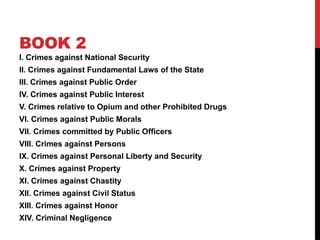
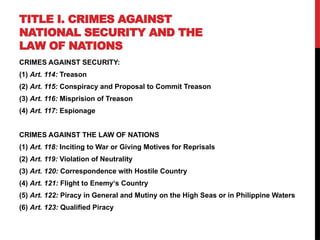

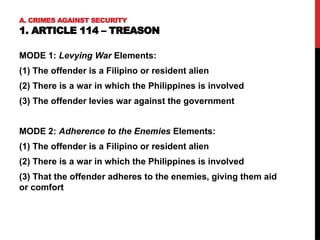

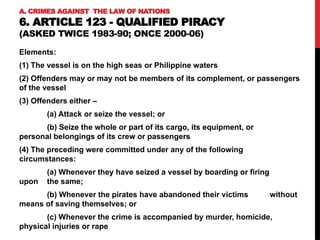


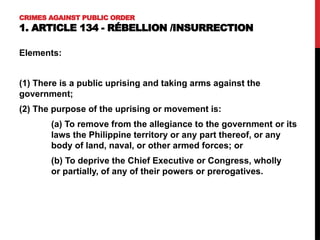
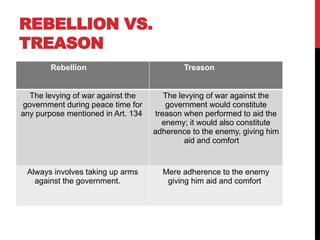
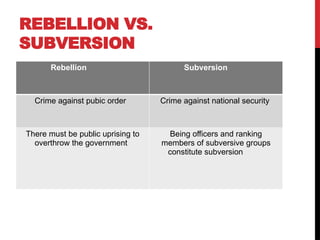
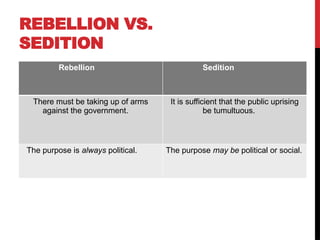
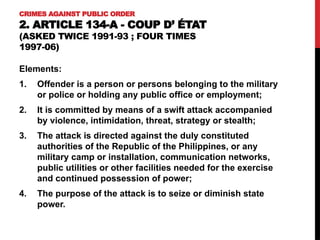
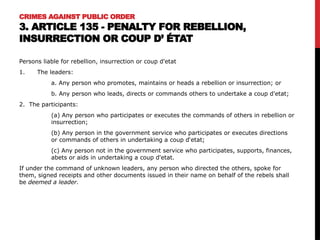
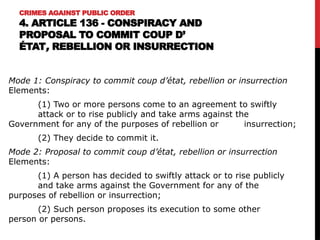
![INCITING TO REBELLION VS.
PROPOSAL TO COMMIT
REBELLION
Proposal to Commit Rebellion Inciting to Rebellion
The offender induces another to
commit rebellion. Rebellion should
not be actually committed by the
persons to whom it is proposed or
who are incited. [Otherwise, they
become principals by inducement in
the crime of rebellion.]
The offender induces another to
commit rebellion. Rebellion should
not be actually committed by the
persons to whom it is proposed or
who are incited. [Otherwise, they
become principals by inducement in
the crime of rebellion.]
The person who proposes has
decided to commit rebellion.
There is no need that the offender
has decided to commit rebellion.
The person who proposes the
execution of the crime uses secret
means.
The act of inciting is done publicly.](https://image.slidesharecdn.com/385994743-rpc-book-2-250301070724-7e27fe6e/85/Revised-penal-code-criminal-law-BOOK-2-pptx-39-320.jpg)
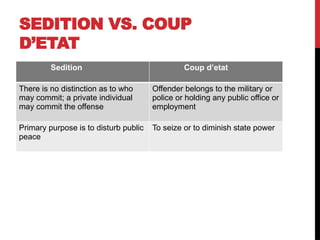
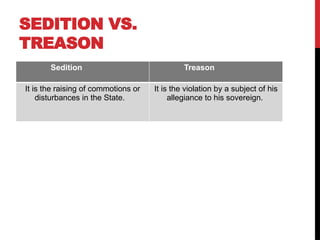
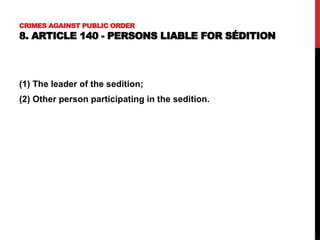
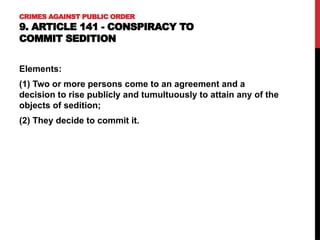
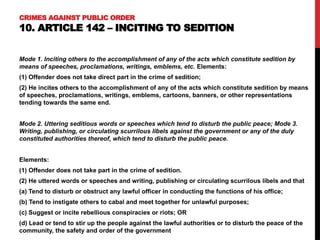
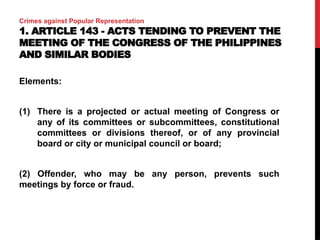
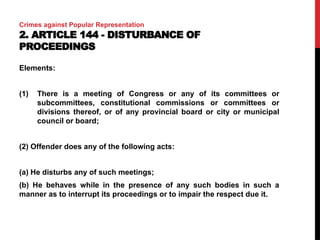
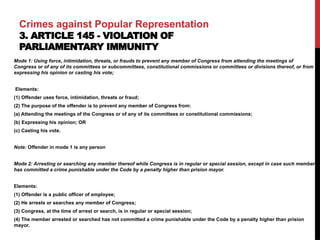
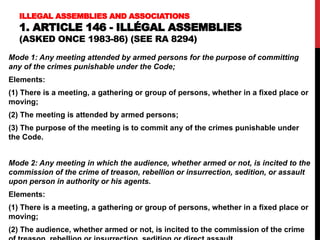
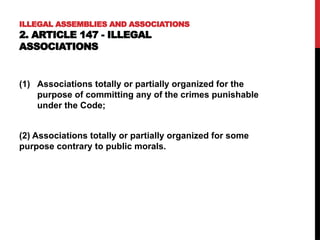
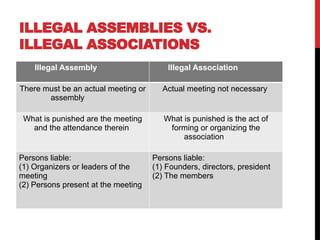
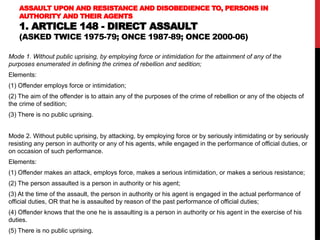
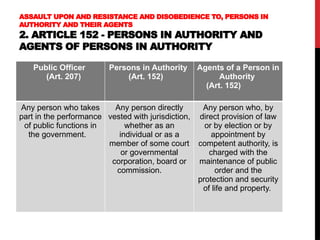
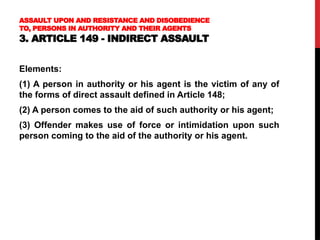
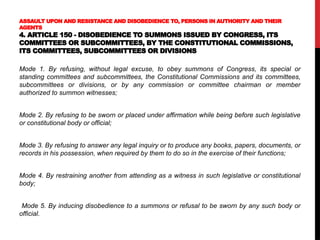
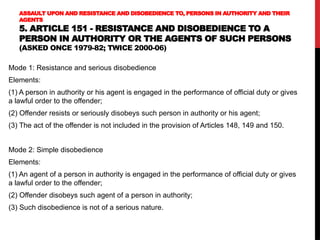
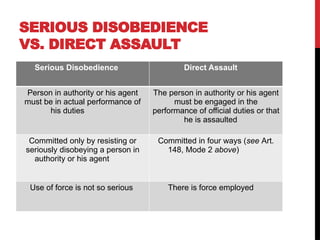
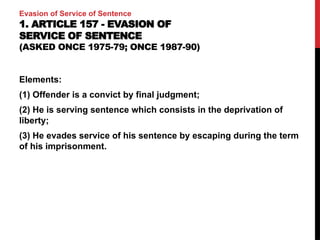
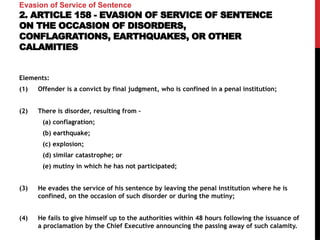

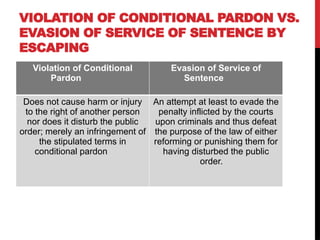
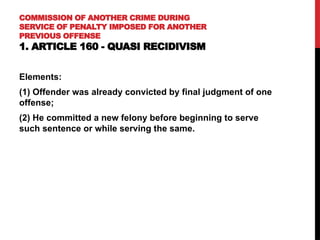

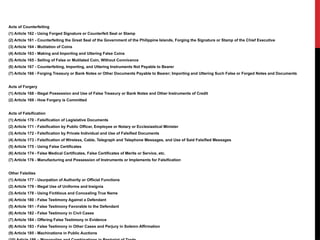

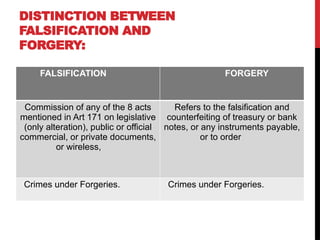
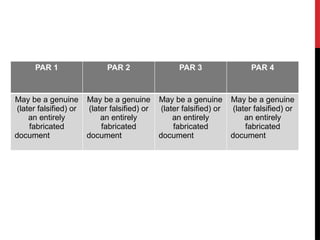

![2. ARTICLE 178 - USING FICTITIOUS
AND CONCEALING TRUE NAME
Mode 1: Using fictitious name
Elements:
(1) Offender uses a name other than his real name;
(2) He uses the fictitious name publicly;
(3) Purpose of use is to conceal a crime, to evade the execution of a
judgment or to cause damage [to public interest – Reyes].
Mode 2: Concealing true name
Elements:
(1) Offender conceals his true name and other personal circumstances;
(2) Purpose is only to conceal his identity.](https://image.slidesharecdn.com/385994743-rpc-book-2-250301070724-7e27fe6e/85/Revised-penal-code-criminal-law-BOOK-2-pptx-98-320.jpg)
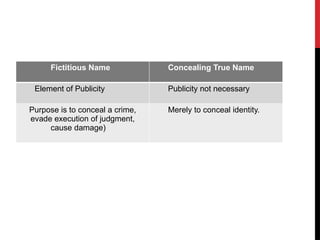
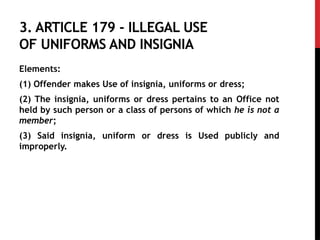
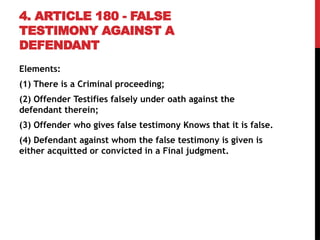

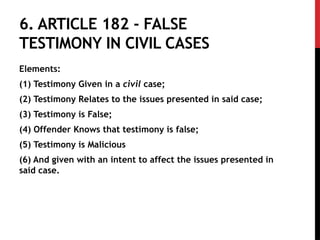
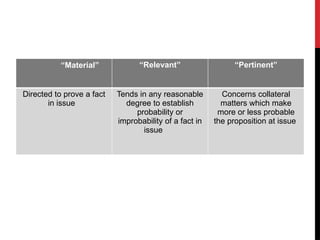
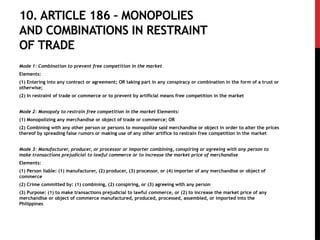
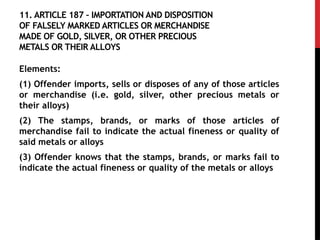
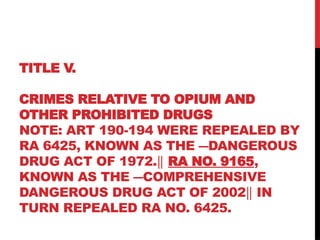
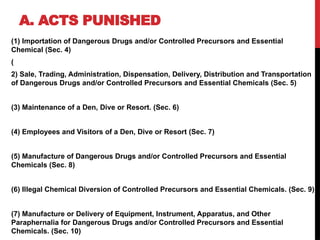
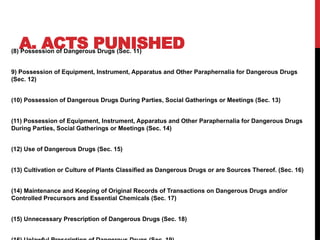
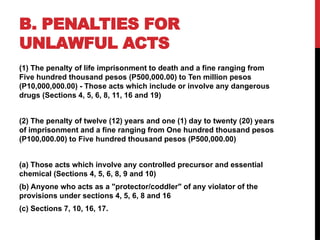
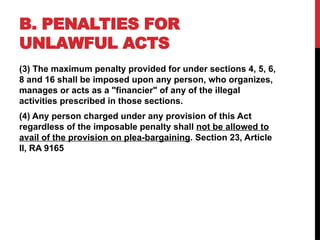
![C. DEFINITION OF
IMPORTANT TERMS
Dangerous drugs: include those listed
(1) in the Schedules annexed to the 1961 Single Convention
on Narcotic Drugs, as amended by the 1972 Protocol, and
(2) in the Schedules annexed to the 1971 Single Convention
on Psychotropic Substances as enumerated in the attached
annex which is an integral part of this Act. [Section 3 (j), RA
9165]](https://image.slidesharecdn.com/385994743-rpc-book-2-250301070724-7e27fe6e/85/Revised-penal-code-criminal-law-BOOK-2-pptx-115-320.jpg)
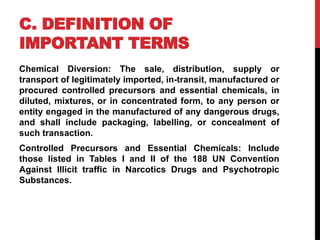





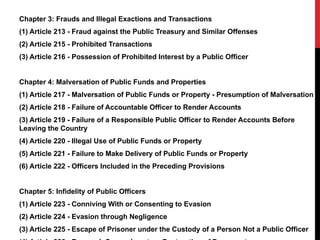
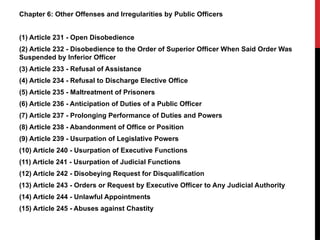
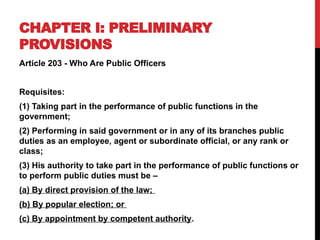
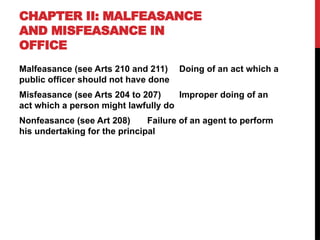

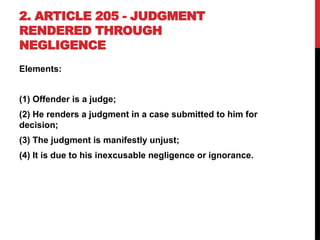
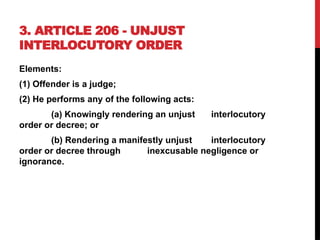

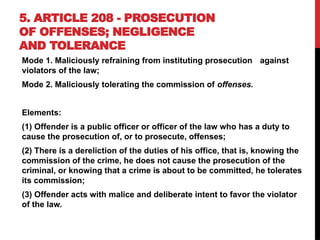
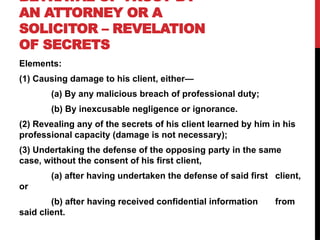
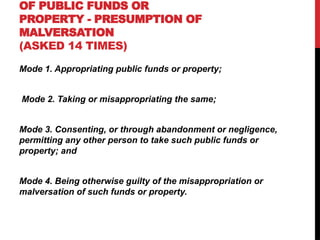
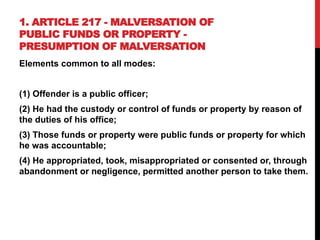

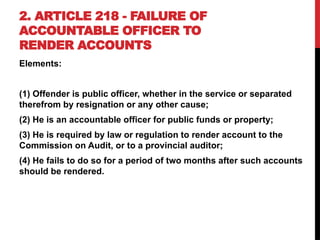
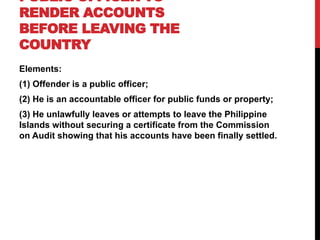
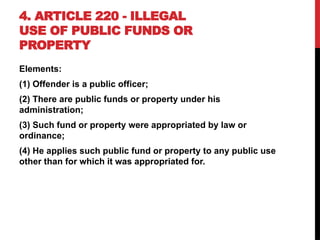
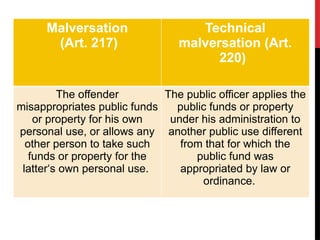
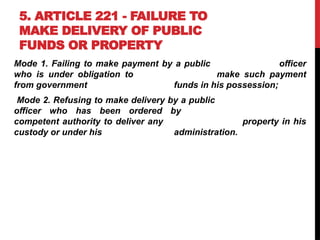
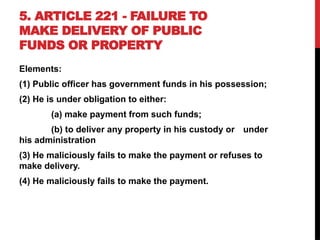
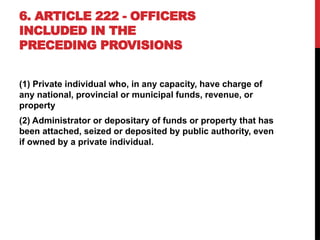


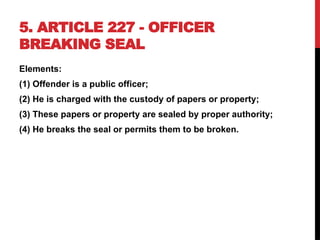
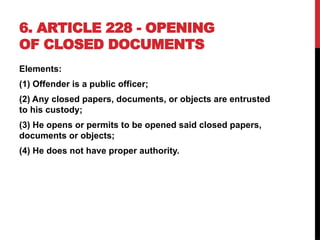
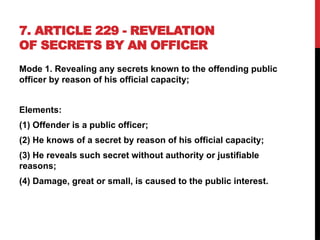
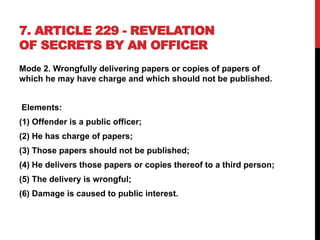

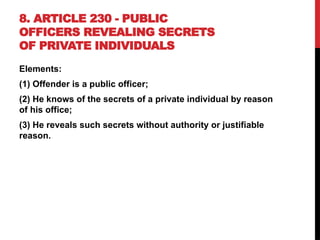
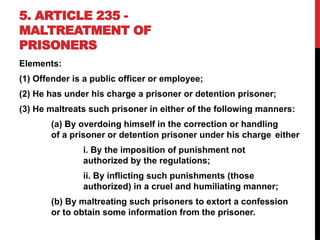
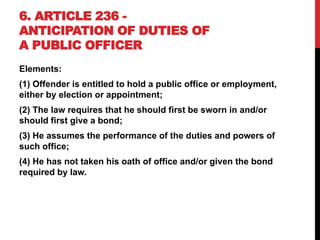
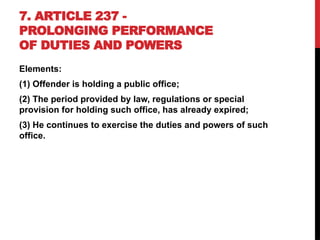
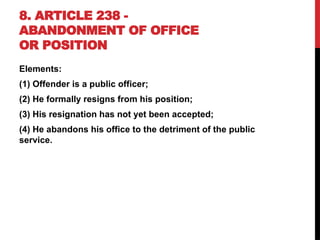
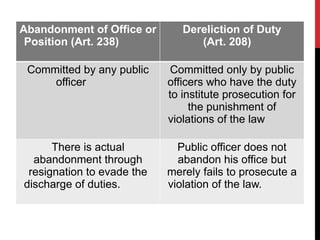
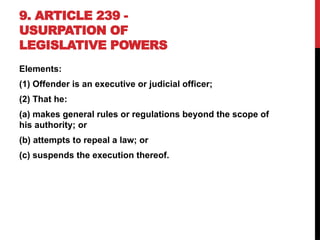
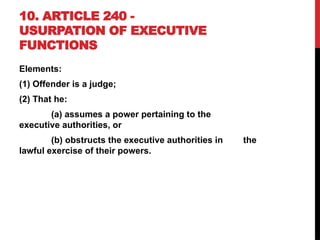
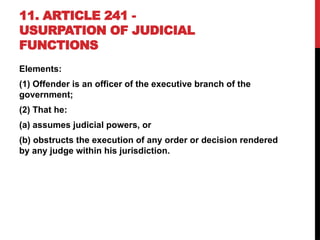

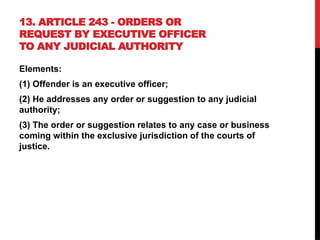
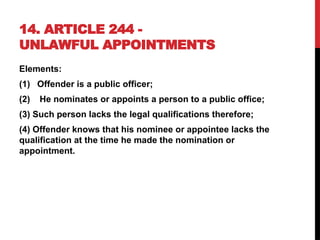
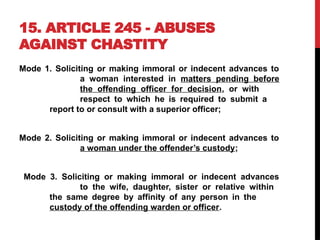
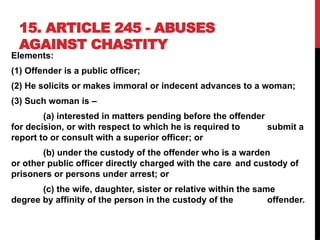
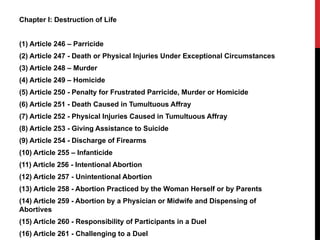
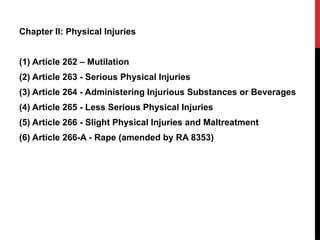
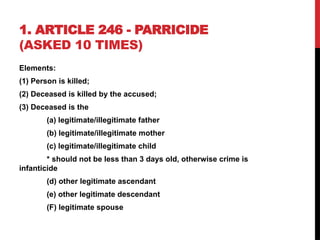
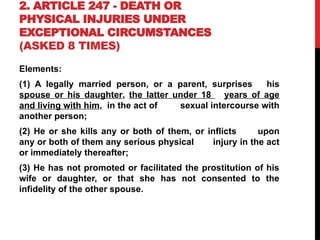
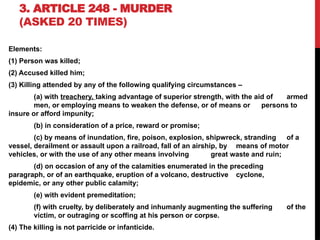
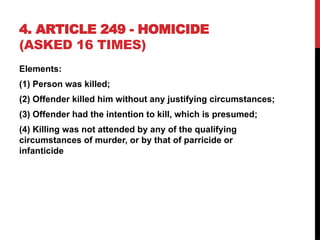
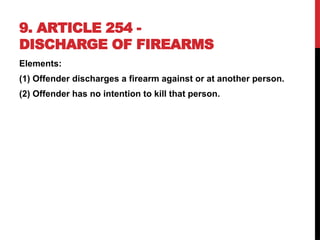
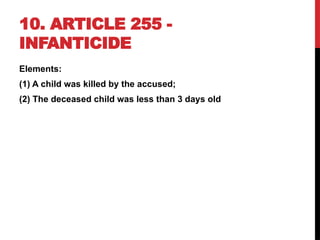
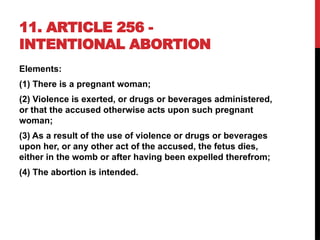
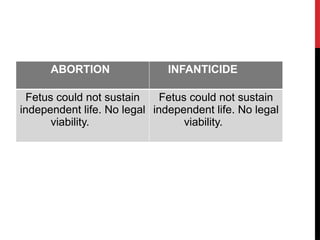
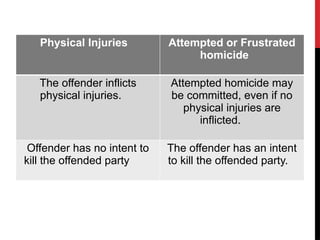
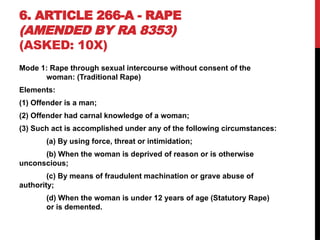

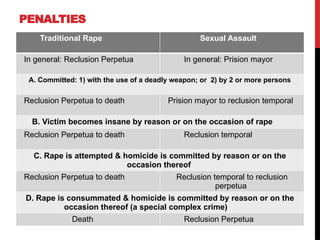
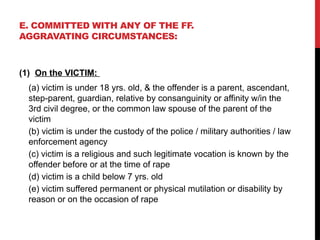
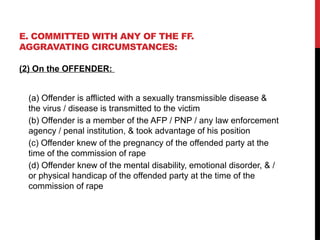
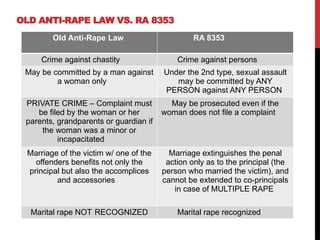
![JURISPRUDENCE ON
TITLE EIGHT:
Frustrated Homicide By invoking self-defense, accused, in fact, admitted that he
inflicted injuries on the victim. The burden of proving with clear and convincing
evidence the justifying circumstances to exculpate him from criminal liability was
thereby shifted to him. [De Leon v. People (2007)]
Homicide Direct evidence of the crime is not the only matrix wherefrom a trial court
may draw its conclusion and finding of guilt. The rules of evidence allow a trial court
to rely on circumstantial evidence to support its conclusion of guilt.
Circumstantial evidence is that evidence which proves a fact or series of facts from
which the facts in issue may be established by inference. At times, resort to
circumstantial evidence is imperative since to insist on direct testimony would, in
many cases, result in setting felons free and deny proper protection to the community.
All the circumstances must be consistent with one another, consistent with the
hypothesis that the accused is guilty, and at the same time inconsistent with the
hypothesis that he is innocent.
Thus, conviction based on circumstantial evidence can be upheld, provided that the
circumstances proven constitute an unbroken chain which leads to one fair and
reasonable conclusion that points to the accused, to the exclusion of all others, as the
guilty person. [Salvador v. People (2008)]](https://image.slidesharecdn.com/385994743-rpc-book-2-250301070724-7e27fe6e/85/Revised-penal-code-criminal-law-BOOK-2-pptx-229-320.jpg)
![JURISPRUDENCE ON TITLE EIGHT:
Murder Murder is committed by any person who, not falling within the
provisions of Article 246 of the Revised Penal Code (RPC), kills another, if
the killing is committed with treachery. The essence of treachery is the
sudden and unexpected attack by an aggressor on an unsuspecting victim,
depriving the latter of any real chance to defend himself and thereby
ensuring its commission without risk to himself. The killing occurred at
around two o‘clock in the morning, an hour when generally people are
asleep and the victim was shot at the back. [People v. Bohol (2008)]
Qualified Rape There is qualified rape when the facts alleged in the
Information and the facts proven in court establish the qualifying
circumstances of minority and relationship. [People v. Abellano (2007)]
A stepfather, who exercises moral and physical ascendancy over his
stepdaughter, need not make any threat against her because the latter is
cowed into submission when gripped with the fear of refusing the advances
of a person she customarily obeys.
Rape may, likewise, be committed in a room adjacent to where the victim's
family is sleeping, or even in a room shared with other people. There is no
rule that rape can only be committed in seclusion. [People v. Glivano (2008)]](https://image.slidesharecdn.com/385994743-rpc-book-2-250301070724-7e27fe6e/85/Revised-penal-code-criminal-law-BOOK-2-pptx-230-320.jpg)
![JURISPRUDENCE ON TITLE EIGHT:
Rape Physical resistance need not be established in rape when intimidation is exercised
upon the victim who submits against her will to the rapist‘s lust because of fear for her life or
personal safety. The force, violence or intimidation in rape is a relative term, depending not
only on the age, size, and strength of the parties but also on their relationship with each other.
Because of the victim‘s youthfulness, coupled with the fact that the assailant is her stepfather,
it was easy for her to believe that appellant would make good his threat to kill her should she
resist. [People v. Tuazon (2007)]
Rape An information is valid as long as it distinctly states the elements of the offense and the
acts or omissions constitutive thereof. The precise time or date of the commission of an
offense need not be alleged in the complaint or information, unless it is an essential element
of the crime charged. In rape, it is not. The gravamen of rape is carnal knowledge of a woman
through force and intimidation. In fact, the precise time when the rape takes place has no
substantial bearing on its commission. As such, the date or time need not be stated with
absolute accuracy. It is sufficient that the complaint or information states that the crime has
been committed at any time as near as possible to the date of its actual commission. [People
v. Domingo (2007)]
Rape BY a Minor The accused at the time of the commission of the offense was only 13
years old and it occurred prior to RA 9344 or the Juvenile Justice and Welfare Act of 2006.
The subsequently enacted law should be construed to retroact in favor of the accused. While
the latter is now 25 years old as of this decision, he is still exculpated from criminal liability.
However,
RA 9344 does not relieve the minor of civil liability arising from the offense. [Ortega v. People
(2008)]](https://image.slidesharecdn.com/385994743-rpc-book-2-250301070724-7e27fe6e/85/Revised-penal-code-criminal-law-BOOK-2-pptx-231-320.jpg)