Cycloids and Sustainability
                 The New Crownhill Crematorium in Milton Keynes

                                     Adrian Morrow BA (Hons), BArch (Manc), RIBA
                        Principal Architect, Environmental Health, Milton Keynes Council


     A new and distinctive single chapel crematorium has
     been designed to sit alongside the existing chapel at
     Crownhill Crematorium in Milton Keynes. The original
     building, which opened in 1982 was designed by
     Roger Hobbs, John Corbey & Associates. Although
     design work for the new facility started in September
     2005 the project was put on hold for sometime while
     the client, Milton Keynes Council, put considerable
     effort into obtaining the necessary funding. At that
     time, the key drivers of the project were to establish
     the best part of the site to locate the new building,
     ensure that the design met the needs of the “process”
     involved in managing funeral services and find a
     suitable architectural theme or character for the
     building that was calm, and tranquil but not pertaining
     to any religion in particular.


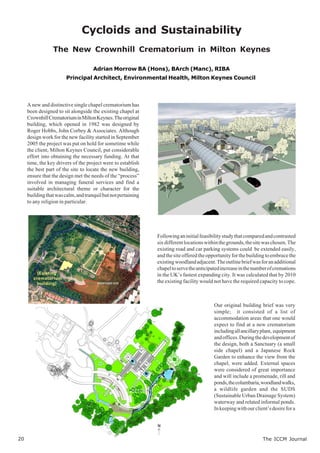
                                                               Following an initial feasibility study that compared and contrasted
                                                               six different locations within the grounds, the site was chosen. The
                                                               existing road and car parking systems could be extended easily,
                                                               and the site offered the opportunity for the building to embrace the
                                                               existing woodland adjacent. The outline brief was for an additional
                                                               chapel to serve the anticipated increase in the number of cremations
          (Existing                                            in the UK’s fastest expanding city. It was calculated that by 2010
        crematorium
         building)                                             the existing facility would not have the required capacity to cope.


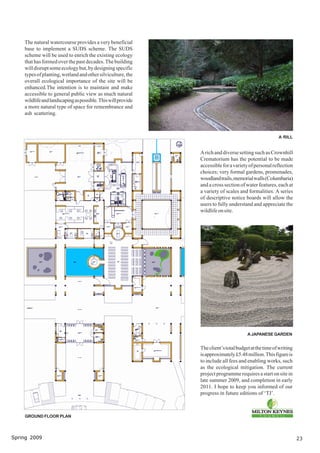
                                                                                          Our original building brief was very
                                                                                          simple; it consisted of a list of
                                                                                          accommodation areas that one would
                                                                                          expect to find at a new crematorium
                                                                                          including all ancillary plant, equipment
                                                                                          and offices. During the development of
                                                                                          the design, both a Sanctuary (a small
                                                                                          side chapel) and a Japanese Rock
                                                                                          Garden to enhance the view from the
                                                                                          chapel, were added. External spaces
                                                                                          were considered of great importance
                                                                                          and will include a promenade, rill and
                                                                                          ponds, the columbaria, woodland walks,
                                                                                          a wildlife garden and the SUDS
                                                                                          (Sustainable Urban Drainage System)
                                                                                          waterway and related informal ponds.
                                                                                          In keeping with our client’s desire for a


20                                                                                                                The ICCM Journal
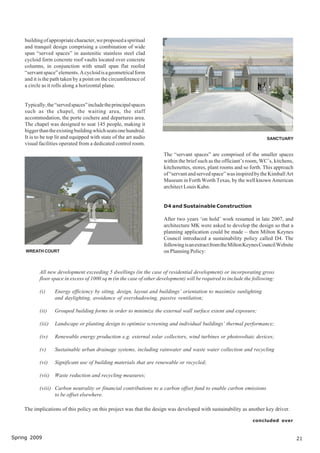
building of appropriate character, we proposed a spiritual
    and tranquil design comprising a combination of wide
    span “served spaces” in austenitic stainless steel clad
    cycloid form concrete roof vaults located over concrete
    columns, in conjunction with small span flat roofed
    “servant space” elements. A cycloid is a geometrical form
    and it is the path taken by a point on the circumference of
    a circle as it rolls along a horizontal plane.


    Typically, the “served spaces” include the principal spaces
    such as the chapel, the waiting area, the staff
    accommodation, the porte cochere and departures area.
    The chapel was designed to seat 145 people, making it
    bigger than the existing building which seats one hundred.
    It is to be top lit and equipped with state of the art audio                                                       SANCTUARY
    visual facilities operated from a dedicated control room.

                                                                      The “servant spaces” are comprised of the smaller spaces
                                                                      within the brief such as the officiant’s room, WC’s, kitchens,
                                                                      kitchenettes, stores, plant rooms and so forth. This approach
                                                                      of “servant and served space” was inspired by the Kimball Art
                                                                      Museum in Forth Worth Texas, by the well known American
                                                                      architect Louis Kahn.


                                                                      D4 and Sustainable Construction

                                                                      After two years ‘on hold’ work resumed in late 2007, and
                                                                      architecture MK were asked to develop the design so that a
                                                                      planning application could be made – then Milton Keynes
                                                                      Council introduced a sustainability policy called D4. The
                                                                      following is an extract from the Milton Keynes Council Website
     WREATH COURT                                                     on Planning Policy:


           All new development exceeding 5 dwellings (in the case of residential development) or incorporating gross
           floor space in excess of 1000 sq m (in the case of other development) will be required to include the following:

           (i)     Energy efficiency by siting, design, layout and buildings’ orientation to maximize sunlighting
                   and daylighting, avoidance of overshadowing, passive ventilation;

           (ii)    Grouped building forms in order to minimize the external wall surface extent and exposure;

           (iii)   Landscape or planting design to optimise screening and individual buildings’ thermal performance;

           (iv)    Renewable energy production e.g. external solar collectors, wind turbines or photovoltaic devices;

           (v)     Sustainable urban drainage systems, including rainwater and waste water collection and recycling

           (vi)    Significant use of building materials that are renewable or recycled;

           (vii)   Waste reduction and recycling measures;

           (viii) Carbon neutrality or financial contributions to a carbon offset fund to enable carbon emissions
                  to be offset elsewhere.

    The implications of this policy on this project was that the design was developed with sustainability as another key driver.

                                                                                                                concluded over


Spring 2009                                                                                                                            21
Cycloids and Sustainability....

     Energy conservation and the minimising of energy usage have been prime considerations in the development of the design.
     Further to point (iv), above, it was agreed with the planners that heat recovery from the cremators would be an acceptable
     alternative to renewable energy by recovering the excess heat produced by the cremators to heat water which will be stored in
     buffer tanks. The recovered hot water to be used to heat the building by means of both underfloor heating and radiators. A back-
     up gas fired condensing boiler will also be provided.


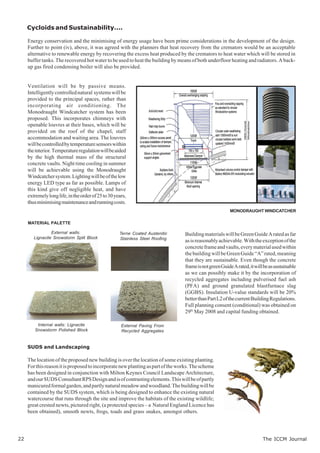
     Ventilation will be by passive means.
     Intelligently controlled natural systems will be
     provided to the principal spaces, rather than
     incorporating air conditioning. The
     Monodraught Windcatcher system has been
     proposed. This incorporates chimneys with
     openable louvres at their bases, which will be
     provided on the roof of the chapel, staff
     accommodation and waiting area. The louvres
     will be controlled by temperature sensors within
     the interior. Temperature regulation will be aided
     by the high thermal mass of the structural
     concrete vaults. Night time cooling in summer
     will be achievable using the Monodraught
     Windcatcher system. Lighting will be of the low
     energy LED type as far as possible. Lamps of
     this kind give off negligible heat, and have
     extremely long life, in the order of 25 to 30 years,
     thus minimising maintenance and running costs.
                                                                                                        MONODRAUGHT WINDCATCHER

     MATERIAL PALETTE

                 External walls:                     Terne Coated Austenitic     Building materials will be Green Guide A rated as far
        Lignacite Snowstorm Split Block              Stainless Steel Roofing
                                                                                 as is reasonably achievable. With the exception of the
                                                                                 concrete frame and vaults, every material used within
                                                                                 the building will be Green Guide “A” rated, meaning
                                                                                 that they are sustainable. Even though the concrete
                                                                                 frame is not green Guide A rated, it will be as sustainable
                                                                                 as we can possibly make it by the incorporation of
                                                                                 recycled aggregates including pulverised fuel ash
                                                                                 (PFA) and ground granulated blastfurnace slag
                                                                                 (GGBS). Insulation U-value standards will be 20%
                                                                                 better than Part L2 of the current Building Regulations.
                                                                                 Full planning consent (conditional) was obtained on
                                                                                 29th May 2008 and capital funding obtained.

         Internal walls: Lignacite                    External Paving From
        Snowstorm Polished Block                      Recycled Aggregates


     SUDS and Landscaping

     The location of the proposed new building is over the location of some existing planting.
     For this reason it is proposed to incorporate new planting as part of the works. The scheme
     has been designed in conjunction with Milton Keynes Council Landscape Architecture,
     and our SUDS Consultant RPS Design and is of contrasting elements. This will be of partly
     manicured formal garden, and partly natural meadow and woodland. The building will be
     contained by the SUDS system, which is being designed to enhance the existing natural
     watercourse that runs through the site and improve the habitats of the existing wildlife;
     great crested newts, pictured right, (a protected species – a Natural England Licence has
     been obtained), smooth newts, frogs, toads and grass snakes, amongst others.


22                                                                                                                        The ICCM Journal
The natural watercourse provides a very beneficial
    base to implement a SUDS scheme. The SUDS
    scheme will be used to enrich the existing ecology
    that has formed over the past decades. The building
    will disrupt some ecology but, by designing specific
    types of planting, wetland and other silviculture, the
    overall ecological importance of the site will be
    enhanced.The intention is to maintain and make
    accessible to general public view as much natural
    wildlife and landscaping as possible. This will provide
    a more natural type of space for remembrance and
    ash scattering.


                                                                                                      A RILL


                                                              A rich and diverse setting such as Crownhill
                                                              Crematorium has the potential to be made
                                                              accessible for a variety of personal reflection
                                                              choices; very formal gardens, promenades,
                                                              woodland trails, memorial walls (Columbaria)
                                                              and a cross section of water features, each at
                                                              a variety of scales and formalities. A series
                                                              of descriptive notice boards will allow the
                                                              users to fully understand and appreciate the
                                                              wildlife on site.


                                                                                      A JAPANESE GARDEN


                                                              The client’s total budget at the time of writing
                                                              is approximately £5.48 million. This figure is
                                                              to include all fees and enabling works, such
                                                              as the ecological mitigation. The current
                                                              project programme requires a start on site in
                                                              late summer 2009, and completion in early
                                                              2011. I hope to keep you informed of our
                                                              progress in future editions of ‘TJ’.


    GROUND FLOOR PLAN


Spring 2009                                                                                                      23

Crematorium Article 28.01.09

  • 1.
    Cycloids and Sustainability The New Crownhill Crematorium in Milton Keynes Adrian Morrow BA (Hons), BArch (Manc), RIBA Principal Architect, Environmental Health, Milton Keynes Council A new and distinctive single chapel crematorium has been designed to sit alongside the existing chapel at Crownhill Crematorium in Milton Keynes. The original building, which opened in 1982 was designed by Roger Hobbs, John Corbey & Associates. Although design work for the new facility started in September 2005 the project was put on hold for sometime while the client, Milton Keynes Council, put considerable effort into obtaining the necessary funding. At that time, the key drivers of the project were to establish the best part of the site to locate the new building, ensure that the design met the needs of the “process” involved in managing funeral services and find a suitable architectural theme or character for the building that was calm, and tranquil but not pertaining to any religion in particular. Following an initial feasibility study that compared and contrasted six different locations within the grounds, the site was chosen. The existing road and car parking systems could be extended easily, and the site offered the opportunity for the building to embrace the existing woodland adjacent. The outline brief was for an additional chapel to serve the anticipated increase in the number of cremations (Existing in the UK’s fastest expanding city. It was calculated that by 2010 crematorium building) the existing facility would not have the required capacity to cope. Our original building brief was very simple; it consisted of a list of accommodation areas that one would expect to find at a new crematorium including all ancillary plant, equipment and offices. During the development of the design, both a Sanctuary (a small side chapel) and a Japanese Rock Garden to enhance the view from the chapel, were added. External spaces were considered of great importance and will include a promenade, rill and ponds, the columbaria, woodland walks, a wildlife garden and the SUDS (Sustainable Urban Drainage System) waterway and related informal ponds. In keeping with our client’s desire for a 20 The ICCM Journal
  • 2.
    building of appropriatecharacter, we proposed a spiritual and tranquil design comprising a combination of wide span “served spaces” in austenitic stainless steel clad cycloid form concrete roof vaults located over concrete columns, in conjunction with small span flat roofed “servant space” elements. A cycloid is a geometrical form and it is the path taken by a point on the circumference of a circle as it rolls along a horizontal plane. Typically, the “served spaces” include the principal spaces such as the chapel, the waiting area, the staff accommodation, the porte cochere and departures area. The chapel was designed to seat 145 people, making it bigger than the existing building which seats one hundred. It is to be top lit and equipped with state of the art audio SANCTUARY visual facilities operated from a dedicated control room. The “servant spaces” are comprised of the smaller spaces within the brief such as the officiant’s room, WC’s, kitchens, kitchenettes, stores, plant rooms and so forth. This approach of “servant and served space” was inspired by the Kimball Art Museum in Forth Worth Texas, by the well known American architect Louis Kahn. D4 and Sustainable Construction After two years ‘on hold’ work resumed in late 2007, and architecture MK were asked to develop the design so that a planning application could be made – then Milton Keynes Council introduced a sustainability policy called D4. The following is an extract from the Milton Keynes Council Website WREATH COURT on Planning Policy: All new development exceeding 5 dwellings (in the case of residential development) or incorporating gross floor space in excess of 1000 sq m (in the case of other development) will be required to include the following: (i) Energy efficiency by siting, design, layout and buildings’ orientation to maximize sunlighting and daylighting, avoidance of overshadowing, passive ventilation; (ii) Grouped building forms in order to minimize the external wall surface extent and exposure; (iii) Landscape or planting design to optimise screening and individual buildings’ thermal performance; (iv) Renewable energy production e.g. external solar collectors, wind turbines or photovoltaic devices; (v) Sustainable urban drainage systems, including rainwater and waste water collection and recycling (vi) Significant use of building materials that are renewable or recycled; (vii) Waste reduction and recycling measures; (viii) Carbon neutrality or financial contributions to a carbon offset fund to enable carbon emissions to be offset elsewhere. The implications of this policy on this project was that the design was developed with sustainability as another key driver. concluded over Spring 2009 21
  • 3.
    Cycloids and Sustainability.... Energy conservation and the minimising of energy usage have been prime considerations in the development of the design. Further to point (iv), above, it was agreed with the planners that heat recovery from the cremators would be an acceptable alternative to renewable energy by recovering the excess heat produced by the cremators to heat water which will be stored in buffer tanks. The recovered hot water to be used to heat the building by means of both underfloor heating and radiators. A back- up gas fired condensing boiler will also be provided. Ventilation will be by passive means. Intelligently controlled natural systems will be provided to the principal spaces, rather than incorporating air conditioning. The Monodraught Windcatcher system has been proposed. This incorporates chimneys with openable louvres at their bases, which will be provided on the roof of the chapel, staff accommodation and waiting area. The louvres will be controlled by temperature sensors within the interior. Temperature regulation will be aided by the high thermal mass of the structural concrete vaults. Night time cooling in summer will be achievable using the Monodraught Windcatcher system. Lighting will be of the low energy LED type as far as possible. Lamps of this kind give off negligible heat, and have extremely long life, in the order of 25 to 30 years, thus minimising maintenance and running costs. MONODRAUGHT WINDCATCHER MATERIAL PALETTE External walls: Terne Coated Austenitic Building materials will be Green Guide A rated as far Lignacite Snowstorm Split Block Stainless Steel Roofing as is reasonably achievable. With the exception of the concrete frame and vaults, every material used within the building will be Green Guide “A” rated, meaning that they are sustainable. Even though the concrete frame is not green Guide A rated, it will be as sustainable as we can possibly make it by the incorporation of recycled aggregates including pulverised fuel ash (PFA) and ground granulated blastfurnace slag (GGBS). Insulation U-value standards will be 20% better than Part L2 of the current Building Regulations. Full planning consent (conditional) was obtained on 29th May 2008 and capital funding obtained. Internal walls: Lignacite External Paving From Snowstorm Polished Block Recycled Aggregates SUDS and Landscaping The location of the proposed new building is over the location of some existing planting. For this reason it is proposed to incorporate new planting as part of the works. The scheme has been designed in conjunction with Milton Keynes Council Landscape Architecture, and our SUDS Consultant RPS Design and is of contrasting elements. This will be of partly manicured formal garden, and partly natural meadow and woodland. The building will be contained by the SUDS system, which is being designed to enhance the existing natural watercourse that runs through the site and improve the habitats of the existing wildlife; great crested newts, pictured right, (a protected species – a Natural England Licence has been obtained), smooth newts, frogs, toads and grass snakes, amongst others. 22 The ICCM Journal
  • 4.
    The natural watercourseprovides a very beneficial base to implement a SUDS scheme. The SUDS scheme will be used to enrich the existing ecology that has formed over the past decades. The building will disrupt some ecology but, by designing specific types of planting, wetland and other silviculture, the overall ecological importance of the site will be enhanced.The intention is to maintain and make accessible to general public view as much natural wildlife and landscaping as possible. This will provide a more natural type of space for remembrance and ash scattering. A RILL A rich and diverse setting such as Crownhill Crematorium has the potential to be made accessible for a variety of personal reflection choices; very formal gardens, promenades, woodland trails, memorial walls (Columbaria) and a cross section of water features, each at a variety of scales and formalities. A series of descriptive notice boards will allow the users to fully understand and appreciate the wildlife on site. A JAPANESE GARDEN The client’s total budget at the time of writing is approximately £5.48 million. This figure is to include all fees and enabling works, such as the ecological mitigation. The current project programme requires a start on site in late summer 2009, and completion in early 2011. I hope to keep you informed of our progress in future editions of ‘TJ’. GROUND FLOOR PLAN Spring 2009 23