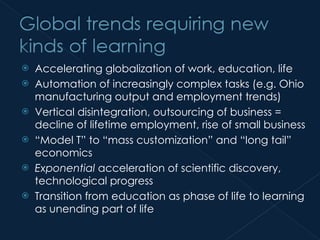
Accelerating globalization of work, education, life Automation of increasingly complex tasks (e.g. Ohio manufacturing output and employment trends) Vertical disintegration, outsourcing of business = decline of lifetime employment, rise of small business “ Model T” to “mass customization” and “long tail” economics Exponential  acceleration of scientific discovery, technological progress Transition from education as phase of life to learning as unending part of life
Performance/$ of computers doubling every year.  By time next year’s freshman leave college, same money buys PC 500X more powerful than today’s.  $500 of computing power today will cost $1. Virtually all of human knowledge available to everyone, everywhere, all the time, on demand 21 st  Century will see as much technological progress as previous 200 combined 20 th  Century’s worth of change by 2025
How can we predict the content that will have value to our students in the future? If we can’t accurately predict, how can we “future-proof” the education we provide our students today?
Students must learn how to learn Develop self-knowledge, ability to self-motivate, sense of personal responsibility for learning Find, filter, and organize information Find (or create) and work with learning communities of mentors and peers Skill in using existing technologies for learning Intrepid attitude toward mastering future technologies for learning and thinking
State level School level Student level
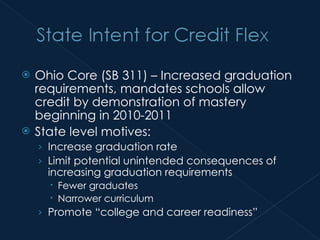
Ohio Core (SB 311) – Increased graduation requirements, mandates schools allow credit by demonstration of mastery beginning in 2010-2011  State level motives: Increase graduation rate Limit potential unintended consequences of increasing graduation requirements Fewer graduates Narrower curriculum Promote “college and career readiness”
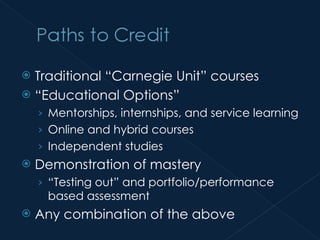
Traditional “Carnegie Unit” courses “ Educational Options” Mentorships, internships, and service learning Online and hybrid courses Independent studies Demonstration of mastery “ Testing out” and portfolio/performance based assessment Any combination of the above
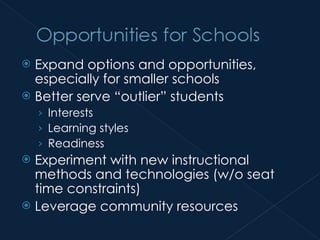
Expand options and opportunities, especially for smaller schools Better serve “outlier” students Interests Learning styles Readiness Experiment with new instructional methods and technologies (w/o seat time constraints) Leverage community resources
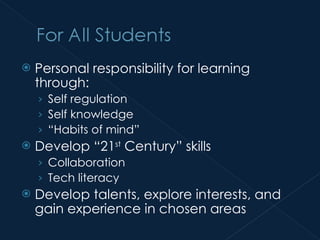
Personal responsibility for learning through: Self regulation Self knowledge “ Habits of mind” Develop “21 st  Century” skills Collaboration Tech literacy Develop talents, explore interests, and gain experience in chosen areas
Learn and progress at an appropriate accelerated pace Connect with expert mentors and advanced peers Develop time management and study skills, positive risk taking Gain a competitive advantage for college admissions and scholarships
 
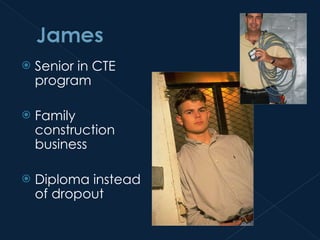
Senior in CTE program Family construction business Diploma instead of dropout
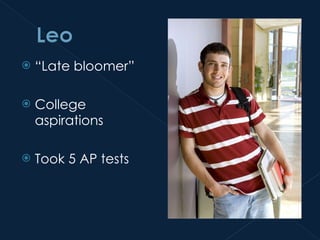
“ Late bloomer” College aspirations Took 5 AP tests
Managing requests and referrals Process for determining standards for awarding credit and grading Consider “tiering” for weighted grades Publicizing opportunities and communicating requirements Responsibility for developing opportunities, promoting equity Addressing costs
February 2010 ODE guidance 5 Case studies Highlights from states March 2010 Soft launch of online community at SharedWork.org Related Performance-based assessment Operating Standards revision Content standards revision EMIS adjustments
Attendance and progress monitoring Charging fees Athletic eligibility OHSAA NCAA (Rules,  Core Course Look-up ) Early graduation Assessment quality
Online Resources Learning|Connective Credit Flex Site Official documents Sample policy template Athletic eligibility information OnlineEdOps Wiki  February 23 session with Fred Bramante on lessons from New Hampshire.  See webinar details here.
 

Credit Flexibility: An Overview for Gifted Educators

  • 1.
  • 2.
  • 3.
    Accelerating globalization ofwork, education, life Automation of increasingly complex tasks (e.g. Ohio manufacturing output and employment trends) Vertical disintegration, outsourcing of business = decline of lifetime employment, rise of small business “ Model T” to “mass customization” and “long tail” economics Exponential acceleration of scientific discovery, technological progress Transition from education as phase of life to learning as unending part of life
  • 4.
    Performance/$ of computersdoubling every year. By time next year’s freshman leave college, same money buys PC 500X more powerful than today’s. $500 of computing power today will cost $1. Virtually all of human knowledge available to everyone, everywhere, all the time, on demand 21 st Century will see as much technological progress as previous 200 combined 20 th Century’s worth of change by 2025
  • 5.
    How can wepredict the content that will have value to our students in the future? If we can’t accurately predict, how can we “future-proof” the education we provide our students today?
  • 6.
    Students must learnhow to learn Develop self-knowledge, ability to self-motivate, sense of personal responsibility for learning Find, filter, and organize information Find (or create) and work with learning communities of mentors and peers Skill in using existing technologies for learning Intrepid attitude toward mastering future technologies for learning and thinking
  • 7.
    State level Schoollevel Student level
  • 8.
    Ohio Core (SB311) – Increased graduation requirements, mandates schools allow credit by demonstration of mastery beginning in 2010-2011 State level motives: Increase graduation rate Limit potential unintended consequences of increasing graduation requirements Fewer graduates Narrower curriculum Promote “college and career readiness”
  • 9.
    Traditional “Carnegie Unit”courses “ Educational Options” Mentorships, internships, and service learning Online and hybrid courses Independent studies Demonstration of mastery “ Testing out” and portfolio/performance based assessment Any combination of the above
  • 10.
    Expand options andopportunities, especially for smaller schools Better serve “outlier” students Interests Learning styles Readiness Experiment with new instructional methods and technologies (w/o seat time constraints) Leverage community resources
  • 11.
    Personal responsibility forlearning through: Self regulation Self knowledge “ Habits of mind” Develop “21 st Century” skills Collaboration Tech literacy Develop talents, explore interests, and gain experience in chosen areas
  • 12.
    Learn and progressat an appropriate accelerated pace Connect with expert mentors and advanced peers Develop time management and study skills, positive risk taking Gain a competitive advantage for college admissions and scholarships
  • 13.
  • 14.
    Senior in CTEprogram Family construction business Diploma instead of dropout
  • 15.
    “ Late bloomer”College aspirations Took 5 AP tests
  • 16.
    Managing requests andreferrals Process for determining standards for awarding credit and grading Consider “tiering” for weighted grades Publicizing opportunities and communicating requirements Responsibility for developing opportunities, promoting equity Addressing costs
  • 17.
    February 2010 ODEguidance 5 Case studies Highlights from states March 2010 Soft launch of online community at SharedWork.org Related Performance-based assessment Operating Standards revision Content standards revision EMIS adjustments
  • 18.
    Attendance and progressmonitoring Charging fees Athletic eligibility OHSAA NCAA (Rules, Core Course Look-up ) Early graduation Assessment quality
  • 19.
    Online Resources Learning|ConnectiveCredit Flex Site Official documents Sample policy template Athletic eligibility information OnlineEdOps Wiki February 23 session with Fred Bramante on lessons from New Hampshire. See webinar details here.
  • 20.

Editor's Notes

  • #5 Mobile internet speeds doubling every year, expanding coverage. Majority of cell phones will be “smart” phones in next 2-3 years. In 2000, 1 billion people worldwide had cellphones. Now it’s 4 billion – ¾ of them are in developing countries. This year, the number of people with cell phones will surpass the number of people with reliable access to clean water.