Creative Curriculum by Teaching
Strategies for early childhood
educators was developed originally in
1978 and has grown since with
multiple revisions and editions. It
implements developmentally
appropriate practice founded by
theory and research in early
childhood education. It details
curriculum in a very tangible way so
that educators may have effective
outcomes through their lesson
planning and translate theory and
research into the classroom on a daily
basis.
OVERVIEW OF THE STRATEGY
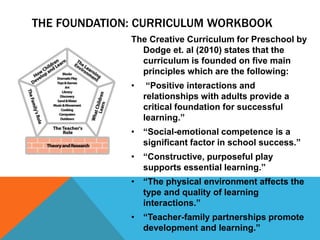
The Creative Curriculum for Preschool by
Dodge et. al (2010) states that the
curriculum is founded on five main
principles which are the following:
• “Positive interactions and
relationships with adults provide a
critical foundation for successful
learning.”
• “Social-emotional competence is a
significant factor in school success.”
• “Constructive, purposeful play
supports essential learning.”
• “The physical environment affects the
type and quality of learning
interactions.”
• “Teacher-family partnerships promote
development and learning.”
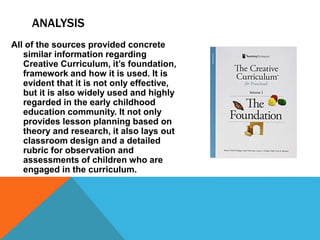
THE FOUNDATION: CURRICULUM WORKBOOK
According the Teaching Strategies website,
Creative Curriculum also provides a list of
38 objectives used for the lesson
planning process by educators that are
key in it’s success within the classroom.
This is due to it’s foundation in multiple
and varying modes of learning aiding in
it’s developmental appropriateness. In
this curriculum it includes 10 different
areas of development and learning. They
include:
• Social-Emotional
• Physical
• Language
• Cognitive
• Literacy
• Mathematics
• Science and Technology
• Social Studies
• The Arts
TEACHING STRATEGIES WEBSITE
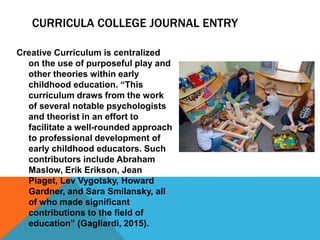
Creative Curriculum is centralized
on the use of purposeful play and
other theories within early
childhood education. “This
curriculum draws from the work
of several notable psychologists
and theorist in an effort to
facilitate a well-rounded approach
to professional development of
early childhood educators. Such
contributors include Abraham
Maslow, Erik Erikson, Jean
Piaget, Lev Vygotsky, Howard
Gardner, and Sara Smilansky, all
of who made significant
contributions to the field of
education” (Gagliardi, 2015).
CURRICULA COLLEGE JOURNAL ENTRY
All of the sources provided concrete
similar information regarding
Creative Curriculum, it’s foundation,
framework and how it is used. It is
evident that it is not only effective,
but it is also widely used and highly
regarded in the early childhood
education community. It not only
provides lesson planning based on
theory and research, it also lays out
classroom design and a detailed
rubric for observation and
assessments of children who are
engaged in the curriculum.
ANALYSIS
It is obvious through the
sources in my
presentation regarding
Creative Curriculum that
as a strategy being used in
a classroom for effective
learning it is a reliable and
valuable resource. This is
because it is completely
founded entirely on
educational psychology
itself.
CONNECTIONS
In my opinion Creative Curriculum is an effective teaching
strategy. I picked Creative Curriculum for my project
because I have used it myself in classrooms as a teacher
as well as supporting it’s use as an Assistant Director.
When used appropriately you can witness educational
psychology in action. The children benefit from a
curriculum that is catered entirely to their development and
learning styles. Typically you pick the theme of your lesson
plan and then use each mode of learning in order to teach
and support your theme. Additionally you pick your
objectives, also considered outcomes, that you would like
your children to learn through the lesson planning
process.
CONCLUSIONS
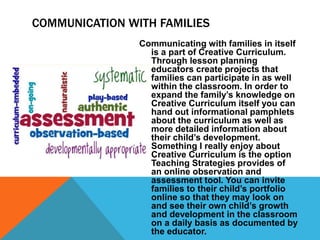
Communicating with families in itself
is a part of Creative Curriculum.
Through lesson planning
educators create projects that
families can participate in as well
within the classroom. In order to
expand the family’s knowledge on
Creative Curriculum itself you can
hand out informational pamphlets
about the curriculum as well as
more detailed information about
their child’s development.
Something I really enjoy about
Creative Curriculum is the option
Teaching Strategies provides of
an online observation and
assessment tool. You can invite
families to their child’s portfolio
online so that they may look on
and see their own child’s growth
and development in the classroom
on a daily basis as documented by
the educator.
COMMUNICATION WITH FAMILIES
REFERENCES
Dodge, D., Heroman, C., Colker, EdD, L., Bickart, T. (2010). The Creative
Curriculum for Preschool, Volume 1, The Foundation. Washington, D.C.:
Teaching Strategies, LLC.
Gagliardi, D. (2015) Lev Vygotsky Speaks: Early Childhood Curricula, JMU
Scholarly Commons, Senior Honor Projects 2010 – current, 3. Retrieved
from
http://commons.lib.jmu.edu/cgi/viewcontent.cgi?article=1010&context=
honors201019.
Our 38 Objectives. (n.d.) In Teaching Strategies. Retrieved August 19, 2018,
from https://teachingstrategies.com/our-approach/our-38-objectives/.

Creative Curriculum

  • 2.
    Creative Curriculum byTeaching Strategies for early childhood educators was developed originally in 1978 and has grown since with multiple revisions and editions. It implements developmentally appropriate practice founded by theory and research in early childhood education. It details curriculum in a very tangible way so that educators may have effective outcomes through their lesson planning and translate theory and research into the classroom on a daily basis. OVERVIEW OF THE STRATEGY
  • 3.
    The Creative Curriculumfor Preschool by Dodge et. al (2010) states that the curriculum is founded on five main principles which are the following: • “Positive interactions and relationships with adults provide a critical foundation for successful learning.” • “Social-emotional competence is a significant factor in school success.” • “Constructive, purposeful play supports essential learning.” • “The physical environment affects the type and quality of learning interactions.” • “Teacher-family partnerships promote development and learning.” THE FOUNDATION: CURRICULUM WORKBOOK
  • 4.
    According the TeachingStrategies website, Creative Curriculum also provides a list of 38 objectives used for the lesson planning process by educators that are key in it’s success within the classroom. This is due to it’s foundation in multiple and varying modes of learning aiding in it’s developmental appropriateness. In this curriculum it includes 10 different areas of development and learning. They include: • Social-Emotional • Physical • Language • Cognitive • Literacy • Mathematics • Science and Technology • Social Studies • The Arts TEACHING STRATEGIES WEBSITE
  • 5.
    Creative Curriculum iscentralized on the use of purposeful play and other theories within early childhood education. “This curriculum draws from the work of several notable psychologists and theorist in an effort to facilitate a well-rounded approach to professional development of early childhood educators. Such contributors include Abraham Maslow, Erik Erikson, Jean Piaget, Lev Vygotsky, Howard Gardner, and Sara Smilansky, all of who made significant contributions to the field of education” (Gagliardi, 2015). CURRICULA COLLEGE JOURNAL ENTRY
  • 6.
    All of thesources provided concrete similar information regarding Creative Curriculum, it’s foundation, framework and how it is used. It is evident that it is not only effective, but it is also widely used and highly regarded in the early childhood education community. It not only provides lesson planning based on theory and research, it also lays out classroom design and a detailed rubric for observation and assessments of children who are engaged in the curriculum. ANALYSIS
  • 7.
    It is obviousthrough the sources in my presentation regarding Creative Curriculum that as a strategy being used in a classroom for effective learning it is a reliable and valuable resource. This is because it is completely founded entirely on educational psychology itself. CONNECTIONS
  • 8.
    In my opinionCreative Curriculum is an effective teaching strategy. I picked Creative Curriculum for my project because I have used it myself in classrooms as a teacher as well as supporting it’s use as an Assistant Director. When used appropriately you can witness educational psychology in action. The children benefit from a curriculum that is catered entirely to their development and learning styles. Typically you pick the theme of your lesson plan and then use each mode of learning in order to teach and support your theme. Additionally you pick your objectives, also considered outcomes, that you would like your children to learn through the lesson planning process. CONCLUSIONS
  • 9.
    Communicating with familiesin itself is a part of Creative Curriculum. Through lesson planning educators create projects that families can participate in as well within the classroom. In order to expand the family’s knowledge on Creative Curriculum itself you can hand out informational pamphlets about the curriculum as well as more detailed information about their child’s development. Something I really enjoy about Creative Curriculum is the option Teaching Strategies provides of an online observation and assessment tool. You can invite families to their child’s portfolio online so that they may look on and see their own child’s growth and development in the classroom on a daily basis as documented by the educator. COMMUNICATION WITH FAMILIES
  • 10.
    REFERENCES Dodge, D., Heroman,C., Colker, EdD, L., Bickart, T. (2010). The Creative Curriculum for Preschool, Volume 1, The Foundation. Washington, D.C.: Teaching Strategies, LLC. Gagliardi, D. (2015) Lev Vygotsky Speaks: Early Childhood Curricula, JMU Scholarly Commons, Senior Honor Projects 2010 – current, 3. Retrieved from http://commons.lib.jmu.edu/cgi/viewcontent.cgi?article=1010&context= honors201019. Our 38 Objectives. (n.d.) In Teaching Strategies. Retrieved August 19, 2018, from https://teachingstrategies.com/our-approach/our-38-objectives/.