Geisler, Norman 
Systematic Theology 
TH 513 Systematic Theology II 
PPt by Dr. Mark E. Hardgrove
Systematic Theology II 
Chapter Fifty-Five 
“The Origin of Sin”
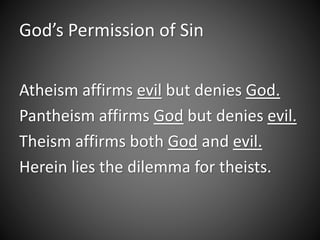
God’s Permission of Sin 
Atheism affirms evil but denies God. 
Pantheism affirms God but denies evil. 
Theism affirms both God and evil. 
Herein lies the dilemma for theists.
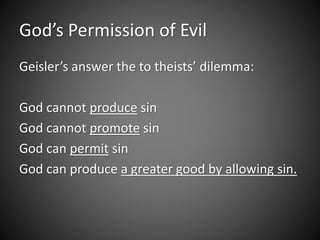
God’s Permission of Evil 
Geisler’s answer the to theists’ dilemma: 
God cannot produce sin 
God cannot promote sin 
God can permit sin 
God can produce a greater good by allowing sin.
The Origin of Sin on Earth by Humans 
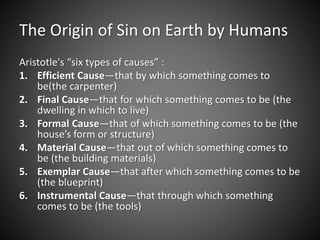
Aristotle's “six types of causes” : 
1. Efficient Cause—that by which something comes to 
be(the carpenter) 
2. Final Cause—that for which something comes to be (the 
dwelling in which to live) 
3. Formal Cause—that of which something comes to be (the 
house’s form or structure) 
4. Material Cause—that out of which something comes to 
be (the building materials) 
5. Exemplar Cause—that after which something comes to be 
(the blueprint) 
6. Instrumental Cause—that through which something 
comes to be (the tools)
The Origin of Sin on Earth by Humans 
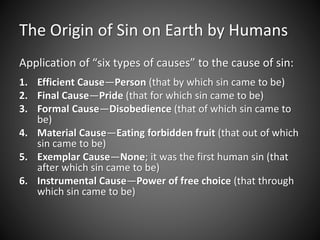
Application of “six types of causes” to the cause of sin: 
1. Efficient Cause—Person (that by which sin came to be) 
2. Final Cause—Pride (that for which sin came to be) 
3. Formal Cause—Disobedience (that of which sin came to 
be) 
4. Material Cause—Eating forbidden fruit (that out of which 
sin came to be) 
5. Exemplar Cause—None; it was the first human sin (that 
after which sin came to be) 
6. Instrumental Cause—Power of free choice (that through 
which sin came to be)
The Nature of Free Will 
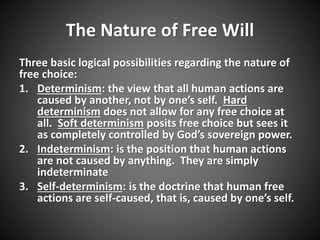
Three basic logical possibilities regarding the nature of 
free choice: 
1. Determinism: the view that all human actions are 
caused by another, not by one’s self. Hard 
determinism does not allow for any free choice at 
all. Soft determinism posits free choice but sees it 
as completely controlled by God’s sovereign power. 
2. Indeterminism: is the position that human actions 
are not caused by anything. They are simply 
indeterminate 
3. Self-determinism: is the doctrine that human free 
actions are self-caused, that is, caused by one’s self.
Origin of Earthly Evil 
Through Human Free Will 
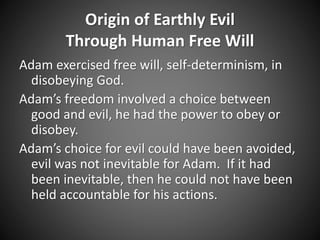
Adam exercised free will, self-determinism, in 
disobeying God. 
Adam’s freedom involved a choice between 
good and evil, he had the power to obey or 
disobey. 
Adam’s choice for evil could have been avoided, 
evil was not inevitable for Adam. If it had 
been inevitable, then he could not have been 
held accountable for his actions.
The Nature of God’s Free Will 
The original humans were free to sin or not to 
sin. God is free, and yet God cannot sin, He 
cannot even be tempted to sin (Ja. 1:13) 
In heaven free choice becomes what it is for 
God: the self-determined ability to choose 
only good. 
Heaven is not the destruction of true freedom, 
but the fulfillment of it.

Chapter 55

  • 1.
    Geisler, Norman SystematicTheology TH 513 Systematic Theology II PPt by Dr. Mark E. Hardgrove
  • 2.
    Systematic Theology II Chapter Fifty-Five “The Origin of Sin”
  • 3.
    God’s Permission ofSin Atheism affirms evil but denies God. Pantheism affirms God but denies evil. Theism affirms both God and evil. Herein lies the dilemma for theists.
  • 4.
    God’s Permission ofEvil Geisler’s answer the to theists’ dilemma: God cannot produce sin God cannot promote sin God can permit sin God can produce a greater good by allowing sin.
  • 5.
    The Origin ofSin on Earth by Humans Aristotle's “six types of causes” : 1. Efficient Cause—that by which something comes to be(the carpenter) 2. Final Cause—that for which something comes to be (the dwelling in which to live) 3. Formal Cause—that of which something comes to be (the house’s form or structure) 4. Material Cause—that out of which something comes to be (the building materials) 5. Exemplar Cause—that after which something comes to be (the blueprint) 6. Instrumental Cause—that through which something comes to be (the tools)
  • 6.
    The Origin ofSin on Earth by Humans Application of “six types of causes” to the cause of sin: 1. Efficient Cause—Person (that by which sin came to be) 2. Final Cause—Pride (that for which sin came to be) 3. Formal Cause—Disobedience (that of which sin came to be) 4. Material Cause—Eating forbidden fruit (that out of which sin came to be) 5. Exemplar Cause—None; it was the first human sin (that after which sin came to be) 6. Instrumental Cause—Power of free choice (that through which sin came to be)
  • 7.
    The Nature ofFree Will Three basic logical possibilities regarding the nature of free choice: 1. Determinism: the view that all human actions are caused by another, not by one’s self. Hard determinism does not allow for any free choice at all. Soft determinism posits free choice but sees it as completely controlled by God’s sovereign power. 2. Indeterminism: is the position that human actions are not caused by anything. They are simply indeterminate 3. Self-determinism: is the doctrine that human free actions are self-caused, that is, caused by one’s self.
  • 8.
    Origin of EarthlyEvil Through Human Free Will Adam exercised free will, self-determinism, in disobeying God. Adam’s freedom involved a choice between good and evil, he had the power to obey or disobey. Adam’s choice for evil could have been avoided, evil was not inevitable for Adam. If it had been inevitable, then he could not have been held accountable for his actions.
  • 9.
    The Nature ofGod’s Free Will The original humans were free to sin or not to sin. God is free, and yet God cannot sin, He cannot even be tempted to sin (Ja. 1:13) In heaven free choice becomes what it is for God: the self-determined ability to choose only good. Heaven is not the destruction of true freedom, but the fulfillment of it.