PPt by Mark E. Hardgrove, PhD, DMin
Systematic Theology II 
Chapter 53 
“The Origin of Human Beings”
The Original Created Conditions 
Created Guiltless and Innocent became Sinful 
According to Genesis 1-2, Adam and Eve were created 
with complete innocence. They were not only guiltless 
of any sin, but also innocent of sin. 
According to the NT, by disobedience Adam and Eve 
became sinful (Rom. 5:12; 1 Tim. 2:14) and brought 
condemnation on themselves and their posterity (Rom. 
5:18).
The Original Created Conditions 
Created Virtuous and Upright 
Not only were Adam and Eve innocent (without evil), they 
were morally virtuous , created with moral perfection, or 
righteous. 
The Supernatural View: A view held by Catholics that original 
righteousness was not natural but supernatural. 
The Natural View: A position promoted by Shedd, it held that 
man’s righteousness was that natural state for man and that 
sin introduced an unnatural state in the human condition.
The Original Created Conditions 
A State of Moral Responsibility 
Adam was free in that his actions were self-determined; 
God specifically said, “You are free” (Gen. 2:16). When 
Adam chose to disobey, God blamed Adam, asking, 
“Have you eaten from the tree of which I commanded 
you that you should not eat?” (3:11, AMP). God’s words 
point to a self-determined act.
Theological Basis for the Original 
State of Innocence and Perfection 
1. God is an absolute perfect Being. 
2. An absolutely perfect Being cannot 
produce an imperfect creation. 
3. Therefore, the original creation God 
made was perfect.
Three Views: 
The Origin of the Human Soul 
1. The Preexistence View 
2. The Created View 
3. The Traducian View
Three Views: 
The Origin of the Human Soul 
The Preexistence View 
Two Forms of the Preexistence View 
1. The Uncreated-Preexistence View 
2. The Created-Preexistence View 
These views contradict the clear 
teaching of Scripture about the creation 
of human beings.
Three Views: 
The Origin of the Human Soul 
The Creation View 
The essence is that God directly creates a 
new individual soul for everyone born 
into this world. The body is generated 
by his or her parents through a natural 
process, the soul is supernaturally 
created by God.
Three Views: 
The Origin of the Human Soul 
Creation of the Soul at Conception 
There are various view as to the exact 
moment of the creation of the soul. 
Most evangelicals who hold the 
creationist view maintain that the 
creation of the souls by God occurs at 
the moment of conception.
Three Views: 
The Origin of the Human Soul 
Creation of the Soul at Implantation 
Some believe that the soul is created at the 
moment the fertilized egg implants into the 
uterus. The argument is that until 
implantation the egg can still divide into 
identical twins, if the soul is created at 
conception, then two people would share 
the same soul. 
Geisler dismisses this argument.
Three Views: 
The Origin of the Human Soul 
Creation of the Soul after Implantation 
Thomas Aquinas placed the creation of 
the human soul well after conception— 
40 days after for boys, and 90 days after 
for girls. 
However, with new scientific studies, 
this argument has been abandoned.
Three Views: 
The Origin of the Human Soul 
Creation of the Soul at Animation 
Some theologians have speculated that 
God does not create a human soul until 
just before the baby stars moving in the 
mother’s womb. Another theory based 
on outdated science.
Three Views: 
The Origin of the Human Soul 
Creation of the Soul at Birth 
Some Christians argue that the soul is 
created at birth. Their two main points: 
1. Human life is biblically designated 
from the point of birth (Gen. 5:1ff.) 
2. Adam was not human until be began 
to breathe (Gen. 2:7)
Three Views: 
The Origin of the Human Soul 
Creation of the Soul at Birth -- Geisler refutes this view on these points: 
1. Adam wasn’t conceived and born like other humans; he was directly created. 
2. His first breath is no more an evidence of being human, than his being created adult is a 
sign of being human. 
3. Breath, in the Heb. ruach, denotes the origin of “life.” It indicates when God have life to 
Adam, not simply because Adam began breathing. 
4. Other animals breathe, but they aren’t humans—breath does not determine “humaness.” 
5. Some people stop breathing, but then are revived and sustained with aid of a machine. 
6. One does not stop being human when they stop breathing. God’s Word teaches that 
human being continue to exist after they stop breathing (Phil. 1:23; 2 Cor. 5:5-6; Rev. 6:9). 
7. The Scriptures speak of human life in the womb long before breathing begins, namely, 
from the point of conception (Ps. 51:5; Matt. 1:20).
Three Views: 
The Origin of the Human Soul 
The Traducian View 
The word “traducian” come from the Latin 
tradux, meaning “branch of a vine.” As 
applied to the soul, it means that each new 
human being is a branch off of his or her 
parents; that is to say, in the traducian model 
both soul and body are generated by father 
and mother. ~Geisler
Three Views: 
The Origin of the Human Soul 
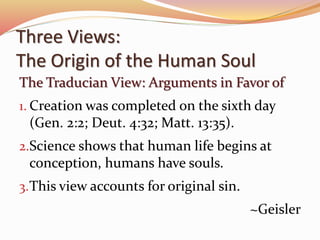
The Traducian View: Arguments in Favor of 
1. Creation was completed on the sixth day 
(Gen. 2:2; Deut. 4:32; Matt. 13:35). 
2.Science shows that human life begins at 
conception, humans have souls. 
3.This view accounts for original sin. 
~Geisler
Three Views: 
The Origin of the Human Soul 
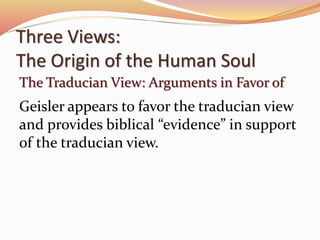
The Traducian View: Arguments in Favor of 
Geisler appears to favor the traducian view 
and provides biblical “evidence” in support 
of the traducian view.
Systematic Theology II 
Chapter 54 
“The Nature of Human Beings”
Biblical Terms for the Immaterial 
Dimension of Human Beings 
Soul 
Hebrew, nephesh: Greek, psuche 
Basically “soul” means “life.” It refers to 
the principle of life in a human being, or 
to that which animates the body.
Biblical Terms for the Immaterial 
Dimension of Human Beings 
Spirit 
Hebrew, ruach: Greek, pneuma 
Almost always refers to the immaterial 
dimension of a human being. It is often 
used interchangeably with the word 
soul. Spirit is immaterial (Lk. 24:38-39; 
Jn. 4:24).
Biblical Terms for the Immaterial 
Dimension of Human Beings 
Heart 
Hebrew, leb: Greek, kardia 
The heart (sometimes used to mean 
“mind”) is the instrument with which we 
are to worship God (Deut. 6:5). It is also 
the seat of evil (Matt. 12:34). For better 
of worse, it the heart reflects the whole 
inner being.
Biblical Terms for the Immaterial 
Dimension of Human Beings 
Mind 
Greek, nous 
Refers to the immaterial dimension of a 
human being by which he or she thinks 
and imagines.
Biblical Terms for the Material 
Dimension of Human Beings 
Body 
Hebrew, basar: Greek, soma 
Is normally used of the outer (material) 
aspect of human nature (Matt. 10:28; 
James 2:26)
Biblical Terms for the Material 
Dimension of Human Beings 
Flesh 
Hebrew, basar: Greek, sarx 
Use of both the moral and resurrected 
body.
Biblical Terms for the Material 
Dimension of Human Beings 
Earthen Vessel (2 Cor. 4:7) 
Used as an illustration of the human 
body, since it is an outer structure 
containing something else (a soul) 
inside.
Biblical Terms for the Material 
Dimension of Human Beings 
Earthly Tent (2 Cor. 5:1; John 1:14) 
A figure of speech used to illustrate the 
mortal body as a material shell that in 
this world houses the presence of the 
immaterial soul.
Biblical Terms for the Material 
Dimension of Human Beings 
Outward Man (2 Cor. 4:16, KJV) 
If the soul is the “inner man” then the 
body is the “outer man.” The outward 
person is visible, material, and tangible. 
It is subject to decay and destruction 
since it can “perish.”
The Relationship Between 
Soul and Body 
Anthropological Materialism 
Affirms the material body, but denies the 
existence of an immaterial soul. Only the 
body exists. 
Anthropological Epiphenomenalism 
The soul is only a silhouette of the body; the 
body is the to the soul what a tree is to it’s 
shadow. The soul is reducible to the body.
The Relationship Between 
Soul and Body 
Anthropological Idealism 
A non-theistic view that materialism is idealism. 
Humans have a soul, but the body is merely an 
illusion that exists only in the mind. 
Anthropological Monism (Double-Aspect View) 
Soul and body are two sides (inner and outer) of 
the same thing. Body and soul are of one 
substance, two aspects of the same entity.
The Relationship Between 
Soul and Body 
Anthropological Dualism/Dichotomy 
Soul and body are separate and parallel entities; 
like railroad tracks, they run side by side, but 
never intersect. However, this lack of contact is 
problematic in that they do appear to intersect. 
Anthropological Interactionism 
Body and soul are two different substances: The 
intellectual soul (mind) is a thinking, non-extended 
entity, and the physical body is a non-thinking, 
spatially extended entity.
The Relationship Between 
Soul and Body 
Anthropological Pre-Established Harmony 
A preestablished harmony exists between soul and body. 
Though not directly aware of each other, they are 
synchronized by God and thus connected. 
Anthropological Hylomorphism 
From two Greek words, the theory proposes that there is 
form/matter unity between the soul and the body, just as 
there is unity between shape and form of a statue and the 
rock out of which it is made. Asserts that the soul (mind) is 
to the body (matter) what ideas are to words: they form a 
unity, inner and outer dimensions fo their holistic oneness.
Dichotomists & Trichotomists 
Dichotomists 
Argue that since soul and spirit are used interchangeably in 
many passages of Scripture, a human being has only two 
parts (body and soul/spirit). Verses where the two are used 
interchangeably include Luke 1:46-47. 
Trichotomists 
Hold that a human being is tripartate (“having three parts”), 
namely, body, soul and spirit. The following passages appear 
to support the trichotomists’ view: Heb.4:12; 1 Thess. 5:23; 
Rom. 8:16; 1 Cor. 15:44; Mark 10:5; 1 Cor. 6:19).
Elements of Human Personhood 
Intellect: Self-reflective mind that have the power of 
syllogistic reasoning. Redemption of the mind is 
“renewed in knowledge in the image of its Creator” (Col. 
3:10). 
Emotion: Feeling. Humans are capable of deep emotions 
and feelings such as joy and sorrow. 
Will: Choice. Humans were created with the moral capacity 
to know right from wrong and to choose one over the 
other. 
Conscience: Moral Capacity. A God-given moral capacity 
which enables us to recognize good and evil and provides 
the potential to make the right choices, if we exercise our 
will.

Chapters 53 54

  • 1.
    PPt by MarkE. Hardgrove, PhD, DMin
  • 2.
    Systematic Theology II Chapter 53 “The Origin of Human Beings”
  • 3.
    The Original CreatedConditions Created Guiltless and Innocent became Sinful According to Genesis 1-2, Adam and Eve were created with complete innocence. They were not only guiltless of any sin, but also innocent of sin. According to the NT, by disobedience Adam and Eve became sinful (Rom. 5:12; 1 Tim. 2:14) and brought condemnation on themselves and their posterity (Rom. 5:18).
  • 4.
    The Original CreatedConditions Created Virtuous and Upright Not only were Adam and Eve innocent (without evil), they were morally virtuous , created with moral perfection, or righteous. The Supernatural View: A view held by Catholics that original righteousness was not natural but supernatural. The Natural View: A position promoted by Shedd, it held that man’s righteousness was that natural state for man and that sin introduced an unnatural state in the human condition.
  • 5.
    The Original CreatedConditions A State of Moral Responsibility Adam was free in that his actions were self-determined; God specifically said, “You are free” (Gen. 2:16). When Adam chose to disobey, God blamed Adam, asking, “Have you eaten from the tree of which I commanded you that you should not eat?” (3:11, AMP). God’s words point to a self-determined act.
  • 6.
    Theological Basis forthe Original State of Innocence and Perfection 1. God is an absolute perfect Being. 2. An absolutely perfect Being cannot produce an imperfect creation. 3. Therefore, the original creation God made was perfect.
  • 7.
    Three Views: TheOrigin of the Human Soul 1. The Preexistence View 2. The Created View 3. The Traducian View
  • 8.
    Three Views: TheOrigin of the Human Soul The Preexistence View Two Forms of the Preexistence View 1. The Uncreated-Preexistence View 2. The Created-Preexistence View These views contradict the clear teaching of Scripture about the creation of human beings.
  • 9.
    Three Views: TheOrigin of the Human Soul The Creation View The essence is that God directly creates a new individual soul for everyone born into this world. The body is generated by his or her parents through a natural process, the soul is supernaturally created by God.
  • 10.
    Three Views: TheOrigin of the Human Soul Creation of the Soul at Conception There are various view as to the exact moment of the creation of the soul. Most evangelicals who hold the creationist view maintain that the creation of the souls by God occurs at the moment of conception.
  • 11.
    Three Views: TheOrigin of the Human Soul Creation of the Soul at Implantation Some believe that the soul is created at the moment the fertilized egg implants into the uterus. The argument is that until implantation the egg can still divide into identical twins, if the soul is created at conception, then two people would share the same soul. Geisler dismisses this argument.
  • 12.
    Three Views: TheOrigin of the Human Soul Creation of the Soul after Implantation Thomas Aquinas placed the creation of the human soul well after conception— 40 days after for boys, and 90 days after for girls. However, with new scientific studies, this argument has been abandoned.
  • 13.
    Three Views: TheOrigin of the Human Soul Creation of the Soul at Animation Some theologians have speculated that God does not create a human soul until just before the baby stars moving in the mother’s womb. Another theory based on outdated science.
  • 14.
    Three Views: TheOrigin of the Human Soul Creation of the Soul at Birth Some Christians argue that the soul is created at birth. Their two main points: 1. Human life is biblically designated from the point of birth (Gen. 5:1ff.) 2. Adam was not human until be began to breathe (Gen. 2:7)
  • 15.
    Three Views: TheOrigin of the Human Soul Creation of the Soul at Birth -- Geisler refutes this view on these points: 1. Adam wasn’t conceived and born like other humans; he was directly created. 2. His first breath is no more an evidence of being human, than his being created adult is a sign of being human. 3. Breath, in the Heb. ruach, denotes the origin of “life.” It indicates when God have life to Adam, not simply because Adam began breathing. 4. Other animals breathe, but they aren’t humans—breath does not determine “humaness.” 5. Some people stop breathing, but then are revived and sustained with aid of a machine. 6. One does not stop being human when they stop breathing. God’s Word teaches that human being continue to exist after they stop breathing (Phil. 1:23; 2 Cor. 5:5-6; Rev. 6:9). 7. The Scriptures speak of human life in the womb long before breathing begins, namely, from the point of conception (Ps. 51:5; Matt. 1:20).
  • 16.
    Three Views: TheOrigin of the Human Soul The Traducian View The word “traducian” come from the Latin tradux, meaning “branch of a vine.” As applied to the soul, it means that each new human being is a branch off of his or her parents; that is to say, in the traducian model both soul and body are generated by father and mother. ~Geisler
  • 17.
    Three Views: TheOrigin of the Human Soul The Traducian View: Arguments in Favor of 1. Creation was completed on the sixth day (Gen. 2:2; Deut. 4:32; Matt. 13:35). 2.Science shows that human life begins at conception, humans have souls. 3.This view accounts for original sin. ~Geisler
  • 18.
    Three Views: TheOrigin of the Human Soul The Traducian View: Arguments in Favor of Geisler appears to favor the traducian view and provides biblical “evidence” in support of the traducian view.
  • 19.
    Systematic Theology II Chapter 54 “The Nature of Human Beings”
  • 20.
    Biblical Terms forthe Immaterial Dimension of Human Beings Soul Hebrew, nephesh: Greek, psuche Basically “soul” means “life.” It refers to the principle of life in a human being, or to that which animates the body.
  • 21.
    Biblical Terms forthe Immaterial Dimension of Human Beings Spirit Hebrew, ruach: Greek, pneuma Almost always refers to the immaterial dimension of a human being. It is often used interchangeably with the word soul. Spirit is immaterial (Lk. 24:38-39; Jn. 4:24).
  • 22.
    Biblical Terms forthe Immaterial Dimension of Human Beings Heart Hebrew, leb: Greek, kardia The heart (sometimes used to mean “mind”) is the instrument with which we are to worship God (Deut. 6:5). It is also the seat of evil (Matt. 12:34). For better of worse, it the heart reflects the whole inner being.
  • 23.
    Biblical Terms forthe Immaterial Dimension of Human Beings Mind Greek, nous Refers to the immaterial dimension of a human being by which he or she thinks and imagines.
  • 24.
    Biblical Terms forthe Material Dimension of Human Beings Body Hebrew, basar: Greek, soma Is normally used of the outer (material) aspect of human nature (Matt. 10:28; James 2:26)
  • 25.
    Biblical Terms forthe Material Dimension of Human Beings Flesh Hebrew, basar: Greek, sarx Use of both the moral and resurrected body.
  • 26.
    Biblical Terms forthe Material Dimension of Human Beings Earthen Vessel (2 Cor. 4:7) Used as an illustration of the human body, since it is an outer structure containing something else (a soul) inside.
  • 27.
    Biblical Terms forthe Material Dimension of Human Beings Earthly Tent (2 Cor. 5:1; John 1:14) A figure of speech used to illustrate the mortal body as a material shell that in this world houses the presence of the immaterial soul.
  • 28.
    Biblical Terms forthe Material Dimension of Human Beings Outward Man (2 Cor. 4:16, KJV) If the soul is the “inner man” then the body is the “outer man.” The outward person is visible, material, and tangible. It is subject to decay and destruction since it can “perish.”
  • 29.
    The Relationship Between Soul and Body Anthropological Materialism Affirms the material body, but denies the existence of an immaterial soul. Only the body exists. Anthropological Epiphenomenalism The soul is only a silhouette of the body; the body is the to the soul what a tree is to it’s shadow. The soul is reducible to the body.
  • 30.
    The Relationship Between Soul and Body Anthropological Idealism A non-theistic view that materialism is idealism. Humans have a soul, but the body is merely an illusion that exists only in the mind. Anthropological Monism (Double-Aspect View) Soul and body are two sides (inner and outer) of the same thing. Body and soul are of one substance, two aspects of the same entity.
  • 31.
    The Relationship Between Soul and Body Anthropological Dualism/Dichotomy Soul and body are separate and parallel entities; like railroad tracks, they run side by side, but never intersect. However, this lack of contact is problematic in that they do appear to intersect. Anthropological Interactionism Body and soul are two different substances: The intellectual soul (mind) is a thinking, non-extended entity, and the physical body is a non-thinking, spatially extended entity.
  • 32.
    The Relationship Between Soul and Body Anthropological Pre-Established Harmony A preestablished harmony exists between soul and body. Though not directly aware of each other, they are synchronized by God and thus connected. Anthropological Hylomorphism From two Greek words, the theory proposes that there is form/matter unity between the soul and the body, just as there is unity between shape and form of a statue and the rock out of which it is made. Asserts that the soul (mind) is to the body (matter) what ideas are to words: they form a unity, inner and outer dimensions fo their holistic oneness.
  • 33.
    Dichotomists & Trichotomists Dichotomists Argue that since soul and spirit are used interchangeably in many passages of Scripture, a human being has only two parts (body and soul/spirit). Verses where the two are used interchangeably include Luke 1:46-47. Trichotomists Hold that a human being is tripartate (“having three parts”), namely, body, soul and spirit. The following passages appear to support the trichotomists’ view: Heb.4:12; 1 Thess. 5:23; Rom. 8:16; 1 Cor. 15:44; Mark 10:5; 1 Cor. 6:19).
  • 34.
    Elements of HumanPersonhood Intellect: Self-reflective mind that have the power of syllogistic reasoning. Redemption of the mind is “renewed in knowledge in the image of its Creator” (Col. 3:10). Emotion: Feeling. Humans are capable of deep emotions and feelings such as joy and sorrow. Will: Choice. Humans were created with the moral capacity to know right from wrong and to choose one over the other. Conscience: Moral Capacity. A God-given moral capacity which enables us to recognize good and evil and provides the potential to make the right choices, if we exercise our will.