©Copyright Kennedy and Coe, LLC 2014. ©Copyright Kennedy and Coe, LLC 20 A1l4l .r iAglhl trsig rhetsse revseedr.v ed. 
Creating a Sustainability Plan to Maximize Profits and Create Differentiation 
Emily Johannes, Kennedy and Coe 
Ryan Heuer, Novozymes
©Copyright Kennedy and Coe, LLC 2014. All rights reserved. 
What we will talk about today… 
• 
What is sustainability? 
•How can a sustainability plan maximize profits and create differentiation in the marketplace? 
•How can we get there?
©Copyright Kennedy and Coe, LLC 2014. All rights reserved. 
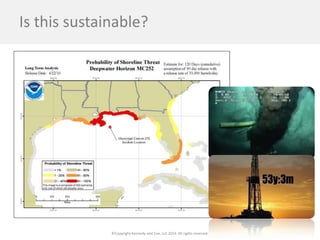
Is this sustainable?
©Copyright Kennedy and Coe, LLC 2014. All rights reserved. 
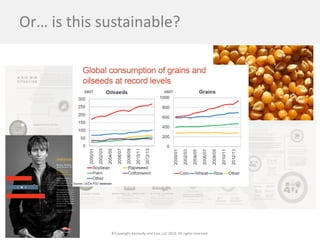
Or… is this sustainable?
©Copyright Kennedy and Coe, LLC 2014. All rights reserved. 
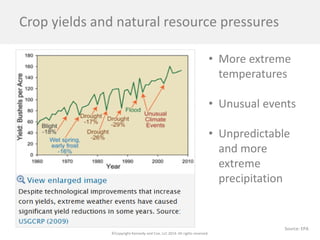
Crop yields and natural resource pressures 
• 
More extreme temperatures 
• 
Unusual events 
• 
Unpredictable and more extreme precipitation 
Source: EPA
©Copyright Kennedy and Coe, LLC 2014. All rights reserved. 
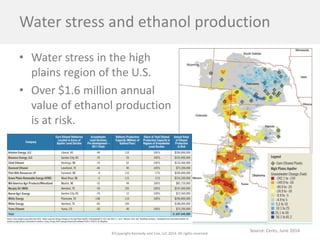
Water stress and ethanol production 
• 
Water stress in the high plains region of the U.S. 
• 
Over $1.6 million annual value of ethanol production is at risk. 
Source: Ceres, June 2014
©Copyright Kennedy and Coe, LLC 2014. All rights reserved. 
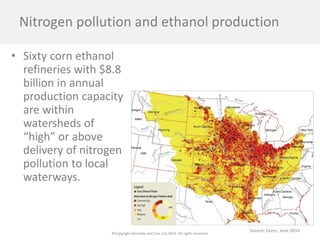
Nitrogen pollution and ethanol production 
• 
Sixty corn ethanol refineries with $8.8 billion in annual production capacity are within watersheds of “high” or above delivery of nitrogen pollution to local waterways. 
Source: Ceres, June 2014
©Copyright Kennedy and Coe, LLC 2014. All rights reserved. 
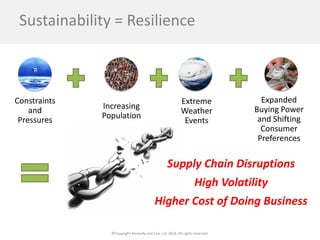
Constraints and Pressures 
Increasing Population 
Extreme Weather Events 
Expanded Buying Power and Shifting Consumer Preferences 
Supply Chain Disruptions 
High Volatility 
Higher Cost of Doing Business 
Sustainability = Resilience
©Copyright Kennedy and Coe, LLC 2014. All rights reserved. 
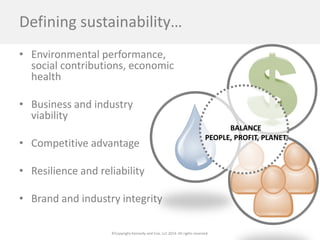
Defining sustainability… 
• 
Environmental performance, social contributions, economic health 
•Business and industry viability 
•Competitive advantage 
•Resilience and reliability 
•Brand and industry integrity 
BALANCE PEOPLE, PROFIT, PLANET
©Copyright Kennedy and Coe, LLC 2014. All rights reserved. 
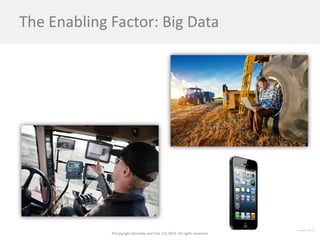
The Enabling Factor: Big Data
©Copyright Kennedy and Coe, LLC 2014. All rights reserved. 
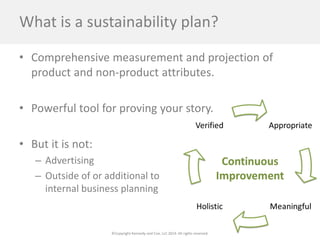
What is a sustainability plan? 
• 
Comprehensive measurement and projection of product and non-product attributes. 
• 
Powerful tool for proving your story. 
• 
But it is not: 
– 
Advertising 
– 
Outside of or additional to internal business planning
©Copyright Kennedy and Coe, LLC 2014. All rights reserved. 
Sustainability Plan = Political Insurance Policy 
• 
Differentiation and value via sustainability plans can help demonstrate industry best practices and innovation. 
• 
Proactive engagement on sustainability issues resonates with D.C.
©Copyright Kennedy and Coe, LLC 2014. All rights reserved. 
Sustainability Plan = Long-term Thinking 
• 
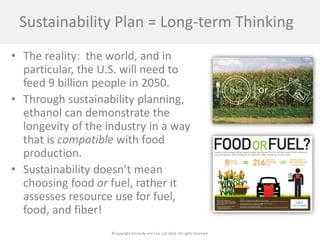
The reality: the world, and in particular, the U.S. will need to feed 9 billion people in 2050. 
• 
Through sustainability planning, ethanol can demonstrate the longevity of the industry in a way that is compatible with food production. 
• 
Sustainability doesn’t mean choosing food or fuel, rather it assesses resource use for fuel, food, and fiber!
©Copyright Kennedy and Coe, LLC 2014. All rights reserved. 
How are sustainability plans created? 
• 
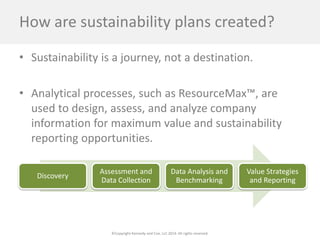
Sustainability is a journey, not a destination. 
• 
Analytical processes, such as ResourceMax™, are used to design, assess, and analyze company information for maximum value and sustainability reporting opportunities. 
Discovery 
Assessment and Data Collection 
Data Analysis and Benchmarking 
Value Strategies and Reporting
©Copyright Kennedy and Coe, LLC 2014. All rights reserved. 
Outcomes of ResourceMax 
• 
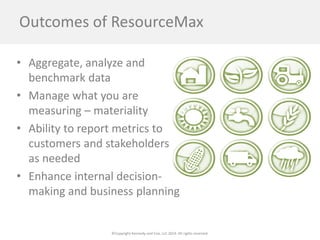
Aggregate, analyze and benchmark data 
• 
Manage what you are measuring – materiality 
• 
Ability to report metrics to customers and stakeholders as needed 
• 
Enhance internal decision- making and business planning
©Copyright Kennedy and Coe, LLC 2014. All rights reserved. 
Integrating sustainability plans 
• 
Board of Directors / Executive Management Level 
• 
Annual and Strategic Planning 
• 
Procurement requirements and supplier codes 
• 
Budgeting 
• 
Modeling and Projections 
Source: MIT Sloan Management Review, 2013
©Copyright Kennedy and Coe, LLC 2014. All rights reserved. 
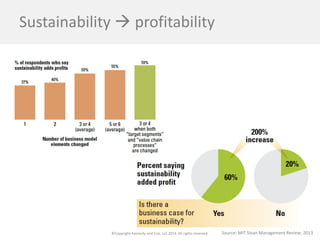
Sustainability  profitability 
Source: MIT Sloan Management Review, 2013
©Copyright Kennedy and Coe, LLC 2014. All rights reserved. 
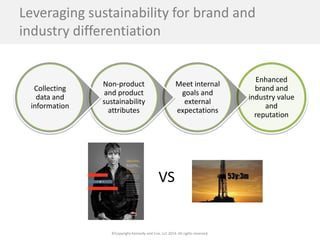
Leveraging sustainability for brand and industry differentiation 
Enhanced brand and industry value and reputation 
Meet internal goals and external expectations 
Non-product and product sustainability attributes 
Collecting data and information 
VS
How to Get There Ryan Heuer - December 11, 2014 At Kennedy & Coe’s Ethanol Leaders’ Summit
1. 
Build business – place sustainability at the heart of your business strategy 
2. 
Integrate, integrate, integrate – cross-functional, high-level and day-to-day oversight 
3. 
Link goals to bonus schemes – integrate sustainability targets into bonus schemes 
4. 
Don’t underestimate training – build sustainability competences across the organization 
5. 
Make success measurable – measure progress through targets and indicators 
How to Organize Sustainability In Business
©Copyright Kennedy and Coe, LLC 2014. All rights reserved. 
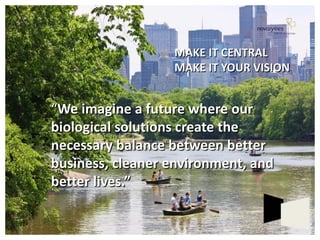
“We imagine a future where our biological solutions create the necessary balance between better business, cleaner environment, and better lives.” 
MAKE IT CENTRAL MAKE IT YOUR VISION
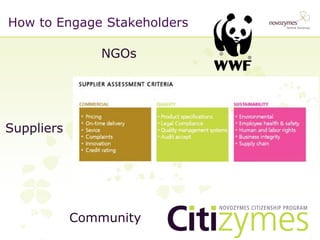
NGOs 
Suppliers 
Community 
How to Engage Stakeholders
Key Stakeholders: The Customer 
+
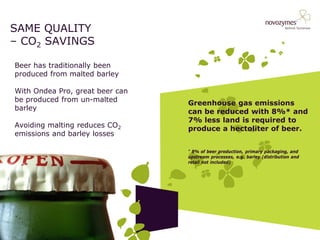
SAME QUALITY – CO2 SAVINGS 
Beer has traditionally been produced from malted barley With Ondea Pro, great beer can be produced from un-malted barley Avoiding malting reduces CO2 emissions and barley losses 
Greenhouse gas emissions can be reduced with 8%* and 7% less land is required to produce a hectoliter of beer. 
* 8% of beer production, primary packaging, and upstream processes, e.g. barley (distribution and retail not included)
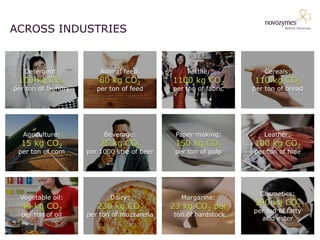
ACROSS INDUSTRIES 
Cereals: 
110 kg CO2 
per ton of bread 
Detergent: 
100 kg CO2 
per ton of laundry 
Animal feed: 
80 kg CO2 
per ton of feed 
Textile: 1100 kg CO2 per ton of fabric 
Agriculture: 15 kg CO2 per ton of corn 
Beverage: 
25 kg CO2 
per 1000 litre of beer 
Leather: 
100 kg CO2 
per ton of hide 
Paper making: 
150 kg CO2 
per ton of pulp 
Vegetable oil: 
44 kg CO2 
per ton of oil 
Dairy: 
230 kg CO2 
per ton of mozzarella 
Cosmetics: 
190 kg CO2 
per ton of fatty 
acid ester 
Margarine: 23 kg CO2 per ton of hardstock
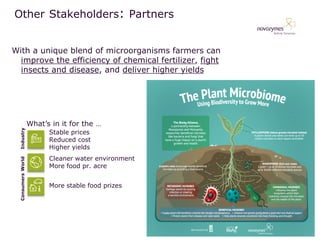
What’s in it for the … 
Consumers World Industry 
Other Stakeholders: Partners 
With a unique blend of microorganisms farmers can improve the efficiency of chemical fertilizer, fight insects and disease, and deliver higher yields 
Stable prices 
Reduced cost 
Higher yields 
Cleaner water environment More food pr. acre 
More stable food prizes
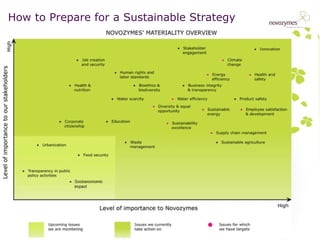
How to Prepare for a Sustainable Strategy
Corporate Sustainability 
28 
Source: 
Unilever Sustainable Living Plan Progress Report 2014,Internal analysis 
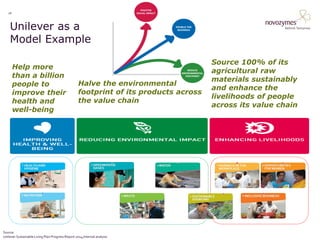
Help more than a billion people to improve their health and well-being 
Halve the environmental footprint of its products across the value chain 
Source 100% of its agricultural raw materials sustainably and enhance the livelihoods of people across its value chain 
Unilever as a Model Example
©Copyright Kennedy and Coe, LLC 2014. All rights reserved. 
THANK YOU 
Novozymes Contributors: 
Arlan Peters – Head of Sustainability 
Jesper Kloverpris – Manager, Sustainability 
Chris Bender – Head of Public Affairs & Communications

Creating Sustainability Plan to Maximize Profits & Create Differentiation

  • 1.
    ©Copyright Kennedy andCoe, LLC 2014. ©Copyright Kennedy and Coe, LLC 20 A1l4l .r iAglhl trsig rhetsse revseedr.v ed. Creating a Sustainability Plan to Maximize Profits and Create Differentiation Emily Johannes, Kennedy and Coe Ryan Heuer, Novozymes
  • 2.
    ©Copyright Kennedy andCoe, LLC 2014. All rights reserved. What we will talk about today… • What is sustainability? •How can a sustainability plan maximize profits and create differentiation in the marketplace? •How can we get there?
  • 3.
    ©Copyright Kennedy andCoe, LLC 2014. All rights reserved. Is this sustainable?
  • 4.
    ©Copyright Kennedy andCoe, LLC 2014. All rights reserved. Or… is this sustainable?
  • 5.
    ©Copyright Kennedy andCoe, LLC 2014. All rights reserved. Crop yields and natural resource pressures • More extreme temperatures • Unusual events • Unpredictable and more extreme precipitation Source: EPA
  • 6.
    ©Copyright Kennedy andCoe, LLC 2014. All rights reserved. Water stress and ethanol production • Water stress in the high plains region of the U.S. • Over $1.6 million annual value of ethanol production is at risk. Source: Ceres, June 2014
  • 7.
    ©Copyright Kennedy andCoe, LLC 2014. All rights reserved. Nitrogen pollution and ethanol production • Sixty corn ethanol refineries with $8.8 billion in annual production capacity are within watersheds of “high” or above delivery of nitrogen pollution to local waterways. Source: Ceres, June 2014
  • 8.
    ©Copyright Kennedy andCoe, LLC 2014. All rights reserved. Constraints and Pressures Increasing Population Extreme Weather Events Expanded Buying Power and Shifting Consumer Preferences Supply Chain Disruptions High Volatility Higher Cost of Doing Business Sustainability = Resilience
  • 9.
    ©Copyright Kennedy andCoe, LLC 2014. All rights reserved. Defining sustainability… • Environmental performance, social contributions, economic health •Business and industry viability •Competitive advantage •Resilience and reliability •Brand and industry integrity BALANCE PEOPLE, PROFIT, PLANET
  • 10.
    ©Copyright Kennedy andCoe, LLC 2014. All rights reserved. The Enabling Factor: Big Data
  • 11.
    ©Copyright Kennedy andCoe, LLC 2014. All rights reserved. What is a sustainability plan? • Comprehensive measurement and projection of product and non-product attributes. • Powerful tool for proving your story. • But it is not: – Advertising – Outside of or additional to internal business planning
  • 12.
    ©Copyright Kennedy andCoe, LLC 2014. All rights reserved. Sustainability Plan = Political Insurance Policy • Differentiation and value via sustainability plans can help demonstrate industry best practices and innovation. • Proactive engagement on sustainability issues resonates with D.C.
  • 13.
    ©Copyright Kennedy andCoe, LLC 2014. All rights reserved. Sustainability Plan = Long-term Thinking • The reality: the world, and in particular, the U.S. will need to feed 9 billion people in 2050. • Through sustainability planning, ethanol can demonstrate the longevity of the industry in a way that is compatible with food production. • Sustainability doesn’t mean choosing food or fuel, rather it assesses resource use for fuel, food, and fiber!
  • 14.
    ©Copyright Kennedy andCoe, LLC 2014. All rights reserved. How are sustainability plans created? • Sustainability is a journey, not a destination. • Analytical processes, such as ResourceMax™, are used to design, assess, and analyze company information for maximum value and sustainability reporting opportunities. Discovery Assessment and Data Collection Data Analysis and Benchmarking Value Strategies and Reporting
  • 15.
    ©Copyright Kennedy andCoe, LLC 2014. All rights reserved. Outcomes of ResourceMax • Aggregate, analyze and benchmark data • Manage what you are measuring – materiality • Ability to report metrics to customers and stakeholders as needed • Enhance internal decision- making and business planning
  • 16.
    ©Copyright Kennedy andCoe, LLC 2014. All rights reserved. Integrating sustainability plans • Board of Directors / Executive Management Level • Annual and Strategic Planning • Procurement requirements and supplier codes • Budgeting • Modeling and Projections Source: MIT Sloan Management Review, 2013
  • 17.
    ©Copyright Kennedy andCoe, LLC 2014. All rights reserved. Sustainability  profitability Source: MIT Sloan Management Review, 2013
  • 18.
    ©Copyright Kennedy andCoe, LLC 2014. All rights reserved. Leveraging sustainability for brand and industry differentiation Enhanced brand and industry value and reputation Meet internal goals and external expectations Non-product and product sustainability attributes Collecting data and information VS
  • 19.
    How to GetThere Ryan Heuer - December 11, 2014 At Kennedy & Coe’s Ethanol Leaders’ Summit
  • 20.
    1. Build business– place sustainability at the heart of your business strategy 2. Integrate, integrate, integrate – cross-functional, high-level and day-to-day oversight 3. Link goals to bonus schemes – integrate sustainability targets into bonus schemes 4. Don’t underestimate training – build sustainability competences across the organization 5. Make success measurable – measure progress through targets and indicators How to Organize Sustainability In Business
  • 21.
    ©Copyright Kennedy andCoe, LLC 2014. All rights reserved. “We imagine a future where our biological solutions create the necessary balance between better business, cleaner environment, and better lives.” MAKE IT CENTRAL MAKE IT YOUR VISION
  • 22.
    NGOs Suppliers Community How to Engage Stakeholders
  • 23.
  • 24.
    SAME QUALITY –CO2 SAVINGS Beer has traditionally been produced from malted barley With Ondea Pro, great beer can be produced from un-malted barley Avoiding malting reduces CO2 emissions and barley losses Greenhouse gas emissions can be reduced with 8%* and 7% less land is required to produce a hectoliter of beer. * 8% of beer production, primary packaging, and upstream processes, e.g. barley (distribution and retail not included)
  • 25.
    ACROSS INDUSTRIES Cereals: 110 kg CO2 per ton of bread Detergent: 100 kg CO2 per ton of laundry Animal feed: 80 kg CO2 per ton of feed Textile: 1100 kg CO2 per ton of fabric Agriculture: 15 kg CO2 per ton of corn Beverage: 25 kg CO2 per 1000 litre of beer Leather: 100 kg CO2 per ton of hide Paper making: 150 kg CO2 per ton of pulp Vegetable oil: 44 kg CO2 per ton of oil Dairy: 230 kg CO2 per ton of mozzarella Cosmetics: 190 kg CO2 per ton of fatty acid ester Margarine: 23 kg CO2 per ton of hardstock
  • 26.
    What’s in itfor the … Consumers World Industry Other Stakeholders: Partners With a unique blend of microorganisms farmers can improve the efficiency of chemical fertilizer, fight insects and disease, and deliver higher yields Stable prices Reduced cost Higher yields Cleaner water environment More food pr. acre More stable food prizes
  • 27.
    How to Preparefor a Sustainable Strategy
  • 28.
    Corporate Sustainability 28 Source: Unilever Sustainable Living Plan Progress Report 2014,Internal analysis Help more than a billion people to improve their health and well-being Halve the environmental footprint of its products across the value chain Source 100% of its agricultural raw materials sustainably and enhance the livelihoods of people across its value chain Unilever as a Model Example
  • 29.
    ©Copyright Kennedy andCoe, LLC 2014. All rights reserved. THANK YOU Novozymes Contributors: Arlan Peters – Head of Sustainability Jesper Kloverpris – Manager, Sustainability Chris Bender – Head of Public Affairs & Communications