Sustainable Sourcing for BEVERAGE Category Managers: Using the FMI GuideFive Winds International &Ecos USConference Number(s):  1-877-782-5094 Participant Code: 200436 January 26, 2011
AcknowledgementsProduced “by the industry for the industry”Thank you to:United Soybean BoardFMI Sustainability Executive Committee and CouncilSpecifically those that helped to launch the development of the guide: Suzanne Forbes (Wakefern), Harriet Hentges (Ahold USA), Tom McIntyre (SUPERVALU), Karen Meleta (Wakefern), Tracy Taylor (Ahold USA) and Jeanne von Zastrow (FMI)All those who participated in our Guide survey and submitted additional comments
Background on Guide & PresentationThis presentation accompanies the document:Sustainability on the ShelvesA Guide for Category ManagersPlease customize the Guide and these slides for your own use
AgendaLearning ObjectivesWhat is Sustainability?Sustainable SourcingDecision Framework for BeverageTake-Home MessagesQuestions
Learning ObjectivesProvide good working understanding of sustainability in the food retail sectorIdentify key sustainability issues specific to each product categoryPossess questions and tools to help understand and verify sustainability claims, recognize “greenwashing”, and select more sustainable products
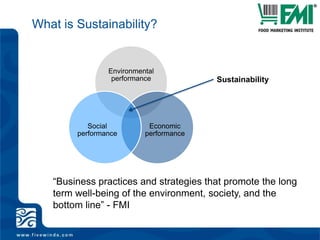
What is Sustainability?Sustainability“Business practices and strategies that promote the long term well-being of the environment, society, and the bottom line” - FMI
Sustainability in Your CompanyPoll: Who is in charge of sustainability in your company?Corporate Sustainability Director Senior Executive designated to manage sustainabilityc.	Sustainability Teamd.	Othere.	No one7
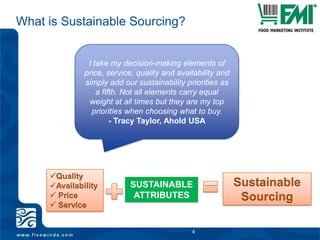
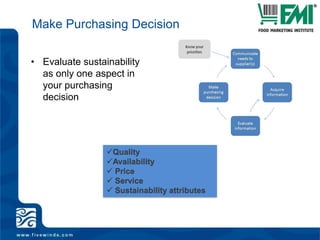
What is Sustainable Sourcing?8I take my decision-making elements of price, service, quality and availability and simply add our sustainability priorities as a fifth. Not all elements carry equal weight at all times but they are my top priorities when choosing what to buy. - Tracy Taylor, Ahold USAQuality
Availability
 Price
 ServiceSustainable SourcingSUSTAINABLE ATTRIBUTES
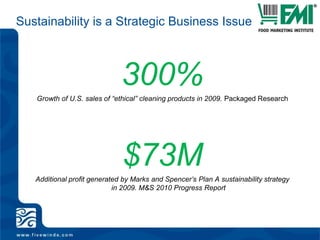
Sustainability is a Strategic Business Issue300% Growth of U.S. sales of “ethical” cleaning products in 2009. Packaged Research$73MAdditional profit generated by Marks and Spencer’s Plan A sustainability strategy in 2009. M&S 2010 Progress Report
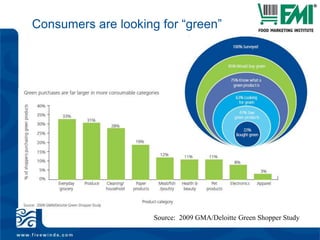
Consumers are looking for “green”Source:  2009 GMA/Deloitte Green Shopper Study
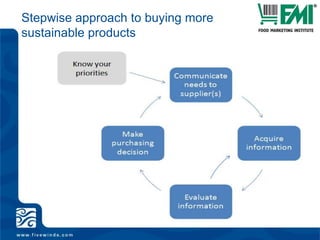
Stepwise approach to buying more sustainable products
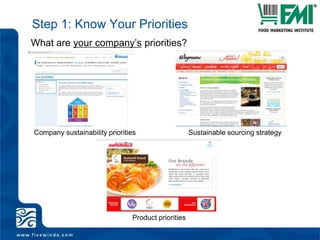
Step 1: Know Your PrioritiesWhat are your company’s priorities? Sustainable sourcing strategyCompany sustainability prioritiesProduct priorities
Poll: What sustainability issues are your customers asking about? (select all that apply)a) Packaging	b) Sustainable seafood	c) Organic	d) Local	e) Toxic/natural ingredients	f)  OtherStep 1: What are your customers’ priorities?
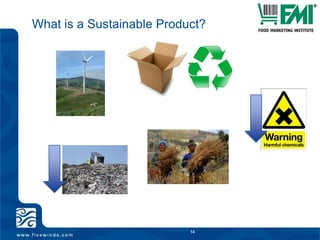
What is a Sustainable Product? 14
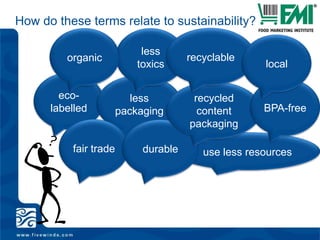
How do these terms relate to sustainability? recyclableless toxicsorganiclocaleco-labelledless packagingBPA-freerecycled content packagingfair tradedurableuse less resources
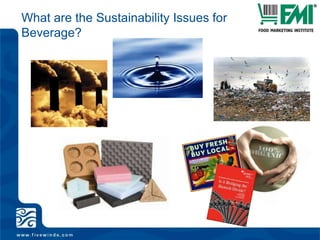
What are the Sustainability Issues for Beverage?
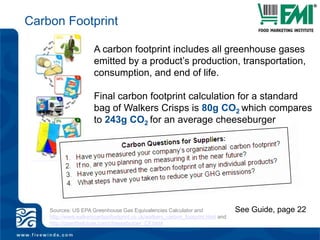
Carbon FootprintA carbon footprint includes all greenhouse gases emitted by a product’s production, transportation, consumption, and end of life.Final carbon footprint calculation for a standard bag of Walkers Crisps is 80g CO2 which compares to 243g CO2 for an average cheeseburgerSee Guide, page 22Sources: US EPA Greenhouse Gas Equivalencies Calculator and  http://www.walkerscarbonfootprint.co.uk/walkers_carbon_footprint.html and  http://openthefuture.com/cheeseburger_CF.html
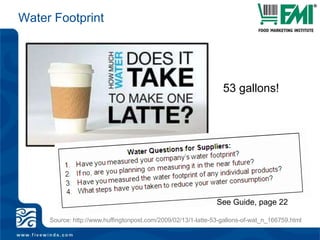
Water Footprint53 gallons!See Guide, page 22Source: http://www.huffingtonpost.com/2009/02/13/1-latte-53-gallons-of-wat_n_166759.html
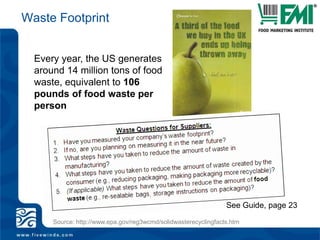
Waste FootprintEvery year, the US generates around 14 million tons of food waste, equivalent to 106 pounds of food waste per personSee Guide, page 23Source: http://www.epa.gov/reg3wcmd/solidwasterecyclingfacts.htm
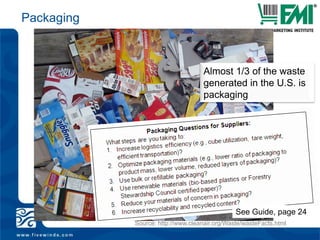
PackagingAlmost 1/3 of the waste generated in the U.S. is packagingSee Guide, page 24Source: http://www.cleanair.org/Waste/wasteFacts.html
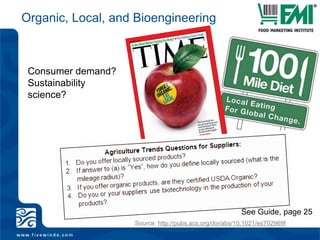
Organic, Local, and BioengineeringConsumer demand? Sustainability science?See Guide, page 25Source: http://pubs.acs.org/doi/abs/10.1021/es702969f
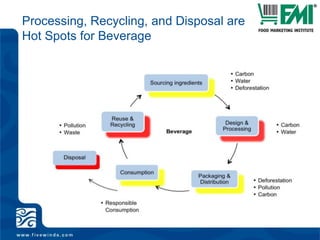
Processing, Recycling, and Disposal are       Hot Spots for Beverage
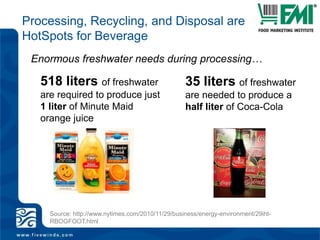
Processing, Recycling, and Disposal are       HotSpots for BeverageEnormous freshwater needs during processing…518 liters of freshwater are required to produce just 1 liter of Minute Maid orange juice35 liters of freshwater are needed to produce a half liter of Coca-ColaSource: http://www.nytimes.com/2010/11/29/business/energy-environment/29iht-RBOGFOOT.html
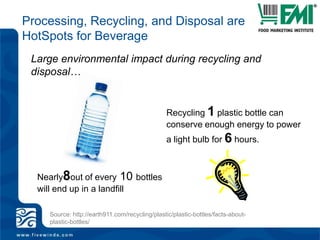
Processing, Recycling, and Disposal are       HotSpots for BeverageLarge environmental impact during recycling and disposal…Recycling 1 plastic bottle can conserve enough energy to power a light bulb for 6 hours.Nearly8out of every 10 bottles will end up in a landfillSource: http://earth911.com/recycling/plastic/plastic-bottles/facts-about-plastic-bottles/
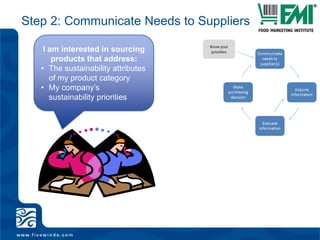
Step 2: Communicate Needs to SuppliersI am interested in sourcing products that address:The sustainability attributes of my product category
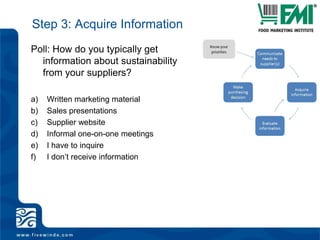
My company’s sustainability prioritiesStep 3: Acquire InformationPoll: How do you typically get information about sustainability from your suppliers?Written marketing materialSales presentationsSupplier websiteInformal one-on-one meetingsI have to inquireI don’t receive information
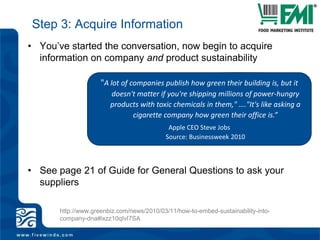
Step 3: Acquire InformationYou’ve started the conversation, now begin to acquire information on company and product sustainabilitySee page 21 of Guide for General Questions to ask your suppliers 		http://www.greenbiz.com/news/2010/03/11/how-to-embed-sustainability-into-	company-dna#ixzz10qIvI7SA"A lot of companies publish how green their building is, but it doesn't matter if you're shipping millions of power-hungry products with toxic chemicals in them," …."It's like asking a cigarette company how green their office is.”Apple CEO Steve JobsSource: Businessweek 2010
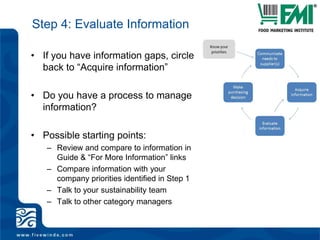
Step 4: Evaluate InformationIf you have information gaps, circle back to “Acquire information”Do you have a process to manage information?
Possible starting points:Review and compare to information in Guide & “For More Information” linksCompare information with your company priorities identified in Step 1Talk to your sustainability teamTalk to other category managers
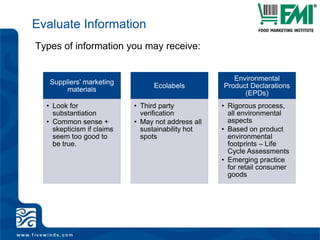
Evaluate InformationTypes of information you may receive:
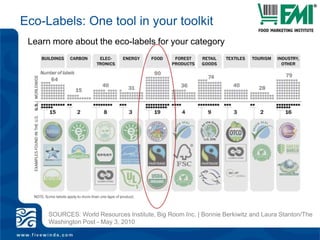
Eco-Labels: One tool in your toolkitLearn more about the eco-labels for your categorySOURCES: World Resources Institute, Big Room Inc. | Bonnie Berkiwitz and Laura Stanton/The Washington Post - May 3, 2010
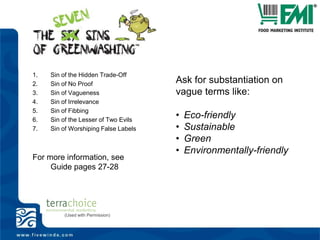
Ask for substantiation on vague terms like:Eco-friendly
Sustainable
Green
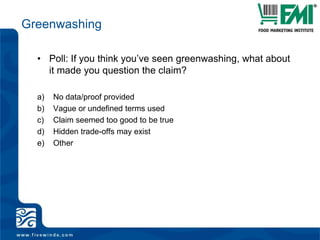
Environmentally-friendlySin of the Hidden Trade-OffSin of No ProofSin of VaguenessSin of IrrelevanceSin of FibbingSin of the Lesser of Two EvilsSin of Worshiping False LabelsFor more information, see Guide pages 27-28(Used with Permission)

Fmi final beverage cat man webinar[1]

  • 1.
    Sustainable Sourcing forBEVERAGE Category Managers: Using the FMI GuideFive Winds International &Ecos USConference Number(s):  1-877-782-5094 Participant Code: 200436 January 26, 2011
  • 2.
    AcknowledgementsProduced “by theindustry for the industry”Thank you to:United Soybean BoardFMI Sustainability Executive Committee and CouncilSpecifically those that helped to launch the development of the guide: Suzanne Forbes (Wakefern), Harriet Hentges (Ahold USA), Tom McIntyre (SUPERVALU), Karen Meleta (Wakefern), Tracy Taylor (Ahold USA) and Jeanne von Zastrow (FMI)All those who participated in our Guide survey and submitted additional comments
  • 3.
    Background on Guide& PresentationThis presentation accompanies the document:Sustainability on the ShelvesA Guide for Category ManagersPlease customize the Guide and these slides for your own use
  • 4.
    AgendaLearning ObjectivesWhat isSustainability?Sustainable SourcingDecision Framework for BeverageTake-Home MessagesQuestions
  • 5.
    Learning ObjectivesProvide goodworking understanding of sustainability in the food retail sectorIdentify key sustainability issues specific to each product categoryPossess questions and tools to help understand and verify sustainability claims, recognize “greenwashing”, and select more sustainable products
  • 6.
    What is Sustainability?Sustainability“Businesspractices and strategies that promote the long term well-being of the environment, society, and the bottom line” - FMI
  • 7.
    Sustainability in YourCompanyPoll: Who is in charge of sustainability in your company?Corporate Sustainability Director Senior Executive designated to manage sustainabilityc. Sustainability Teamd. Othere. No one7
  • 8.
    What is SustainableSourcing?8I take my decision-making elements of price, service, quality and availability and simply add our sustainability priorities as a fifth. Not all elements carry equal weight at all times but they are my top priorities when choosing what to buy. - Tracy Taylor, Ahold USAQuality
  • 9.
  • 10.
  • 11.
  • 12.
    Sustainability is aStrategic Business Issue300% Growth of U.S. sales of “ethical” cleaning products in 2009. Packaged Research$73MAdditional profit generated by Marks and Spencer’s Plan A sustainability strategy in 2009. M&S 2010 Progress Report
  • 13.
    Consumers are lookingfor “green”Source: 2009 GMA/Deloitte Green Shopper Study
  • 14.
    Stepwise approach tobuying more sustainable products
  • 15.
    Step 1: KnowYour PrioritiesWhat are your company’s priorities? Sustainable sourcing strategyCompany sustainability prioritiesProduct priorities
  • 16.
    Poll: What sustainabilityissues are your customers asking about? (select all that apply)a) Packaging b) Sustainable seafood c) Organic d) Local e) Toxic/natural ingredients f) OtherStep 1: What are your customers’ priorities?
  • 17.
    What is aSustainable Product? 14
  • 18.
    How do theseterms relate to sustainability? recyclableless toxicsorganiclocaleco-labelledless packagingBPA-freerecycled content packagingfair tradedurableuse less resources
  • 19.
    What are theSustainability Issues for Beverage?
  • 20.
    Carbon FootprintA carbonfootprint includes all greenhouse gases emitted by a product’s production, transportation, consumption, and end of life.Final carbon footprint calculation for a standard bag of Walkers Crisps is 80g CO2 which compares to 243g CO2 for an average cheeseburgerSee Guide, page 22Sources: US EPA Greenhouse Gas Equivalencies Calculator and http://www.walkerscarbonfootprint.co.uk/walkers_carbon_footprint.html and http://openthefuture.com/cheeseburger_CF.html
  • 21.
    Water Footprint53 gallons!SeeGuide, page 22Source: http://www.huffingtonpost.com/2009/02/13/1-latte-53-gallons-of-wat_n_166759.html
  • 22.
    Waste FootprintEvery year,the US generates around 14 million tons of food waste, equivalent to 106 pounds of food waste per personSee Guide, page 23Source: http://www.epa.gov/reg3wcmd/solidwasterecyclingfacts.htm
  • 23.
    PackagingAlmost 1/3 ofthe waste generated in the U.S. is packagingSee Guide, page 24Source: http://www.cleanair.org/Waste/wasteFacts.html
  • 24.
    Organic, Local, andBioengineeringConsumer demand? Sustainability science?See Guide, page 25Source: http://pubs.acs.org/doi/abs/10.1021/es702969f
  • 25.
    Processing, Recycling, andDisposal are Hot Spots for Beverage
  • 26.
    Processing, Recycling, andDisposal are HotSpots for BeverageEnormous freshwater needs during processing…518 liters of freshwater are required to produce just 1 liter of Minute Maid orange juice35 liters of freshwater are needed to produce a half liter of Coca-ColaSource: http://www.nytimes.com/2010/11/29/business/energy-environment/29iht-RBOGFOOT.html
  • 27.
    Processing, Recycling, andDisposal are HotSpots for BeverageLarge environmental impact during recycling and disposal…Recycling 1 plastic bottle can conserve enough energy to power a light bulb for 6 hours.Nearly8out of every 10 bottles will end up in a landfillSource: http://earth911.com/recycling/plastic/plastic-bottles/facts-about-plastic-bottles/
  • 28.
    Step 2: CommunicateNeeds to SuppliersI am interested in sourcing products that address:The sustainability attributes of my product category
  • 29.
    My company’s sustainabilityprioritiesStep 3: Acquire InformationPoll: How do you typically get information about sustainability from your suppliers?Written marketing materialSales presentationsSupplier websiteInformal one-on-one meetingsI have to inquireI don’t receive information
  • 30.
    Step 3: AcquireInformationYou’ve started the conversation, now begin to acquire information on company and product sustainabilitySee page 21 of Guide for General Questions to ask your suppliers http://www.greenbiz.com/news/2010/03/11/how-to-embed-sustainability-into- company-dna#ixzz10qIvI7SA"A lot of companies publish how green their building is, but it doesn't matter if you're shipping millions of power-hungry products with toxic chemicals in them," …."It's like asking a cigarette company how green their office is.”Apple CEO Steve JobsSource: Businessweek 2010
  • 31.
    Step 4: EvaluateInformationIf you have information gaps, circle back to “Acquire information”Do you have a process to manage information?
  • 32.
    Possible starting points:Reviewand compare to information in Guide & “For More Information” linksCompare information with your company priorities identified in Step 1Talk to your sustainability teamTalk to other category managers
  • 33.
    Evaluate InformationTypes ofinformation you may receive:
  • 34.
    Eco-Labels: One toolin your toolkitLearn more about the eco-labels for your categorySOURCES: World Resources Institute, Big Room Inc. | Bonnie Berkiwitz and Laura Stanton/The Washington Post - May 3, 2010
  • 35.
    Ask for substantiationon vague terms like:Eco-friendly
  • 36.
  • 37.
  • 38.
    Environmentally-friendlySin of theHidden Trade-OffSin of No ProofSin of VaguenessSin of IrrelevanceSin of FibbingSin of the Lesser of Two EvilsSin of Worshiping False LabelsFor more information, see Guide pages 27-28(Used with Permission)

Editor's Notes

  • #11 Source: 2009 GMA/Deloitte Green Shopper Study “Finding the green in today’s shoppers”. Sample Size is 6,498 Shoppers Interviewed as they exited the store; Percent figures indicate portion of respondents who indicated that they a) would purchase a green product (q14) b) answered ‘Yes’ to knowing what a green product is (unaided q9) c) were looking for a green product (yes or no to seeing green products q10) d) saw green products (q10) and e) purchased a green product (aided) (q11). A sample questionnaire provided to shoppers is in Appendix A
  • #13 Supervalu private organic brand – product priorities
  • #15 There are many aspects of products to be considered in sustainability – one of many thingsAttributes of sustainable products include:Promotes the responsible use and conservation of land, fuels and electricity;Is certified to third-party standards or ecolabels for sustainability attributes;Reduces waste and makes efficient use of resources (energy and water especially);Was sourced, grown, or made using fair labor standards;Reduces polluting by-products or safety hazards during manufacture, use and disposal;Packaging or product can be recycled; andPackaging or product contains recycled materials.
  • #16 Add person with question mark to bottom left of slide – use monochromeHow does cat man sort through these things?
  • #17 Carbon footprintWater footprintWaste footprintPackagingCurrent agriculture trends (locally sourced, organic and use of biotechnology)
  • #18 Carbon footprint – look a grocery product for footprint (walker’s crisps) and say equivalence in …What is it – product imageWhy important – cost of energyWhat should you ask your suppliers
  • #19 Carbon footprintWater footprintWaste footprintPackagingCurrent agriculture trends (locally sourced, organic and use of biotechnology)
  • #20 Carbon footprintWater footprintWaste footprintPackagingCurrent agriculture trends (locally sourced, organic and use of biotechnology)
  • #21 Carbon footprintWater footprintWaste footprintPackagingCurrent agriculture trends (locally sourced, organic and use of biotechnology)
  • #22 Carbon footprintWater footprintWaste footprintPackagingCurrent agriculture trends (locally sourced, organic and use of biotechnology)
  • #25 Agricultural land occupies 50% of the Earth's habitable land (World Wildlife Fund)Globally, the agricultural sector consumes about 69% of the planet's fresh water-more than twice that of industry (23%) and dwarfing municipal uses (8%) (World Wildlife Fund)World food production will have to increase 70% to meet the needs of the 2.3 billion people that are expected to inhabit the planet and increasing demand of higher incomes. (FAO)
  • #26 Picture of 2 ppl talking to each other – bubble with contentWhat you need to tell them, and then how you tell themTell your suppliers about your interest in sourcing products that address:the sustainability attributes of your product category andyour company’s sustainability prioritiesMode of communication: individual phone calls or emails, a webinar, or mass messages sent to all your suppliersDepends on how many suppliers you would like to contact
  • #31 What makes a “good” ecolabel?Ecolabeling organization itself is credible, with appropriate management practicesMarket recognitionGood performance standardAddresses important sustainability hot spotsDeveloped in a transparent process with participation of all relevant stakeholdersPublically available
  • #32 Mention FTC work in this area
  • #35 Take guide, customize it, and make it your own