Constructing Mathematical
Arguments
Jana Banks
Karen Brown
Lucy Marincel
Purpose
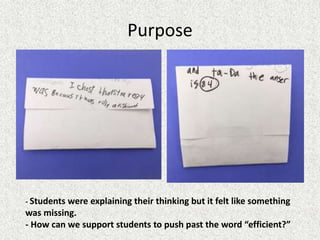
- Students were explaining their thinking but it felt like something
was missing.
- How can we support students to push past the word “efficient?”
Purpose
• What could help students construct viable
arguments and critique the reasoning of
others (SMP.3)?
• How can we make the “prove it” more
natural?
Always, Sometimes, Never
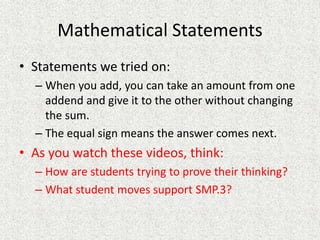
Mathematical Statements
• Statements we tried on:
– When you add, you can take an amount from one
addend and give it to the other without changing
the sum.
– The equal sign means the answer comes next.
• As you watch these videos, think:
– How are students trying to prove their thinking?
– What student moves support SMP.3?
When you add, you can take an amount
from one addend and give it to the other
without changing the sum.
*Audio clips of students have been removed.
When you add, you can take an amount
from one addend and give it to the other
without changing the sum.
*Audio clips of students have been removed.
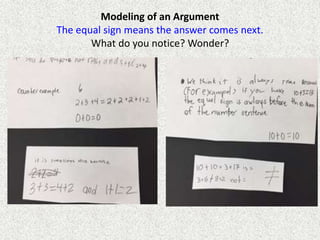
Modeling of an Argument
The equal sign means the answer comes next.
What do you notice? Wonder?
Supporting SMP.3
• How are students trying to prove their thinking
• What student moves support SMP.3?
• A few moves our students have already combed out
that help convince others:
– Examples
– Counterexamples
– Describe what is happening without using numbers
– Background information
• Other thoughts?
Try it out!
• Please choose geometry and/or fractions. The point
isn’t to rush but to develop rich arguments and try to
convince your partner if and when you disagree.
• Work with a partner and decide where to tape your
statement.
• Feel free to write all over your paper!
• Note: This work is messy! We may not know if we
are right or wrong.
Think back to standards
• How does this work support SMP.3?
– Create viable arguments and critique the
reasoning of others.
• How does this work support SMP.4?
– Model with mathematics.
• How does this work support SMP.7?
– Look for and make use of structure.
Teachers as Learners
• How did this feel?
• What struggles did you have?
• What statements were tricky? Easy?
• What helped you to support your opinion?
Reflections
• How could this be used in your classroom?
• What are you excited about?
• What did you notice about your own thinking?
• What did you notice about your partner’s
argument?
• What are you still wondering about?
• What are you curious about?
• Can this concept be used in other content areas?
Resources
• There is a crowd-sourced list on Google Drive of Elementary Always,
Sometimes, Never statements. I can share with you!
• Includes resources of how other teachers are implementing this
work in their classrooms.
• Jana Banks
• Karen Brown
– karen.brown.dcps.4@gmail.com (send emails here for
resources)
– Twitter: @kiby33
• Lucy Marincel

Creating Math Arg 5_1_15 *pubilc

  • 1.
  • 2.
    Purpose - Students wereexplaining their thinking but it felt like something was missing. - How can we support students to push past the word “efficient?”
  • 3.
    Purpose • What couldhelp students construct viable arguments and critique the reasoning of others (SMP.3)? • How can we make the “prove it” more natural?
  • 4.
  • 5.
    Mathematical Statements • Statementswe tried on: – When you add, you can take an amount from one addend and give it to the other without changing the sum. – The equal sign means the answer comes next. • As you watch these videos, think: – How are students trying to prove their thinking? – What student moves support SMP.3?
  • 6.
    When you add,you can take an amount from one addend and give it to the other without changing the sum. *Audio clips of students have been removed.
  • 7.
    When you add,you can take an amount from one addend and give it to the other without changing the sum. *Audio clips of students have been removed.
  • 8.
    Modeling of anArgument The equal sign means the answer comes next. What do you notice? Wonder?
  • 9.
    Supporting SMP.3 • Howare students trying to prove their thinking • What student moves support SMP.3? • A few moves our students have already combed out that help convince others: – Examples – Counterexamples – Describe what is happening without using numbers – Background information • Other thoughts?
  • 10.
    Try it out! •Please choose geometry and/or fractions. The point isn’t to rush but to develop rich arguments and try to convince your partner if and when you disagree. • Work with a partner and decide where to tape your statement. • Feel free to write all over your paper! • Note: This work is messy! We may not know if we are right or wrong.
  • 11.
    Think back tostandards • How does this work support SMP.3? – Create viable arguments and critique the reasoning of others. • How does this work support SMP.4? – Model with mathematics. • How does this work support SMP.7? – Look for and make use of structure.
  • 12.
    Teachers as Learners •How did this feel? • What struggles did you have? • What statements were tricky? Easy? • What helped you to support your opinion?
  • 13.
    Reflections • How couldthis be used in your classroom? • What are you excited about? • What did you notice about your own thinking? • What did you notice about your partner’s argument? • What are you still wondering about? • What are you curious about? • Can this concept be used in other content areas?
  • 14.
    Resources • There isa crowd-sourced list on Google Drive of Elementary Always, Sometimes, Never statements. I can share with you! • Includes resources of how other teachers are implementing this work in their classrooms. • Jana Banks • Karen Brown – karen.brown.dcps.4@gmail.com (send emails here for resources) – Twitter: @kiby33 • Lucy Marincel

Editor's Notes