Creating marketing
effective online store
- M. K. Valvi
Introduction
● Online stores achieve maximum value when they’re
customer-centric, anticipating users’ needs and filling
them.
● This ppt emphasizes the marketing characteristics
of a successful online store, rather than the
technical details of implementing a storefront
solution.
Examining the Key Components of
an Online Store
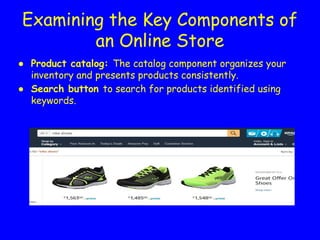
● Product catalog: The catalog component organizes your
inventory and presents products consistently.
● Search button to search for products identified using
keywords.
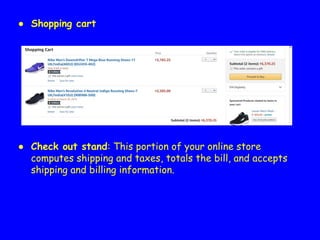
● Shopping cart
● Check out stand: This portion of your online store
computes shipping and taxes, totals the bill, and accepts
shipping and billing information.
● Reporting and order tracking: Order tracking allows you,
and your customer, to know the status of an order in
terms of fulfillment and shipping.
● A detailed product description: Facts such as the
expiration date, size dimensions, weight, manufacturers
date, and practical uses must be included in a good product
description.
● Customer reviews: 88% of consumers say they trust online
reviews as much as personal recommendations. Your
audience wants to read about the experiences of other
people who have used the product.
Selling B2B with an Online
Store
● Main changes will be pricing, merchandising, and packaging —
most businesses buy larger quantities than individuals.
● Include a secure application form with spaces for a state resale
number and credit references. At the very least, ask them to
call or e-mail! You might also have an online form for them to
apply for a trade account and pay by purchase order (PO).
● If you’re a wholesaler or manufacturer, consider implementing a
password login so only approved dealers can view your wholesale
prices and place orders.
Merchandising Your Online
Store
Selecting and pricing products: Price
competition online is intense.
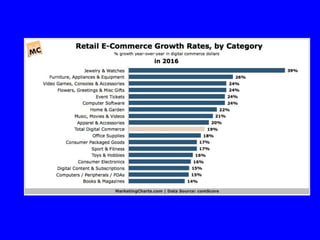
Deciding what types of products to sell
The list, in descending order of online sales dollars in
20016, is shown in following figure.
Choosing specific items to include in your
catalog
Given intense competition online and shoppers’ desires
for good selections, you need a critical mass of products
and choices unless you have a very narrow niche with high
demand.
3. Pricing your products
● Check competitors’ prices on one of the many
comparison sites like PriceGrabber.com, or
BizRate.com.
● If your prices are going to be substantially higher, be
sure to state your value proposition clearly so that
shoppers perceive a benefit for paying more.
II. Displaying products: At the top level, a
storefront page displays thumbnails
representing each category and sub
categories. Here are some key decisions you
need to make for each product category:
Choosing which products to feature:
bestsellers, have high profit margins,
descending order of importance.
Sorting products: Relevance, Price low to high
and high to low, new arrivals, best selling,
etc.
Positioning special items on the page
III. Informing users of product options:
offer shoppers choices of colour, size, or
other attributes. If a product is out of stock,
either remove it immediately from your
catalog or notify customers onscreen and
prompt them to enter their email id to be
informed as soon as that product is available.
IV. Enhancing revenue:
Features that help increase the sales:
▪ cross-sales and upsales
▪ Personal recommendations
▪ Bestsellers
▪ Gift recommendations
▪ special hot deals
▪ limited time coupon codes
▪ referral codes
▪ Wish lists
▪ gift cards
V. Including product detail:
▪ It’s very important to give the product
information in as much detail as
possible, like material, dimensions, shelf
life, colours available, number of pieces,
etc.
▪ Include bright and high quality images
from all angles, close up images,
products in real life setting and people
modelling your products.
Making It Easy for Customers
to Buy
Providing a product search engine:
Users might want to search by the
following criteria, alone or in
combination:
▪ Product name
▪ Product type
▪ Price
▪ Product attributes, such as size, color, or
material
▪ Brand
II. Implementing 2 clicks to buy: Put a ‘Buy
Now’ or ‘Add to Cart’ on product detail pages.
And the second click is to make payment.
III. Offering multiple payment options:
Even though online ordering has become
more secure and commonplace, some
customers still worry about providing
credit card information online. It’s a best
practice to offer options.
Besides, multiple payment options
increase your conversion rate. Various
Payment options are:
▪ Paypal
▪ Google Pay
▪ Paytm
▪ PhonePe
▪ Credit card
▪ Debit card
▪ Android Pay
▪ Cash on delivery
▪ Bank transfers
▪ E-wallets like Alipay
IV. Supporting customers:
▪ Enable customers to communicate with a real
person using email, toll-free number, online
chat option.
▪ Build trust- Publish your business hours and a
street address, to establish basic, business
credibility. Post the logos of all organizations
that validate your standing, preferably in the
footer.
▪ Spell out warranty, refund, and return policies.
▪ Notify customers if you place cookies on their
computer
V. Fulfilling orders:
▪ A customer receives an e-mail confirmation
when she completes her order
▪ If your shipping process assigns a unique
tracking number to the order, she can access
a link directly to the carrier’s site whether
you use UPS, the U.S. Postal Service, FedEx,
or other carriers.
▪ Sophisticated, storefront packages offer
additional automated features, including
― Well-integrated systems print out packing slips and
shipping labels.
― Production tracking
― Shipping confirmation:
Understanding Do’s and Don’t
of Online store
DOs:
▪ Do include customer reviews.
▪ The focus of the website should be about how it has
been designed.
▪ The system that you have used to develop and
design your website should be an efficient one,
which also loads quickly. Ex: shopify, woocommerce.
▪ pick a straightforward payment processor
▪ Encourage Those Impulses by Up-Selling
II. DON’Ts:
▪ Don’t just open a web shop and think you’re done.
There’s marketing, advertising, maintenance and a
lot of work after launching the site.
▪ Don’t forget to start an email newsletter.
▪ Don’t forget to test each and every link.
▪ Don’t make false promises about delivery time,
product specifications, etc.
▪ Don’t Spam Them With Pop-ups
▪ Don’t Add Too Many Banner Ads On The Site 
● References
▪ Web marketing for Dummies –Jan Zimmerman
▪ https://www.impactbnd.com/blog/top-7-dos-donts-ecommerce-website
▪ http://onlineincometeacher.com/business-tips/running-an-online-ecommerce-
website/
▪ https://mediaridge.com/blog/the-dos-and-donts-of-an-e-commerce-website/
▪ https://www.segmentify.com/blog/7-payment-methods-e-commerce-store/
▪ https://www.tisindia.com/blog/components-to-build-online-store/
▪ https://shortiedesigns.com/blog/7-essential-components-successful-ecommerc
e-website/

Creating marketing effective online store

  • 1.
  • 2.
    Introduction ● Online storesachieve maximum value when they’re customer-centric, anticipating users’ needs and filling them. ● This ppt emphasizes the marketing characteristics of a successful online store, rather than the technical details of implementing a storefront solution.
  • 3.
    Examining the KeyComponents of an Online Store ● Product catalog: The catalog component organizes your inventory and presents products consistently. ● Search button to search for products identified using keywords.
  • 4.
    ● Shopping cart ●Check out stand: This portion of your online store computes shipping and taxes, totals the bill, and accepts shipping and billing information.
  • 5.
    ● Reporting andorder tracking: Order tracking allows you, and your customer, to know the status of an order in terms of fulfillment and shipping. ● A detailed product description: Facts such as the expiration date, size dimensions, weight, manufacturers date, and practical uses must be included in a good product description. ● Customer reviews: 88% of consumers say they trust online reviews as much as personal recommendations. Your audience wants to read about the experiences of other people who have used the product.
  • 6.
    Selling B2B withan Online Store ● Main changes will be pricing, merchandising, and packaging — most businesses buy larger quantities than individuals. ● Include a secure application form with spaces for a state resale number and credit references. At the very least, ask them to call or e-mail! You might also have an online form for them to apply for a trade account and pay by purchase order (PO). ● If you’re a wholesaler or manufacturer, consider implementing a password login so only approved dealers can view your wholesale prices and place orders.
  • 7.
    Merchandising Your Online Store Selectingand pricing products: Price competition online is intense. Deciding what types of products to sell The list, in descending order of online sales dollars in 20016, is shown in following figure. Choosing specific items to include in your catalog Given intense competition online and shoppers’ desires for good selections, you need a critical mass of products and choices unless you have a very narrow niche with high demand.
  • 9.
    3. Pricing yourproducts ● Check competitors’ prices on one of the many comparison sites like PriceGrabber.com, or BizRate.com. ● If your prices are going to be substantially higher, be sure to state your value proposition clearly so that shoppers perceive a benefit for paying more. II. Displaying products: At the top level, a storefront page displays thumbnails representing each category and sub categories. Here are some key decisions you need to make for each product category:
  • 10.
    Choosing which productsto feature: bestsellers, have high profit margins, descending order of importance. Sorting products: Relevance, Price low to high and high to low, new arrivals, best selling, etc. Positioning special items on the page III. Informing users of product options: offer shoppers choices of colour, size, or other attributes. If a product is out of stock, either remove it immediately from your catalog or notify customers onscreen and prompt them to enter their email id to be informed as soon as that product is available.
  • 11.
    IV. Enhancing revenue: Featuresthat help increase the sales: ▪ cross-sales and upsales ▪ Personal recommendations ▪ Bestsellers ▪ Gift recommendations ▪ special hot deals ▪ limited time coupon codes ▪ referral codes ▪ Wish lists ▪ gift cards
  • 12.
    V. Including productdetail: ▪ It’s very important to give the product information in as much detail as possible, like material, dimensions, shelf life, colours available, number of pieces, etc. ▪ Include bright and high quality images from all angles, close up images, products in real life setting and people modelling your products.
  • 13.
    Making It Easyfor Customers to Buy Providing a product search engine: Users might want to search by the following criteria, alone or in combination: ▪ Product name ▪ Product type ▪ Price ▪ Product attributes, such as size, color, or material ▪ Brand
  • 14.
    II. Implementing 2clicks to buy: Put a ‘Buy Now’ or ‘Add to Cart’ on product detail pages. And the second click is to make payment. III. Offering multiple payment options: Even though online ordering has become more secure and commonplace, some customers still worry about providing credit card information online. It’s a best practice to offer options.
  • 15.
    Besides, multiple paymentoptions increase your conversion rate. Various Payment options are: ▪ Paypal ▪ Google Pay ▪ Paytm ▪ PhonePe ▪ Credit card ▪ Debit card ▪ Android Pay ▪ Cash on delivery ▪ Bank transfers ▪ E-wallets like Alipay
  • 16.
    IV. Supporting customers: ▪Enable customers to communicate with a real person using email, toll-free number, online chat option. ▪ Build trust- Publish your business hours and a street address, to establish basic, business credibility. Post the logos of all organizations that validate your standing, preferably in the footer. ▪ Spell out warranty, refund, and return policies. ▪ Notify customers if you place cookies on their computer
  • 17.
    V. Fulfilling orders: ▪A customer receives an e-mail confirmation when she completes her order ▪ If your shipping process assigns a unique tracking number to the order, she can access a link directly to the carrier’s site whether you use UPS, the U.S. Postal Service, FedEx, or other carriers. ▪ Sophisticated, storefront packages offer additional automated features, including ― Well-integrated systems print out packing slips and shipping labels. ― Production tracking ― Shipping confirmation:
  • 18.
    Understanding Do’s andDon’t of Online store DOs: ▪ Do include customer reviews. ▪ The focus of the website should be about how it has been designed. ▪ The system that you have used to develop and design your website should be an efficient one, which also loads quickly. Ex: shopify, woocommerce. ▪ pick a straightforward payment processor ▪ Encourage Those Impulses by Up-Selling
  • 19.
    II. DON’Ts: ▪ Don’tjust open a web shop and think you’re done. There’s marketing, advertising, maintenance and a lot of work after launching the site. ▪ Don’t forget to start an email newsletter. ▪ Don’t forget to test each and every link. ▪ Don’t make false promises about delivery time, product specifications, etc. ▪ Don’t Spam Them With Pop-ups ▪ Don’t Add Too Many Banner Ads On The Site 
  • 20.
    ● References ▪ Webmarketing for Dummies –Jan Zimmerman ▪ https://www.impactbnd.com/blog/top-7-dos-donts-ecommerce-website ▪ http://onlineincometeacher.com/business-tips/running-an-online-ecommerce- website/ ▪ https://mediaridge.com/blog/the-dos-and-donts-of-an-e-commerce-website/ ▪ https://www.segmentify.com/blog/7-payment-methods-e-commerce-store/ ▪ https://www.tisindia.com/blog/components-to-build-online-store/ ▪ https://shortiedesigns.com/blog/7-essential-components-successful-ecommerc e-website/