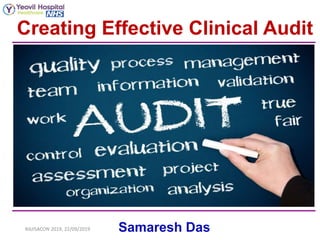
Creating Effective Clinical Audit
RAJISACON 2019, 22/09/2019 Samaresh Das
What is Clinical Audit?
“Clinical audit is a quality improvement process that seeks
to improve patient care & outcomes through systematic
review of care against explicit criteria…Where indicated,
changes are implemented…and further monitoring is used
to confirm improvement in healthcare delivery.”
RAJISACON 2019, 22/09/2019
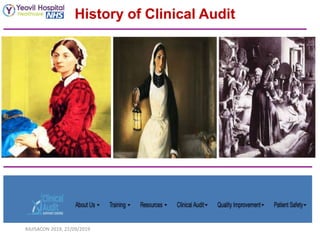
History of Clinical Audit
RAJISACON 2019, 22/09/2019
Why clinical audit is important?
• Improve the quality of the service being offered & to ensure
that what should be done is being done
• Effective/cost effectiveness
• Minimises error or harm to patients
• Provides opportunities for training & education
RAJISACON 2019, 22/09/2019
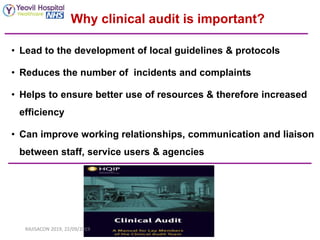
• Lead to the development of local guidelines & protocols
• Reduces the number of incidents and complaints
• Helps to ensure better use of resources & therefore increased
efficiency
• Can improve working relationships, communication and liaison
between staff, service users & agencies
Why clinical audit is important?
RAJISACON 2019, 22/09/2019
Why get involved in audit?
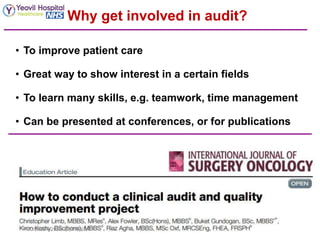
• To improve patient care
• Great way to show interest in a certain fields
• To learn many skills, e.g. teamwork, time management
• Can be presented at conferences, or for publications
RAJISACON 2019, 22/09/2019
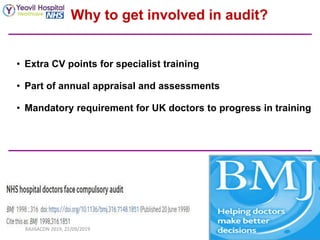
• Extra CV points for specialist training
• Part of annual appraisal and assessments
• Mandatory requirement for UK doctors to progress in training
Why to get involved in audit?
RAJISACON 2019, 22/09/2019
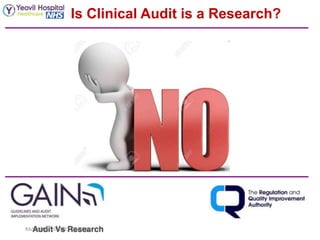
Is Clinical Audit is a Research?
RAJISACON 2019, 22/09/2019
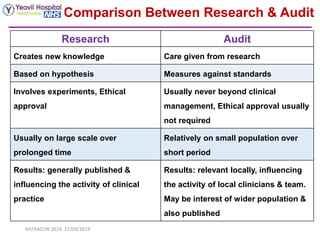
Comparison Between Research & Audit
Research Audit
Creates new knowledge Care given from research
Based on hypothesis Measures against standards
Involves experiments, Ethical
approval
Usually never beyond clinical
management, Ethical approval usually
not required
Usually on large scale over
prolonged time
Relatively on small population over
short period
Results: generally published &
influencing the activity of clinical
practice
Results: relevant locally, influencing
the activity of local clinicians & team.
May be interest of wider population &
also published
RAJISACON 2019, 22/09/2019
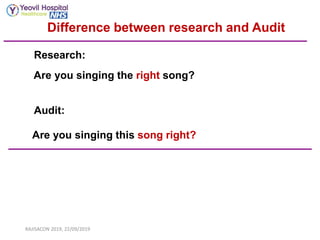
Difference between research and Audit
Research:
Audit:
Are you singing the right song?
Are you singing this song right?
RAJISACON 2019, 22/09/2019
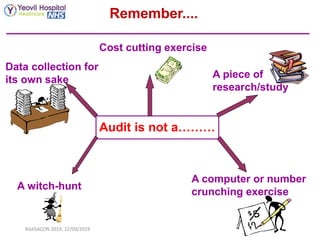
Audit is not a………
A piece of
research/study
Data collection for
its own sake
A computer or number
crunching exercise
Cost cutting exercise
A witch-hunt
Remember....
RAJISACON 2019, 22/09/2019
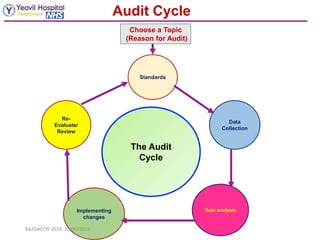
Audit Cycle
Choose a Topic
(Reason for Audit)
Standards
Data
Collection
Data analysisImplementing
changes
Re-
Evaluate/
Review
The Audit
Cycle
RAJISACON 2019, 22/09/2019
Stage 1: Choosing a Topic
RAJISACON 2019, 22/09/2019
Reason for Audit
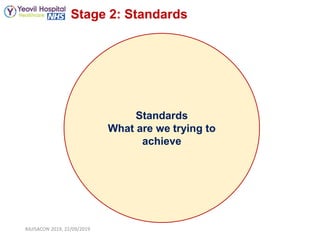
Stage 2: Standards
RAJISACON 2019, 22/09/2019
Standards
What are we trying to
achieve
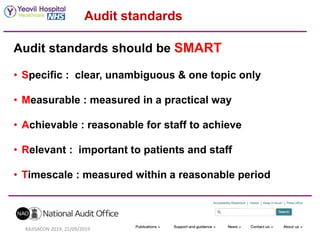
Audit standards
Audit standards should be SMART
• Specific : clear, unambiguous & one topic only
• Measurable : measured in a practical way
• Achievable : reasonable for staff to achieve
• Relevant : important to patients and staff
• Timescale : measured within a reasonable period
RAJISACON 2019, 22/09/2019
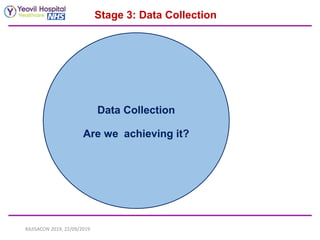
Stage 3: Data Collection
RAJISACON 2019, 22/09/2019
Data Collection
Are we achieving it?
Stage 4: Comparing performance with the standards
RAJISACON 2019, 22/09/2019
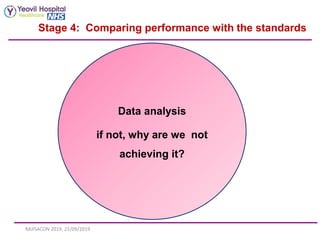
Data analysis
if not, why are we not
achieving it?
Stage 5: Implementing changes
RAJISACON 2019, 22/09/2019
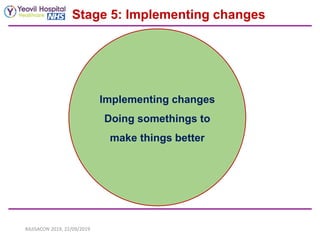
Implementing changes
Doing somethings to
make things better
Stage 6 : Re-audit ; sustaining improvements
RAJISACON 2019, 22/09/2019
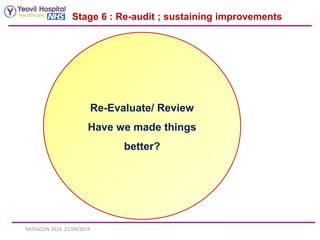
Re-Evaluate/ Review
Have we made things
better?
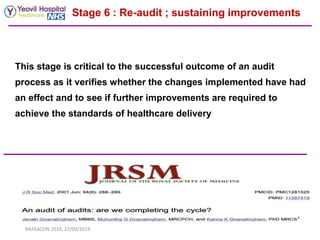
This stage is critical to the successful outcome of an audit
process as it verifies whether the changes implemented have had
an effect and to see if further improvements are required to
achieve the standards of healthcare delivery
Stage 6 : Re-audit ; sustaining improvements
RAJISACON 2019, 22/09/2019
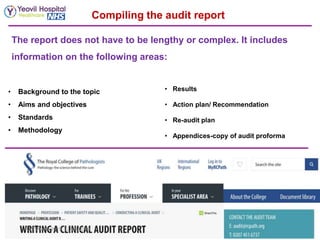
Compiling the audit report
The report does not have to be lengthy or complex. It includes
information on the following areas:
• Background to the topic
• Aims and objectives
• Standards
• Methodology
• Results
• Action plan/ Recommendation
• Re-audit plan
• Appendices-copy of audit proforma
• References
RAJISACON 2019, 22/09/2019
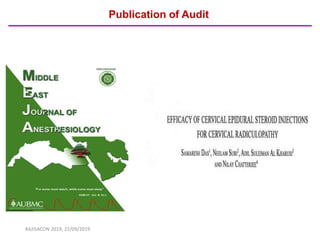
Publication of Audit
RAJISACON 2019, 22/09/2019
For Suggestions/comments: drsamareshdas@gmail.com
samaresh.das@ydh.nhs.uk

Creating effective clinical audit

  • 1.
    Creating Effective ClinicalAudit RAJISACON 2019, 22/09/2019 Samaresh Das
  • 2.
    What is ClinicalAudit? “Clinical audit is a quality improvement process that seeks to improve patient care & outcomes through systematic review of care against explicit criteria…Where indicated, changes are implemented…and further monitoring is used to confirm improvement in healthcare delivery.” RAJISACON 2019, 22/09/2019
  • 3.
    History of ClinicalAudit RAJISACON 2019, 22/09/2019
  • 4.
    Why clinical auditis important? • Improve the quality of the service being offered & to ensure that what should be done is being done • Effective/cost effectiveness • Minimises error or harm to patients • Provides opportunities for training & education RAJISACON 2019, 22/09/2019
  • 5.
    • Lead tothe development of local guidelines & protocols • Reduces the number of incidents and complaints • Helps to ensure better use of resources & therefore increased efficiency • Can improve working relationships, communication and liaison between staff, service users & agencies Why clinical audit is important? RAJISACON 2019, 22/09/2019
  • 6.
    Why get involvedin audit? • To improve patient care • Great way to show interest in a certain fields • To learn many skills, e.g. teamwork, time management • Can be presented at conferences, or for publications RAJISACON 2019, 22/09/2019
  • 7.
    • Extra CVpoints for specialist training • Part of annual appraisal and assessments • Mandatory requirement for UK doctors to progress in training Why to get involved in audit? RAJISACON 2019, 22/09/2019
  • 8.
    Is Clinical Auditis a Research? RAJISACON 2019, 22/09/2019
  • 9.
    Comparison Between Research& Audit Research Audit Creates new knowledge Care given from research Based on hypothesis Measures against standards Involves experiments, Ethical approval Usually never beyond clinical management, Ethical approval usually not required Usually on large scale over prolonged time Relatively on small population over short period Results: generally published & influencing the activity of clinical practice Results: relevant locally, influencing the activity of local clinicians & team. May be interest of wider population & also published RAJISACON 2019, 22/09/2019
  • 10.
    Difference between researchand Audit Research: Audit: Are you singing the right song? Are you singing this song right? RAJISACON 2019, 22/09/2019
  • 11.
    Audit is nota……… A piece of research/study Data collection for its own sake A computer or number crunching exercise Cost cutting exercise A witch-hunt Remember.... RAJISACON 2019, 22/09/2019
  • 12.
    Audit Cycle Choose aTopic (Reason for Audit) Standards Data Collection Data analysisImplementing changes Re- Evaluate/ Review The Audit Cycle RAJISACON 2019, 22/09/2019
  • 13.
    Stage 1: Choosinga Topic RAJISACON 2019, 22/09/2019 Reason for Audit
  • 14.
    Stage 2: Standards RAJISACON2019, 22/09/2019 Standards What are we trying to achieve
  • 15.
    Audit standards Audit standardsshould be SMART • Specific : clear, unambiguous & one topic only • Measurable : measured in a practical way • Achievable : reasonable for staff to achieve • Relevant : important to patients and staff • Timescale : measured within a reasonable period RAJISACON 2019, 22/09/2019
  • 16.
    Stage 3: DataCollection RAJISACON 2019, 22/09/2019 Data Collection Are we achieving it?
  • 17.
    Stage 4: Comparingperformance with the standards RAJISACON 2019, 22/09/2019 Data analysis if not, why are we not achieving it?
  • 18.
    Stage 5: Implementingchanges RAJISACON 2019, 22/09/2019 Implementing changes Doing somethings to make things better
  • 19.
    Stage 6 :Re-audit ; sustaining improvements RAJISACON 2019, 22/09/2019 Re-Evaluate/ Review Have we made things better?
  • 20.
    This stage iscritical to the successful outcome of an audit process as it verifies whether the changes implemented have had an effect and to see if further improvements are required to achieve the standards of healthcare delivery Stage 6 : Re-audit ; sustaining improvements RAJISACON 2019, 22/09/2019
  • 21.
    Compiling the auditreport The report does not have to be lengthy or complex. It includes information on the following areas: • Background to the topic • Aims and objectives • Standards • Methodology • Results • Action plan/ Recommendation • Re-audit plan • Appendices-copy of audit proforma • References RAJISACON 2019, 22/09/2019
  • 22.
  • 23.
    RAJISACON 2019, 22/09/2019 ForSuggestions/comments: drsamareshdas@gmail.com samaresh.das@ydh.nhs.uk

Editor's Notes

  • #4 One of first clinical audits was undertaken by Florence Nightingale during the Crimean War of 1853–55. On arrival at the medical barracks hospital in Scutari in 1854, Nightingale was appalled by the unsanitary conditions and high mortality rates among injured or ill soldiers. She and her team of 38 nurses applied strict sanitary routines and standards of hygiene to the hospital and equipment; in addition, Nightingale had a talent for mathematics and statistics, and she and her staff kept meticulous records of the mortality rates among the hospital patients. Following these changes the mortality rates fell from 40% to 2%, and the results were instrumental in overcoming the resistance of the British doctors and officers to Nightingale's procedures. Her methodical approach, as well as the emphasis on uniformity and comparability of the results of health care, is recognised as one of the earliest programs of outcomes managemet