How do I create
a literate
environment for
my learners?
Getting to Know
Literacy
Learners
Getting to Know
Literacy Learners
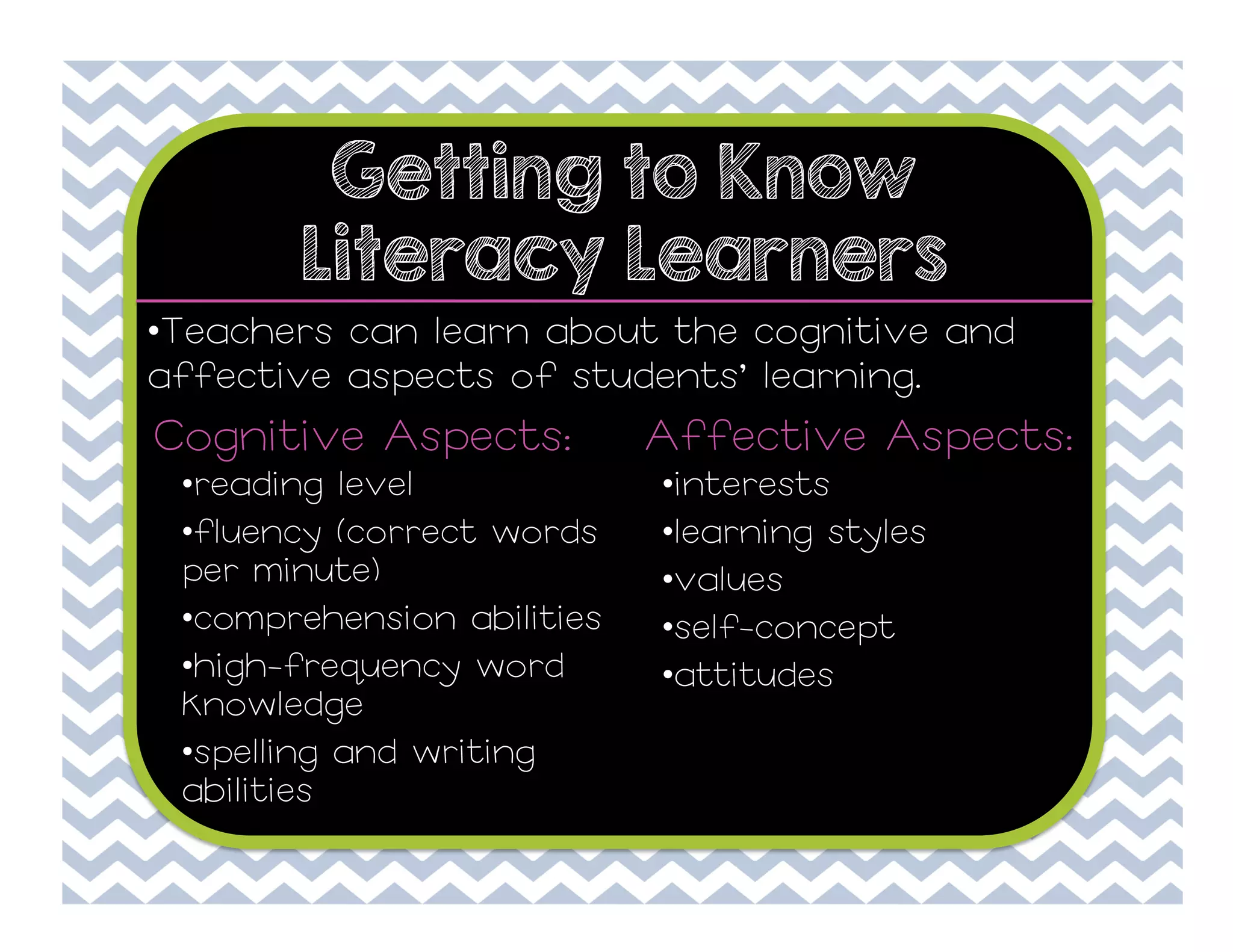
• Teachers can learn about the cognitive and
affective aspects of students’ learning.

Cognitive Aspects:
• reading level
• fluency (correct words
per minute)
• comprehension abilities
• high-frequency word
knowledge
• spelling and writing
abilities

Affective Aspects:
• interests
• learning styles
• values
• self-concept
• attitudes
Getting to Know
Literacy Learners
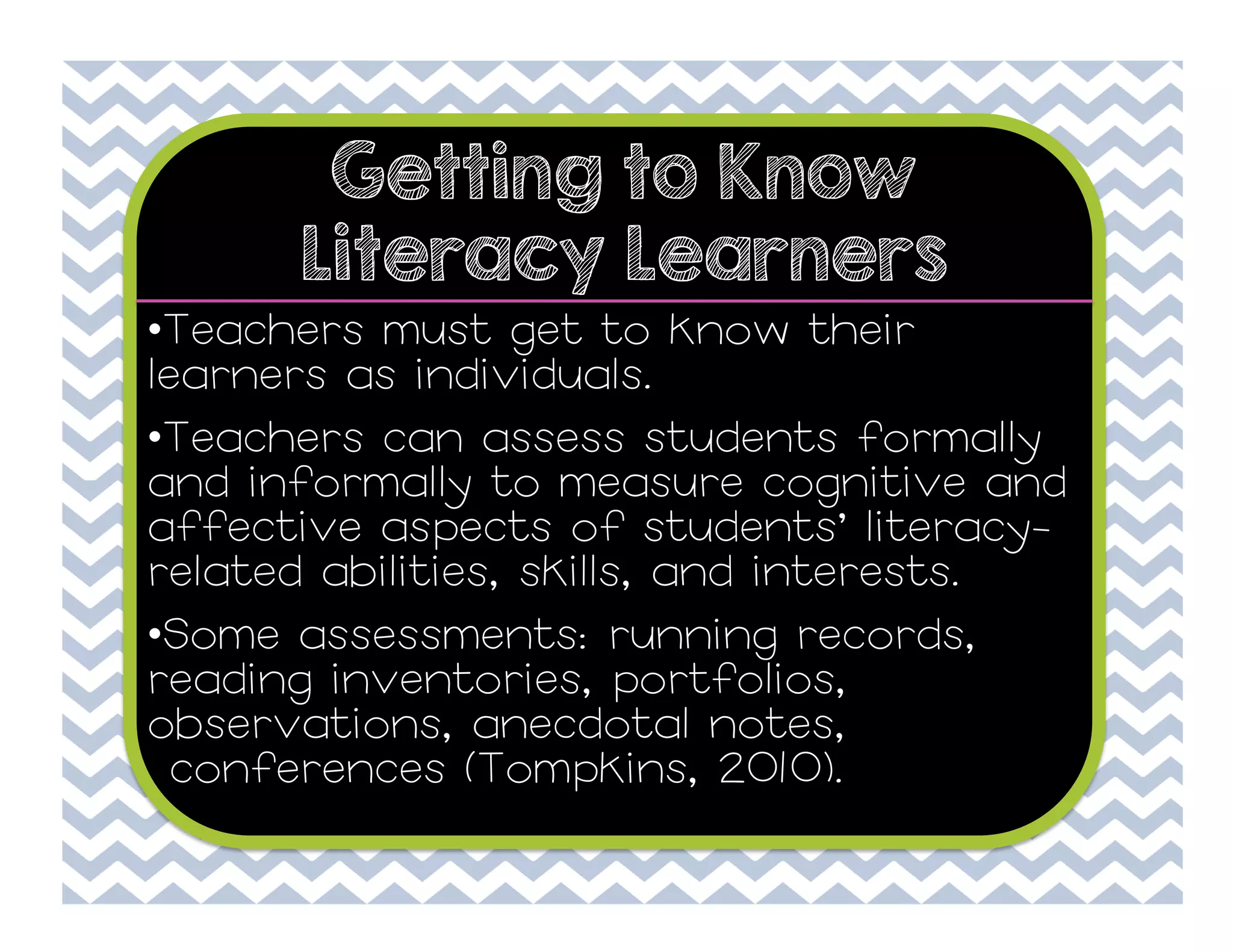
• Teachers must get to know their
learners as individuals.
• Teachers can assess students formally
and informally to measure cognitive and
affective aspects of students’ literacyrelated abilities, skills, and interests.
• Some assessments: running records,
reading inventories, portfolios,
observations, anecdotal notes,
tconferences (Tompkins, 2010).
Getting to Know
Literacy Learners

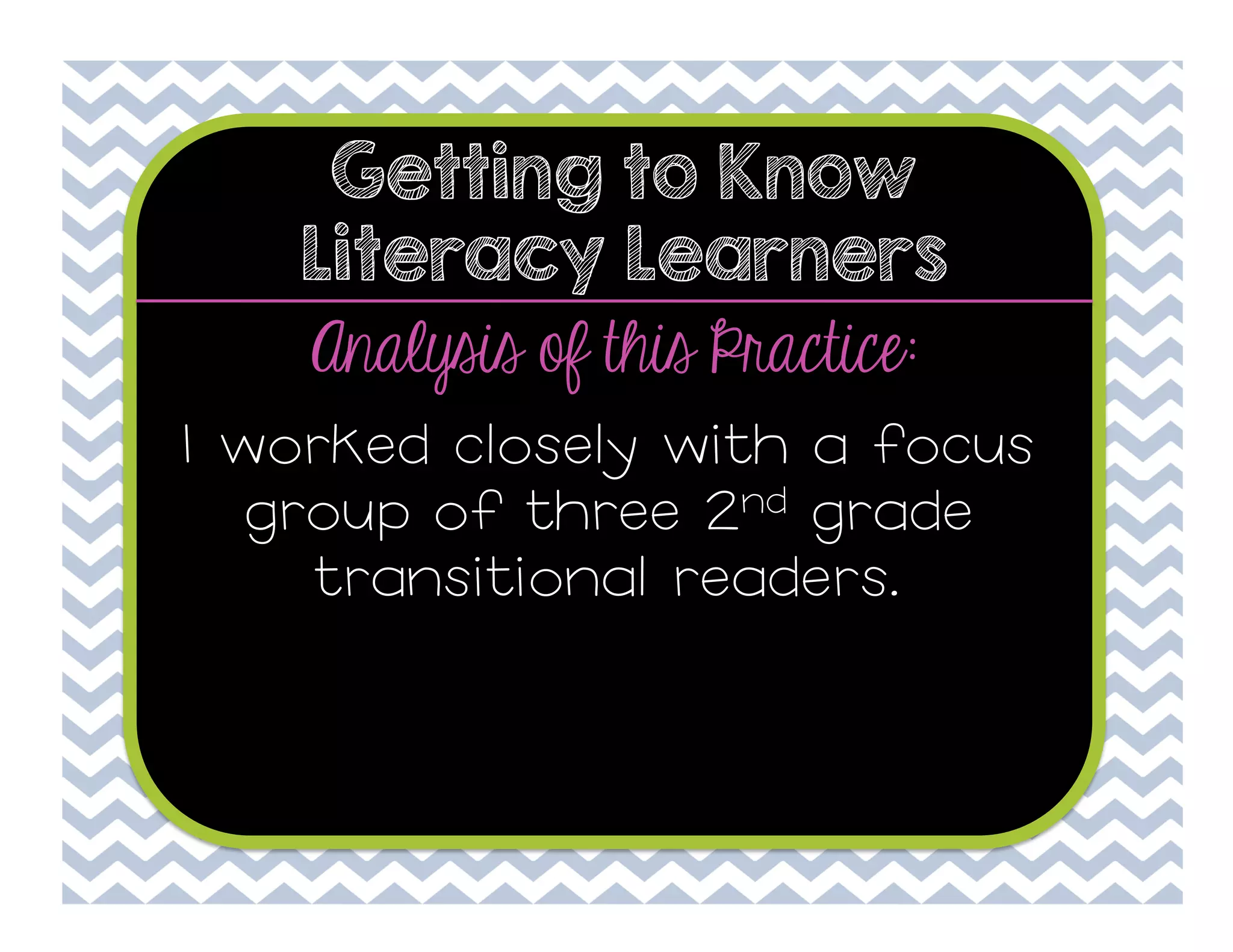
Analysis of this Practice:
I worked closely with a focus
group of three 2nd grade
transitional readers.
Getting to Know
Literacy Learners

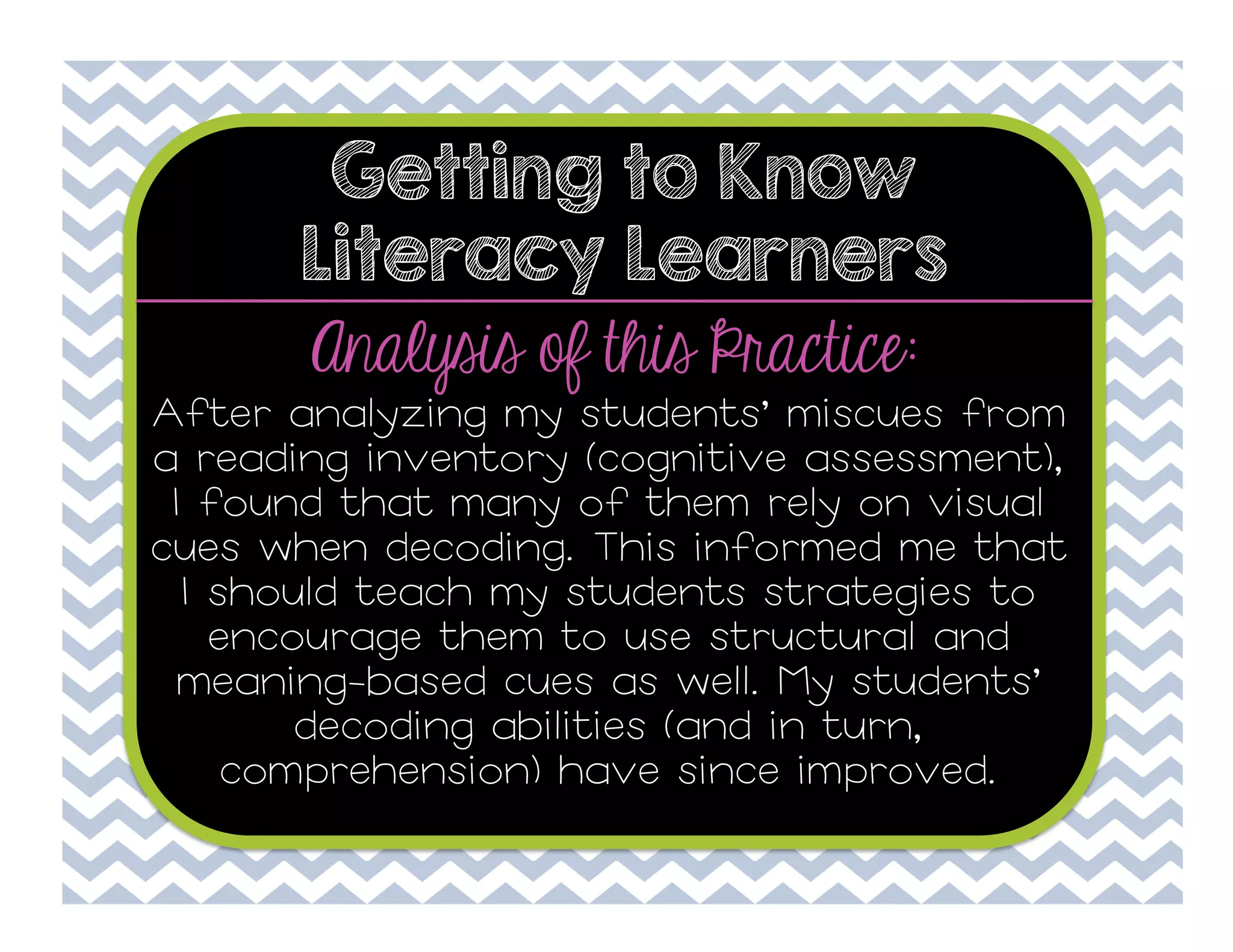
Analysis of this Practice:

After analyzing my students’ miscues from
a reading inventory (cognitive assessment),
I found that many of them rely on visual
cues when decoding. This informed me that
I should teach my students strategies to
encourage them to use structural and
meaning-based cues as well. My students’
decoding abilities (and in turn,
comprehension) have since improved.
Getting to Know
Literacy Learners

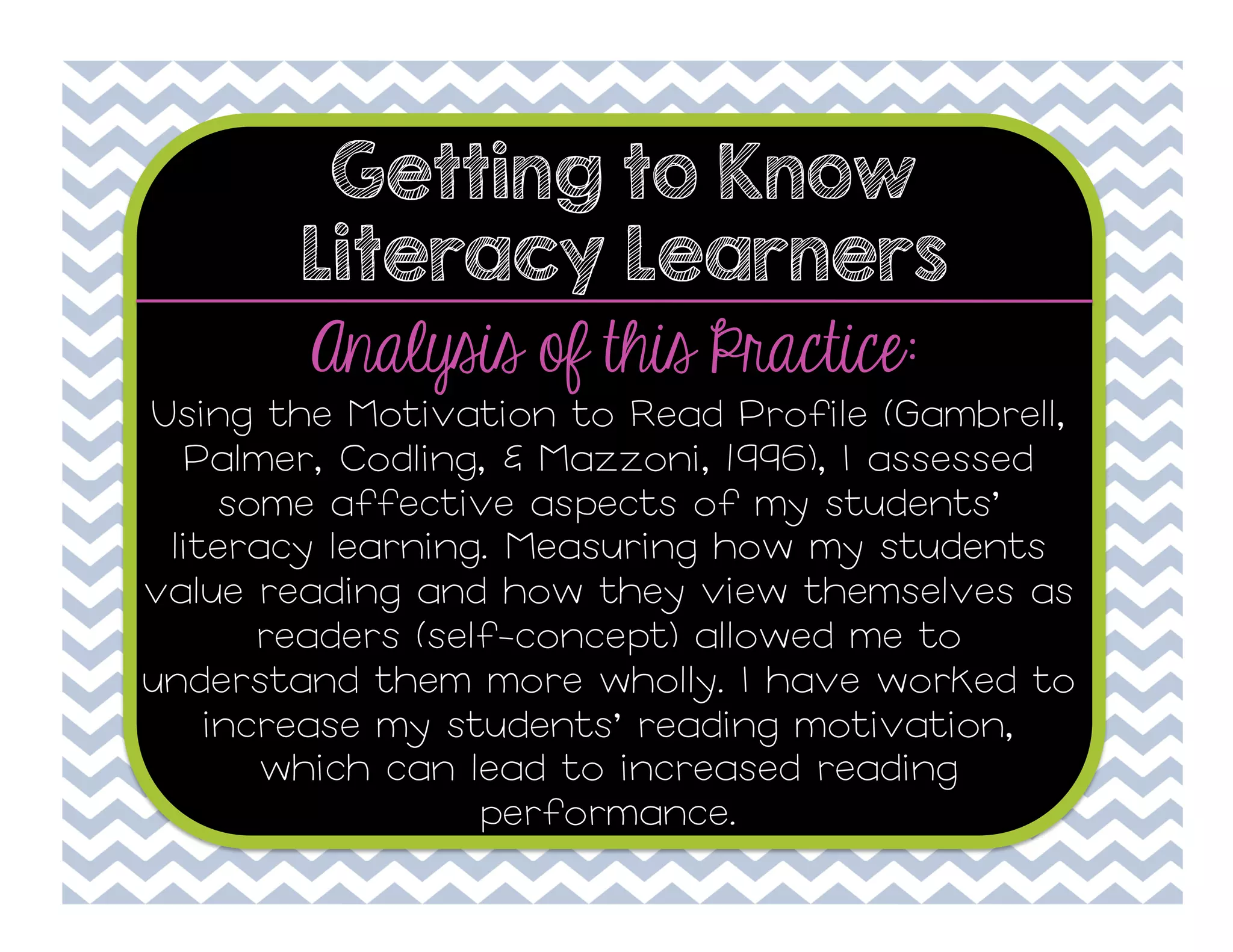
Analysis of this Practice:
Using the Motivation to Read Profile (Gambrell,
Palmer, Codling, & Mazzoni, 1996), I assessed
some affective aspects of my students’
literacy learning. Measuring how my students
value reading and how they view themselves as
readers (self-concept) allowed me to
understand them more wholly. I have worked to
increase my students’ reading motivation,
which can lead to increased reading
performance.
Selecting Texts
Selecting Texts
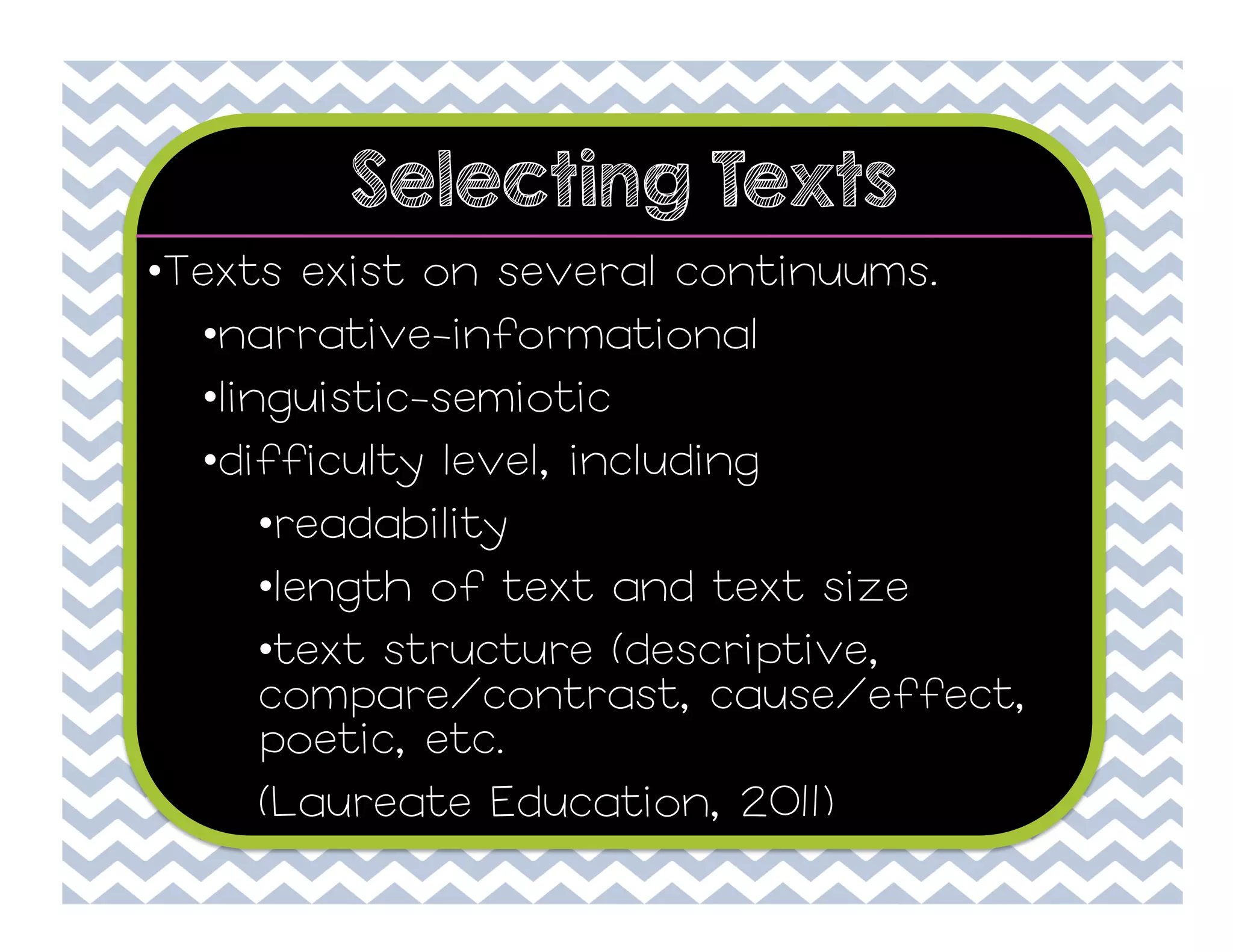
• Texts exist on several continuums.
• narrative-informational
• linguistic-semiotic
• difficulty level, including
• readability
• length of text and text size
• text structure (descriptive,
compare/contrast, cause/effect,
poetic, etc.
(Laureate Education, 2011)
Selecting Texts
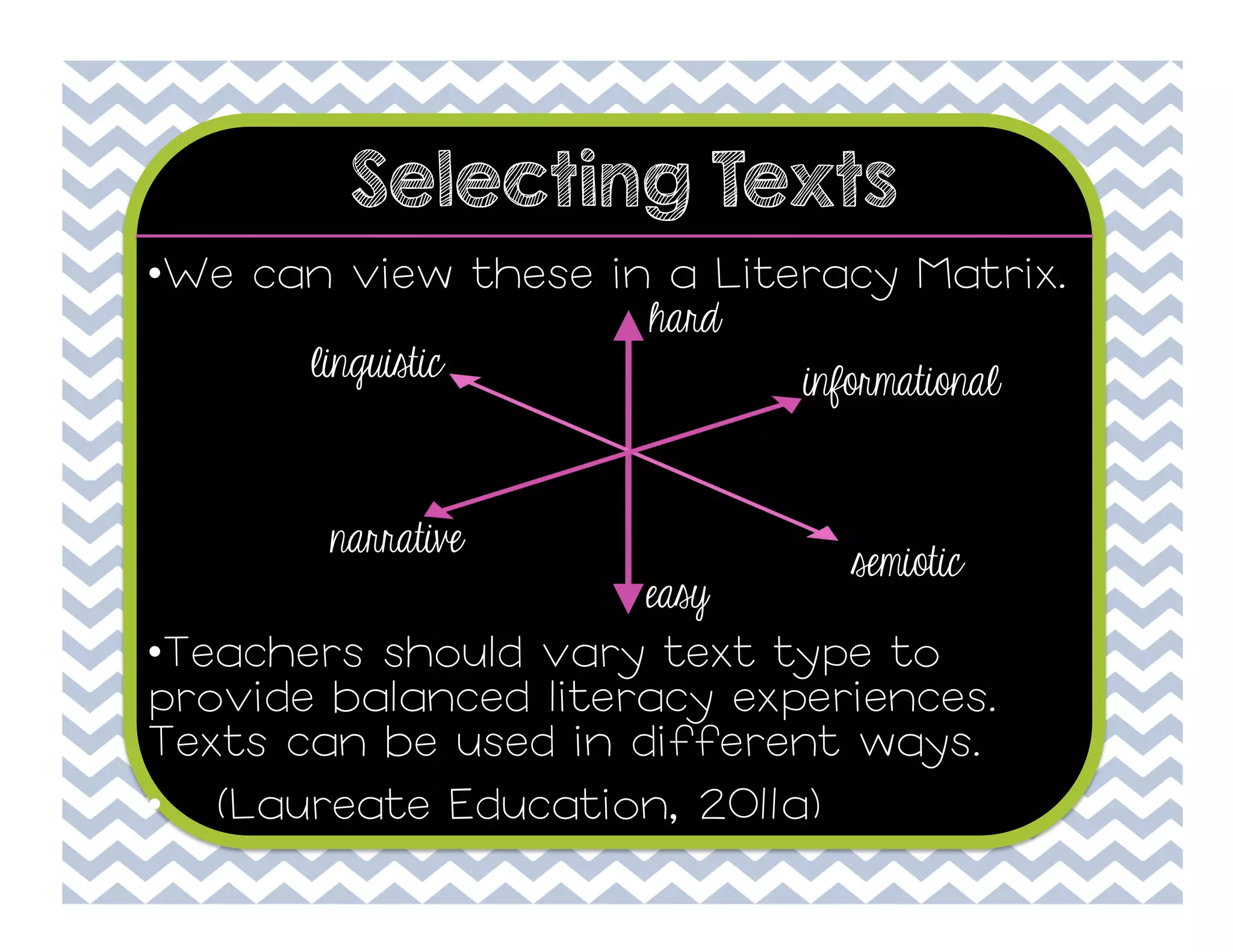
• We can view these in a Literacy Matrix.
hard
linguistic
informational
narrative

semiotic

easy
• Teachers should vary text type to
provide balanced literacy experiences.
Texts can be used in different ways.
•  (Laureate Education, 2011a)
Selecting Texts

Analysis of this Practice:

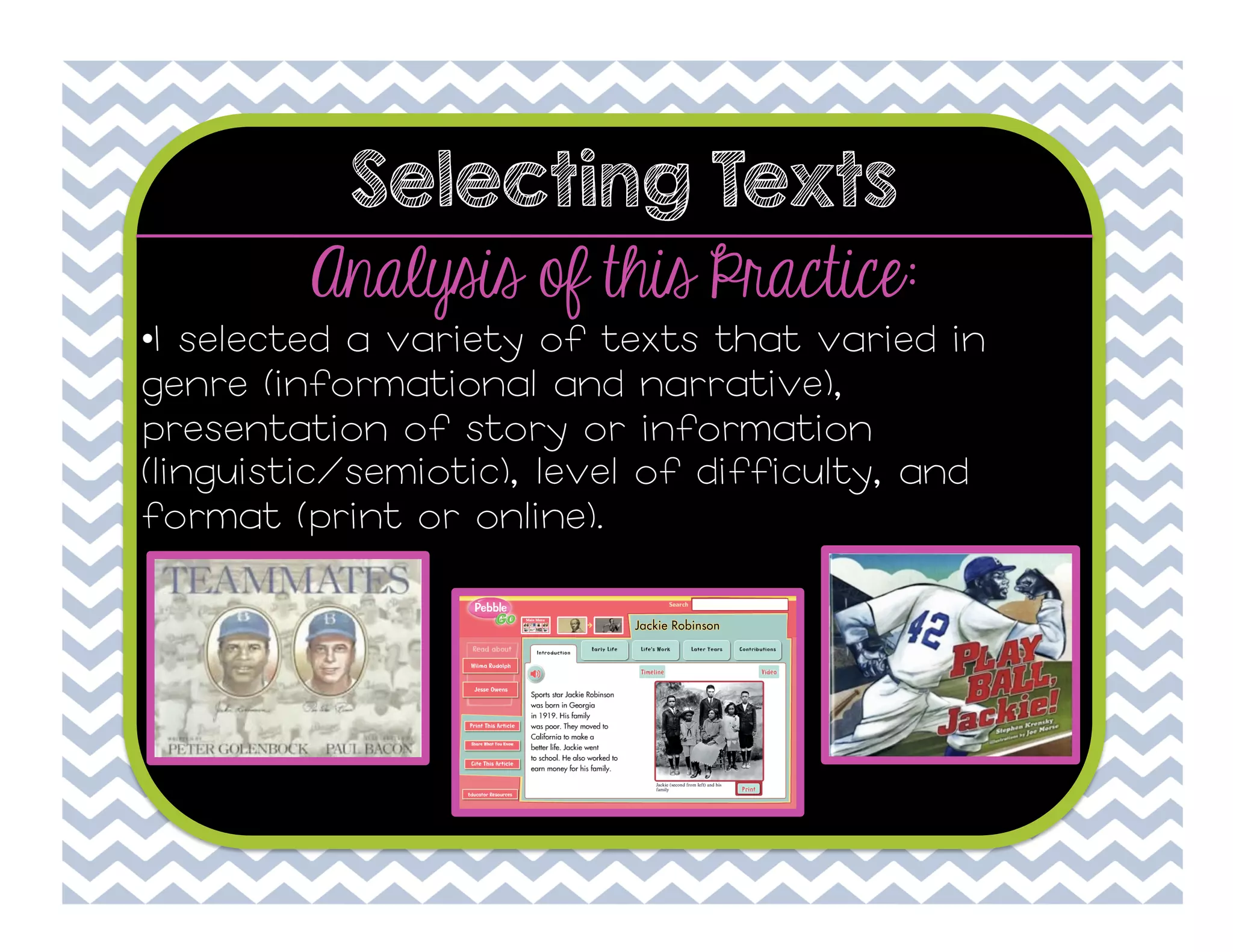
• I selected a variety of texts that varied in
genre (informational and narrative),
presentation of story or information
(linguistic/semiotic), level of difficulty, and
format (print or online).
Selecting Texts

Analysis of this Practice:

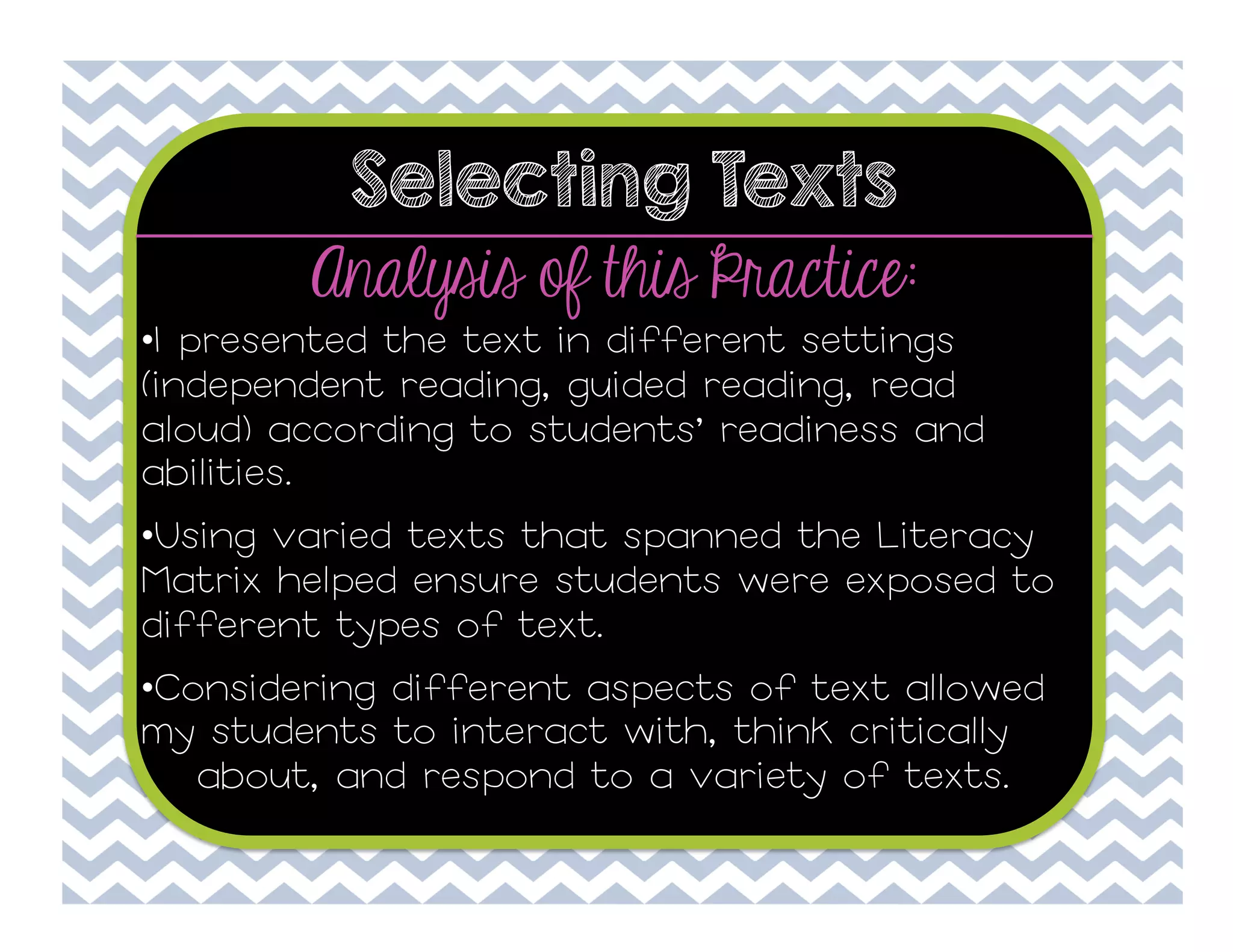
• I presented the text in different settings
(independent reading, guided reading, read
aloud) according to students’ readiness and
abilities.
• Using varied texts that spanned the Literacy
Matrix helped ensure students were exposed to
different types of text.
• Considering different aspects of text allowed
my students to interact with, think critically
about, and respond to a variety of texts.
Literacy Lesson:
Interactive
Perspective
Literacy Lesson:
Interactive Perspective
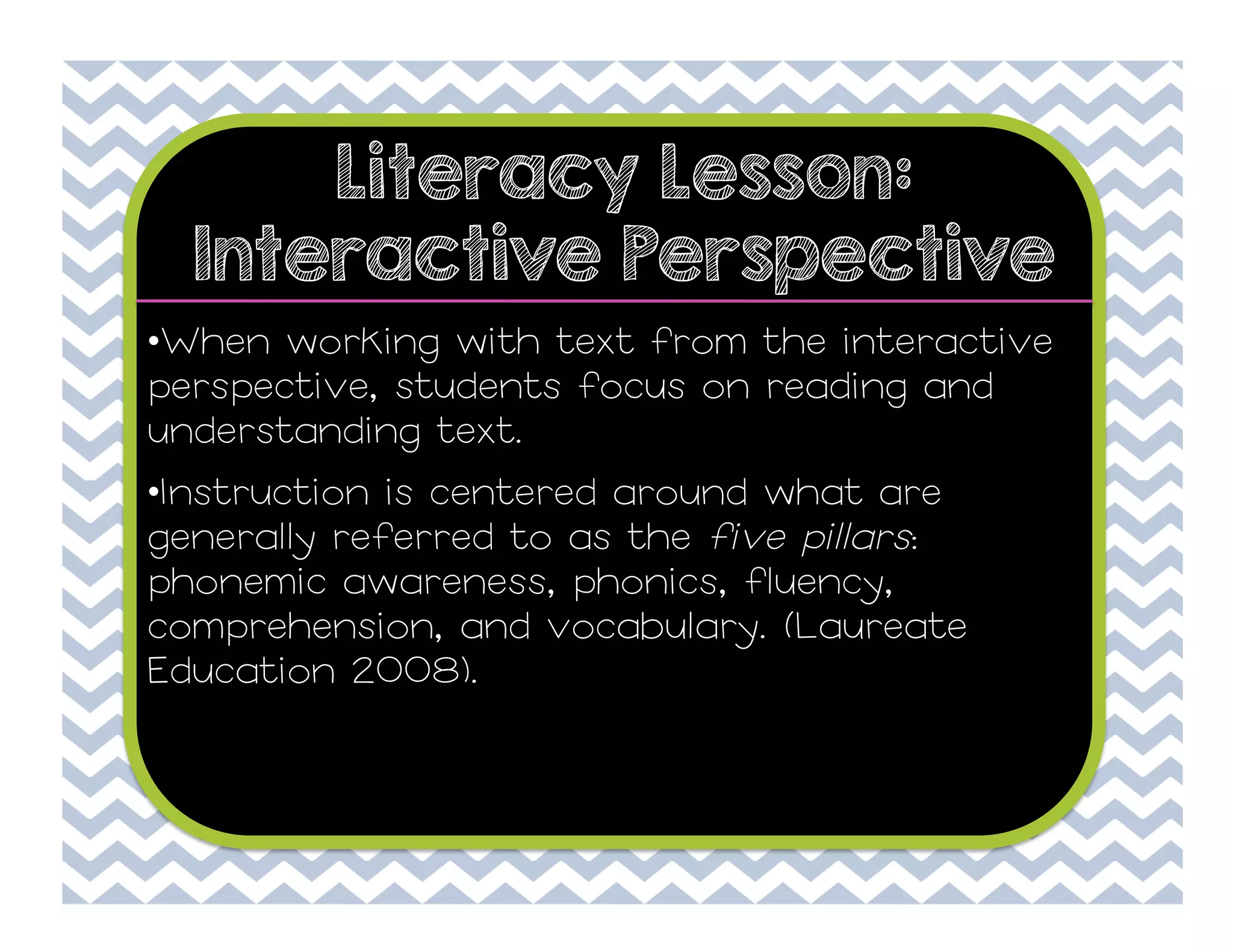
• When working with text from the interactive
perspective, students focus on reading and
understanding text.
• Instruction is centered around what are
generally referred to as the five pillars:
phonemic awareness, phonics, fluency,
comprehension, and vocabulary. (Laureate
Education 2008).
Literacy Lesson:
Interactive Perspective
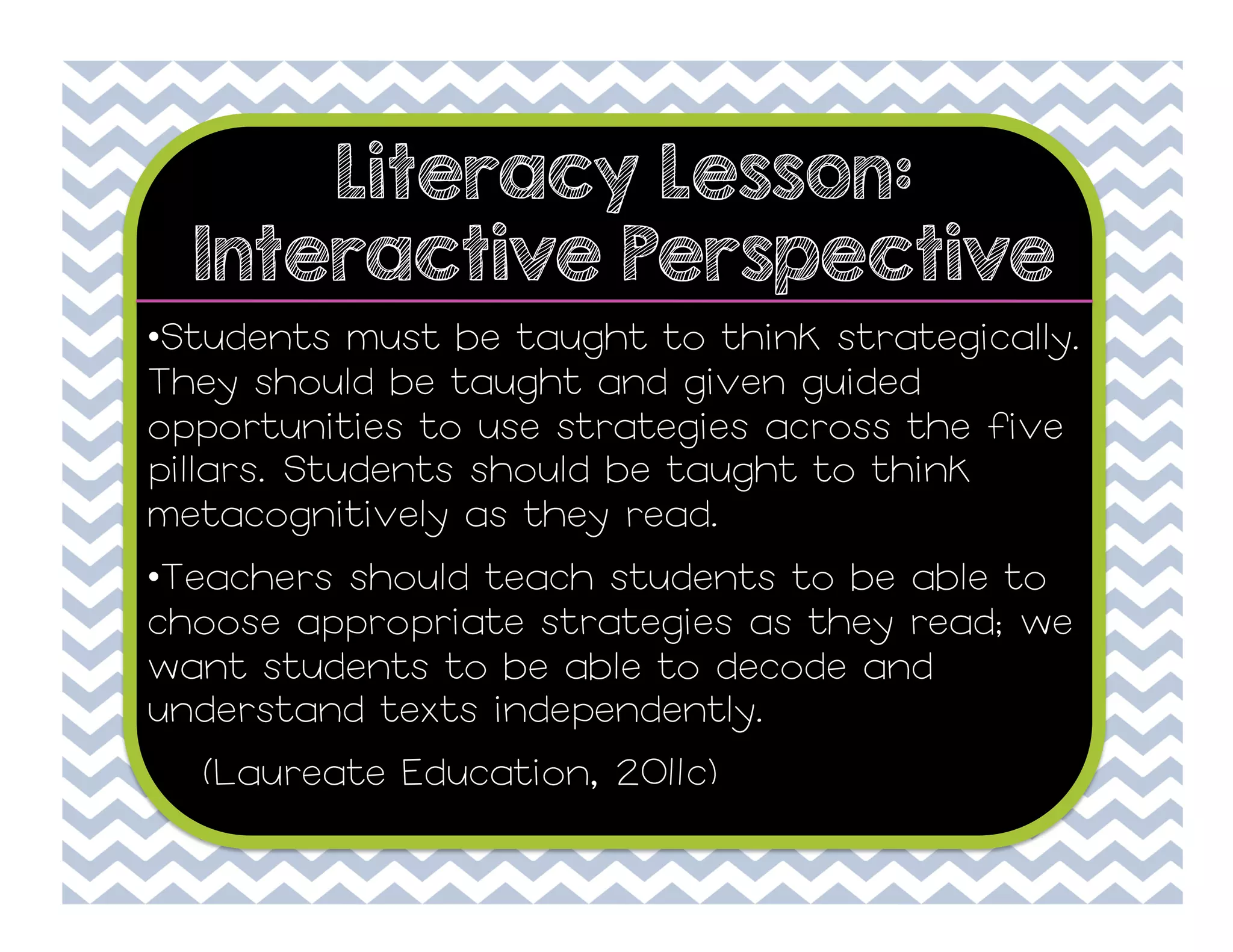
• Students must be taught to think strategically.
They should be taught and given guided
opportunities to use strategies across the five
pillars. Students should be taught to think
metacognitively as they read.
• Teachers should teach students to be able to
choose appropriate strategies as they read; we
want students to be able to decode and
understand texts independently.
(Laureate Education, 2011c)
Literacy Lesson:
Interactive Perspective

Analysis of this Practice:

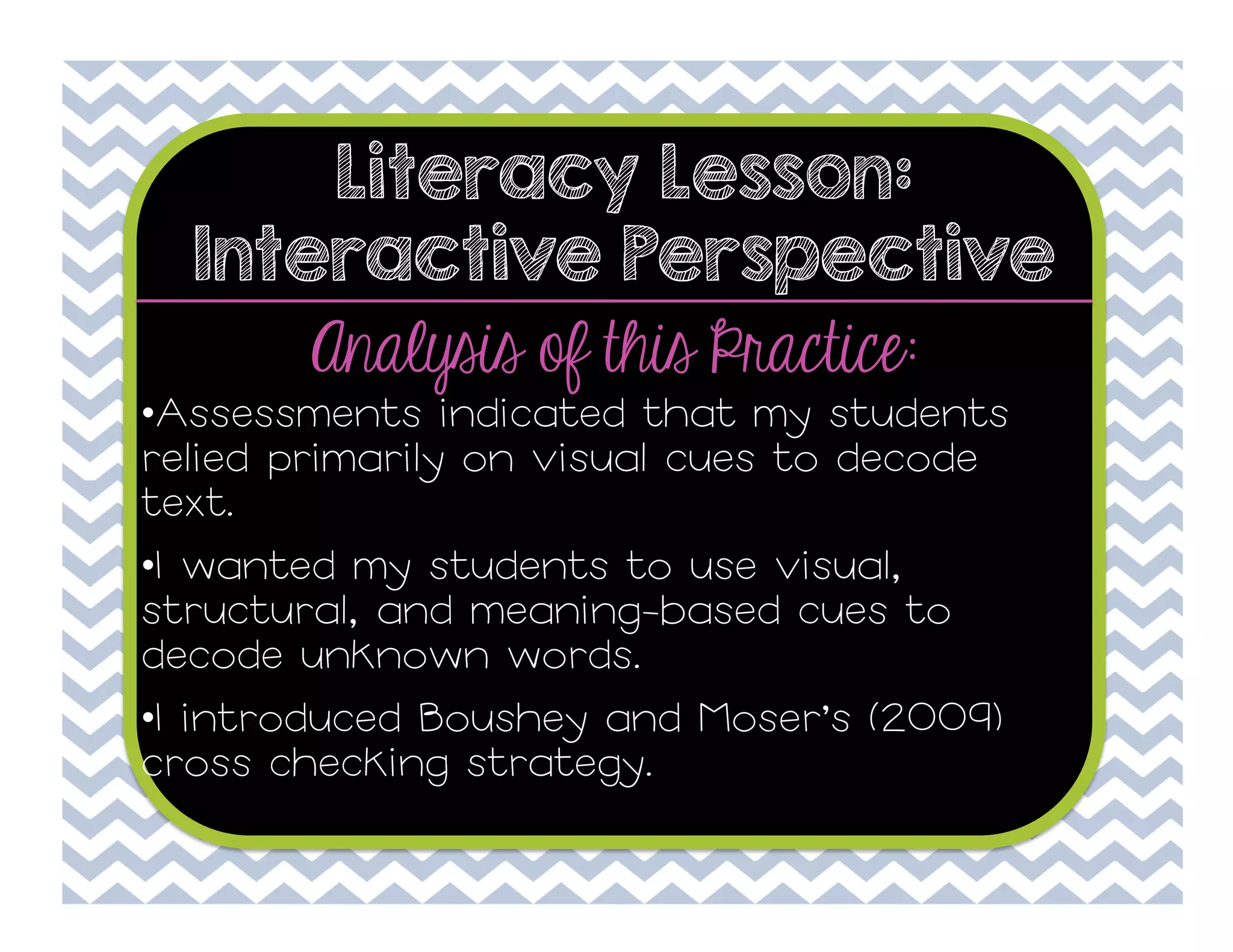
• Assessments indicated that my students
relied primarily on visual cues to decode
text.
• I wanted my students to use visual,
structural, and meaning-based cues to
decode unknown words.
• I introduced Boushey and Moser’s (2009)
cross checking strategy.
Literacy Lesson:
Interactive Perspective

Analysis of this Practice:

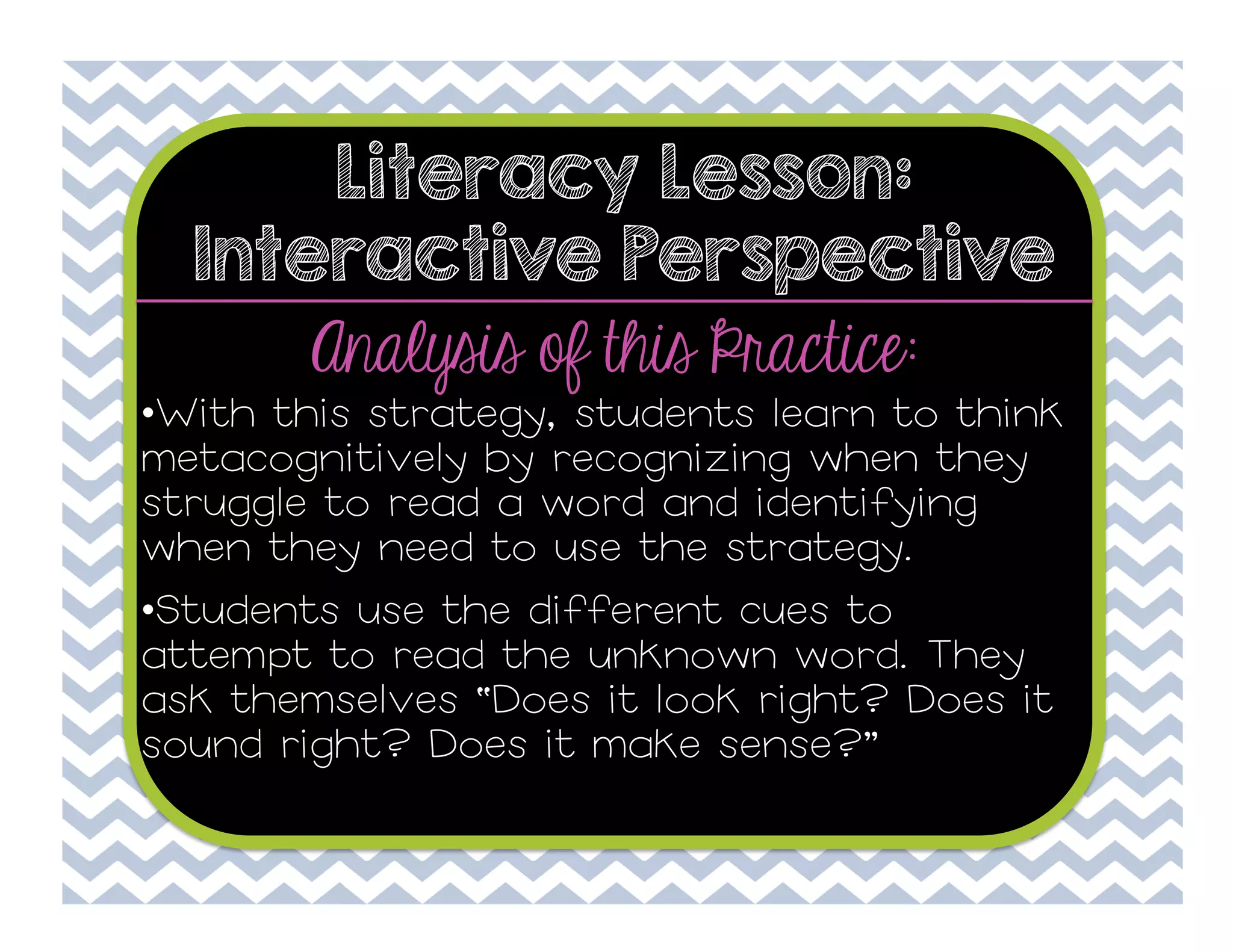
• With this strategy, students learn to think
metacognitively by recognizing when they
struggle to read a word and identifying
when they need to use the strategy.
• Students use the different cues to
attempt to read the unknown word. They
ask themselves “Does it look right? Does it
sound right? Does it make sense?”
Literacy Lesson:
Interactive Perspective

Analysis of this Practice:

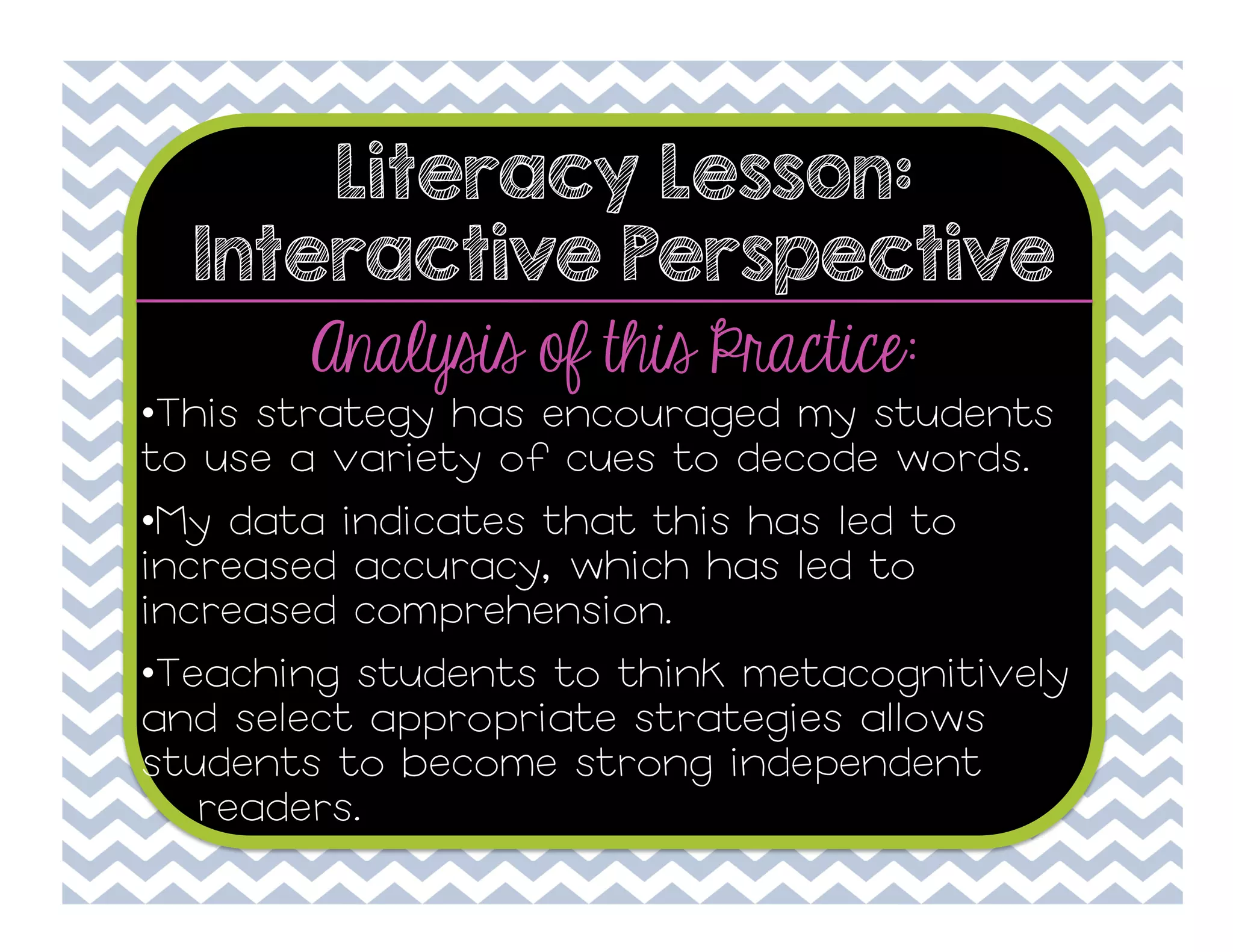
• This strategy has encouraged my students
to use a variety of cues to decode words.
• My data indicates that this has led to
increased accuracy, which has led to
increased comprehension.
• Teaching students to think metacognitively
and select appropriate strategies allows
students to become strong independent
readers.
Literacy Lesson:
Critical and
Response
Perspectives
Literacy Lesson:
Critical and Response
Perspectives
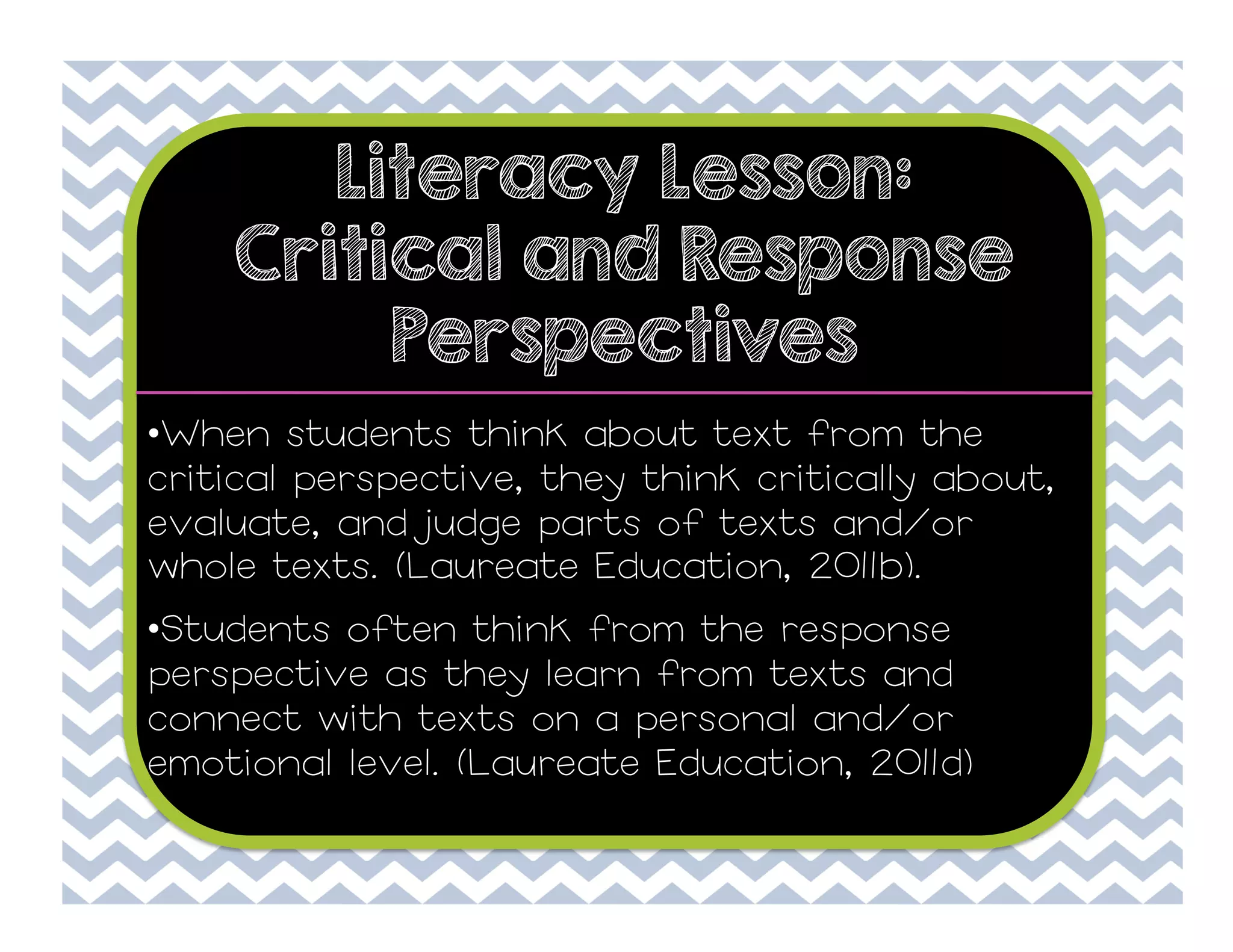
• When students think about text from the
critical perspective, they think critically about,
evaluate, and judge parts of texts and/or
whole texts. (Laureate Education, 2011b).
• Students often think from the response
perspective as they learn from texts and
connect with texts on a personal and/or
emotional level. (Laureate Education, 2011d)
Literacy Lesson:
Critical and Response
Perspectives

Analysis of this Practice:

• I guided my students to recall important
events from a story and rank those events
from most to least exciting (10 to 1).
• The events were placed on a graph
horizontally. Each event was moved
vertically based on how exciting it was.
Literacy Lesson:
Critical and Response
Perspectives

Analysis of this Practice:

• This allowed students to visually
understand a narrative story arc with
rising action, a climax, and falling action.
• This allowed me to see which students
were able to participate actively, evaluate
events, and explain their thinking.
Literacy Lesson:
Critical and Response
Perspectives

Analysis of this Practice:

• I planned later instruction and practice
with critical thinking based on my
observations during this lesson.
• The critical thinking skills students use to
evaluate text extend to critical thinking in
other subject areas and in life. This helps
students become productive thinkers.
Summary

To create a literate environment,
consider the following:
• your literacy learners
• the texts you select
• the perspectives from which you encourage
students to think, including
• interactive
• critical
• response
Feedback
• What insights did you gain about literacy and
literacy instruction from viewing this
presentation?
• How might the information presented change
your literacy practices and/or your literacy
interactions with students?
• In what ways can I support you in the literacy
development of your students or children?
How might you support me in my work with
students or your children?
• What questions do you have?
References
• 

Boushey, G., & Moser, J. (2009). The CAFÉ book. Portland,
ME: Stenhouse.

• 

Gambrell, L. B., Palmer, B. M., Codling, R. M., & Mazzoni, S. A.
(1996). Assessing motivation to read. The Reading Teacher,
49(7), 518--533. Retrieved from http://
web.ebscohost.com.ezp.waldenulibrary.org/ehost/
pdfviewer/pdfviewer?
sid=1195f82c-4a9f-4336-9b9d-7232909f93c7%40sessionmgr1
11&vid=2&hid=118
Laureate Education, Inc. (Executive Producer). (2008) The
stages of reading development. Baltimore: Author. Retrieved
from https://class.waldenu.edu/webapps/portal/
frameset.jsp?tab_tab_group_id=_2_1&url=%2Fwebapps
%2Fblackboard%2Fexecute%2Flauncher%3Ftype%3DCourse
%26id%3D_3467476_1%26url%3D

• 
References
• 

Laureate Education, Inc. (Executive Producer). (2011a)
Analyzing and selecting text. Baltimore: Author. Retrieved
from https://class.waldenu.edu/webapps/portal/
frameset.jsp?tab_tab_group_id=_2_1&url=%2Fwebapps
%2Fblackboard%2Fexecute%2Flauncher%3Ftype%3DCourse
%26id%3D_4199147_1%26url%3D

• 

Laureate Education, Inc. (Executive Producer). (2011b) Critical
perspective. Baltimore: Author. Retrieved from https://
class.waldenu.edu/webapps/portal/frameset.jsp?
tab_tab_group_id=_2_1&url=%2Fwebapps%2Fblackboard
%2Fexecute%2Flauncher%3Ftype%3DCourse%26id
%3D_4199147_1%26url%3D
References
• 

Laureate Education, Inc. (Executive Producer). (2011c)
Strategic processing. Baltimore: Author. Retrieved from
https://class.waldenu.edu/webapps/portal/frameset.jsp?
tab_tab_group_id=_2_1&url=%2Fwebapps%2Fblackboard
%2Fexecute%2Flauncher%3Ftype%3DCourse%26id
%3D_4199147_1%26url%3D

• 

Laureate Education, Inc. (Executive Producer). (2011d)
Response perspective. Baltimore: Author. Retrieved from
https://class.waldenu.edu/webapps/portal/frameset.jsp?
tab_tab_group_id=_2_1&url=%2Fwebapps%2Fblackboard
%2Fexecute%2Flauncher%3Ftype%3DCourse%26id
%3D_4199147_1%26url%3D
Tompkins, G. E. (2010). Literacy for the 21st century: A
balanced approach (5th ed.). Boston: Allyn & Bacon.

• 

Literate Environment Analysis Presentation

  • 1.
    How do Icreate a literate environment for my learners?
  • 2.
  • 3.
    Getting to Know LiteracyLearners • Teachers can learn about the cognitive and affective aspects of students’ learning. Cognitive Aspects: • reading level • fluency (correct words per minute) • comprehension abilities • high-frequency word knowledge • spelling and writing abilities Affective Aspects: • interests • learning styles • values • self-concept • attitudes
  • 4.
    Getting to Know LiteracyLearners • Teachers must get to know their learners as individuals. • Teachers can assess students formally and informally to measure cognitive and affective aspects of students’ literacyrelated abilities, skills, and interests. • Some assessments: running records, reading inventories, portfolios, observations, anecdotal notes, tconferences (Tompkins, 2010).
  • 5.
    Getting to Know LiteracyLearners Analysis of this Practice: I worked closely with a focus group of three 2nd grade transitional readers.
  • 6.
    Getting to Know LiteracyLearners Analysis of this Practice: After analyzing my students’ miscues from a reading inventory (cognitive assessment), I found that many of them rely on visual cues when decoding. This informed me that I should teach my students strategies to encourage them to use structural and meaning-based cues as well. My students’ decoding abilities (and in turn, comprehension) have since improved.
  • 7.
    Getting to Know LiteracyLearners Analysis of this Practice: Using the Motivation to Read Profile (Gambrell, Palmer, Codling, & Mazzoni, 1996), I assessed some affective aspects of my students’ literacy learning. Measuring how my students value reading and how they view themselves as readers (self-concept) allowed me to understand them more wholly. I have worked to increase my students’ reading motivation, which can lead to increased reading performance.
  • 8.
  • 9.
    Selecting Texts • Texts existon several continuums. • narrative-informational • linguistic-semiotic • difficulty level, including • readability • length of text and text size • text structure (descriptive, compare/contrast, cause/effect, poetic, etc. (Laureate Education, 2011)
  • 10.
    Selecting Texts • We canview these in a Literacy Matrix. hard linguistic informational narrative semiotic easy • Teachers should vary text type to provide balanced literacy experiences. Texts can be used in different ways. •  (Laureate Education, 2011a)
  • 11.
    Selecting Texts Analysis ofthis Practice: • I selected a variety of texts that varied in genre (informational and narrative), presentation of story or information (linguistic/semiotic), level of difficulty, and format (print or online).
  • 12.
    Selecting Texts Analysis ofthis Practice: • I presented the text in different settings (independent reading, guided reading, read aloud) according to students’ readiness and abilities. • Using varied texts that spanned the Literacy Matrix helped ensure students were exposed to different types of text. • Considering different aspects of text allowed my students to interact with, think critically about, and respond to a variety of texts.
  • 13.
  • 14.
    Literacy Lesson: Interactive Perspective • Whenworking with text from the interactive perspective, students focus on reading and understanding text. • Instruction is centered around what are generally referred to as the five pillars: phonemic awareness, phonics, fluency, comprehension, and vocabulary. (Laureate Education 2008).
  • 15.
    Literacy Lesson: Interactive Perspective • Studentsmust be taught to think strategically. They should be taught and given guided opportunities to use strategies across the five pillars. Students should be taught to think metacognitively as they read. • Teachers should teach students to be able to choose appropriate strategies as they read; we want students to be able to decode and understand texts independently. (Laureate Education, 2011c)
  • 16.
    Literacy Lesson: Interactive Perspective Analysisof this Practice: • Assessments indicated that my students relied primarily on visual cues to decode text. • I wanted my students to use visual, structural, and meaning-based cues to decode unknown words. • I introduced Boushey and Moser’s (2009) cross checking strategy.
  • 17.
    Literacy Lesson: Interactive Perspective Analysisof this Practice: • With this strategy, students learn to think metacognitively by recognizing when they struggle to read a word and identifying when they need to use the strategy. • Students use the different cues to attempt to read the unknown word. They ask themselves “Does it look right? Does it sound right? Does it make sense?”
  • 18.
    Literacy Lesson: Interactive Perspective Analysisof this Practice: • This strategy has encouraged my students to use a variety of cues to decode words. • My data indicates that this has led to increased accuracy, which has led to increased comprehension. • Teaching students to think metacognitively and select appropriate strategies allows students to become strong independent readers.
  • 19.
  • 20.
    Literacy Lesson: Critical andResponse Perspectives • When students think about text from the critical perspective, they think critically about, evaluate, and judge parts of texts and/or whole texts. (Laureate Education, 2011b). • Students often think from the response perspective as they learn from texts and connect with texts on a personal and/or emotional level. (Laureate Education, 2011d)
  • 21.
    Literacy Lesson: Critical andResponse Perspectives Analysis of this Practice: • I guided my students to recall important events from a story and rank those events from most to least exciting (10 to 1). • The events were placed on a graph horizontally. Each event was moved vertically based on how exciting it was.
  • 22.
    Literacy Lesson: Critical andResponse Perspectives Analysis of this Practice: • This allowed students to visually understand a narrative story arc with rising action, a climax, and falling action. • This allowed me to see which students were able to participate actively, evaluate events, and explain their thinking.
  • 23.
    Literacy Lesson: Critical andResponse Perspectives Analysis of this Practice: • I planned later instruction and practice with critical thinking based on my observations during this lesson. • The critical thinking skills students use to evaluate text extend to critical thinking in other subject areas and in life. This helps students become productive thinkers.
  • 24.
    Summary To create aliterate environment, consider the following: • your literacy learners • the texts you select • the perspectives from which you encourage students to think, including • interactive • critical • response
  • 25.
    Feedback • What insights didyou gain about literacy and literacy instruction from viewing this presentation? • How might the information presented change your literacy practices and/or your literacy interactions with students? • In what ways can I support you in the literacy development of your students or children? How might you support me in my work with students or your children? • What questions do you have?
  • 26.
    References •  Boushey, G., &Moser, J. (2009). The CAFÉ book. Portland, ME: Stenhouse. •  Gambrell, L. B., Palmer, B. M., Codling, R. M., & Mazzoni, S. A. (1996). Assessing motivation to read. The Reading Teacher, 49(7), 518--533. Retrieved from http:// web.ebscohost.com.ezp.waldenulibrary.org/ehost/ pdfviewer/pdfviewer? sid=1195f82c-4a9f-4336-9b9d-7232909f93c7%40sessionmgr1 11&vid=2&hid=118 Laureate Education, Inc. (Executive Producer). (2008) The stages of reading development. Baltimore: Author. Retrieved from https://class.waldenu.edu/webapps/portal/ frameset.jsp?tab_tab_group_id=_2_1&url=%2Fwebapps %2Fblackboard%2Fexecute%2Flauncher%3Ftype%3DCourse %26id%3D_3467476_1%26url%3D • 
  • 27.
    References •  Laureate Education, Inc.(Executive Producer). (2011a) Analyzing and selecting text. Baltimore: Author. Retrieved from https://class.waldenu.edu/webapps/portal/ frameset.jsp?tab_tab_group_id=_2_1&url=%2Fwebapps %2Fblackboard%2Fexecute%2Flauncher%3Ftype%3DCourse %26id%3D_4199147_1%26url%3D •  Laureate Education, Inc. (Executive Producer). (2011b) Critical perspective. Baltimore: Author. Retrieved from https:// class.waldenu.edu/webapps/portal/frameset.jsp? tab_tab_group_id=_2_1&url=%2Fwebapps%2Fblackboard %2Fexecute%2Flauncher%3Ftype%3DCourse%26id %3D_4199147_1%26url%3D
  • 28.
    References •  Laureate Education, Inc.(Executive Producer). (2011c) Strategic processing. Baltimore: Author. Retrieved from https://class.waldenu.edu/webapps/portal/frameset.jsp? tab_tab_group_id=_2_1&url=%2Fwebapps%2Fblackboard %2Fexecute%2Flauncher%3Ftype%3DCourse%26id %3D_4199147_1%26url%3D •  Laureate Education, Inc. (Executive Producer). (2011d) Response perspective. Baltimore: Author. Retrieved from https://class.waldenu.edu/webapps/portal/frameset.jsp? tab_tab_group_id=_2_1&url=%2Fwebapps%2Fblackboard %2Fexecute%2Flauncher%3Ftype%3DCourse%26id %3D_4199147_1%26url%3D Tompkins, G. E. (2010). Literacy for the 21st century: A balanced approach (5th ed.). Boston: Allyn & Bacon. •