LiterateEnvironmentAnalysisPresentation
Patricia Muniru
Walden University
Dr. Bernice Parrott
The Beginning Reader, PreK-3
EDUC -6706R-3
Literacy
• Literacy is complex, it requires the ability to
process both reading and writing of a variety of
text (Tompkins, 2010).
Getting to Know Literacy Learners
Analysis
• Getting to know the backgrounds of my students
is crucial to their success. This research-based
practice has allowed me to learn about the whole
child and their motivation to read (Laureate
Education, Inc., 2010a). Getting to know literacy
learners can be achieved through formal and
informal assessments.
Gettingto Know Literacy Learners:
Research
• To assess students motivation to read I used a Motivation
to Read Profile (MRP). It includes a reading
survey, completed by the student, and a conversational
interview, conducted by the teacher
(Gambrell, Palmer, Codling, & Mazzoni, 1996).
• To measure students attitudes towards reading I used an
Elementary Reading Attitude Survey (McKenna &
Kear, 1990).
• Me stew is another great way to find out more about
students. This is a recipe about the student. They bring
three items in a bag that are exclusively about them, and
each child meets with the teacher to talk about what went
into their stew (Laureate Education, Inc., 2010a).
Selecting Texts
Analysis
• Texts today comes in many forms. When
selecting a text you should consider;
readability, illustrations, text length, text
structure, and size of print. (Laureate
Education, Inc., 2010b).
• With this knowledge I choose text that are of
interest to students, that will engage them, a
text that is readable, challenging, but will not
push them past their level of frustration.
Selecting Texts: Research
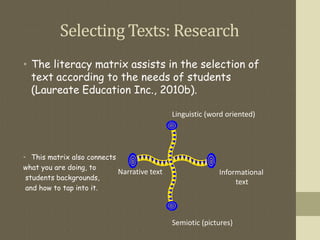
• The literacy matrix assists in the selection of
text according to the needs of students
(Laureate Education Inc., 2010b).
• This matrix also connects
what you are doing, to
students backgrounds,
and how to tap into it.
Linguistic (word oriented)
Semiotic (pictures)
Narrative text Informational
text
Literacy Lesson:
Interactive Perspective Analysis
• Interactive perspective teaches students how to
read.
• Spending time teaching students how to
effectively read text is important.
• With this in mind some strategies I have used
are read alouds, word walls, and modeling for my
students what good readers do while reading.
Literacy Lesson:
Interactive Perspective Research
• There are a variety of ways to teach the
interactive perspective. Using word
study, shared reading lessons, read alouds, and
word sorts will give students the necessary tools
to navigate effectively through texts, and derive
meaning from text.
Literacy Lesson: Critical and
Response Perspectives Analysis
• The critical perspective of literacy gives students the
opportunity to think analytically about text, looking at
believability (Laureate Education, Inc., 2010c).
• Response perspective of literacy should effect students on a
personal and emotional level (Laureate
Education, Inc., 2010d).
• Knowing this it has helped me choose text that my students
will connect with , and give them experiences they may not
normally have with text.
• I have also given my students more time to work on these
perspectives.
Literacy Lesson: Critical and
Response Perspectives Research
• Critical Perspective
• Students should:
• Judge validity and veracity of text
• Evaluate websites for credibility
• Critically view text from multiple perspectives
• Have thinking time and space to analyze text
(Laureate Education, Inc., 2010c)
Response Perspective
• Students should:
• Be given time and space, and safety in the classroom to support
text
• Be given time to transform their identities
• Be given a lot of think time
• Connect to text emotionally and personally
(Laureate Education, Inc., 2010d)
References
Gambrell, L. B., Palmer, B. M., Codling, R. M., & Mazzoni, S. A. (1996).
Assessing motivation to read. The Reading Teacher, 49(7),
518--533.
Laureate Education, Inc. (Producer). (2010b). Analyzing and selecting
texts. [Video webcast]. The beginning reader, PreK-3.
Baltimore: author.
Laureate Education, Inc. (Producer). (2010c). Critical Perspective.
[Video webcast]. The beginning reader, PreK-3 . Baltimore:
author.
Laureate Education, Inc. (Producer). (2010a). Getting to know your
students. [Video webcast]. The beginning reader, PreK-3.
Baltimore: author.
Laureate Education, Inc. (Producer). (2010d). Response Perspective. [Video
webcast]. The beginning reader, PreK-3. Baltimore: author.
McKenna, M. C., & Kear, D. J. (1990). Measuring attitude toward reading: A
new tool for teachers. The Reading Teacher, 43(9), 626--639.

Literate environment analysis presentation

  • 1.
    LiterateEnvironmentAnalysisPresentation Patricia Muniru Walden University Dr.Bernice Parrott The Beginning Reader, PreK-3 EDUC -6706R-3
  • 2.
    Literacy • Literacy iscomplex, it requires the ability to process both reading and writing of a variety of text (Tompkins, 2010).
  • 3.
    Getting to KnowLiteracy Learners Analysis • Getting to know the backgrounds of my students is crucial to their success. This research-based practice has allowed me to learn about the whole child and their motivation to read (Laureate Education, Inc., 2010a). Getting to know literacy learners can be achieved through formal and informal assessments.
  • 4.
    Gettingto Know LiteracyLearners: Research • To assess students motivation to read I used a Motivation to Read Profile (MRP). It includes a reading survey, completed by the student, and a conversational interview, conducted by the teacher (Gambrell, Palmer, Codling, & Mazzoni, 1996). • To measure students attitudes towards reading I used an Elementary Reading Attitude Survey (McKenna & Kear, 1990). • Me stew is another great way to find out more about students. This is a recipe about the student. They bring three items in a bag that are exclusively about them, and each child meets with the teacher to talk about what went into their stew (Laureate Education, Inc., 2010a).
  • 5.
    Selecting Texts Analysis • Textstoday comes in many forms. When selecting a text you should consider; readability, illustrations, text length, text structure, and size of print. (Laureate Education, Inc., 2010b). • With this knowledge I choose text that are of interest to students, that will engage them, a text that is readable, challenging, but will not push them past their level of frustration.
  • 6.
    Selecting Texts: Research •The literacy matrix assists in the selection of text according to the needs of students (Laureate Education Inc., 2010b). • This matrix also connects what you are doing, to students backgrounds, and how to tap into it. Linguistic (word oriented) Semiotic (pictures) Narrative text Informational text
  • 7.
    Literacy Lesson: Interactive PerspectiveAnalysis • Interactive perspective teaches students how to read. • Spending time teaching students how to effectively read text is important. • With this in mind some strategies I have used are read alouds, word walls, and modeling for my students what good readers do while reading.
  • 8.
    Literacy Lesson: Interactive PerspectiveResearch • There are a variety of ways to teach the interactive perspective. Using word study, shared reading lessons, read alouds, and word sorts will give students the necessary tools to navigate effectively through texts, and derive meaning from text.
  • 9.
    Literacy Lesson: Criticaland Response Perspectives Analysis • The critical perspective of literacy gives students the opportunity to think analytically about text, looking at believability (Laureate Education, Inc., 2010c). • Response perspective of literacy should effect students on a personal and emotional level (Laureate Education, Inc., 2010d). • Knowing this it has helped me choose text that my students will connect with , and give them experiences they may not normally have with text. • I have also given my students more time to work on these perspectives.
  • 10.
    Literacy Lesson: Criticaland Response Perspectives Research • Critical Perspective • Students should: • Judge validity and veracity of text • Evaluate websites for credibility • Critically view text from multiple perspectives • Have thinking time and space to analyze text (Laureate Education, Inc., 2010c) Response Perspective • Students should: • Be given time and space, and safety in the classroom to support text • Be given time to transform their identities • Be given a lot of think time • Connect to text emotionally and personally (Laureate Education, Inc., 2010d)
  • 11.
    References Gambrell, L. B.,Palmer, B. M., Codling, R. M., & Mazzoni, S. A. (1996). Assessing motivation to read. The Reading Teacher, 49(7), 518--533. Laureate Education, Inc. (Producer). (2010b). Analyzing and selecting texts. [Video webcast]. The beginning reader, PreK-3. Baltimore: author. Laureate Education, Inc. (Producer). (2010c). Critical Perspective. [Video webcast]. The beginning reader, PreK-3 . Baltimore: author. Laureate Education, Inc. (Producer). (2010a). Getting to know your students. [Video webcast]. The beginning reader, PreK-3. Baltimore: author. Laureate Education, Inc. (Producer). (2010d). Response Perspective. [Video webcast]. The beginning reader, PreK-3. Baltimore: author. McKenna, M. C., & Kear, D. J. (1990). Measuring attitude toward reading: A new tool for teachers. The Reading Teacher, 43(9), 626--639.