1
Craig Parker
TRANSFORMATIONAL SHIFTS
RESHAPING THE FUTURE OF
MOBILITY
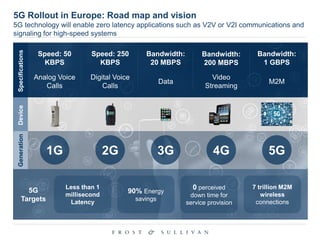
5G Rollout in Europe: Road map and vision
5G technology will enable zero latency applications such as V2V or V2I communications and
signaling for high-speed systems
Specifications
Speed: 50
KBPS
Speed: 250
KBPS
Bandwidth:
20 MBPS
Bandwidth:
200 MBPS
Bandwidth:
1 GBPS
Analog Voice
Calls
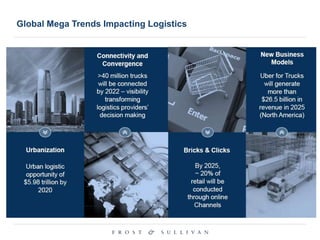
Digital Voice
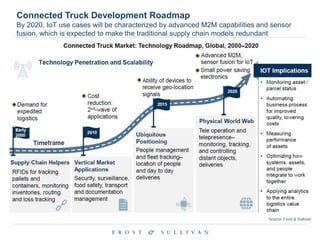
Calls
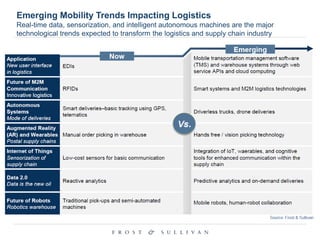
Data
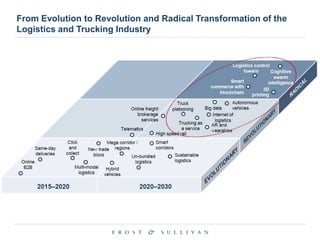
Video
Streaming
M2M
DeviceGeneration
1G 2G 3G 4G 5G
Less than 1
millisecond
Latency
90% Energy
savings
0 perceived
down time for
service provision
7 trillion M2M
wireless
connections
5G
Targets
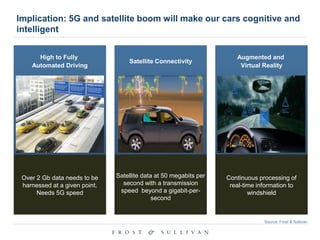
Augmented and
Virtual Reality
Continuous processing of
real-time information to
windshield
High to Fully
Automated Driving
Over 2 Gb data needs to be
harnessed at a given point.
Needs 5G speed
Satellite Connectivity
Satellite data at 50 megabits per
second with a transmission
speed beyond a gigabit-per-
second
Source: Frost & Sullivan
Implication: 5G and satellite boom will make our cars cognitive and
intelligent
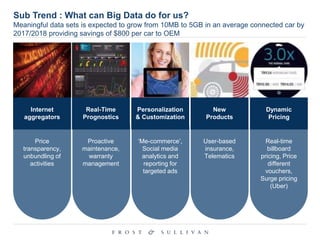
Sub Trend : What can Big Data do for us?
Meaningful data sets is expected to grow from 10MB to 5GB in an average connected car by
2017/2018 providing savings of $800 per car to OEM
Internet
aggregators
Real-Time
Prognostics
Personalization
& Customization
New
Products
Dynamic
Pricing
Price
transparency,
unbundling of
activities
Proactive
maintenance,
warranty
management
‘Me-commerce’,
Social media
analytics and
reporting for
targeted ads
User-based
insurance,
Telematics
Real-time
billboard
pricing, Price
different
vouchers,
Surge pricing
(Uber)
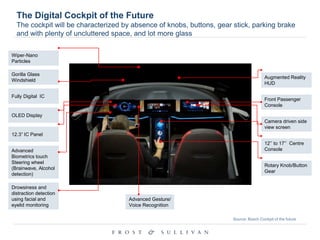
The Digital Cockpit of the Future
The cockpit will be characterized by absence of knobs, buttons, gear stick, parking brake
and with plenty of uncluttered space, and lot more glass
Augmented Reality
HUD
Fully Digital IC
12.3” IC Panel
Camera driven side
view screen
Wiper-Nano
Particles
Gorilla Glass
Windshield
Front Passenger
Console
Advanced
Biometrics touch
Steering wheel
(Brainwave, Alcohol
detection)
12’’ to 17’’ Centre
Console
OLED Display
Rotary Knob/Button
Gear
Advanced Gesture/
Voice Recognition
Drowsiness and
distraction detection
using facial and
eyelid monitoring
Source: Bosch Cockpit of the future
Advent of the
Cognitive Era
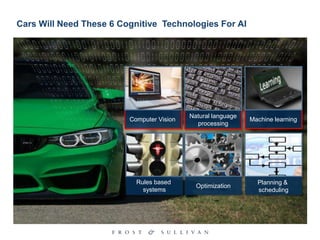
Rules based
systems
Computer Vision Machine learning
Natural language
processing
Optimization
Planning &
scheduling
Cars Will Need These 6 Cognitive Technologies For AI
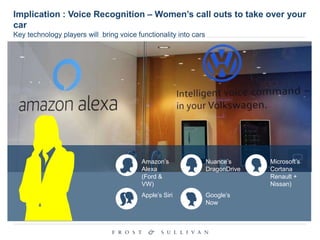
Implication : Voice Recognition – Women’s call outs to take over your
car
Key technology players will bring voice functionality into cars
Amazon’s
Alexa
(Ford &
VW)
Nuance’s
DragonDrive
Microsoft’s
Cortana
Renault +
Nissan)
Apple’s Siri Google’s
Now
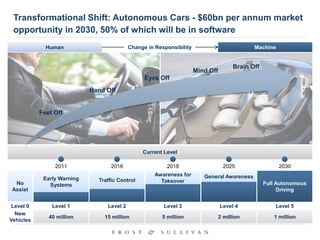
Transformational Shift: Autonomous Cars - $60bn per annum market
opportunity in 2030, 50% of which will be in software
Human MachineChange in Responsibility
Level 0 Level 1 Level 2 Level 3 Level 4
No
Assist
Early Warning
Systems
Traffic Control
Awareness for
Takeover
General Awareness
Full Autonomous
Driving
Level 5
Current Level
5 million 2 million15 million 1 million
New
Vehicles
40 million
20302025201820162011
Feet Off
Hand Off
Eyes Off
Mind Off
Brain Off
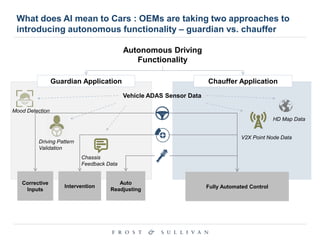
What does AI mean to Cars : OEMs are taking two approaches to
introducing autonomous functionality – guardian vs. chauffer
Autonomous Driving
Functionality
Chauffer ApplicationGuardian Application
Mood Detection
Driving Pattern
Validation
Auto
Readjusting Fully Automated Control
Vehicle ADAS Sensor Data
Intervention
Corrective
Inputs
HD Map Data
V2X Point Node Data
Chassis
Feedback Data
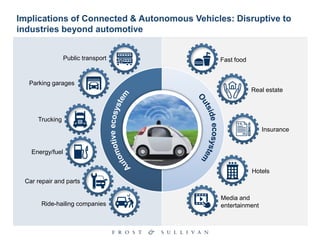
Public transport
Parking garages
Trucking
Energy/fuel
Car repair and parts
Ride-hailing companies
Fast food
Real estate
Insurance
Media and
entertainment
Hotels
Implications of Connected & Autonomous Vehicles: Disruptive to
industries beyond automotive
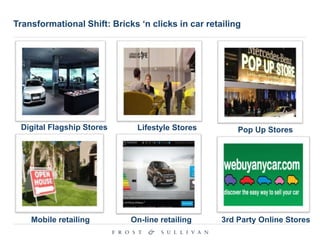
Digital Flagship Stores Lifestyle Stores Pop Up Stores
On-line retailing 3rd Party Online StoresMobile retailing
Transformational Shift: Bricks ‘n clicks in car retailing
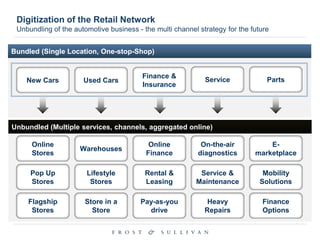
Digitization of the Retail Network
Unbundling of the automotive business - the multi channel strategy for the future
Bundled (Single Location, One-stop-Shop)
Warehouses
Lifestyle
Stores
Store in a
Store
Online
Finance
Rental &
Leasing
Pay-as-you
drive
On-the-air
diagnostics
Service &
Maintenance
Heavy
Repairs
E-
marketplace
Mobility
Solutions
Finance
Options
Used Cars
Finance &
Insurance
Service PartsNew Cars
Online
Stores
Pop Up
Stores
Flagship
Stores
Unbundled (Multiple services, channels, aggregated online)
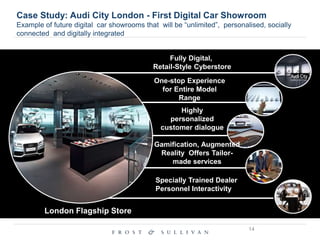
Case Study: Audi City London - First Digital Car Showroom
Example of future digital car showrooms that will be “unlimited”, personalised, socially
connected and digitally integrated
14
Fully Digital,
Retail-Style Cyberstore
One-stop Experience
for Entire Model
Range
Gamification, Augmented
Reality Offers Tailor-
made services
Specially Trained Dealer
Personnel Interactivity
London Flagship Store
Highly
personalized
customer dialogue
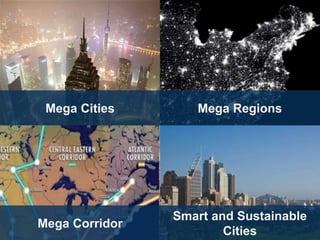
Mega Cities Mega Regions
Mega Corridor
Smart and Sustainable
Cities
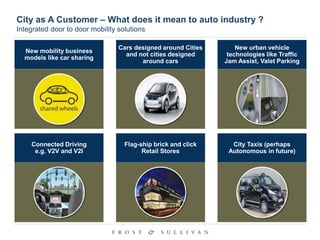
New mobility business
models like car sharing
Cars designed around Cities
and not cities designed
around cars
New urban vehicle
technologies like Traffic
Jam Assist, Valet Parking
Connected Driving
e.g. V2V and V2I
Flag-ship brick and click
Retail Stores
City Taxis (perhaps
Autonomous in future)
City as A Customer – What does it mean to auto industry ?
Integrated door to door mobility solutions
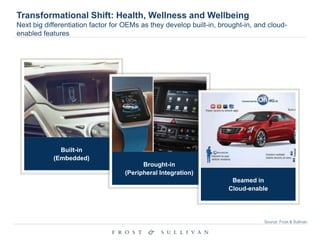
Built-in
(Embedded)
Brought-in
(Peripheral Integration)
Beamed in
Cloud-enable
Source: Frost & Sullivan
Transformational Shift: Health, Wellness and Wellbeing
Next big differentiation factor for OEMs as they develop built-in, brought-in, and cloud-
enabled features
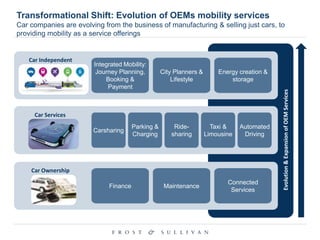
Evolution&ExpansionofOEMServices
Car Independent
Car Services
Car Ownership
Integrated Mobility:
Journey Planning,
Booking &
Payment
City Planners &
Lifestyle
Energy creation &
storage
Finance Maintenance
Connected
Services
Carsharing
Parking &
Charging
Ride-
sharing
Taxi &
Limousine
Automated
Driving
Transformational Shift: Evolution of OEMs mobility services
Car companies are evolving from the business of manufacturing & selling just cars, to
providing mobility as a service offerings
Electric Vehicles
Cybersecurity OTA (Over The Air Update) AI Software
V2V/V2X
HMI
Sensors Hardware
HD Mapping
Aftermarket Telematics
Driver Safety
VINILI
Mobility Integration
Blockchain
UBI (Usage based Insurance)
P2P Used Car Market Place Autonomous Algorithm
Autonomous Solution
Autonomous Processing
VINILI
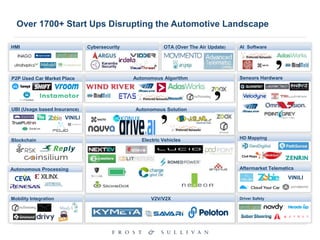
Over 1700+ Start Ups Disrupting the Automotive Landscape
Connected Truck and Logistics Trends
Global Mega Trends Impacting Logistics
Connected Truck Development Roadmap
By 2020, IoT use cases will be characterized by advanced M2M capabilities and sensor
fusion, which is expected to make the traditional supply chain models redundant
Emerging Mobility Trends Impacting Logistics
Real-time data, sensorization, and intelligent autonomous machines are the major
technological trends expected to transform the logistics and supply chain industry
From Evolution to Revolution and Radical Transformation of the
Logistics and Trucking Industry
AFRICAN MOBILITY TRENDS
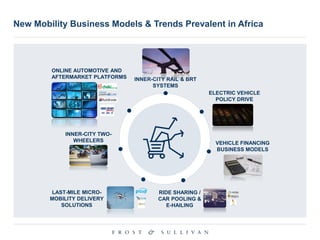
New Mobility Business Models & Trends Prevalent in Africa
ONLINE AUTOMOTIVE AND
AFTERMARKET PLATFORMS INNER-CITY RAIL & BRT
SYSTEMS
ELECTRIC VEHICLE
POLICY DRIVE
VEHICLE FINANCING
BUSINESS MODELS
RIDE SHARING /
CAR POOLING &
E-HAILING
LAST-MILE MICRO-
MOBILITY DELIVERY
SOLUTIONS
INNER-CITY TWO-
WHEELERS
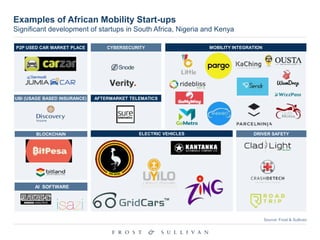
Examples of African Mobility Start-ups
Significant development of startups in South Africa, Nigeria and Kenya
Source: Frost & Sullivan
ELECTRIC VEHICLES
CYBERSECURITY
AI SOFTWARE
AFTERMARKET TELEMATICS
DRIVER SAFETY
MOBILITY INTEGRATION
BLOCKCHAIN
UBI (USAGE BASED INSURANCE)
P2P USED CAR MARKET PLACE
Conclusions
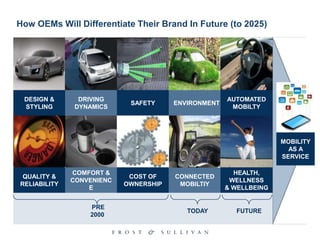
QUALITY &
RELIABILITY
COMFORT &
CONVENIENC
E
COST OF
OWNERSHIP
CONNECTED
MOBILTIY
HEALTH,
WELLNESS
& WELLBEING
DESIGN &
STYLING
DRIVING
DYNAMICS
SAFETY ENVIRONMENT
AUTOMATED
MOBILTY
PRE
2000
TODAY FUTURE
MOBILITY
AS A
SERVICE
How OEMs Will Differentiate Their Brand In Future (to 2025)
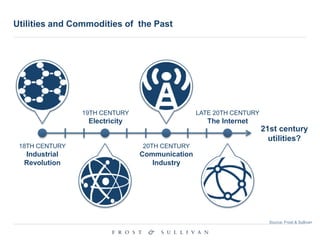
Utilities and Commodities of the Past
18TH CENTURY
Industrial
Revolution
19TH CENTURY
Electricity
20TH CENTURY
Communication
Industry
LATE 20TH CENTURY
The Internet
21st century
utilities?
Source: Frost & Sullivan
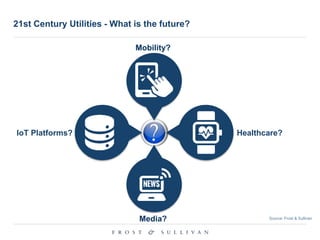
21st Century Utilities - What is the future?
Source: Frost & Sullivan
IoT Platforms? Healthcare?
Mobility?
Media?
32
Contact details for more information…
CRAIG PARKER
Programme Manager Africa Mobility
Mobile : + 27 (0)21 680 3292
Email : Craig.Parker@frost.com
www.frost.com
PETER DE BEER
Relationship Manager Africa Mobility
Mobile : +27 (0) 21 680 3572
Email : Peter.debeer@frost.com
www.frost.com

Craig parker fleet x presentation

  • 1.
  • 2.
    5G Rollout inEurope: Road map and vision 5G technology will enable zero latency applications such as V2V or V2I communications and signaling for high-speed systems Specifications Speed: 50 KBPS Speed: 250 KBPS Bandwidth: 20 MBPS Bandwidth: 200 MBPS Bandwidth: 1 GBPS Analog Voice Calls Digital Voice Calls Data Video Streaming M2M DeviceGeneration 1G 2G 3G 4G 5G Less than 1 millisecond Latency 90% Energy savings 0 perceived down time for service provision 7 trillion M2M wireless connections 5G Targets
  • 3.
    Augmented and Virtual Reality Continuousprocessing of real-time information to windshield High to Fully Automated Driving Over 2 Gb data needs to be harnessed at a given point. Needs 5G speed Satellite Connectivity Satellite data at 50 megabits per second with a transmission speed beyond a gigabit-per- second Source: Frost & Sullivan Implication: 5G and satellite boom will make our cars cognitive and intelligent
  • 4.
    Sub Trend :What can Big Data do for us? Meaningful data sets is expected to grow from 10MB to 5GB in an average connected car by 2017/2018 providing savings of $800 per car to OEM Internet aggregators Real-Time Prognostics Personalization & Customization New Products Dynamic Pricing Price transparency, unbundling of activities Proactive maintenance, warranty management ‘Me-commerce’, Social media analytics and reporting for targeted ads User-based insurance, Telematics Real-time billboard pricing, Price different vouchers, Surge pricing (Uber)
  • 5.
    The Digital Cockpitof the Future The cockpit will be characterized by absence of knobs, buttons, gear stick, parking brake and with plenty of uncluttered space, and lot more glass Augmented Reality HUD Fully Digital IC 12.3” IC Panel Camera driven side view screen Wiper-Nano Particles Gorilla Glass Windshield Front Passenger Console Advanced Biometrics touch Steering wheel (Brainwave, Alcohol detection) 12’’ to 17’’ Centre Console OLED Display Rotary Knob/Button Gear Advanced Gesture/ Voice Recognition Drowsiness and distraction detection using facial and eyelid monitoring Source: Bosch Cockpit of the future
  • 6.
  • 7.
    Rules based systems Computer VisionMachine learning Natural language processing Optimization Planning & scheduling Cars Will Need These 6 Cognitive Technologies For AI
  • 8.
    Implication : VoiceRecognition – Women’s call outs to take over your car Key technology players will bring voice functionality into cars Amazon’s Alexa (Ford & VW) Nuance’s DragonDrive Microsoft’s Cortana Renault + Nissan) Apple’s Siri Google’s Now
  • 9.
    Transformational Shift: AutonomousCars - $60bn per annum market opportunity in 2030, 50% of which will be in software Human MachineChange in Responsibility Level 0 Level 1 Level 2 Level 3 Level 4 No Assist Early Warning Systems Traffic Control Awareness for Takeover General Awareness Full Autonomous Driving Level 5 Current Level 5 million 2 million15 million 1 million New Vehicles 40 million 20302025201820162011 Feet Off Hand Off Eyes Off Mind Off Brain Off
  • 10.
    What does AImean to Cars : OEMs are taking two approaches to introducing autonomous functionality – guardian vs. chauffer Autonomous Driving Functionality Chauffer ApplicationGuardian Application Mood Detection Driving Pattern Validation Auto Readjusting Fully Automated Control Vehicle ADAS Sensor Data Intervention Corrective Inputs HD Map Data V2X Point Node Data Chassis Feedback Data
  • 11.
    Public transport Parking garages Trucking Energy/fuel Carrepair and parts Ride-hailing companies Fast food Real estate Insurance Media and entertainment Hotels Implications of Connected & Autonomous Vehicles: Disruptive to industries beyond automotive
  • 12.
    Digital Flagship StoresLifestyle Stores Pop Up Stores On-line retailing 3rd Party Online StoresMobile retailing Transformational Shift: Bricks ‘n clicks in car retailing
  • 13.
    Digitization of theRetail Network Unbundling of the automotive business - the multi channel strategy for the future Bundled (Single Location, One-stop-Shop) Warehouses Lifestyle Stores Store in a Store Online Finance Rental & Leasing Pay-as-you drive On-the-air diagnostics Service & Maintenance Heavy Repairs E- marketplace Mobility Solutions Finance Options Used Cars Finance & Insurance Service PartsNew Cars Online Stores Pop Up Stores Flagship Stores Unbundled (Multiple services, channels, aggregated online)
  • 14.
    Case Study: AudiCity London - First Digital Car Showroom Example of future digital car showrooms that will be “unlimited”, personalised, socially connected and digitally integrated 14 Fully Digital, Retail-Style Cyberstore One-stop Experience for Entire Model Range Gamification, Augmented Reality Offers Tailor- made services Specially Trained Dealer Personnel Interactivity London Flagship Store Highly personalized customer dialogue
  • 15.
    Mega Cities MegaRegions Mega Corridor Smart and Sustainable Cities
  • 16.
    New mobility business modelslike car sharing Cars designed around Cities and not cities designed around cars New urban vehicle technologies like Traffic Jam Assist, Valet Parking Connected Driving e.g. V2V and V2I Flag-ship brick and click Retail Stores City Taxis (perhaps Autonomous in future) City as A Customer – What does it mean to auto industry ? Integrated door to door mobility solutions
  • 17.
    Built-in (Embedded) Brought-in (Peripheral Integration) Beamed in Cloud-enable Source:Frost & Sullivan Transformational Shift: Health, Wellness and Wellbeing Next big differentiation factor for OEMs as they develop built-in, brought-in, and cloud- enabled features
  • 18.
    Evolution&ExpansionofOEMServices Car Independent Car Services CarOwnership Integrated Mobility: Journey Planning, Booking & Payment City Planners & Lifestyle Energy creation & storage Finance Maintenance Connected Services Carsharing Parking & Charging Ride- sharing Taxi & Limousine Automated Driving Transformational Shift: Evolution of OEMs mobility services Car companies are evolving from the business of manufacturing & selling just cars, to providing mobility as a service offerings
  • 19.
    Electric Vehicles Cybersecurity OTA(Over The Air Update) AI Software V2V/V2X HMI Sensors Hardware HD Mapping Aftermarket Telematics Driver Safety VINILI Mobility Integration Blockchain UBI (Usage based Insurance) P2P Used Car Market Place Autonomous Algorithm Autonomous Solution Autonomous Processing VINILI Over 1700+ Start Ups Disrupting the Automotive Landscape
  • 20.
    Connected Truck andLogistics Trends
  • 21.
    Global Mega TrendsImpacting Logistics
  • 22.
    Connected Truck DevelopmentRoadmap By 2020, IoT use cases will be characterized by advanced M2M capabilities and sensor fusion, which is expected to make the traditional supply chain models redundant
  • 23.
    Emerging Mobility TrendsImpacting Logistics Real-time data, sensorization, and intelligent autonomous machines are the major technological trends expected to transform the logistics and supply chain industry
  • 24.
    From Evolution toRevolution and Radical Transformation of the Logistics and Trucking Industry
  • 25.
  • 26.
    New Mobility BusinessModels & Trends Prevalent in Africa ONLINE AUTOMOTIVE AND AFTERMARKET PLATFORMS INNER-CITY RAIL & BRT SYSTEMS ELECTRIC VEHICLE POLICY DRIVE VEHICLE FINANCING BUSINESS MODELS RIDE SHARING / CAR POOLING & E-HAILING LAST-MILE MICRO- MOBILITY DELIVERY SOLUTIONS INNER-CITY TWO- WHEELERS
  • 27.
    Examples of AfricanMobility Start-ups Significant development of startups in South Africa, Nigeria and Kenya Source: Frost & Sullivan ELECTRIC VEHICLES CYBERSECURITY AI SOFTWARE AFTERMARKET TELEMATICS DRIVER SAFETY MOBILITY INTEGRATION BLOCKCHAIN UBI (USAGE BASED INSURANCE) P2P USED CAR MARKET PLACE
  • 28.
  • 29.
    QUALITY & RELIABILITY COMFORT & CONVENIENC E COSTOF OWNERSHIP CONNECTED MOBILTIY HEALTH, WELLNESS & WELLBEING DESIGN & STYLING DRIVING DYNAMICS SAFETY ENVIRONMENT AUTOMATED MOBILTY PRE 2000 TODAY FUTURE MOBILITY AS A SERVICE How OEMs Will Differentiate Their Brand In Future (to 2025)
  • 30.
    Utilities and Commoditiesof the Past 18TH CENTURY Industrial Revolution 19TH CENTURY Electricity 20TH CENTURY Communication Industry LATE 20TH CENTURY The Internet 21st century utilities? Source: Frost & Sullivan
  • 31.
    21st Century Utilities- What is the future? Source: Frost & Sullivan IoT Platforms? Healthcare? Mobility? Media?
  • 32.
    32 Contact details formore information… CRAIG PARKER Programme Manager Africa Mobility Mobile : + 27 (0)21 680 3292 Email : Craig.Parker@frost.com www.frost.com PETER DE BEER Relationship Manager Africa Mobility Mobile : +27 (0) 21 680 3572 Email : Peter.debeer@frost.com www.frost.com

Editor's Notes

  • #3 Value chain/strategy
  • #4 5g and implecations to cars 5 G characteristics Speed: 1-10GB/s Latency: 1-5ms Bandwidth: 6-30GHZ Coverage: 100% 70% faster than LTE High Download Speed Close to 1–10Gbs/s Latency Period Close to 1–5ms Support 1,000X more Traffic Volume 100% Network Coverage The basic idea is higher download speeds, extremely low latency times (Reaction times) and end to end connectivity. Once you cross L3 automation (which is the vehicle driving itself in urban and freeway driving) encountering a wide variety of dynamic obstacles, need to talk to other vehicles on the road, traffic lights, the amount of data that needs to be processed in real-time and the reaction time needs a tech like 5G. With 4.5G, latency will be only 10 milliseconds, which will start to make it suitable for applications such as connected vehicles. It also will be able to connect more than 30 billion things as part of the Internet of Things. With 5G, the industry is talking about one millisecond latency, according to Ding, with data rates up to 10 gigabits per second and 100 billion things connected. “With LTE, when you touch your screen, you wait for the web response, and it’s fast enough. For example, if it’s less than 16ms, you feel like there’s no delay and everything’s a very good experience. If you use GSM, it’s 500 to 600 ms. You have a half second of latency… It’s improved [with subsequent generations of mobile tech], but if you’re driving a car and you ask a car to turn left, if you still have 100ms delay, that car will be in trouble,” said Dr Wen Tong, head of Huawei’s Wireless Research division. “That needs a very fast response, and that’s something we don’t have today with LTE,” Tong said. “We need to reduce latency to less than 1ms. That means that you need a new design.”
  • #5 Value chain/strategy
  • #7 Advent of cognitive era – add a couple of slides but not too many
  • #8 This slide enumerates certain technologies that impart the learning abilities in the AI machines and thus making it more cognitive. Among them, the 3 important technologies where most of the industry efforts go are Computer Vision, Natural Language Processing and Machine Learning Computer vision: Computer vision technology uses sequences of imaging-processing operations and other techniques to decompose the task of analyzing images into manageable pieces. There are techniques for detecting the edges and textures of objects in an image, for instance. Computer vision has diverse applications, including analyzing medical imaging to improve prediction, diagnosis, and treatment of diseases; face recognition, used by Facebook to automatically identify people in photographs and in security and surveillance to spot suspects. Natural Language Processing: refers to the ability of computers to work with text or dialect the way humans do, for instance, extracting meaning from text or even generating text that is readable, stylistically natural, and grammatically correct. Because context is so important for understanding, practical applications of natural language processing includes analyzing customer feedback about a particular product or service, automating discovery in civil litigation or government investigations (e-discovery), among others. Machine Learning: refers to the ability of computer systems to improve their performance by exposure to data without the need to follow explicitly programmed instructions. Applications of machine learning are very broad, with the potential to improve performance in nearly any activity that generates large amounts of data. Machine learning techniques also play a role in other cognitive technologies such as computer vision, which can train vision models on a large database of images to improve their ability to recognize classes of objects.
  • #10 Speaker Notes: In 1992, Mitsubishi Motors first introduced their state-of-the art distance warning system on their flag ship Debonair luxury saloon, it laid a foundation for what is likely to be a $60 billion industry in a decade to come. By 2030, one in five cars in developed markets will have level-3 automation or higher, and thus, the technology will no longer be confined to pockets of disruption, but be truly game changing. Having said that, between now and the 2030 milestone, there are numerous hurdles, both quantitative and qualitative that the industry will need to tackle if autonomous driving has to bring a long lasting impact to make safe, clean and lean transportation a reality. The biggest hurdle today though is the lack of clear regulatory frameworks that define the outlines of how these products can be made available to the consumers. Statistically, even in a mid scenario, where autonomous emergency braking is mandated before 2020 and fully autonomous technology is made available commercially in the next decade, it will take more than 25 years from then to bring road fatalities to zero thanks to fast growing parc figures globally. From a technology standpoint, among the many advancements like growing processing capability and enhancing image processing, the stand out challenge for any OEM is to improve vision detection and data processing across all driving conditions and weather patterns. Today over 30 test beds and more than 100 R&D labs dedicated to improving autonomous driving software. Notes to refer: Levels, Definitions and Exapmples: Level 0: The driver (human) controls it all: steering, brakes, throttle, power. Level 1: This semi-autonomous level means that most functions are still controlled by a driver, but some (like braking) can be done automatically by the car. Level 2: In level 2, at least 2 functions are automated, like cruise control and lane-centering. It means that the "driver is disengaged from physically operating the vehicle by having hands off the steering wheel AND foot off pedal at the same time." The driver must be still always be ready to take control of the vehicle, however. Volvo has recently released a feature called "Pilot Assist", which takes over some—but not all—of the driving. On the SAE (defined above) scale, Volvo's Pilot Assist qualifies as Level 2 (partial automation). This ranks it above Level 1 (driver assist). Volvo is also starting a program called DriveMe next year that will see the automaker give Level 4 autonomous cars to 100 test vehicles in Sweden and China. Level 3: Drivers are able to completely shift "safety-critical functions" to the vehicle, under certain traffic or environmental conditions. It means that the driver is still present, but is not required to monitor the situation in the same way it does for previous levels. Ford is focusing on switching straight to Level 4, since Level 3, which involves transferring control from car to human, can often pose difficulties. Level 4: This is what is meant by "fully autonomous." According to the DOT, level 4 vehicles are "designed to perform all safety-critical driving functions and monitor roadway conditions for an entire trip." But the driver will need to take control on some challenging driving scenarios upon being informed in advance. Level 5: Driverless car. Good Links for back reading: http://www.sae.org/misc/pdfs/automated_driving.pdf http://www.telegraph.co.uk/technology/news/11609406/The-car-of-the-future-is-the-most-powerful-computer-you-will-ever-own.html http://www.economist.com/news/business/21685459-carmakers-increasingly-fret-their-industry-brink-huge-disruption http://gelookahead.economist.com/future-scope/driverless-cars/
  • #14 This shift will affect the traditional automotive model by breaking up the one-stop-shop into a variety of specialised options. As ancillary activities move online in developed markets, dealerships will focus more on providing customer services and functioning as a delivery point There is a potential for OEMs to expand into new online offerings and/or to ensure visibility on the brand/its offerings throughout lifecycle Traditionally all automotive products and services were offered under one roof. A single dealership was used to buy cars, test drives, store inventories, deliveries and after-sales service. In future, distributors are expected to break up bundled operations to develop a variety of specialised options which can function as independent silos and have options to suit customer preferences right from product consultation to buying and mobility solutions. It will be convenient for car buyers to have an identity in their buying process with multifold options to choose from assisted by digitization.
  • #15 Hard KPIs 60% - 70% increase in new car sales Increase in optional equipment sales - 15 to 20% of vehicle price Audi City London sells an average of seven cars a week Average transaction price higher than in average dealership High acquisition of first time Audi buyers Decline in average age of customer Sales consistent across all models and full line up 39% of prospective clients are buying a car in Audi City Soft KPIs 50 to 60% of buyers buying cars without test drive About 47% of prospective clients order a test drive 84% of test drives lead to car orders 75% of orders are placed by new customers More than 50,000 visitors in Audi City 75% of visitors would recommend a visit to friends/family Average time spend by customer at Audi store is much higher than traditional dealership Better quality leads and easier follow ups through integrated social media strategy
  • #17 Robotaxis and taxi market - Add it Add tracker mobility city clusters Make a so what slide for urbanisation too Add slide for city as a customer – 2 or 3 slides
  • #18 HWW in the automotive industry falls under 3 broad categories, according to Frost & Sullivan analysis— built-in, brought-in, and cloud-enabled. Built-in HWW features are enabled via hardware that automotive OEMs build into their vehicles on the factory floor or OE fitments, such as infotainment equipment-driven features or sensors (e.g., Ford’s pollen sensors). Brought-in HWW features are enabled through devices that a driver and passengers carry with them into the vehicles, such as smartphones and smart watches (e.g., BMW’s smartwatch integration and Hyundai’s Google Glass integration). On the other hand, Cloud-enabled HWW features are enabled via a secure virtual information technology platform into vehicles, such as cloud-based information, from secured private/public databases (e.g., GM’s 4G LTE connectivity). Brought-in and cloud-enabled are expected to have more short-term and rapid realization. The proliferation of wearable devices, smartphones, and cloud-based solutions are seen as key. 
  • #31 18th century was marked by molecular innovation – the industrial revolution 19th century – shift from molecules to electrons – Electricity 20th century – electrons to waves – communication industry Late 20th century – new data utility the Internet So what will the 21st century utilities be ?
  • #32 Four utilities of the future Big data utilities Mobility Health utility Media utility