CQRS – Eine Einführung
                        .Net Online Usergroup – 10.10.2011

                                   Presenter: Dennis Traub

             Speaker, Author, Software Developer since 1991
                      Currently at ProAvia GmbH, Stuttgart

                                         Twitter: @DTraub
What CQRS is NOT
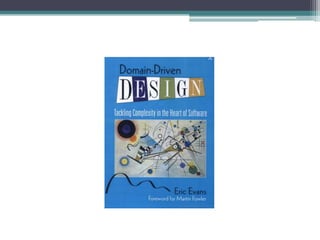
DDD revisited
Usual Patterns
 ▫ Entities
 ▫ Value Objects
 ▫ Repositories
DDD revisited
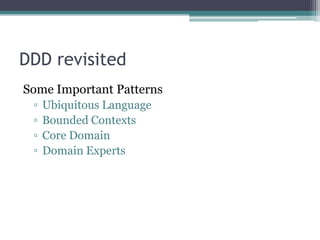
Some Important Patterns
 ▫   Ubiquitous Language
 ▫   Bounded Contexts
 ▫   Core Domain
 ▫   Domain Experts
DDD Revisited

An Example:
 Competitive advantage through an efficient
 online claims procedure
DDD revisited

DO use DDD:
 ▫ Where we get competitive advantage
DDD revisited

DO use DDD:
 ▫ Where we get competitive advantage

DON‘T use DDD
 ▫ When there‘s no value in formalizing the problem
DDD revisited

• The point of DDD is not Software Analysis
DDD revisited

• The point of DDD is not Software Analysis

• It‘s Business Analysis
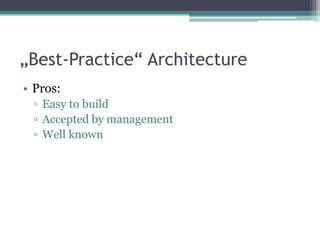
„Best-Practice“ Architecture
• Pros:
 ▫ Easy to build
 ▫ Accepted by management
 ▫ Well known
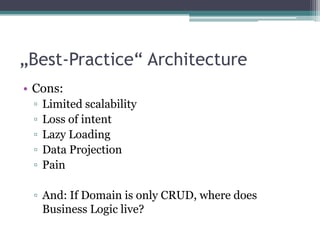
„Best-Practice“ Architecture
• Cons:
 ▫   Limited scalability
 ▫   Loss of intent
 ▫   Lazy Loading
 ▫   Data Projection
 ▫   Pain

 ▫ And: If Domain is only CRUD, where does
   Business Logic live?
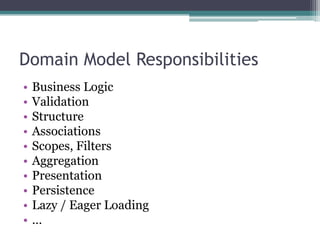
Domain Model Responsibilities
•   Business Logic
•   Validation
•   Structure
•   Associations
•   Scopes, Filters
•   Aggregation
•   Presentation
•   Persistence
•   Lazy / Eager Loading
•   …
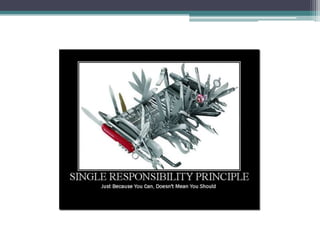
The S in SOLID
Read vs. Write
• Reads and Writes are completely different from
  eachother

• Why do we try to build the One Model to
  Rule Them All?

• Sometimes it‘s cheaper to do two things than
  dealing with the trade-offs
Command-Query Separation
• Bertrand Meyer:
 ▫ Every method should either be a command that
   performs an action, or a query that returns data
   to the caller

• In other words:
 ▫ Asking a question should not change the answer.
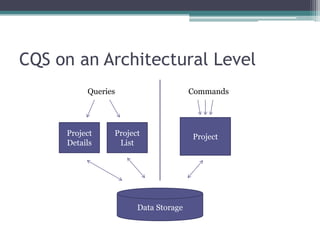
CQS on an Architectural Level
          Queries                    Commands


     Project    Project              Project
     Details     List


                      Data Storage
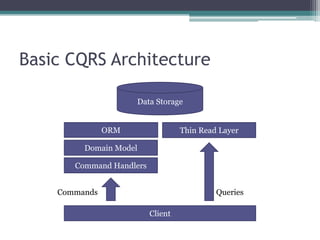
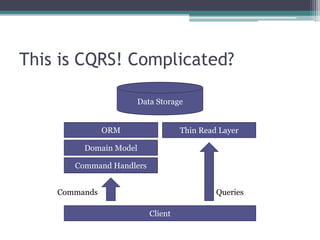
Basic CQRS Architecture

                     Data Storage


               ORM                 Thin Read Layer

         Domain Model

       Command Handlers


    Commands                                Queries

                          Client
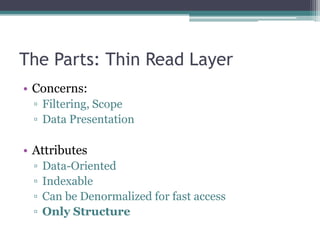
The Parts: Thin Read Layer
• Concerns:
 ▫ Filtering, Scope
 ▫ Data Presentation

• Attributes
 ▫   Data-Oriented
 ▫   Indexable
 ▫   Can be Denormalized for fast access
 ▫   Only Structure
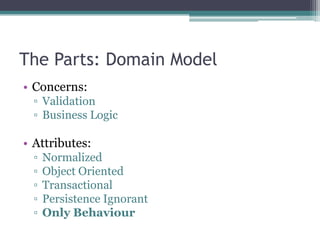
The Parts: Domain Model
• Concerns:
  ▫ Validation
  ▫ Business Logic

• Attributes:
  ▫   Normalized
  ▫   Object Oriented
  ▫   Transactional
  ▫   Persistence Ignorant
  ▫   Only Behaviour
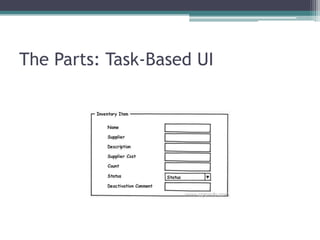
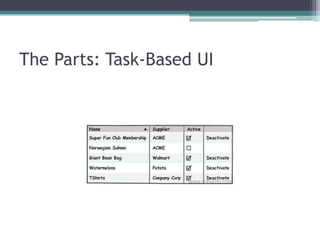
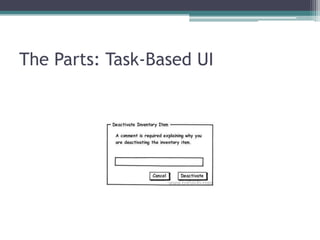
The Parts: Task-Based UI
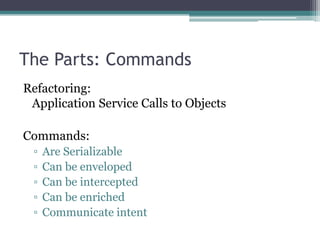
The Parts: Commands
Refactoring:
 Application Service Calls to Objects

Commands:
 ▫   Are Serializable
 ▫   Can be enveloped
 ▫   Can be intercepted
 ▫   Can be enriched
 ▫   Communicate intent
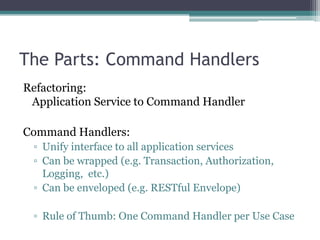
The Parts: Command Handlers
Refactoring:
 Application Service to Command Handler

Command Handlers:
 ▫ Unify interface to all application services
 ▫ Can be wrapped (e.g. Transaction, Authorization,
   Logging, etc.)
 ▫ Can be enveloped (e.g. RESTful Envelope)

 ▫ Rule of Thumb: One Command Handler per Use Case
This is CQRS! Complicated?

                     Data Storage


               ORM                 Thin Read Layer

         Domain Model

       Command Handlers


    Commands                                Queries

                          Client
But what about Eventual Consistency?
The First Rule


             Source: www.kinoweb.de
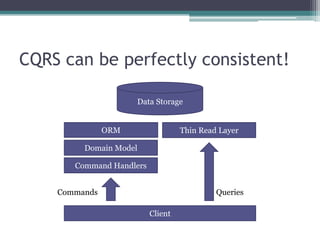
CQRS can be perfectly consistent!

                     Data Storage


               ORM                 Thin Read Layer

         Domain Model

       Command Handlers


    Commands                                Queries

                          Client
Advanced topics for another day
•   Events
•   Sagas
•   Event Log
•   Messaging
•   Service Busses
•   NoSQL
•   Event Store
Thanks!
 Dennis Traub
   @DTraub
Resources
• cqrsinfo.com

• groups.google.com/group/dddcqrs

• distributedpodcast.com

CQRS - Eine Einführung - NOUG 2011