CQRS : 
Introduction 
Shah Ali Newaj Topu, CTO, Selise
How do we architect enterprise application 
Application Layer (Client) 
Service Layer 
Business Logic Layer 
Data Access Layer 
Sec 
uri 
t 
y 
Loggi 
ng 
Relational Database
A typical request LifeCycle 
newContactID=ContactService.AddContact(Contact) 
return ContactManager.AddContact(Contact); 
If(Validate(Contact)) 
return ContactRepository.Add(Contact) 
Insert into… return newContactID 
Relational Database
What happens on UI
What happens on UI
and we wait
and taken back to the grid
Why we wait? 
Because it takes some time to add the 
information to the Database and return us the 
newly created ID.
Why database takes time? 
● More write operation might be in progress. 
● Lot of read operation might be in progress. 
● Some request itself might take longer than 
others because it has to update multiple 
tables. 
● And so on.
What happens when we read data 
contactList=ContactService.GetContacts() 
return ContactManager.GetContact(); 
return ContactRepository.Get() 
Select from ...join…join return contactList 
Relational Database
and we wait
and ta da..
We have 2 wait screens 
Can we get rid of them?
Why we wait? 
● Lots of Joins in Select query 
● There was some write request from other 
users which locked the table we were trying 
to read.
Why we have Joins 
Because we have Normalized Database
And we need Normalized database because
Normalization slows down read operation 
The best READ performance can be achieved 
from a Denormalized Database where data is 
duplicated and found in columns rather than 
rows.
Can we have best of both 
Imaging you have one service that does all the 
WRITE operation and updates your Normalized 
Database and ensures data integrity. 
Then you have one service that reads the data 
from a Denormalized Database. 
And somehow these two Databases are 
synchronized.
Separation of Read and Write 
contactList=ContactREADService. 
GetContacts() 
return ContactManager.GetContact(); 
return ContactRepository.Get() 
Select * from Contact return 
contactList 
Denormalized Database 
newContactID=ContactWRITEService. 
AddContact(Contact) 
return ContactManager.AddContact 
(Contact); 
If(Validate(Contact)) 
return ContactRepository.Add(Contact) 
Insert into… return newContactID 
Sync Normalized Database
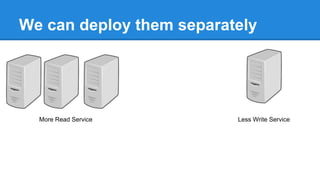
We can deploy them separately 
More Read Service Less Write Service
But this just a small improvement 
We still need the loading screen because Sync 
will take time and if we make a call to the read 
service before the sync is done we will not get 
the data we are looking for.
But lets look back
We have all the data on the Client 
We refresh our grid to show the newly added row by doing 
a query to the read service. 
Why? 
We have all the data in the client because user just now 
entered it, remember? In the add contact screen. Why we 
need to query to the read service for data which we already 
have?
So.. 
Can we add the row to the grid without making 
a call to the Read Service?
But we still have to wait for Write 
Remember our Write Operation returns an ID. 
We need this ID to uniquely identify the Data 
we are writing. 
What if the Write takes long? We will need a 
wait for that anyway!
Redefining ID 
What if we stop asking the Database to create 
this id and send it back? 
What if we generate the ID at the client? 
What if the ID is a GUID?
Redefining ID 
ContactWRITEService.AddContact 
(Contact) 
ContactManager.AddContact(Contact); 
If(Validate(Contact)) 
ContactRepository.Add(Contact) 
Insert into… 
Normalized Database
Client becomes independent 
For each data change client can now make a 
call to the write service and without waiting for 
return value it go back to do the next operation. 
Write service can take its time to perform the 
operation and update the read database 
accordingly.
Read and Write are independent 
Read services only reads data 
Write services only changes the data.
Command Query Responsibility Segregation. 
● A Pattern 
○ Not an Architecture 
○ Not an Architectural style 
○ Not a principal 
Udi Dahan Greg Young 
● Based on Command Query Separation Principle
CQS Principal 
Command–query separation (CQS) is a principle of imperative computer 
programming. It was devised by Bertrand Meyer as part of his pioneering work 
on the Eiffel programming language. 
It states that a method should either change the state of an object or return a 
result but not both.
The Reactive Manifesto 
Systems built as Reactive Systems are more 
flexible, loosely-coupled and scalable. This 
makes them easier to develop and amenable to 
change. They are significantly more tolerant of 
failure and when failure does occur they meet it 
with elegance rather than disaster. Reactive 
Systems are highly responsive, giving users 
effective interactive feedback.
Reactive Systems are 
● Responsive 
● Resilient 
● Elastic 
● Message Driven
Necessary patterns 
CQRS 
Event Sourcing 
Domain Driven Design 
Event Driven Architecture
How does it look
Who is doing it? 
Microsoft 
In July 2012 Ms started a project called CQRS Journey. The project is focused 
on building highly scalable, highly available and maintainable applications with 
the Command & Query Responsibility Segregation and the Event Sourcing 
patterns. Now they published a book and a fully documented source for 
implementing CQRS.
Who is doing it? 
Java: 
● AxonFramework 
● Jdon Framework 
Scala: 
● eventsourced
Who is doing it? 
Selise: 
We are building Publiweb, a massive multi 
module, multi tenant , SaaS based highly 
scalable application using CQRS, Event 
Sourcing and Domain driven design for Swiss 
E-Gov.
What no one told me 
When you are asked to develop a scalable web 
application you are indeed asked to build a 
distributed system.
What is a Distributed System 
Write Read
What that has to do with Web App
Fallacies of Distributed Computing 
● The network is reliable. 
● Latency is zero. 
● Bandwidth is infinite. 
● The network is secure. 
● Topology doesn't change. 
● There is one administrator. 
● Transport cost is zero. 
● The network is homogeneous.
CQRS : Introduction

CQRS : Introduction

  • 1.
    CQRS : Introduction Shah Ali Newaj Topu, CTO, Selise
  • 2.
    How do wearchitect enterprise application Application Layer (Client) Service Layer Business Logic Layer Data Access Layer Sec uri t y Loggi ng Relational Database
  • 3.
    A typical requestLifeCycle newContactID=ContactService.AddContact(Contact) return ContactManager.AddContact(Contact); If(Validate(Contact)) return ContactRepository.Add(Contact) Insert into… return newContactID Relational Database
  • 4.
  • 5.
  • 6.
  • 7.
    and taken backto the grid
  • 8.
    Why we wait? Because it takes some time to add the information to the Database and return us the newly created ID.
  • 9.
    Why database takestime? ● More write operation might be in progress. ● Lot of read operation might be in progress. ● Some request itself might take longer than others because it has to update multiple tables. ● And so on.
  • 10.
    What happens whenwe read data contactList=ContactService.GetContacts() return ContactManager.GetContact(); return ContactRepository.Get() Select from ...join…join return contactList Relational Database
  • 11.
  • 12.
  • 13.
    We have 2wait screens Can we get rid of them?
  • 14.
    Why we wait? ● Lots of Joins in Select query ● There was some write request from other users which locked the table we were trying to read.
  • 15.
    Why we haveJoins Because we have Normalized Database
  • 16.
    And we needNormalized database because
  • 17.
    Normalization slows downread operation The best READ performance can be achieved from a Denormalized Database where data is duplicated and found in columns rather than rows.
  • 18.
    Can we havebest of both Imaging you have one service that does all the WRITE operation and updates your Normalized Database and ensures data integrity. Then you have one service that reads the data from a Denormalized Database. And somehow these two Databases are synchronized.
  • 19.
    Separation of Readand Write contactList=ContactREADService. GetContacts() return ContactManager.GetContact(); return ContactRepository.Get() Select * from Contact return contactList Denormalized Database newContactID=ContactWRITEService. AddContact(Contact) return ContactManager.AddContact (Contact); If(Validate(Contact)) return ContactRepository.Add(Contact) Insert into… return newContactID Sync Normalized Database
  • 20.
    We can deploythem separately More Read Service Less Write Service
  • 21.
    But this justa small improvement We still need the loading screen because Sync will take time and if we make a call to the read service before the sync is done we will not get the data we are looking for.
  • 22.
  • 23.
    We have allthe data on the Client We refresh our grid to show the newly added row by doing a query to the read service. Why? We have all the data in the client because user just now entered it, remember? In the add contact screen. Why we need to query to the read service for data which we already have?
  • 24.
    So.. Can weadd the row to the grid without making a call to the Read Service?
  • 25.
    But we stillhave to wait for Write Remember our Write Operation returns an ID. We need this ID to uniquely identify the Data we are writing. What if the Write takes long? We will need a wait for that anyway!
  • 26.
    Redefining ID Whatif we stop asking the Database to create this id and send it back? What if we generate the ID at the client? What if the ID is a GUID?
  • 27.
    Redefining ID ContactWRITEService.AddContact (Contact) ContactManager.AddContact(Contact); If(Validate(Contact)) ContactRepository.Add(Contact) Insert into… Normalized Database
  • 28.
    Client becomes independent For each data change client can now make a call to the write service and without waiting for return value it go back to do the next operation. Write service can take its time to perform the operation and update the read database accordingly.
  • 29.
    Read and Writeare independent Read services only reads data Write services only changes the data.
  • 30.
    Command Query ResponsibilitySegregation. ● A Pattern ○ Not an Architecture ○ Not an Architectural style ○ Not a principal Udi Dahan Greg Young ● Based on Command Query Separation Principle
  • 31.
    CQS Principal Command–queryseparation (CQS) is a principle of imperative computer programming. It was devised by Bertrand Meyer as part of his pioneering work on the Eiffel programming language. It states that a method should either change the state of an object or return a result but not both.
  • 32.
    The Reactive Manifesto Systems built as Reactive Systems are more flexible, loosely-coupled and scalable. This makes them easier to develop and amenable to change. They are significantly more tolerant of failure and when failure does occur they meet it with elegance rather than disaster. Reactive Systems are highly responsive, giving users effective interactive feedback.
  • 33.
    Reactive Systems are ● Responsive ● Resilient ● Elastic ● Message Driven
  • 34.
    Necessary patterns CQRS Event Sourcing Domain Driven Design Event Driven Architecture
  • 35.
  • 36.
    Who is doingit? Microsoft In July 2012 Ms started a project called CQRS Journey. The project is focused on building highly scalable, highly available and maintainable applications with the Command & Query Responsibility Segregation and the Event Sourcing patterns. Now they published a book and a fully documented source for implementing CQRS.
  • 37.
    Who is doingit? Java: ● AxonFramework ● Jdon Framework Scala: ● eventsourced
  • 38.
    Who is doingit? Selise: We are building Publiweb, a massive multi module, multi tenant , SaaS based highly scalable application using CQRS, Event Sourcing and Domain driven design for Swiss E-Gov.
  • 39.
    What no onetold me When you are asked to develop a scalable web application you are indeed asked to build a distributed system.
  • 40.
    What is aDistributed System Write Read
  • 41.
    What that hasto do with Web App
  • 42.
    Fallacies of DistributedComputing ● The network is reliable. ● Latency is zero. ● Bandwidth is infinite. ● The network is secure. ● Topology doesn't change. ● There is one administrator. ● Transport cost is zero. ● The network is homogeneous.