Contributor Personality Development
Subtopics
 Definition of static and dynamic
identities
 Need of Identity
 Differences
 Application
 Examples
 Interrelations
 Conclusion
Static Identity
 A Static identity is the one that doesn’t
undergo change and remains the same
as it was in the beginning.
 It depends on:
1. Degree of education
2. Position and Power
3. Achievements
4. Amount of knowledge
Dynamic Identity
 A dynamic identity is the one which does
undergo an essential change. This
change can be in commitment,
understanding or values.
 A dynamic identity carries following
qualities:
1. Contributing something to world
2. Taking responsibilities
3. Having faith in oneself
4. Willingness to know more
Differences
 Static Identity
1. He/she is arrogant
over one’s
qualification.
2. Focuses on past
achievements.
3. Tries to changes the
situation.
4. Believes in ‘Power of
Position’
 Dynamic Identity
1. He/she is always
willing to learn more.
2. Focuses on
increasing future
potentials.
3. Gets adapted to the
situation.
4. Believes in
‘Responsibility of
Position’
Why do we need Identities?
 Identity is defined as the characteristics
which determines what or who an
individual is.
 Need of identity is arise when we
encounter an entirely unfamiliar culture
or make unpredictable decisions.
 Selection of proper identity is what
differentiates a contributor and non-
contributor.
Applications
 Dynamic Identity allows one to change
according to a particular system hence
allowing oneself to adapt newer qualities.
 Dynamic Identity increases the ingenuity
and knowledge along with conviction.
 Application of this identity is experienced on
stepping into an entire new environment or
facing unusual situations.
 Compared to Static Identity, it’s
advantageous in most of the cases.
 Although the benefits of static identity are
fewer, it can turn something to one’s
advantage.
 When we are sure about our concept or
confident over our attitude towards a
situation, static identity can show
something to good advantage.
 Static identity is experienced when we
have a negative influence of a community
or when change of ideas is not going to
make much difference.
How Static Identity helped
Pichai
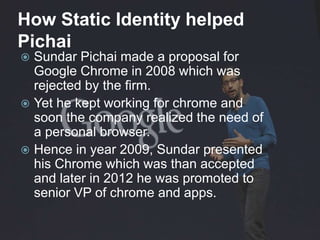
 Sundar Pichai made a proposal for
Google Chrome in 2008 which was
rejected by the firm.
 Yet he kept working for chrome and
soon the company realized the need of
a personal browser.
 Hence in year 2009, Sundar presented
his Chrome which was than accepted
and later in 2012 he was promoted to
senior VP of chrome and apps.
How Dynamic Identity
developed Google
 If we compare statistics of Google in
previous and present century, vital
differences would be found.
 This is because Google made changes
and upgraded itself as per time.
 As Google adapted to change its annual
revenue is increasing for 36% every
year.
Interrelations
 From the last two examples, we can say
that Google accepted static attitude of
Pichai and itself remained Dynamic.
 Therefore for all round development
both identities are needed. Their ratio
maybe unequal, but they are vital.
 Improper selection of identity can cause
an increase in effort and time delay
towards the path of success.
 Hence the selection of identities can
make a major difference in the outcome
of a decision.
 Thus to conclude, achievement of a goal
is possible if a person has the ability to
make proper correspondence of his
identities towards a particular situation.
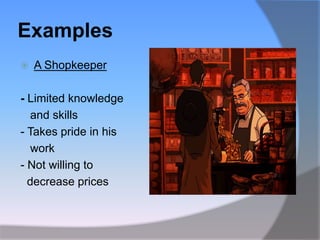
Examples
 A Shopkeeper
- Limited knowledge
and skills
- Takes pride in his
work
- Not willing to
decrease prices
 Static Behavior
 Don’t want to learn
anything new
 Does not change
marketing
techniques
 Dynamic Behavior
 Has less Qualification
yet takes pride in his
work
 Keeps his shop clean
with proper
arrangement of
products
The Conclusion:
 Developing identities is a skill and it
needs experience as well as patience.
 After developing these identities proper
selection of them is equally vital.
 One’s personality and attitude is crafted
after mastering this skill.
 Developing identities is very significant
in engineer’s life because he has to face
many unusual situations in his career.
Presented by
 Darsh Patel 170280116067
 Darshan Rathod 170280116092
 Arjun Sondagar 170280116115
 Hardik Vavadiya 170280116120

CPD PPT

  • 1.
  • 2.
    Subtopics  Definition ofstatic and dynamic identities  Need of Identity  Differences  Application  Examples  Interrelations  Conclusion
  • 3.
    Static Identity  AStatic identity is the one that doesn’t undergo change and remains the same as it was in the beginning.  It depends on: 1. Degree of education 2. Position and Power 3. Achievements 4. Amount of knowledge
  • 4.
    Dynamic Identity  Adynamic identity is the one which does undergo an essential change. This change can be in commitment, understanding or values.  A dynamic identity carries following qualities: 1. Contributing something to world 2. Taking responsibilities 3. Having faith in oneself 4. Willingness to know more
  • 5.
    Differences  Static Identity 1.He/she is arrogant over one’s qualification. 2. Focuses on past achievements. 3. Tries to changes the situation. 4. Believes in ‘Power of Position’  Dynamic Identity 1. He/she is always willing to learn more. 2. Focuses on increasing future potentials. 3. Gets adapted to the situation. 4. Believes in ‘Responsibility of Position’
  • 6.
    Why do weneed Identities?  Identity is defined as the characteristics which determines what or who an individual is.  Need of identity is arise when we encounter an entirely unfamiliar culture or make unpredictable decisions.  Selection of proper identity is what differentiates a contributor and non- contributor.
  • 7.
    Applications  Dynamic Identityallows one to change according to a particular system hence allowing oneself to adapt newer qualities.  Dynamic Identity increases the ingenuity and knowledge along with conviction.  Application of this identity is experienced on stepping into an entire new environment or facing unusual situations.  Compared to Static Identity, it’s advantageous in most of the cases.
  • 8.
     Although thebenefits of static identity are fewer, it can turn something to one’s advantage.  When we are sure about our concept or confident over our attitude towards a situation, static identity can show something to good advantage.  Static identity is experienced when we have a negative influence of a community or when change of ideas is not going to make much difference.
  • 9.
    How Static Identityhelped Pichai  Sundar Pichai made a proposal for Google Chrome in 2008 which was rejected by the firm.  Yet he kept working for chrome and soon the company realized the need of a personal browser.  Hence in year 2009, Sundar presented his Chrome which was than accepted and later in 2012 he was promoted to senior VP of chrome and apps.
  • 10.
    How Dynamic Identity developedGoogle  If we compare statistics of Google in previous and present century, vital differences would be found.  This is because Google made changes and upgraded itself as per time.  As Google adapted to change its annual revenue is increasing for 36% every year.
  • 11.
    Interrelations  From thelast two examples, we can say that Google accepted static attitude of Pichai and itself remained Dynamic.  Therefore for all round development both identities are needed. Their ratio maybe unequal, but they are vital.  Improper selection of identity can cause an increase in effort and time delay towards the path of success.
  • 12.
     Hence theselection of identities can make a major difference in the outcome of a decision.  Thus to conclude, achievement of a goal is possible if a person has the ability to make proper correspondence of his identities towards a particular situation.
  • 13.
    Examples  A Shopkeeper -Limited knowledge and skills - Takes pride in his work - Not willing to decrease prices
  • 14.
     Static Behavior Don’t want to learn anything new  Does not change marketing techniques  Dynamic Behavior  Has less Qualification yet takes pride in his work  Keeps his shop clean with proper arrangement of products
  • 15.
    The Conclusion:  Developingidentities is a skill and it needs experience as well as patience.  After developing these identities proper selection of them is equally vital.  One’s personality and attitude is crafted after mastering this skill.  Developing identities is very significant in engineer’s life because he has to face many unusual situations in his career.
  • 16.
    Presented by  DarshPatel 170280116067  Darshan Rathod 170280116092  Arjun Sondagar 170280116115  Hardik Vavadiya 170280116120