zBY- SMARAJIT TEWARI
REG. NO – 163H1ROO47
BATCH – 2016-2020
STREAM – B.PHARMACY(FINAL SEMSETER)
ADITYA COLLEGE OF PHARMACY
z
WHAT IS CORONA VIRUS ?
Corona viruses (CoV) are a large family of viruses which cause ranging from common cold
to more chronic diseases. A novel corona is a new strain no reported earlier in humans. On
31 December 2019, WHO was notified in Wuhan City, China of cases of pneumonia of an
unknown origin. Countries across the globe have stepped up their testing to rapidly detect
any new CoV-19 incidents. Since then, several new infections with this virus have been
found in China, as have cases imported into other countries, including the European region.
The virus was named Corona virus because of the outer surface that reflects crown-like
spikes. The viruses are somewhat spherical, with the particles ranging from 65-125 nm in
diameter. As nucleic material, corona viruses are single-stranded, positive-sense RNA. This
virus is one of the largest of all RNA viruses, ranging in size from 26 to 32 kbs. The four
structural genes comprising spike (S), envelope (E), membrane (M), and nucleocapsids (N)
encode the structural proteins.
z
HOW TO FIGHT AGAINST COVID-19 ?
 To fight against the global pandemic caused by SARS-COV2 named as per it's
genetic resemblance with the SARS Coronavirus outbreak in 2002, rapid
diagnostic measures have to be adopted. The disease created an undying
panic amongst the people over the world. The prominent
 symptoms involved Fever, dry cough, sore throat etc. though there may be
asymptomatic cases also The risk of getting invaded by the virus is more with
the hypertensive and diabetic patients.
 The medical science need to curb this virus, the most critical risk lies with the
asymptomatic cases as they contribute to community transmission without
diagnosis, so rapid screening of asymptomatic cases play a vital role in
Controlling this epidemic. Since the virus is gradually reaching to the globe,
instead of getting anxious the necessity of the diagnosis must be understood
by the common people and only thus the spreading can be limited. So, this
review highlights on the diagnostic procedures and possible ways to control
the abiding fear among the patients
z
DIAGNOSIS OF CORONA VIRUS
Computed tomography : For resolving the conditions arising out of Polymerase chain reaction
computed tomography scans can be used. A computed tomography scan is the process of
obtaining medical images by the use of X rays and many other rays to get the cross-sectional
images of the definite area. Without causing Pain or harm to the subject, the inner side of the
object can be viewed easily. This screening indicates ground glass and unified lung opacities, it
checks for the normal conditions of alveolar tissues in Lung Parenchyma, if not, disease like
pneumonia is indicated. Apparency of lesions in multiple regions of lung observed in chest CT.
Diagnosis of virus in a pregnant woman : Once a pregnant woman is suspected to be infected
by COVID-19, the RT-PCR test is performed initially. If the person detected to be positive,
managing her pregnancy, child birth and post-partum period in a standardized way is very
important. Exact strategies for Parturition depend on age of gestation. She has to be subjected to
diagnosis of chest images if suffering from shortness of breath. Furthermore, the depth of the
disease is screened by chest imaging in post-partum period, monitoring to be done accordingly.
But if she tested negative but still suffering from breathing difficulties, apart from
the Polymerase chain reaction, her chest screening should be done as a confirmatory information.
Now if the result shows positive the above mentioned measure is taken. In case it’s negative she
is kept under close observations only.
z
Test Kits for the early detection of COVID-19:
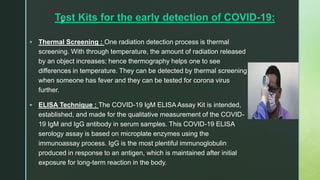
 Thermal Screening : One radiation detection process is thermal
screening. With through temperature, the amount of radiation released
by an object increases; hence thermography helps one to see
differences in temperature. They can be detected by thermal screening
when someone has fever and they can be tested for corona virus
further.
 ELISA Technique : The COVID-19 IgM ELISA Assay Kit is intended,
established, and made for the qualitative measurement of the COVID-
19 IgM and IgG antibody in serum samples. This COVID-19 ELISA
serology assay is based on microplate enzymes using the
immunoassay process. IgG is the most plentiful immunoglobulin
produced in response to an antigen, which is maintained after initial
exposure for long-term reaction in the body.
z CONTINUE
 Rapid Test Based On Antigen Detection : In a sample from a person's respiratory
tract, one form of rapid diagnostic test (RDT) identifies the presence of antigens
(viral proteins) formed by the COVID-19 virus. When the target antigen is present in
the solution at appropriate concentrations, it binds to specific antibodies attached to
a paper strip wrapped in a plastic case and usually generates a visually reasonable
result within 30 minutes.
 Rapid Test Based on Host Antibody Detection : Antibodies are produced during
the days or even weeks following infection with the virus. The strength of an antibody
response depends on numerous parameters including age, dietary condition, and
seriousness of the disease. Molecular testing has been reported in some people with
COVID-19 confirming small, late or absent antibody responses to disease. His
implication is that a COVID-19 infection diagnosis based on an antibody response
seems to be mostly only available in the recovery process after several probabilities
of therapeutic intervention or disease transmission interruption have already passed.
COVID-19 tests that target antibody detection can also interact with other pathogens
including other human coronaviruses.
zSAFETY MEASURES AGASINST COVID-19
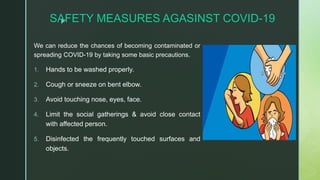
We can reduce the chances of becoming contaminated or
spreading COVID-19 by taking some basic precautions.
1. Hands to be washed properly.
2. Cough or sneeze on bent elbow.
3. Avoid touching nose, eyes, face.
4. Limit the social gatherings & avoid close contact
with affected person.
5. Disinfected the frequently touched surfaces and
objects.
z
Social distancing
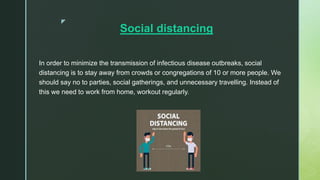
In order to minimize the transmission of infectious disease outbreaks, social
distancing is to stay away from crowds or congregations of 10 or more people. We
should say no to parties, social gatherings, and unnecessary travelling. Instead of
this we need to work from home, workout regularly.
z
CONCLUSION
To conclude this review, we are extremely anxious to survive this evil pandemic
through the best care steps possible. Instead of being frightened one must
specifically preserve an acceptable distance from social contact to avoid droplet
contamination from the individual infected with SARS-CoV2.Sufficient testing
kits, sufficient resources, ample protective equipment will certainly be able to
restrict the disease's rapid spread. Early diagnosis, thermal screening at a
certain moment, wearing protective equipment such as mask, gloves, listening
to health workers' organized instructions, maintaining social distance, in-house
quarantine will conquer this malignant virus.
z
REFARENCES
1. Tang YW, Schmitz JE,Persing DH, Stratton CW. The laboratory Diagnosis of
COVID-19 Infection- Current Issues and Challenges. J. Clin. Microbial. 2020
April; doi:10.1128/JCM.00512-20.
2. COVID-19 Diagnostics: Performing a Nasopharyngeal and Oropharyngeal
Swab. Available from: https://youtu.be/syXd7kgLSN8, accessed on May 24
,2020.
3. Woo PC, HuangYi, Lau SK, Yuen KY. Corona virus Genomics and
Bioinformatics Analysis. Viruses 2010 Aug; 2(8): 1804–20.
4. Zhang W, Du R, Li B, Zheng X. Molecular and serological investigation of
2019-nCoV infected patients: implication of multiple shedding routes.
Emerging microbes and infections2020;9(1): 386-9.
Covid 19 diagnosis

Covid 19 diagnosis

  • 1.
    zBY- SMARAJIT TEWARI REG.NO – 163H1ROO47 BATCH – 2016-2020 STREAM – B.PHARMACY(FINAL SEMSETER) ADITYA COLLEGE OF PHARMACY
  • 2.
    z WHAT IS CORONAVIRUS ? Corona viruses (CoV) are a large family of viruses which cause ranging from common cold to more chronic diseases. A novel corona is a new strain no reported earlier in humans. On 31 December 2019, WHO was notified in Wuhan City, China of cases of pneumonia of an unknown origin. Countries across the globe have stepped up their testing to rapidly detect any new CoV-19 incidents. Since then, several new infections with this virus have been found in China, as have cases imported into other countries, including the European region. The virus was named Corona virus because of the outer surface that reflects crown-like spikes. The viruses are somewhat spherical, with the particles ranging from 65-125 nm in diameter. As nucleic material, corona viruses are single-stranded, positive-sense RNA. This virus is one of the largest of all RNA viruses, ranging in size from 26 to 32 kbs. The four structural genes comprising spike (S), envelope (E), membrane (M), and nucleocapsids (N) encode the structural proteins.
  • 3.
    z HOW TO FIGHTAGAINST COVID-19 ?  To fight against the global pandemic caused by SARS-COV2 named as per it's genetic resemblance with the SARS Coronavirus outbreak in 2002, rapid diagnostic measures have to be adopted. The disease created an undying panic amongst the people over the world. The prominent  symptoms involved Fever, dry cough, sore throat etc. though there may be asymptomatic cases also The risk of getting invaded by the virus is more with the hypertensive and diabetic patients.  The medical science need to curb this virus, the most critical risk lies with the asymptomatic cases as they contribute to community transmission without diagnosis, so rapid screening of asymptomatic cases play a vital role in Controlling this epidemic. Since the virus is gradually reaching to the globe, instead of getting anxious the necessity of the diagnosis must be understood by the common people and only thus the spreading can be limited. So, this review highlights on the diagnostic procedures and possible ways to control the abiding fear among the patients
  • 4.
    z DIAGNOSIS OF CORONAVIRUS Computed tomography : For resolving the conditions arising out of Polymerase chain reaction computed tomography scans can be used. A computed tomography scan is the process of obtaining medical images by the use of X rays and many other rays to get the cross-sectional images of the definite area. Without causing Pain or harm to the subject, the inner side of the object can be viewed easily. This screening indicates ground glass and unified lung opacities, it checks for the normal conditions of alveolar tissues in Lung Parenchyma, if not, disease like pneumonia is indicated. Apparency of lesions in multiple regions of lung observed in chest CT. Diagnosis of virus in a pregnant woman : Once a pregnant woman is suspected to be infected by COVID-19, the RT-PCR test is performed initially. If the person detected to be positive, managing her pregnancy, child birth and post-partum period in a standardized way is very important. Exact strategies for Parturition depend on age of gestation. She has to be subjected to diagnosis of chest images if suffering from shortness of breath. Furthermore, the depth of the disease is screened by chest imaging in post-partum period, monitoring to be done accordingly. But if she tested negative but still suffering from breathing difficulties, apart from the Polymerase chain reaction, her chest screening should be done as a confirmatory information. Now if the result shows positive the above mentioned measure is taken. In case it’s negative she is kept under close observations only.
  • 5.
    z Test Kits forthe early detection of COVID-19:  Thermal Screening : One radiation detection process is thermal screening. With through temperature, the amount of radiation released by an object increases; hence thermography helps one to see differences in temperature. They can be detected by thermal screening when someone has fever and they can be tested for corona virus further.  ELISA Technique : The COVID-19 IgM ELISA Assay Kit is intended, established, and made for the qualitative measurement of the COVID- 19 IgM and IgG antibody in serum samples. This COVID-19 ELISA serology assay is based on microplate enzymes using the immunoassay process. IgG is the most plentiful immunoglobulin produced in response to an antigen, which is maintained after initial exposure for long-term reaction in the body.
  • 6.
    z CONTINUE  RapidTest Based On Antigen Detection : In a sample from a person's respiratory tract, one form of rapid diagnostic test (RDT) identifies the presence of antigens (viral proteins) formed by the COVID-19 virus. When the target antigen is present in the solution at appropriate concentrations, it binds to specific antibodies attached to a paper strip wrapped in a plastic case and usually generates a visually reasonable result within 30 minutes.  Rapid Test Based on Host Antibody Detection : Antibodies are produced during the days or even weeks following infection with the virus. The strength of an antibody response depends on numerous parameters including age, dietary condition, and seriousness of the disease. Molecular testing has been reported in some people with COVID-19 confirming small, late or absent antibody responses to disease. His implication is that a COVID-19 infection diagnosis based on an antibody response seems to be mostly only available in the recovery process after several probabilities of therapeutic intervention or disease transmission interruption have already passed. COVID-19 tests that target antibody detection can also interact with other pathogens including other human coronaviruses.
  • 7.
    zSAFETY MEASURES AGASINSTCOVID-19 We can reduce the chances of becoming contaminated or spreading COVID-19 by taking some basic precautions. 1. Hands to be washed properly. 2. Cough or sneeze on bent elbow. 3. Avoid touching nose, eyes, face. 4. Limit the social gatherings & avoid close contact with affected person. 5. Disinfected the frequently touched surfaces and objects.
  • 8.
    z Social distancing In orderto minimize the transmission of infectious disease outbreaks, social distancing is to stay away from crowds or congregations of 10 or more people. We should say no to parties, social gatherings, and unnecessary travelling. Instead of this we need to work from home, workout regularly.
  • 9.
    z CONCLUSION To conclude thisreview, we are extremely anxious to survive this evil pandemic through the best care steps possible. Instead of being frightened one must specifically preserve an acceptable distance from social contact to avoid droplet contamination from the individual infected with SARS-CoV2.Sufficient testing kits, sufficient resources, ample protective equipment will certainly be able to restrict the disease's rapid spread. Early diagnosis, thermal screening at a certain moment, wearing protective equipment such as mask, gloves, listening to health workers' organized instructions, maintaining social distance, in-house quarantine will conquer this malignant virus.
  • 10.
    z REFARENCES 1. Tang YW,Schmitz JE,Persing DH, Stratton CW. The laboratory Diagnosis of COVID-19 Infection- Current Issues and Challenges. J. Clin. Microbial. 2020 April; doi:10.1128/JCM.00512-20. 2. COVID-19 Diagnostics: Performing a Nasopharyngeal and Oropharyngeal Swab. Available from: https://youtu.be/syXd7kgLSN8, accessed on May 24 ,2020. 3. Woo PC, HuangYi, Lau SK, Yuen KY. Corona virus Genomics and Bioinformatics Analysis. Viruses 2010 Aug; 2(8): 1804–20. 4. Zhang W, Du R, Li B, Zheng X. Molecular and serological investigation of 2019-nCoV infected patients: implication of multiple shedding routes. Emerging microbes and infections2020;9(1): 386-9.