COPYRIGHT IN
DISTANCE
EDUCATION
POWERPOINT
4/13/2020Courtney Harris Power Point
COPYRIGHT IN DISTANCE EDUCATION
• Student will be allowed to copyright laws and the fair use policy
towards the creation of a distance education curriculum.
• The student will be able to describe how the teach act relates to a
distance education curriculum and demonstrate how it is used in a
distance education course
WHAT IS COPYRIGHT?
• Legal rights to an original work
• Right granted to authors to reproduce and sell their work
• No protection, new materials, and compensation
• Created to protect creative work
WHAT IS
COPYRIGHT?
• Protected for the author/creator for 70
years plus
• Assume for any work created after 1978
is copyrighted unless otherwise noted
5 RIGHTS
OF
COPYRIGHT
HOLDERS
• Display the work publicly
• Sell the material
• Create a derivative work
• Reproduce the material
• Perform the work publicly
WHAT IS FAIR USE?
• Fair use grants certain types of
conditional rights to use or reproduce
limited amounts of certain
copyrighted materials
• Not all copying for the purpose of
teaching is considered Fair Use
FAIR USE FOR IMAGES AND GRAPHICS
• From collection, no more than 15 images or 10 percent may be used
• Images from internet may be downloaded for student projects
• Single works may be used in their entirely, but no more than 5 times
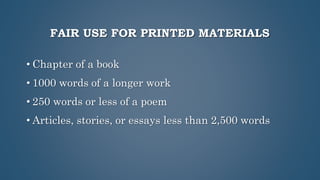
FAIR USE FOR PRINTED MATERIALS
• Chapter of a book
• 1000 words of a longer work
• 250 words or less of a poem
• Articles, stories, or essays less than 2,500 words
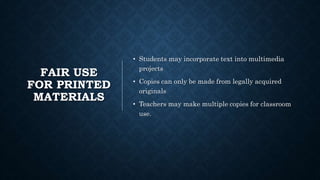
FAIR USE
FOR PRINTED
MATERIALS
• Students may incorporate text into multimedia
projects
• Copies can only be made from legally acquired
originals
• Teachers may make multiple copies for classroom
use.
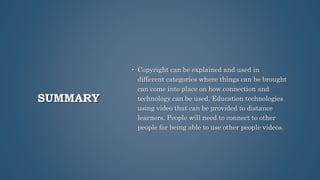
SUMMARY
• Copyright can be explained and used in
different categories where things can be brought
can come into place on how connection and
technology can be used. Education technologies
using video that can be provided to distance
learners. People will need to connect to other
people for being able to use other people videos.
NAME
COURTNEY HARRIS CONTACT:
HA.CH804@GMAIL.COM

Courtney harris 502 module 11 pp

  • 1.
  • 2.
    COPYRIGHT IN DISTANCEEDUCATION • Student will be allowed to copyright laws and the fair use policy towards the creation of a distance education curriculum. • The student will be able to describe how the teach act relates to a distance education curriculum and demonstrate how it is used in a distance education course
  • 3.
    WHAT IS COPYRIGHT? •Legal rights to an original work • Right granted to authors to reproduce and sell their work • No protection, new materials, and compensation • Created to protect creative work
  • 4.
    WHAT IS COPYRIGHT? • Protectedfor the author/creator for 70 years plus • Assume for any work created after 1978 is copyrighted unless otherwise noted
  • 5.
    5 RIGHTS OF COPYRIGHT HOLDERS • Displaythe work publicly • Sell the material • Create a derivative work • Reproduce the material • Perform the work publicly
  • 6.
    WHAT IS FAIRUSE? • Fair use grants certain types of conditional rights to use or reproduce limited amounts of certain copyrighted materials • Not all copying for the purpose of teaching is considered Fair Use
  • 7.
    FAIR USE FORIMAGES AND GRAPHICS • From collection, no more than 15 images or 10 percent may be used • Images from internet may be downloaded for student projects • Single works may be used in their entirely, but no more than 5 times
  • 8.
    FAIR USE FORPRINTED MATERIALS • Chapter of a book • 1000 words of a longer work • 250 words or less of a poem • Articles, stories, or essays less than 2,500 words
  • 9.
    FAIR USE FOR PRINTED MATERIALS •Students may incorporate text into multimedia projects • Copies can only be made from legally acquired originals • Teachers may make multiple copies for classroom use.
  • 10.
    SUMMARY • Copyright canbe explained and used in different categories where things can be brought can come into place on how connection and technology can be used. Education technologies using video that can be provided to distance learners. People will need to connect to other people for being able to use other people videos.
  • 11.