PROGRAMME SPECIFICATION
                               MBA Generic Programme


Programme Overview
The MBA generic pathway is offered via both full-time and part-time mode of attendance.
The MBA generic pathway is a multi-disciplinary area which includes modules such as
strategic marketing, financial management, operations management, innovation
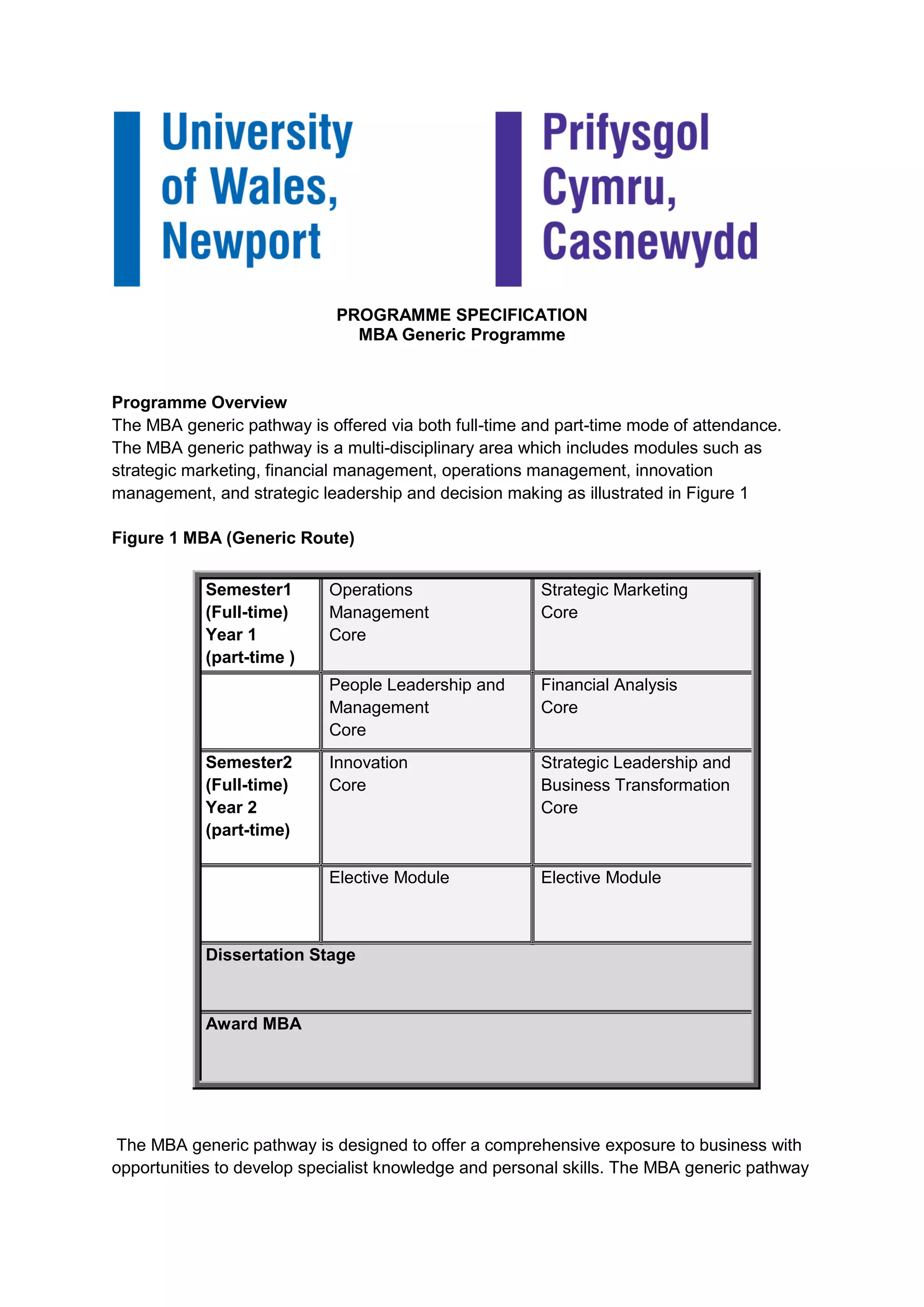
management, and strategic leadership and decision making as illustrated in Figure 1

Figure 1 MBA (Generic Route)


            Semester1       Operations                 Strategic Marketing
            (Full-time)     Management                 Core
            Year 1          Core
            (part-time )
                            People Leadership and      Financial Analysis
                            Management                 Core
                            Core
            Semester2       Innovation                 Strategic Leadership and
            (Full-time)     Core                       Business Transformation
            Year 2                                     Core
            (part-time)

                            Elective Module            Elective Module


            Dissertation Stage


            Award MBA


The MBA generic pathway is designed to offer a comprehensive exposure to business with
opportunities to develop specialist knowledge and personal skills. The MBA generic pathway
blends the theoretical and practical; with the practical side being explored through the
extensive use of case studies, live projects linked to businesses, students’ workplaces and
via an internship opportunity to undertake work based learning.

Additionally, all full-time and part-time MBA pathways have been designed with a common
first semester (full-time)/ first year (part-time) experience. Therefore, students who
successfully complete the first semester (full-time)/ first year (part-time) of the MBA generic
pathway, but feel that they would prefer to complete a named MBA award, can identify an
MBA pathway of their choice and undertake a more specialist study. Student will chose two
elective modules to study during the second semester (full-time)/ second year (part-time).
Their choice of elective modules may lead to a named MBA award.

Programme Aims

       To enable the advanced study of organisations, their management and the changing
       external context in which they operate.

       Prepare individuals for and/or development of a career in business and management
       by developing skills at a professional or equivalent level, or as preparation for
       research or further study in the area.

       Development of the ability to apply knowledge and understanding of business and
       management to complex issues, both systematically and creatively, to improve
       business and management practice.

       Enhancement of lifelong learning skills and personal development so as to be able to
       work with self-direction and originality and to contribute to business and society at
       large.

Learning Outcomes
The programme learning outcomes will be delivered via the core modules of the programme.
However, elective modules such as Stakeholder Management and Globalisation offer
students further opportunities to develop skills and gain knowledge and understanding.

Each module specification contains six learning outcomes which mirror the format and
language of the programme learning outcomes detailed below.

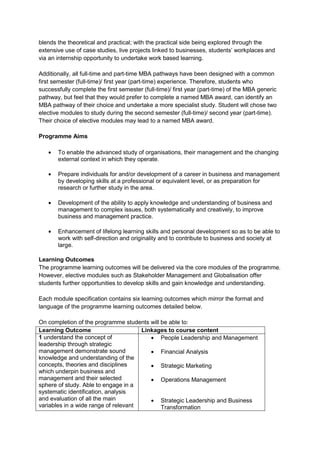
On completion of the programme students will be able to:
Learning Outcome                      Linkages to course content
1 understand the concept of                  People Leadership and Management
leadership through strategic
management demonstrate sound                 Financial Analysis
knowledge and understanding of the
concepts, theories and disciplines           Strategic Marketing
which underpin business and
management and their selected                Operations Management
sphere of study. Able to engage in a
systematic identification, analysis
and evaluation of all the main               Strategic Leadership and Business
variables in a wide range of relevant        Transformation
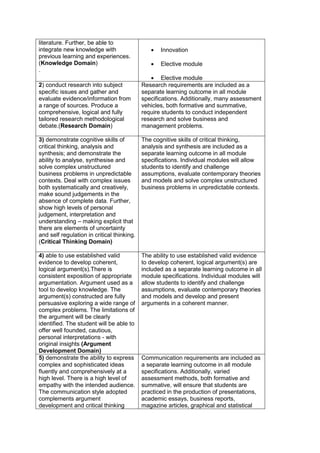
literature. Further, be able to
integrate new knowledge with                       Innovation
previous learning and experiences.
(Knowledge Domain)                                 Elective module
.
                                                    Elective module
2) conduct research into subject            Research requirements are included as a
specific issues and gather and              separate learning outcome in all module
evaluate evidence/information from          specifications. Additionally, many assessment
a range of sources. Produce a               vehicles, both formative and summative,
comprehensive, logical and fully            require students to conduct independent
tailored research methodological            research and solve business and
debate.(Research Domain)                    management problems.

3) demonstrate cognitive skills of          The cognitive skills of critical thinking,
critical thinking, analysis and             analysis and synthesis are included as a
synthesis; and demonstrate the              separate learning outcome in all module
ability to analyse, synthesise and          specifications. Individual modules will allow
solve complex unstructured                  students to identify and challenge
business problems in unpredictable          assumptions, evaluate contemporary theories
contexts. Deal with complex issues          and models and solve complex unstructured
both systematically and creatively,         business problems in unpredictable contexts.
make sound judgements in the
absence of complete data. Further,
show high levels of personal
judgement, interpretation and
understanding – making explicit that
there are elements of uncertainty
and self regulation in critical thinking.
(Critical Thinking Domain)

4) able to use established valid            The ability to use established valid evidence
evidence to develop coherent,               to develop coherent, logical argument(s) are
logical argument(s).There is                included as a separate learning outcome in all
consistent exposition of appropriate        module specifications. Individual modules will
argumentation. Argument used as a           allow students to identify and challenge
tool to develop knowledge. The              assumptions, evaluate contemporary theories
argument(s) constructed are fully           and models and develop and present
persuasive exploring a wide range of        arguments in a coherent manner.
complex problems. The limitations of
the argument will be clearly
identified. The student will be able to
offer well founded, cautious,
personal interpretations - with
original insights (Argument
Development Domain)
5) demonstrate the ability to express       Communication requirements are included as
complex and sophisticated ideas             a separate learning outcome in all module
fluently and comprehensively at a           specifications. Additionally, varied
high level. There is a high level of        assessment methods, both formative and
empathy with the intended audience.         summative, will ensure that students are
The communication style adopted             practiced in the production of presentations,
complements argument                        academic essays, business reports,
development and critical thinking           magazine articles, graphical and statistical
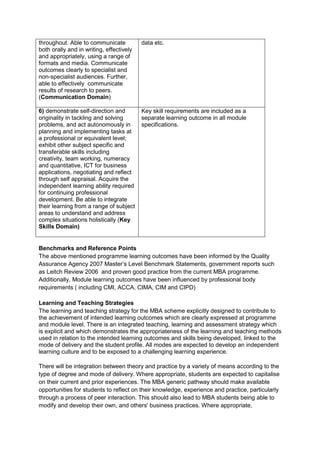
throughout. Able to communicate           data etc.
both orally and in writing, effectively
and appropriately, using a range of
formats and media. Communicate
outcomes clearly to specialist and
non-specialist audiences. Further,
able to effectively communicate
results of research to peers.
(Communication Domain)

6) demonstrate self-direction and         Key skill requirements are included as a
originality in tackling and solving       separate learning outcome in all module
problems, and act autonomously in         specifications.
planning and implementing tasks at
a professional or equivalent level;
exhibit other subject specific and
transferable skills including
creativity, team working, numeracy
and quantitative, ICT for business
applications, negotiating and reflect
through self appraisal. Acquire the
independent learning ability required
for continuing professional
development. Be able to integrate
their learning from a range of subject
areas to understand and address
complex situations holistically (Key
Skills Domain)


Benchmarks and Reference Points
The above mentioned programme learning outcomes have been informed by the Quality
Assurance Agency 2007 Master’s Level Benchmark Statements, government reports such
as Leitch Review 2006 and proven good practice from the current MBA programme.
Additionally, Module learning outcomes have been influenced by professional body
requirements ( including CMI, ACCA, CIMA, CIM and CIPD)

Learning and Teaching Strategies
The learning and teaching strategy for the MBA scheme explicitly designed to contribute to
the achievement of intended learning outcomes which are clearly expressed at programme
and module level. There is an integrated teaching, learning and assessment strategy which
is explicit and which demonstrates the appropriateness of the learning and teaching methods
used in relation to the intended learning outcomes and skills being developed, linked to the
mode of delivery and the student profile. All modes are expected to develop an independent
learning culture and to be exposed to a challenging learning experience.

There will be integration between theory and practice by a variety of means according to the
type of degree and mode of delivery. Where appropriate, students are expected to capitalise
on their current and prior experiences. The MBA generic pathway should make available
opportunities for students to reflect on their knowledge, experience and practice, particularly
through a process of peer interaction. This should also lead to MBA students being able to
modify and develop their own, and others' business practices. Where appropriate,
assignments may include, immediate application of knowledge and skills within
organisations.

The general approach to the learning process for most modules is one which involves:
   a lecture programme;
   a workshop programme;
   a reading programme; and,
   independent study (including use of MLE)

However, due to the variety of modules included in the MBA programme, there may be
different approaches adopted that are appropriate for particular subjects. At the start of each
module, tutors will provide a Module Implementation Plan which details the module structure,
assessment and learning and teaching approaches to be adopted.

The lecture and workshop programmes are timetabled and together make up the lecturer
supported study hours. The reading programme constitutes directed learning. Finally,
students are expected to undertake independent learning. A variety of means such as case
study analysis, role play, peer group led presentation, computer packages, and business
simulations will be used. Many MBA students are in part-time or full-time employment.
Therefore, whenever possible, these employment experiences are utilized as part of the
learning and teaching approaches.

The university employs a virtual learning environment (MLE) where students can access
lecture notes and engage with staff, other MBA students and the wider university community.

Assessment Strategies
The assessment process for the MBA programme reflects both the aims and learning
objectives of the programme and establishes clear links with the underlying philosophy of the
learning and teaching strategy. This requires the use of a wide range of assessment
methods involving an appropriate balance between formative and summative methods.

Summative assessment is guided by the need to measure student achievement in relation to
the aims and objectives specified for the programme and the specified learning outcomes of
the individual modules. This type of summative assessment could take the form of
examinations or coursework e.g. essays, reports, presentations and reflective journals. For
each year of study the course tutor will monitor summative assessment requirements across
modules in order to, where possible, smooth student workload.

Overall, the assessment methods should aim to assess achievement, both
formatively and summatively, over the whole degree programme. It is recognised however
that achievement of some components may be difficult to assess. Nevertheless graduates
will be expected to have achieved master's level in knowledge, understanding and skills
taken as a whole.


Formative assessment is guided by the need to provide students with developmental
feedback. Of particular importance is feed forward to enhance student dissertation
performance. This type of formative assessment encourages reflective practice, develops
academic and personal skills and builds student confidence. Formative assessment is in
evidence in all modules throughout the programme, but is seen as particularly important in
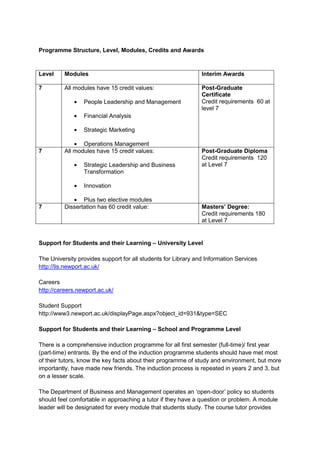
the first semester (full-time)/ first year (part-time) of the MBA programme. summarized in the
Programme Structure section below.
Programme Structure, Level, Modules, Credits and Awards


Level     Modules                                              Interim Awards

7         All modules have 15 credit values:                   Post-Graduate
                                                               Certificate
                 People Leadership and Management              Credit requirements 60 at
                                                               level 7
                 Financial Analysis

                 Strategic Marketing

                 Operations Management
7         All modules have 15 credit values:                   Post-Graduate Diploma
                                                               Credit requirements 120
                 Strategic Leadership and Business             at Level 7
                 Transformation

                 Innovation

                 Plus two elective modules
7         Dissertation has 60 credit value:                    Masters’ Degree:
                                                               Credit requirements 180
                                                               at Level 7


Support for Students and their Learning – University Level

The University provides support for all students for Library and Information Services
http://lis.newport.ac.uk/

Careers
http://careers.newport.ac.uk/

Student Support
http://www3.newport.ac.uk/displayPage.aspx?object_id=931&type=SEC

Support for Students and their Learning – School and Programme Level

There is a comprehensive induction programme for all first semester (full-time)/ first year
(part-time) entrants. By the end of the induction programme students should have met most
of their tutors, know the key facts about their programme of study and environment, but more
importantly, have made new friends. The induction process is repeated in years 2 and 3, but
on a lesser scale.

The Department of Business and Management operates an ‘open-door’ policy so students
should feel comfortable in approaching a tutor if they have a question or problem. A module
leader will be designated for every module that students study. The course tutor provides
pastoral care and can discuss any issues that may arise, but cannot be rectified at module
level.

Criteria for Admission to the Programme
http://www3.newport.ac.uk/displayPage.aspx?object_id=544&type=PAG

$Equal Opportunities and Diversity
Newport Business School respects and values all people and welcomes having a diverse
population of students and staff. Our commitment is to promote equality of opportunity to all,
and not to tolerate any unfair or indirect discrimination. The full policy can be seen at
http://hr2.newport.ac.uk/diversity/index.htm . Additionally, prospective students with
disabilities will find a wide variety of information on the university’s Disability Homepage.
http://registry.newport.ac.uk/a/MenuStudent/indexstudent.htm


Indicators of Quality and Standards - University Level

University of Wales, Newport achieved the highest possible outcome in a 2004 Institutional
Audit conducted by the Quality Assurance Agency for Higher Education:
http://www.qaa.ac.uk/reviews/reports/instReports.asp?instID=H-0086

Quality Assurance systems given strong endorsement in two audits of overseas provision by
the Quality Assurance Agency:
http://www.qaa.ac.uk/reviews/reports/instReports.asp?instID=H-0086

Top in Wales for enterprise education (KEF ranking 2002).

Excellent graduate employment record.

National standards are assured by external examiners.


Indicators of Quality and Standards – School and Programme Level
Why Study at Newport Business School?
       In November 2002 the school was awarded the highest rating for standards and
       quality by the Quality Assurance Agency for Higher Education.
       In November 2004 the QAA gave the University a ‘confidence’ rating for the
       soundness of the institutions quality of its academic programmes. This is the highest
       grade that can be awarded by the QAA.

Date at Which the Programme Specification Was Written – January 2008


Student Contract
All students will be required, as a condition of enrolment, to abide by and submit to the
procedures of the University’s disciplinary rules and regulations, as amended from time to
time. A copy of the current disciplinary rules and regulations is available, on request, from
the University Information Centre.
The University will use all reasonable endeavours to deliver courses in accordance with the
descriptions set out in the prospectus. However, the University does not provide education to
UK undergraduates on a commercial basis. It is also very largely dependent upon charitable
and public funds, which the University has to manage in a way that is efficient and cost-
effective, in the context of the provision of a diverse range of courses to a large number of
students. The University therefore:

   Reserves the right to make variations to the contents or methods of delivery to courses,
   to discontinue courses and to merge or combine courses, if such action is reasonably
   considered to be necessary by the University. If the University discontinues any course,
   it will use its reasonable endeavours to provide a suitable alternative course.

   Cannot accept responsibility and expressly excludes liability, for damage to students’
   property, transfer of computer viruses to students’ equipment or liability for breach of
   contract.

Mba generic

  • 1.
    PROGRAMME SPECIFICATION MBA Generic Programme Programme Overview The MBA generic pathway is offered via both full-time and part-time mode of attendance. The MBA generic pathway is a multi-disciplinary area which includes modules such as strategic marketing, financial management, operations management, innovation management, and strategic leadership and decision making as illustrated in Figure 1 Figure 1 MBA (Generic Route) Semester1 Operations Strategic Marketing (Full-time) Management Core Year 1 Core (part-time ) People Leadership and Financial Analysis Management Core Core Semester2 Innovation Strategic Leadership and (Full-time) Core Business Transformation Year 2 Core (part-time) Elective Module Elective Module Dissertation Stage Award MBA The MBA generic pathway is designed to offer a comprehensive exposure to business with opportunities to develop specialist knowledge and personal skills. The MBA generic pathway
  • 2.
    blends the theoreticaland practical; with the practical side being explored through the extensive use of case studies, live projects linked to businesses, students’ workplaces and via an internship opportunity to undertake work based learning. Additionally, all full-time and part-time MBA pathways have been designed with a common first semester (full-time)/ first year (part-time) experience. Therefore, students who successfully complete the first semester (full-time)/ first year (part-time) of the MBA generic pathway, but feel that they would prefer to complete a named MBA award, can identify an MBA pathway of their choice and undertake a more specialist study. Student will chose two elective modules to study during the second semester (full-time)/ second year (part-time). Their choice of elective modules may lead to a named MBA award. Programme Aims To enable the advanced study of organisations, their management and the changing external context in which they operate. Prepare individuals for and/or development of a career in business and management by developing skills at a professional or equivalent level, or as preparation for research or further study in the area. Development of the ability to apply knowledge and understanding of business and management to complex issues, both systematically and creatively, to improve business and management practice. Enhancement of lifelong learning skills and personal development so as to be able to work with self-direction and originality and to contribute to business and society at large. Learning Outcomes The programme learning outcomes will be delivered via the core modules of the programme. However, elective modules such as Stakeholder Management and Globalisation offer students further opportunities to develop skills and gain knowledge and understanding. Each module specification contains six learning outcomes which mirror the format and language of the programme learning outcomes detailed below. On completion of the programme students will be able to: Learning Outcome Linkages to course content 1 understand the concept of People Leadership and Management leadership through strategic management demonstrate sound Financial Analysis knowledge and understanding of the concepts, theories and disciplines Strategic Marketing which underpin business and management and their selected Operations Management sphere of study. Able to engage in a systematic identification, analysis and evaluation of all the main Strategic Leadership and Business variables in a wide range of relevant Transformation
  • 3.
    literature. Further, beable to integrate new knowledge with Innovation previous learning and experiences. (Knowledge Domain) Elective module . Elective module 2) conduct research into subject Research requirements are included as a specific issues and gather and separate learning outcome in all module evaluate evidence/information from specifications. Additionally, many assessment a range of sources. Produce a vehicles, both formative and summative, comprehensive, logical and fully require students to conduct independent tailored research methodological research and solve business and debate.(Research Domain) management problems. 3) demonstrate cognitive skills of The cognitive skills of critical thinking, critical thinking, analysis and analysis and synthesis are included as a synthesis; and demonstrate the separate learning outcome in all module ability to analyse, synthesise and specifications. Individual modules will allow solve complex unstructured students to identify and challenge business problems in unpredictable assumptions, evaluate contemporary theories contexts. Deal with complex issues and models and solve complex unstructured both systematically and creatively, business problems in unpredictable contexts. make sound judgements in the absence of complete data. Further, show high levels of personal judgement, interpretation and understanding – making explicit that there are elements of uncertainty and self regulation in critical thinking. (Critical Thinking Domain) 4) able to use established valid The ability to use established valid evidence evidence to develop coherent, to develop coherent, logical argument(s) are logical argument(s).There is included as a separate learning outcome in all consistent exposition of appropriate module specifications. Individual modules will argumentation. Argument used as a allow students to identify and challenge tool to develop knowledge. The assumptions, evaluate contemporary theories argument(s) constructed are fully and models and develop and present persuasive exploring a wide range of arguments in a coherent manner. complex problems. The limitations of the argument will be clearly identified. The student will be able to offer well founded, cautious, personal interpretations - with original insights (Argument Development Domain) 5) demonstrate the ability to express Communication requirements are included as complex and sophisticated ideas a separate learning outcome in all module fluently and comprehensively at a specifications. Additionally, varied high level. There is a high level of assessment methods, both formative and empathy with the intended audience. summative, will ensure that students are The communication style adopted practiced in the production of presentations, complements argument academic essays, business reports, development and critical thinking magazine articles, graphical and statistical
  • 4.
    throughout. Able tocommunicate data etc. both orally and in writing, effectively and appropriately, using a range of formats and media. Communicate outcomes clearly to specialist and non-specialist audiences. Further, able to effectively communicate results of research to peers. (Communication Domain) 6) demonstrate self-direction and Key skill requirements are included as a originality in tackling and solving separate learning outcome in all module problems, and act autonomously in specifications. planning and implementing tasks at a professional or equivalent level; exhibit other subject specific and transferable skills including creativity, team working, numeracy and quantitative, ICT for business applications, negotiating and reflect through self appraisal. Acquire the independent learning ability required for continuing professional development. Be able to integrate their learning from a range of subject areas to understand and address complex situations holistically (Key Skills Domain) Benchmarks and Reference Points The above mentioned programme learning outcomes have been informed by the Quality Assurance Agency 2007 Master’s Level Benchmark Statements, government reports such as Leitch Review 2006 and proven good practice from the current MBA programme. Additionally, Module learning outcomes have been influenced by professional body requirements ( including CMI, ACCA, CIMA, CIM and CIPD) Learning and Teaching Strategies The learning and teaching strategy for the MBA scheme explicitly designed to contribute to the achievement of intended learning outcomes which are clearly expressed at programme and module level. There is an integrated teaching, learning and assessment strategy which is explicit and which demonstrates the appropriateness of the learning and teaching methods used in relation to the intended learning outcomes and skills being developed, linked to the mode of delivery and the student profile. All modes are expected to develop an independent learning culture and to be exposed to a challenging learning experience. There will be integration between theory and practice by a variety of means according to the type of degree and mode of delivery. Where appropriate, students are expected to capitalise on their current and prior experiences. The MBA generic pathway should make available opportunities for students to reflect on their knowledge, experience and practice, particularly through a process of peer interaction. This should also lead to MBA students being able to modify and develop their own, and others' business practices. Where appropriate,
  • 5.
    assignments may include,immediate application of knowledge and skills within organisations. The general approach to the learning process for most modules is one which involves: a lecture programme; a workshop programme; a reading programme; and, independent study (including use of MLE) However, due to the variety of modules included in the MBA programme, there may be different approaches adopted that are appropriate for particular subjects. At the start of each module, tutors will provide a Module Implementation Plan which details the module structure, assessment and learning and teaching approaches to be adopted. The lecture and workshop programmes are timetabled and together make up the lecturer supported study hours. The reading programme constitutes directed learning. Finally, students are expected to undertake independent learning. A variety of means such as case study analysis, role play, peer group led presentation, computer packages, and business simulations will be used. Many MBA students are in part-time or full-time employment. Therefore, whenever possible, these employment experiences are utilized as part of the learning and teaching approaches. The university employs a virtual learning environment (MLE) where students can access lecture notes and engage with staff, other MBA students and the wider university community. Assessment Strategies The assessment process for the MBA programme reflects both the aims and learning objectives of the programme and establishes clear links with the underlying philosophy of the learning and teaching strategy. This requires the use of a wide range of assessment methods involving an appropriate balance between formative and summative methods. Summative assessment is guided by the need to measure student achievement in relation to the aims and objectives specified for the programme and the specified learning outcomes of the individual modules. This type of summative assessment could take the form of examinations or coursework e.g. essays, reports, presentations and reflective journals. For each year of study the course tutor will monitor summative assessment requirements across modules in order to, where possible, smooth student workload. Overall, the assessment methods should aim to assess achievement, both formatively and summatively, over the whole degree programme. It is recognised however that achievement of some components may be difficult to assess. Nevertheless graduates will be expected to have achieved master's level in knowledge, understanding and skills taken as a whole. Formative assessment is guided by the need to provide students with developmental feedback. Of particular importance is feed forward to enhance student dissertation performance. This type of formative assessment encourages reflective practice, develops academic and personal skills and builds student confidence. Formative assessment is in evidence in all modules throughout the programme, but is seen as particularly important in the first semester (full-time)/ first year (part-time) of the MBA programme. summarized in the Programme Structure section below.
  • 6.
    Programme Structure, Level,Modules, Credits and Awards Level Modules Interim Awards 7 All modules have 15 credit values: Post-Graduate Certificate People Leadership and Management Credit requirements 60 at level 7 Financial Analysis Strategic Marketing Operations Management 7 All modules have 15 credit values: Post-Graduate Diploma Credit requirements 120 Strategic Leadership and Business at Level 7 Transformation Innovation Plus two elective modules 7 Dissertation has 60 credit value: Masters’ Degree: Credit requirements 180 at Level 7 Support for Students and their Learning – University Level The University provides support for all students for Library and Information Services http://lis.newport.ac.uk/ Careers http://careers.newport.ac.uk/ Student Support http://www3.newport.ac.uk/displayPage.aspx?object_id=931&type=SEC Support for Students and their Learning – School and Programme Level There is a comprehensive induction programme for all first semester (full-time)/ first year (part-time) entrants. By the end of the induction programme students should have met most of their tutors, know the key facts about their programme of study and environment, but more importantly, have made new friends. The induction process is repeated in years 2 and 3, but on a lesser scale. The Department of Business and Management operates an ‘open-door’ policy so students should feel comfortable in approaching a tutor if they have a question or problem. A module leader will be designated for every module that students study. The course tutor provides
  • 7.
    pastoral care andcan discuss any issues that may arise, but cannot be rectified at module level. Criteria for Admission to the Programme http://www3.newport.ac.uk/displayPage.aspx?object_id=544&type=PAG $Equal Opportunities and Diversity Newport Business School respects and values all people and welcomes having a diverse population of students and staff. Our commitment is to promote equality of opportunity to all, and not to tolerate any unfair or indirect discrimination. The full policy can be seen at http://hr2.newport.ac.uk/diversity/index.htm . Additionally, prospective students with disabilities will find a wide variety of information on the university’s Disability Homepage. http://registry.newport.ac.uk/a/MenuStudent/indexstudent.htm Indicators of Quality and Standards - University Level University of Wales, Newport achieved the highest possible outcome in a 2004 Institutional Audit conducted by the Quality Assurance Agency for Higher Education: http://www.qaa.ac.uk/reviews/reports/instReports.asp?instID=H-0086 Quality Assurance systems given strong endorsement in two audits of overseas provision by the Quality Assurance Agency: http://www.qaa.ac.uk/reviews/reports/instReports.asp?instID=H-0086 Top in Wales for enterprise education (KEF ranking 2002). Excellent graduate employment record. National standards are assured by external examiners. Indicators of Quality and Standards – School and Programme Level Why Study at Newport Business School? In November 2002 the school was awarded the highest rating for standards and quality by the Quality Assurance Agency for Higher Education. In November 2004 the QAA gave the University a ‘confidence’ rating for the soundness of the institutions quality of its academic programmes. This is the highest grade that can be awarded by the QAA. Date at Which the Programme Specification Was Written – January 2008 Student Contract All students will be required, as a condition of enrolment, to abide by and submit to the procedures of the University’s disciplinary rules and regulations, as amended from time to time. A copy of the current disciplinary rules and regulations is available, on request, from the University Information Centre.
  • 8.
    The University willuse all reasonable endeavours to deliver courses in accordance with the descriptions set out in the prospectus. However, the University does not provide education to UK undergraduates on a commercial basis. It is also very largely dependent upon charitable and public funds, which the University has to manage in a way that is efficient and cost- effective, in the context of the provision of a diverse range of courses to a large number of students. The University therefore: Reserves the right to make variations to the contents or methods of delivery to courses, to discontinue courses and to merge or combine courses, if such action is reasonably considered to be necessary by the University. If the University discontinues any course, it will use its reasonable endeavours to provide a suitable alternative course. Cannot accept responsibility and expressly excludes liability, for damage to students’ property, transfer of computer viruses to students’ equipment or liability for breach of contract.