“ I did not get good at trading  until I realized I was not good at trading .” Leroy Rushing
Counter Trend Trading For Profits
Services Disclaimer  (for full disclosure, see “Disclaimers” section of website) Information Contained within our website and affiliates is not a substitute for professional advice (e.g., stock broker, financial advisor, traderal banker). Provided by us does not constitute legal or financial advice nor is it meant to be. Intended to be general information relevant to common Trading issues and is offered in good faith (i.e., you do not have to use this information). Decisions Made by you are yours and yours alone, and you cannot under any circumstances hold Trading EveryDay responsible for any and all of your trading actions, losses, and costs incurred by you. Indemnification Client agrees to indemnify Trading EveryDay (TED) in the event of any claims  against the Founder of TED and nothing in the materials shall be considered legal, financial, or actuarial advice. Educational Disclaimer  (for full disclosure, see “Disclaimers” section of website) All information, training, and coaching sessions offered by TED are for educational purposes only. No warranties or guarantees of stock market success  are offered of any kind. No advice will be given on specific stocks or on general financial management. TED will provide you with the tools to improve your trading skills. How you use the tools is up to you.
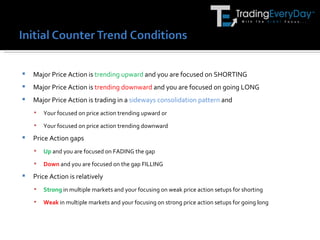
Major Price Action is  trending upward  and you are focused on SHORTING Major Price Action is  trending downward  and you are focused on going LONG Major Price Action is trading in a  sideways consolidation pattern  and  Your focused on price action trending upward or  Your focused on price action trending downward Price Action gaps  Up  and you are focused on FADING the gap Down  and you are focused on the gap FILLING Price Action is relatively  Strong  in multiple markets and your focusing on weak price action setups for shorting Weak  in multiple markets and your focusing on strong price action setups for going long
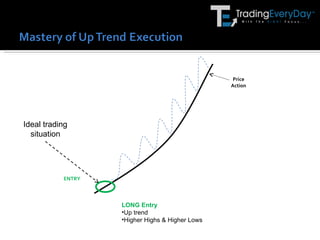
Ideal trading situation ENTRY LONG Entry Up trend Higher Highs & Higher Lows Price Action
Natural pullbacks in price action Ideal trading situation ENTRY LONG Entry Up trend Higher Highs & Higher Lows Price Action 4 4 4 4 4 4
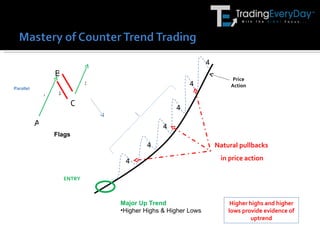
Natural pullbacks in price action Higher highs and higher lows provide evidence of uptrend Major Up Trend Higher Highs & Higher Lows ENTRY Price Action 4 4 4 4 4 4 B A C Flags Parallel 1 2 3
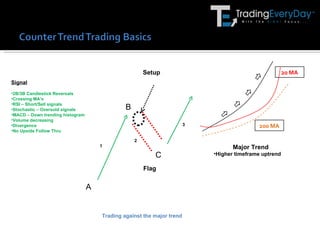
1 2 3 Setup Signal 2B/3B Candlestick Reversals Crossing MA’s RSI – Short/Sell signals Stochastic – Oversold signals MACD – Down trending histogram Volume decreasing Divergence No Upside Follow Thru Major Trend  Higher timeframe uptrend 200 MA 20 MA B A C Flag Trading against the major trend
2. Bullish Rally 3. Sideways Topping Action 1. Sideways Bottoming Action 4. Bearish Rally 1. Sideways Bottoming Action Focus on Speed of uptrend Long Setups Focus on Speed of downtrend Short Setups
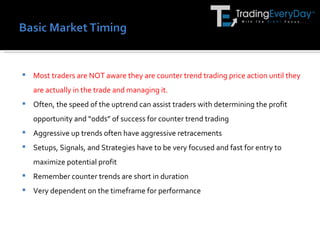
Most traders are NOT aware they are counter trend trading price action until they are actually in the trade and managing it. Often, the speed of the uptrend can assist traders with determining the profit opportunity and “odds” of success for counter trend trading Aggressive up trends often have aggressive retracements Setups, Signals, and Strategies have to be very focused and fast for entry to maximize potential profit Remember counter trends are short in duration Very dependent on the timeframe for performance
Often traders loose trying to accurately trade the countertrend paradigm Buying New Lows: “ Bottom-fishing” to pick the market bottoms and focus on exactly getting in at the low of the price action  downtrend . Traditional trading suggest waiting  for  confirmation  that support has held and prices are moving in an  uptrend  with higher highs and higher lows Selling New Highs: Traders trying to pick the market tops and focus on exactly getting out or shorting at the high of the price action  uptrend .  Traditional trading suggest waiting  for  confirmation  that overhead resistance has held and prices are moving in a  downtrend  with lower highs and lower lows
When countertrend trading know: Support and resistance  levels where traders identify entry and exit opportunities when trading.  Fibonacci percentage "retracement" levels  where savvy traders use them to improve their entry and exit points. How traders often try buying into support If the major price action trend is in a downtrend, more than likely, it will continue How traders often try buying a breakout  Buying breakouts in an uptrend is often chasing the move; similar to buying new highs  or shorting new lows How traders often try shorting into resistance  If the major price action trend is in a up trend, more than likely, it will continue How traders often try shorting a breakdown
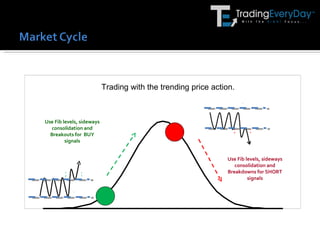
Use Fib levels, sideways consolidation and Breakouts for  BUY signals Use Fib levels, sideways consolidation and Breakdowns for SHORT signals Trading with the trending price action. 1 2 3 1 3 2
2. Bullish Rally 3. Sideways Topping Action 1. Sideways Bottoming Action 4. Bearish Rally 1. Sideways Bottoming Action 1 2 3 1 3 2
REWARD REWARD RISK RISK STOP ENTRY TARGET TARGET ENTRY STOP LONG Entry Up trend Higher Highs & Higher Lows Short Entry Down trend Lower Highs & Lower  Lows Price Action (1R) (1R) ( multiple  R) ( multiple  R)
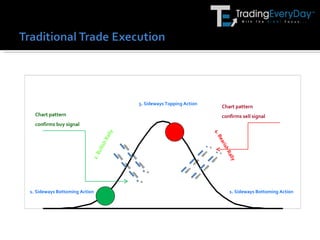
2. Bullish Rally 3. Sideways Topping Action 1. Sideways Bottoming Action 4. Bearish Rally 1. Sideways Bottoming Action Chart pattern confirms buy signal Chart pattern  confirms sell signal
2. Bullish Rally 3. Sideways Topping Action 1. Sideways Bottoming Action 4. Bearish Rally 1. Sideways Bottoming Action Aggressive Short Aggressive Buy
Lack of patience and discipline Tunnel vision in reference to market conditions Inter-market Analysis Improper money management or risk management Over-trading Too many markets at one time – not enough trades setups Excessive trades – trying to recoup losses Pursuit of Perfection and High expectations of “Winnings” and “Profits” Catching  “The falling Knife” Trying to Pick “Tops” and/or “Bottoms” Not having a “trust-worthy” trading plan for trading trends NO accountability for actions
Like fast-paced, risk-filled environment Looking for “Instant Gratification”  Trading from a mindset of “greed” or “desperation” Overconfidence Have a very demanding ego that unfortunately distorts one’s rational thinking Emotions empower your actions Remaining in position to avoid admitting wrong Relying on “Sense of Timing” or “Trading Intuition”
2. Bullish Rally 3. Sideways Topping Action 1. Sideways Bottoming Action 4. Bearish Rally 1. Sideways Bottoming Action Chasing Short entry  Chasing Long entry
End of counter trend End of counter trend  (1R) (1R)
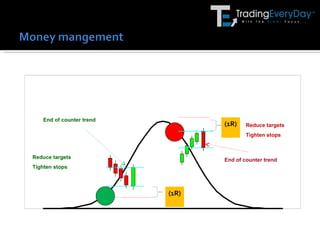
Reduce targets  Tighten stops  Reduce targets  Tighten stops  (1R) (1R) End of counter trend End of counter trend
Immediate exit Pre-Market Late Day Breakdown High Low Yesterday Today Gap Gap Fill

Counter Trend Trading

  • 1.
    “ I didnot get good at trading until I realized I was not good at trading .” Leroy Rushing
  • 2.
  • 3.
    Services Disclaimer (for full disclosure, see “Disclaimers” section of website) Information Contained within our website and affiliates is not a substitute for professional advice (e.g., stock broker, financial advisor, traderal banker). Provided by us does not constitute legal or financial advice nor is it meant to be. Intended to be general information relevant to common Trading issues and is offered in good faith (i.e., you do not have to use this information). Decisions Made by you are yours and yours alone, and you cannot under any circumstances hold Trading EveryDay responsible for any and all of your trading actions, losses, and costs incurred by you. Indemnification Client agrees to indemnify Trading EveryDay (TED) in the event of any claims against the Founder of TED and nothing in the materials shall be considered legal, financial, or actuarial advice. Educational Disclaimer (for full disclosure, see “Disclaimers” section of website) All information, training, and coaching sessions offered by TED are for educational purposes only. No warranties or guarantees of stock market success are offered of any kind. No advice will be given on specific stocks or on general financial management. TED will provide you with the tools to improve your trading skills. How you use the tools is up to you.
  • 4.
    Major Price Actionis trending upward and you are focused on SHORTING Major Price Action is trending downward and you are focused on going LONG Major Price Action is trading in a sideways consolidation pattern and Your focused on price action trending upward or Your focused on price action trending downward Price Action gaps Up and you are focused on FADING the gap Down and you are focused on the gap FILLING Price Action is relatively Strong in multiple markets and your focusing on weak price action setups for shorting Weak in multiple markets and your focusing on strong price action setups for going long
  • 5.
    Ideal trading situationENTRY LONG Entry Up trend Higher Highs & Higher Lows Price Action
  • 6.
    Natural pullbacks inprice action Ideal trading situation ENTRY LONG Entry Up trend Higher Highs & Higher Lows Price Action 4 4 4 4 4 4
  • 7.
    Natural pullbacks inprice action Higher highs and higher lows provide evidence of uptrend Major Up Trend Higher Highs & Higher Lows ENTRY Price Action 4 4 4 4 4 4 B A C Flags Parallel 1 2 3
  • 8.
    1 2 3Setup Signal 2B/3B Candlestick Reversals Crossing MA’s RSI – Short/Sell signals Stochastic – Oversold signals MACD – Down trending histogram Volume decreasing Divergence No Upside Follow Thru Major Trend Higher timeframe uptrend 200 MA 20 MA B A C Flag Trading against the major trend
  • 9.
    2. Bullish Rally3. Sideways Topping Action 1. Sideways Bottoming Action 4. Bearish Rally 1. Sideways Bottoming Action Focus on Speed of uptrend Long Setups Focus on Speed of downtrend Short Setups
  • 10.
    Most traders areNOT aware they are counter trend trading price action until they are actually in the trade and managing it. Often, the speed of the uptrend can assist traders with determining the profit opportunity and “odds” of success for counter trend trading Aggressive up trends often have aggressive retracements Setups, Signals, and Strategies have to be very focused and fast for entry to maximize potential profit Remember counter trends are short in duration Very dependent on the timeframe for performance
  • 11.
    Often traders loosetrying to accurately trade the countertrend paradigm Buying New Lows: “ Bottom-fishing” to pick the market bottoms and focus on exactly getting in at the low of the price action downtrend . Traditional trading suggest waiting for confirmation that support has held and prices are moving in an uptrend with higher highs and higher lows Selling New Highs: Traders trying to pick the market tops and focus on exactly getting out or shorting at the high of the price action uptrend . Traditional trading suggest waiting for confirmation that overhead resistance has held and prices are moving in a downtrend with lower highs and lower lows
  • 12.
    When countertrend tradingknow: Support and resistance levels where traders identify entry and exit opportunities when trading. Fibonacci percentage "retracement" levels where savvy traders use them to improve their entry and exit points. How traders often try buying into support If the major price action trend is in a downtrend, more than likely, it will continue How traders often try buying a breakout Buying breakouts in an uptrend is often chasing the move; similar to buying new highs or shorting new lows How traders often try shorting into resistance If the major price action trend is in a up trend, more than likely, it will continue How traders often try shorting a breakdown
  • 13.
    Use Fib levels,sideways consolidation and Breakouts for BUY signals Use Fib levels, sideways consolidation and Breakdowns for SHORT signals Trading with the trending price action. 1 2 3 1 3 2
  • 14.
    2. Bullish Rally3. Sideways Topping Action 1. Sideways Bottoming Action 4. Bearish Rally 1. Sideways Bottoming Action 1 2 3 1 3 2
  • 15.
    REWARD REWARD RISKRISK STOP ENTRY TARGET TARGET ENTRY STOP LONG Entry Up trend Higher Highs & Higher Lows Short Entry Down trend Lower Highs & Lower Lows Price Action (1R) (1R) ( multiple R) ( multiple R)
  • 16.
    2. Bullish Rally3. Sideways Topping Action 1. Sideways Bottoming Action 4. Bearish Rally 1. Sideways Bottoming Action Chart pattern confirms buy signal Chart pattern confirms sell signal
  • 17.
    2. Bullish Rally3. Sideways Topping Action 1. Sideways Bottoming Action 4. Bearish Rally 1. Sideways Bottoming Action Aggressive Short Aggressive Buy
  • 18.
    Lack of patienceand discipline Tunnel vision in reference to market conditions Inter-market Analysis Improper money management or risk management Over-trading Too many markets at one time – not enough trades setups Excessive trades – trying to recoup losses Pursuit of Perfection and High expectations of “Winnings” and “Profits” Catching “The falling Knife” Trying to Pick “Tops” and/or “Bottoms” Not having a “trust-worthy” trading plan for trading trends NO accountability for actions
  • 19.
    Like fast-paced, risk-filledenvironment Looking for “Instant Gratification” Trading from a mindset of “greed” or “desperation” Overconfidence Have a very demanding ego that unfortunately distorts one’s rational thinking Emotions empower your actions Remaining in position to avoid admitting wrong Relying on “Sense of Timing” or “Trading Intuition”
  • 20.
    2. Bullish Rally3. Sideways Topping Action 1. Sideways Bottoming Action 4. Bearish Rally 1. Sideways Bottoming Action Chasing Short entry Chasing Long entry
  • 21.
    End of countertrend End of counter trend (1R) (1R)
  • 22.
    Reduce targets Tighten stops Reduce targets Tighten stops (1R) (1R) End of counter trend End of counter trend
  • 23.
    Immediate exit Pre-MarketLate Day Breakdown High Low Yesterday Today Gap Gap Fill