•cost of production or of running a
business
•by allocating expenditure to various
stages of production or to different
operations of a business
The first problem for cost estimation is the total
cost allocation of the product. In fact, the total
cost has now more indirect cost components,
which is a significant share percentage, because
all the activities are being done at different
places, the actual supply chain is more
complex, and this fact has changed the product
cost structure.
 accepting or rejecting the sales price is the real
key to profit.
 challenge is to know the variable cost and
margins of an order before order and sales
price approved
 considering detailed product details lead times,
sales costs, detailed manufacturing cost and
order quantities.
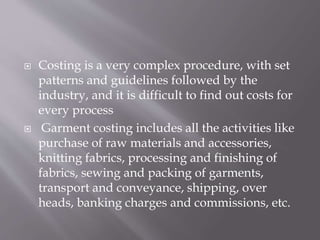
 Costing is a very complex procedure, with set
patterns and guidelines followed by the
industry, and it is difficult to find out costs for
every process
 Garment costing includes all the activities like
purchase of raw materials and accessories,
knitting fabrics, processing and finishing of
fabrics, sewing and packing of garments,
transport and conveyance, shipping, over
heads, banking charges and commissions, etc.
 To do perfect garment costing, one must know
about all these activities thoroughly about their
costs, procedures, advantages and risk factors.
 Also he must know how to solve the problems
when occurred and to take suitable alternate
decision immediately in time.
 We must be aware that there are always
fluctuations in the costs of raw materials and
accessories, charges of knitting, processing,
finishing, sewing and packing, charges of
transport
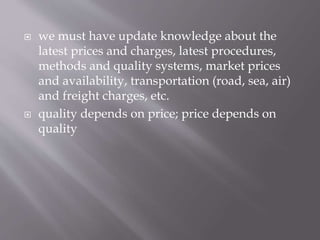
 we must have update knowledge about the
latest prices and charges, latest procedures,
methods and quality systems, market prices
and availability, transportation (road, sea, air)
and freight charges, etc.
 quality depends on price; price depends on
quality
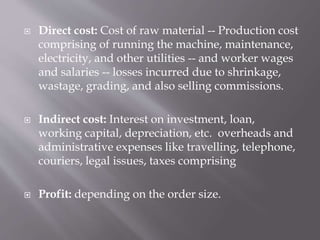
 Direct cost: Cost of raw material -- Production cost
comprising of running the machine, maintenance,
electricity, and other utilities -- and worker wages
and salaries -- losses incurred due to shrinkage,
wastage, grading, and also selling commissions.
 Indirect cost: Interest on investment, loan,
working capital, depreciation, etc. overheads and
administrative expenses like travelling, telephone,
couriers, legal issues, taxes comprising
 Profit: depending on the order size.
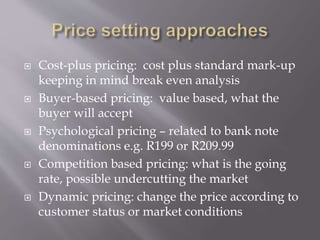
 Cost-plus pricing: cost plus standard mark-up
keeping in mind break even analysis
 Buyer-based pricing: value based, what the
buyer will accept
 Psychological pricing – related to bank note
denominations e.g. R199 or R209.99
 Competition based pricing: what is the going
rate, possible undercutting the market
 Dynamic pricing: change the price according to
customer status or market conditions
There are set patterns and guidelines followed by the industry. It is difficult
to find out costs for every process as there are some inbuilt costs while
costing. A larger picture has been taken into account while quoting the
cost. Costing depends a lot on quantity and order received. Indirect cost
is about 15 - 20%. On top of the cost a profit of 15 - 20% is added. It is not
only the cost of the final product that matters, for exports the cost is
generally given as FAS, FOB, CIF and LDP.
 FAS (Free along Side) means: It is the cost of finished goods plus it
includes the delivery of the goods to port, dock, etc. The price does not
include loading into the ship, etc, or the shipping or any other charges
incurred from that point on.
 FOB (Free on Board): It is the cost of finished goods, cost of delivery of
the goods to port and loading onto the ship, plane, etc. The cost does not
include the shipping or any other costs incurred from that point on.
 CIF (Cost Insurance and Freight): It includes the cost of finished goods
plus it includes the delivery of the goods to the port, loading on the ship,
shipping charges, all applicable insurance fees along the way. The price
does not include going through customs or any duties or other costs
incurred from that point.
 LDP (Landed & Duty Paid): It is the cost of the finished goods, plus it
includes the delivery of the goods to port, loading on the ship, shipping
charges and the goods brought through the customs with all applicable
duties and taxes paid.
 8 working hours per day: 8x5=40hours per
week
 Rate per hour: R25.42
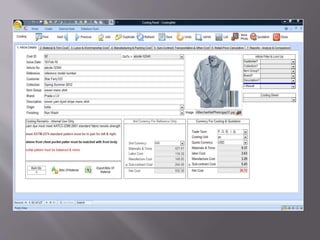
 Design your own costing sheet according to
your product line.
 Transportation cost: Look at AA rates: Cost
per km.
 http://www.aa.co.za/content/63/rates-
calculator/

Costing.pptx

  • 1.
    •cost of productionor of running a business •by allocating expenditure to various stages of production or to different operations of a business
  • 2.
    The first problemfor cost estimation is the total cost allocation of the product. In fact, the total cost has now more indirect cost components, which is a significant share percentage, because all the activities are being done at different places, the actual supply chain is more complex, and this fact has changed the product cost structure.
  • 3.
     accepting orrejecting the sales price is the real key to profit.  challenge is to know the variable cost and margins of an order before order and sales price approved  considering detailed product details lead times, sales costs, detailed manufacturing cost and order quantities.
  • 4.
     Costing isa very complex procedure, with set patterns and guidelines followed by the industry, and it is difficult to find out costs for every process  Garment costing includes all the activities like purchase of raw materials and accessories, knitting fabrics, processing and finishing of fabrics, sewing and packing of garments, transport and conveyance, shipping, over heads, banking charges and commissions, etc.
  • 5.
     To doperfect garment costing, one must know about all these activities thoroughly about their costs, procedures, advantages and risk factors.  Also he must know how to solve the problems when occurred and to take suitable alternate decision immediately in time.  We must be aware that there are always fluctuations in the costs of raw materials and accessories, charges of knitting, processing, finishing, sewing and packing, charges of transport
  • 6.
     we musthave update knowledge about the latest prices and charges, latest procedures, methods and quality systems, market prices and availability, transportation (road, sea, air) and freight charges, etc.  quality depends on price; price depends on quality
  • 7.
     Direct cost:Cost of raw material -- Production cost comprising of running the machine, maintenance, electricity, and other utilities -- and worker wages and salaries -- losses incurred due to shrinkage, wastage, grading, and also selling commissions.  Indirect cost: Interest on investment, loan, working capital, depreciation, etc. overheads and administrative expenses like travelling, telephone, couriers, legal issues, taxes comprising  Profit: depending on the order size.
  • 8.
     Cost-plus pricing:cost plus standard mark-up keeping in mind break even analysis  Buyer-based pricing: value based, what the buyer will accept  Psychological pricing – related to bank note denominations e.g. R199 or R209.99  Competition based pricing: what is the going rate, possible undercutting the market  Dynamic pricing: change the price according to customer status or market conditions
  • 9.
    There are setpatterns and guidelines followed by the industry. It is difficult to find out costs for every process as there are some inbuilt costs while costing. A larger picture has been taken into account while quoting the cost. Costing depends a lot on quantity and order received. Indirect cost is about 15 - 20%. On top of the cost a profit of 15 - 20% is added. It is not only the cost of the final product that matters, for exports the cost is generally given as FAS, FOB, CIF and LDP.  FAS (Free along Side) means: It is the cost of finished goods plus it includes the delivery of the goods to port, dock, etc. The price does not include loading into the ship, etc, or the shipping or any other charges incurred from that point on.  FOB (Free on Board): It is the cost of finished goods, cost of delivery of the goods to port and loading onto the ship, plane, etc. The cost does not include the shipping or any other costs incurred from that point on.  CIF (Cost Insurance and Freight): It includes the cost of finished goods plus it includes the delivery of the goods to the port, loading on the ship, shipping charges, all applicable insurance fees along the way. The price does not include going through customs or any duties or other costs incurred from that point.  LDP (Landed & Duty Paid): It is the cost of the finished goods, plus it includes the delivery of the goods to port, loading on the ship, shipping charges and the goods brought through the customs with all applicable duties and taxes paid.
  • 11.
     8 workinghours per day: 8x5=40hours per week  Rate per hour: R25.42  Design your own costing sheet according to your product line.  Transportation cost: Look at AA rates: Cost per km.  http://www.aa.co.za/content/63/rates- calculator/