Cost-Effectiveness
Arleen A. Leibowitz, Ph.D.
Research Professor
UCLA Luskin School of Public Affairs
Efficacy vs. Effectiveness
• Efficacy –can it work?
“the extent to which interventions achieve health
improvements under ideal circumstances”
• Effectiveness—does it work in the real
world?
“the extent to which interventions achieve health
improvements in real practice settings”
• Cost-Effectiveness – are improvements
worth the additional cost?
Outline
I. Why Use Cost-Effectiveness Analysis?
II. CEA Methods
III. Outcomes
IV. Costs
V. Summary
I. Why Is Cost/Effectiveness
Analysis Used?
• Evaluating new treatment or policy
– How much additional benefit does the new
policy bring?
– Is it worth the added cost?
• Allocating budget over set of projects
– Which set of projects brings greatest benefit for
a given budget?
Why Is This Important?
• Need to consider benefits and costs of new
interventions, procedures
– Not just cost minimization, also consider gains
• Government has budget constraint
– Allocate spending to get the greatest benefit for
given spending
– Be conscious of trade-off. Spending on one
program reduces budget for others
• Document your effect
• Useful tool to advise policy makers
Types of Cost Comparisons
Method Interventions With Measure Summary Measure
Cost-Benefit
Analysis
Outcomes in
different units
(health and non)
Dollars Cost/benefit ratio
Or net benefit
Cost-
Effectiveness
Common Outcomes Health in
common units
Incremental CE
ratio; cost/case
averted
Cost-Utility
Analysis
Morbidity or
mortality outcomes
Quality adjusted
life years
(QALY)
Cost/QALY
Comparative
Effectiveness
(ACA)
Common Outcomes Health in
common units
Outcome
difference (no
cost)
II. How
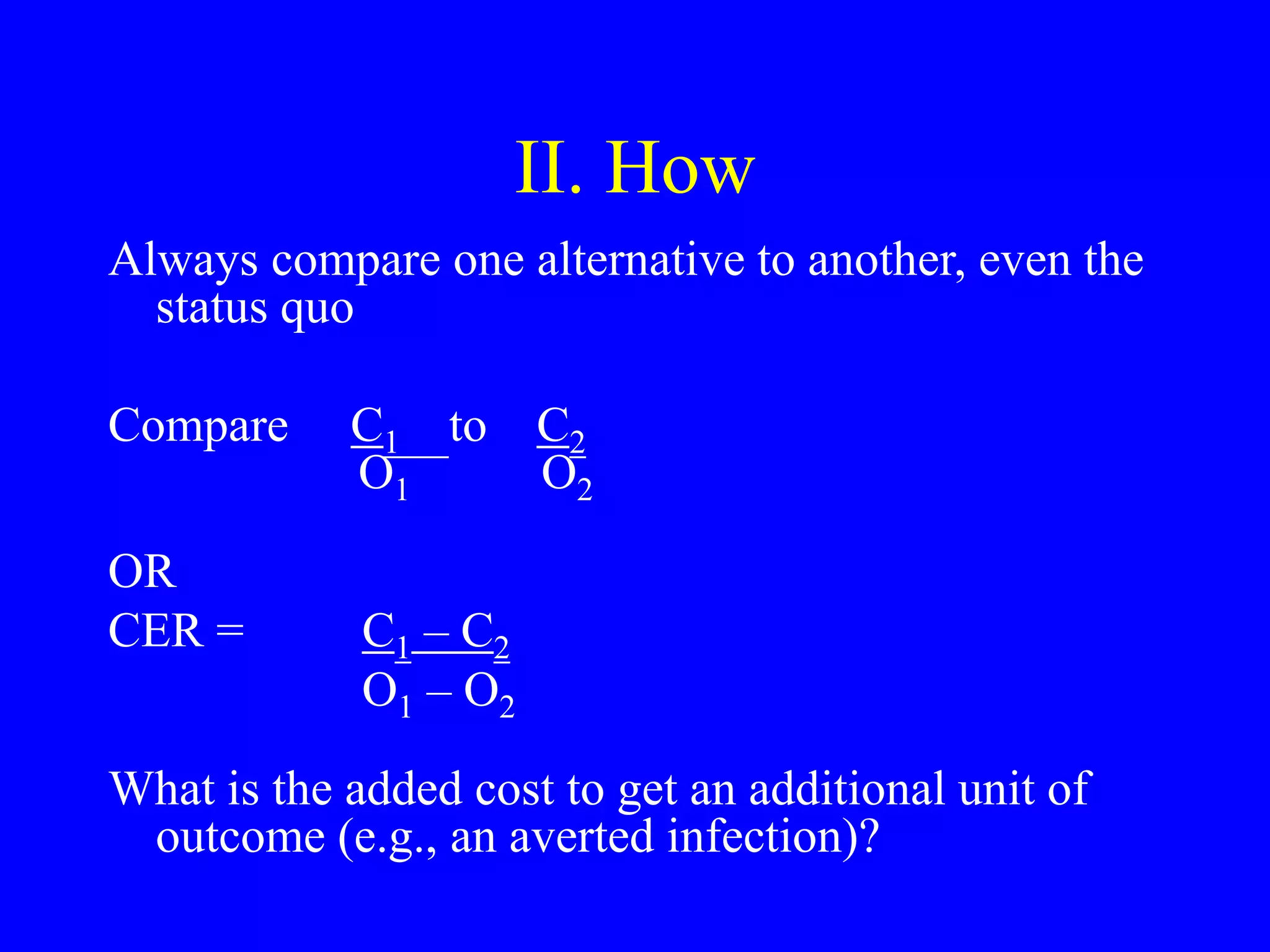
Always compare one alternative to another, even the
status quo
Compare C1 to C2
O1 O2
OR
CER = C1 – C2
O1 – O2
What is the added cost to get an additional unit of
outcome (e.g., an averted infection)?
Identify Alternatives
• “Next best” option is relevant comparison
– Either usual care (status quo)
– Or another widely accepted treatment
– Yet, most drug studies compare to placebo
• Misleading to compare to an inferior
alternative or no intervention at all
• Determine costs/outcomes for each
alternative
III. What is an Outcome?
• CEA Measures Outcomes Directly
– Identification
– HIV infections
– Hospitalization, death
• Proximate outcomes (e.g. risk acts; blood
pressure) can predict long run outcomes
(HIV infections; stroke)
• Proxy outcomes
Examples of HIV Detection
Outcomes
• Number of tests for HIV in 6 month period
– Administrative data
– Some may test more than once
– Proportion returning for test results
• Proportion of people who have gotten VCT
in a 6 month period
– Requires survey of individuals
– Proportion who received their test results
– Response error?
Examples of Prevention Outcomes
• Reported number of risk acts
– Number of unprotected sex acts (anal, vaginal)
– Number of sex partners
– Know serostatus of sex partners?
– Needle sharing
• Condom use or purchase
• Number of other STI
• Predicted number of new HIV infections
Predicting HIV Infection From Data
on Behaviors
a is per act HIV transmission probability
1-a is probability of staying uninfected if one
unprotected sex with HIV+ partner
(1-a)u is monthly probability of no infection
after u unprotected acts over a month, e.g. if
a=.01 and u=4, (1-.01)(1-.01)(1-.01) )(1-.01) =
.96
[1-(1-c)a]p is monthly prob of no infection after p
protected acts with condom efficiency of c
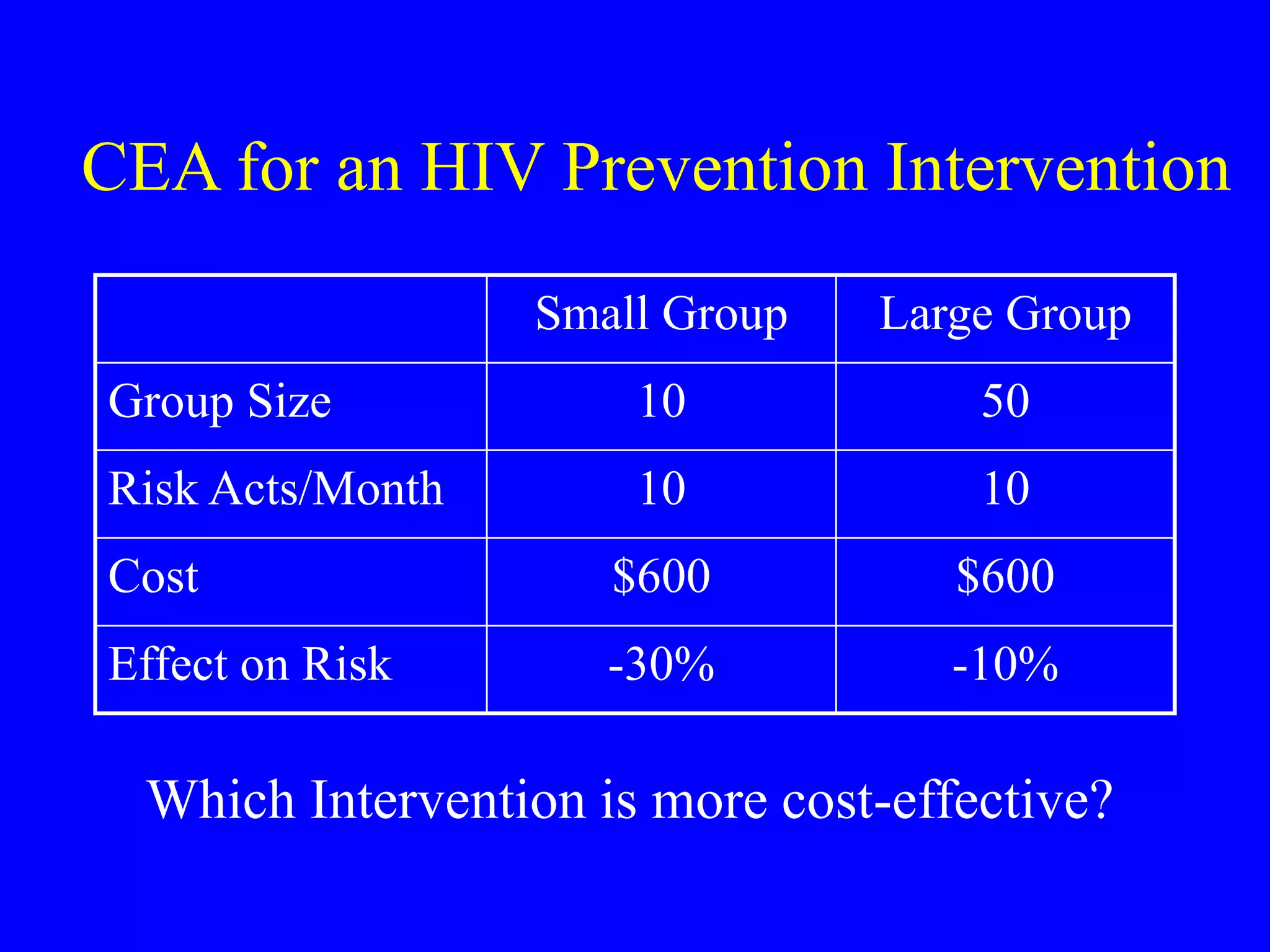
CEA for an HIV Prevention Intervention
Small Group Large Group
Group Size 10 50
Risk Acts/Month 10 10
Cost $600 $600
Effect on Risk -30% -10%
Which Intervention is more cost-effective?
CEA for an HIV Prevention Intervention
Small Group Large Group
Group Size 10 50
Risk Acts/Month 10 10
Cost $600 $600
Effect on Risk -30% -10%
Risk Acts Averted 30 50
Cost/Risk Act
Averted
600/30=$20 600/50=$12
Choose the Large Group
Intervention!!
• Keep goal in mind: reducing total risk acts
• Even though each person in large group
reduces risk acts less
• The same budget can prevent 50 risk acts
instead of 30—costs less/risk act averted
• If you could increase the budget so that
everyone could be in small group, get more
reduction
IV. What Is A Cost?
Direct Costs
- HIV test kits, lab costs, salaries, rent
- Medical prices often used instead of costs
Indirect costs --“Opportunity costs” of person who
could have been doing something else
-Patient
-Staff
Over what time period?
- Discount to present value
What are costs for a prevention intervention?
An Example
Condom Distribution in L.A. Jail
Cost Calculation
• Monthly Costs of Intervention
– Personnel $822
– Condoms $ 36
– Other $103
– Total Direct $961
• Medical care costs saved/HIV infection
averted (discounted)
$ 367,121 in 2009$
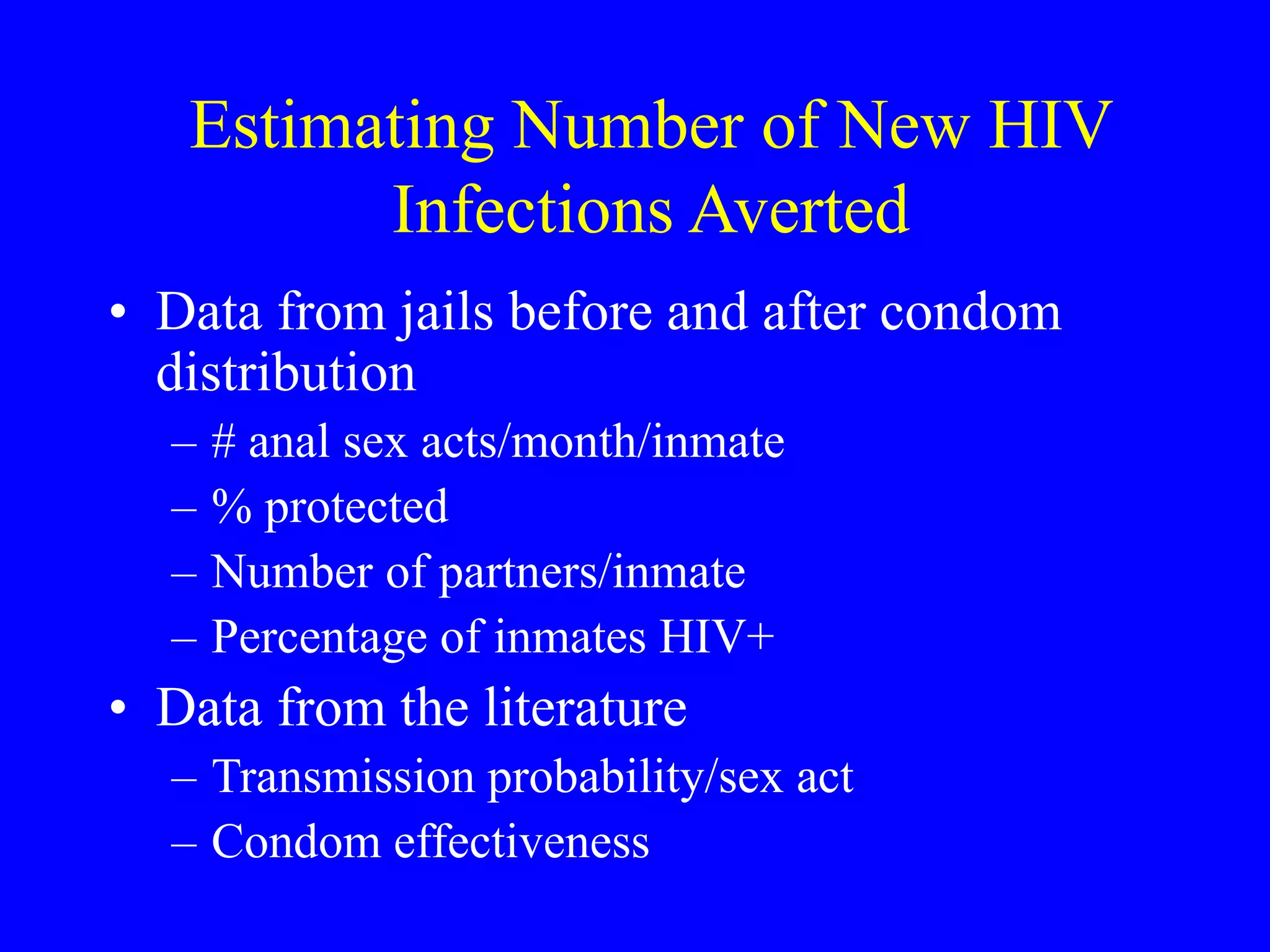
Estimating Number of New HIV
Infections Averted
• Data from jails before and after condom
distribution
– # anal sex acts/month/inmate
– % protected
– Number of partners/inmate
– Percentage of inmates HIV+
• Data from the literature
– Transmission probability/sex act
– Condom effectiveness
CEA for Condom Distribution in
Jails
Condom
Distribution
Status Quo Difference
# of new
infections/mo.
.61 .82 -.21
Cost/month $961 0 $961
Treatment
costs (2009$)
$223,944 $301,039 -$77.095
Net costs $224,905 $301,039 -$76,134
Condom Distribution in LA Jails Is
Cost-Saving
• The discounted cost of distributing condoms
is lower than the medical care costs avoided
because of HIV infections averted
• Monthly discounted costs saved $76,134
• Without counting the transmission to others
or value of lost lives
• Societal costs or costs to jail system?
V. Summary
• Things to Remember about outcomes
• Things to Remember about costs
• Decision Rules
• Using CEA for Policy
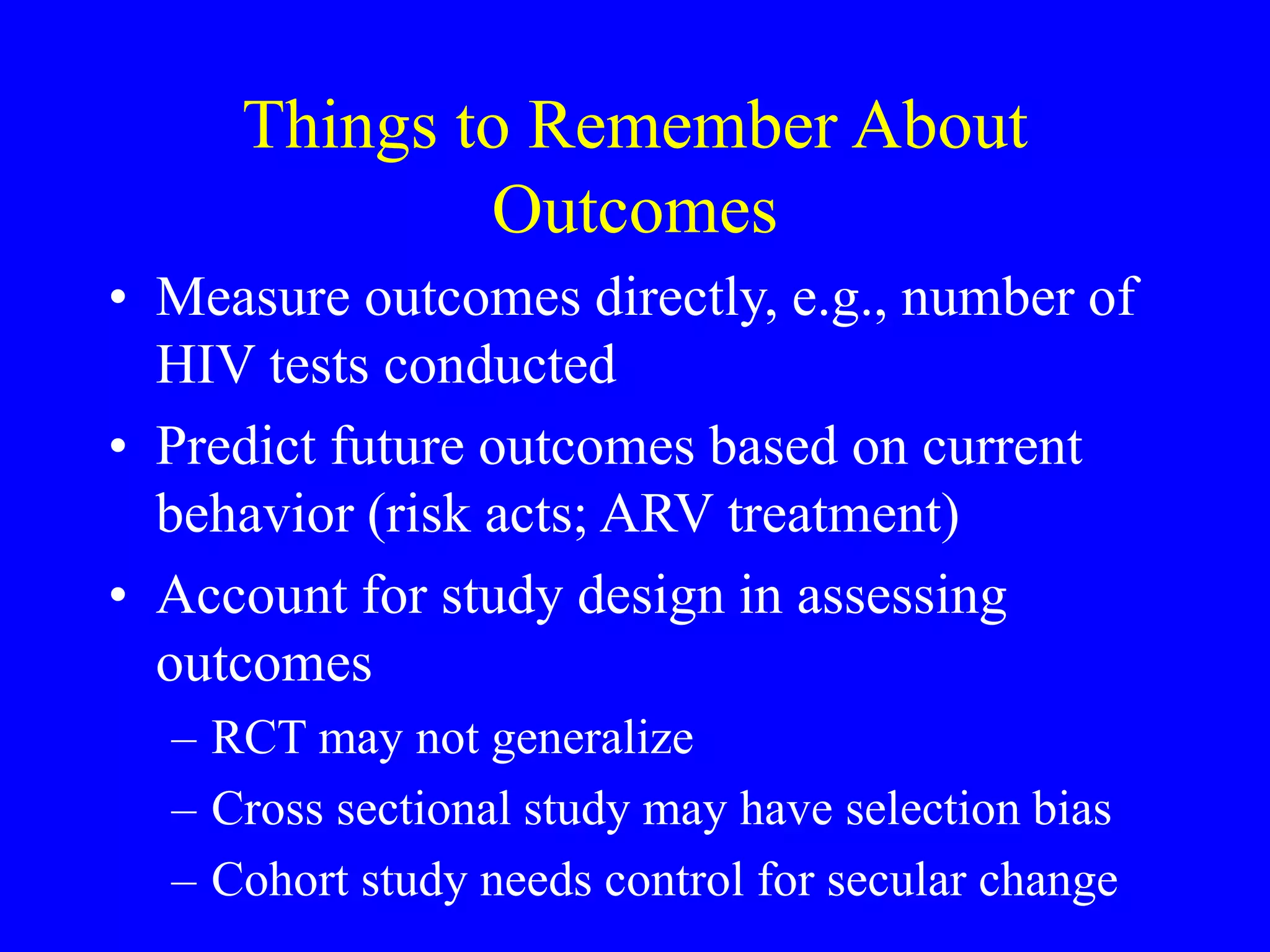
Things to Remember About
Outcomes
• Measure outcomes directly, e.g., number of
HIV tests conducted
• Predict future outcomes based on current
behavior (risk acts; ARV treatment)
• Account for study design in assessing
outcomes
– RCT may not generalize
– Cross sectional study may have selection bias
– Cohort study needs control for secular change
Things to Remember About Costs
• Measure both direct and opportunity costs
• Important to measure all costs—
– Control group may be more difficult
– May need to estimate from utilization data
• Long term costs and benefits
– Costs often occur up front; but benefits later
– Future treatment costs may exceed prevention or
screening costs
– Discount future costs and benefits to present value
• Do not include research study costs
Decision Rules
• Cost-effectiveness is NOT cost-minimization
• If benefits > costs, DO IT!
• If costs > benefits
– Consider cost-effectiveness relative to
alternatives
– Rank options like soccer standings, pick the most
cost-effective
– Money is wasted if not spent on cost-effective
alternative
Rules of Thumb
• Cost-Saving if decrease in total costs with
increased or constant outcomes. Do it!
• US: cost-effective if CE ratio<$100,000
• UK and Australia CE ratio <$50,000
• Developing countries
– Very cost Effective if incremental cost/life year
saved<annual GDP/capita
– Cost-effective if incremental CE/life year saved
<3*annual GDP/capita
(Walensky RP et al. NEJM Oct 31,2012; 369(18):1715-25)
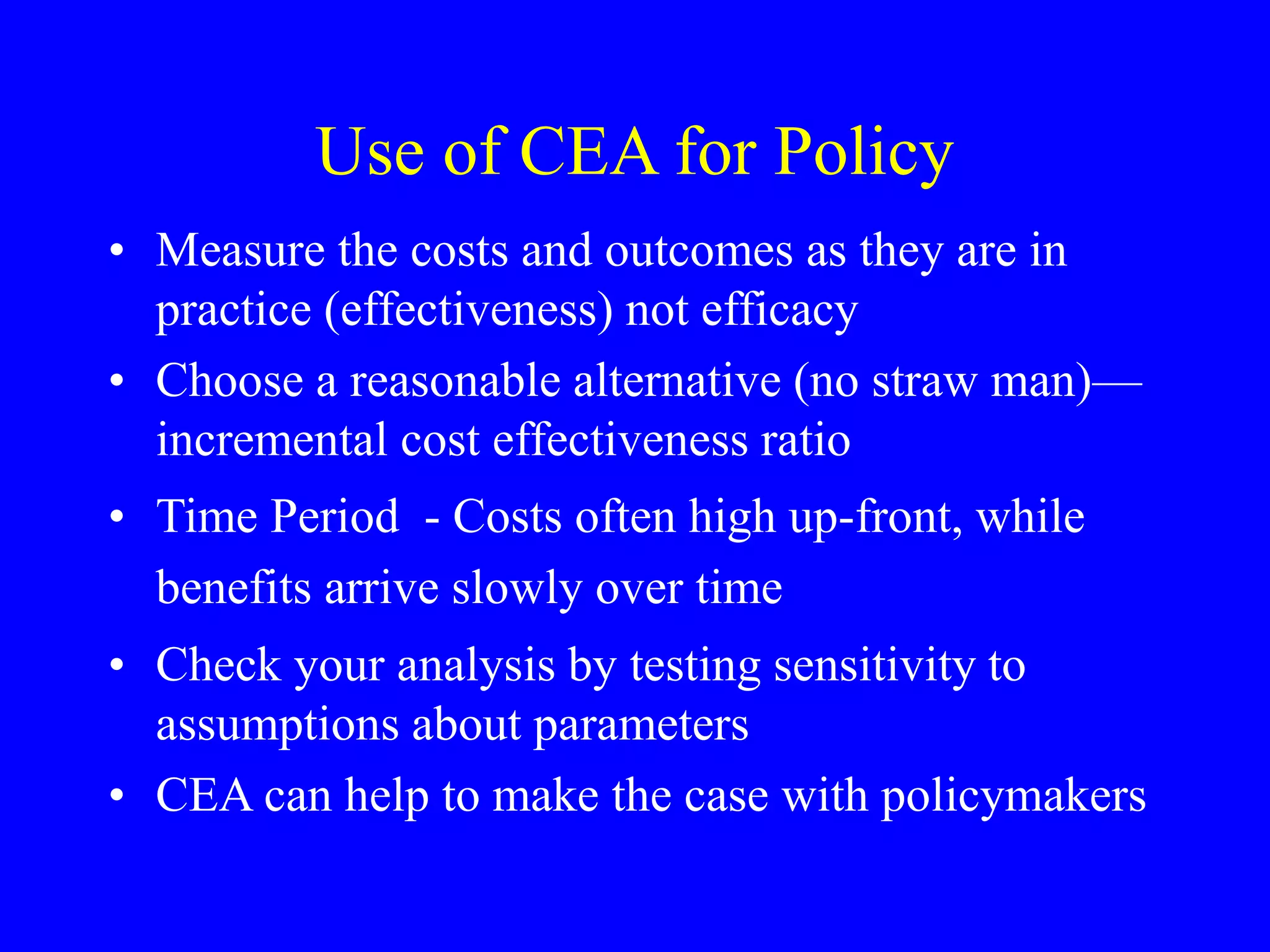
Use of CEA for Policy
• Measure the costs and outcomes as they are in
practice (effectiveness) not efficacy
• Choose a reasonable alternative (no straw man)—
incremental cost effectiveness ratio
• Time Period - Costs often high up-front, while
benefits arrive slowly over time
• Check your analysis by testing sensitivity to
assumptions about parameters
• CEA can help to make the case with policymakers
Additional Resources
Marthe R. Gold, et al. Cost-Effectiveness in Health
and Medicine. New York: Oxford University Press,
1996.
http://www.cdc.gov/owcd/EET/CostEffect2/1.html
http://www.popcouncil.org/horizons/projects/Global_
GOALSModel.htm
http://www.popline.org/docs/1605/283548.html
http://www.treeage.com/products/download.html
http://www.tufts-nemc.org/cearegistry
http://www.academyhealth.org/hsrproj
Cost-utility Analysis
Cost-utility:
– Effectiveness measured as quality-adjusted life
years
CU = Incremental Costs
QALYs
What is the cost per quality-adjusted life year?
Health Related Quality of Life
(HRQL)
QALYs are number of years lived, weighted by
HRQL scores in each time period
– e.g., QALYs = 5, whether you live 10 years with
HRQL= .5, or 5 years with HRQL = 1
Utility can be measured by:
time trade-off
standard gamble
Study Designs
Randomized controlled trials – measure efficacy
– Assures identical populations, the “gold standard”
– Strong internal validity
– Non-random attrition can lead to selection bias
– “Intent-to-treat” rather than “as-treated”
– Inclusion and exclusion criteria => lack of
generalizability
– High cost => small sample sizes => low power
– Short followup periods
Observational Study Designs to
Measure Effectiveness
Cross-sectional
– Selection bias
Cohort - Pre/post with no comparison group
– Regression to the mean/natural disease course
– Secular changes that affect outcome
Quasi-experimental (“difference-in-differences”)
– Pre/post comparison of x-sectional differences
– Still biased if time trends aren’t similar

2014_Mar_Leibowitz (2).ppt

  • 1.
    Cost-Effectiveness Arleen A. Leibowitz,Ph.D. Research Professor UCLA Luskin School of Public Affairs
  • 2.
    Efficacy vs. Effectiveness •Efficacy –can it work? “the extent to which interventions achieve health improvements under ideal circumstances” • Effectiveness—does it work in the real world? “the extent to which interventions achieve health improvements in real practice settings” • Cost-Effectiveness – are improvements worth the additional cost?
  • 3.
    Outline I. Why UseCost-Effectiveness Analysis? II. CEA Methods III. Outcomes IV. Costs V. Summary
  • 4.
    I. Why IsCost/Effectiveness Analysis Used? • Evaluating new treatment or policy – How much additional benefit does the new policy bring? – Is it worth the added cost? • Allocating budget over set of projects – Which set of projects brings greatest benefit for a given budget?
  • 5.
    Why Is ThisImportant? • Need to consider benefits and costs of new interventions, procedures – Not just cost minimization, also consider gains • Government has budget constraint – Allocate spending to get the greatest benefit for given spending – Be conscious of trade-off. Spending on one program reduces budget for others • Document your effect • Useful tool to advise policy makers
  • 6.
    Types of CostComparisons Method Interventions With Measure Summary Measure Cost-Benefit Analysis Outcomes in different units (health and non) Dollars Cost/benefit ratio Or net benefit Cost- Effectiveness Common Outcomes Health in common units Incremental CE ratio; cost/case averted Cost-Utility Analysis Morbidity or mortality outcomes Quality adjusted life years (QALY) Cost/QALY Comparative Effectiveness (ACA) Common Outcomes Health in common units Outcome difference (no cost)
  • 7.
    II. How Always compareone alternative to another, even the status quo Compare C1 to C2 O1 O2 OR CER = C1 – C2 O1 – O2 What is the added cost to get an additional unit of outcome (e.g., an averted infection)?
  • 8.
    Identify Alternatives • “Nextbest” option is relevant comparison – Either usual care (status quo) – Or another widely accepted treatment – Yet, most drug studies compare to placebo • Misleading to compare to an inferior alternative or no intervention at all • Determine costs/outcomes for each alternative
  • 9.
    III. What isan Outcome? • CEA Measures Outcomes Directly – Identification – HIV infections – Hospitalization, death • Proximate outcomes (e.g. risk acts; blood pressure) can predict long run outcomes (HIV infections; stroke) • Proxy outcomes
  • 10.
    Examples of HIVDetection Outcomes • Number of tests for HIV in 6 month period – Administrative data – Some may test more than once – Proportion returning for test results • Proportion of people who have gotten VCT in a 6 month period – Requires survey of individuals – Proportion who received their test results – Response error?
  • 11.
    Examples of PreventionOutcomes • Reported number of risk acts – Number of unprotected sex acts (anal, vaginal) – Number of sex partners – Know serostatus of sex partners? – Needle sharing • Condom use or purchase • Number of other STI • Predicted number of new HIV infections
  • 12.
    Predicting HIV InfectionFrom Data on Behaviors a is per act HIV transmission probability 1-a is probability of staying uninfected if one unprotected sex with HIV+ partner (1-a)u is monthly probability of no infection after u unprotected acts over a month, e.g. if a=.01 and u=4, (1-.01)(1-.01)(1-.01) )(1-.01) = .96 [1-(1-c)a]p is monthly prob of no infection after p protected acts with condom efficiency of c
  • 13.
    CEA for anHIV Prevention Intervention Small Group Large Group Group Size 10 50 Risk Acts/Month 10 10 Cost $600 $600 Effect on Risk -30% -10% Which Intervention is more cost-effective?
  • 14.
    CEA for anHIV Prevention Intervention Small Group Large Group Group Size 10 50 Risk Acts/Month 10 10 Cost $600 $600 Effect on Risk -30% -10% Risk Acts Averted 30 50 Cost/Risk Act Averted 600/30=$20 600/50=$12
  • 15.
    Choose the LargeGroup Intervention!! • Keep goal in mind: reducing total risk acts • Even though each person in large group reduces risk acts less • The same budget can prevent 50 risk acts instead of 30—costs less/risk act averted • If you could increase the budget so that everyone could be in small group, get more reduction
  • 16.
    IV. What IsA Cost? Direct Costs - HIV test kits, lab costs, salaries, rent - Medical prices often used instead of costs Indirect costs --“Opportunity costs” of person who could have been doing something else -Patient -Staff Over what time period? - Discount to present value What are costs for a prevention intervention?
  • 17.
  • 18.
    Cost Calculation • MonthlyCosts of Intervention – Personnel $822 – Condoms $ 36 – Other $103 – Total Direct $961 • Medical care costs saved/HIV infection averted (discounted) $ 367,121 in 2009$
  • 19.
    Estimating Number ofNew HIV Infections Averted • Data from jails before and after condom distribution – # anal sex acts/month/inmate – % protected – Number of partners/inmate – Percentage of inmates HIV+ • Data from the literature – Transmission probability/sex act – Condom effectiveness
  • 20.
    CEA for CondomDistribution in Jails Condom Distribution Status Quo Difference # of new infections/mo. .61 .82 -.21 Cost/month $961 0 $961 Treatment costs (2009$) $223,944 $301,039 -$77.095 Net costs $224,905 $301,039 -$76,134
  • 21.
    Condom Distribution inLA Jails Is Cost-Saving • The discounted cost of distributing condoms is lower than the medical care costs avoided because of HIV infections averted • Monthly discounted costs saved $76,134 • Without counting the transmission to others or value of lost lives • Societal costs or costs to jail system?
  • 22.
    V. Summary • Thingsto Remember about outcomes • Things to Remember about costs • Decision Rules • Using CEA for Policy
  • 23.
    Things to RememberAbout Outcomes • Measure outcomes directly, e.g., number of HIV tests conducted • Predict future outcomes based on current behavior (risk acts; ARV treatment) • Account for study design in assessing outcomes – RCT may not generalize – Cross sectional study may have selection bias – Cohort study needs control for secular change
  • 24.
    Things to RememberAbout Costs • Measure both direct and opportunity costs • Important to measure all costs— – Control group may be more difficult – May need to estimate from utilization data • Long term costs and benefits – Costs often occur up front; but benefits later – Future treatment costs may exceed prevention or screening costs – Discount future costs and benefits to present value • Do not include research study costs
  • 25.
    Decision Rules • Cost-effectivenessis NOT cost-minimization • If benefits > costs, DO IT! • If costs > benefits – Consider cost-effectiveness relative to alternatives – Rank options like soccer standings, pick the most cost-effective – Money is wasted if not spent on cost-effective alternative
  • 26.
    Rules of Thumb •Cost-Saving if decrease in total costs with increased or constant outcomes. Do it! • US: cost-effective if CE ratio<$100,000 • UK and Australia CE ratio <$50,000 • Developing countries – Very cost Effective if incremental cost/life year saved<annual GDP/capita – Cost-effective if incremental CE/life year saved <3*annual GDP/capita (Walensky RP et al. NEJM Oct 31,2012; 369(18):1715-25)
  • 27.
    Use of CEAfor Policy • Measure the costs and outcomes as they are in practice (effectiveness) not efficacy • Choose a reasonable alternative (no straw man)— incremental cost effectiveness ratio • Time Period - Costs often high up-front, while benefits arrive slowly over time • Check your analysis by testing sensitivity to assumptions about parameters • CEA can help to make the case with policymakers
  • 28.
    Additional Resources Marthe R.Gold, et al. Cost-Effectiveness in Health and Medicine. New York: Oxford University Press, 1996. http://www.cdc.gov/owcd/EET/CostEffect2/1.html http://www.popcouncil.org/horizons/projects/Global_ GOALSModel.htm http://www.popline.org/docs/1605/283548.html http://www.treeage.com/products/download.html http://www.tufts-nemc.org/cearegistry http://www.academyhealth.org/hsrproj
  • 29.
    Cost-utility Analysis Cost-utility: – Effectivenessmeasured as quality-adjusted life years CU = Incremental Costs QALYs What is the cost per quality-adjusted life year?
  • 30.
    Health Related Qualityof Life (HRQL) QALYs are number of years lived, weighted by HRQL scores in each time period – e.g., QALYs = 5, whether you live 10 years with HRQL= .5, or 5 years with HRQL = 1 Utility can be measured by: time trade-off standard gamble
  • 31.
    Study Designs Randomized controlledtrials – measure efficacy – Assures identical populations, the “gold standard” – Strong internal validity – Non-random attrition can lead to selection bias – “Intent-to-treat” rather than “as-treated” – Inclusion and exclusion criteria => lack of generalizability – High cost => small sample sizes => low power – Short followup periods
  • 32.
    Observational Study Designsto Measure Effectiveness Cross-sectional – Selection bias Cohort - Pre/post with no comparison group – Regression to the mean/natural disease course – Secular changes that affect outcome Quasi-experimental (“difference-in-differences”) – Pre/post comparison of x-sectional differences – Still biased if time trends aren’t similar