Bases of classifying the costs
1. Components classified under production and service
cost
2. Direct and Indirect costs
3. Classification of the cost based on the behavior
4. Cost classification for decision making
 Relevant and Irrelevant costs
 Avoidable and Unavoidable costs
Manufacturing organizations purchase raw materials from
suppliers and convert these materials into tangible products
through the use of labour and capital inputs (e.g. plant and
machinery).
 Cost of material
 Cost of labour
 Other costs
 Costs that are assigned to cost objects can be divided into two
broad categories as
 Direct cost
 Indirect costs
 Both categories can be further divided into direct and indirect
materials and direct and indirect labor costs and direct and indirect
other costs.
 The costs that can be specifically and exclusively identified with a
particular cost object
 Direct materials become part of a physical product
 Example: wood used in the manufacture of different types of
furniture can be directly identified with each specific type of
furniture such as chairs, tables and bookcases.
 The costs that can be specifically and exclusively identified with a
particular cost object
 The direct labor cost in producing a product includes the cost of
converting the raw materials into a product.
 Example: The machine operatives engaged in the production
process in the manufacture of televisions.
 Indirect costs cannot be identified specifically and exclusively with
a given cost object.
 They consist of indirect labour, materials and expenses. In a
manufacturing organization, the wages of all employees whose
time cannot be identified with a specific product, represent
indirect labour costs.
 Examples :
◦ Labour cost of staff employed in the maintenance and repair of production
equipment and staff employed in the stores department.
◦ The cost of materials used to repair machinery cannot be identified with a
specific product and can therefore be classified as indirect material costs.
 The term overheads is widely used instead of indirect costs.
 Overhead costs are categorized as,
1. Manufacturing (all the costs of manufacturing apart from direct
labour, material and other costs)
2. Administration (all costs associated with the general
administration of the organization. Eg. top executive salaries,
general accounting, secretarial, and research and development
costs)
3. Selling and distribution overheads / order-getting and order-
filling costs (costs that are necessary to market and distribute a
product or service are categorized as selling and distribution
costs. Examples; advertising, sales personnel
salaries/commissions, warehousing and delivery transportation
costs)
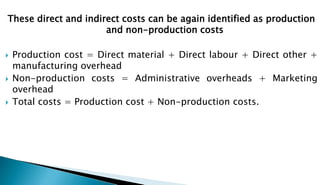
These direct and indirect costs can be again identified as production
and non-production costs
 Production cost = Direct material + Direct labour + Direct other +
manufacturing overhead
 Non-production costs = Administrative overheads + Marketing
overhead
 Total costs = Production cost + Non-production costs.
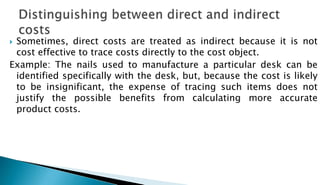
 Sometimes, direct costs are treated as indirect because it is not
cost effective to trace costs directly to the cost object.
Example: The nails used to manufacture a particular desk can be
identified specifically with the desk, but, because the cost is likely
to be insignificant, the expense of tracing such items does not
justify the possible benefits from calculating more accurate
product costs.
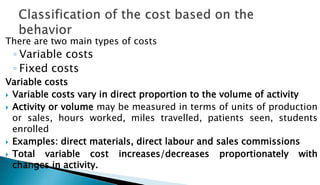
There are two main types of costs
◦ Variable costs
◦ Fixed costs
Variable costs
 Variable costs vary in direct proportion to the volume of activity
 Activity or volume may be measured in terms of units of production
or sales, hours worked, miles travelled, patients seen, students
enrolled
 Examples: direct materials, direct labour and sales commissions
 Total variable cost increases/decreases proportionately with
changes in activity.
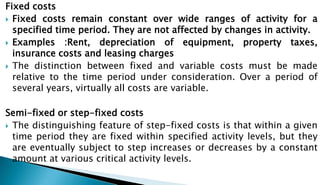
Fixed costs
 Fixed costs remain constant over wide ranges of activity for a
specified time period. They are not affected by changes in activity.
 Examples :Rent, depreciation of equipment, property taxes,
insurance costs and leasing charges
 The distinction between fixed and variable costs must be made
relative to the time period under consideration. Over a period of
several years, virtually all costs are variable.
Semi-fixed or step-fixed costs
 The distinguishing feature of step-fixed costs is that within a given
time period they are fixed within specified activity levels, but they
are eventually subject to step increases or decreases by a constant
amount at various critical activity levels.
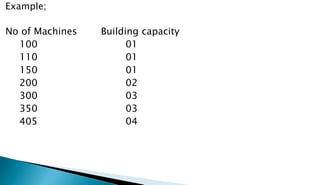
Example;
No of Machines Building capacity
100 01
110 01
150 01
200 02
300 03
350 03
405 04
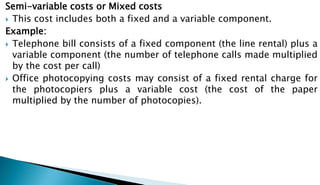
Semi-variable costs or Mixed costs
 This cost includes both a fixed and a variable component.
Example:
 Telephone bill consists of a fixed component (the line rental) plus a
variable component (the number of telephone calls made multiplied
by the cost per call)
 Office photocopying costs may consist of a fixed rental charge for
the photocopiers plus a variable cost (the cost of the paper
multiplied by the number of photocopies).
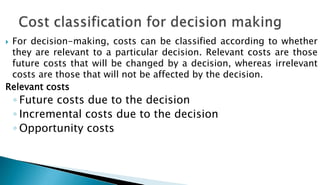
 For decision-making, costs can be classified according to whether
they are relevant to a particular decision. Relevant costs are those
future costs that will be changed by a decision, whereas irrelevant
costs are those that will not be affected by the decision.
Relevant costs
◦ Future costs due to the decision
◦ Incremental costs due to the decision
◦ Opportunity costs
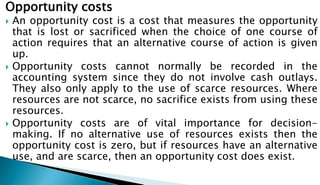
Opportunity costs
 An opportunity cost is a cost that measures the opportunity
that is lost or sacrificed when the choice of one course of
action requires that an alternative course of action is given
up.
 Opportunity costs cannot normally be recorded in the
accounting system since they do not involve cash outlays.
They also only apply to the use of scarce resources. Where
resources are not scarce, no sacrifice exists from using these
resources.
 Opportunity costs are of vital importance for decision-
making. If no alternative use of resources exists then the
opportunity cost is zero, but if resources have an alternative
use, and are scarce, then an opportunity cost does exist.
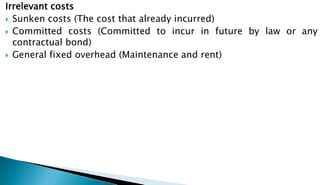
Irrelevant costs
 Sunken costs (The cost that already incurred)
 Committed costs (Committed to incur in future by law or any
contractual bond)
 General fixed overhead (Maintenance and rent)
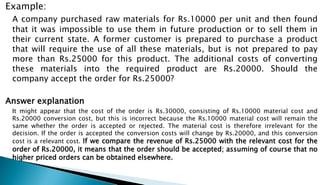
Example:
A company purchased raw materials for Rs.10000 per unit and then found
that it was impossible to use them in future production or to sell them in
their current state. A former customer is prepared to purchase a product
that will require the use of all these materials, but is not prepared to pay
more than Rs.25000 for this product. The additional costs of converting
these materials into the required product are Rs.20000. Should the
company accept the order for Rs.25000?
Answer explanation
It might appear that the cost of the order is Rs.30000, consisting of Rs.10000 material cost and
Rs.20000 conversion cost, but this is incorrect because the Rs.10000 material cost will remain the
same whether the order is accepted or rejected. The material cost is therefore irrelevant for the
decision. If the order is accepted the conversion costs will change by Rs.20000, and this conversion
cost is a relevant cost. If we compare the revenue of Rs.25000 with the relevant cost for the
order of Rs.20000, it means that the order should be accepted; assuming of course that no
higher priced orders can be obtained elsewhere.
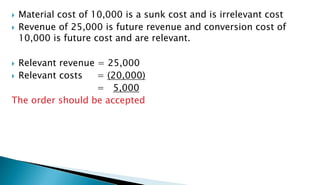
 Material cost of 10,000 is a sunk cost and is irrelevant cost
 Revenue of 25,000 is future revenue and conversion cost of
10,000 is future cost and are relevant.
 Relevant revenue = 25,000
 Relevant costs = (20,000)
= 5,000
The order should be accepted
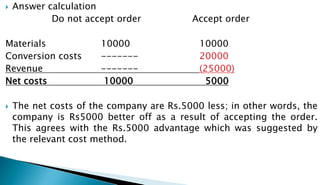
 Answer calculation
Do not accept order Accept order
Materials 10000 10000
Conversion costs ------- 20000
Revenue ------- (25000)
Net costs 10000 5000
 The net costs of the company are Rs.5000 less; in other words, the
company is Rs5000 better off as a result of accepting the order.
This agrees with the Rs.5000 advantage which was suggested by
the relevant cost method.
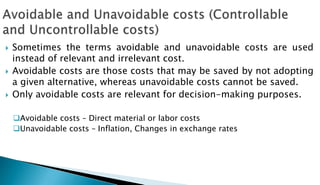
 Sometimes the terms avoidable and unavoidable costs are used
instead of relevant and irrelevant cost.
 Avoidable costs are those costs that may be saved by not adopting
a given alternative, whereas unavoidable costs cannot be saved.
 Only avoidable costs are relevant for decision-making purposes.
Avoidable costs – Direct material or labor costs
Unavoidable costs – Inflation, Changes in exchange rates
Thank you

Cost Classification in Management Accountingx

  • 2.
    Bases of classifyingthe costs 1. Components classified under production and service cost 2. Direct and Indirect costs 3. Classification of the cost based on the behavior 4. Cost classification for decision making  Relevant and Irrelevant costs  Avoidable and Unavoidable costs
  • 3.
    Manufacturing organizations purchaseraw materials from suppliers and convert these materials into tangible products through the use of labour and capital inputs (e.g. plant and machinery).  Cost of material  Cost of labour  Other costs
  • 4.
     Costs thatare assigned to cost objects can be divided into two broad categories as  Direct cost  Indirect costs  Both categories can be further divided into direct and indirect materials and direct and indirect labor costs and direct and indirect other costs.
  • 5.
     The coststhat can be specifically and exclusively identified with a particular cost object  Direct materials become part of a physical product  Example: wood used in the manufacture of different types of furniture can be directly identified with each specific type of furniture such as chairs, tables and bookcases.
  • 6.
     The coststhat can be specifically and exclusively identified with a particular cost object  The direct labor cost in producing a product includes the cost of converting the raw materials into a product.  Example: The machine operatives engaged in the production process in the manufacture of televisions.
  • 7.
     Indirect costscannot be identified specifically and exclusively with a given cost object.  They consist of indirect labour, materials and expenses. In a manufacturing organization, the wages of all employees whose time cannot be identified with a specific product, represent indirect labour costs.  Examples : ◦ Labour cost of staff employed in the maintenance and repair of production equipment and staff employed in the stores department. ◦ The cost of materials used to repair machinery cannot be identified with a specific product and can therefore be classified as indirect material costs.  The term overheads is widely used instead of indirect costs.
  • 8.
     Overhead costsare categorized as, 1. Manufacturing (all the costs of manufacturing apart from direct labour, material and other costs) 2. Administration (all costs associated with the general administration of the organization. Eg. top executive salaries, general accounting, secretarial, and research and development costs) 3. Selling and distribution overheads / order-getting and order- filling costs (costs that are necessary to market and distribute a product or service are categorized as selling and distribution costs. Examples; advertising, sales personnel salaries/commissions, warehousing and delivery transportation costs)
  • 9.
    These direct andindirect costs can be again identified as production and non-production costs  Production cost = Direct material + Direct labour + Direct other + manufacturing overhead  Non-production costs = Administrative overheads + Marketing overhead  Total costs = Production cost + Non-production costs.
  • 10.
     Sometimes, directcosts are treated as indirect because it is not cost effective to trace costs directly to the cost object. Example: The nails used to manufacture a particular desk can be identified specifically with the desk, but, because the cost is likely to be insignificant, the expense of tracing such items does not justify the possible benefits from calculating more accurate product costs.
  • 11.
    There are twomain types of costs ◦ Variable costs ◦ Fixed costs Variable costs  Variable costs vary in direct proportion to the volume of activity  Activity or volume may be measured in terms of units of production or sales, hours worked, miles travelled, patients seen, students enrolled  Examples: direct materials, direct labour and sales commissions  Total variable cost increases/decreases proportionately with changes in activity.
  • 12.
    Fixed costs  Fixedcosts remain constant over wide ranges of activity for a specified time period. They are not affected by changes in activity.  Examples :Rent, depreciation of equipment, property taxes, insurance costs and leasing charges  The distinction between fixed and variable costs must be made relative to the time period under consideration. Over a period of several years, virtually all costs are variable. Semi-fixed or step-fixed costs  The distinguishing feature of step-fixed costs is that within a given time period they are fixed within specified activity levels, but they are eventually subject to step increases or decreases by a constant amount at various critical activity levels.
  • 13.
    Example; No of MachinesBuilding capacity 100 01 110 01 150 01 200 02 300 03 350 03 405 04
  • 14.
    Semi-variable costs orMixed costs  This cost includes both a fixed and a variable component. Example:  Telephone bill consists of a fixed component (the line rental) plus a variable component (the number of telephone calls made multiplied by the cost per call)  Office photocopying costs may consist of a fixed rental charge for the photocopiers plus a variable cost (the cost of the paper multiplied by the number of photocopies).
  • 15.
     For decision-making,costs can be classified according to whether they are relevant to a particular decision. Relevant costs are those future costs that will be changed by a decision, whereas irrelevant costs are those that will not be affected by the decision. Relevant costs ◦ Future costs due to the decision ◦ Incremental costs due to the decision ◦ Opportunity costs
  • 16.
    Opportunity costs  Anopportunity cost is a cost that measures the opportunity that is lost or sacrificed when the choice of one course of action requires that an alternative course of action is given up.  Opportunity costs cannot normally be recorded in the accounting system since they do not involve cash outlays. They also only apply to the use of scarce resources. Where resources are not scarce, no sacrifice exists from using these resources.  Opportunity costs are of vital importance for decision- making. If no alternative use of resources exists then the opportunity cost is zero, but if resources have an alternative use, and are scarce, then an opportunity cost does exist.
  • 17.
    Irrelevant costs  Sunkencosts (The cost that already incurred)  Committed costs (Committed to incur in future by law or any contractual bond)  General fixed overhead (Maintenance and rent)
  • 18.
    Example: A company purchasedraw materials for Rs.10000 per unit and then found that it was impossible to use them in future production or to sell them in their current state. A former customer is prepared to purchase a product that will require the use of all these materials, but is not prepared to pay more than Rs.25000 for this product. The additional costs of converting these materials into the required product are Rs.20000. Should the company accept the order for Rs.25000? Answer explanation It might appear that the cost of the order is Rs.30000, consisting of Rs.10000 material cost and Rs.20000 conversion cost, but this is incorrect because the Rs.10000 material cost will remain the same whether the order is accepted or rejected. The material cost is therefore irrelevant for the decision. If the order is accepted the conversion costs will change by Rs.20000, and this conversion cost is a relevant cost. If we compare the revenue of Rs.25000 with the relevant cost for the order of Rs.20000, it means that the order should be accepted; assuming of course that no higher priced orders can be obtained elsewhere.
  • 19.
     Material costof 10,000 is a sunk cost and is irrelevant cost  Revenue of 25,000 is future revenue and conversion cost of 10,000 is future cost and are relevant.  Relevant revenue = 25,000  Relevant costs = (20,000) = 5,000 The order should be accepted
  • 20.
     Answer calculation Donot accept order Accept order Materials 10000 10000 Conversion costs ------- 20000 Revenue ------- (25000) Net costs 10000 5000  The net costs of the company are Rs.5000 less; in other words, the company is Rs5000 better off as a result of accepting the order. This agrees with the Rs.5000 advantage which was suggested by the relevant cost method.
  • 21.
     Sometimes theterms avoidable and unavoidable costs are used instead of relevant and irrelevant cost.  Avoidable costs are those costs that may be saved by not adopting a given alternative, whereas unavoidable costs cannot be saved.  Only avoidable costs are relevant for decision-making purposes. Avoidable costs – Direct material or labor costs Unavoidable costs – Inflation, Changes in exchange rates
  • 22.