C L A S S I F I C A T I O N O F
C O S T F O R M A N A G E M E N T
ROLL NO. UID NAME
203 22BCM328 DAKSH PATEL
204 22BCM329 PRATHAM PATEL
205 22BCM330 TWISHA PATEL
206 22BCM332 DIKSHA PATEL
207 22BCM333 KIRAN PATIL
208 22BCM335 SUDEEPITA PATNAIK
209 22BCM336 MARIA PATRAWALA
210 22BCM339 OM PAWAR
211 22BCM341 SIONA PEREIRA
212 22BCM342 ANAGHA PILLAI
213 22BCM345 TEJAS PODDAR
214 22BCM347 OM PRAJAPATI
215 22BCM350 KRISH PUROHIT
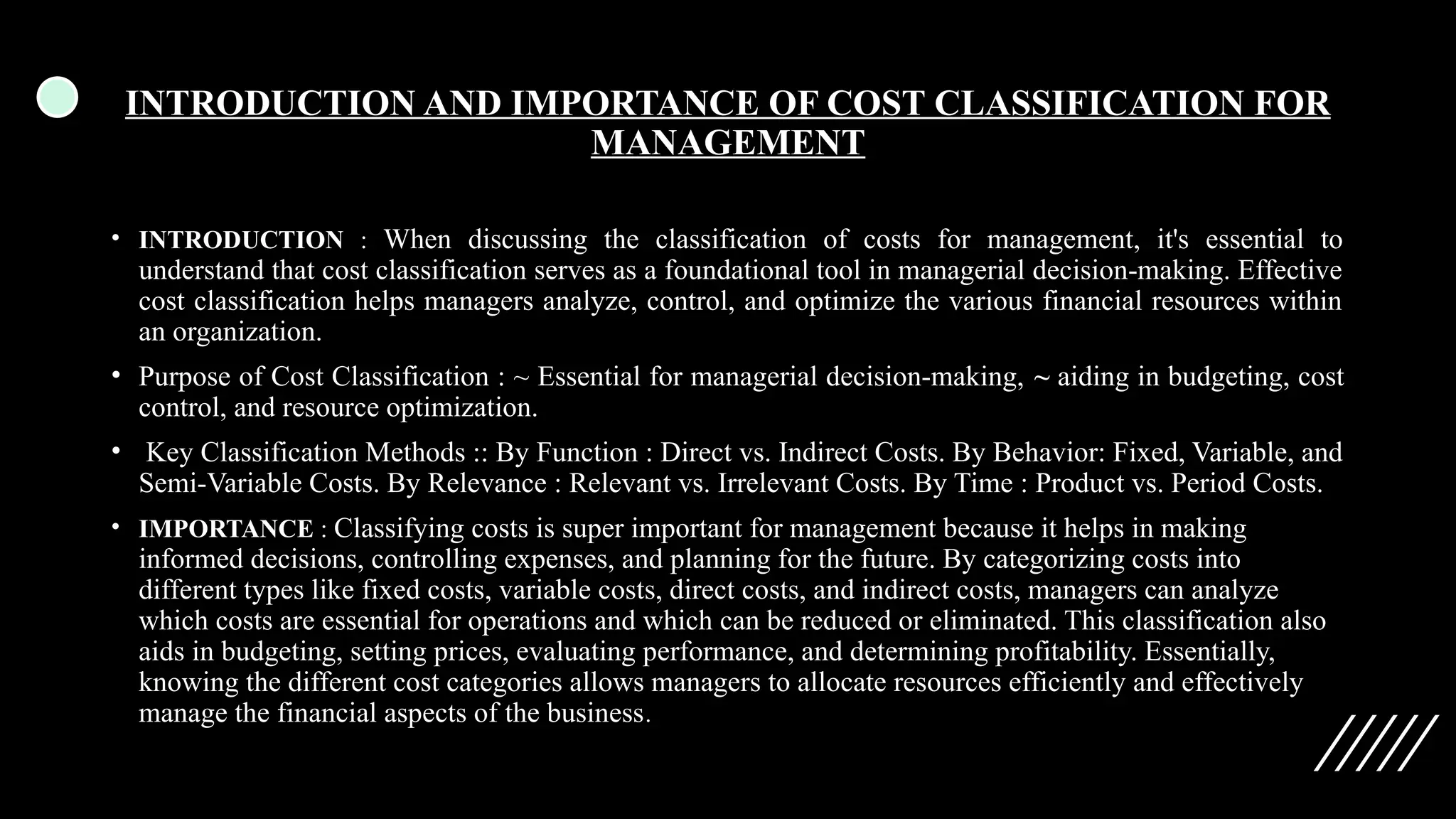
INTRODUCTION AND IMPORTANCE OF COST CLASSIFICATION FOR
MANAGEMENT
• INTRODUCTION : When discussing the classification of costs for management, it's essential to
understand that cost classification serves as a foundational tool in managerial decision-making. Effective
cost classification helps managers analyze, control, and optimize the various financial resources within
an organization.
• Purpose of Cost Classification : ~ Essential for managerial decision-making, ~ aiding in budgeting, cost
control, and resource optimization.
• Key Classification Methods :: By Function : Direct vs. Indirect Costs. By Behavior: Fixed, Variable, and
Semi-Variable Costs. By Relevance : Relevant vs. Irrelevant Costs. By Time : Product vs. Period Costs.
• IMPORTANCE : Classifying costs is super important for management because it helps in making
informed decisions, controlling expenses, and planning for the future. By categorizing costs into
different types like fixed costs, variable costs, direct costs, and indirect costs, managers can analyze
which costs are essential for operations and which can be reduced or eliminated. This classification also
aids in budgeting, setting prices, evaluating performance, and determining profitability. Essentially,
knowing the different cost categories allows managers to allocate resources efficiently and effectively
manage the financial aspects of the business.
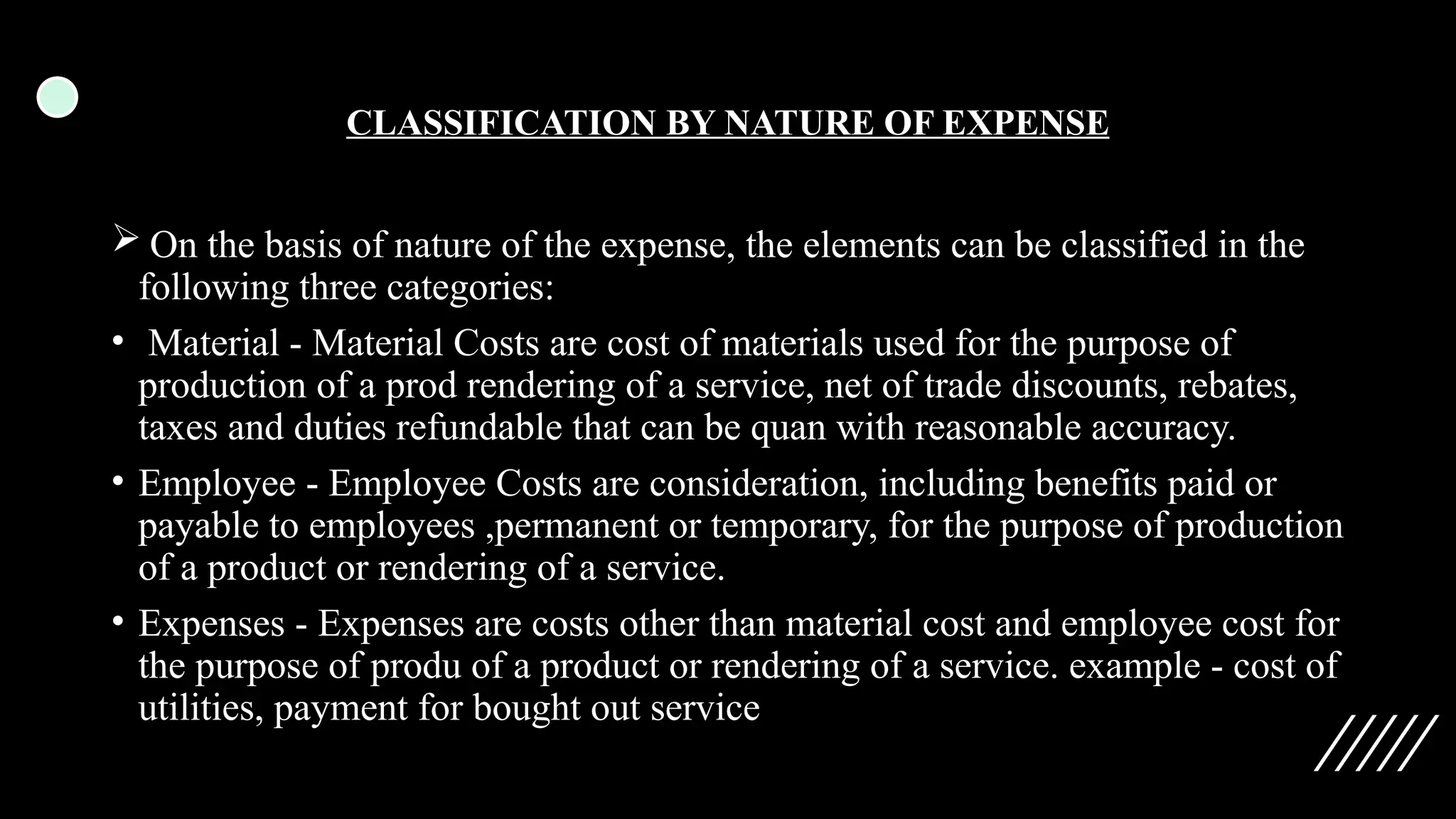
CLASSIFICATION BY NATURE OF EXPENSE
 On the basis of nature of the expense, the elements can be classified in the
following three categories:
• Material - Material Costs are cost of materials used for the purpose of
production of a prod rendering of a service, net of trade discounts, rebates,
taxes and duties refundable that can be quan with reasonable accuracy.
• Employee - Employee Costs are consideration, including benefits paid or
payable to employees ,permanent or temporary, for the purpose of production
of a product or rendering of a service.
• Expenses - Expenses are costs other than material cost and employee cost for
the purpose of produ of a product or rendering of a service. example - cost of
utilities, payment for bought out service
CLASSIFICATION BY TRACEABILITY OF THE COST TO A COST OBJECT
( DIRECT COST)
Definition
• Direct costs are expenses that can be directly attributed to a specific cost object, such as a
product, service, department, or project. These costs are directly traceable and identifiable
with the cost object.
Examples
• Direct Materials : Raw materials used in manufacturing, like steel in car production or flour in
bread-making.
• Direct Labor : Wages paid to workers who are directly involved in the production process,
such as assembly line workers.
Key Characteristics
• Traceability : Direct costs can be easily and accurately traced to a specific cost object without
the need for allocation.
• Variable in Nature : Typically, direct costs vary in proportion to the level of production or
service provision.
• Impact on Cost Object : Direct costs have a direct impact on the cost object’s overall cost,
making them crucial for accurate cost accounting and pricing decisions.
CLASSIFICATION BY TRACEABILITY OF THE COST TO A COST OBJECT
( INDIRECT COST)
 INDIRECT COST - if a cost is not identifiable as a direct cost then it is
referred to as indirect cost. It comprises the following :
• Indirect material - Indirect Material Costs are the cost of materials,
which cannot be directly assigned to a particular cost object. Example :
Consumable stores, lubricants.
• Indirect employee cost - Wages of the employees which are not
directly allocable to a particular cost centre. Example: Salaries of
admin staff , security staff.
• Indirect expenses - Indirect Expenses are expenses other than nature
of material and labour which cannot be directly assigned to a
particular cost object or centre. Example: Insurance,taxes and duties.
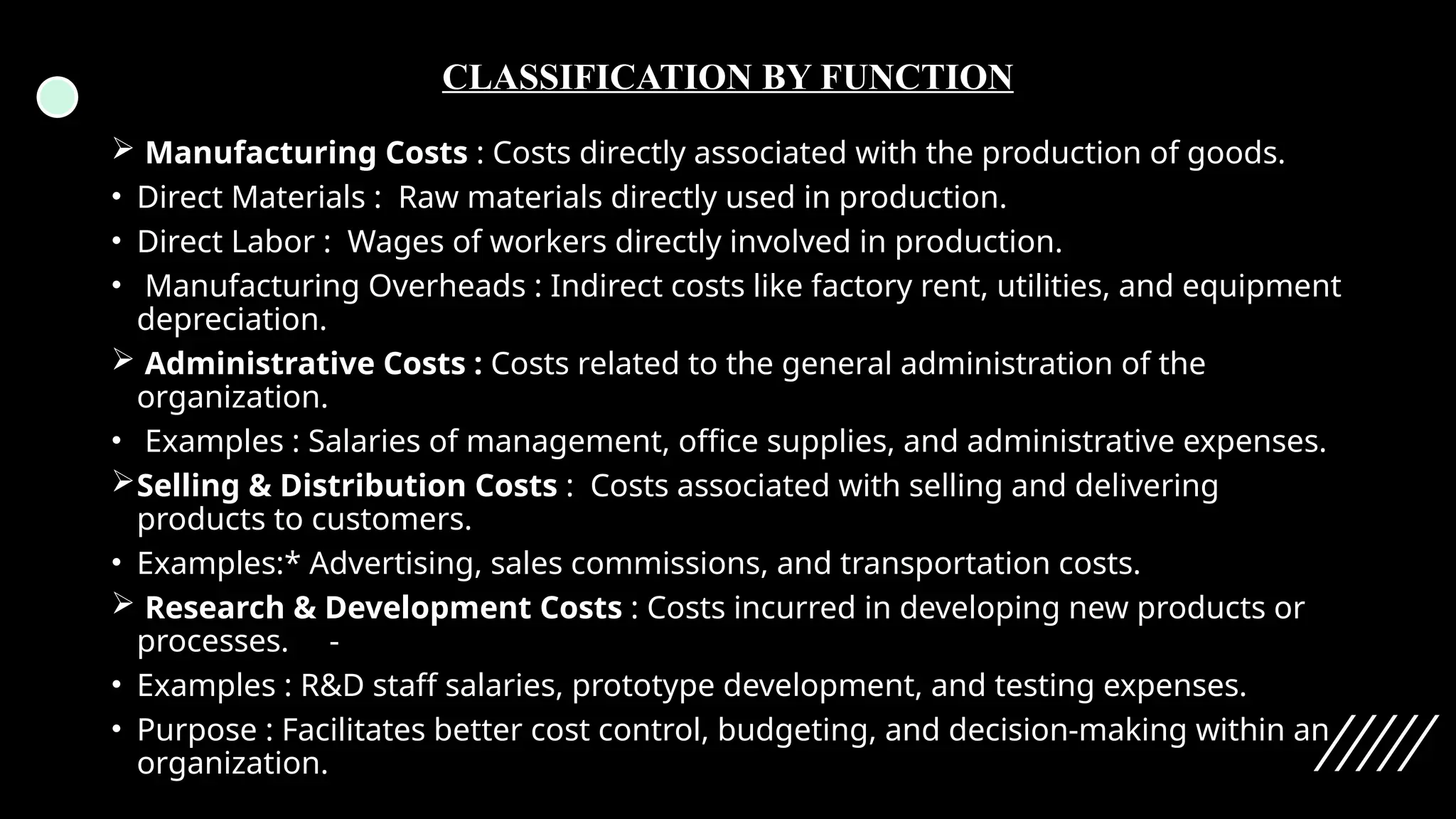
CLASSIFICATION BY FUNCTION
 Manufacturing Costs : Costs directly associated with the production of goods.
• Direct Materials : Raw materials directly used in production.
• Direct Labor : Wages of workers directly involved in production.
• Manufacturing Overheads : Indirect costs like factory rent, utilities, and equipment
depreciation.
 Administrative Costs : Costs related to the general administration of the
organization.
• Examples : Salaries of management, office supplies, and administrative expenses.
Selling & Distribution Costs : Costs associated with selling and delivering
products to customers.
• Examples:* Advertising, sales commissions, and transportation costs.
 Research & Development Costs : Costs incurred in developing new products or
processes. -
• Examples : R&D staff salaries, prototype development, and testing expenses.
• Purpose : Facilitates better cost control, budgeting, and decision-making within an
organization.
CLASSIFICATION BY NATURE OF BEHAVIOUR
• Fixed Cost : These are costs that do not change with the
level of production or sales within a certain range. Example
includes rent, salaries etc
• Variable Cost: These costs vary directly with the level of
production. As production increases, variable costs increase;
as production decreases, these costs decrease as well.
Examples include raw materials, direct labor etc.
• Semi-Variable Cost: These have both fixed and variable
components. The fixed portion remains constant up to a
certain level of production, while the variable portion
fluctuates with production levels.
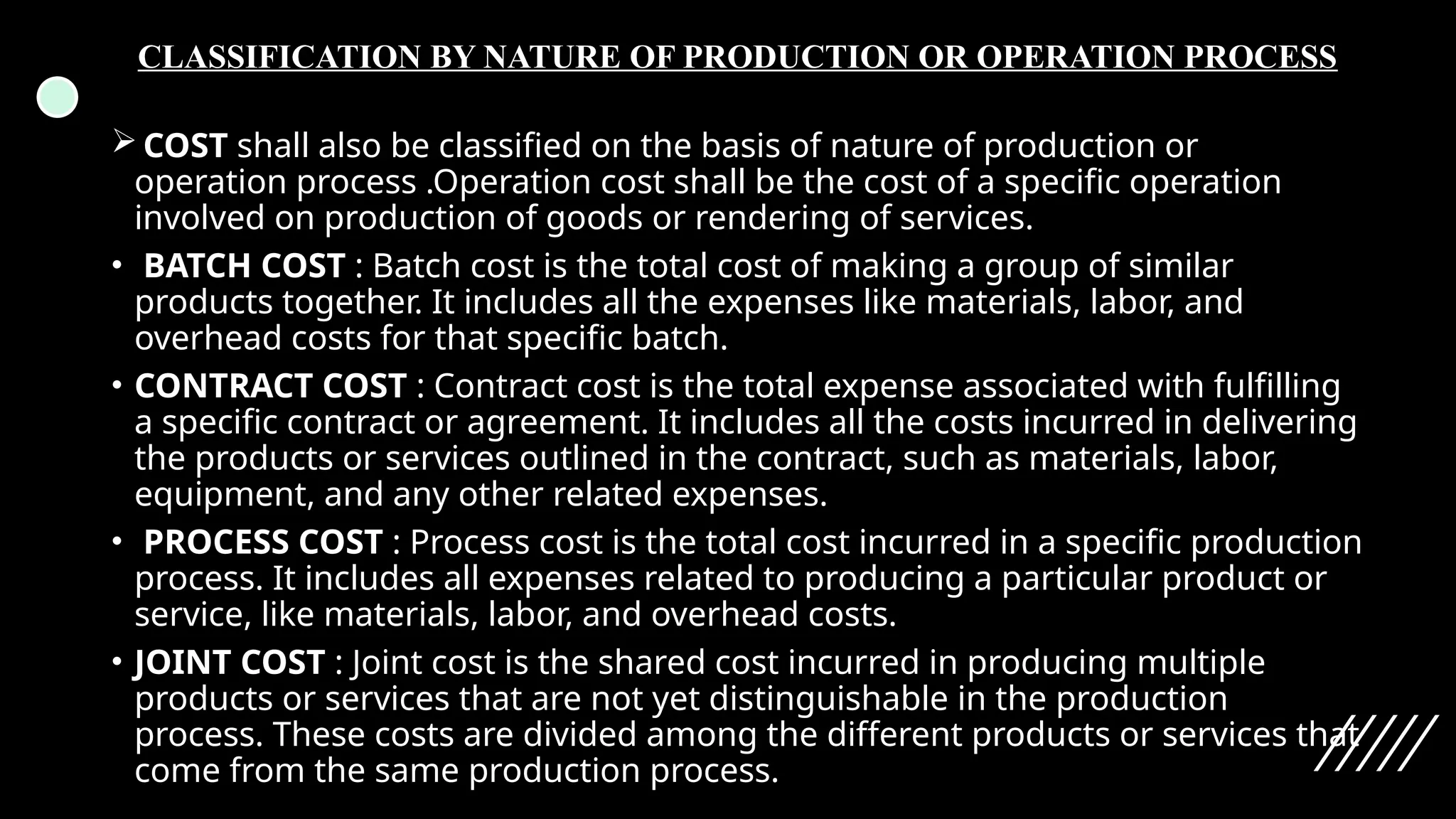
CLASSIFICATION BY NATURE OF PRODUCTION OR OPERATION PROCESS
 COST shall also be classified on the basis of nature of production or
operation process .Operation cost shall be the cost of a specific operation
involved on production of goods or rendering of services.
• BATCH COST : Batch cost is the total cost of making a group of similar
products together. It includes all the expenses like materials, labor, and
overhead costs for that specific batch.
• CONTRACT COST : Contract cost is the total expense associated with fulfilling
a specific contract or agreement. It includes all the costs incurred in delivering
the products or services outlined in the contract, such as materials, labor,
equipment, and any other related expenses.
• PROCESS COST : Process cost is the total cost incurred in a specific production
process. It includes all expenses related to producing a particular product or
service, like materials, labor, and overhead costs.
• JOINT COST : Joint cost is the shared cost incurred in producing multiple
products or services that are not yet distinguishable in the production
process. These costs are divided among the different products or services that
come from the same production process.
CLASSIFICATION BY DECISION MAKING RELEVANCE
Classification of costs by decision-making relevance helps businesses identify which costs are
important for making decisions and which are not. This classification includes:
• Relevant Costs : Costs that will be directly affected by a specific business decision. They are future
costs that differ between alternatives.
• Examples :
o Avoidable Costs : Costs that can be eliminated if a decision is made to discontinue an activity.
o Incremental Costs: Additional costs incurred when choosing one alternative over another.
o Opportunity Costs: The potential benefit lost when one alternative is chosen over another.
• Irrelevant Costs : Costs that do not influence a decision because they will remain unchanged
regardless of the chosen alternative.
• Examples :
o Sunk Costs: Costs that have already been incurred and cannot be recovered.
o Fixed Costs: Costs that remain constant regardless of the level of production or decision.
o Committed Costs: Costs that the company is already committed to, which will not be affected by
future decisions.
Understanding the classification of costs by decision-making relevance allows businesses to focus on
the costs that matter when analyzing different options, thereby leading to better-informed decisions..
CLASSIFICATION BY CONTROLLABILITY
Classification by Controllability Classification of costs by controllability divides costs
into controllable costs and uncontrollable costs:
• Controllable Costs - These are costs that can be influenced or regulated by a
manager or a specific level of management. - For example, a department manager
can control costs related to labor, materials, and overhead within their department.
• Uncontrollable Costs - These are costs that cannot be influenced or regulated by a
manager or specific level of management. - These costs are usually determined by
external factors or higher levels of management. Examples include rent, salaries of
top management, and regulatory fees.
This classification helps in evaluating managerial performance by focusing on the
costs that a manager can actually control.
CLASSIFICATION BY NORMALITY
 Normal Costs
• Definition: Normal costs are the regular, expected costs that are incurred during typical
business operations. These costs fall within the standard range of expenses for
producing goods or services under normal conditions.
• Characteristics:
• They occur regularly and predictably.
• They are budgeted and accounted for in standard cost systems.
• They align with the company's normal level of activity and output.
 Abnormal Costs
• Definition: Abnormal costs are those that are unexpected, non-recurring, and usually
arise due to unforeseen circumstances or events. These costs are not part of the regular
operating process and are considered to be outside the control of management.
• Characteristics:
• They are infrequent and do not typically occur during normal operations.
• They are often treated as extraordinary items and may require special consideration in financial
reporting.
• They may result from events like accidents, inefficiencies, or emergencies.
CLASSIFICATION BY PRODUCT
• 1. Direct Costs Direct costs are those that can be directly traced to a specific product, service, or cost object. These
costs are clearly identifiable with the production or provision of a particular product.
• Can be directly attributed to a product without allocation.
• Vary with the level of production or service delivery.
• 2. Indirect Costs Indirect costs are those that cannot be directly traced to a specific product or cost object. These
costs are incurred for the benefit of multiple products or are necessary for overall operations but are not directly
linked to the production of a single product.
• Require allocation to products based on some rationale or cost driver (e.g., labor hours, machine hours).
• Can be either fixed or variable.
• 3. Fixed Costs Fixed costs are costs that remain constant regardless of the level of production or the number of units
produced. These costs do not vary with production volume and are incurred even if no products are made.
• Do not change in total with the level of production but can change on a per-unit basis as production volume
changes.
• Often include overhead and administrative costs.
• 4. Variable Costs Variable costs fluctuate in direct proportion to the level of production or the number of units
produced. As production increases, total variable costs increase, and as production decreases, total variable costs
decrease.
• Directly tied to the production process.
• Usually include costs that vary with the level of output.
• 5. Semi-Variable (Mixed) Costs Semi-variable costs contain both fixed and variable components. Part of the cost
remains fixed, while the other part varies with production volume.
• A portion of the cost will incur regardless of production level (fixed), while the remaining portion will vary with
activity (variable).
• Often requires separation into fixed and variable components for analysis.
EXAMPLE OF ANY TWO TYPES OF CLASSIFICATION
CONCLUSION
When classifying costs for management purposes, the goal is
to provide insights into how costs behave, how they relate to
the products and services being produced, and how they
impact financial decision-making. Classifying costs is essential
for management because it provides a clear framework for
analyzing how expenses affect the business, supports better
financial decision-making, and helps control and optimize
operational performance. Through proper classification,
management can align its strategies to improve cost-
efficiency, pricing accuracy, and overall profitability.
GROUP LEADER’S REPORT
ROLL NO. UID NAME CONTRIBUTION OTHER
REMARKS
203 22BCM328 DAKSH PATEL EXCELLENT
204 22BCM329 PRATHAM PATEL EXCELLENT
205 22BCM330 TWISHA PATEL EXCELLENT
206 22BCM332 DIKSHA PATEL EXCELLENT
207 22BCM333 KIRAN PATIL EXCELLENT
208 22BCM335 SUDEEPITA
PATNAIK
EXCELLENT
209 22BCM336 MARIA PATRAWALA EXCELLENT
210 22BCM339 OM PAWAR EXCELLENT
211 22BCM341 SIONA PEREIRA EXCELLENT
212 22BCM342 ANAGHA PILLAI EXCELLENT
213 22BCM345 TEJAS PODDAR EXCELLENT
214 22BCM347 OM PRAJAPATI EXCELLENT
215 KRISH PUROHIT EXCELLENT
LEADER NAME DIKSHA PATIL
CLASS TY BCOM
ROLL NO. 206
UID 22BCM332
DIVISION B
SUBJECT COST
ACCOUNTING

COST accounting presentation tybcom PPT.pptx

  • 1.
    C L AS S I F I C A T I O N O F C O S T F O R M A N A G E M E N T ROLL NO. UID NAME 203 22BCM328 DAKSH PATEL 204 22BCM329 PRATHAM PATEL 205 22BCM330 TWISHA PATEL 206 22BCM332 DIKSHA PATEL 207 22BCM333 KIRAN PATIL 208 22BCM335 SUDEEPITA PATNAIK 209 22BCM336 MARIA PATRAWALA 210 22BCM339 OM PAWAR 211 22BCM341 SIONA PEREIRA 212 22BCM342 ANAGHA PILLAI 213 22BCM345 TEJAS PODDAR 214 22BCM347 OM PRAJAPATI 215 22BCM350 KRISH PUROHIT
  • 2.
    INTRODUCTION AND IMPORTANCEOF COST CLASSIFICATION FOR MANAGEMENT • INTRODUCTION : When discussing the classification of costs for management, it's essential to understand that cost classification serves as a foundational tool in managerial decision-making. Effective cost classification helps managers analyze, control, and optimize the various financial resources within an organization. • Purpose of Cost Classification : ~ Essential for managerial decision-making, ~ aiding in budgeting, cost control, and resource optimization. • Key Classification Methods :: By Function : Direct vs. Indirect Costs. By Behavior: Fixed, Variable, and Semi-Variable Costs. By Relevance : Relevant vs. Irrelevant Costs. By Time : Product vs. Period Costs. • IMPORTANCE : Classifying costs is super important for management because it helps in making informed decisions, controlling expenses, and planning for the future. By categorizing costs into different types like fixed costs, variable costs, direct costs, and indirect costs, managers can analyze which costs are essential for operations and which can be reduced or eliminated. This classification also aids in budgeting, setting prices, evaluating performance, and determining profitability. Essentially, knowing the different cost categories allows managers to allocate resources efficiently and effectively manage the financial aspects of the business.
  • 3.
    CLASSIFICATION BY NATUREOF EXPENSE  On the basis of nature of the expense, the elements can be classified in the following three categories: • Material - Material Costs are cost of materials used for the purpose of production of a prod rendering of a service, net of trade discounts, rebates, taxes and duties refundable that can be quan with reasonable accuracy. • Employee - Employee Costs are consideration, including benefits paid or payable to employees ,permanent or temporary, for the purpose of production of a product or rendering of a service. • Expenses - Expenses are costs other than material cost and employee cost for the purpose of produ of a product or rendering of a service. example - cost of utilities, payment for bought out service
  • 4.
    CLASSIFICATION BY TRACEABILITYOF THE COST TO A COST OBJECT ( DIRECT COST) Definition • Direct costs are expenses that can be directly attributed to a specific cost object, such as a product, service, department, or project. These costs are directly traceable and identifiable with the cost object. Examples • Direct Materials : Raw materials used in manufacturing, like steel in car production or flour in bread-making. • Direct Labor : Wages paid to workers who are directly involved in the production process, such as assembly line workers. Key Characteristics • Traceability : Direct costs can be easily and accurately traced to a specific cost object without the need for allocation. • Variable in Nature : Typically, direct costs vary in proportion to the level of production or service provision. • Impact on Cost Object : Direct costs have a direct impact on the cost object’s overall cost, making them crucial for accurate cost accounting and pricing decisions.
  • 5.
    CLASSIFICATION BY TRACEABILITYOF THE COST TO A COST OBJECT ( INDIRECT COST)  INDIRECT COST - if a cost is not identifiable as a direct cost then it is referred to as indirect cost. It comprises the following : • Indirect material - Indirect Material Costs are the cost of materials, which cannot be directly assigned to a particular cost object. Example : Consumable stores, lubricants. • Indirect employee cost - Wages of the employees which are not directly allocable to a particular cost centre. Example: Salaries of admin staff , security staff. • Indirect expenses - Indirect Expenses are expenses other than nature of material and labour which cannot be directly assigned to a particular cost object or centre. Example: Insurance,taxes and duties.
  • 6.
    CLASSIFICATION BY FUNCTION Manufacturing Costs : Costs directly associated with the production of goods. • Direct Materials : Raw materials directly used in production. • Direct Labor : Wages of workers directly involved in production. • Manufacturing Overheads : Indirect costs like factory rent, utilities, and equipment depreciation.  Administrative Costs : Costs related to the general administration of the organization. • Examples : Salaries of management, office supplies, and administrative expenses. Selling & Distribution Costs : Costs associated with selling and delivering products to customers. • Examples:* Advertising, sales commissions, and transportation costs.  Research & Development Costs : Costs incurred in developing new products or processes. - • Examples : R&D staff salaries, prototype development, and testing expenses. • Purpose : Facilitates better cost control, budgeting, and decision-making within an organization.
  • 7.
    CLASSIFICATION BY NATUREOF BEHAVIOUR • Fixed Cost : These are costs that do not change with the level of production or sales within a certain range. Example includes rent, salaries etc • Variable Cost: These costs vary directly with the level of production. As production increases, variable costs increase; as production decreases, these costs decrease as well. Examples include raw materials, direct labor etc. • Semi-Variable Cost: These have both fixed and variable components. The fixed portion remains constant up to a certain level of production, while the variable portion fluctuates with production levels.
  • 8.
    CLASSIFICATION BY NATUREOF PRODUCTION OR OPERATION PROCESS  COST shall also be classified on the basis of nature of production or operation process .Operation cost shall be the cost of a specific operation involved on production of goods or rendering of services. • BATCH COST : Batch cost is the total cost of making a group of similar products together. It includes all the expenses like materials, labor, and overhead costs for that specific batch. • CONTRACT COST : Contract cost is the total expense associated with fulfilling a specific contract or agreement. It includes all the costs incurred in delivering the products or services outlined in the contract, such as materials, labor, equipment, and any other related expenses. • PROCESS COST : Process cost is the total cost incurred in a specific production process. It includes all expenses related to producing a particular product or service, like materials, labor, and overhead costs. • JOINT COST : Joint cost is the shared cost incurred in producing multiple products or services that are not yet distinguishable in the production process. These costs are divided among the different products or services that come from the same production process.
  • 9.
    CLASSIFICATION BY DECISIONMAKING RELEVANCE Classification of costs by decision-making relevance helps businesses identify which costs are important for making decisions and which are not. This classification includes: • Relevant Costs : Costs that will be directly affected by a specific business decision. They are future costs that differ between alternatives. • Examples : o Avoidable Costs : Costs that can be eliminated if a decision is made to discontinue an activity. o Incremental Costs: Additional costs incurred when choosing one alternative over another. o Opportunity Costs: The potential benefit lost when one alternative is chosen over another. • Irrelevant Costs : Costs that do not influence a decision because they will remain unchanged regardless of the chosen alternative. • Examples : o Sunk Costs: Costs that have already been incurred and cannot be recovered. o Fixed Costs: Costs that remain constant regardless of the level of production or decision. o Committed Costs: Costs that the company is already committed to, which will not be affected by future decisions. Understanding the classification of costs by decision-making relevance allows businesses to focus on the costs that matter when analyzing different options, thereby leading to better-informed decisions..
  • 10.
    CLASSIFICATION BY CONTROLLABILITY Classificationby Controllability Classification of costs by controllability divides costs into controllable costs and uncontrollable costs: • Controllable Costs - These are costs that can be influenced or regulated by a manager or a specific level of management. - For example, a department manager can control costs related to labor, materials, and overhead within their department. • Uncontrollable Costs - These are costs that cannot be influenced or regulated by a manager or specific level of management. - These costs are usually determined by external factors or higher levels of management. Examples include rent, salaries of top management, and regulatory fees. This classification helps in evaluating managerial performance by focusing on the costs that a manager can actually control.
  • 11.
    CLASSIFICATION BY NORMALITY Normal Costs • Definition: Normal costs are the regular, expected costs that are incurred during typical business operations. These costs fall within the standard range of expenses for producing goods or services under normal conditions. • Characteristics: • They occur regularly and predictably. • They are budgeted and accounted for in standard cost systems. • They align with the company's normal level of activity and output.  Abnormal Costs • Definition: Abnormal costs are those that are unexpected, non-recurring, and usually arise due to unforeseen circumstances or events. These costs are not part of the regular operating process and are considered to be outside the control of management. • Characteristics: • They are infrequent and do not typically occur during normal operations. • They are often treated as extraordinary items and may require special consideration in financial reporting. • They may result from events like accidents, inefficiencies, or emergencies.
  • 12.
    CLASSIFICATION BY PRODUCT •1. Direct Costs Direct costs are those that can be directly traced to a specific product, service, or cost object. These costs are clearly identifiable with the production or provision of a particular product. • Can be directly attributed to a product without allocation. • Vary with the level of production or service delivery. • 2. Indirect Costs Indirect costs are those that cannot be directly traced to a specific product or cost object. These costs are incurred for the benefit of multiple products or are necessary for overall operations but are not directly linked to the production of a single product. • Require allocation to products based on some rationale or cost driver (e.g., labor hours, machine hours). • Can be either fixed or variable. • 3. Fixed Costs Fixed costs are costs that remain constant regardless of the level of production or the number of units produced. These costs do not vary with production volume and are incurred even if no products are made. • Do not change in total with the level of production but can change on a per-unit basis as production volume changes. • Often include overhead and administrative costs. • 4. Variable Costs Variable costs fluctuate in direct proportion to the level of production or the number of units produced. As production increases, total variable costs increase, and as production decreases, total variable costs decrease. • Directly tied to the production process. • Usually include costs that vary with the level of output. • 5. Semi-Variable (Mixed) Costs Semi-variable costs contain both fixed and variable components. Part of the cost remains fixed, while the other part varies with production volume. • A portion of the cost will incur regardless of production level (fixed), while the remaining portion will vary with activity (variable). • Often requires separation into fixed and variable components for analysis.
  • 13.
    EXAMPLE OF ANYTWO TYPES OF CLASSIFICATION
  • 14.
    CONCLUSION When classifying costsfor management purposes, the goal is to provide insights into how costs behave, how they relate to the products and services being produced, and how they impact financial decision-making. Classifying costs is essential for management because it provides a clear framework for analyzing how expenses affect the business, supports better financial decision-making, and helps control and optimize operational performance. Through proper classification, management can align its strategies to improve cost- efficiency, pricing accuracy, and overall profitability.
  • 15.
    GROUP LEADER’S REPORT ROLLNO. UID NAME CONTRIBUTION OTHER REMARKS 203 22BCM328 DAKSH PATEL EXCELLENT 204 22BCM329 PRATHAM PATEL EXCELLENT 205 22BCM330 TWISHA PATEL EXCELLENT 206 22BCM332 DIKSHA PATEL EXCELLENT 207 22BCM333 KIRAN PATIL EXCELLENT 208 22BCM335 SUDEEPITA PATNAIK EXCELLENT 209 22BCM336 MARIA PATRAWALA EXCELLENT 210 22BCM339 OM PAWAR EXCELLENT 211 22BCM341 SIONA PEREIRA EXCELLENT 212 22BCM342 ANAGHA PILLAI EXCELLENT 213 22BCM345 TEJAS PODDAR EXCELLENT 214 22BCM347 OM PRAJAPATI EXCELLENT 215 KRISH PUROHIT EXCELLENT LEADER NAME DIKSHA PATIL CLASS TY BCOM ROLL NO. 206 UID 22BCM332 DIVISION B SUBJECT COST ACCOUNTING