FINAL PROJECT
CORY COOK
Contents
1. Introduction 1
2. Method 1
2.1. Requirements 2
2.2. Abstraction 2
2.3. Design: Addressing Scheme 2
2.4. Design: Performance Testing 3
2.5. Node Device Specifications 3
2.6. Implementation Description 4
3. Implementation 4
4. Conclusion 6
1. Introduction
The internet is a tool that is used by a third of the world’s population. It allows
us to connect and exchange information, provide services, and exchange ideas. The
only problem is that in order to connect all of these devices and servers we need
to lay out miles of wire and provide hubs that connect all of these wires together.
Since most of us don’t want to lay out the wires needed nor do we want to be
responsible for managing the routers that connect all of these devices we need to
have companies do this for us. Companies are happy to do this for us, for a modest
fee. This turns out to be a bad deal for the customer as we are usually very limited
to which internet service providers are available in the area, and, as such, those
internet service providers have a lot of control over pricing and the quality of the
services offered. Wouldn’t it be better if we could do without the Internet Service
Providers (ISPs) all together? In order to do this, however, we would need to
be able to rid ourselves of our dependence on wires, routers, and other externally
managed network focal points.
The goal of my final project is to provide a (very) basic implementation of a
node-based networking system: including an addressing scheme, latency test, and
speed test. Once I have a working implementation I will determine if the design is
feasible by comparing it to modern internet tests and speeds offered by ISPs.
2. Method
I’m going to lay out the requirements of the design and then I’m going to ab-
stract the requirements to better focus my solution to a general case, rather than
a complete system. I’m going to ignore environmental and economic requirements
1
2 CORY COOK
and problems that would need to be considered as part of the design, and Im go-
ing to make false assumptions regarding the ethical use of the design by its users.
Including such things would exceed the scope of the project and complicate the
design beyond the problem I’m trying to solve.
2.1. Requirements.
(1) The system must allow connections to be established between any two de-
vices on the network.
(2) The system must allow data to be transferred from one device to another.
(3) The system must not rely on any managed nodes or complicated systems
that would require repair or maintenance.
(4) The system must be extensible such that connections can be made over
several different network types.
(5) The system must be secure and data-safe.
(6) The system must be able to forward data without recieving the entirety of
the data (packets)
2.2. Abstraction. For the purposes of this project I’m only going to consider the
requirements necessary to establish connections and transfer data (1, 2, and 3). I’m
also going to make several assumptions about the system that would not be true
in a physical setting:
(1) Assume all nodes are active. Nodes will not deactive throughout the dura-
tion of any transfers.
(2) Assume all nodes are stationary. There will be no mobile nodes.
(3) Assume that there is no data loss during transfer.
(4) Assume that all nodes are techinically equivalent. All nodes will have the
same properties (range, power, transfer rate, response time, etc.)
(5) Assume that the devices can make an unlimitted number of concurrent
connections.
Given these abstractions I can create a relatively simple and expandable model that
should be easy to implement.
2.3. Design: Addressing Scheme. The addressing scheme will have to be one
such that a device will be able to contact another device on the network. In a
network that doesn’t have a cleary defined hierarchy, such as the one we are trying
to implement, using a standard IP addressing scheme would not give the device
enough information to know where to send its data. I’m sure that there are many
solutions available to resolving addresses in a node-based network such as this. A
couple of design solutions for addressing that I was able to come up with would
work but each has its inefficiencies.
The first solution is to use a Global Positioning Satellite (GPS) Service to resolve
addresses based on physical location. This would require the use of an external
service that the device would have no control over. This GPS system would need
to be actively maintained and serviced, which means that someone has to get paid.
However, GPS services are currently being provided by the government so we are
paying for it whether we like it or not. This does have the added benefit of being
able to use the GPS coordinates to send data directly. Implementation of this
would be relatively simple. Each device would poll a GPS system for its physical
FINAL PROJECT 3
coordinates and build its address based on that. When the device needs to forward
data it will forward the data to the device in the direction of the target system.
The second solution is to create a hierarchy by combining devices that are near
each other. So a set of devices would represent a network group which would be con-
tained within a larger group of groups, and so on until all devices are encompassed.
Each device in the group would have addressing information for all devices within
that group. This would be more difficult to implement as addressing would not be
based on any kind of technology that already exists, and each device would need
to have a lot more information and do a lot more calculation to resolve addressing
for all requests. However, it does have the added benefit of not having to rely on
any external system that would require regular maintenance. Implementation of
this scheme would be more difficult than the first, expecially for optimization. Ad-
dressing would be based on levels, each level would contain a set number of devices
or groups within it and assign an address for that group at that level. This could
result in some very long addresses. When the device needs to forward data it will
forward it outwards to all devices or groups until there is a match at that level.
For the purposes of this project I am going to implement the first solution, as
it is much simpler. I am going to assume that the GPS system is a free service
that is already in place. Each device on the network will be able to resolve its
own address. I’m going to assume that the GPS has a high enough accuracy to
give each device its own unique address. In a real-world situation there would be
devices that fall within the same GPS coordinates and the system would have to
account for that by adding the ability to select a specific device within an address
or by expanding the address itself to fit a device-specific element. Either way it
involves added complexity in device selection that, while being very closely related
to this project, can be abstracted to get to (what I believe to be) the true goal
of this project. That is to compare theoretical performance of this system to the
high-maintenance systems currently being used. So I’m going to abstract this by
assuming that each coordinate will have, at most, a single device. I’m going to
abstract this further by not using true GPS coordinates and instead define the area
of my test and randomly place objects within that area. Using true GPS would
create very large addresses with very little meaning in the actual testing.
2.4. Design: Performance Testing. The performance of these systems can be
determined through analysis of the specifications of the nodes, the relative distance
between the client and the host, and the distance between each of the nodes. In
order to analyze the performance between the design and currently used systems
we must first be able to determine the best method for transferring data in the
system that we attempting to design. Once I have my emulated devices I am going
to simulate data transfer as a function of the specification, analyze my data set to
find the worst case scenario for my test area, and use the result to compare with
current internet speed standards.
2.5. Node Device Specifications.
Data Transfer Rate: Gigabit
Maximum Range: 40 meters
Signal Degredation Rate: −x−40
40
The Data Transfer Rate is the rate of data transfer within the optimum range. The
maximum range is the maximum distance in which a connection can be established.
4 CORY COOK
These specifications were selected to ensure that the entire area of the next ad-
dress over would be within optimum range for an addressing range of 8m regardless
of the current position of the object within its own address range.
2.6. Implementation Description. Each node is going to be an object with an
address and a physical position. If the current address is (a,b) and the target
address is (c,d) then the next address down the line will be determined by the
following function (one-dimension):
(1) a = c?a : a +
c − a
|c − a|
We need to determine the physical distance between the nodes such that we can
determine the signal strength and throughput. The throughput of the system is
determined by the slowest data transfer on the line so if the bandwidth of the current
node is less that that of the system throughput then set the system throughput as
the current. Add any delay or latency incurred at the current node. Repeat until
we reach the destination.
This should give us a latency and a throuput for a connection which is all we
need to determine its performance. I will repeat this method for many random
connections and record the data. Once I have the data I will determine a function
that fits the given data and use optimization technique to find the worst case
scenario for the system. Once this is determined I will compare the performance to
the performance of the average internet users’ connection and determine (roughly)
if having a massive mesh networking system would be feasible.
3. Implementation
1 grid =1000 // Sets the size of the test area
2 ps=8 // Sets the plot size (size per unit area)
3 datarate =1000
4 A = rand(grid ,grid ,2)
5 A = A*ps
6 // This is the signal degredation based on distance
7 function b=sig(t)
8 b=sqrt(-(t -40) /40)
9 endfunction
10 // Caluclates the distance between nodes
11 function d=dist(curr ,next)
12 d=sqrt (( curr (1) -next (1))^2+( curr (2)-next (2))^2)
13 endfunction
14 // Gets the coordinates of the node
15 function coords=cor(x)
16 coords =[x(1)+A(x(1) ,x(2) ,1)/ps x(2)+A(x(1),x(2) ,2)/ps]
17 endfunction
18 // Gets the next node address
19 function out=np(u, v)
20 if u==v then
21 out=u
22 else
23 out=u+((v-u)/abs(v-u))
24 end
25 endfunction
26 function [latency , throughput ]= set_val(start_pos ,end_pos ,speed)
27 latency =0
FINAL PROJECT 5
Figure 1. Latency Histogram Distribution vs. Time (ms)
28 throughput=speed
29 current_pos = start_pos
30 while or(current_pos ~= end_pos)
31 next_pos (1 ,1)=np( current_pos (1), end_pos (1))
32 next_pos (1 ,2)=np( current_pos (2), end_pos (2))
33 latency=latency +1
34 val=sig(dist(cor(current_pos), cor(next_pos)))*datarate
35 if val <throughput then
36 throughput=val
37 end
38 current_pos = next_pos
39 end
40 endfunction
41 for i=1:1000
42 start_pos =[ ceil(grid*rand ()) ceil(grid*rand ())]
43 end_pos =[ ceil(grid*rand ()) ceil(grid*rand ())]
44 startp(i,:)=start_pos
45 endp(i,:)=end_pos
46 [lat(i), band(i)] = set_val(start_pos ,end_pos ,datarate)
47 end
Listing 1. Mesh Network Implementation
6 CORY COOK
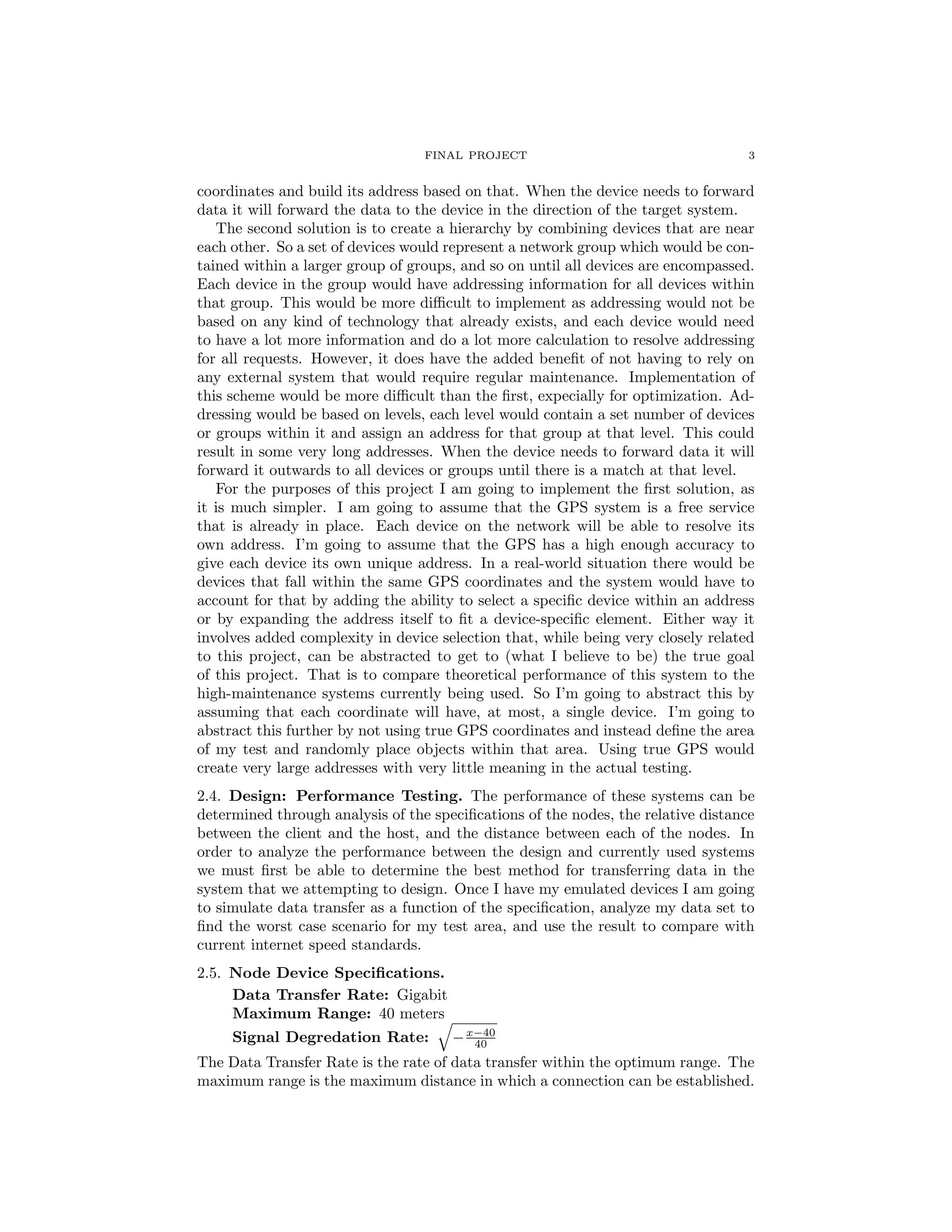
Figure 2. Bandwidth Histogram @ Gigabit Distribution vs Speed (Mbps)
4. Conclusion
The data shows that given the test area of 64km2
the current implementation of
the wireless mesh network would be infeasible due to high latency. However, there
is a large improvement in bandwidth over the average high-speed internet available
via ISP, which currently averages about 30 Mbps.
This is a very abstract model of a simple implementation of a mesh network. A
complete mesh network would be able to determine the best node to forward the
data to based on the situation. It would also be able to send data to multiple nodes
to ensure delivery or improve performance.
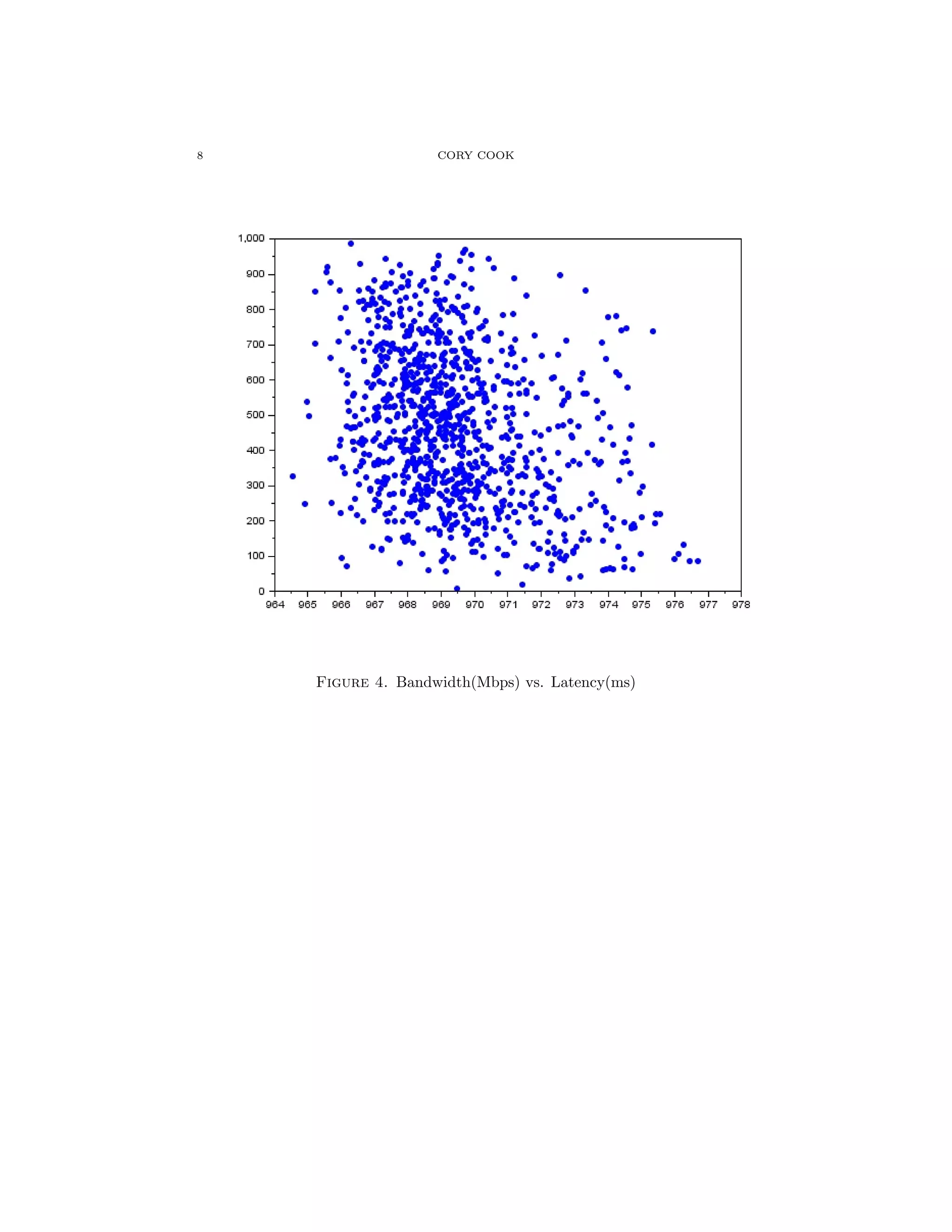
The charts show that Bandwidth and Latency are not directly correllated. This
means that an effect in the latency does not guarantee an effect in the bandwidth
and the only real factors are the distance between the nodes and the number of
nodes transversed. Theoretically, although not supported by my charts, bandwidth
and latency are correllated because selecting nodes that are further away would
reduce the number of nodes necessary and, therefore, improve latency. On the
other hand, choosing nodes that are closer would close the distance between nodes
and, therefore, improve the bandwidth between the nodes. So distance between
nodes affects both latency and bandwidth.
FINAL PROJECT 7
Figure 3. Bandwidth Histogram @ 300 Mbps Distribution vs
Speed (Mbps)
I would like to move in the direction of a self-managed networking system similar
to the one modelled here. This would allow us to move away from the shackles of
ISPs and Data Carriers and implement network capability into nearly all devices.
Cars would be able to talk to each other freely to prevent accidents and improve
road safety, data would be available to you from almost any device at nearly any
location, lost devices and people could easily be tracked and found, the benefits
are limitless and all without having to pay hundreds of dollars for the privilege to
access them.
8 CORY COOK
Figure 4. Bandwidth(Mbps) vs. Latency(ms)

CoryCookFinalProject535

  • 1.
    FINAL PROJECT CORY COOK Contents 1.Introduction 1 2. Method 1 2.1. Requirements 2 2.2. Abstraction 2 2.3. Design: Addressing Scheme 2 2.4. Design: Performance Testing 3 2.5. Node Device Specifications 3 2.6. Implementation Description 4 3. Implementation 4 4. Conclusion 6 1. Introduction The internet is a tool that is used by a third of the world’s population. It allows us to connect and exchange information, provide services, and exchange ideas. The only problem is that in order to connect all of these devices and servers we need to lay out miles of wire and provide hubs that connect all of these wires together. Since most of us don’t want to lay out the wires needed nor do we want to be responsible for managing the routers that connect all of these devices we need to have companies do this for us. Companies are happy to do this for us, for a modest fee. This turns out to be a bad deal for the customer as we are usually very limited to which internet service providers are available in the area, and, as such, those internet service providers have a lot of control over pricing and the quality of the services offered. Wouldn’t it be better if we could do without the Internet Service Providers (ISPs) all together? In order to do this, however, we would need to be able to rid ourselves of our dependence on wires, routers, and other externally managed network focal points. The goal of my final project is to provide a (very) basic implementation of a node-based networking system: including an addressing scheme, latency test, and speed test. Once I have a working implementation I will determine if the design is feasible by comparing it to modern internet tests and speeds offered by ISPs. 2. Method I’m going to lay out the requirements of the design and then I’m going to ab- stract the requirements to better focus my solution to a general case, rather than a complete system. I’m going to ignore environmental and economic requirements 1
  • 2.
    2 CORY COOK andproblems that would need to be considered as part of the design, and Im go- ing to make false assumptions regarding the ethical use of the design by its users. Including such things would exceed the scope of the project and complicate the design beyond the problem I’m trying to solve. 2.1. Requirements. (1) The system must allow connections to be established between any two de- vices on the network. (2) The system must allow data to be transferred from one device to another. (3) The system must not rely on any managed nodes or complicated systems that would require repair or maintenance. (4) The system must be extensible such that connections can be made over several different network types. (5) The system must be secure and data-safe. (6) The system must be able to forward data without recieving the entirety of the data (packets) 2.2. Abstraction. For the purposes of this project I’m only going to consider the requirements necessary to establish connections and transfer data (1, 2, and 3). I’m also going to make several assumptions about the system that would not be true in a physical setting: (1) Assume all nodes are active. Nodes will not deactive throughout the dura- tion of any transfers. (2) Assume all nodes are stationary. There will be no mobile nodes. (3) Assume that there is no data loss during transfer. (4) Assume that all nodes are techinically equivalent. All nodes will have the same properties (range, power, transfer rate, response time, etc.) (5) Assume that the devices can make an unlimitted number of concurrent connections. Given these abstractions I can create a relatively simple and expandable model that should be easy to implement. 2.3. Design: Addressing Scheme. The addressing scheme will have to be one such that a device will be able to contact another device on the network. In a network that doesn’t have a cleary defined hierarchy, such as the one we are trying to implement, using a standard IP addressing scheme would not give the device enough information to know where to send its data. I’m sure that there are many solutions available to resolving addresses in a node-based network such as this. A couple of design solutions for addressing that I was able to come up with would work but each has its inefficiencies. The first solution is to use a Global Positioning Satellite (GPS) Service to resolve addresses based on physical location. This would require the use of an external service that the device would have no control over. This GPS system would need to be actively maintained and serviced, which means that someone has to get paid. However, GPS services are currently being provided by the government so we are paying for it whether we like it or not. This does have the added benefit of being able to use the GPS coordinates to send data directly. Implementation of this would be relatively simple. Each device would poll a GPS system for its physical
  • 3.
    FINAL PROJECT 3 coordinatesand build its address based on that. When the device needs to forward data it will forward the data to the device in the direction of the target system. The second solution is to create a hierarchy by combining devices that are near each other. So a set of devices would represent a network group which would be con- tained within a larger group of groups, and so on until all devices are encompassed. Each device in the group would have addressing information for all devices within that group. This would be more difficult to implement as addressing would not be based on any kind of technology that already exists, and each device would need to have a lot more information and do a lot more calculation to resolve addressing for all requests. However, it does have the added benefit of not having to rely on any external system that would require regular maintenance. Implementation of this scheme would be more difficult than the first, expecially for optimization. Ad- dressing would be based on levels, each level would contain a set number of devices or groups within it and assign an address for that group at that level. This could result in some very long addresses. When the device needs to forward data it will forward it outwards to all devices or groups until there is a match at that level. For the purposes of this project I am going to implement the first solution, as it is much simpler. I am going to assume that the GPS system is a free service that is already in place. Each device on the network will be able to resolve its own address. I’m going to assume that the GPS has a high enough accuracy to give each device its own unique address. In a real-world situation there would be devices that fall within the same GPS coordinates and the system would have to account for that by adding the ability to select a specific device within an address or by expanding the address itself to fit a device-specific element. Either way it involves added complexity in device selection that, while being very closely related to this project, can be abstracted to get to (what I believe to be) the true goal of this project. That is to compare theoretical performance of this system to the high-maintenance systems currently being used. So I’m going to abstract this by assuming that each coordinate will have, at most, a single device. I’m going to abstract this further by not using true GPS coordinates and instead define the area of my test and randomly place objects within that area. Using true GPS would create very large addresses with very little meaning in the actual testing. 2.4. Design: Performance Testing. The performance of these systems can be determined through analysis of the specifications of the nodes, the relative distance between the client and the host, and the distance between each of the nodes. In order to analyze the performance between the design and currently used systems we must first be able to determine the best method for transferring data in the system that we attempting to design. Once I have my emulated devices I am going to simulate data transfer as a function of the specification, analyze my data set to find the worst case scenario for my test area, and use the result to compare with current internet speed standards. 2.5. Node Device Specifications. Data Transfer Rate: Gigabit Maximum Range: 40 meters Signal Degredation Rate: −x−40 40 The Data Transfer Rate is the rate of data transfer within the optimum range. The maximum range is the maximum distance in which a connection can be established.
  • 4.
    4 CORY COOK Thesespecifications were selected to ensure that the entire area of the next ad- dress over would be within optimum range for an addressing range of 8m regardless of the current position of the object within its own address range. 2.6. Implementation Description. Each node is going to be an object with an address and a physical position. If the current address is (a,b) and the target address is (c,d) then the next address down the line will be determined by the following function (one-dimension): (1) a = c?a : a + c − a |c − a| We need to determine the physical distance between the nodes such that we can determine the signal strength and throughput. The throughput of the system is determined by the slowest data transfer on the line so if the bandwidth of the current node is less that that of the system throughput then set the system throughput as the current. Add any delay or latency incurred at the current node. Repeat until we reach the destination. This should give us a latency and a throuput for a connection which is all we need to determine its performance. I will repeat this method for many random connections and record the data. Once I have the data I will determine a function that fits the given data and use optimization technique to find the worst case scenario for the system. Once this is determined I will compare the performance to the performance of the average internet users’ connection and determine (roughly) if having a massive mesh networking system would be feasible. 3. Implementation 1 grid =1000 // Sets the size of the test area 2 ps=8 // Sets the plot size (size per unit area) 3 datarate =1000 4 A = rand(grid ,grid ,2) 5 A = A*ps 6 // This is the signal degredation based on distance 7 function b=sig(t) 8 b=sqrt(-(t -40) /40) 9 endfunction 10 // Caluclates the distance between nodes 11 function d=dist(curr ,next) 12 d=sqrt (( curr (1) -next (1))^2+( curr (2)-next (2))^2) 13 endfunction 14 // Gets the coordinates of the node 15 function coords=cor(x) 16 coords =[x(1)+A(x(1) ,x(2) ,1)/ps x(2)+A(x(1),x(2) ,2)/ps] 17 endfunction 18 // Gets the next node address 19 function out=np(u, v) 20 if u==v then 21 out=u 22 else 23 out=u+((v-u)/abs(v-u)) 24 end 25 endfunction 26 function [latency , throughput ]= set_val(start_pos ,end_pos ,speed) 27 latency =0
  • 5.
    FINAL PROJECT 5 Figure1. Latency Histogram Distribution vs. Time (ms) 28 throughput=speed 29 current_pos = start_pos 30 while or(current_pos ~= end_pos) 31 next_pos (1 ,1)=np( current_pos (1), end_pos (1)) 32 next_pos (1 ,2)=np( current_pos (2), end_pos (2)) 33 latency=latency +1 34 val=sig(dist(cor(current_pos), cor(next_pos)))*datarate 35 if val <throughput then 36 throughput=val 37 end 38 current_pos = next_pos 39 end 40 endfunction 41 for i=1:1000 42 start_pos =[ ceil(grid*rand ()) ceil(grid*rand ())] 43 end_pos =[ ceil(grid*rand ()) ceil(grid*rand ())] 44 startp(i,:)=start_pos 45 endp(i,:)=end_pos 46 [lat(i), band(i)] = set_val(start_pos ,end_pos ,datarate) 47 end Listing 1. Mesh Network Implementation
  • 6.
    6 CORY COOK Figure2. Bandwidth Histogram @ Gigabit Distribution vs Speed (Mbps) 4. Conclusion The data shows that given the test area of 64km2 the current implementation of the wireless mesh network would be infeasible due to high latency. However, there is a large improvement in bandwidth over the average high-speed internet available via ISP, which currently averages about 30 Mbps. This is a very abstract model of a simple implementation of a mesh network. A complete mesh network would be able to determine the best node to forward the data to based on the situation. It would also be able to send data to multiple nodes to ensure delivery or improve performance. The charts show that Bandwidth and Latency are not directly correllated. This means that an effect in the latency does not guarantee an effect in the bandwidth and the only real factors are the distance between the nodes and the number of nodes transversed. Theoretically, although not supported by my charts, bandwidth and latency are correllated because selecting nodes that are further away would reduce the number of nodes necessary and, therefore, improve latency. On the other hand, choosing nodes that are closer would close the distance between nodes and, therefore, improve the bandwidth between the nodes. So distance between nodes affects both latency and bandwidth.
  • 7.
    FINAL PROJECT 7 Figure3. Bandwidth Histogram @ 300 Mbps Distribution vs Speed (Mbps) I would like to move in the direction of a self-managed networking system similar to the one modelled here. This would allow us to move away from the shackles of ISPs and Data Carriers and implement network capability into nearly all devices. Cars would be able to talk to each other freely to prevent accidents and improve road safety, data would be available to you from almost any device at nearly any location, lost devices and people could easily be tracked and found, the benefits are limitless and all without having to pay hundreds of dollars for the privilege to access them.
  • 8.
    8 CORY COOK Figure4. Bandwidth(Mbps) vs. Latency(ms)