Corporate
Governance -
Realities and
Emerging ScenarioPavan Kumar Vijay
MD, Corporate Professionals
Corporate Governance rests with the Vision
and Perception of the Leadership
and
a Leader need to adopt
Vision for Good Corporate Governance
Whereas the 20th century might be viewed as
the age of management, the 21st century is
predicted to be more focused on governance.
Corporate
Governance
Corporate governance is "the system by which companies
are directed and controlled" (Cadbury Committee, 1992).
What is Corporate Governance?
Cadbury Committee
"Corporate governance involves a set of relationships
between a company’s management, its board, its
shareholders and other stakeholders. Corporate
governance also provides the structure through which the
objectives of the company are set, and the means of
attaining those objectives and monitoring performance are
determined” OECD Principles of Corporate Governance
What is Corporate Governance?
“Corporate Governance is the application of best
management practices, compliance of law in letter and
spirit and adherence to ethical standards for effective
management and distribution of wealth and discharge of
social responsibility for sustainable development of all
stakeholders”
What is Corporate Governance?
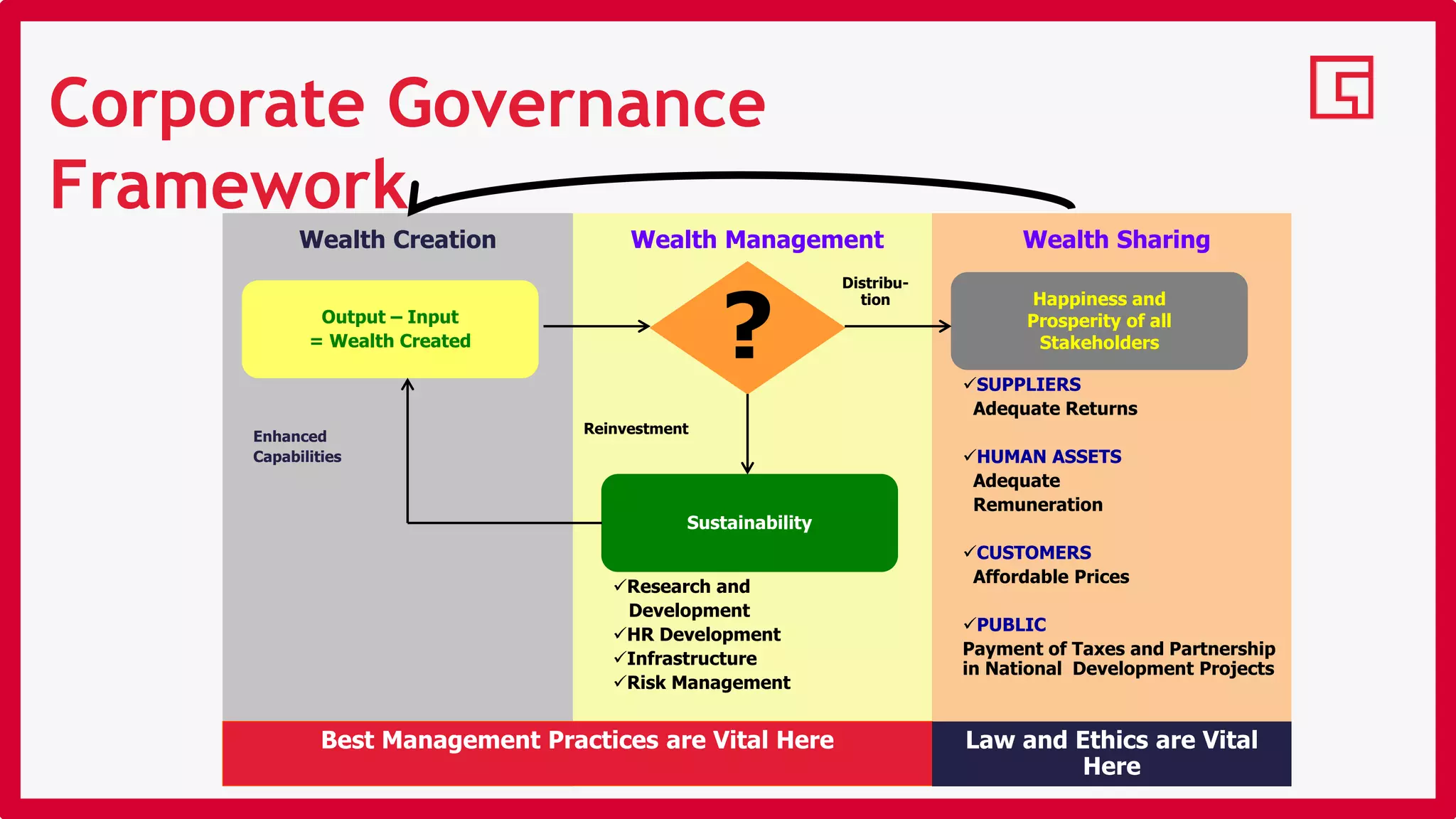
Output – Input
= Wealth Created
?
Sustainability
Happiness and
Prosperity of all
Stakeholders
Reinvestment
Distribu-
tion
Research and
Development
HR Development
Infrastructure
Risk Management
SUPPLIERS
Adequate Returns
HUMAN ASSETS
Adequate
Remuneration
CUSTOMERS
Affordable Prices
PUBLIC
Payment of Taxes and Partnership
in National Development Projects
Wealth Creation Wealth Management Wealth Sharing
Enhanced
Capabilities
Best Management Practices are Vital Here Law and Ethics are Vital
Here
Corporate Governance
Framework
Shareholders are not the only
Stakeholders in Corporate
Governance
Investors 1/3rd Investment
Lenders 2/3rd Investment
Customers 100% Earnings
Suppliers ½ of Working Capital
Employees 100% Value Generation
Government Basic Infrastructure & Facilities
Regulator Dispute Resolution
2 : 1
Debt – Equity
Ratio
2 : 1
Current Ratio
Stakeholders’ Stake in Corporate
Governance Value Chain
SUPPLIERS CUSTOMERS
HUMAN
RESOURCE
Supply Funds,
Materials and Services
Value Addition and
Management of
Resources
Give Opportunity to Co.
to Satisfy their Needs
Adequate Returns for
Funds, Material and
Services Supplied
Adequate Salary and
Security for leading a
Happy Life
Best Quality Products
and Customer Care at
Minimum Prices
ROLE OF STAKEHOLDERS
EXPECTATIONS OF STAKEHOLDERS
Potential Suppliers, Human
Resources and Customers
Biological, Economic and
Cultural EnvironmentPUBLIC
PUBLIC EXPECTS PARTNERHIP FOR SUSTAINABLE DEVELOPMENT
Stakeholders in Value Chain
Advantages of applying
Best Corporate Governance Practices
Growth
Growing
Revenues
Growing
Profits
Growing
Market Value
Widespread Goodwill and Brand
Reputation
Access to Global
Markets
Better Access to
Human Capital
Ready Market for
New Products
Widening
Customer Base
Enhanced Trust and
Confidence of all
Stakeholders
EMPLOYEES
INVESTORS
CUSTOMERS
SUPPLIERS
GOVERNMENT AND
REGULATORS
SOCIETY
Leading to…
Environment
Civil Society Business Society
SUSTAINABLE
DEVELOPMENT
Report on Corporate Governance –
Cadbury Committee …1992
First step towards Modern Corporate
Governance
In India it is an age old
concept
Rig Veda … 1500-1200 BC
Commitment to well-being and progress of all
stakeholders is our age old mantra
Indian Mythology
Satyam Vada Dharmam
Chara
- Taittariya Upanishad
“Forever speak the truth and follow the
dharma”
Truth : Disclosure of Actual State of
Affairs (Transparency in operations and
transactions)
Dharma : “Dharma is for the stability of
society, the maintenance of social order and
the general well-being and progress of
humankind.”
- Karna Parva of the Mahabharata. Verse-58 in Chapter 69
To provide “the maximum happiness for
the maximum number of people for the
maximum period, based on the principles
of Dharma – righteousness and moral
values.” - Ayodhya Kand
Governance Concept in
‘Ramayana’
“The Customer is King”
This is the soul behind modern
Marketing Management
Worshipping 33 Crore
Godheads
signifying various species,
plants,
cosmic elements, …
Care for Panchtatvas - Prithvi,
Jal, Vaayu, Akaash and Agni
that make a human being
This is our approach to
Environment Protection
The four essential principles of Mahatma
Gandhi's philosophy
Truth, Ahimsa, Trusteeship and
Constructive Action
Capacity, Knowledge and Resources
Maximisation of stakeholders’ value and well-being and progress
of humankind
TOWARDS
THROUGH
Transparency, accountability and truthful disclosure of state of
affairs
Dharma
Truth
Corporates are also expected
to use their
Companies that have followed
these
principles of
Corporate Governance
have
Consistently earned high returns,
increased their net worth and
enhanced their shareholders
wealth
Invested significantly in
proactive research and
development
Developed people into
‘achievers’ than just
‘performers’
Dealt ethically with customers,
government and business
partners
Maintained and updated their
professional management culture,
system and processes
..and accomplished
WINNING
EMPLOYEES
GROWING
INVESTORS
DELIGHTED
CUSTOMERS
TRUSTED
SUPPLIERS
SATISFIED
GOVERNMENT AND
REGULATORS
HAPPY
SOCIETY
CADBURY REPORT (1992)
Focus on control and reporting functions of boards and the role of auditors.
KING I REPORT ON CORPORATE GOVERNANCE (1994)
Standards of conduct for boards and directors, banks, and certain state-owned enterprises
Integrated approach to good governance
GREENBURY REPORT (1995)
Directors’ Remuneration - Remuneration Committee to determine remuneration of CEO and
executive directors and its disclosure;
HAMPEL REPORT (1998)
Sound system of internal control;
Board accountable for all aspects of risk management.
Corporate Governance –
International Scenario
KING II REPORT ON CORPORATE GOVERNANCE (2002)
• Code of Corporate Practices and Conduct
• Discipline ,Transparency, Independence, Accountability, Responsibility, Fairness, Social
Responsibility
OECD PRINCIPLES OF CORPORATE GOVERNANCE (1999/2004)
• Ensuring the Basis for an Effective Corporate Governance Framework.
• Rights of Shareholders and Key Ownership Functions
• Equitable Treatment of Shareholders
• Role of Stakeholders in Corporate Governance
• Disclosure and Transparency
• Responsibilities of the Board
Corporate Governance –
International Scenario
COMBINED CODE ON CORPORATE GOVERNANCE (2008)
• Standards of good practice in relation to board composition and development,
remuneration, accountability and audit and relations with shareholders.
KING III REPORT ON CORPORATE GOVERNANCE (2009)
• Ethical leadership and corporate citizenship
• Governance of risk
• Governance of information technology
• Compliance with laws, rules , codes and standards
• Internal audit
• Governing stakeholder relationships
• Integrated reporting and disclosure.
Corporate Governance –
International Scenario
From end justifies the means to long term sustainable growth
From inform others on a need to know basis to transparency
From family owned businesses to institution owned businesses
From domestic to global investors
From closely held Boards to professionally managed Boards
GOVERNANCE LANDSCAPE –
INTERNATIONAL TRENDS
From less active regulatory mechanism to more active regulatory mechanism
From Financial disclosures [14%] to Non-financial disclosures [86%] – Integrated
Reporting
From unstructured to Robust Board Processes
From adhoc replacements to focused Succession Planning
From letter to spirit and transparency
GOVERNANCE LANDSCAPE –
INTERNATIONAL TRENDS
Corporate Governance - Scenario in
India
 Promoters think Corporate Governance is all about
complying with Law
 Companies Act, 2013 & SEBI (LODR) Regulations,
2015 lay down the broad framework of CG.
 A CG certificate at the end of every F.Y., is good
enough to certify your CG status
Corporate Governance - Scenario in
India
Adequate
disclosures to
market
Board &
Committee
driven
processes
Independent
Directors
Key components of CG consist of:
Theory
Quality in Board Structure
Better Board Management and
Practices
Professional Contribution of
Independent Directors
Successful Strategies
Adequacy of Controls
Independence of Auditors
Practice
Ensured Minimum Compliance
Level
Standard Corporate Governance
Reports
Interdependent Directors – “Yes
Man”
Strategies to ensure personal
benefit of promoters
Mock controls
No qualification reports with the
consent of directors
CG – Theory & Practice in India
Integrated Reporting by Listed Entities
Compensation Agreements
Board Evaluation Norms
Sustainability Reporting
Secretarial Standards
Recent Developments
Role of Independent Directors
 Independent Directors are the messiah of Corporate
Governance in India
 Good or bad Corporate Governance, Independent
Directors are responsible
 So far, Independent Directors have performed averagely.
 Positive impact created by Independent Director
• Board processes and meetings, have become more
sacrosanct.
• Bring experience & expertise, on table
• Promoters have become more careful.
Role of Independent Directors
Why Independent Directors have failed to create a much bigger impact?
 Afraid to take aggressive stand
 Don’t have any veto power or are suppressed by
brute promoter majority
 Always at the mercy of Promoters, who can appoint
and remove them at any point of time.
 Conflict of interest
Corporate Governance issues -
TATA/Infosys
Key Reasons
- Professionally managed companies
- Follows ethical business practices
- Honest Promoters
- Created value for Stakeholders
But recent events raise eyebrows
What can be the probable reasons:
- Lack of confidence between Board & Promoters
- Deviation from business philosophy
- Question mark on business decisions
Till recently, TATA & Infosys renowned example of good Corporate Governance
Practices
What we learn?
0 Bust the myth that professionally governed companies follow
high standards of CG compared to promoter driven
businesses.
0 Extent to which promoters should interfere with professionally
managed Board
0 Limit up to which promoters and professionally managed
Boards should interact on business related issues
0 Promoters or Independent Directors, who should be the real
judge of evaluation of performance of Directors
0 Whether professionally managed Board should work on the
basis of broad philosophy of promoters or changing business
dynamics.
0 Independent Directors – are we allowing them to play an
important role?
CG vs Greed
0 Organizations are driven by Leaders and their philosophy
0 Personal aspirations play an important role in the success/downfall of any organization
0 Personal Aspirations & CG are two sides of same coin.
0 High personal aspirations come at the cost of good CG practices.
0 Some live examples are :
CG Parameters
Different type of entities, different objectives, therefore
different CG parameters
Type Working pattern
PSU
- Socialistic
- Bureaucratic controls
Professional Driven
Companies
- High accountability
- Maximizing stakeholder’s
wealth
Promoter Driven
Companies
- Personal Wealth creation
• As an organization
– Have a dynamic stakeholder driven vision
– Focus on innovative practices
– Undertake sustainable development efforts
– Use Information Technology to make governance more efficient and
effective
• Creating effective and robust Board processes through
– Use of Information Technology
– Structured Agenda and MIS
Recommendations to further
improve CG
• Directors
– Encouragement to speak freely
– Institutionalization of appointment of Independent Directors
– Implementing a rational and objective Directors Performance Evaluation
system and disclosing its results with the shareholders.
– Clear and objective Succession planning taking Board in confidence
• Disclosures
– Timely & effective disclosures to all stakeholder
– More focus should be on non-financial disclosures
– Simple and Standard annual report should be prepared
Recommendations to further
improve CG
• Policies
– Should be more result oriented
– Should reflect spirit rather than compliance of law
• Employees
– Create a happiness index in organization
– Promote Entrepreneurship
• Disciplining of Professionals – effective oversight of the
accounting and audit profession
Recommendations to further
improve CG
Clarity of Law –
Simplification of law will need to
better governance
Thus, Although a lot has been
done, but a lot needs to be
done.
CORPORATES SHOULD ACT LIKE HONEY BEE
WHICH SUCK THE NECTAR OF THE FLOWER WITHOUT
EFFECTING ITS FRAGRANCE AND PRODUCE
HONEY FOR THE WELL –BEING OF SOCIETY .
Pavan Kumar Vijay
Founder & Managing Director
D-28, South Extn. Part- I,
New Delhi 110049
F: +91 1140622201
T: +91 1140622200
pkvijay@indiacp.com
www.corporateprofessionals.com
/pkvijay
/pkvijay
www.pkvijay.com
/pkvijay
/pavanvijay

Corporate Governance - Realities and Emerging Scenario

  • 1.
    Corporate Governance - Realities and EmergingScenarioPavan Kumar Vijay MD, Corporate Professionals
  • 2.
    Corporate Governance restswith the Vision and Perception of the Leadership
  • 3.
    and a Leader needto adopt Vision for Good Corporate Governance
  • 4.
    Whereas the 20thcentury might be viewed as the age of management, the 21st century is predicted to be more focused on governance. Corporate Governance
  • 5.
    Corporate governance is"the system by which companies are directed and controlled" (Cadbury Committee, 1992). What is Corporate Governance? Cadbury Committee
  • 6.
    "Corporate governance involvesa set of relationships between a company’s management, its board, its shareholders and other stakeholders. Corporate governance also provides the structure through which the objectives of the company are set, and the means of attaining those objectives and monitoring performance are determined” OECD Principles of Corporate Governance What is Corporate Governance?
  • 7.
    “Corporate Governance isthe application of best management practices, compliance of law in letter and spirit and adherence to ethical standards for effective management and distribution of wealth and discharge of social responsibility for sustainable development of all stakeholders” What is Corporate Governance?
  • 8.
    Output – Input =Wealth Created ? Sustainability Happiness and Prosperity of all Stakeholders Reinvestment Distribu- tion Research and Development HR Development Infrastructure Risk Management SUPPLIERS Adequate Returns HUMAN ASSETS Adequate Remuneration CUSTOMERS Affordable Prices PUBLIC Payment of Taxes and Partnership in National Development Projects Wealth Creation Wealth Management Wealth Sharing Enhanced Capabilities Best Management Practices are Vital Here Law and Ethics are Vital Here Corporate Governance Framework
  • 9.
    Shareholders are notthe only Stakeholders in Corporate Governance
  • 10.
    Investors 1/3rd Investment Lenders2/3rd Investment Customers 100% Earnings Suppliers ½ of Working Capital Employees 100% Value Generation Government Basic Infrastructure & Facilities Regulator Dispute Resolution 2 : 1 Debt – Equity Ratio 2 : 1 Current Ratio Stakeholders’ Stake in Corporate Governance Value Chain
  • 11.
    SUPPLIERS CUSTOMERS HUMAN RESOURCE Supply Funds, Materialsand Services Value Addition and Management of Resources Give Opportunity to Co. to Satisfy their Needs Adequate Returns for Funds, Material and Services Supplied Adequate Salary and Security for leading a Happy Life Best Quality Products and Customer Care at Minimum Prices ROLE OF STAKEHOLDERS EXPECTATIONS OF STAKEHOLDERS Potential Suppliers, Human Resources and Customers Biological, Economic and Cultural EnvironmentPUBLIC PUBLIC EXPECTS PARTNERHIP FOR SUSTAINABLE DEVELOPMENT Stakeholders in Value Chain
  • 12.
    Advantages of applying BestCorporate Governance Practices
  • 13.
  • 14.
    Widespread Goodwill andBrand Reputation Access to Global Markets Better Access to Human Capital Ready Market for New Products Widening Customer Base
  • 15.
    Enhanced Trust and Confidenceof all Stakeholders EMPLOYEES INVESTORS CUSTOMERS SUPPLIERS GOVERNMENT AND REGULATORS SOCIETY
  • 16.
  • 17.
    Environment Civil Society BusinessSociety SUSTAINABLE DEVELOPMENT
  • 18.
    Report on CorporateGovernance – Cadbury Committee …1992 First step towards Modern Corporate Governance
  • 19.
    In India itis an age old concept
  • 20.
    Rig Veda …1500-1200 BC
  • 21.
    Commitment to well-beingand progress of all stakeholders is our age old mantra Indian Mythology
  • 22.
    Satyam Vada Dharmam Chara -Taittariya Upanishad
  • 23.
    “Forever speak thetruth and follow the dharma”
  • 24.
    Truth : Disclosureof Actual State of Affairs (Transparency in operations and transactions)
  • 25.
    Dharma : “Dharmais for the stability of society, the maintenance of social order and the general well-being and progress of humankind.” - Karna Parva of the Mahabharata. Verse-58 in Chapter 69
  • 26.
    To provide “themaximum happiness for the maximum number of people for the maximum period, based on the principles of Dharma – righteousness and moral values.” - Ayodhya Kand Governance Concept in ‘Ramayana’
  • 27.
  • 28.
    This is thesoul behind modern Marketing Management
  • 29.
    Worshipping 33 Crore Godheads signifyingvarious species, plants, cosmic elements, …
  • 30.
    Care for Panchtatvas- Prithvi, Jal, Vaayu, Akaash and Agni that make a human being
  • 31.
    This is ourapproach to Environment Protection
  • 32.
    The four essentialprinciples of Mahatma Gandhi's philosophy Truth, Ahimsa, Trusteeship and Constructive Action
  • 33.
    Capacity, Knowledge andResources Maximisation of stakeholders’ value and well-being and progress of humankind TOWARDS THROUGH Transparency, accountability and truthful disclosure of state of affairs Dharma Truth Corporates are also expected to use their
  • 34.
    Companies that havefollowed these principles of Corporate Governance have
  • 35.
    Consistently earned highreturns, increased their net worth and enhanced their shareholders wealth
  • 36.
    Invested significantly in proactiveresearch and development
  • 37.
    Developed people into ‘achievers’than just ‘performers’
  • 38.
    Dealt ethically withcustomers, government and business partners
  • 39.
    Maintained and updatedtheir professional management culture, system and processes
  • 40.
  • 41.
  • 42.
    CADBURY REPORT (1992) Focuson control and reporting functions of boards and the role of auditors. KING I REPORT ON CORPORATE GOVERNANCE (1994) Standards of conduct for boards and directors, banks, and certain state-owned enterprises Integrated approach to good governance GREENBURY REPORT (1995) Directors’ Remuneration - Remuneration Committee to determine remuneration of CEO and executive directors and its disclosure; HAMPEL REPORT (1998) Sound system of internal control; Board accountable for all aspects of risk management. Corporate Governance – International Scenario
  • 43.
    KING II REPORTON CORPORATE GOVERNANCE (2002) • Code of Corporate Practices and Conduct • Discipline ,Transparency, Independence, Accountability, Responsibility, Fairness, Social Responsibility OECD PRINCIPLES OF CORPORATE GOVERNANCE (1999/2004) • Ensuring the Basis for an Effective Corporate Governance Framework. • Rights of Shareholders and Key Ownership Functions • Equitable Treatment of Shareholders • Role of Stakeholders in Corporate Governance • Disclosure and Transparency • Responsibilities of the Board Corporate Governance – International Scenario
  • 44.
    COMBINED CODE ONCORPORATE GOVERNANCE (2008) • Standards of good practice in relation to board composition and development, remuneration, accountability and audit and relations with shareholders. KING III REPORT ON CORPORATE GOVERNANCE (2009) • Ethical leadership and corporate citizenship • Governance of risk • Governance of information technology • Compliance with laws, rules , codes and standards • Internal audit • Governing stakeholder relationships • Integrated reporting and disclosure. Corporate Governance – International Scenario
  • 45.
    From end justifiesthe means to long term sustainable growth From inform others on a need to know basis to transparency From family owned businesses to institution owned businesses From domestic to global investors From closely held Boards to professionally managed Boards GOVERNANCE LANDSCAPE – INTERNATIONAL TRENDS
  • 46.
    From less activeregulatory mechanism to more active regulatory mechanism From Financial disclosures [14%] to Non-financial disclosures [86%] – Integrated Reporting From unstructured to Robust Board Processes From adhoc replacements to focused Succession Planning From letter to spirit and transparency GOVERNANCE LANDSCAPE – INTERNATIONAL TRENDS
  • 48.
    Corporate Governance -Scenario in India  Promoters think Corporate Governance is all about complying with Law  Companies Act, 2013 & SEBI (LODR) Regulations, 2015 lay down the broad framework of CG.  A CG certificate at the end of every F.Y., is good enough to certify your CG status
  • 49.
    Corporate Governance -Scenario in India Adequate disclosures to market Board & Committee driven processes Independent Directors Key components of CG consist of:
  • 50.
    Theory Quality in BoardStructure Better Board Management and Practices Professional Contribution of Independent Directors Successful Strategies Adequacy of Controls Independence of Auditors Practice Ensured Minimum Compliance Level Standard Corporate Governance Reports Interdependent Directors – “Yes Man” Strategies to ensure personal benefit of promoters Mock controls No qualification reports with the consent of directors CG – Theory & Practice in India
  • 51.
    Integrated Reporting byListed Entities Compensation Agreements Board Evaluation Norms Sustainability Reporting Secretarial Standards Recent Developments
  • 52.
    Role of IndependentDirectors  Independent Directors are the messiah of Corporate Governance in India  Good or bad Corporate Governance, Independent Directors are responsible  So far, Independent Directors have performed averagely.  Positive impact created by Independent Director • Board processes and meetings, have become more sacrosanct. • Bring experience & expertise, on table • Promoters have become more careful.
  • 53.
    Role of IndependentDirectors Why Independent Directors have failed to create a much bigger impact?  Afraid to take aggressive stand  Don’t have any veto power or are suppressed by brute promoter majority  Always at the mercy of Promoters, who can appoint and remove them at any point of time.  Conflict of interest
  • 54.
    Corporate Governance issues- TATA/Infosys Key Reasons - Professionally managed companies - Follows ethical business practices - Honest Promoters - Created value for Stakeholders But recent events raise eyebrows What can be the probable reasons: - Lack of confidence between Board & Promoters - Deviation from business philosophy - Question mark on business decisions Till recently, TATA & Infosys renowned example of good Corporate Governance Practices
  • 55.
    What we learn? 0Bust the myth that professionally governed companies follow high standards of CG compared to promoter driven businesses. 0 Extent to which promoters should interfere with professionally managed Board 0 Limit up to which promoters and professionally managed Boards should interact on business related issues 0 Promoters or Independent Directors, who should be the real judge of evaluation of performance of Directors 0 Whether professionally managed Board should work on the basis of broad philosophy of promoters or changing business dynamics. 0 Independent Directors – are we allowing them to play an important role?
  • 56.
    CG vs Greed 0Organizations are driven by Leaders and their philosophy 0 Personal aspirations play an important role in the success/downfall of any organization 0 Personal Aspirations & CG are two sides of same coin. 0 High personal aspirations come at the cost of good CG practices. 0 Some live examples are :
  • 57.
    CG Parameters Different typeof entities, different objectives, therefore different CG parameters Type Working pattern PSU - Socialistic - Bureaucratic controls Professional Driven Companies - High accountability - Maximizing stakeholder’s wealth Promoter Driven Companies - Personal Wealth creation
  • 58.
    • As anorganization – Have a dynamic stakeholder driven vision – Focus on innovative practices – Undertake sustainable development efforts – Use Information Technology to make governance more efficient and effective • Creating effective and robust Board processes through – Use of Information Technology – Structured Agenda and MIS Recommendations to further improve CG
  • 59.
    • Directors – Encouragementto speak freely – Institutionalization of appointment of Independent Directors – Implementing a rational and objective Directors Performance Evaluation system and disclosing its results with the shareholders. – Clear and objective Succession planning taking Board in confidence • Disclosures – Timely & effective disclosures to all stakeholder – More focus should be on non-financial disclosures – Simple and Standard annual report should be prepared Recommendations to further improve CG
  • 60.
    • Policies – Shouldbe more result oriented – Should reflect spirit rather than compliance of law • Employees – Create a happiness index in organization – Promote Entrepreneurship • Disciplining of Professionals – effective oversight of the accounting and audit profession Recommendations to further improve CG
  • 61.
    Clarity of Law– Simplification of law will need to better governance
  • 63.
    Thus, Although alot has been done, but a lot needs to be done.
  • 64.
    CORPORATES SHOULD ACTLIKE HONEY BEE WHICH SUCK THE NECTAR OF THE FLOWER WITHOUT EFFECTING ITS FRAGRANCE AND PRODUCE HONEY FOR THE WELL –BEING OF SOCIETY .
  • 65.
    Pavan Kumar Vijay Founder& Managing Director D-28, South Extn. Part- I, New Delhi 110049 F: +91 1140622201 T: +91 1140622200 pkvijay@indiacp.com www.corporateprofessionals.com /pkvijay /pkvijay www.pkvijay.com /pkvijay /pavanvijay