Corporate Solutions & Services Inc.


              How do you achieve security for your enterprise and
                    in turn achieve effective Compliance?


                                                     Saskatchewan Summit 3.0
                                                      Payment Card Industry


                                     “Compliance does not equal to security”


      Bashir Fancy, MD, Corporate Solutions & Services Inc.
      Special Advisor,
      Grant Thornton LLP
      April 25, 2012
© 2010 Grant Thornton International. All rights reserved.      1                 Corporate Solutions & Services
Objectives


This session will focus on:

1. A quick review of what the problem was and is
2. How we are approaching the PCI Compliance
   standard in the last few years
   1. The reason for limited success
3. How to approach PCI Compliance as part of your
   overall security compliance effectively and
   achieve sustainability

                              2
Challenges that Organizations face

Without an effective data protection policy/process in place, your Organization
   runs the potential risk of sensitive data loss, which can impact:
         – Brand reputation
         – Fraud Losses and financial impact
         – Breach notification costs
         – Costs to manage fraud
         – Possible fines from credit card companies
         – Loss of customer confidence
         – Undesired regulatory attention


Your Organization may not be taking advantage of the opportunity to improve
   efficiency, cost savings and improved bottom-line
PCI compliance would not have been required in the first place, if all the
   Organization had been doing the right thing to protect the sensitive
   information

                                                3
Background to the development of PCI


Significant Fraud losses have been occurring in Canada & Globally in both card present (swiped)
    & card not present (online) environment
      • Stored data not protected by acquirers/merchants/3rd Party Processors
      • Sensitive data easily accessible, was not protected by processors
      • Transmission of credit card data in clear text, making it easy to compromise
      • Organized crime infiltrated major organizations and continue to do so today
      • High proportion of compromise had a major internal component
      • Lot more information continues to be stored than needed to conduct business
Brand impact can be significant with loss of confidence by consumers being impacted by the
    compromise.
Significant costs to handle customer service issues including card replacement costs, credit
    monitoring fraud losses and eventually resulting in loss of business
Visa was concerned that fraud losses were becoming acceptable as “cost of doing business”


4 Grant Thornton LLP - Achieving compliance and security                  Corporate Solutions & Services Inc.
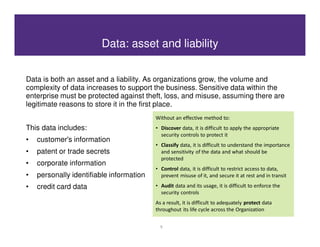
Data: asset and liability


Data is both an asset and a liability. As organizations grow, the volume and
complexity of data increases to support the business. Sensitive data within the
enterprise must be protected against theft, loss, and misuse, assuming there are
legitimate reasons to store it in the first place.
                                          Without an effective method to:
This data includes:                       • Discover data, it is difficult to apply the appropriate
                                            security controls to protect it
•   customer's information
                                          • Classify data, it is difficult to understand the importance
•   patent or trade secrets                 and sensitivity of the data and what should be
                                            protected
•   corporate information
                                          • Control data, it is difficult to restrict access to data,
•   personally identifiable information     prevent misuse of it, and secure it at rest and in transit

•   credit card data                      • Audit data and its usage, it is difficult to enforce the
                                            security controls
                                          As a result, it is difficult to adequately protect data
                                          throughout its life cycle across the Organization


                                            5
Challenges that Organizations face


• Initially there was a lack of support from the corner suite as not all
  Organizations truly understand the value of PCI standards
• Today many Organizations adopt it as a compliance issue, primarily to achieve
  the certification paper
• Organizational silos prevent a holistic view to the magnitude of the problem
  that create subsequent losses and costs
• Worse, these costs and inefficiencies have become part of our infrastructure
• Fraud is seen by many organizations as a “cost of doing business” and these
  losses have been normalized
• Organizations track only the dollars they write off on the books and NOT costs
  to manage fraud that are distributed across the organization


                                           6
Lessons Learnt (Observations)

• Organizations are doing the bare minimum to comply- putting their brand at
  risk
• PCI is NOT part of broad regulatory/audit/compliance with no ongoing
  oversight or program/strategy in place to sustain compliance
• Remediation efforts have been undertaken using the letter of law. No
  “enterprise wide owner” – lack of stakeholder involvement
• Widespread access to critical data – “grandfather rights” -reluctance to change
• PCI still seen as a “Credit Card” mandate only
• Lack of effective access controls, including the Point of Sale
• Communication and awareness has been lacking or has been selective
• There are a lot of make work projects that neither produce security or
  enhance the operations!
• We still see misunderstanding of the requirements and/or collusion
                                          7
Lessons Learnt (Observations)


•   Organizations continue to store data that is not required to conduct the business.
•   Some Organizations have opted for tokenization, but the benefits of this approach
    have been minimized because the whole project was not thought through.
     • For example the ability to translate exists in many parts of the Organization.

•   Some credit card processing has been outsourced without due diligence to whether
    the outsourced organization is in fact PCI compliant or secure. Outsourcers do
    outsource some of the work further down the stream compounding the problem
•   Lack of an enterprise-wide owner and done on a one time effort – NOT SUSTAINABLE
•   Organization have not done the mapping and as such duplicate the work instead of
    “do it once and satisfy many”
•   Some Organizations have embarked upon remediation without first doing data
    classification/discovery - Lack of Strategy

                                             8
Going Forward


•   Contracts managing third parties have not keep pace with changing business
    needs and in some instances, have not stipulated the right to audit the third
    parties – need to review contracts
•   Many of the processes have been derived from the paper based business and
    do not necessarily reflect the current environment or need
•   Utilize “compensating controls”. This has significant impact where legacy
    systems are involved or where organizations may have invested in a different
    approach/technology to secure themselves
•   The road to PCI compliance crosses many departments - Must have buy-in
    from the top; otherwise organizations risk failure and/or continued exposure
•   Take into account the original problem (fraud, data loss, data breaches, brand
    impact) that the PCI-DSS standard was developed to address, thereby taking a
    broader perspective, so that organizations can get a return on their investment

                                           9
Going Forward

•   A carefully thought through, holistic and risk-based approach is required to take
    advantage of the synergies that exist between PCI-DSS, SOX, AML etc.) – “Do Once
    and Satisfy Many”
•   Take a “risk based approach” – not all risks have to addressed, but they must be
    understood
•   First and foremost understand the data flows fully. Review, justify and rationalize
    what you really need to conduct your business. There will be resistance but
    Organizations must enforce the discipline of streamlining and managing who has
    access to what, why with proper oversight.
•   This approach will help reduce the overall effort, optimize operations and produce a
    “return on investment”

•   Review access controls and limit access

•   Build a value proposition beyond just compliance

                   •   Technology, Process and People must be aligned
                                              10
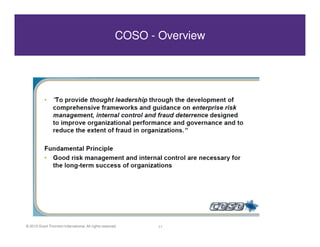
COSO - Overview


© 2010 Grant Thornton International. All rights reserved.     11
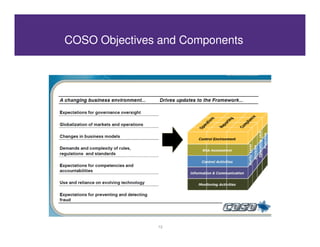
COSO Objectives and Components


               12
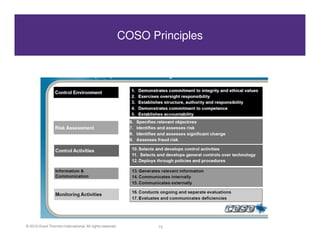
COSO Principles


© 2010 Grant Thornton International. All rights reserved.          13
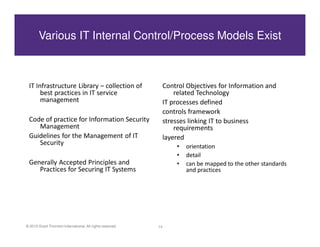
Frameworks for IT 'GRC'
       Various IT Internal Control/Process Models Exist


 ITIL                                                        CobiT
 IT Infrastructure Library – collection of                   Control Objectives for Information and
      best practices in IT service                               related Technology
      management                                             IT processes defined
 ISO 27001/ ISO27002                                         controls framework
 Code of practice for Information Security                   stresses linking IT to business
    Management                                                   requirements
 Guidelines for the Management of IT                         layered
    Security                                                     •   orientation
 NIST 800 series                                                 •   detail
 Generally Accepted Principles and                               •   can be mapped to the other standards
    Practices for Securing IT Systems                                and practices


© 2010 Grant Thornton International. All rights reserved.   14
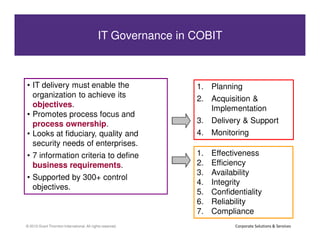
IT Governance in COBIT in COBIT
                IT Governance


 • IT delivery must enable the                              1. Planning
   organization to achieve its                              2. Acquisition &
   objectives.                                                 Implementation
 • Promotes process focus and
   process ownership.                                       3. Delivery & Support
 • Looks at fiduciary, quality and                          4. Monitoring
   security needs of enterprises.
 • 7 information criteria to define                         1.   Effectiveness
   business requirements.                                   2.   Efficiency
                                                            3.   Availability
 • Supported by 300+ control
                                                            4.   Integrity
   objectives.
                                                            5.   Confidentiality
                                                            6.   Reliability
15
                                                            7.   Compliance
© 2010 Grant Thornton International. All rights reserved.               Corporate Solutions & Services
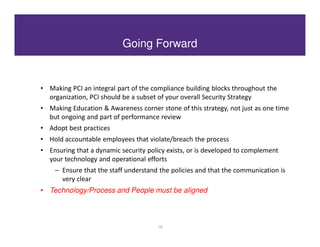
Going Forward


• Making PCI an integral part of the compliance building blocks throughout the
  organization, PCI should be a subset of your overall Security Strategy
• Making Education & Awareness corner stone of this strategy, not just as one time
  but ongoing and part of performance review
• Adopt best practices
• Hold accountable employees that violate/breach the process
• Ensuring that a dynamic security policy exists, or is developed to complement
  your technology and operational efforts
    – Ensure that the staff understand the policies and that the communication is
      very clear
• Technology/Process and People must be aligned


                                       16
Addressing Compliance
The Sustainable Approach


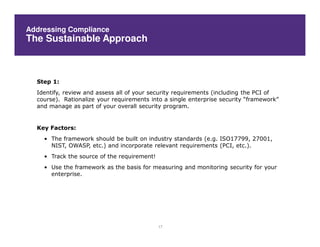
  Step 1:
  Identify, review and assess all of your security requirements (including the PCI of
  course). Rationalize your requirements into a single enterprise security “framework”
  and manage as part of your overall security program.


  Key Factors:
    • The framework should be built on industry standards (e.g. ISO17799, 27001,
      NIST, OWASP, etc.) and incorporate relevant requirements (PCI, etc.).
    • Track the source of the requirement!
    • Use the framework as the basis for measuring and monitoring security for your
      enterprise.


                                             17
Addressing Compliance
The Sustainable Approach


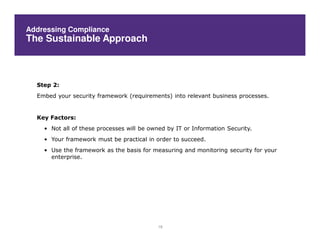
  Step 2:
  Embed your security framework (requirements) into relevant business processes.


  Key Factors:
    • Not all of these processes will be owned by IT or Information Security.
    • Your framework must be practical in order to succeed.
    • Use the framework as the basis for measuring and monitoring security for your
      enterprise.


                                            18
Addressing Compliance
The Sustainable Approach

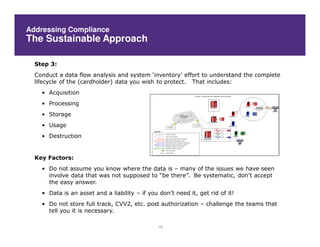
  Step 3:
  Conduct a data flow analysis and system ‘inventory’ effort to understand the complete
  lifecycle of the (cardholder) data you wish to protect. That includes:
    • Acquisition
    • Processing
    • Storage
    • Usage
    • Destruction


  Key Factors:
    • Do not assume you know where the data is – many of the issues we have seen
      involve data that was not supposed to “be there”. Be systematic, don’t accept
      the easy answer.
    • Data is an asset and a liability – if you don’t need it, get rid of it!
    • Do not store full track, CVV2, etc. post authorization – challenge the teams that
      tell you it is necessary.

                                                19
Addressing Compliance
The Sustainable Approach


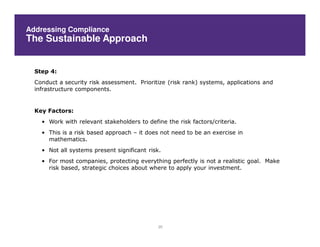
  Step 4:
  Conduct a security risk assessment. Prioritize (risk rank) systems, applications and
  infrastructure components.


  Key Factors:
    • Work with relevant stakeholders to define the risk factors/criteria.
    • This is a risk based approach – it does not need to be an exercise in
      mathematics.
    • Not all systems present significant risk.
    • For most companies, protecting everything perfectly is not a realistic goal. Make
      risk based, strategic choices about where to apply your investment.


                                              20
Addressing Compliance
The Sustainable Approach


 Step 5:
 Systematically assess the critical systems, applications and components in your
 environment using your security framework. Identify gaps, develop solutions
 appropriate to the risk and remediate.


 Key Factors:
   • Look beyond the individual requirements and across the environment. Address
     issues from a enterprise security perspective where appropriate.
   • Leverage other functions where possible (e.g. Internal Audit)
   • Automate assessment tasks where possible. Sample where appropriate.
   • Use the framework as the basis for measuring and monitoring security for your
     enterprise.


                                            21
Addressing Compliance
The Sustainable Approach


  Step 6:
  Make this an ongoing process. Repeat.


  Key Factors:
    • This should be an ongoing process. The initial effort will be the most significant
      but it should greatly reduce the effort going forward.
    • The data flow analysis and system inventory should return value across multiple
      initiatives. It should be incrementally updated on a regular basis.
    • As new requirements are devised, add them to your framework and continue
      moving forward.
    • Use the framework as the basis for measuring and monitoring security for your
      enterprise.


                                            22
Addressing Compliance
Benefits of The Sustainable Approach


  • Reduced Effort
     - One program as opposed to multiple programs
     - Streamline compliance validation going forward
     - Leverage technology and process improvements to meet multiple requirements


  • Improved Security
     - Risk based approach allows for investment in the most critical areas
     - Systematic, consistent assessment against the enterprise security framework
       allows for a holistic approach to security


                                           23
Addressing Compliance
Level 3 and 4 Merchants

The same process should work for you:
   • Simplified framework
   • Fewer systems to inventory, risk rank, assess, etc.


Other Factors to consider:
   • Focus on security when dealing with key service providers: web design and
     hosting companies, payment processors, POS systems integrators, etc.
        - Ask about their security strategy and design as it relates to the
          product/service they offer.
        - Are they are PCI compliant? Do they store track data? What safeguards
          do they have in place to protect your customers?
   • To the extent possible, understand your entire payment chain.
   • Ensure you legal contracts reflects your needs and protects you.
   • You don’t have to be big to be a target. Criminals are opportunistic.


                                            24
Remediation


I
    Approach
    Compensating Controls
    Common Compliance Issues
    Scope Reduction
    Other Items to Consider
    Tactical Fraud Prevention
    Be Prepared - Incident Response
    What To Do If Compromised


                                      25
Remediation
Approach

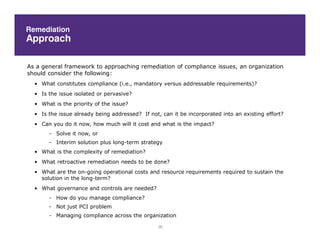
As a general framework to approaching remediation of compliance issues, an organization
should consider the following:
  • What constitutes compliance (i.e., mandatory versus addressable requirements)?
  • Is the issue isolated or pervasive?
  • What is the priority of the issue?
  • Is the issue already being addressed? If not, can it be incorporated into an existing effort?
  • Can you do it now, how much will it cost and what is the impact?
       - Solve it now, or
       - Interim solution plus long-term strategy
  • What is the complexity of remediation?
  • What retroactive remediation needs to be done?
  • What are the on-going operational costs and resource requirements required to sustain the
    solution in the long-term?
  • What governance and controls are needed?
       - How do you manage compliance?
       - Not just PCI problem
       - Managing compliance across the organization

                                                 26
Remediation
Compensating Controls


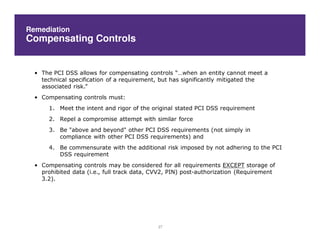
  • The PCI DSS allows for compensating controls “…when an entity cannot meet a
    technical specification of a requirement, but has significantly mitigated the
    associated risk.”
  • Compensating controls must:
       1. Meet the intent and rigor of the original stated PCI DSS requirement
       2. Repel a compromise attempt with similar force
       3. Be "above and beyond" other PCI DSS requirements (not simply in
          compliance with other PCI DSS requirements) and
       4. Be commensurate with the additional risk imposed by not adhering to the PCI
          DSS requirement
  • Compensating controls may be considered for all requirements EXCEPT storage of
    prohibited data (i.e., full track data, CVV2, PIN) post-authorization (Requirement
    3.2).


                                             27
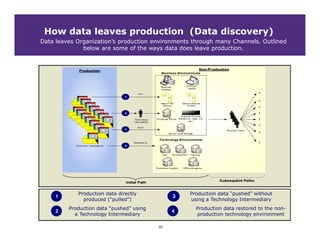
How data leaves production (Data discovery)
Data leaves Organization’s production environments through many Channels. Outlined
              below are some of the ways data does leave production.


            Production data directly               Production data “pushed” without
     1
              produced (“pulled”)                  using a Technology Intermediary
         Production data “pushed” using              Production data restored to the non-
     2                                         4
           a Technology Intermediary                 production technology environment

                                          28
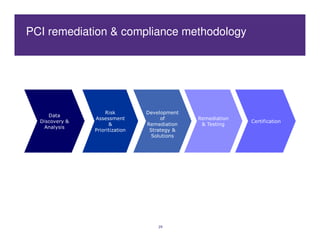
PCI remediation & compliance methodology


                    Risk         Development
     Data
                Assessment            of       Remediation
  Discovery &                                                Certification
                      &          Remediation    & Testing
   Analysis
                Prioritization    Strategy &
                                   Solutions


                                     29
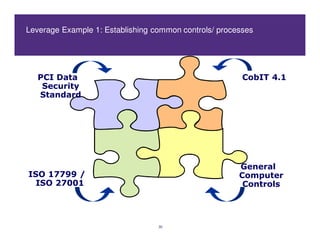
Leverage Example 1: Establishing common controls/ processes


   PCI Data                                             CobIT 4.1
    Security
   Standard


                                                       General
ISO 17799 /                                            Computer
  ISO 27001                                             Controls


                                  30
Corporate Solutions & Services Inc.


Achieving compliance does not necessarily mean
becoming secure.

However, achieving security does translate into
compliance.
Corporate Solutions & Services Inc.


Questions
Corporate Solutions & Services Inc.


Thank You

Bashir Fancy,
Special Advisor
Grant Thornton LLP
E bashir.fancy@ca.gt.com
bsfancy@rogers.com
T: 905 232 9191
C (416) 716-3418

Sask 3.0 Summit Pci dss presentation Bashir Fancy

  • 1.
    Corporate Solutions &Services Inc. How do you achieve security for your enterprise and in turn achieve effective Compliance? Saskatchewan Summit 3.0 Payment Card Industry “Compliance does not equal to security” Bashir Fancy, MD, Corporate Solutions & Services Inc. Special Advisor, Grant Thornton LLP April 25, 2012 © 2010 Grant Thornton International. All rights reserved. 1 Corporate Solutions & Services
  • 2.
    Objectives This session willfocus on: 1. A quick review of what the problem was and is 2. How we are approaching the PCI Compliance standard in the last few years 1. The reason for limited success 3. How to approach PCI Compliance as part of your overall security compliance effectively and achieve sustainability 2
  • 3.
    Challenges that Organizationsface Without an effective data protection policy/process in place, your Organization runs the potential risk of sensitive data loss, which can impact: – Brand reputation – Fraud Losses and financial impact – Breach notification costs – Costs to manage fraud – Possible fines from credit card companies – Loss of customer confidence – Undesired regulatory attention Your Organization may not be taking advantage of the opportunity to improve efficiency, cost savings and improved bottom-line PCI compliance would not have been required in the first place, if all the Organization had been doing the right thing to protect the sensitive information 3
  • 4.
    Background to thedevelopment of PCI Significant Fraud losses have been occurring in Canada & Globally in both card present (swiped) & card not present (online) environment • Stored data not protected by acquirers/merchants/3rd Party Processors • Sensitive data easily accessible, was not protected by processors • Transmission of credit card data in clear text, making it easy to compromise • Organized crime infiltrated major organizations and continue to do so today • High proportion of compromise had a major internal component • Lot more information continues to be stored than needed to conduct business Brand impact can be significant with loss of confidence by consumers being impacted by the compromise. Significant costs to handle customer service issues including card replacement costs, credit monitoring fraud losses and eventually resulting in loss of business Visa was concerned that fraud losses were becoming acceptable as “cost of doing business” 4 Grant Thornton LLP - Achieving compliance and security Corporate Solutions & Services Inc.
  • 5.
    Data: asset andliability Data is both an asset and a liability. As organizations grow, the volume and complexity of data increases to support the business. Sensitive data within the enterprise must be protected against theft, loss, and misuse, assuming there are legitimate reasons to store it in the first place. Without an effective method to: This data includes: • Discover data, it is difficult to apply the appropriate security controls to protect it • customer's information • Classify data, it is difficult to understand the importance • patent or trade secrets and sensitivity of the data and what should be protected • corporate information • Control data, it is difficult to restrict access to data, • personally identifiable information prevent misuse of it, and secure it at rest and in transit • credit card data • Audit data and its usage, it is difficult to enforce the security controls As a result, it is difficult to adequately protect data throughout its life cycle across the Organization 5
  • 6.
    Challenges that Organizationsface • Initially there was a lack of support from the corner suite as not all Organizations truly understand the value of PCI standards • Today many Organizations adopt it as a compliance issue, primarily to achieve the certification paper • Organizational silos prevent a holistic view to the magnitude of the problem that create subsequent losses and costs • Worse, these costs and inefficiencies have become part of our infrastructure • Fraud is seen by many organizations as a “cost of doing business” and these losses have been normalized • Organizations track only the dollars they write off on the books and NOT costs to manage fraud that are distributed across the organization 6
  • 7.
    Lessons Learnt (Observations) •Organizations are doing the bare minimum to comply- putting their brand at risk • PCI is NOT part of broad regulatory/audit/compliance with no ongoing oversight or program/strategy in place to sustain compliance • Remediation efforts have been undertaken using the letter of law. No “enterprise wide owner” – lack of stakeholder involvement • Widespread access to critical data – “grandfather rights” -reluctance to change • PCI still seen as a “Credit Card” mandate only • Lack of effective access controls, including the Point of Sale • Communication and awareness has been lacking or has been selective • There are a lot of make work projects that neither produce security or enhance the operations! • We still see misunderstanding of the requirements and/or collusion 7
  • 8.
    Lessons Learnt (Observations) • Organizations continue to store data that is not required to conduct the business. • Some Organizations have opted for tokenization, but the benefits of this approach have been minimized because the whole project was not thought through. • For example the ability to translate exists in many parts of the Organization. • Some credit card processing has been outsourced without due diligence to whether the outsourced organization is in fact PCI compliant or secure. Outsourcers do outsource some of the work further down the stream compounding the problem • Lack of an enterprise-wide owner and done on a one time effort – NOT SUSTAINABLE • Organization have not done the mapping and as such duplicate the work instead of “do it once and satisfy many” • Some Organizations have embarked upon remediation without first doing data classification/discovery - Lack of Strategy 8
  • 9.
    Going Forward • Contracts managing third parties have not keep pace with changing business needs and in some instances, have not stipulated the right to audit the third parties – need to review contracts • Many of the processes have been derived from the paper based business and do not necessarily reflect the current environment or need • Utilize “compensating controls”. This has significant impact where legacy systems are involved or where organizations may have invested in a different approach/technology to secure themselves • The road to PCI compliance crosses many departments - Must have buy-in from the top; otherwise organizations risk failure and/or continued exposure • Take into account the original problem (fraud, data loss, data breaches, brand impact) that the PCI-DSS standard was developed to address, thereby taking a broader perspective, so that organizations can get a return on their investment 9
  • 10.
    Going Forward • A carefully thought through, holistic and risk-based approach is required to take advantage of the synergies that exist between PCI-DSS, SOX, AML etc.) – “Do Once and Satisfy Many” • Take a “risk based approach” – not all risks have to addressed, but they must be understood • First and foremost understand the data flows fully. Review, justify and rationalize what you really need to conduct your business. There will be resistance but Organizations must enforce the discipline of streamlining and managing who has access to what, why with proper oversight. • This approach will help reduce the overall effort, optimize operations and produce a “return on investment” • Review access controls and limit access • Build a value proposition beyond just compliance • Technology, Process and People must be aligned 10
  • 11.
    COSO - Overview ©2010 Grant Thornton International. All rights reserved. 11
  • 12.
    COSO Objectives andComponents 12
  • 13.
    COSO Principles © 2010Grant Thornton International. All rights reserved. 13
  • 14.
    Frameworks for IT'GRC' Various IT Internal Control/Process Models Exist ITIL CobiT IT Infrastructure Library – collection of Control Objectives for Information and best practices in IT service related Technology management IT processes defined ISO 27001/ ISO27002 controls framework Code of practice for Information Security stresses linking IT to business Management requirements Guidelines for the Management of IT layered Security • orientation NIST 800 series • detail Generally Accepted Principles and • can be mapped to the other standards Practices for Securing IT Systems and practices © 2010 Grant Thornton International. All rights reserved. 14
  • 15.
    IT Governance inCOBIT in COBIT IT Governance • IT delivery must enable the 1. Planning organization to achieve its 2. Acquisition & objectives. Implementation • Promotes process focus and process ownership. 3. Delivery & Support • Looks at fiduciary, quality and 4. Monitoring security needs of enterprises. • 7 information criteria to define 1. Effectiveness business requirements. 2. Efficiency 3. Availability • Supported by 300+ control 4. Integrity objectives. 5. Confidentiality 6. Reliability 15 7. Compliance © 2010 Grant Thornton International. All rights reserved. Corporate Solutions & Services
  • 16.
    Going Forward • MakingPCI an integral part of the compliance building blocks throughout the organization, PCI should be a subset of your overall Security Strategy • Making Education & Awareness corner stone of this strategy, not just as one time but ongoing and part of performance review • Adopt best practices • Hold accountable employees that violate/breach the process • Ensuring that a dynamic security policy exists, or is developed to complement your technology and operational efforts – Ensure that the staff understand the policies and that the communication is very clear • Technology/Process and People must be aligned 16
  • 17.
    Addressing Compliance The SustainableApproach Step 1: Identify, review and assess all of your security requirements (including the PCI of course). Rationalize your requirements into a single enterprise security “framework” and manage as part of your overall security program. Key Factors: • The framework should be built on industry standards (e.g. ISO17799, 27001, NIST, OWASP, etc.) and incorporate relevant requirements (PCI, etc.). • Track the source of the requirement! • Use the framework as the basis for measuring and monitoring security for your enterprise. 17
  • 18.
    Addressing Compliance The SustainableApproach Step 2: Embed your security framework (requirements) into relevant business processes. Key Factors: • Not all of these processes will be owned by IT or Information Security. • Your framework must be practical in order to succeed. • Use the framework as the basis for measuring and monitoring security for your enterprise. 18
  • 19.
    Addressing Compliance The SustainableApproach Step 3: Conduct a data flow analysis and system ‘inventory’ effort to understand the complete lifecycle of the (cardholder) data you wish to protect. That includes: • Acquisition • Processing • Storage • Usage • Destruction Key Factors: • Do not assume you know where the data is – many of the issues we have seen involve data that was not supposed to “be there”. Be systematic, don’t accept the easy answer. • Data is an asset and a liability – if you don’t need it, get rid of it! • Do not store full track, CVV2, etc. post authorization – challenge the teams that tell you it is necessary. 19
  • 20.
    Addressing Compliance The SustainableApproach Step 4: Conduct a security risk assessment. Prioritize (risk rank) systems, applications and infrastructure components. Key Factors: • Work with relevant stakeholders to define the risk factors/criteria. • This is a risk based approach – it does not need to be an exercise in mathematics. • Not all systems present significant risk. • For most companies, protecting everything perfectly is not a realistic goal. Make risk based, strategic choices about where to apply your investment. 20
  • 21.
    Addressing Compliance The SustainableApproach Step 5: Systematically assess the critical systems, applications and components in your environment using your security framework. Identify gaps, develop solutions appropriate to the risk and remediate. Key Factors: • Look beyond the individual requirements and across the environment. Address issues from a enterprise security perspective where appropriate. • Leverage other functions where possible (e.g. Internal Audit) • Automate assessment tasks where possible. Sample where appropriate. • Use the framework as the basis for measuring and monitoring security for your enterprise. 21
  • 22.
    Addressing Compliance The SustainableApproach Step 6: Make this an ongoing process. Repeat. Key Factors: • This should be an ongoing process. The initial effort will be the most significant but it should greatly reduce the effort going forward. • The data flow analysis and system inventory should return value across multiple initiatives. It should be incrementally updated on a regular basis. • As new requirements are devised, add them to your framework and continue moving forward. • Use the framework as the basis for measuring and monitoring security for your enterprise. 22
  • 23.
    Addressing Compliance Benefits ofThe Sustainable Approach • Reduced Effort - One program as opposed to multiple programs - Streamline compliance validation going forward - Leverage technology and process improvements to meet multiple requirements • Improved Security - Risk based approach allows for investment in the most critical areas - Systematic, consistent assessment against the enterprise security framework allows for a holistic approach to security 23
  • 24.
    Addressing Compliance Level 3and 4 Merchants The same process should work for you: • Simplified framework • Fewer systems to inventory, risk rank, assess, etc. Other Factors to consider: • Focus on security when dealing with key service providers: web design and hosting companies, payment processors, POS systems integrators, etc. - Ask about their security strategy and design as it relates to the product/service they offer. - Are they are PCI compliant? Do they store track data? What safeguards do they have in place to protect your customers? • To the extent possible, understand your entire payment chain. • Ensure you legal contracts reflects your needs and protects you. • You don’t have to be big to be a target. Criminals are opportunistic. 24
  • 25.
    Remediation I Approach Compensating Controls Common Compliance Issues Scope Reduction Other Items to Consider Tactical Fraud Prevention Be Prepared - Incident Response What To Do If Compromised 25
  • 26.
    Remediation Approach As a generalframework to approaching remediation of compliance issues, an organization should consider the following: • What constitutes compliance (i.e., mandatory versus addressable requirements)? • Is the issue isolated or pervasive? • What is the priority of the issue? • Is the issue already being addressed? If not, can it be incorporated into an existing effort? • Can you do it now, how much will it cost and what is the impact? - Solve it now, or - Interim solution plus long-term strategy • What is the complexity of remediation? • What retroactive remediation needs to be done? • What are the on-going operational costs and resource requirements required to sustain the solution in the long-term? • What governance and controls are needed? - How do you manage compliance? - Not just PCI problem - Managing compliance across the organization 26
  • 27.
    Remediation Compensating Controls • The PCI DSS allows for compensating controls “…when an entity cannot meet a technical specification of a requirement, but has significantly mitigated the associated risk.” • Compensating controls must: 1. Meet the intent and rigor of the original stated PCI DSS requirement 2. Repel a compromise attempt with similar force 3. Be "above and beyond" other PCI DSS requirements (not simply in compliance with other PCI DSS requirements) and 4. Be commensurate with the additional risk imposed by not adhering to the PCI DSS requirement • Compensating controls may be considered for all requirements EXCEPT storage of prohibited data (i.e., full track data, CVV2, PIN) post-authorization (Requirement 3.2). 27
  • 28.
    How data leavesproduction (Data discovery) Data leaves Organization’s production environments through many Channels. Outlined below are some of the ways data does leave production. Production data directly Production data “pushed” without 1 produced (“pulled”) using a Technology Intermediary Production data “pushed” using Production data restored to the non- 2 4 a Technology Intermediary production technology environment 28
  • 29.
    PCI remediation &compliance methodology Risk Development Data Assessment of Remediation Discovery & Certification & Remediation & Testing Analysis Prioritization Strategy & Solutions 29
  • 30.
    Leverage Example 1:Establishing common controls/ processes PCI Data CobIT 4.1 Security Standard General ISO 17799 / Computer ISO 27001 Controls 30
  • 31.
    Corporate Solutions &Services Inc. Achieving compliance does not necessarily mean becoming secure. However, achieving security does translate into compliance.
  • 32.
    Corporate Solutions &Services Inc. Questions
  • 33.
    Corporate Solutions &Services Inc. Thank You Bashir Fancy, Special Advisor Grant Thornton LLP E bashir.fancy@ca.gt.com bsfancy@rogers.com T: 905 232 9191 C (416) 716-3418