recipe
   Cornish pasties are a very, very
    famous British dish. They are
    known and loved throughout
    Great Britain and Ireland.
   They were originally made for
    Cornish tin miners as a way of
    taking their lunch down the
    mine with them.
   They are a delicious, filling snack, lunch dish, or also an easy, cheap
    dinner served with fresh vegetables and gravy.
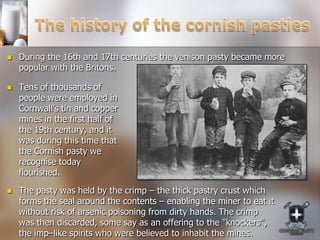
   During the 16th and 17th centuries the venison pasty became more
    popular with the Britons.

   Tens of thousands of
    people were employed in
    Cornwall’s tin and copper
    mines in the first half of
    the 19th century, and it
    was during this time that
    the Cornish pasty we
    recognise today
    flourished.

   The pasty was held by the crimp – the thick pastry crust which
    forms the seal around the contents – enabling the miner to eat it
    without risk of arsenic poisoning from dirty hands. The crimp
    was then discarded, some say as an offering to the "knockers",
    the imp–like spirits who were believed to inhabit the mines.
   110g plain flour
1
    2        pinch of salt


    3        55g butter, cubed
4
       2-3 tbsp cold water
   To make pastry use all purpose or plain flour, butter a little salt and some
    cold water.
   First sieve the flour into a large glass bowl, add the butter and a pinch of
    salt. Working quickly, rub the butter into the flour until it looks like coarse
    sand and there are no large lumps of butter left
   Then add the water one tablespoon at a time. As soon as the water is
    absorbed, using your fingers bring the pastry together into a ball.
   This now needs to be wrapped in plastic wrap and popped into the
    refrigerator for 15 minutes or 30 minutes if possible.
   And now we’ll put the pasties together. Begin by rolling out the pastry
    into a circle to the size of a tea plate. Trim off the excess pastry. This
    is the base for the Cornish pasty.
    50g onion, finely
                     chopped
1
    2             110g potato, cut into
                   1/4 inch /5 mm dice


    3             110g rump steak,

4                  cut into small cubes

           salt and pepper
           1 egg, lightly beaten
   Into a glass bowl add the beef, potato, chopped onion and salt and
    pepper. Mix these together really well.
   Lay the filling down the center of the pastry circle. Using a beaten egg
    and a pastry brush, dampen the edges of the pastry circle.
   Draw the edges of the pastry together and press well to seal the
    pasty.
   Brush all over with beaten egg to create a golden brown pasty when
    cooked.
   Cook in a very hot oven, 220C/Gas 7 for 45 minutes.
Made by:
   Julia Megalinskaya
   Kate Rogachova
   Anna Tilte
   Maria Kozakova
School 622

Cornish Pasty

  • 1.
  • 2.
    Cornish pasties are a very, very famous British dish. They are known and loved throughout Great Britain and Ireland.  They were originally made for Cornish tin miners as a way of taking their lunch down the mine with them.  They are a delicious, filling snack, lunch dish, or also an easy, cheap dinner served with fresh vegetables and gravy.
  • 3.
    During the 16th and 17th centuries the venison pasty became more popular with the Britons.  Tens of thousands of people were employed in Cornwall’s tin and copper mines in the first half of the 19th century, and it was during this time that the Cornish pasty we recognise today flourished.  The pasty was held by the crimp – the thick pastry crust which forms the seal around the contents – enabling the miner to eat it without risk of arsenic poisoning from dirty hands. The crimp was then discarded, some say as an offering to the "knockers", the imp–like spirits who were believed to inhabit the mines.
  • 4.
    110g plain flour 1 2  pinch of salt 3  55g butter, cubed 4  2-3 tbsp cold water
  • 5.
    To make pastry use all purpose or plain flour, butter a little salt and some cold water.
  • 6.
    First sieve the flour into a large glass bowl, add the butter and a pinch of salt. Working quickly, rub the butter into the flour until it looks like coarse sand and there are no large lumps of butter left
  • 7.
    Then add the water one tablespoon at a time. As soon as the water is absorbed, using your fingers bring the pastry together into a ball.
  • 8.
    This now needs to be wrapped in plastic wrap and popped into the refrigerator for 15 minutes or 30 minutes if possible.
  • 9.
    And now we’ll put the pasties together. Begin by rolling out the pastry into a circle to the size of a tea plate. Trim off the excess pastry. This is the base for the Cornish pasty.
  • 10.
    50g onion, finely chopped 1 2  110g potato, cut into 1/4 inch /5 mm dice 3  110g rump steak, 4 cut into small cubes  salt and pepper  1 egg, lightly beaten
  • 11.
    Into a glass bowl add the beef, potato, chopped onion and salt and pepper. Mix these together really well.
  • 12.
    Lay the filling down the center of the pastry circle. Using a beaten egg and a pastry brush, dampen the edges of the pastry circle.
  • 13.
    Draw the edges of the pastry together and press well to seal the pasty.
  • 14.
    Brush all over with beaten egg to create a golden brown pasty when cooked.
  • 15.
    Cook in a very hot oven, 220C/Gas 7 for 45 minutes.
  • 17.
    Made by:  Julia Megalinskaya  Kate Rogachova  Anna Tilte  Maria Kozakova School 622