Hogmanay
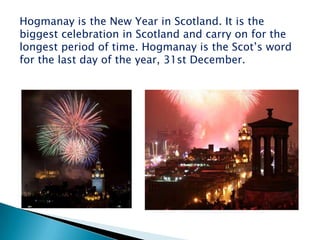
Hogmanay is the New Year in Scotland. It is the
biggest celebration in Scotland and carry on for the
longest period of time. Hogmanay is the Scot‟s word
for the last day of the year, 31st December.
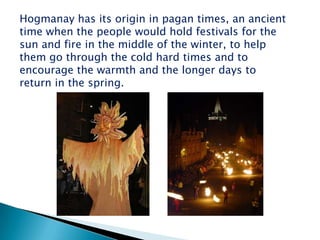
Hogmanay has its origin in pagan times, an ancient
time when the people would hold festivals for the
sun and fire in the middle of the winter, to help
them go through the cold hard times and to
encourage the warmth and the longer days to
return in the spring.
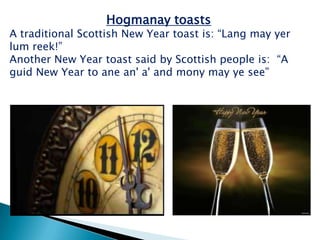
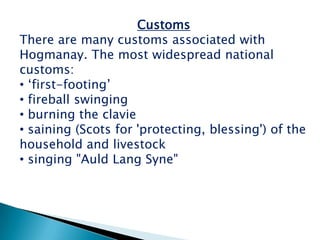
Hogmanay toasts
A traditional Scottish New Year toast is: “Lang may yer
lum reek!”
Another New Year toast said by Scottish people is: “A
guid New Year to ane an' a' and mony may ye see”
Customs
There are many customs associated with
Hogmanay. The most widespread national
customs:
• „first-footing‟
• fireball swinging
• burning the clavie
• saining (Scots for 'protecting, blessing') of the
household and livestock
• singing "Auld Lang Syne"
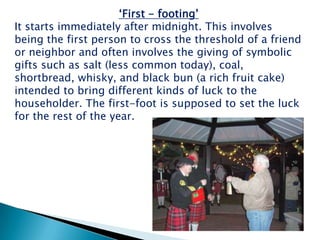
„First - footing‟
It starts immediately after midnight. This involves
being the first person to cross the threshold of a friend
or neighbor and often involves the giving of symbolic
gifts such as salt (less common today), coal,
shortbread, whisky, and black bun (a rich fruit cake)
intended to bring different kinds of luck to the
householder. The first-foot is supposed to set the luck
for the rest of the year.
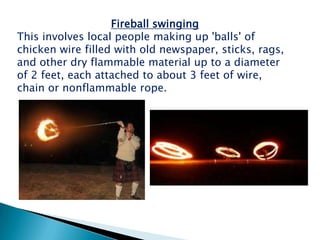
Fireball swinging
This involves local people making up 'balls' of
chicken wire filled with old newspaper, sticks, rags,
and other dry flammable material up to a diameter
of 2 feet, each attached to about 3 feet of wire,
chain or nonflammable rope.
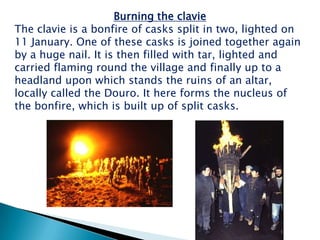
Burning the clavie
The clavie is a bonfire of casks split in two, lighted on
11 January. One of these casks is joined together again
by a huge nail. It is then filled with tar, lighted and
carried flaming round the village and finally up to a
headland upon which stands the ruins of an altar,
locally called the Douro. It here forms the nucleus of
the bonfire, which is built up of split casks.
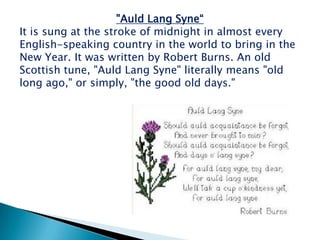
"Auld Lang Syne“
It is sung at the stroke of midnight in almost every
English-speaking country in the world to bring in the
New Year. It was written by Robert Burns. An old
Scottish tune, "Auld Lang Syne" literally means "old
long ago," or simply, "the good old days."
Thank you for watching
Made by Varicheva Valya and Babaeva Saida, 8B

New year in scotland

  • 1.
  • 2.
    Hogmanay is theNew Year in Scotland. It is the biggest celebration in Scotland and carry on for the longest period of time. Hogmanay is the Scot‟s word for the last day of the year, 31st December.
  • 3.
    Hogmanay has itsorigin in pagan times, an ancient time when the people would hold festivals for the sun and fire in the middle of the winter, to help them go through the cold hard times and to encourage the warmth and the longer days to return in the spring.
  • 4.
    Hogmanay toasts A traditionalScottish New Year toast is: “Lang may yer lum reek!” Another New Year toast said by Scottish people is: “A guid New Year to ane an' a' and mony may ye see”
  • 5.
    Customs There are manycustoms associated with Hogmanay. The most widespread national customs: • „first-footing‟ • fireball swinging • burning the clavie • saining (Scots for 'protecting, blessing') of the household and livestock • singing "Auld Lang Syne"
  • 6.
    „First - footing‟ Itstarts immediately after midnight. This involves being the first person to cross the threshold of a friend or neighbor and often involves the giving of symbolic gifts such as salt (less common today), coal, shortbread, whisky, and black bun (a rich fruit cake) intended to bring different kinds of luck to the householder. The first-foot is supposed to set the luck for the rest of the year.
  • 7.
    Fireball swinging This involveslocal people making up 'balls' of chicken wire filled with old newspaper, sticks, rags, and other dry flammable material up to a diameter of 2 feet, each attached to about 3 feet of wire, chain or nonflammable rope.
  • 8.
    Burning the clavie Theclavie is a bonfire of casks split in two, lighted on 11 January. One of these casks is joined together again by a huge nail. It is then filled with tar, lighted and carried flaming round the village and finally up to a headland upon which stands the ruins of an altar, locally called the Douro. It here forms the nucleus of the bonfire, which is built up of split casks.
  • 9.
    "Auld Lang Syne“ Itis sung at the stroke of midnight in almost every English-speaking country in the world to bring in the New Year. It was written by Robert Burns. An old Scottish tune, "Auld Lang Syne" literally means "old long ago," or simply, "the good old days."
  • 10.
    Thank you forwatching Made by Varicheva Valya and Babaeva Saida, 8B