Guided by, Presented by,
Dr. JYOTI PANDEY ANSHU SINGH
M.Sc. (DAC)
Introduction
It is a reactive substance that contains a great amount of
potential energy .
It can produce an explosion if released suddenly.
Explosives usually have less potential energy than fuels,
but their high rate of energy release produces a great
blast .
 Largest commercial use of explosives is in mining,
military.
Cordite
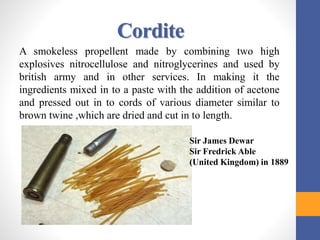
A smokeless propellent made by combining two high
explosives nitrocellulose and nitroglycerines and used by
british army and in other services. In making it the
ingredients mixed in to a paste with the addition of acetone
and pressed out in to cords of various diameter similar to
brown twine ,which are dried and cut in to length.
Sir James Dewar
Sir Fredrick Able
(United Kingdom) in 1889
Development
Cordite was developed by reverse engineering Alfred
Noble's, Ballistite and Paul Vieille's, powder B . The
original mixture of cordite was about 37.5%
nitrocellulose, 57.5 % nitroglycerine and 5%
petroleum jelly and named Cordite Mk1. Cordite
Mk1 is a double base powder.
Cordite was reformulated into several other
propellants.
 Cordite MD was a modified mixture of Cordite Mk1 to
burn cooler and save on barrel wear; 65% nitrocellulose,
30% nitroglycerine, and 5% petroleum jelly.
 Cordite RDB was developed with collodion
(nitrocellulose in soluble form) 52% nitrocellulose, 42%
nitroglycerine, and 6% petroleum jelly.
 Cordite SC was a process of producing cordite without
solvents (solvents are what make nitrocellulose into
collodion).
 Cordite N was produce by adding nitroguanidine to the
nitrocellulose and nitroglycerine mixture making this
cordite a triple base powder and specifically designed for
naval guns.
The problem with cordite
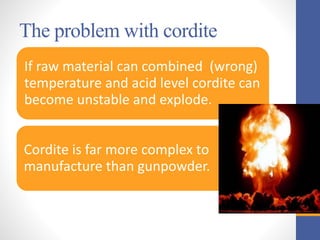
If raw material can combined (wrong)
temperature and acid level cordite can
become unstable and explode.
Cordite is far more complex to
manufacture than gunpowder.
Basic Processes in Cordite
Production :
(1) Raw Materials :
Some prepared separately at ICI Drungans, at
Cargenbridge near Dumfries and shipped in by
rail. Other materials were shipped in from
production sites in southern Scotland and
Northern.
1. Nitrocellulose- It is a highly flammable
compound formed by nitrating cellulose
through exposure of nitric acid or
another powerful nitrating agent.
2. Mixed acid( M/A)- concentrated
sulphuric acid (57%) and nitric acid
(43%) .
3. 3.Oleum:(Fuming sulphuric acid)- It is
used in reprocessing of refuse acids .
4. Glycerine: Glycerol is used to produce
nitroglycerine. Then a product of the soap
making indrustry.
5. Sodium carbonate: It is used to neutralise
remaining acids in the separated
nitroglycerine and so make it less likely to
explode when moved to other processes.
6.Acetone: It is used to stablised the
nitroglycerine and later it helped to gelatinise
the nitrocellulose and nitroglycerine to a paste
for forming in to cords.
7.Vaseline- mix as a stabliser and as a gun
barrel lubricant.
8. Graphite- Lampblack to reduce the risk of
static ignition in some forms of loose cordite
but it may have been needed for small arms
ammunition.
9.Nitroguanidine- stablise the cordite in
stroage, added during mixing in small
amount.
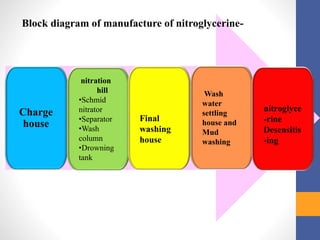
Charge
house
nitration
hill
•Schmid
nitrator
•Separator
•Wash
column
•Drowning
tank
Final
washing
house
Wash
water
settling
house and
Mud
washing
nitroglyce
-rine
Desensitis
-ing
Block diagram of manufacture of nitroglycerine-
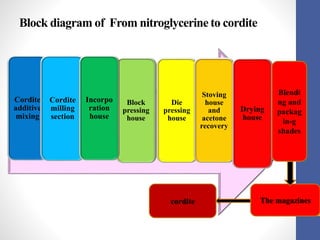
Block diagram of From nitroglycerine to cordite
Cordite
additive
mixing
Block
pressing
house
Cordite
milling
section
Incorpo
ration
house
Die
pressing
house
Stoving
house
and
acetone
recovery
Drying
house
Blendi
ng and
packag
in-g
shades
The magazinescordite
In addition, large amounts of the following were needed
during cordite manufacture
• Coal -Three rail truckloads per day were needed for
process steam to drive equipment and to dry the cord.
• Water 100,000 -gallons per day of drinking quality water
from Lochenkit Reservoir nearite Corsock. This was
needed as wash water, for process steam and a range of
other tasks.
(2) Acid Production :
Mixed acid received in tankers MS Factory, Dumfries.
It was stored in 3 X 80-tonne mild steel beside the track.
From there, it was pumped down 2” steel pipes some 1520
feet long to 2 X 80-tonne tanks at the charge house beside
the nitration hill.
From there, it was blown by low pressure air along a 200
feet long pipe into the nitrator.
The nitration process produces much weaker acid with
small amount of nitroglycerine, water and impurities.
This ‘Refuse Acid’ was piped back to the waste acid plant
for reprocessing.
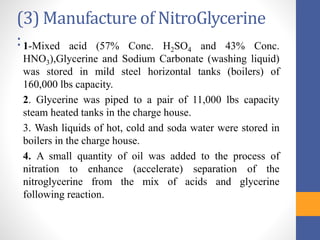
(3) Manufacture of NitroGlycerine
:1-Mixed acid (57% Conc. H2SO4 and 43% Conc.
HNO3),Glycerine and Sodium Carbonate (washing liquid)
was stored in mild steel horizontal tanks (boilers) of
160,000 lbs capacity.
2. Glycerine was piped to a pair of 11,000 lbs capacity
steam heated tanks in the charge house.
3. Wash liquids of hot, cold and soda water were stored in
boilers in the charge house.
4. A small quantity of oil was added to the process of
nitration to enhance (accelerate) separation of the
nitroglycerine from the mix of acids and glycerine
following reaction.
The Nitration Hill
• The Nitration Hill was the highest of
several hollow artificial hills at each Unit.
• The function of the earth and brick was to
contain and direct upwards any accidental
explosion.
The following section summaries
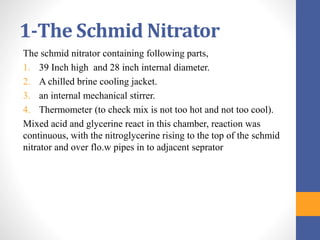
1-The Schmid Nitrator
The schmid nitrator containing following parts,
1. 39 Inch high and 28 inch internal diameter.
2. A chilled brine cooling jacket.
3. an internal mechanical stirrer.
4. Thermometer (to check mix is not too hot and not too cool).
Mixed acid and glycerine react in this chamber, reaction was
continuous, with the nitroglycerine rising to the top of the schmid
nitrator and over flo.w pipes in to adjacent seprator
2- The Separator :
The acid and nitroglycerine
mixture flow from the nitrator
flow down in to the seprator.
The mixture gradually seprated.
This allowed a much slower flow
than in the Nitrator, allowing the
nitroglycerine to accumulate.
The refuse acid with water sent to
tank outside the hill.
3. The Wash Columns and
Intermediate Separators :
 Consist of glass cylinder stacked on the top of another,
rubber glands joining them.
 Three columns 8 feet high were located in the Nitration
House.
The nitroglycerine from the separator was piped with
injected cold water to the first column.
The nitroglycerine/water flowed from the top of the
intermediate separator the nitroglycerine then flowing to
the bottom of the second wash column, where the process
was repeated in water at 40%C. The third wash column
used 1.3% sodium carbonate solution to neutralize any
remaining acid
4.TheDrowningTank
The over heated mixture was discharge by the water in
drowing tank, which automatically is aerated and topped
up with more water.
The Final Washing House
This held a further two columns that washed the soda and
nitroglycerine in hot water at 40° C and then in cold water
at at least 12° C.
Once it had left the fifth wash column's intermediate
separator, the now virtually pure nitroglycerine was
collected in a lead settling tank containing about 820 lbs of
the explosive.
Up to 280 lbs of nitroglycerine at a time was removed to lead
weighing tanks before being moved to the next process.
The Wash Water Settling House and Mud
Washing :
Addition of some clay like substance to act as a flocculant,
gathering the oil and nitroglycerine traces and forcing them
to precipitate.
Impurities from the wash water unlikely, as the water
would have been of drinking water purity.
Nitroglycerine desensitizing:
Nitroglycerine is comparatively unstable product.
It (stabilised) by mixing with alcohol, acetone or
dinitrotoluene, or blended with ethylene glycol nitrate to
keep it liquid.
nitroglycerine/acetone mixture was placed in an
individual bogie tank for despatch to the burette houses.
From Nitroglycerine to Cordite
The nitroglycerine would have had to be moved to the 'Wet
Mix' or Burette Houses for mixing with the nitrocellulose.
The nitro cellulose was placed in double-walled lead-lined
container circulating by water tank to kept at steady
tempreature .
Nitroglycerine was slowly added and carefully mixed with
nitrocellulose.
Acetone added to stablise the nitroglycerine enhance the
gelatinisation process and would make to cordite easier to
work.
CorditeAdditive Mixing
After gelatinisation is complete but it is unclear whether
it was used to try and provide a common quality of
product, or whether dyes.
 Vaseline were added at this point.
Additives were blended in at the Incorporation Houses
before the mixture was taken in bags to the Paste Rolling
Houses or the Press Houses.
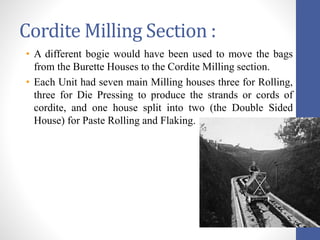
Cordite Milling Section :
• A different bogie would have been used to move the bags
from the Burette Houses to the Cordite Milling section.
• Each Unit had seven main Milling houses three for Rolling,
three for Die Pressing to produce the strands or cords of
cordite, and one house split into two (the Double Sided
House) for Paste Rolling and Flaking.
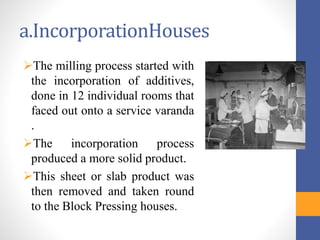
a.IncorporationHouses
The milling process started with
the incorporation of additives,
done in 12 individual rooms that
faced out onto a service varanda
.
The incorporation process
produced a more solid product.
This sheet or slab product was
then removed and taken round
to the Block Pressing houses.
b.Block Pressing Houses
• The purpose of these presses, sited in eight rooms with
double doors and a splitlevel floor, was to turn the slabs
or sheets of cordite into blocks the right size and
consistency for extrusion in the Die Presses.
c.Die pressing houses
In these presses oversized spaghetti that were cut in to
length.
The purpose of this extrusion or pressing was to give a
large surface area for ignition by the explosion charge by
the gun.
Drying Houses :
 A similar process to Stoving but at a lower temperatures
was used to remove any remaining moisture so that the
cordite was left completely dry.
Blending and packing sheds:
 The sorting or blending was a matter of taking mixtures
of pressed cords from various batches.
 So that each case held a standard quantity and quality.
 The cordite was checked before being boxed and taken
by cart down to the magazines until time for dispatch.
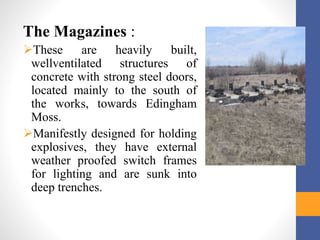
The Magazines :
These are heavily built,
wellventilated structures of
concrete with strong steel doors,
located mainly to the south of
the works, towards Edingham
Moss.
Manifestly designed for holding
explosives, they have external
weather proofed switch frames
for lighting and are sunk into
deep trenches.
Gun Cotton or Nitro Cellulose
 Nitro Cellulose- (cellulose nitrate,flash paper,flash cotton, gun
cotton,flash string)
 A highly flammable compound. It formed by nitrating cellulose through
exposure to nitric acid or another powerful nitrating agent.
 When used as a propellant or low order explosive, it was originally known
as guncotton.
 If the cellulose is not fully nitrated then it has found uses as a plastic film
and wood coatings.
Uses of nitrocellulose:
 In 1846 nitrated cellulose was found to be soluble
in ether and alcohol. This solution was soon used
as a dressing for wounds.
 Adolph Noe developed a method of peeling coal
balls using nitrocellulose.
 Nail polish is made from nitrocellulose lacquer as
it is inexpensive, dries quickly and do not
damaging skin.
 It is used as a finish on guitars and saxophones.
Blasting gelatin
• Blasting gelatin is also known as oil well explosive.
• It is a rubber-textured explosive made by adding
nitrocellulose (guncotton) to nitroglycerin find a slow-
burning rate powder.
• Blasting gelatin was tried in guns.
• This explosive is less violent, yet equally clear and
smokeless.
Acknowledgement
I would like to thank Dr. Jyoti Pandey
Mam help me to prepare the project
and guide me on this topic. I would
also like to thank my friends who help
me preparing this project.
Cordite

Cordite

  • 1.
    Guided by, Presentedby, Dr. JYOTI PANDEY ANSHU SINGH M.Sc. (DAC)
  • 2.
    Introduction It is areactive substance that contains a great amount of potential energy . It can produce an explosion if released suddenly. Explosives usually have less potential energy than fuels, but their high rate of energy release produces a great blast .  Largest commercial use of explosives is in mining, military.
  • 3.
    Cordite A smokeless propellentmade by combining two high explosives nitrocellulose and nitroglycerines and used by british army and in other services. In making it the ingredients mixed in to a paste with the addition of acetone and pressed out in to cords of various diameter similar to brown twine ,which are dried and cut in to length. Sir James Dewar Sir Fredrick Able (United Kingdom) in 1889
  • 4.
    Development Cordite was developedby reverse engineering Alfred Noble's, Ballistite and Paul Vieille's, powder B . The original mixture of cordite was about 37.5% nitrocellulose, 57.5 % nitroglycerine and 5% petroleum jelly and named Cordite Mk1. Cordite Mk1 is a double base powder. Cordite was reformulated into several other propellants.
  • 5.
     Cordite MDwas a modified mixture of Cordite Mk1 to burn cooler and save on barrel wear; 65% nitrocellulose, 30% nitroglycerine, and 5% petroleum jelly.  Cordite RDB was developed with collodion (nitrocellulose in soluble form) 52% nitrocellulose, 42% nitroglycerine, and 6% petroleum jelly.  Cordite SC was a process of producing cordite without solvents (solvents are what make nitrocellulose into collodion).  Cordite N was produce by adding nitroguanidine to the nitrocellulose and nitroglycerine mixture making this cordite a triple base powder and specifically designed for naval guns.
  • 6.
    The problem withcordite If raw material can combined (wrong) temperature and acid level cordite can become unstable and explode. Cordite is far more complex to manufacture than gunpowder.
  • 7.
    Basic Processes inCordite Production : (1) Raw Materials : Some prepared separately at ICI Drungans, at Cargenbridge near Dumfries and shipped in by rail. Other materials were shipped in from production sites in southern Scotland and Northern.
  • 8.
    1. Nitrocellulose- Itis a highly flammable compound formed by nitrating cellulose through exposure of nitric acid or another powerful nitrating agent. 2. Mixed acid( M/A)- concentrated sulphuric acid (57%) and nitric acid (43%) . 3. 3.Oleum:(Fuming sulphuric acid)- It is used in reprocessing of refuse acids .
  • 9.
    4. Glycerine: Glycerolis used to produce nitroglycerine. Then a product of the soap making indrustry. 5. Sodium carbonate: It is used to neutralise remaining acids in the separated nitroglycerine and so make it less likely to explode when moved to other processes. 6.Acetone: It is used to stablised the nitroglycerine and later it helped to gelatinise the nitrocellulose and nitroglycerine to a paste for forming in to cords.
  • 10.
    7.Vaseline- mix asa stabliser and as a gun barrel lubricant. 8. Graphite- Lampblack to reduce the risk of static ignition in some forms of loose cordite but it may have been needed for small arms ammunition. 9.Nitroguanidine- stablise the cordite in stroage, added during mixing in small amount.
  • 11.
  • 12.
    Block diagram ofFrom nitroglycerine to cordite Cordite additive mixing Block pressing house Cordite milling section Incorpo ration house Die pressing house Stoving house and acetone recovery Drying house Blendi ng and packag in-g shades The magazinescordite
  • 13.
    In addition, largeamounts of the following were needed during cordite manufacture • Coal -Three rail truckloads per day were needed for process steam to drive equipment and to dry the cord. • Water 100,000 -gallons per day of drinking quality water from Lochenkit Reservoir nearite Corsock. This was needed as wash water, for process steam and a range of other tasks.
  • 14.
    (2) Acid Production: Mixed acid received in tankers MS Factory, Dumfries. It was stored in 3 X 80-tonne mild steel beside the track. From there, it was pumped down 2” steel pipes some 1520 feet long to 2 X 80-tonne tanks at the charge house beside the nitration hill. From there, it was blown by low pressure air along a 200 feet long pipe into the nitrator. The nitration process produces much weaker acid with small amount of nitroglycerine, water and impurities. This ‘Refuse Acid’ was piped back to the waste acid plant for reprocessing.
  • 15.
    (3) Manufacture ofNitroGlycerine :1-Mixed acid (57% Conc. H2SO4 and 43% Conc. HNO3),Glycerine and Sodium Carbonate (washing liquid) was stored in mild steel horizontal tanks (boilers) of 160,000 lbs capacity. 2. Glycerine was piped to a pair of 11,000 lbs capacity steam heated tanks in the charge house. 3. Wash liquids of hot, cold and soda water were stored in boilers in the charge house. 4. A small quantity of oil was added to the process of nitration to enhance (accelerate) separation of the nitroglycerine from the mix of acids and glycerine following reaction.
  • 16.
    The Nitration Hill •The Nitration Hill was the highest of several hollow artificial hills at each Unit. • The function of the earth and brick was to contain and direct upwards any accidental explosion. The following section summaries
  • 17.
    1-The Schmid Nitrator Theschmid nitrator containing following parts, 1. 39 Inch high and 28 inch internal diameter. 2. A chilled brine cooling jacket. 3. an internal mechanical stirrer. 4. Thermometer (to check mix is not too hot and not too cool). Mixed acid and glycerine react in this chamber, reaction was continuous, with the nitroglycerine rising to the top of the schmid nitrator and over flo.w pipes in to adjacent seprator
  • 18.
    2- The Separator: The acid and nitroglycerine mixture flow from the nitrator flow down in to the seprator. The mixture gradually seprated. This allowed a much slower flow than in the Nitrator, allowing the nitroglycerine to accumulate. The refuse acid with water sent to tank outside the hill.
  • 19.
    3. The WashColumns and Intermediate Separators :  Consist of glass cylinder stacked on the top of another, rubber glands joining them.  Three columns 8 feet high were located in the Nitration House. The nitroglycerine from the separator was piped with injected cold water to the first column. The nitroglycerine/water flowed from the top of the intermediate separator the nitroglycerine then flowing to the bottom of the second wash column, where the process was repeated in water at 40%C. The third wash column used 1.3% sodium carbonate solution to neutralize any remaining acid
  • 20.
    4.TheDrowningTank The over heatedmixture was discharge by the water in drowing tank, which automatically is aerated and topped up with more water. The Final Washing House This held a further two columns that washed the soda and nitroglycerine in hot water at 40° C and then in cold water at at least 12° C. Once it had left the fifth wash column's intermediate separator, the now virtually pure nitroglycerine was collected in a lead settling tank containing about 820 lbs of the explosive.
  • 21.
    Up to 280lbs of nitroglycerine at a time was removed to lead weighing tanks before being moved to the next process. The Wash Water Settling House and Mud Washing : Addition of some clay like substance to act as a flocculant, gathering the oil and nitroglycerine traces and forcing them to precipitate. Impurities from the wash water unlikely, as the water would have been of drinking water purity.
  • 22.
    Nitroglycerine desensitizing: Nitroglycerine iscomparatively unstable product. It (stabilised) by mixing with alcohol, acetone or dinitrotoluene, or blended with ethylene glycol nitrate to keep it liquid. nitroglycerine/acetone mixture was placed in an individual bogie tank for despatch to the burette houses.
  • 23.
    From Nitroglycerine toCordite The nitroglycerine would have had to be moved to the 'Wet Mix' or Burette Houses for mixing with the nitrocellulose. The nitro cellulose was placed in double-walled lead-lined container circulating by water tank to kept at steady tempreature . Nitroglycerine was slowly added and carefully mixed with nitrocellulose. Acetone added to stablise the nitroglycerine enhance the gelatinisation process and would make to cordite easier to work.
  • 24.
    CorditeAdditive Mixing After gelatinisationis complete but it is unclear whether it was used to try and provide a common quality of product, or whether dyes.  Vaseline were added at this point. Additives were blended in at the Incorporation Houses before the mixture was taken in bags to the Paste Rolling Houses or the Press Houses.
  • 25.
    Cordite Milling Section: • A different bogie would have been used to move the bags from the Burette Houses to the Cordite Milling section. • Each Unit had seven main Milling houses three for Rolling, three for Die Pressing to produce the strands or cords of cordite, and one house split into two (the Double Sided House) for Paste Rolling and Flaking.
  • 26.
    a.IncorporationHouses The milling processstarted with the incorporation of additives, done in 12 individual rooms that faced out onto a service varanda . The incorporation process produced a more solid product. This sheet or slab product was then removed and taken round to the Block Pressing houses.
  • 27.
    b.Block Pressing Houses •The purpose of these presses, sited in eight rooms with double doors and a splitlevel floor, was to turn the slabs or sheets of cordite into blocks the right size and consistency for extrusion in the Die Presses. c.Die pressing houses In these presses oversized spaghetti that were cut in to length. The purpose of this extrusion or pressing was to give a large surface area for ignition by the explosion charge by the gun.
  • 28.
    Drying Houses : A similar process to Stoving but at a lower temperatures was used to remove any remaining moisture so that the cordite was left completely dry. Blending and packing sheds:  The sorting or blending was a matter of taking mixtures of pressed cords from various batches.  So that each case held a standard quantity and quality.  The cordite was checked before being boxed and taken by cart down to the magazines until time for dispatch.
  • 29.
    The Magazines : Theseare heavily built, wellventilated structures of concrete with strong steel doors, located mainly to the south of the works, towards Edingham Moss. Manifestly designed for holding explosives, they have external weather proofed switch frames for lighting and are sunk into deep trenches.
  • 30.
    Gun Cotton orNitro Cellulose  Nitro Cellulose- (cellulose nitrate,flash paper,flash cotton, gun cotton,flash string)  A highly flammable compound. It formed by nitrating cellulose through exposure to nitric acid or another powerful nitrating agent.  When used as a propellant or low order explosive, it was originally known as guncotton.  If the cellulose is not fully nitrated then it has found uses as a plastic film and wood coatings.
  • 31.
    Uses of nitrocellulose: In 1846 nitrated cellulose was found to be soluble in ether and alcohol. This solution was soon used as a dressing for wounds.  Adolph Noe developed a method of peeling coal balls using nitrocellulose.  Nail polish is made from nitrocellulose lacquer as it is inexpensive, dries quickly and do not damaging skin.  It is used as a finish on guitars and saxophones.
  • 32.
    Blasting gelatin • Blastinggelatin is also known as oil well explosive. • It is a rubber-textured explosive made by adding nitrocellulose (guncotton) to nitroglycerin find a slow- burning rate powder. • Blasting gelatin was tried in guns. • This explosive is less violent, yet equally clear and smokeless.
  • 33.
    Acknowledgement I would liketo thank Dr. Jyoti Pandey Mam help me to prepare the project and guide me on this topic. I would also like to thank my friends who help me preparing this project.