Any work is copyrighted. Even if it does not say so.  Copyright protection?
Whenever something is posted on the internet, the user is given an implied license to share, print, read or downloaded. 
If one intends, he can give his work an express license by attaching a creative commons (www.creativecommons.org) license to the materials posted on the website.
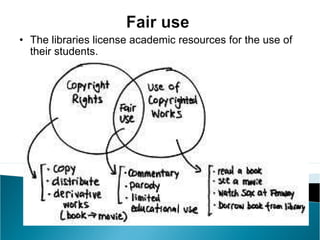
The libraries license academic resources for the use of their students. 
One can also get permission to use a piece of work by obtaining the permission to use it through www.copyright.com.    For the use in classroom you may use these resources as a fair use checklist: www.copyright.iupui.edu/checklist.htm; www.umuc.edu/library/copy.shtml#fairuse
Up to $150,000 in penalties.  For the ignorance of the law one is liable for damages anyway If one disregards copyright laws the court would be willing to grant the highest penalties.
TEACH Act covers works a teacher would show or play during class such as movie or music clips, images of artworks or a poetry reading.  TEACH Act does not cover materials the teacher may want students to study, read, listen to or watch on their own time outside of class.  Checklist for the TEACH act may be found at:    http://copyright.lib.utexas.edu/teachact.html The TEACH act
Because “orphan works” lack sufficient information to identify their owners or the date, most remain outside the digital environment.  It could have been used for nonprofit purposes. Orphan works
www.openlibrary.org and www.opencontentalliance.org are sources where orphaned works and public domain may be accessed. Orphan works
http://copyright.lib.utexas.edu / Google images

Copyright presentation 4th installment

  • 1.
  • 2.
      Any workis copyrighted. Even if it does not say so. Copyright protection?
  • 3.
    Whenever something isposted on the internet, the user is given an implied license to share, print, read or downloaded. 
  • 4.
    If one intends,he can give his work an express license by attaching a creative commons (www.creativecommons.org) license to the materials posted on the website.
  • 5.
    The libraries licenseacademic resources for the use of their students. 
  • 6.
    One can alsoget permission to use a piece of work by obtaining the permission to use it through www.copyright.com.    For the use in classroom you may use these resources as a fair use checklist: www.copyright.iupui.edu/checklist.htm; www.umuc.edu/library/copy.shtml#fairuse
  • 7.
    Up to $150,000in penalties. For the ignorance of the law one is liable for damages anyway If one disregards copyright laws the court would be willing to grant the highest penalties.
  • 8.
    TEACH Act coversworks a teacher would show or play during class such as movie or music clips, images of artworks or a poetry reading.  TEACH Act does not cover materials the teacher may want students to study, read, listen to or watch on their own time outside of class. Checklist for the TEACH act may be found at:   http://copyright.lib.utexas.edu/teachact.html The TEACH act
  • 9.
    Because “orphan works”lack sufficient information to identify their owners or the date, most remain outside the digital environment.  It could have been used for nonprofit purposes. Orphan works
  • 10.
    www.openlibrary.org and www.opencontentalliance.orgare sources where orphaned works and public domain may be accessed. Orphan works
  • 11.