Copyright Crash CourseApril Canales-PerezEDTC 6340.66
CopyrightAccording to the U.S. copyright office definition, copyright is a form of protection provided by the laws of the United States for “original works of authorship”
Public domainWorks in public domain are no longer under copyright protectionThese works can be used, shared, and printed without the permission of the originator
Orphan worksCopyright act protects works whose owner can’t be identified or located,and date created is unknownLibraries are displaying orphan works with special notice they can not be used for any purpose other than to read
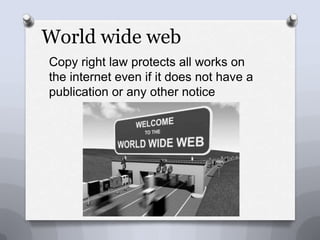
World wide webCopy right law protects all works on the internet even if it does not have a publication or any other notice
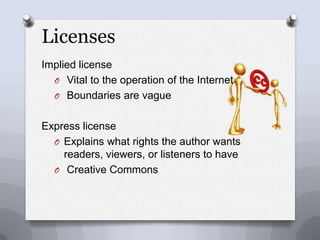
LicensesImplied license Vital to the operation of the Internet Boundaries are vagueExpress licenseExplains what rights the author wants readers, viewers, or listeners to haveCreative Commons
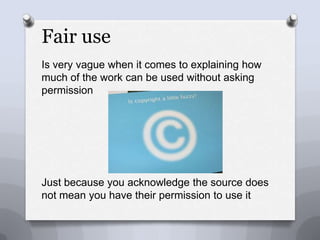
Fair useIs very vague when it comes to explaining how much of the work can be used without asking permissionJust because you acknowledge the source does not mean you have their permission to use it
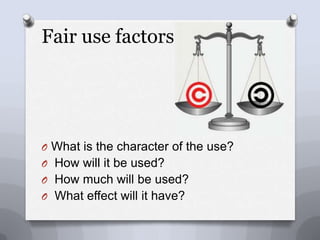
Fair use factorsWhat is the character of the use? How will it be used?  How much will be used?What effect will it have?
Getting permission Depending on type of work follow correct steps Contact author or publisher Research to find copyright owners Get written permission
ReferencesResource Harper, G. K., (2007). Copyright crash course.        Building on others’ creative expression.       Retrieved from http://copyright.lib.utexas.edu/Images (2009). A smarter dummy. U.Va. engineers building          “virtual” crash test dummy. Retrieved from    http://uvamagazine.org/research_and_discovery/ article/a_smarter_dummy/ (2008). Domaining. Domain names. Retrieved fromhttp://premiumdomain.ws/
References continuedDery, M. (2008). Orphan works. Retrieved from 	 http://www.printmag.com/Article.aspx?  ArticleSlug=Orphan_Works (2009). Getting started with websites: Introduction. Retrieved    from http://divyun.com/page/2/(2010). Creative commons and intellectual property. Retrieved           from http://chinesedrum.wordpress.com/PungoM. (2007). Fuzzy copyright. Retrieved from http://www.flickr.com/photos/pugno_muliebriter/1384247192/in/photostream/(2010). SharePoint Item Level Permissions 2010 & 2007.   Retrieved from http://dbweb.sbisite.com/blog/Lists/Posts/Post.aspx?ID=80

Copyright edtc6340.66 april_canales#2

  • 1.
    Copyright Crash CourseAprilCanales-PerezEDTC 6340.66
  • 2.
    CopyrightAccording to theU.S. copyright office definition, copyright is a form of protection provided by the laws of the United States for “original works of authorship”
  • 3.
    Public domainWorks inpublic domain are no longer under copyright protectionThese works can be used, shared, and printed without the permission of the originator
  • 4.
    Orphan worksCopyright actprotects works whose owner can’t be identified or located,and date created is unknownLibraries are displaying orphan works with special notice they can not be used for any purpose other than to read
  • 5.
    World wide webCopyright law protects all works on the internet even if it does not have a publication or any other notice
  • 6.
    LicensesImplied license Vitalto the operation of the Internet Boundaries are vagueExpress licenseExplains what rights the author wants readers, viewers, or listeners to haveCreative Commons
  • 7.
    Fair useIs veryvague when it comes to explaining how much of the work can be used without asking permissionJust because you acknowledge the source does not mean you have their permission to use it
  • 8.
    Fair use factorsWhatis the character of the use? How will it be used? How much will be used?What effect will it have?
  • 9.
    Getting permission Dependingon type of work follow correct steps Contact author or publisher Research to find copyright owners Get written permission
  • 10.
    ReferencesResource Harper, G.K., (2007). Copyright crash course. Building on others’ creative expression. Retrieved from http://copyright.lib.utexas.edu/Images (2009). A smarter dummy. U.Va. engineers building “virtual” crash test dummy. Retrieved from http://uvamagazine.org/research_and_discovery/ article/a_smarter_dummy/ (2008). Domaining. Domain names. Retrieved fromhttp://premiumdomain.ws/
  • 11.
    References continuedDery, M.(2008). Orphan works. Retrieved from http://www.printmag.com/Article.aspx? ArticleSlug=Orphan_Works (2009). Getting started with websites: Introduction. Retrieved from http://divyun.com/page/2/(2010). Creative commons and intellectual property. Retrieved from http://chinesedrum.wordpress.com/PungoM. (2007). Fuzzy copyright. Retrieved from http://www.flickr.com/photos/pugno_muliebriter/1384247192/in/photostream/(2010). SharePoint Item Level Permissions 2010 & 2007. Retrieved from http://dbweb.sbisite.com/blog/Lists/Posts/Post.aspx?ID=80