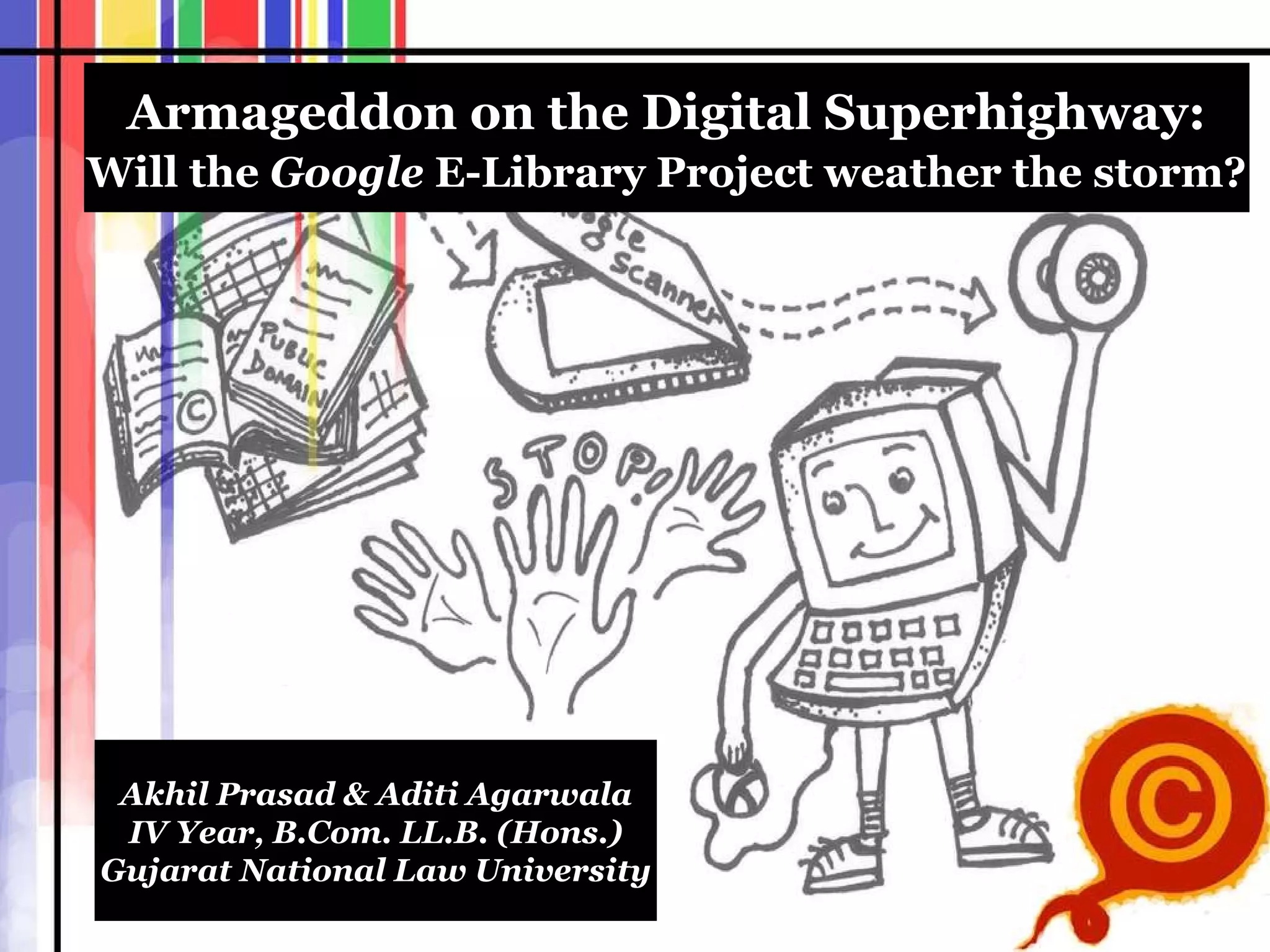
Armageddon on the Digital Superhighway: Will the  Google  E-Library Project weather the storm ? Akhil Prasad & Aditi Agarwala IV Year, B.Com. LL.B. (Hons.) Gujarat National Law University
Copyright - A Stimulus to Creativity -  Slide no. 3 From the Past to the Present  –  The Era of Digitization  -  Slide no. 4 Case Background & Google’s policy  -  Slide no.  6-8  Twin Goal of Copyright Law  -  Slide no.  10 Fair Use  - 4 Factor Test (explained) -  Slide no. 12-17 Advocating Googlelization  -  Slide no. 18 On a concluding note……  -  Slide no.  19 Content Layout
Copyright - A Stimulus to Creativity Positive Right  - Right to make ‘copies’/  authorize reproduction of copies. Negative Right  Historical Roots – Queen Anne’s statute Copyright law receives Constitutional patronage Concept of Public Domain. Limited property right for limited duration.
From the Past to the Present – The Era of Digitization The  Internet Archive,  founded in 1996 is an initiative, a nonprofit founded to build a digital library offering permanent access for researchers, historians, and scholars to historical collections that exist in digital format.  Project Gutenberg , the first and the largest producer of free electronic books (e-books), has placed thousands of e-books on the web since 1989.
However what about the books  enjoying  copyright protection. Can they be digitized without the permission of the owner of the copyright?  Amongst the bundle of rights which the copyright owner enjoys under the aegis of the statute, one of the most important from the economic perspective is the  right of reproduction or to authorize reproduction  of copies in which he owns the copyright
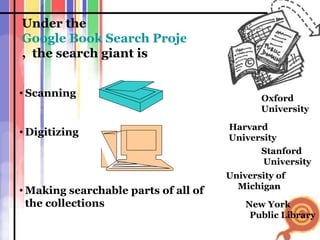
Scanning Digitizing  Making searchable parts of all of the collections  Harvard  University Stanford  University Oxford  University University of  Michigan New York  Public Library Under the  Google Book Search Project ,  the search giant is
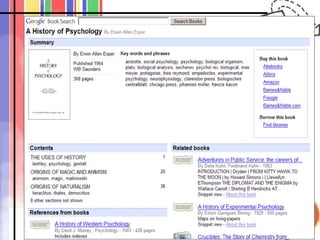
Google’s Policy of the Digitization  Project It is scanning copyrighted books from these 5 libraries. One digital copy  shall be given to the libraries for archival purposes. E-Cataloguing and Free Download  of works in the public domain. To provide a  search index  of copyrighted digitized work and show  few snippets  of each work. Providing a  purchase option  to the customer. Opt out policy.
 
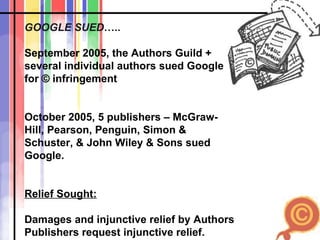
GOOGLE SUED ….. September 2005, the Authors Guild + several individual authors sued Google for  ©  infringement October 2005, 5 publishers – McGraw-Hill, Pearson, Penguin, Simon & Schuster, & John Wiley & Sons sued Google.  Relief Sought: Damages and injunctive relief by Authors Publishers request injunctive relief.
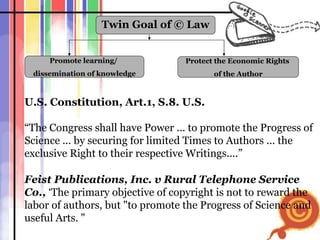
U.S. Constitution, Art.1, S.8. U.S.  “ The Congress shall have Power ... to promote the Progress of Science ... by securing for limited Times to Authors ... the exclusive Right to their respective Writings....”  Feist Publications, Inc. v Rural Telephone Service Co.,  ‘The primary objective of copyright is not to reward the labor of authors, but "to promote the Progress of Science and useful Arts. " Twin Goal of  © Law Promote learning/  dissemination of knowledge Protect the Economic Rights  of the Author
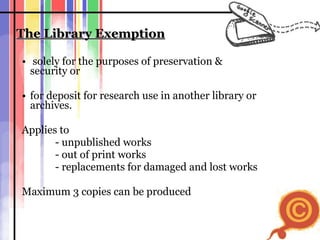
The Library Exemption solely for the purposes of preservation &  security or for deposit for research use in another library or archives.  Applies to - unpublished works  - out of print works - replacements for damaged and lost works Maximum 3 copies can be produced
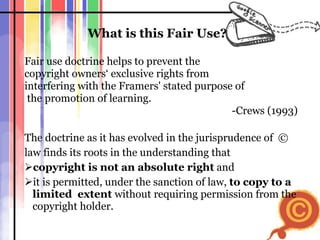
What is this Fair Use?   Fair use doctrine helps to prevent the  copyright owners‘ exclusive rights from  interfering with the Framers' stated purpose of the promotion of learning. -Crews (1993) The doctrine as it has evolved in the jurisprudence of  ©  law finds its roots in the understanding that  copyright is not an absolute right  and  it is permitted, under the sanction of law,  to copy to a limited  extent  without   requiring   permission from the copyright holder.
4 Factor Test The  Purpose  &  Character  of the  use. Nature  of the Copyright  Amount  &  Substantiality  of the portion used in  relation to the Copyright work as a whole. Effect of the use  upon the potential  market . Folsom v. Marsh 9 F. Cas. 342 (1841 )  4 Factors are:
First Test: Purpose & Character of Use Whether such use is of commercial nature or for non  profit educational purposes? It has been observed by the U.S. Supreme Court that  the purpose of the use should be non commercial for  a “commercial or profit making purpose … would be  presumptively unfair” while a non commercial use  would raise a presumption of fairness.  [1]   Subsequently it was held that “the crux of the profit/nonprofit distinction is not whether the sole motive of the use is monetary gain but whether the user stands to profit from the exploitation of the copyrighted material without paying the customary price.”  [2]   Google is selling advertisement space and building a search database and not exploiting the work in the ‘commercial sense’ of copyright.  [1]   Sony Corp. of America v. Universal City Studios, Inc. 464 U.S. 417, 449, 104 S. Ct, 774, 792 (1984) [2]  Harper & Row Publishers, Inc. v. Nation Enterprises 471 U.S. 539, 562; 105 S. Ct. 2218, 2231 (1985)
Second Test: Nature of  the  ©  Work The  second factor  in a fair use analysis is the nature  of the copyrighted work that is potentially infringed. [1]   Courts are likely to find fair use more in factual works  than creative works.  Higher the creativity, more the protection [1]   17 U.S.C. §107(2) (2000).
Third Test: Amount and Substantiality of the portion used Though Google is scanning entire books what will be visible to the netizen while searching  would not be more than a few snippets.  Thus for the purposes of copyright it is ‘de minimis’.
Fourth Test:  Effect of the use upon the potential market . It is improving the marketability of the work by  making the same more “discoverable”. Purchase option is given, the money of which shall go to the right holders. Any party (author or publisher) claiming that the project is or shall cause harm to the market of the work or is of the slightest opinion that has the likelihood of causing harm can resort to the  opt out policy  and thus exclude his work out of the digitization project.
Advocating  Googlelization  of Libraries What is to be appreciated is that Google is promoting the legitimate interests of the right holders and not unreasonably prejudicing their interests.  It is serving the society, though earning profits but not by appropriating labors of the authors. It is also providing that latitude to the right holders to withdraw their works i.e. ‘opt out’ in case they are of the view that scanning and subsequent digitization without their permission and minus paying them any consideration  shall cause unreasonable prejudice to the legitimate interest of the right holders.
On a concluding note… Thus, the final outcome of the Google project is based on perhaps the most fundamental role of copyright law of securing a legal monopoly to the authors for a limited time & of a limited nature. Information and knowledge serve no purpose unless they are communicated or transferred to others. Digitization of books will ensure that information can serve freely serve this purpose. All information, especially those contained in books, should be digitized so that they can be used in a variety of ways. These new uses of information will ultimately benefit of society. There is no reason why such mammoth investment projects should be shown the red signal considering that both the parties and each end of the scales of copyright, are greatly benefited by the balance we call  Google.
Thank You ! Special Thanks to Ridhi Agarwala

Google Digitization Project

  • 1.
    Armageddon on theDigital Superhighway: Will the Google E-Library Project weather the storm ? Akhil Prasad & Aditi Agarwala IV Year, B.Com. LL.B. (Hons.) Gujarat National Law University
  • 2.
    Copyright - AStimulus to Creativity - Slide no. 3 From the Past to the Present – The Era of Digitization - Slide no. 4 Case Background & Google’s policy - Slide no. 6-8 Twin Goal of Copyright Law - Slide no. 10 Fair Use - 4 Factor Test (explained) - Slide no. 12-17 Advocating Googlelization - Slide no. 18 On a concluding note…… - Slide no. 19 Content Layout
  • 3.
    Copyright - AStimulus to Creativity Positive Right - Right to make ‘copies’/ authorize reproduction of copies. Negative Right Historical Roots – Queen Anne’s statute Copyright law receives Constitutional patronage Concept of Public Domain. Limited property right for limited duration.
  • 4.
    From the Pastto the Present – The Era of Digitization The Internet Archive, founded in 1996 is an initiative, a nonprofit founded to build a digital library offering permanent access for researchers, historians, and scholars to historical collections that exist in digital format. Project Gutenberg , the first and the largest producer of free electronic books (e-books), has placed thousands of e-books on the web since 1989.
  • 5.
    However what aboutthe books enjoying copyright protection. Can they be digitized without the permission of the owner of the copyright? Amongst the bundle of rights which the copyright owner enjoys under the aegis of the statute, one of the most important from the economic perspective is the right of reproduction or to authorize reproduction of copies in which he owns the copyright
  • 6.
    Scanning Digitizing Making searchable parts of all of the collections Harvard University Stanford University Oxford University University of Michigan New York Public Library Under the Google Book Search Project , the search giant is
  • 7.
    Google’s Policy ofthe Digitization Project It is scanning copyrighted books from these 5 libraries. One digital copy shall be given to the libraries for archival purposes. E-Cataloguing and Free Download of works in the public domain. To provide a search index of copyrighted digitized work and show few snippets of each work. Providing a purchase option to the customer. Opt out policy.
  • 8.
  • 9.
    GOOGLE SUED …..September 2005, the Authors Guild + several individual authors sued Google for © infringement October 2005, 5 publishers – McGraw-Hill, Pearson, Penguin, Simon & Schuster, & John Wiley & Sons sued Google. Relief Sought: Damages and injunctive relief by Authors Publishers request injunctive relief.
  • 10.
    U.S. Constitution, Art.1,S.8. U.S. “ The Congress shall have Power ... to promote the Progress of Science ... by securing for limited Times to Authors ... the exclusive Right to their respective Writings....” Feist Publications, Inc. v Rural Telephone Service Co., ‘The primary objective of copyright is not to reward the labor of authors, but "to promote the Progress of Science and useful Arts. " Twin Goal of © Law Promote learning/ dissemination of knowledge Protect the Economic Rights of the Author
  • 11.
    The Library Exemptionsolely for the purposes of preservation & security or for deposit for research use in another library or archives. Applies to - unpublished works - out of print works - replacements for damaged and lost works Maximum 3 copies can be produced
  • 12.
    What is thisFair Use? Fair use doctrine helps to prevent the copyright owners‘ exclusive rights from interfering with the Framers' stated purpose of the promotion of learning. -Crews (1993) The doctrine as it has evolved in the jurisprudence of © law finds its roots in the understanding that copyright is not an absolute right and it is permitted, under the sanction of law, to copy to a limited extent without requiring permission from the copyright holder.
  • 13.
    4 Factor TestThe Purpose & Character of the use. Nature of the Copyright Amount & Substantiality of the portion used in relation to the Copyright work as a whole. Effect of the use upon the potential market . Folsom v. Marsh 9 F. Cas. 342 (1841 ) 4 Factors are:
  • 14.
    First Test: Purpose& Character of Use Whether such use is of commercial nature or for non profit educational purposes? It has been observed by the U.S. Supreme Court that the purpose of the use should be non commercial for a “commercial or profit making purpose … would be presumptively unfair” while a non commercial use would raise a presumption of fairness. [1] Subsequently it was held that “the crux of the profit/nonprofit distinction is not whether the sole motive of the use is monetary gain but whether the user stands to profit from the exploitation of the copyrighted material without paying the customary price.” [2] Google is selling advertisement space and building a search database and not exploiting the work in the ‘commercial sense’ of copyright. [1] Sony Corp. of America v. Universal City Studios, Inc. 464 U.S. 417, 449, 104 S. Ct, 774, 792 (1984) [2] Harper & Row Publishers, Inc. v. Nation Enterprises 471 U.S. 539, 562; 105 S. Ct. 2218, 2231 (1985)
  • 15.
    Second Test: Natureof the © Work The second factor in a fair use analysis is the nature of the copyrighted work that is potentially infringed. [1]   Courts are likely to find fair use more in factual works than creative works. Higher the creativity, more the protection [1] 17 U.S.C. §107(2) (2000).
  • 16.
    Third Test: Amountand Substantiality of the portion used Though Google is scanning entire books what will be visible to the netizen while searching would not be more than a few snippets. Thus for the purposes of copyright it is ‘de minimis’.
  • 17.
    Fourth Test: Effect of the use upon the potential market . It is improving the marketability of the work by making the same more “discoverable”. Purchase option is given, the money of which shall go to the right holders. Any party (author or publisher) claiming that the project is or shall cause harm to the market of the work or is of the slightest opinion that has the likelihood of causing harm can resort to the opt out policy and thus exclude his work out of the digitization project.
  • 18.
    Advocating Googlelization of Libraries What is to be appreciated is that Google is promoting the legitimate interests of the right holders and not unreasonably prejudicing their interests. It is serving the society, though earning profits but not by appropriating labors of the authors. It is also providing that latitude to the right holders to withdraw their works i.e. ‘opt out’ in case they are of the view that scanning and subsequent digitization without their permission and minus paying them any consideration shall cause unreasonable prejudice to the legitimate interest of the right holders.
  • 19.
    On a concludingnote… Thus, the final outcome of the Google project is based on perhaps the most fundamental role of copyright law of securing a legal monopoly to the authors for a limited time & of a limited nature. Information and knowledge serve no purpose unless they are communicated or transferred to others. Digitization of books will ensure that information can serve freely serve this purpose. All information, especially those contained in books, should be digitized so that they can be used in a variety of ways. These new uses of information will ultimately benefit of society. There is no reason why such mammoth investment projects should be shown the red signal considering that both the parties and each end of the scales of copyright, are greatly benefited by the balance we call Google.
  • 20.
    Thank You !Special Thanks to Ridhi Agarwala