Copyright, Consensus & Clickers Jonathan Bacon Academic Director Educational Technology Center Johnson County Community College
Channel Setting Instructions for  ResponseCard RF 1. Press and release the "GO" button. 2. While the light is flashing red and green, enter the 2 digit channel code (i.e. channel 1 = 01, channel 21 = 21).   Channel is 41 3. After the second digit is entered, Press and release the "GO" button. 4. Press and release the "1/A" button.  The light should flash yellow to confirm.
Disclaimer I am not a lawyer, have never been a lawyer, and have no intention of becoming one. This is for information and entertainment purposes only. The answers here are not intended as and are not lawyer-client advice. Take my advice, my opinions and my chili with a grain of salt. This information represents my research and my limited understanding of copyright law.
Definition of Copyright The Right to Copy “ Copyright is a form of protection provided by the laws of the United States (title 17, U. S. Code) to the authors of “original works of authorship,” including literary, dramatic, musical, artistic, and certain other intellectual works. This protection is available to both published and unpublished works.” ~ U.S. Copyright Office
Copyright Basics Considered Personal Property (can be sold, transferred, inherited) Automatic Protection when Work Created Original Works of Authorship § 102(a) Must Be in Fixed Form § 102(a) “ Tangible Medium of Expression” Doesn’t Cover Facts or Ideas Registration (Not required after March 1, 1989)
Copyright Notice ~ § 401(b) Copyright Symbol (© or Copyright or abbreviation Copr.) Year of First Publication (e.g., 2008) Year may be omitted for pictorial, graphic or sculptural works and accompanying text (if any) appears on cards, postcards, stationary, jewelry, dolls, toys, or any useful article Name of Copyright Owner (or recognized abbreviation)
Authorship vs. Ownership Creator of Work Considered Author Ownership May Have Transferred Work for Hire § 101 Owning Object ≠ Copyright
Term of Copyright First General Revision of Copyright Law, 1831 28 + 14 Years with Renewal Third General Revision of Copyright Law, 1909  28 + 28 Years with Renewal Title 17, § 302, 1976 Life + 50 Years The Sonny Bono Copyright Term Extension Act, 1998 Life + 70 Years What Really Matters http://www.lib.umn.edu/copyright/PDchart.phtml
Protectable Works ~ § 102(a) Literary Works Musical Works Dramatic Works Pantomimes & Choreographic Works Pictorial, Graphic & Sculptural Works Motion Pictures & Other Audiovisual Works Sound Recordings Architectural Works
Public Domain Copyright Expired Dedicated by Author to Public Works Published before 1978, Failed to Meet 1909 Act Requirements Federal Government Produced (§ 105)
Copyright Holder Rights ~ § 106 To Reproduce Works To Prepare Derivative Works (Adaption)  To Distribute Works Sale, transfer of ownership, rental, leasing, lending To Perform Work Publically  Literary, musical, dramatic, dance, pantomimes, movies, audiovisual works To Display Work Publically  Literary, musical, dramatic, dance, mimes, and pictorial, graphic or sculptural works including individual images from movies & audiovisual works Public Performance of Digital Sound Recordings
Ways to Use Works & Comply with Copyright Laws Is work protected by copyright? Qualify as “fair use?” Qualify under TEACH Act? If not, get permission from copyright holder.
Fair Use Means  Fair  to  Use  Any Copyright Materials in Instruction. True False Not Sure
Fair Use Doctrine ~ § 107 Statutory Basis in § 107, Title 17 (1976 Copyright Act)  “… the fair use of a copyright work, including such use by reproduction in copies…for purposes such as criticism, comment, news reporting, teaching (including multiple copies for classroom use), scholarship or research, is not an infringement of copyright.” “ Equitable rule of reason”
Fair Use Factors ~ § 107 Purpose and Character of Use Commercial vs. Not-for-profit Nature of Work Amount & Substantiality Portion used in relation to whole Effect on Potential Market
Limitations and Revisions 1976 Law Based Predominantly on Print Environment Few Electronic Works (computer programs, databases, mostly indexes) Amendments to Title 17 Cover Digital Digital Millennium Copyright Act (DMCA) 1998 TEACH Act (Distance Learning Amendment) 2002 And More
Fair Use Guidelines for Educational Multimedia 1996 (1) Joint Committee of Publishers, Artist Agents, Higher Ed. Reps. Developed Covers Not-for-profit Educational Uses Lawfully Acquired Copyright Works For Education Purposes in Systematic Learning Activities F2F Instruction Directed Self-study Over Institutions Secure Electronic Network in Real-time
Fair Use Guidelines for Educational Multimedia 1996 (2) Multimedia Limitations Time (2 years max.) Portion (10% or 3 minutes video; 10% or 1000 words; 10% < 30 seconds music; >5 images or photos per artist/photographer) Copying & Distribution Credit Sources Alterations in Original Only in Support of Educational Objectives
Student Submits Class Work (Essay, Artwork, Animation, and So On). The Work Is… Automatically copyright by the student. Copyright by the student if it includes a copyright notice. Owned by student, but can be used by class instructor for any educational purpose. Owned by the college under the “work for hire” concept.
Copyright Holder Rights ~ § 106 To Reproduce Works To Prepare Derivative Works (Adaption)  To Distribute Works To Perform Work Publically  To Display Work Publically  Public Performance of Digital Sound Recordings
Copyright Holder Rights ~ § 106 No copyright notice required, Copyright is automatic, No registration required.
Specifically, Copyright Holder May… Transfer (in writing) or license some or all rights, Authorize derivative works, Control modifications to work, Determine commercialization of work, Control performances or displays of work, Authorize reproductions and transmissions of work.
Faculty Member Records News Broadcast at Home, Shows to Her Class.  Use is illegal because all such programs are copyright. Use in class shortly after recording meets fair use guidelines. Instructor should conduct 4-factor analysis to see if fair use applies. I don’t know.
Four factor Analysis to determine if use qualifies under fair use. Purpose & Character Nature of  Work Amount & Substantiality Effect on Potential Market
Four factor Analysis to determine if use qualifies under fair use. Purpose & Character Nature of  Work Amount & Substantiality Effect on Potential Market Nonprofit, educational, and personal uses are generally favored fair uses while commercial uses are less likely to be deemed fair use.
Four factor Analysis to determine if use qualifies under fair use. Purpose & Character Nature of  Work Amount & Substantiality Effect on Potential Market Factual works, published works and scientific articles (factual in nature) more likely considered fair use than creative, imaginative, artistic, or unpublished works.
Four factor Analysis to determine if use qualifies under fair use. Purpose & Character Nature of  Work Amount & Substantiality Effect on Potential Market Excerpt, extract, clip or small portion  (e.g. only part needed for educational purposes) more likely qualifies as fair use. Entire work or “heart of work” would not.
Four factor Analysis to determine if use qualifies under fair use. Purpose & Character Nature of  Work Amount & Substantiality Effect on Potential Market Economic harm or diminished market for owner of copyright weighs against fair use.
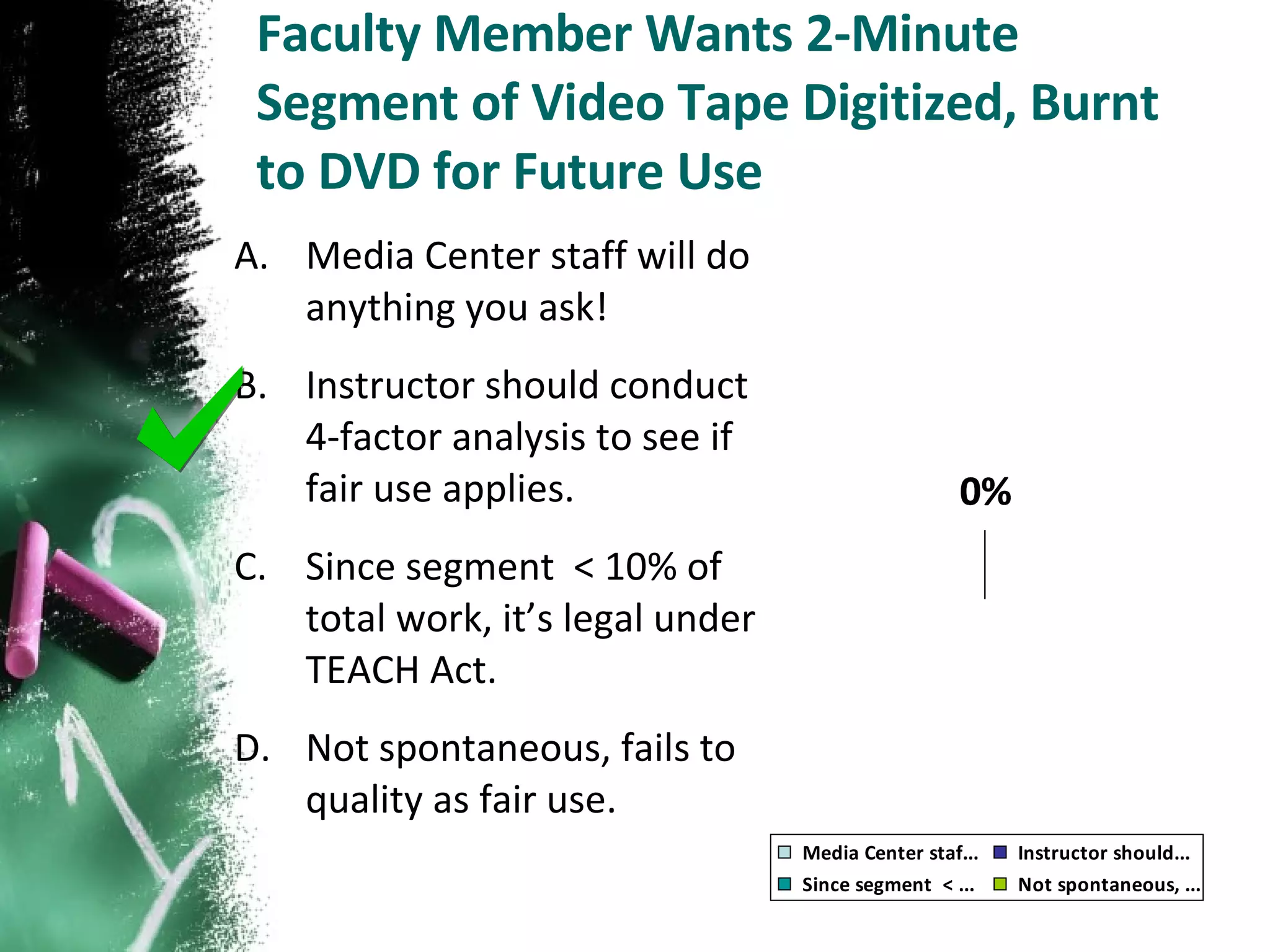
Faculty Member Wants 2-Minute Segment of Video Tape Digitized, Burnt to DVD for Future Use Media Center staff will do anything you ask! Instructor should conduct 4-factor analysis to see if fair use applies. Since segment  < 10% of total work, it’s legal under TEACH Act. Not spontaneous, fails to quality as fair use.
Conditions Change, conduct  4-factor analysis for each subsequent use Purpose & Character Nature of  Copyrighted Work Amount & Substantiality Segment  is “Heart of the Work” Market Effect  Commercial version available
Fair Use: The Tipping Point Fair Use Not Fair Use http://www.lib.ncsu.edu/scc/tutorial/copyuse/worksheet.pdf
Purpose and Character of Use Nonprofit Educational Personal Criticism Commentary News reporting Parody Commercial Fair Use Not Fair Use
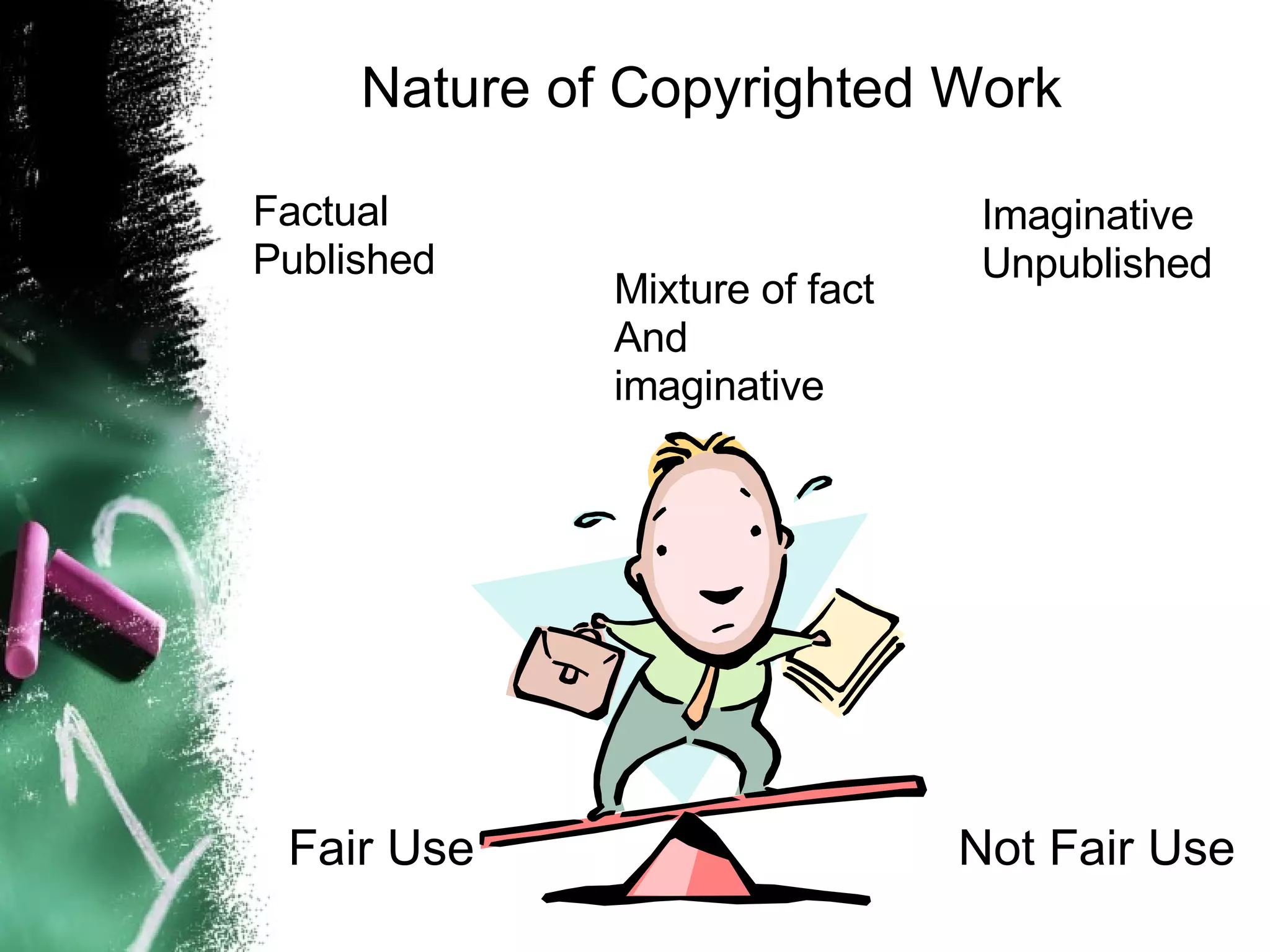
Nature of Copyrighted Work Factual Published Mixture of fact And imaginative Imaginative Unpublished Fair Use Not Fair Use
Amount & Substantiality of Portion Used Small amount, Not the “heart” of the work Large amount, “ Heart”  of the work  Fair Use Not Fair Use
Effect of Use on Market or Value of Work After first 3 factors, if work tips toward Fair Use Original out of print, No ready Permissions Market, Copyright owner not identifiable Competes with sales of Original,  Avoids permissions  payments Fair Use Not Fair Use
Copy of Math Problem from Text (Not Adopted Text) for Class Handout or Online Use Violates Copyright? True False Not Sure
Which Problem, How Many? Cannot copyright concept or idea. Factual vs. “creative” work? Portion of textbook copied? Effect on marketability of textbook? Brevity of quoted material? Conduct 4-Factor Analysis!
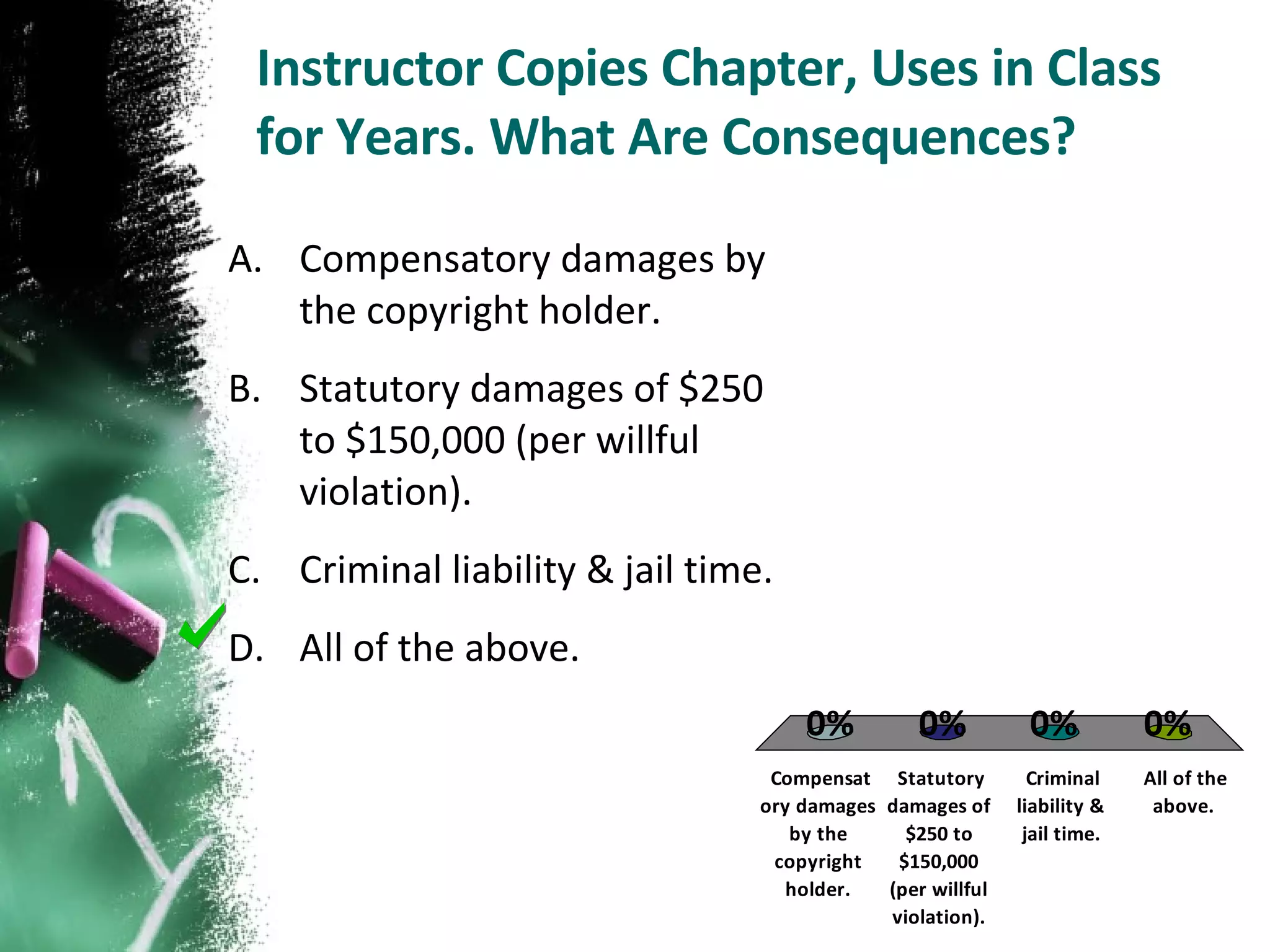
Instructor Copies Chapter, Uses in Class for Years. What Are Consequences?  Compensatory damages by the copyright holder. Statutory damages of $250 to $150,000 (per willful violation). Criminal liability & jail time. All of the above.
T.E.A.C.H. Act ~ Title 17, §110(2) Act Doesn’t Alter Scope of Fair Use Fair Use Technologically Neutral Lack of Guidelines? Fair Use Still Applicable Provides for Transmission of DL Materials § 110(2)
What TEACH Act Does (1) Expands § 110 (Fair Use); Covers Synchronous and Asynchronous Digital Transmissions for DL Expanded Works  Comparable to F2F Instruction Limited Portions Limitations (Uses not covered) Materials Produced/Marketed for DL use Distribution of Illegally Obtained Copies Accredited Nonprofit Educational Institutions or Govt. Bodies Only
What TEACH Act Does (2) Conditions of Permitted Use Directly Related to Teaching Content (Not entertainment) Under Actual Supervision of Instructor Part of Systematic Mediated Instructional Activities Ephemeral Copies ~ Title 17, § 112 (f) Does Not Authorize Wholesale Conversion to Digital Copies Only Retained by Institution for Fair Use Activities Analog Works Digitized Only If Unavailable Free of Technological Protections
What TEACH Act Does (3) Conditions of Recipients Officially Enrolled Students Technologically Limited to Permitted Recipients Mandatory Preconditions Institutional Policies on Copyright Focus on Education Notification of Copyright Ownership to Learners Technological Measures to Prevent Retention Encryption of Transmitted Content Password Required
What TEACH Act Requires Instructors to Inform Students that Works in the Online Course Are Copyright Protected. True False
TEACH Act Requires Instructors to Inform Students that Works in the Online Course Are Copyright Protected. Copyright notice must accompany each work. Course must include general notice of copyright.
The materials on this course web site are only for the use of students enrolled in this course for purposes associated with this course and may not be retained or further disseminated.
Faculty Member Posts Book Excerpt on Her Personal Website for Class to Access. Protected by TEACH Act? Yes, portion comparable to amount used in F2F class. Yes, if not part of a commercial work sold for online use Yes, faculty member posts notice of copyright. No, access not limited to the just class.
TEACH Act Checklist No commercial works designed for online instruction. No pirated or unlawfully made copies. Digital performance or display must be part of mediated instruction. Use software tools to protect access and prevent students from retaining. Notify students that works may be subject  to copyright protection.
Using Work of Others in Instruction? Covered by Copyright? Covered by Fair Use? Covered by TEACH Act? If Not, Get Permission
The Reasonable Good Faith Fair Use Defense Employees of Nonprofit Institutions  Reasonable, Good Faith Determination Court Must Remit Statutory Damages
Resources (1) U.S. Copyright Office and Copyright Law of the United States, see  http://www.copyright.gov/title17/  NewsNet, see  http://www.copyright.gov/newsnet/ Congressional Research Services, Copyright Exemptions for Distance Education: 17 U.S.C. § 110(2), the Technology, Education, and Copyright Harmonization Act of 2002, see  https://www.policyarchive.org/bitstream/handle/10207/2893/RL33516_20060706.pdf?sequence=1
Resources (2) North Carolina State University Fair Use Worksheet, see  http://www.lib.ncsu.edu/scc/tutorial/copyuse/worksheet.pdf  Consortium of College and University Media Centers, “Educational Multimedia Fair Use Guidelines,” see  http://ccumc.org/system/files/MMFUGuides.pdf  The TEACH Toolkit, see  http://www.lib.ncsu.edu/scc/legislative/teachkit/background.html
Resources (3) Copyright Term & the Public Domain in the United States, see  http://www.lib.umn.edu/copyright/PDchart.phtml  Fair Use Analysis Tool, University of Minnesota, see  http://www.lib.umn.edu/copyright/checklist.phtml  History of Copyright, see  http://www.copyright.gov/circs/circ1a.html  Fundamentals of Fair Use and Copyright, California State University, Office of General Counsel, see  http://www.calstate.edu/gc/docs/fair_use.doc

Copyright Clickers Consensus

  • 1.
    Copyright, Consensus &Clickers Jonathan Bacon Academic Director Educational Technology Center Johnson County Community College
  • 2.
    Channel Setting Instructionsfor ResponseCard RF 1. Press and release the &quot;GO&quot; button. 2. While the light is flashing red and green, enter the 2 digit channel code (i.e. channel 1 = 01, channel 21 = 21). Channel is 41 3. After the second digit is entered, Press and release the &quot;GO&quot; button. 4. Press and release the &quot;1/A&quot; button. The light should flash yellow to confirm.
  • 3.
    Disclaimer I amnot a lawyer, have never been a lawyer, and have no intention of becoming one. This is for information and entertainment purposes only. The answers here are not intended as and are not lawyer-client advice. Take my advice, my opinions and my chili with a grain of salt. This information represents my research and my limited understanding of copyright law.
  • 4.
    Definition of CopyrightThe Right to Copy “ Copyright is a form of protection provided by the laws of the United States (title 17, U. S. Code) to the authors of “original works of authorship,” including literary, dramatic, musical, artistic, and certain other intellectual works. This protection is available to both published and unpublished works.” ~ U.S. Copyright Office
  • 5.
    Copyright Basics ConsideredPersonal Property (can be sold, transferred, inherited) Automatic Protection when Work Created Original Works of Authorship § 102(a) Must Be in Fixed Form § 102(a) “ Tangible Medium of Expression” Doesn’t Cover Facts or Ideas Registration (Not required after March 1, 1989)
  • 6.
    Copyright Notice ~§ 401(b) Copyright Symbol (© or Copyright or abbreviation Copr.) Year of First Publication (e.g., 2008) Year may be omitted for pictorial, graphic or sculptural works and accompanying text (if any) appears on cards, postcards, stationary, jewelry, dolls, toys, or any useful article Name of Copyright Owner (or recognized abbreviation)
  • 7.
    Authorship vs. OwnershipCreator of Work Considered Author Ownership May Have Transferred Work for Hire § 101 Owning Object ≠ Copyright
  • 8.
    Term of CopyrightFirst General Revision of Copyright Law, 1831 28 + 14 Years with Renewal Third General Revision of Copyright Law, 1909 28 + 28 Years with Renewal Title 17, § 302, 1976 Life + 50 Years The Sonny Bono Copyright Term Extension Act, 1998 Life + 70 Years What Really Matters http://www.lib.umn.edu/copyright/PDchart.phtml
  • 9.
    Protectable Works ~§ 102(a) Literary Works Musical Works Dramatic Works Pantomimes & Choreographic Works Pictorial, Graphic & Sculptural Works Motion Pictures & Other Audiovisual Works Sound Recordings Architectural Works
  • 10.
    Public Domain CopyrightExpired Dedicated by Author to Public Works Published before 1978, Failed to Meet 1909 Act Requirements Federal Government Produced (§ 105)
  • 11.
    Copyright Holder Rights~ § 106 To Reproduce Works To Prepare Derivative Works (Adaption) To Distribute Works Sale, transfer of ownership, rental, leasing, lending To Perform Work Publically Literary, musical, dramatic, dance, pantomimes, movies, audiovisual works To Display Work Publically Literary, musical, dramatic, dance, mimes, and pictorial, graphic or sculptural works including individual images from movies & audiovisual works Public Performance of Digital Sound Recordings
  • 12.
    Ways to UseWorks & Comply with Copyright Laws Is work protected by copyright? Qualify as “fair use?” Qualify under TEACH Act? If not, get permission from copyright holder.
  • 13.
    Fair Use Means Fair to Use Any Copyright Materials in Instruction. True False Not Sure
  • 14.
    Fair Use Doctrine~ § 107 Statutory Basis in § 107, Title 17 (1976 Copyright Act) “… the fair use of a copyright work, including such use by reproduction in copies…for purposes such as criticism, comment, news reporting, teaching (including multiple copies for classroom use), scholarship or research, is not an infringement of copyright.” “ Equitable rule of reason”
  • 15.
    Fair Use Factors~ § 107 Purpose and Character of Use Commercial vs. Not-for-profit Nature of Work Amount & Substantiality Portion used in relation to whole Effect on Potential Market
  • 16.
    Limitations and Revisions1976 Law Based Predominantly on Print Environment Few Electronic Works (computer programs, databases, mostly indexes) Amendments to Title 17 Cover Digital Digital Millennium Copyright Act (DMCA) 1998 TEACH Act (Distance Learning Amendment) 2002 And More
  • 17.
    Fair Use Guidelinesfor Educational Multimedia 1996 (1) Joint Committee of Publishers, Artist Agents, Higher Ed. Reps. Developed Covers Not-for-profit Educational Uses Lawfully Acquired Copyright Works For Education Purposes in Systematic Learning Activities F2F Instruction Directed Self-study Over Institutions Secure Electronic Network in Real-time
  • 18.
    Fair Use Guidelinesfor Educational Multimedia 1996 (2) Multimedia Limitations Time (2 years max.) Portion (10% or 3 minutes video; 10% or 1000 words; 10% < 30 seconds music; >5 images or photos per artist/photographer) Copying & Distribution Credit Sources Alterations in Original Only in Support of Educational Objectives
  • 19.
    Student Submits ClassWork (Essay, Artwork, Animation, and So On). The Work Is… Automatically copyright by the student. Copyright by the student if it includes a copyright notice. Owned by student, but can be used by class instructor for any educational purpose. Owned by the college under the “work for hire” concept.
  • 20.
    Copyright Holder Rights~ § 106 To Reproduce Works To Prepare Derivative Works (Adaption) To Distribute Works To Perform Work Publically To Display Work Publically Public Performance of Digital Sound Recordings
  • 21.
    Copyright Holder Rights~ § 106 No copyright notice required, Copyright is automatic, No registration required.
  • 22.
    Specifically, Copyright HolderMay… Transfer (in writing) or license some or all rights, Authorize derivative works, Control modifications to work, Determine commercialization of work, Control performances or displays of work, Authorize reproductions and transmissions of work.
  • 23.
    Faculty Member RecordsNews Broadcast at Home, Shows to Her Class. Use is illegal because all such programs are copyright. Use in class shortly after recording meets fair use guidelines. Instructor should conduct 4-factor analysis to see if fair use applies. I don’t know.
  • 24.
    Four factor Analysisto determine if use qualifies under fair use. Purpose & Character Nature of Work Amount & Substantiality Effect on Potential Market
  • 25.
    Four factor Analysisto determine if use qualifies under fair use. Purpose & Character Nature of Work Amount & Substantiality Effect on Potential Market Nonprofit, educational, and personal uses are generally favored fair uses while commercial uses are less likely to be deemed fair use.
  • 26.
    Four factor Analysisto determine if use qualifies under fair use. Purpose & Character Nature of Work Amount & Substantiality Effect on Potential Market Factual works, published works and scientific articles (factual in nature) more likely considered fair use than creative, imaginative, artistic, or unpublished works.
  • 27.
    Four factor Analysisto determine if use qualifies under fair use. Purpose & Character Nature of Work Amount & Substantiality Effect on Potential Market Excerpt, extract, clip or small portion (e.g. only part needed for educational purposes) more likely qualifies as fair use. Entire work or “heart of work” would not.
  • 28.
    Four factor Analysisto determine if use qualifies under fair use. Purpose & Character Nature of Work Amount & Substantiality Effect on Potential Market Economic harm or diminished market for owner of copyright weighs against fair use.
  • 29.
    Faculty Member Wants2-Minute Segment of Video Tape Digitized, Burnt to DVD for Future Use Media Center staff will do anything you ask! Instructor should conduct 4-factor analysis to see if fair use applies. Since segment < 10% of total work, it’s legal under TEACH Act. Not spontaneous, fails to quality as fair use.
  • 30.
    Conditions Change, conduct 4-factor analysis for each subsequent use Purpose & Character Nature of Copyrighted Work Amount & Substantiality Segment is “Heart of the Work” Market Effect Commercial version available
  • 31.
    Fair Use: TheTipping Point Fair Use Not Fair Use http://www.lib.ncsu.edu/scc/tutorial/copyuse/worksheet.pdf
  • 32.
    Purpose and Characterof Use Nonprofit Educational Personal Criticism Commentary News reporting Parody Commercial Fair Use Not Fair Use
  • 33.
    Nature of CopyrightedWork Factual Published Mixture of fact And imaginative Imaginative Unpublished Fair Use Not Fair Use
  • 34.
    Amount & Substantialityof Portion Used Small amount, Not the “heart” of the work Large amount, “ Heart” of the work Fair Use Not Fair Use
  • 35.
    Effect of Useon Market or Value of Work After first 3 factors, if work tips toward Fair Use Original out of print, No ready Permissions Market, Copyright owner not identifiable Competes with sales of Original, Avoids permissions payments Fair Use Not Fair Use
  • 36.
    Copy of MathProblem from Text (Not Adopted Text) for Class Handout or Online Use Violates Copyright? True False Not Sure
  • 37.
    Which Problem, HowMany? Cannot copyright concept or idea. Factual vs. “creative” work? Portion of textbook copied? Effect on marketability of textbook? Brevity of quoted material? Conduct 4-Factor Analysis!
  • 38.
    Instructor Copies Chapter,Uses in Class for Years. What Are Consequences? Compensatory damages by the copyright holder. Statutory damages of $250 to $150,000 (per willful violation). Criminal liability & jail time. All of the above.
  • 39.
    T.E.A.C.H. Act ~Title 17, §110(2) Act Doesn’t Alter Scope of Fair Use Fair Use Technologically Neutral Lack of Guidelines? Fair Use Still Applicable Provides for Transmission of DL Materials § 110(2)
  • 40.
    What TEACH ActDoes (1) Expands § 110 (Fair Use); Covers Synchronous and Asynchronous Digital Transmissions for DL Expanded Works Comparable to F2F Instruction Limited Portions Limitations (Uses not covered) Materials Produced/Marketed for DL use Distribution of Illegally Obtained Copies Accredited Nonprofit Educational Institutions or Govt. Bodies Only
  • 41.
    What TEACH ActDoes (2) Conditions of Permitted Use Directly Related to Teaching Content (Not entertainment) Under Actual Supervision of Instructor Part of Systematic Mediated Instructional Activities Ephemeral Copies ~ Title 17, § 112 (f) Does Not Authorize Wholesale Conversion to Digital Copies Only Retained by Institution for Fair Use Activities Analog Works Digitized Only If Unavailable Free of Technological Protections
  • 42.
    What TEACH ActDoes (3) Conditions of Recipients Officially Enrolled Students Technologically Limited to Permitted Recipients Mandatory Preconditions Institutional Policies on Copyright Focus on Education Notification of Copyright Ownership to Learners Technological Measures to Prevent Retention Encryption of Transmitted Content Password Required
  • 43.
    What TEACH ActRequires Instructors to Inform Students that Works in the Online Course Are Copyright Protected. True False
  • 44.
    TEACH Act RequiresInstructors to Inform Students that Works in the Online Course Are Copyright Protected. Copyright notice must accompany each work. Course must include general notice of copyright.
  • 45.
    The materials onthis course web site are only for the use of students enrolled in this course for purposes associated with this course and may not be retained or further disseminated.
  • 46.
    Faculty Member PostsBook Excerpt on Her Personal Website for Class to Access. Protected by TEACH Act? Yes, portion comparable to amount used in F2F class. Yes, if not part of a commercial work sold for online use Yes, faculty member posts notice of copyright. No, access not limited to the just class.
  • 47.
    TEACH Act ChecklistNo commercial works designed for online instruction. No pirated or unlawfully made copies. Digital performance or display must be part of mediated instruction. Use software tools to protect access and prevent students from retaining. Notify students that works may be subject to copyright protection.
  • 48.
    Using Work ofOthers in Instruction? Covered by Copyright? Covered by Fair Use? Covered by TEACH Act? If Not, Get Permission
  • 49.
    The Reasonable GoodFaith Fair Use Defense Employees of Nonprofit Institutions Reasonable, Good Faith Determination Court Must Remit Statutory Damages
  • 50.
    Resources (1) U.S.Copyright Office and Copyright Law of the United States, see http://www.copyright.gov/title17/ NewsNet, see http://www.copyright.gov/newsnet/ Congressional Research Services, Copyright Exemptions for Distance Education: 17 U.S.C. § 110(2), the Technology, Education, and Copyright Harmonization Act of 2002, see https://www.policyarchive.org/bitstream/handle/10207/2893/RL33516_20060706.pdf?sequence=1
  • 51.
    Resources (2) NorthCarolina State University Fair Use Worksheet, see http://www.lib.ncsu.edu/scc/tutorial/copyuse/worksheet.pdf Consortium of College and University Media Centers, “Educational Multimedia Fair Use Guidelines,” see http://ccumc.org/system/files/MMFUGuides.pdf The TEACH Toolkit, see http://www.lib.ncsu.edu/scc/legislative/teachkit/background.html
  • 52.
    Resources (3) CopyrightTerm & the Public Domain in the United States, see http://www.lib.umn.edu/copyright/PDchart.phtml Fair Use Analysis Tool, University of Minnesota, see http://www.lib.umn.edu/copyright/checklist.phtml History of Copyright, see http://www.copyright.gov/circs/circ1a.html Fundamentals of Fair Use and Copyright, California State University, Office of General Counsel, see http://www.calstate.edu/gc/docs/fair_use.doc

Editor's Notes

  • #2 Thursday, July 31, 2008 SIDLIT 2008