CoPs in Information Service
Organisations: a wild goose
chase?

Paper Presentation by Johann van Wyk at the
HICSA Meeting held on 2 November 2005
Introduction
•
•
•
•
•
•

Knowledge:Tacit or Explicit
Knowledge Management
Learning Organisation
Communities of Practice (CoPs)
Stages in the development of CoPs
CoPs in an Academic Library: Case
Study: Academic Information Service,
University of Pretoria
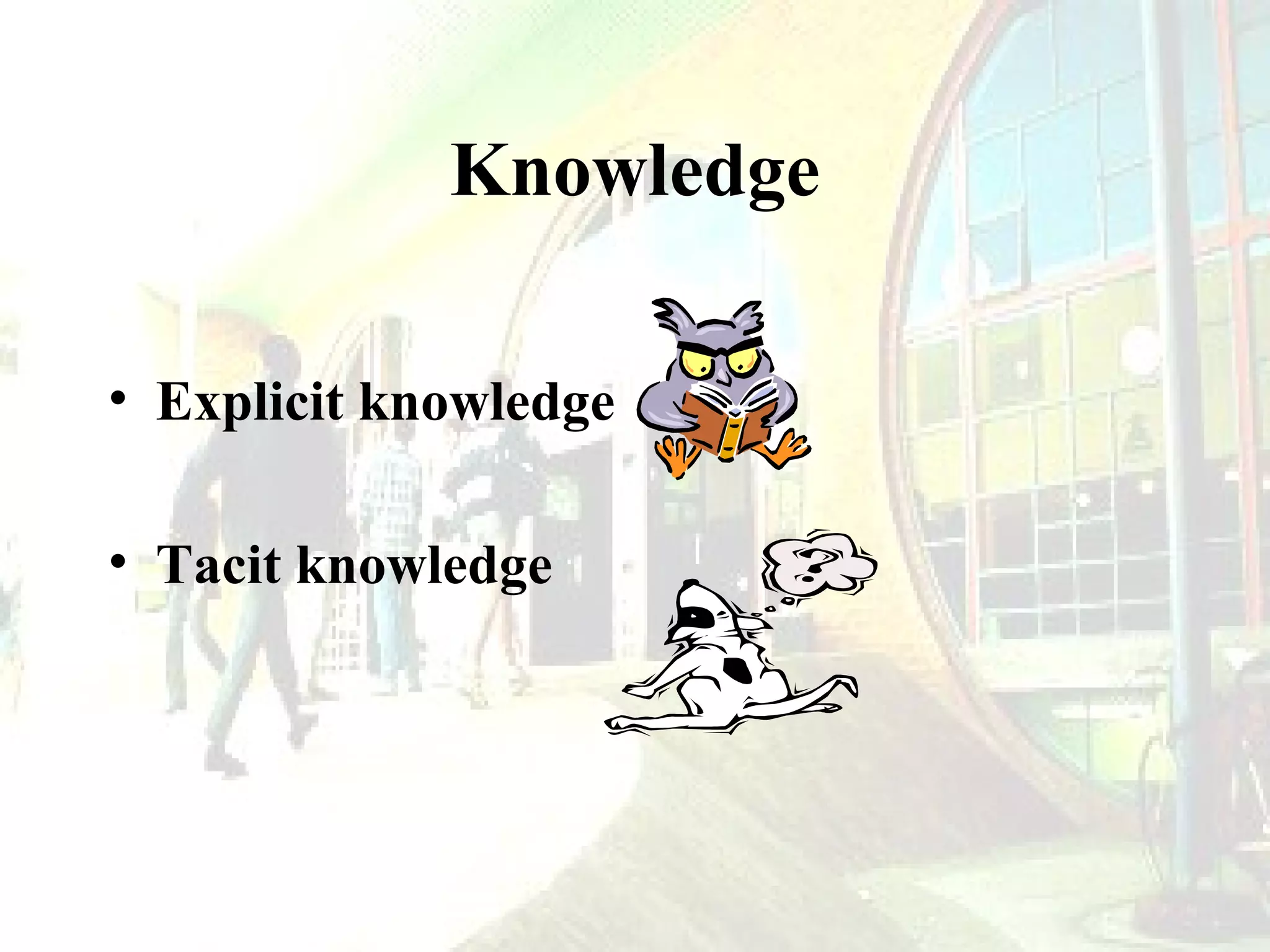
Knowledge
• Explicit knowledge
• Tacit knowledge
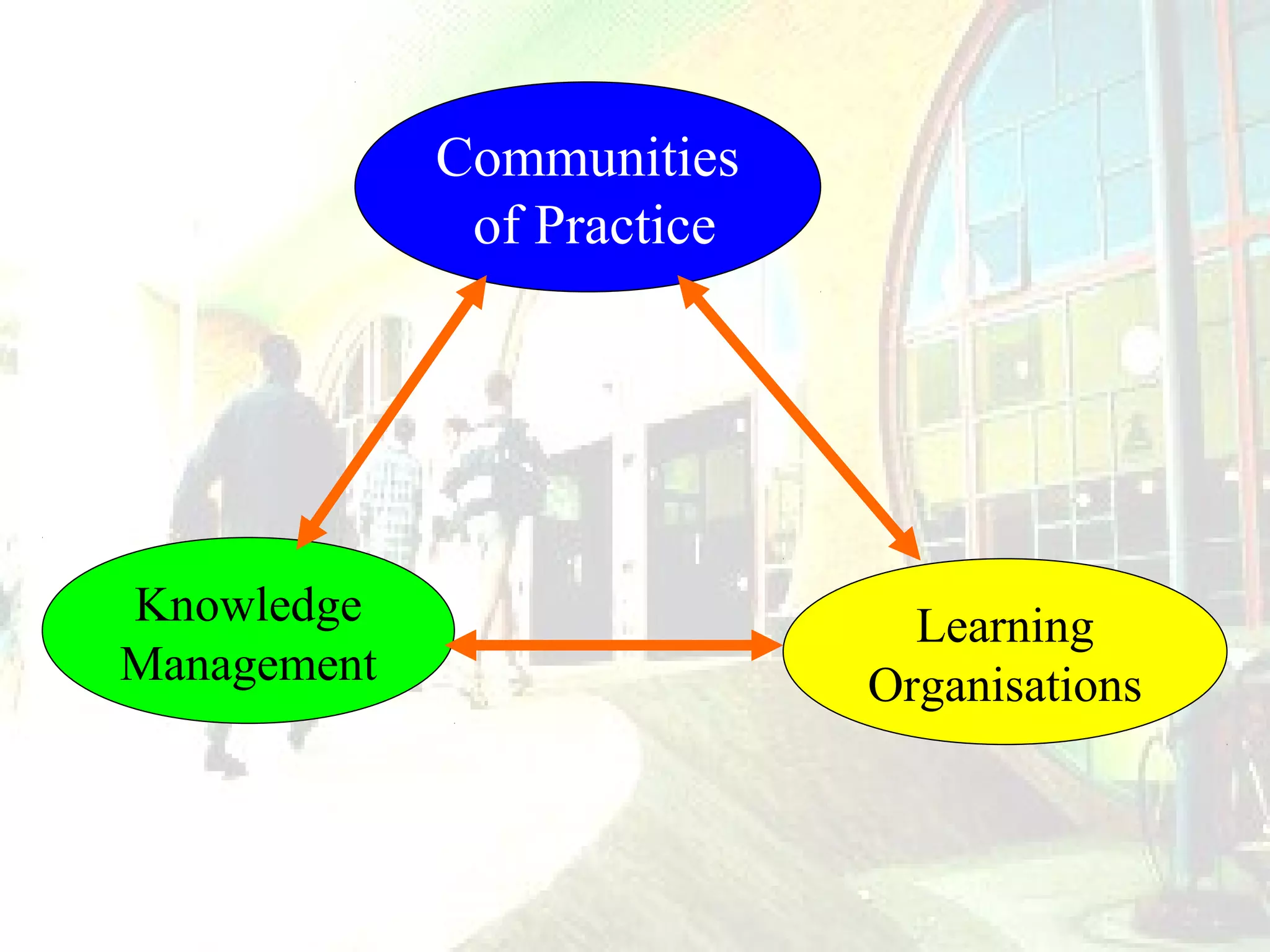
Communities
of Practice

Knowledge
Management

Learning
Organisations
Knowledge Management
• Definition:
- Utilisation and exploitation of all
knowledge assets of organisation
- Including all its info and its human
experience and expertise
- Ensure sustainability and competitive
advantage
KM Definition (Cont.)
- Utilises its culture, processes and
infrastructure to
- Create, identify, capture, share, use & reuse knowledge
- Adding optimal value to client’s
knowledge base
Learning organisations
• Definition:
“An organisation that can identify, develop
and utilize its tacit and explicit knowledge
capabilities, enabling the organisation to
expand its capacity to learn and grow, and to
modify its behaviour to reflect new
knowledge and insights, and in doing so to
improve its performance and success”.
Communities of Practice (CoPs)
• Background:
- Social groups: e.g. Drinking clubs, Roman
Collegia, Guilds, Caste System in India,
regiments, old-boy-networks, peer groups and
gangs.
- Academic groups: e.g. Royal Society, American
Philosophical Society
- Informal Academic Groups: Invisible Colleges
- Xerox: Communities of Professionals
- Jean Lave and Etienne Wenger
What is a Community of
Practice?
“A Community of Practice is a network
of people emerging spontaneously, and
held together by informal relationships
and common purpose, that share
common knowledge or a specific
domain, expertise and tools, and learn
from one another”.
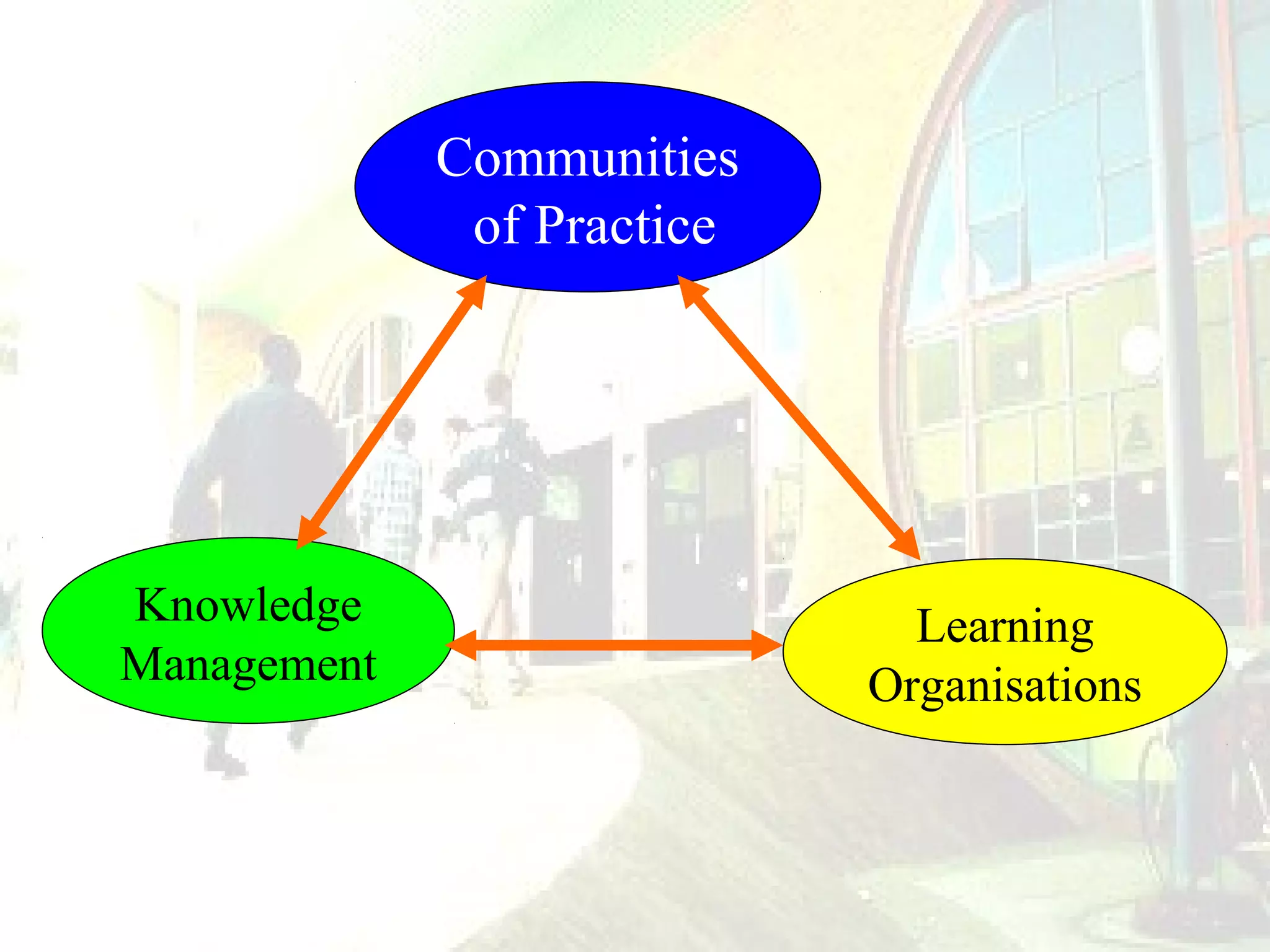
Communities
of Practice

Knowledge
Management

Learning
Organisations
Capturing knowledge through
CoPs
• Storytelling
• Role-play/scenarios
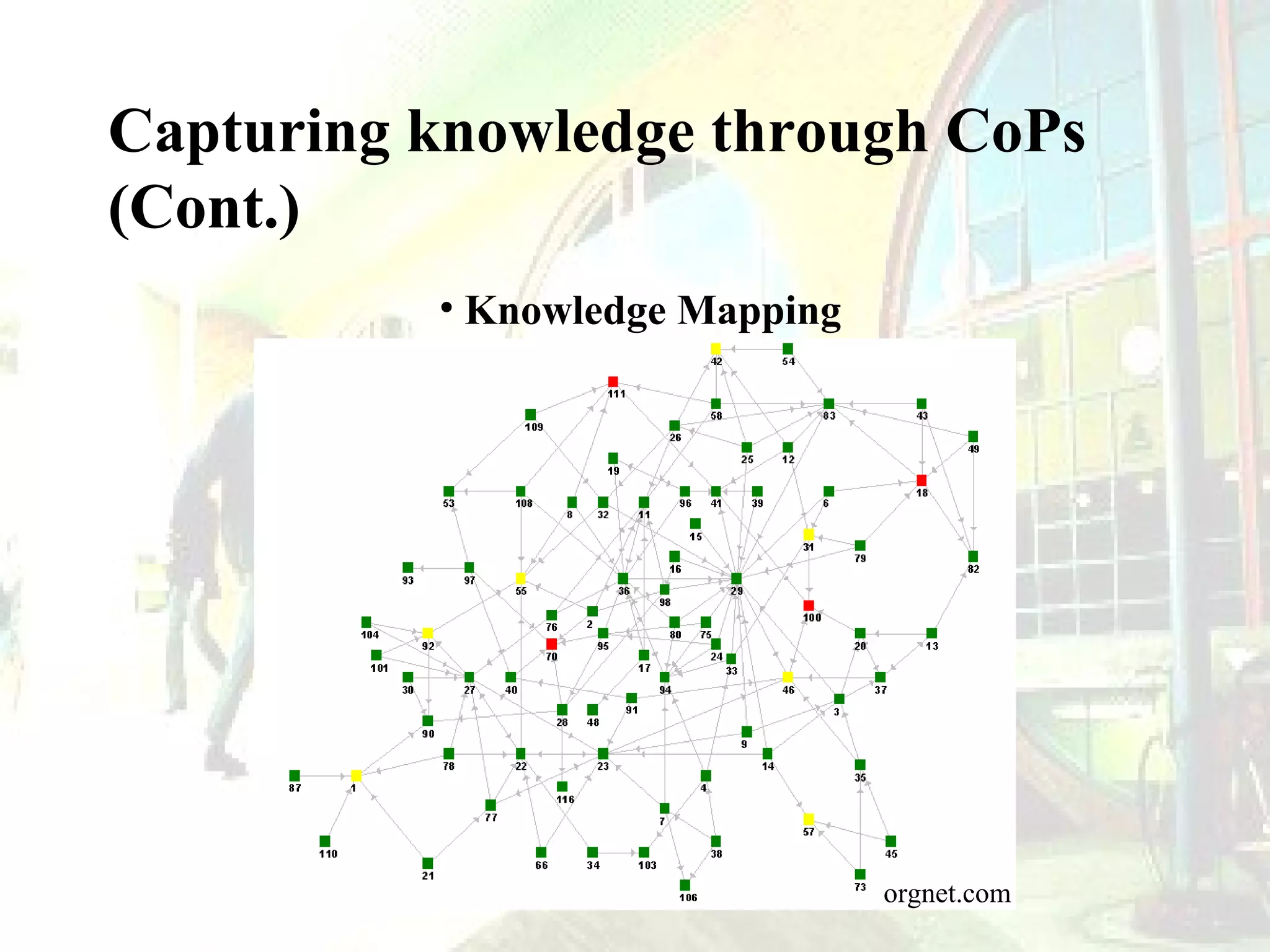
Capturing knowledge through CoPs
(Cont.)
• Knowledge Mapping

orgnet.com
Case Study:
Academic Information Service
(AIS), University of Pretoria,
South Africa

• Background
• Respondents
• Method: Literature study and Interviews
CoPs identified in the AIS
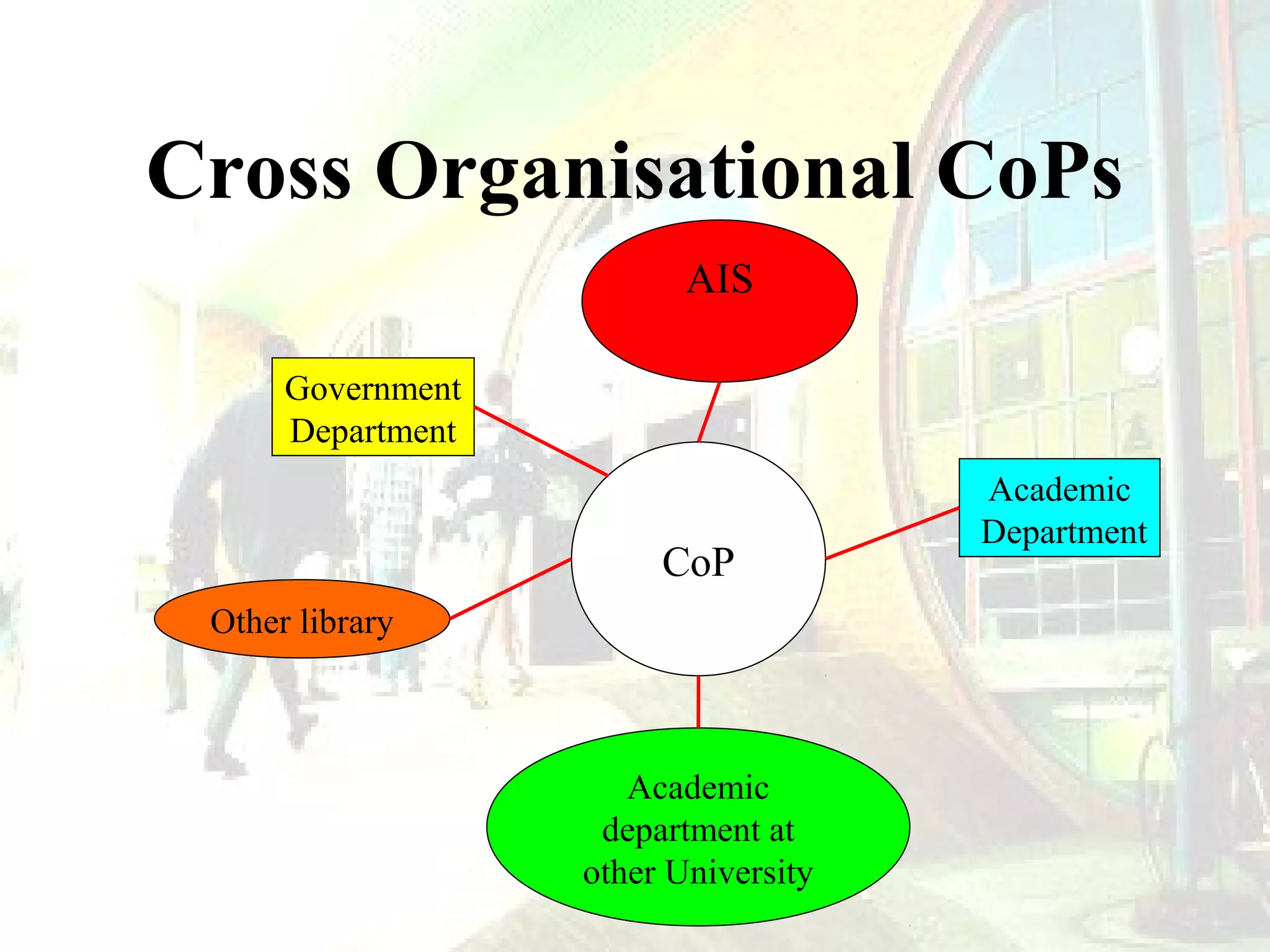
Cross Organisational CoPs
AIS
Government
Department

CoP
Other library

Academic
department at
other University

Academic
Department
Knowledge Management
Practitioners Group of Pretoria
• http://www.kmpg.org
GCATS (GAELIC Cataloguers)
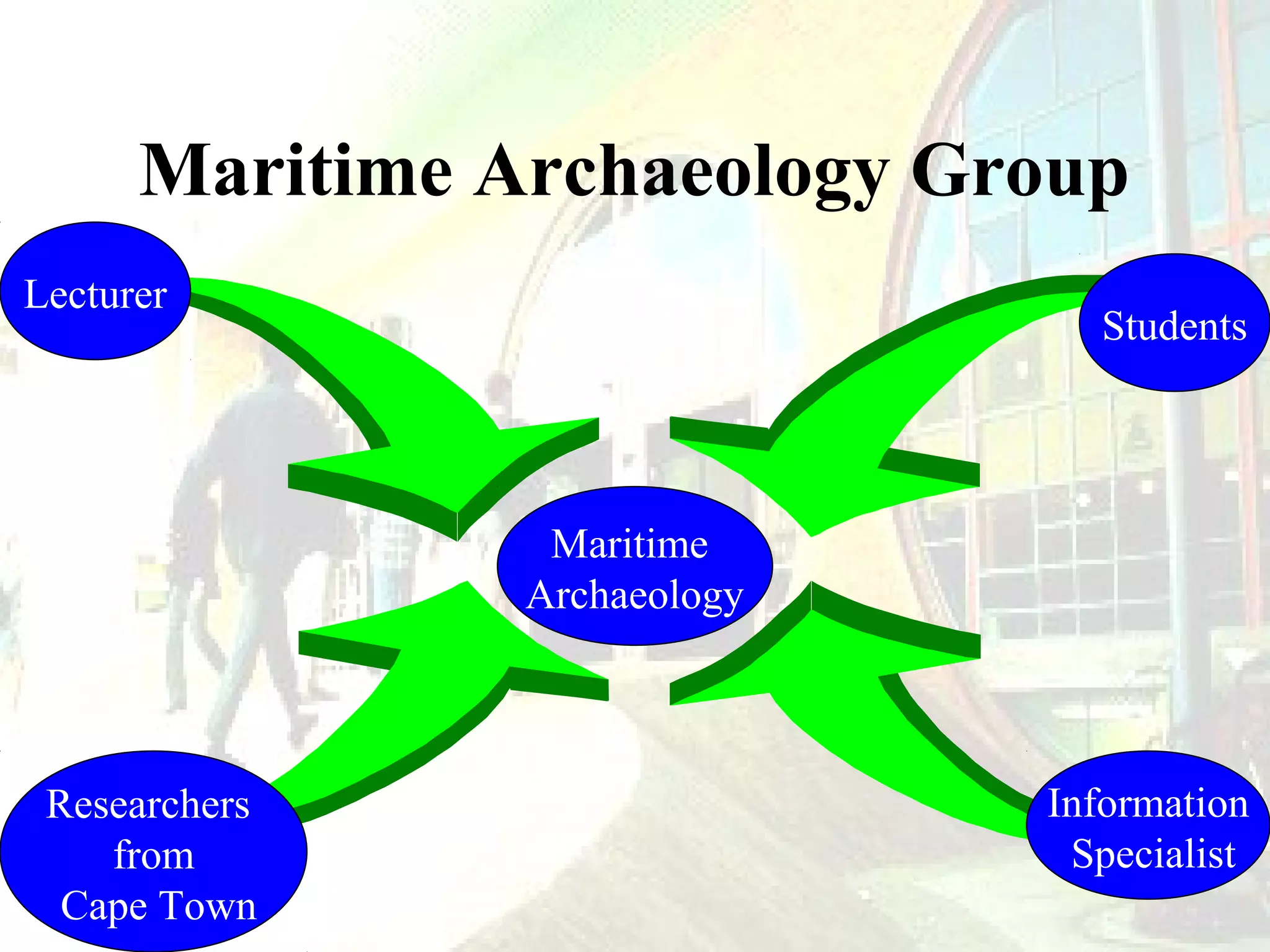
Maritime Archaeology Group
Lecturer

Students

Maritime
Archaeology

Researchers
from
Cape Town

Information
Specialist
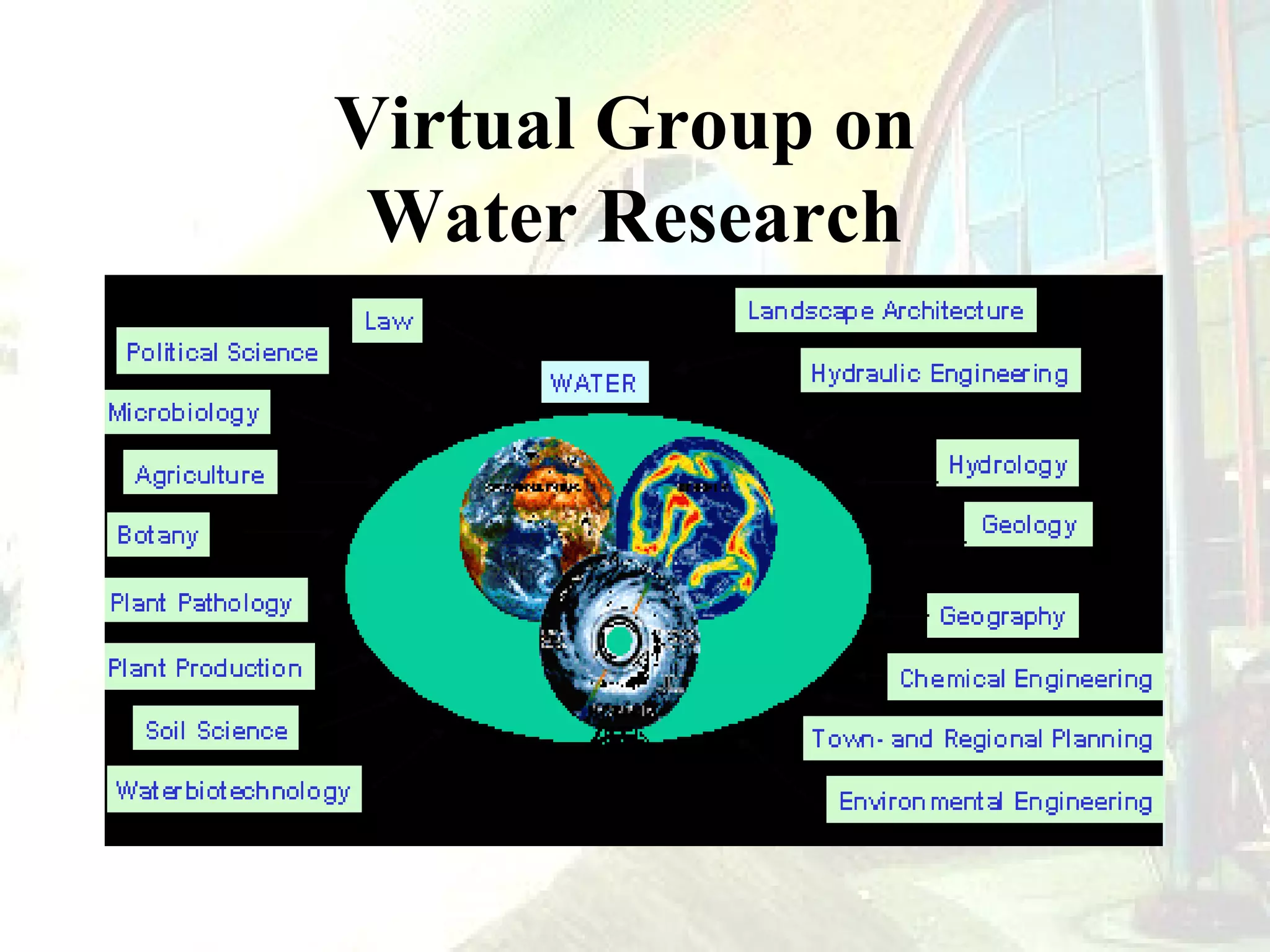
Virtual Group on
Water Research
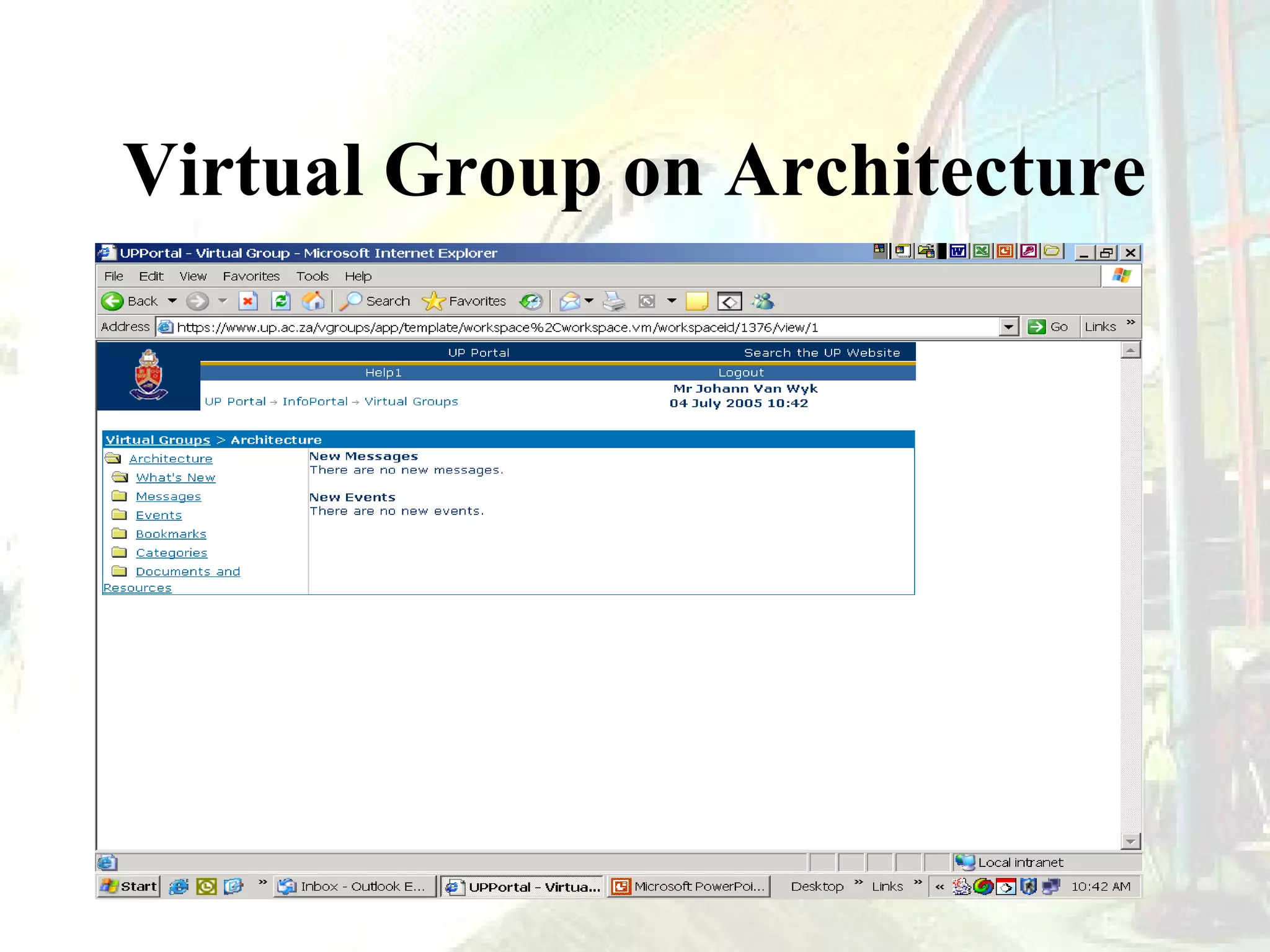
Virtual Group on Architecture
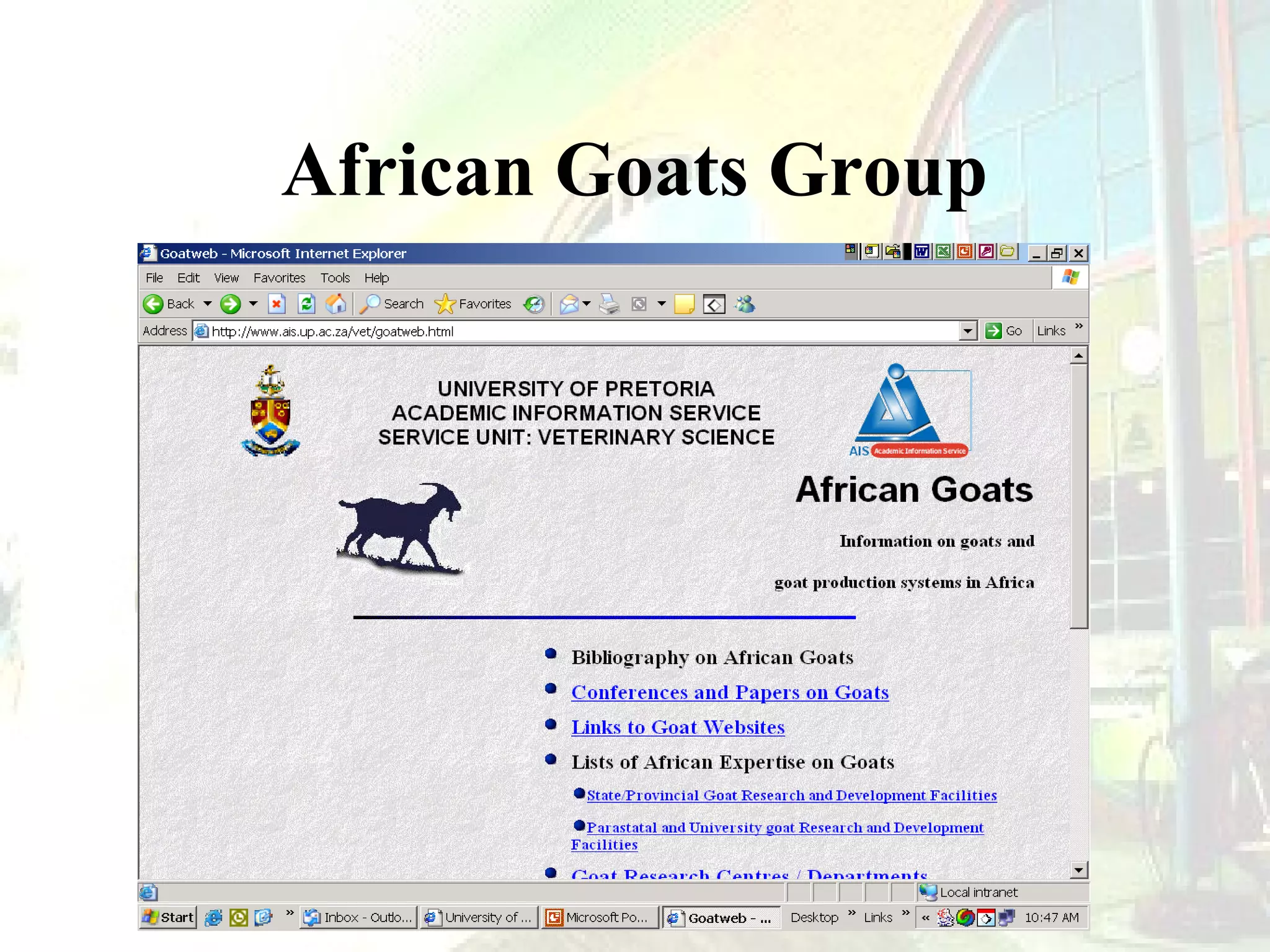
African Goats Group
Internal CoPs in the AIS
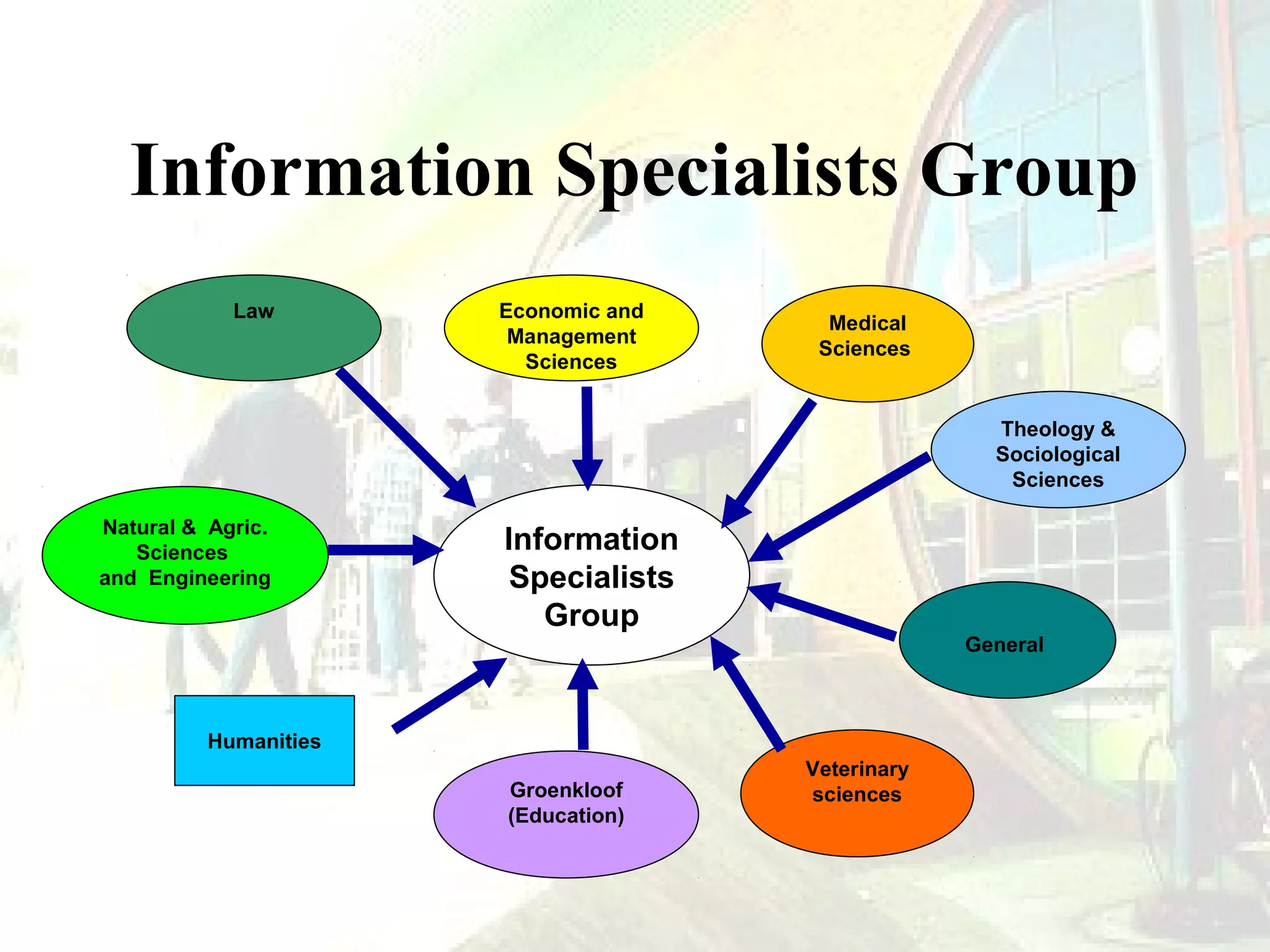
Information Specialists Group
Law

Economic and
Management
Sciences

Medical
Sciences

Theology &
Sociological
Sciences
Natural & Agric.
Sciences
and Engineering

Information
Specialists
Group
General

Humanities
Groenkloof
(Education)

Veterinary
sciences
Digital Repositories Group
Informal Network for
E-Information Experts
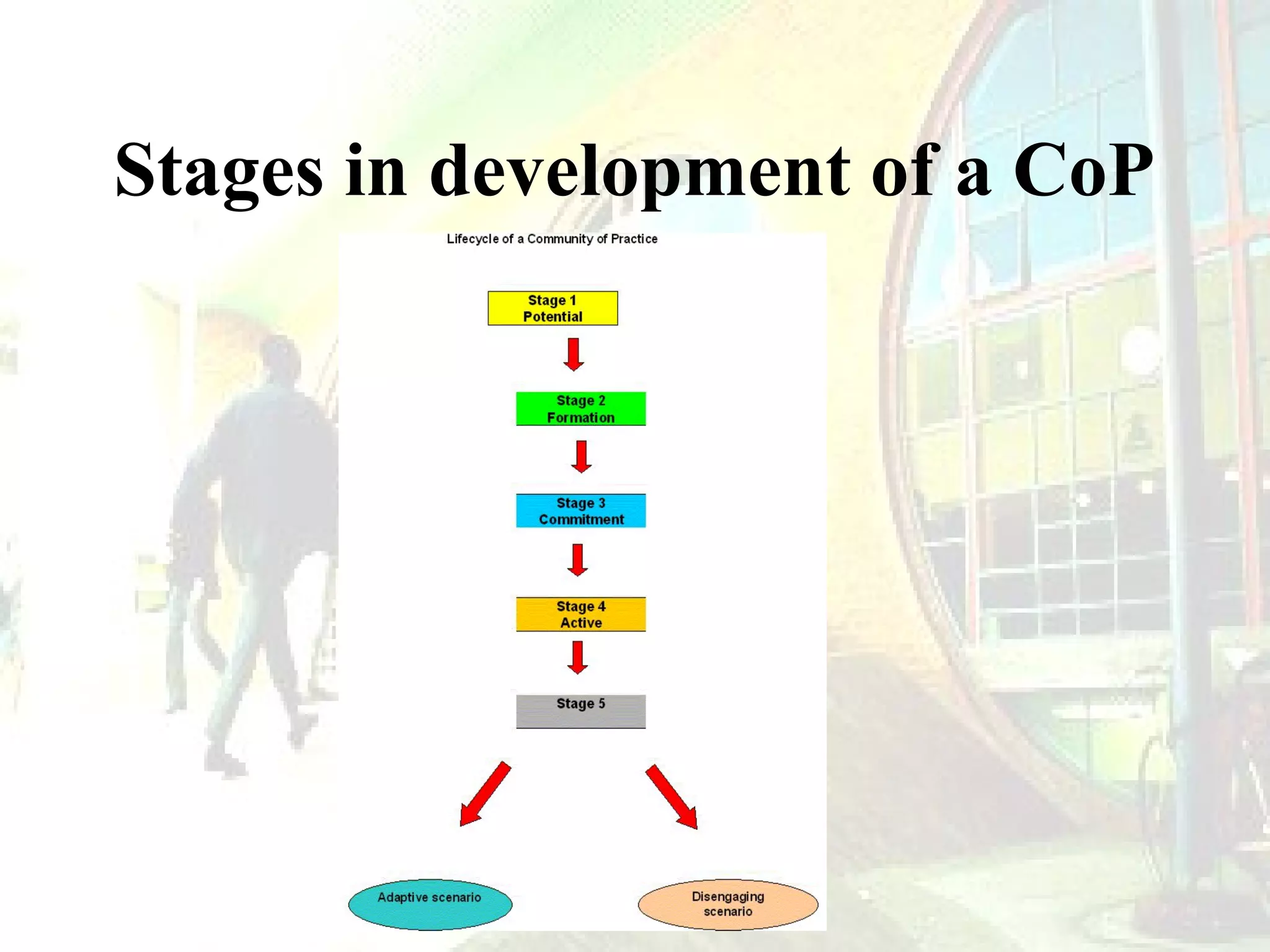
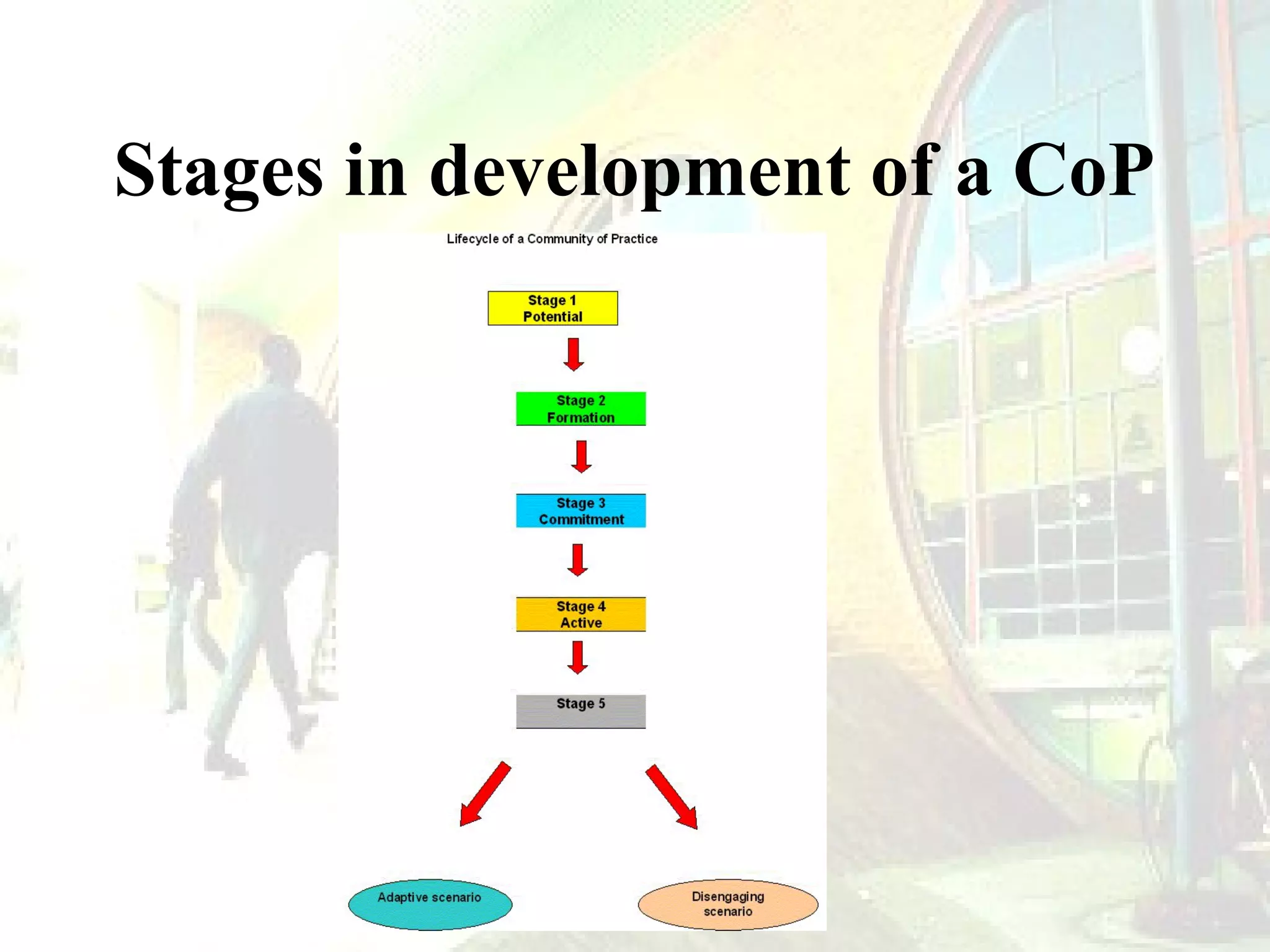
Stages in development of a CoP
Results
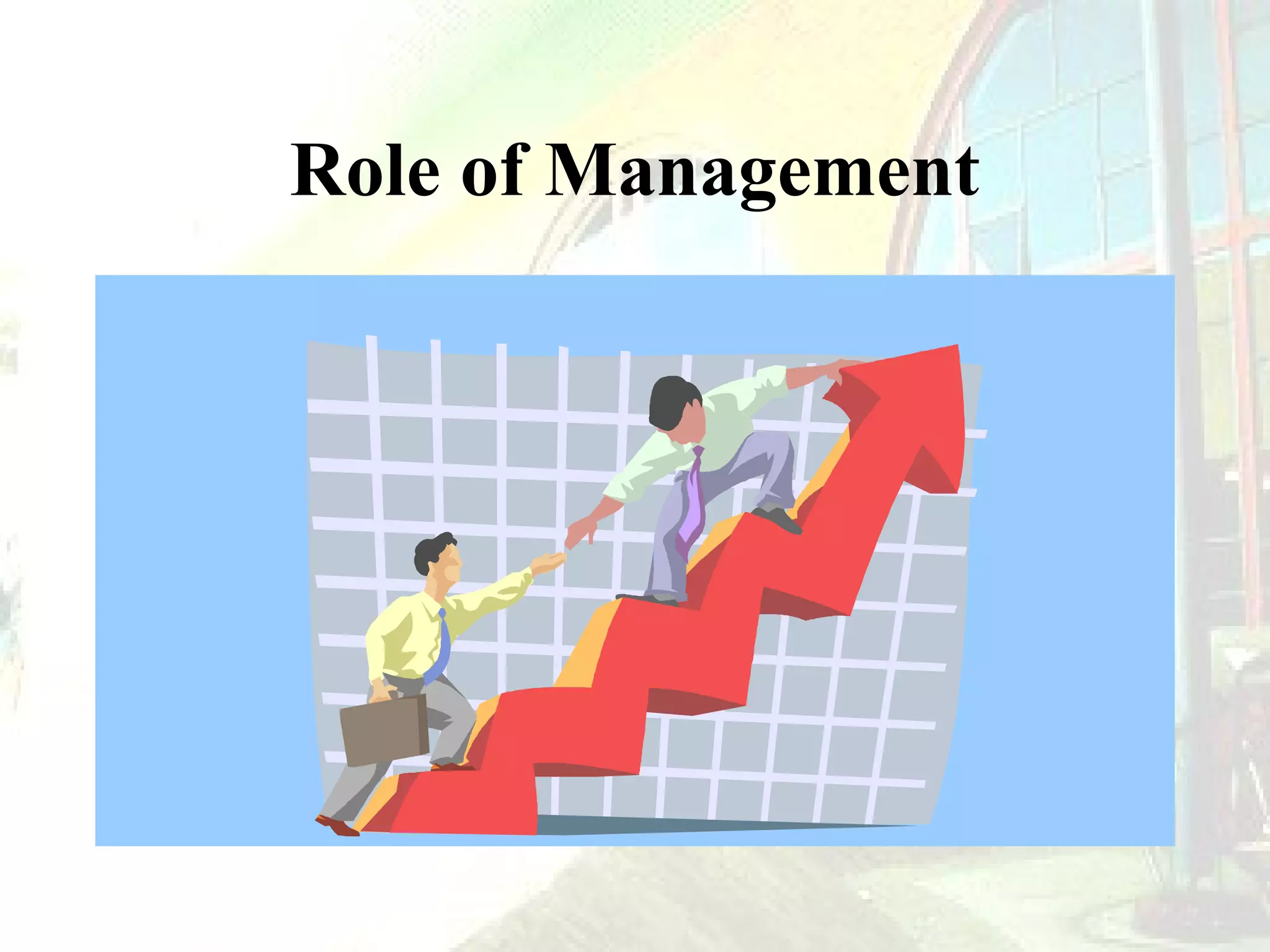
Role of Management
Time to participate
Workload
Rewards or Incentives
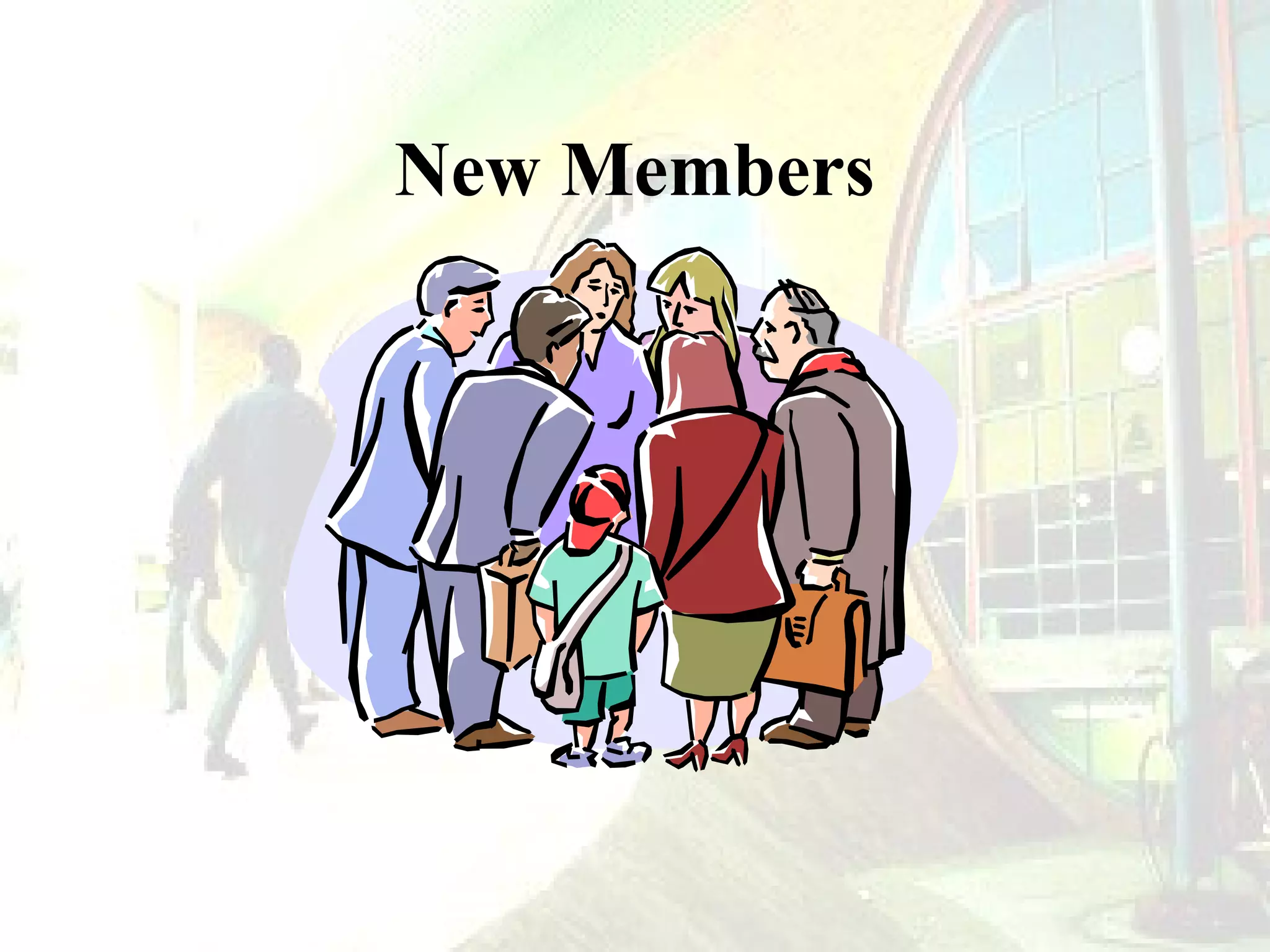
New Members
Size of the CoP
• Ideal size: 15 – 20 members
Trust
Coordination or Facilitation
role in the CoP
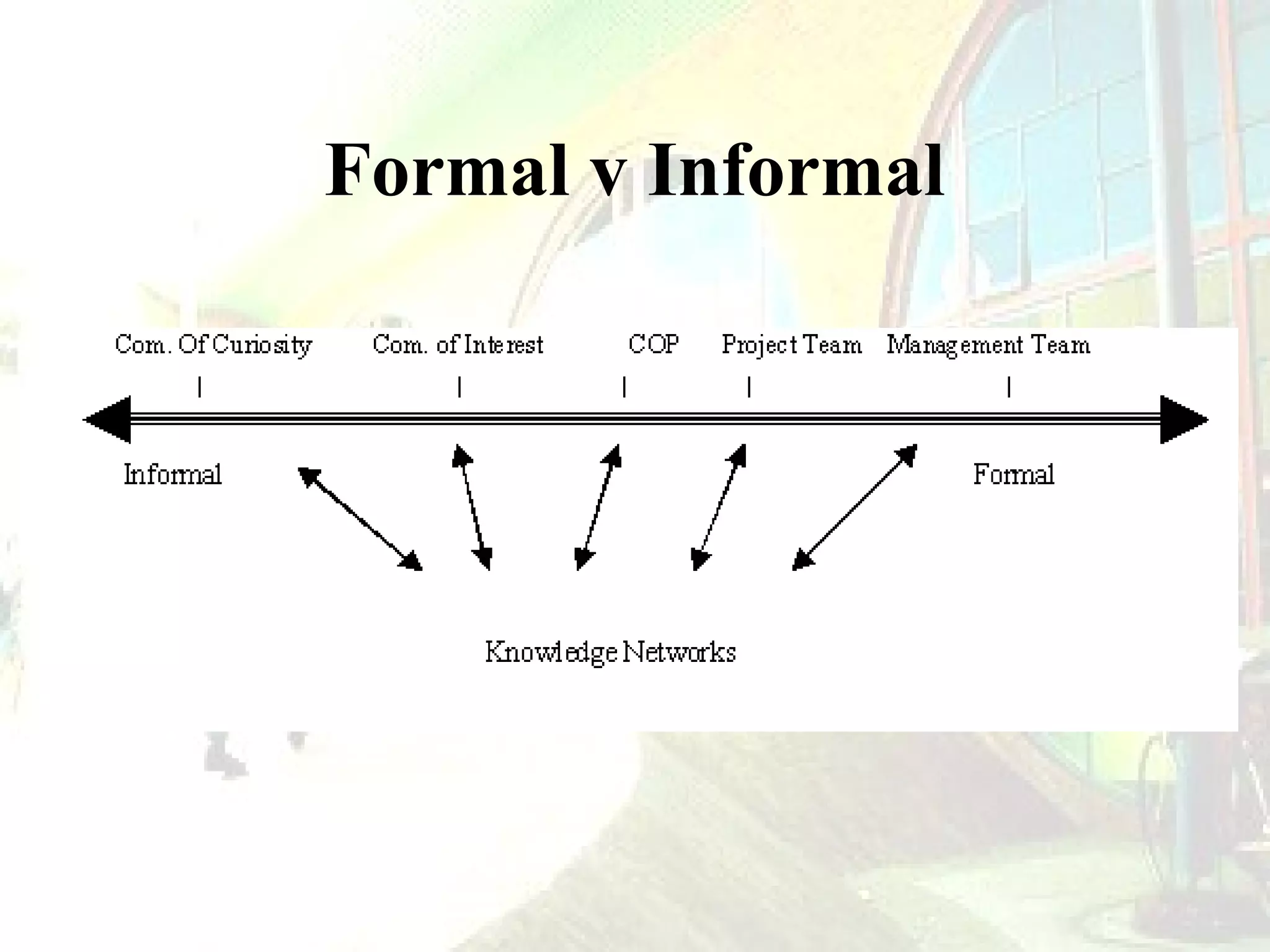
Formal v Informal
Information
Technology
•
•
•
•

E-mail and Listservs
Telephone and Teleconferencing
Web Pages
Virtual Workspaces on Portals, e.g.
InfoPortal of UP
Conclusion
• Are CoPs in Information Service
Organisations a wild goose chase?
Stages in development of a CoP
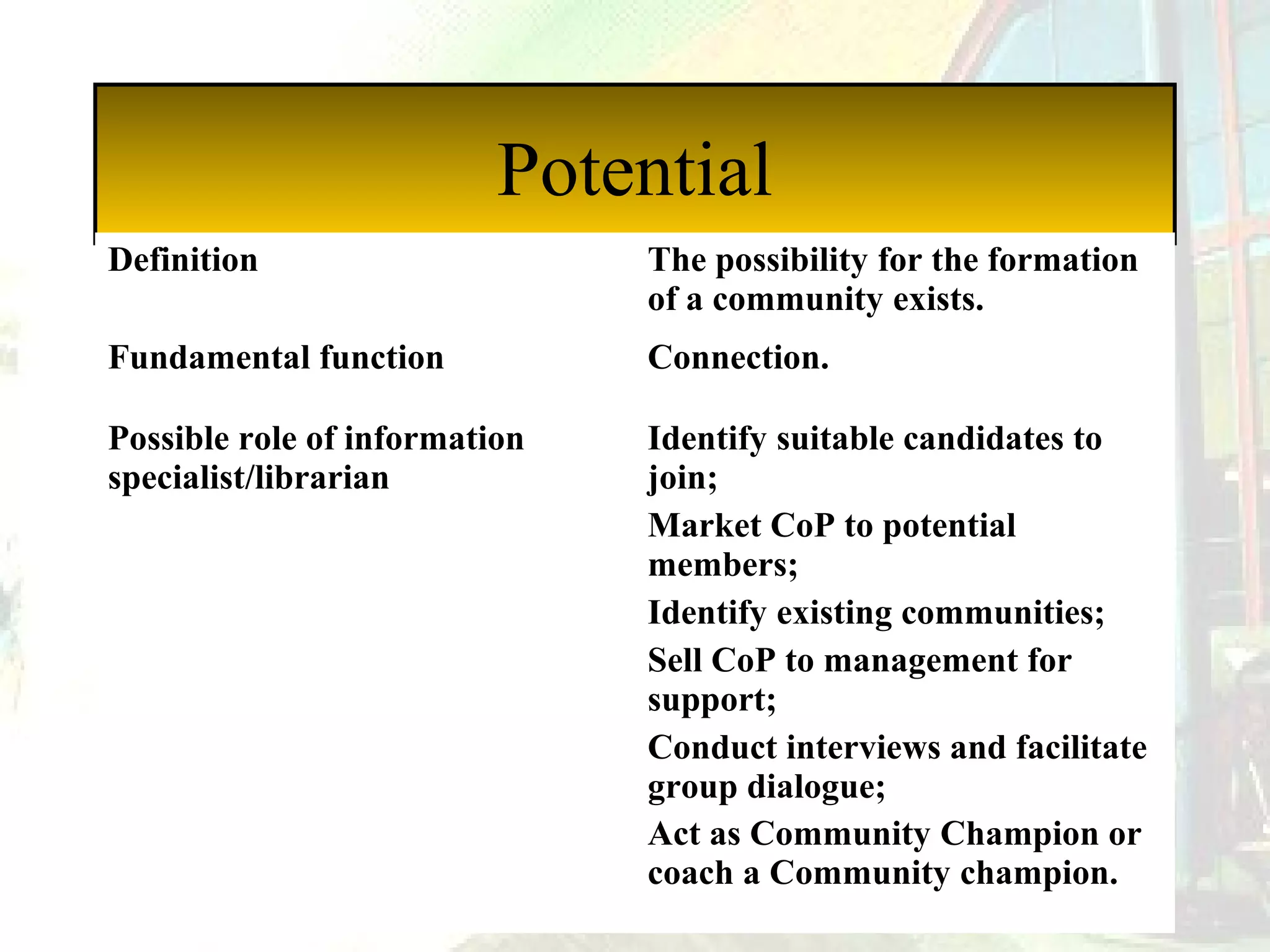
Potential
Definition

The possibility for the formation
of a community exists.

Fundamental function

Connection.

Possible role of information
specialist/librarian
 

Identify suitable candidates to
join;
Market CoP to potential
members;
Identify existing communities;
Sell CoP to management for
support;
Conduct interviews and facilitate
group dialogue;
Act as Community Champion or
coach a Community champion.
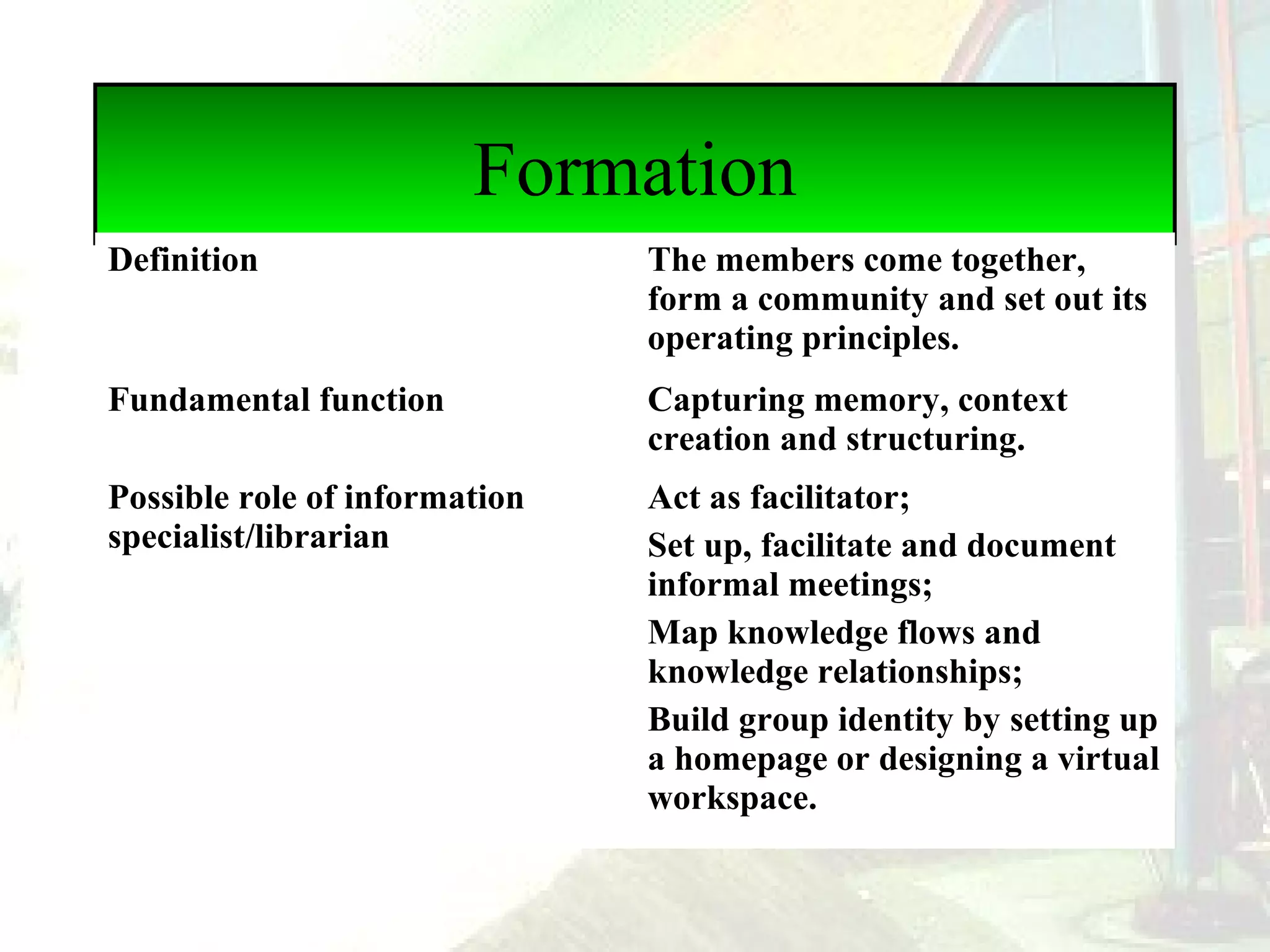
Formation
Definition

The members come together,
form a community and set out its
operating principles.

Fundamental function

Capturing memory, context
creation and structuring.

Possible role of information
specialist/librarian
 

Act as facilitator;
Set up, facilitate and document
informal meetings;
Map knowledge flows and
knowledge relationships;
Build group identity by setting up
a homepage or designing a virtual
workspace.
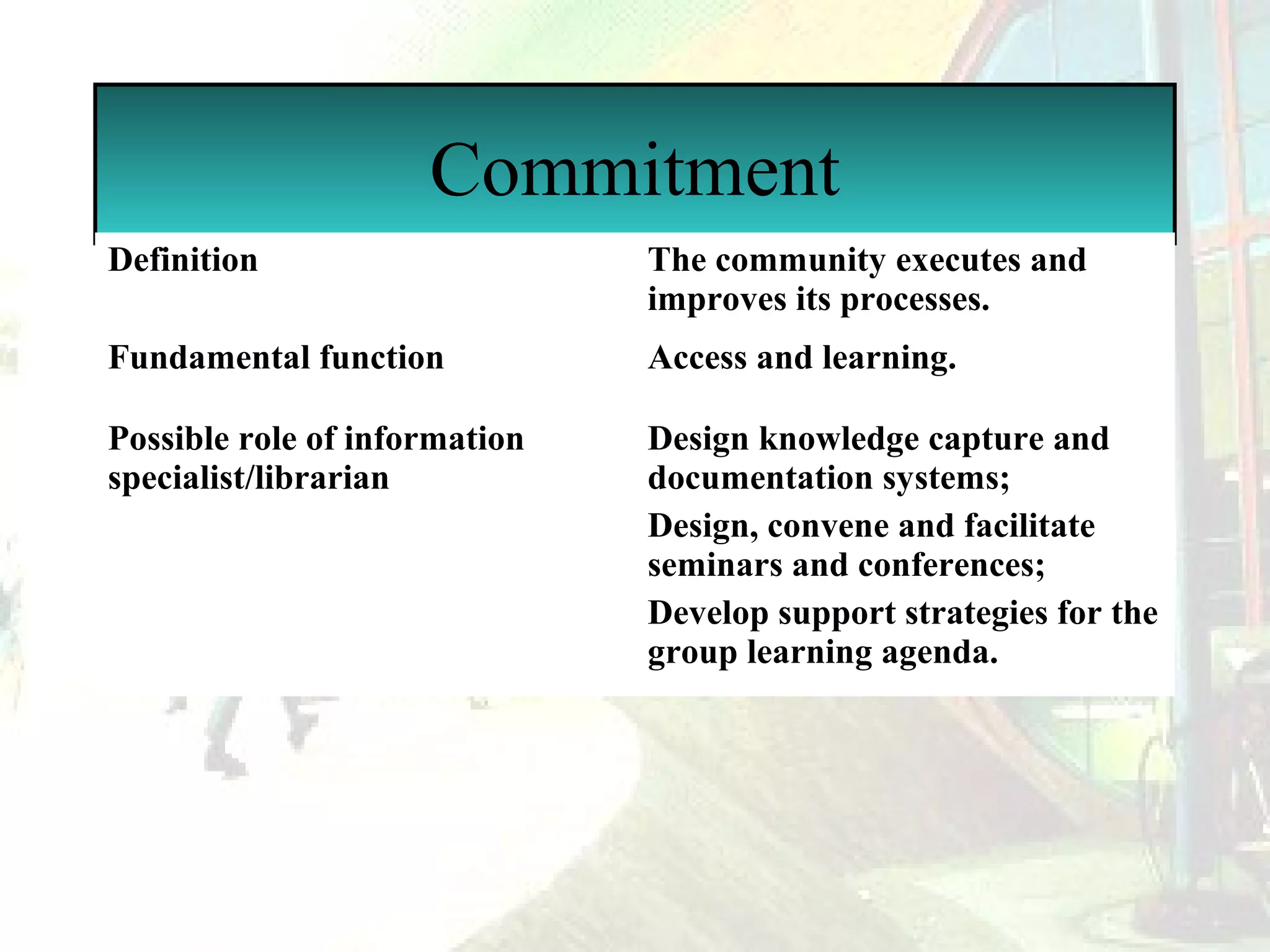
Commitment
Definition

The community executes and
improves its processes.

Fundamental function

Access and learning.

Possible role of information
specialist/librarian
 

Design knowledge capture and
documentation systems;
Design, convene and facilitate
seminars and conferences;
Develop support strategies for the
group learning agenda.
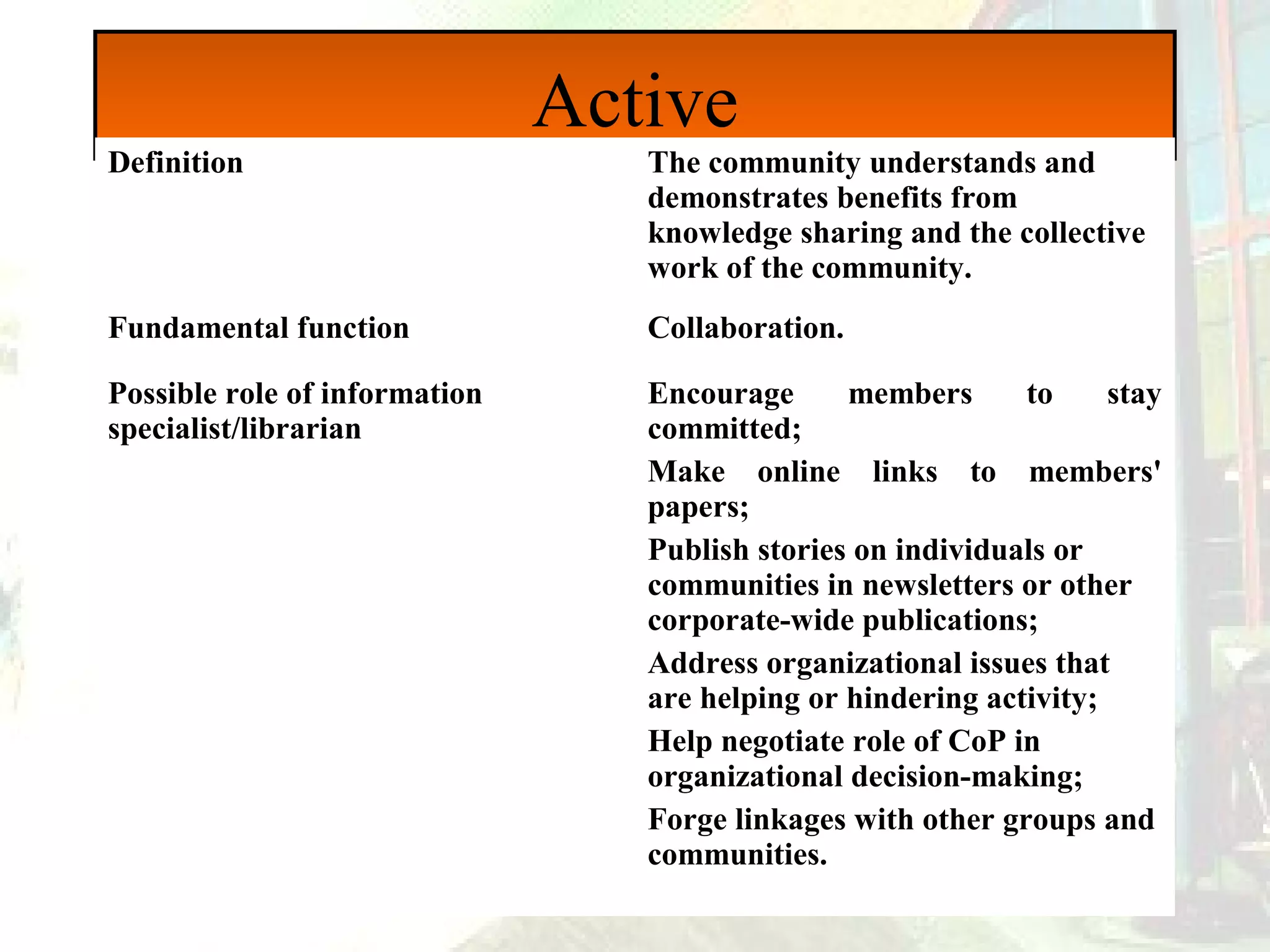
Active
Definition

The community understands and
demonstrates benefits from
knowledge sharing and the collective
work of the community.

Fundamental function

Collaboration.

Possible role of information
specialist/librarian

Encourage
members
to
stay
committed;
Make online links to members'
papers;
Publish stories on individuals or
communities in newsletters or other
corporate-wide publications;
Address organizational issues that
are helping or hindering activity;
Help negotiate role of CoP in
organizational decision-making;
Forge linkages with other groups and
communities.
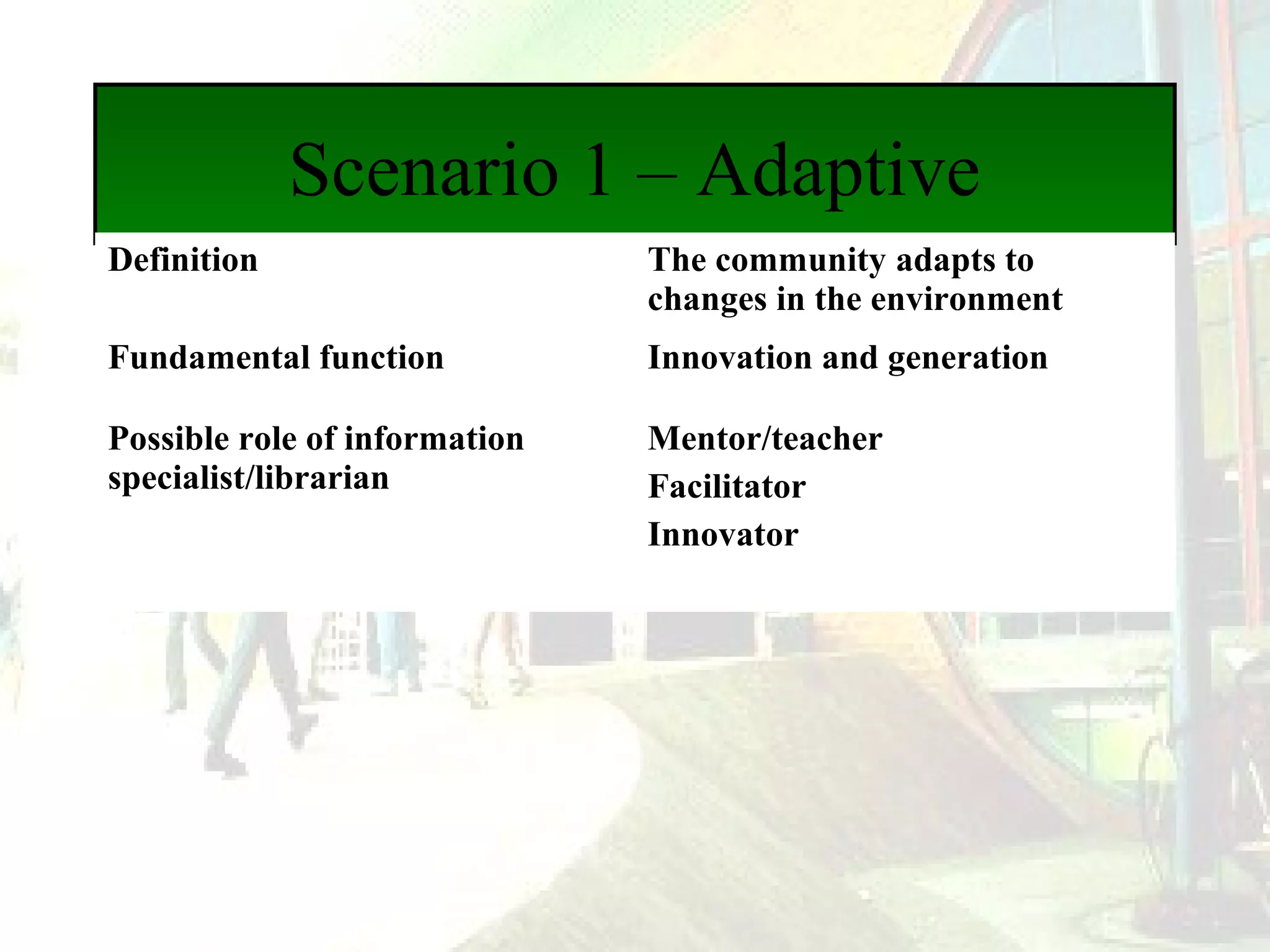
Scenario 1 – Adaptive
Definition

The community adapts to
changes in the environment

Fundamental function

Innovation and generation

Possible role of information
specialist/librarian
 

Mentor/teacher
Facilitator
Innovator
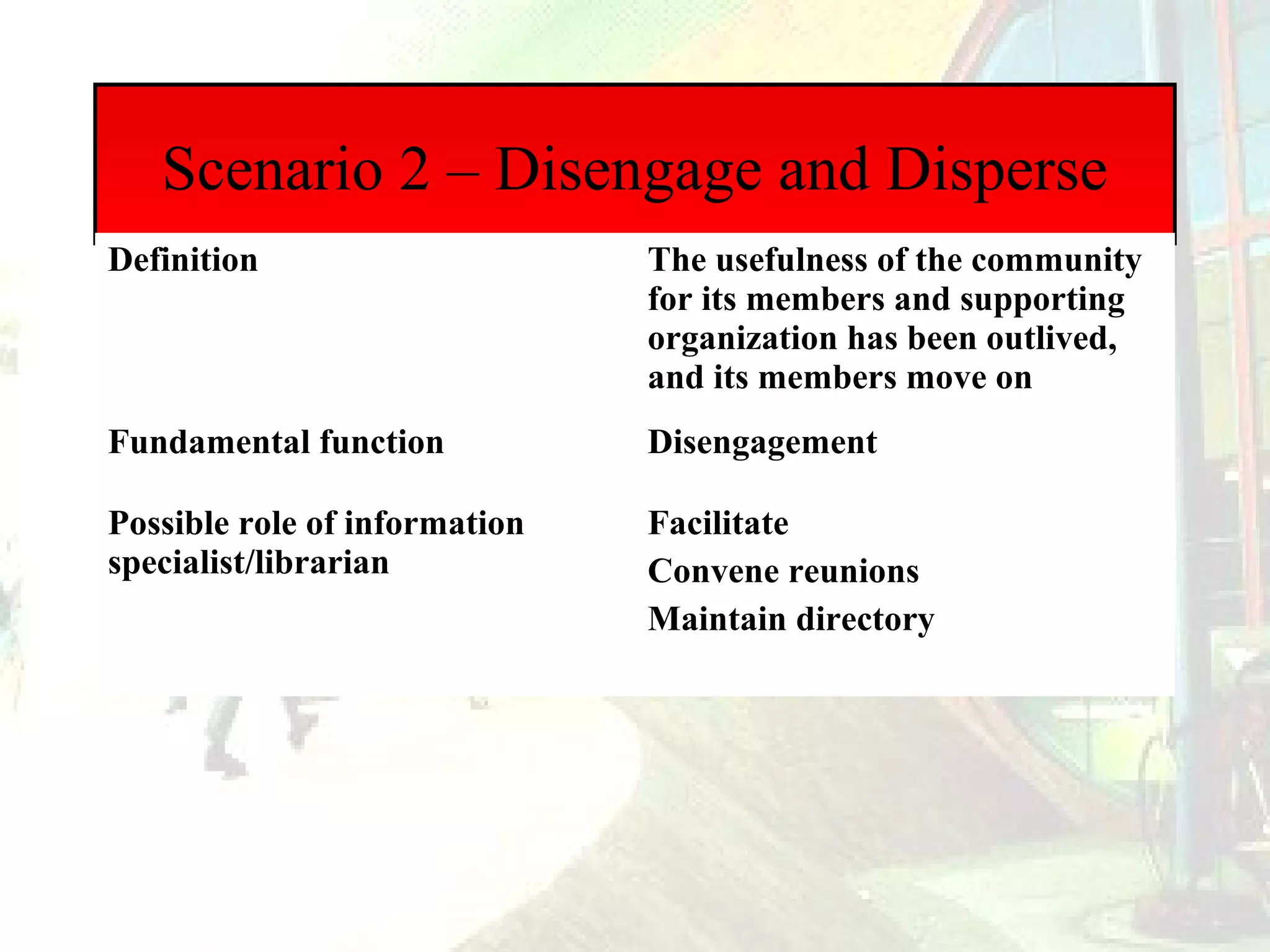
Scenario 2 – Disengage and Disperse
Definition

The usefulness of the community
for its members and supporting
organization has been outlived,
and its members move on

Fundamental function

Disengagement

Possible role of information
specialist/librarian
 

Facilitate
Convene reunions
Maintain directory
Conclusion

CoPs in Information Service Organisations: a wild goose chase?