Continuous Analysis. Reliable Results.
COMPOSER Johann H. Schmelzer - SEIBOLD Online-Analyser for Copper
Sources
Copper is both an essential nutrient and
a drinking-water contaminant
Natural sources. Most of the world’s Cu
is found and mined in the form of copper
sulfides and in combination with other
metals that can also form multi-metal-
sulfide minerals (Fe, Sn, Pb, Se, As, Sb
and Ag).
Industry. Copper is used for in
gelectroplating and semiconducting
industry,…
Natural water. Copper is found in
natural surface waters at an average
concentration of 0.002 mg/L, ranging
from 0.001 to 0.1 mg/L, Cu in seawater
is at the upper end of the range.
Drinking water. Copper concentrations
in drinking-water vary widely, with the
primary source most often being the
corrosion of interior copper plumbing.
A guideline value of 1.5 mg/litre was
recommended for copper in drinking-
water.
Toxicity. Copper is not very toxic to
animals and humans but can be toxic to
some fish, many invertebrates and
microbes, particularly fungi, algae, and
bacteria.
Method
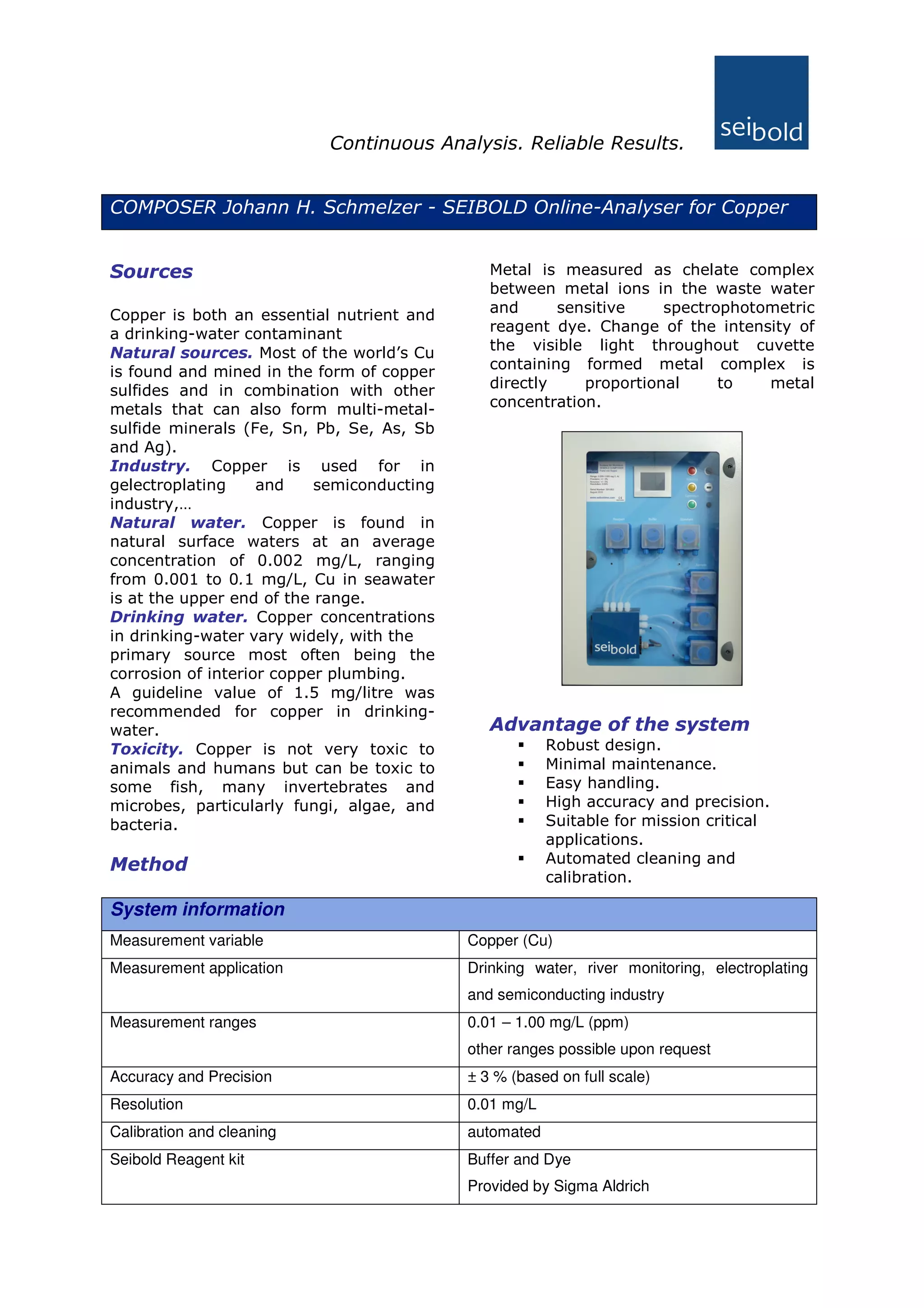
Metal is measured as chelate complex
between metal ions in the waste water
and sensitive spectrophotometric
reagent dye. Change of the intensity of
the visible light throughout cuvette
containing formed metal complex is
directly proportional to metal
concentration.
Advantage of the system
 Robust design.
 Minimal maintenance.
 Easy handling.
 High accuracy and precision.
 Suitable for mission critical
applications.
 Automated cleaning and
calibration.
System information
Measurement variable Copper (Cu)
Measurement application Drinking water, river monitoring, electroplating
and semiconducting industry
Measurement ranges 0.01 – 1.00 mg/L (ppm)
other ranges possible upon request
Accuracy and Precision ± 3 % (based on full scale)
Resolution 0.01 mg/L
Calibration and cleaning automated
Seibold Reagent kit Buffer and Dye
Provided by Sigma Aldrich
Continuous Analysis. Reliable Results.
COMPOSER Johann H. Schmelzer - SEIBOLD Online-Analyser for Copper
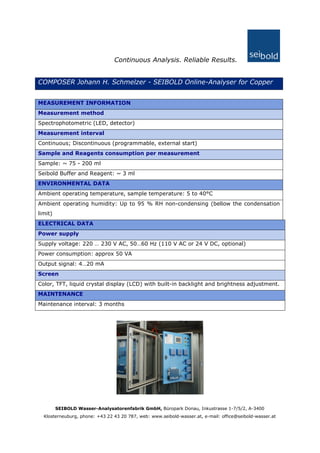
MEASUREMENT INFORMATION
Measurement method
Spectrophotometric (LED, detector)
Measurement interval
Continuous; Discontinuous (programmable, external start)
Sample and Reagents consumption per measurement
Sample: ~ 75 - 200 ml
Seibold Buffer and Reagent: ~ 3 ml
ENVIRONMENTAL DATA
Ambient operating temperature, sample temperature: 5 to 40°C
Ambient operating humidity: Up to 95 % RH non-condensing (bellow the condensation
limit)
ELECTRICAL DATA
Power supply
Supply voltage: 220 … 230 V AC, 50…60 Hz (110 V AC or 24 V DC, optional)
Power consumption: approx 50 VA
Output signal: 4…20 mA
Screen
Color, TFT, liquid crystal display (LCD) with built-in backlight and brightness adjustment.
MAINTENANCE
Maintenance interval: 3 months
SEIBOLD Wasser-Analysatorenfabrik GmbH, Büropark Donau, Inkustrasse 1-7/5/2, A-3400
Klosterneuburg, phone: +43 22 43 20 787, web: www.seibold-wasser.at, e-mail: office@seibold-wasser.at

Copper Continuous Analysis from SEIBOLD-Wasser.pdf

  • 1.
    Continuous Analysis. ReliableResults. COMPOSER Johann H. Schmelzer - SEIBOLD Online-Analyser for Copper Sources Copper is both an essential nutrient and a drinking-water contaminant Natural sources. Most of the world’s Cu is found and mined in the form of copper sulfides and in combination with other metals that can also form multi-metal- sulfide minerals (Fe, Sn, Pb, Se, As, Sb and Ag). Industry. Copper is used for in gelectroplating and semiconducting industry,… Natural water. Copper is found in natural surface waters at an average concentration of 0.002 mg/L, ranging from 0.001 to 0.1 mg/L, Cu in seawater is at the upper end of the range. Drinking water. Copper concentrations in drinking-water vary widely, with the primary source most often being the corrosion of interior copper plumbing. A guideline value of 1.5 mg/litre was recommended for copper in drinking- water. Toxicity. Copper is not very toxic to animals and humans but can be toxic to some fish, many invertebrates and microbes, particularly fungi, algae, and bacteria. Method Metal is measured as chelate complex between metal ions in the waste water and sensitive spectrophotometric reagent dye. Change of the intensity of the visible light throughout cuvette containing formed metal complex is directly proportional to metal concentration. Advantage of the system Robust design. Minimal maintenance. Easy handling. High accuracy and precision. Suitable for mission critical applications. Automated cleaning and calibration. System information Measurement variable Copper (Cu) Measurement application Drinking water, river monitoring, electroplating and semiconducting industry Measurement ranges 0.01 – 1.00 mg/L (ppm) other ranges possible upon request Accuracy and Precision ± 3 % (based on full scale) Resolution 0.01 mg/L Calibration and cleaning automated Seibold Reagent kit Buffer and Dye Provided by Sigma Aldrich
  • 2.
    Continuous Analysis. ReliableResults. COMPOSER Johann H. Schmelzer - SEIBOLD Online-Analyser for Copper MEASUREMENT INFORMATION Measurement method Spectrophotometric (LED, detector) Measurement interval Continuous; Discontinuous (programmable, external start) Sample and Reagents consumption per measurement Sample: ~ 75 - 200 ml Seibold Buffer and Reagent: ~ 3 ml ENVIRONMENTAL DATA Ambient operating temperature, sample temperature: 5 to 40°C Ambient operating humidity: Up to 95 % RH non-condensing (bellow the condensation limit) ELECTRICAL DATA Power supply Supply voltage: 220 … 230 V AC, 50…60 Hz (110 V AC or 24 V DC, optional) Power consumption: approx 50 VA Output signal: 4…20 mA Screen Color, TFT, liquid crystal display (LCD) with built-in backlight and brightness adjustment. MAINTENANCE Maintenance interval: 3 months SEIBOLD Wasser-Analysatorenfabrik GmbH, Büropark Donau, Inkustrasse 1-7/5/2, A-3400 Klosterneuburg, phone: +43 22 43 20 787, web: www.seibold-wasser.at, e-mail: office@seibold-wasser.at