Continuous Analysis. Reliable Results.
COMPOSER Johann J. Fux - SEIBOLD Online-Analyser for Nickel
Sources
Natural sources. The element nickel is
found at low levels 0.0099% in the
earth’s crust and exists mainly in the
form of sulfide, oxide and silicate
minerals.
Industry. Nickel is used in alloys
(stainless steel), electroplating,
foundries, catalysts, welding rods and
coinage, and can be found in electronic
equipment, construction materials,
aerospace equipment and consumer
goods such as batteries, paints and
ceramics.
Drinking water. Sources of nickel in
ambient waters include physical and
chemical degradation of rocks and soils,
deposition of atmospheric nickel-
containing particulate matter and
discharges from industrial processes. A
health-based guideline value of Nickel is
0.02 mg/litre.
Toxicity. Inhaled nickel compounds are
carcinogenic to humans and that metallic
nickel is possibly carcinogenic. Allergic
contact dermatitis is the most prevalent
effect of nickel in the general population.
Method
Metal is measured as chelate complex
between metal ions in the waste water
and sensitive spectrophotometric
reagent dye. Change of the intensity of
the visible light throughout cuvette
containing formed metal complex is
directly proportional to metal
concentration.
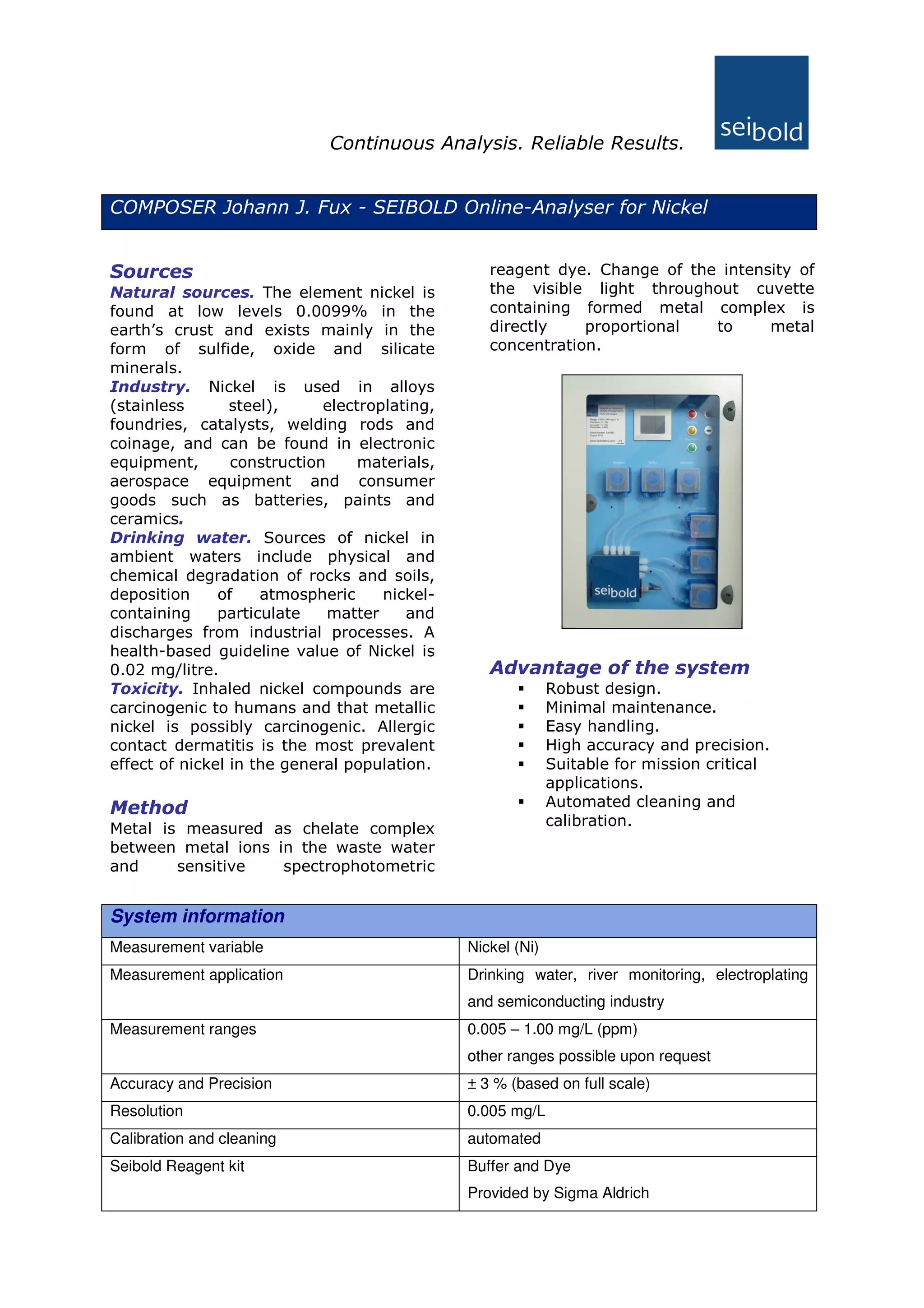
Advantage of the system
 Robust design.
 Minimal maintenance.
 Easy handling.
 High accuracy and precision.
 Suitable for mission critical
applications.
 Automated cleaning and
calibration.
System information
Measurement variable Nickel (Ni)
Measurement application Drinking water, river monitoring, electroplating
and semiconducting industry
Measurement ranges 0.005 – 1.00 mg/L (ppm)
other ranges possible upon request
Accuracy and Precision ± 3 % (based on full scale)
Resolution 0.005 mg/L
Calibration and cleaning automated
Seibold Reagent kit Buffer and Dye
Provided by Sigma Aldrich
Continuous Analysis. Reliable Results.
COMPOSER Johann J. Fux - SEIBOLD Online-Analyser for Nickel
MEASUREMENT INFORMATION
Measurement method
Spectrophotometric (LED, detector)
Measurement interval
Continuous; Discontinuous (programmable, external start)
Sample and Reagents consumption per measurement
Sample: ~ 75 - 200 ml
Seibold Buffer and Reagent: ~ 3 ml
ENVIRONMENTAL DATA
Ambient operating temperature, sample temperature: 5 to 40°C
Ambient operating humidity: Up to 95 % RH non-condensing (bellow the condensation
limit)
ELECTRICAL DATA
Power supply
Supply voltage: 220 … 230 V AC, 50…60 Hz (110 V AC or 24 V DC, optional)
Power consumption: approx 50 VA
Output signal: 4…20 mA
Screen
Color, TFT, liquid crystal display (LCD) with built-in backlight and brightness adjustment.
MAINTENANCE
Maintenance interval: 3 months
SEIBOLD Wasser-Analysatorenfabrik GmbH, Büropark Donau, Inkustrasse 1-7/5/2, A-3400
Klosterneuburg, phone: +43 22 43 20 787, web: www.seibold-wasser.at, e-mail: office@seibold-wasser.at

Nickel Continuous Analysis from SEIBOLD-Wasser.pdf

  • 1.
    Continuous Analysis. ReliableResults. COMPOSER Johann J. Fux - SEIBOLD Online-Analyser for Nickel Sources Natural sources. The element nickel is found at low levels 0.0099% in the earth’s crust and exists mainly in the form of sulfide, oxide and silicate minerals. Industry. Nickel is used in alloys (stainless steel), electroplating, foundries, catalysts, welding rods and coinage, and can be found in electronic equipment, construction materials, aerospace equipment and consumer goods such as batteries, paints and ceramics. Drinking water. Sources of nickel in ambient waters include physical and chemical degradation of rocks and soils, deposition of atmospheric nickel- containing particulate matter and discharges from industrial processes. A health-based guideline value of Nickel is 0.02 mg/litre. Toxicity. Inhaled nickel compounds are carcinogenic to humans and that metallic nickel is possibly carcinogenic. Allergic contact dermatitis is the most prevalent effect of nickel in the general population. Method Metal is measured as chelate complex between metal ions in the waste water and sensitive spectrophotometric reagent dye. Change of the intensity of the visible light throughout cuvette containing formed metal complex is directly proportional to metal concentration. Advantage of the system Robust design. Minimal maintenance. Easy handling. High accuracy and precision. Suitable for mission critical applications. Automated cleaning and calibration. System information Measurement variable Nickel (Ni) Measurement application Drinking water, river monitoring, electroplating and semiconducting industry Measurement ranges 0.005 – 1.00 mg/L (ppm) other ranges possible upon request Accuracy and Precision ± 3 % (based on full scale) Resolution 0.005 mg/L Calibration and cleaning automated Seibold Reagent kit Buffer and Dye Provided by Sigma Aldrich
  • 2.
    Continuous Analysis. ReliableResults. COMPOSER Johann J. Fux - SEIBOLD Online-Analyser for Nickel MEASUREMENT INFORMATION Measurement method Spectrophotometric (LED, detector) Measurement interval Continuous; Discontinuous (programmable, external start) Sample and Reagents consumption per measurement Sample: ~ 75 - 200 ml Seibold Buffer and Reagent: ~ 3 ml ENVIRONMENTAL DATA Ambient operating temperature, sample temperature: 5 to 40°C Ambient operating humidity: Up to 95 % RH non-condensing (bellow the condensation limit) ELECTRICAL DATA Power supply Supply voltage: 220 … 230 V AC, 50…60 Hz (110 V AC or 24 V DC, optional) Power consumption: approx 50 VA Output signal: 4…20 mA Screen Color, TFT, liquid crystal display (LCD) with built-in backlight and brightness adjustment. MAINTENANCE Maintenance interval: 3 months SEIBOLD Wasser-Analysatorenfabrik GmbH, Büropark Donau, Inkustrasse 1-7/5/2, A-3400 Klosterneuburg, phone: +43 22 43 20 787, web: www.seibold-wasser.at, e-mail: office@seibold-wasser.at