at The Children’s Hospital of Philadelphia
                                                             The Cancer Center
Coping with Cancer:
A family journey


                         Melissa A. Alderfer, PhD
 The Children’s Hospital of Philadelphia &
         The University of Pennsylvania School of Medicine
Overview


                                                                  at The Children’s Hospital of Philadelphia
  Discuss a traumatic stress model that we


                                              The Cancer Center
find helpful in understanding coping with
childhood cancer
 Summarize what we know about the
psychosocial impact of childhood cancer on
families
 Provide suggestions for maximizing
adjustment to cancer
Cancer
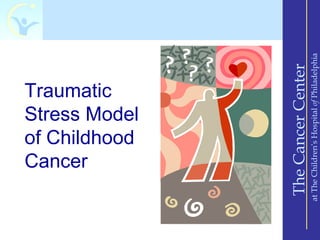
        Traumatic

        of Childhood
        Stress Model


 The Cancer Center
at The Children’s Hospital of Philadelphia
Traumatic Stress Model
 Traumatic Stress Models have been discussed


                                                                                  at The Children’s Hospital of Philadelphia
dating back to the nineteenth century


                                                              The Cancer Center
   - Railway Spine: nightmares, avoidance, chronic pain
   - Hysteria: agitation, dissociation
   - Soldier’s Heart: cardiovascular activation, fatigue
   - Shell Shock: memory loss, emotional outbursts, numbing

 Conceptualization of the phenomenon developed
through the years
 In 1980, Posttraumatic Stress Disorder was
defined by the American Psychiatric Association
Traumatic Stress Model
 A “normal” reaction to catastrophic event


                                                                                      at The Children’s Hospital of Philadelphia
                                                                  The Cancer Center
 Traumatic event:

   - involves actual or threatened death or serious injury or a
     threat to the physical integrity of self or others
   - produces intense fear, horror, or helplessness

 Symptoms include intrusive memories, avoidance,
and physiological arousal
 “Diagnosis of a life threatening illness” and
“learning that one’s child has a life-threatening illness”
specifically listed as potentially traumatic events
Traumatic Stress
 Re-experiencing of the event


                                                                                     at The Children’s Hospital of Philadelphia
                                                                 The Cancer Center
   - Recurrent, intrusive, distressing recollections
   - Recurrent distressing dreams
   - Acting or feeling as if the event is recurring
   - Intense psychological distress at exposure to internal or
       external cues that symbolize or resemble the event
   - Physiological reactivity to such cues
Traumatic Stress
 Avoidance and numbing


                                                                                          at The Children’s Hospital of Philadelphia
                                                                      The Cancer Center
   - Efforts to avoid thoughts, feelings, conversations
   - Efforts to avoid activities, places or people
   - Inability to recall an important aspect
   - Diminished interest or participation in significant activities
   - Feelings of detachment or estrangement
   - Restricted range of affect
   - Sense of foreshortened future
Traumatic Stress
 Increased arousal


                                                                              at The Children’s Hospital of Philadelphia
                                                          The Cancer Center
   - Difficulty falling or staying asleep
   - Irritability or outbursts of anger
   - Difficulty concentrating
   - Hypervigilance
   - Exaggerated startle response

 To qualify for a diagnosis of PTSD

   - 1 re-experiencing, 3 avoidance, 2 arousal symptoms
   - Symptoms for at least 1 month
   - Significant distress or impairment in functioning
Traumatic Stress Model
 Continues to evolve, draw on coping literature


                                                                                    at The Children’s Hospital of Philadelphia
                                                                The Cancer Center
 Trauma symptoms may be normative and adaptive

   - distress communicates a need for support
   - re-experiencing allows cognitive processing of the event
   - avoidance may reduce distress and allow functioning
   - arousal keeps you primed to recognize and deal with
        additional traumatic events
Traumatic Stress Model
 Premise: Traumatic events challenge the patterns


                                                                            at The Children’s Hospital of Philadelphia
of thoughts and behaviors that allow people to


                                                        The Cancer Center
function on a daily basis

 “Psychologically seismic events that can severely
shaken, threaten or reduce to rubble many of the
schematic structures that have guided understanding,
decision making, and meaning in the world”

 Can lead to distress or provide the opportunity for
generative experiences, positive growth, enhanced
adjustment
Families
        Impact of
        Cancer on
        Psychosocial


 The Cancer Center
at The Children’s Hospital of Philadelphia
Patterns of Response
 Different patterns of response are possible:


                                                                                       at The Children’s Hospital of Philadelphia
                                                                   The Cancer Center
   - Hardy (minimal, temporary distress)
   - Chronically Distressed (consistent high levels of distress)
   - Resilient (high levels of distress that improve)
   - Delayed Distress (late increases in distress)
   - Enhanced Functioning (better than baseline)

 Most children with cancer are Hardy; some
evidence of Delayed Distress in young adult survivors
 Most parents and siblings show Resilience

 Growing evidence of Enhanced Functioning
Diagnosis
  Range of expected strong emotions across


                                                                    at The Children’s Hospital of Philadelphia
family members:


                                                The Cancer Center
    - Shock, disbelief, denial
    - Confusion, frustration
    - Anxiety, fear, helplessness
    -   Sadness, mourning, grief
    -   Guilt, anger
Diagnosis
 Within 2 weeks of diagnosis, 85% of parents report


                                                                            at The Children’s Hospital of Philadelphia
significant distress


                                                        The Cancer Center
 Parents have more anxiety, poorer quality of life,
and more symptoms of depression
 Within 1 month of diagnosis, 51% of moms, 40% of
dads qualify for a diagnosis of Acute Stress Disorder
 Within 1 month of diagnosis

   - 75-83% of parents reported re-experiencing
   - 70-83% reported avoidance
   - 83% reported arousal
Diagnosis
 The reactions of the child with cancer to diagnosis


                                                                            at The Children’s Hospital of Philadelphia
vary depending upon his or her age


                                                        The Cancer Center
 Some symptoms of anxiety, fear, and sadness are
common
 May see some developmental regression

 Overall, research does NOT indicate increased
rates of depression or traumatic stress symptoms in
patients shortly after diagnosis
Diagnosis
 Siblings report loneliness, marginalization,


                                                                               at The Children’s Hospital of Philadelphia
jealousy and worry


                                                           The Cancer Center
 Within 1 month of diagnosis, 57% of siblings report
impaired emotional quality of life
 Nearly 40% of siblings report significant difficulties
with memory concentration and learning within one
month after cancer diagnosis
  Rates of traumatic stress symptoms have been
unexplored
Diagnosis
 Marital distress is common: 40% of married


                                                                          at The Children’s Hospital of Philadelphia
parents indicating problems


                                                      The Cancer Center
 Parenting stress is typical: over-protection,
impatience, relaxed rules and inconsistency in
discipline is reported by 32% of fathers and 48% of
mothers
 Families report pulling closer together: 60% of
families report increased cohesion
 Benefit finding and traumatic growth have been
unexplored
Treatment
 Two-thirds of parents report that dealing with


                                                                         at The Children’s Hospital of Philadelphia
their own intense emotions and traumatization is


                                                     The Cancer Center
the greatest challenge
 Feelings of helplessness, powerlessness, and
lack of control are common
 Anxiety and depression symptoms decrease
within the first three months after diagnosis, but
remain significantly elevated for parents
Treatment
 At 6 months post-diagnosis, 40-50% of parents


                                                                            at The Children’s Hospital of Philadelphia
continue to report increased distress


                                                        The Cancer Center
 During the first few months of treatment about
44% of parents qualify for a diagnosis of PTSD

 About one year after diagnosis, 68% of moms
and 57% of dads report moderate to severe PTS
 By 24 months post-diagnosis most parents report
distress levels at normative levels; a small subgroup
remain distressed
Treatment
 During treatment children with cancer continue


                                                                         at The Children’s Hospital of Philadelphia
to show little or no evidence of emotional or


                                                     The Cancer Center
behavioral problems

 Some reports suggest LOWER levels of
depression and anxiety than healthy children

 Traumatic stress symptoms are present, but
mean levels are no different from healthy children
Treatment
  Disruptions in family life take a toll on siblings;


                                                                             at The Children’s Hospital of Philadelphia
absence of their brother or sister, separation from


                                                         The Cancer Center
parents and poor communication fuels confusion
and anxiety
 Three-fold increase in behavior problems, two-
fold increase in emotional problems, decrements in
quality of life, declines in school performance for
siblings
 Within 2 years of diagnosis, 25% qualify for a
diagnosis of PTSD, 60% in moderate to severe
range for PTS
 Report positive aspects of the experience
Treatment
 Significant marital distress continues to be


                                                                              at The Children’s Hospital of Philadelphia
reported among 25 to 30% of parents throughout


                                                          The Cancer Center
the first year post-diagnosis

 Inconsistent discipline continues as parents often
feel guilty about putting their child through treatment

 Role overload is common as family members
must juggle their typical responsibilities with needs
of treatment

 Parenting Stress increases once the child
reaches remission
Survivorship
 Time of ambivalent feelings: relief and joy coupled


                                                                              at The Children’s Hospital of Philadelphia
with fear and uncertainty


                                                          The Cancer Center
 Depression and anxiety scores no longer elevated
for most, a subset of parents continue to have
distress
 Traumatic Stress symptoms remain:

  - Moms: 14 to 20% with current PTSD, 27 to 30% with
     PTSD at some time since diagnosis of cancer; up to
44%     in moderate to severe range

  - Dads: 10% current PTSD, 12% PTSD since cancer; 33
      to 35% in moderate to severe range
Survivorship
 97% of moms, 87% of dads indicate at least one


                                                                              at The Children’s Hospital of Philadelphia
symptom of re-experiencing


                                                          The Cancer Center
 64% of moms, 44% of dads report at least 2
symptoms of physiological arousal
 34% of moms, 16% of dads report at least 3
symptoms of avoidance
 Parents also report positive outcomes of the
experience
   - 86% of moms and 62% of dads indicate a positive
          change in the way they think about their life
   - 58% of moms and 48% of dads indicate a positive
          change in how they treat others
Survivorship
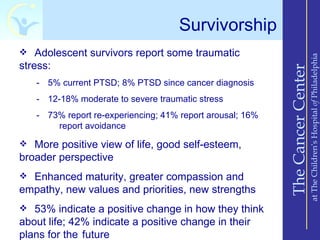
 Adolescent survivors report some traumatic


                                                                               at The Children’s Hospital of Philadelphia
stress:


                                                           The Cancer Center
   - 5% current PTSD; 8% PTSD since cancer diagnosis
   - 12-18% moderate to severe traumatic stress
   - 73% report re-experiencing; 41% report arousal; 16%
       report avoidance

 More positive view of life, good self-esteem,
broader perspective
 Enhanced maturity, greater compassion and
empathy, new values and priorities, new strengths
 53% indicate a positive change in how they think
about life; 42% indicate a positive change in their
plans for the future
Survivorship
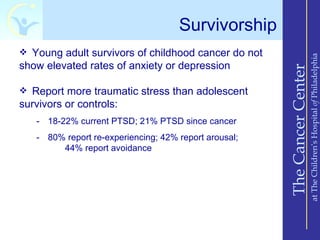
 Young adult survivors of childhood cancer do not


                                                                           at The Children’s Hospital of Philadelphia
show elevated rates of anxiety or depression


                                                       The Cancer Center
 Report more traumatic stress than adolescent
survivors or controls:
   - 18-22% current PTSD; 21% PTSD since cancer
   - 80% report re-experiencing; 42% report arousal;
        44% report avoidance
Survivorship
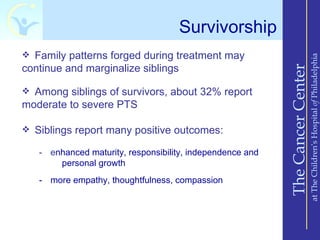
 Family patterns forged during treatment may


                                                                               at The Children’s Hospital of Philadelphia
continue and marginalize siblings


                                                           The Cancer Center
 Among siblings of survivors, about 32% report
moderate to severe PTS

 Siblings report many positive outcomes:

   - enhanced maturity, responsibility, independence and
       personal growth
   - more empathy, thoughtfulness, compassion
Summary
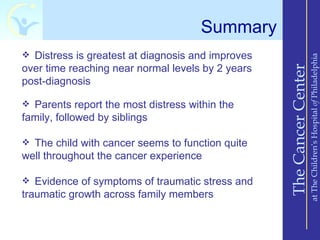
 Distress is greatest at diagnosis and improves


                                                                       at The Children’s Hospital of Philadelphia
over time reaching near normal levels by 2 years


                                                   The Cancer Center
post-diagnosis

 Parents report the most distress within the
family, followed by siblings

 The child with cancer seems to function quite
well throughout the cancer experience

 Evidence of symptoms of traumatic stress and
traumatic growth across family members
your

        Cope
        Family
        Helping


 The Cancer Center
at The Children’s Hospital of Philadelphia
Be patient…
with yourself, your family, and treatment. It takes time:


                                                                                at The Children’s Hospital of Philadelphia
 to learn about cancer, treatment and the medical system


                                                            The Cancer Center
 to adjust emotionally

 to understand the reactions of family members

 to find the best way for your family to
work together and support each other
 to accept the uncertainty


With time it gets better
Help your children…
understand what is happening. Talk to them;


                                                                                             at The Children’s Hospital of Philadelphia
 be age-appropriate (young children don’t need detail; explain


                                                                         The Cancer Center
     physical changes, treatment course, changes in routine)
 be reassuring and supportive (this is not punishment; it is not
      contagious; they will not be abandoned; their needs will be met)
 be sensitive to their preferences and style (not your own)
 be honest (help them prepare; build trust)
 be open to their questions (you don’t
    have to have all the answers)


Talk with your children
Share your feelings…
with family and friends. It is important:


                                                                                at The Children’s Hospital of Philadelphia
                                                            The Cancer Center
 to recognize how your thoughts and feelings impact your
behavior with others
 to talk about how you feel

 to share your feelings with and encourage children to
express their feelings
 to understand positive emotions are OK

 to accept the feelings of others


Emotional connections help
Rely on others…
to help you and your family. Ask or allow


                                                                                    at The Children’s Hospital of Philadelphia
                                                                The Cancer Center
 the medical team to help educate and prepare you and your
children for what is to come
 extended family to help maintain your home, spend time with
healthy siblings, become involved in medical care
 friends, neighbors, community members
        to provide support to your family
 the school to help your children


Don’t try to go it alone
Establish routines…
and maintain rules. Consistency helps:


                                                                    at The Children’s Hospital of Philadelphia
                                                The Cancer Center
 offset the unpredictability of cancer

 allow children to feel more safe and secure

 ward off behavioral problems in the future

 give everyone something to expect


Create your “new normal”
Take care…
of yourself. To be at your best:


                                                                             at The Children’s Hospital of Philadelphia
                                                         The Cancer Center
 take time for yourself

 do enjoyable things with family and friends

 maintain your own physical health

 accept what you can’t control; focus on what you can

 look for realistically positive aspects of
your experience
 don’t pressure yourself to do too much


Replenish yourself
Ask for help…
from a psychosocial provider when:


                                                                                     at The Children’s Hospital of Philadelphia
                                                                 The Cancer Center
 emotional reactions are interfering with cancer treatment or
appropriate follow-up care
 someone has problems with day to day functioning that aren’t
improving with time
 differences in coping style are causing
relationship problems
 you have concerns and need advice


Get help when needed
Conclusions
 Childhood cancer is a


                                                                       at The Children’s Hospital of Philadelphia
stressful, potentially traumatic


                                                   The Cancer Center
event
 Research documents high
levels of distress for families
that improve with time
 A Traumatic Stress Model
seems to capture the nature of
cancer-related distress
  - explains symptoms of distress
  - explains possibility of growth
Conclusions


                                                          at The Children’s Hospital of Philadelphia
 To maximize adjustment:


                                      The Cancer Center
    - be patient, it takes time
    - talk with your children
    - share your feelings
    - rely on others
    - create your “new normal”
    - take care of yourself
    - ask for help when you need it

Coping with Cancer

  • 1.
    at The Children’sHospital of Philadelphia The Cancer Center Coping with Cancer: A family journey Melissa A. Alderfer, PhD The Children’s Hospital of Philadelphia & The University of Pennsylvania School of Medicine
  • 2.
    Overview at The Children’s Hospital of Philadelphia  Discuss a traumatic stress model that we The Cancer Center find helpful in understanding coping with childhood cancer  Summarize what we know about the psychosocial impact of childhood cancer on families  Provide suggestions for maximizing adjustment to cancer
  • 3.
    Cancer Traumatic of Childhood Stress Model The Cancer Center at The Children’s Hospital of Philadelphia
  • 4.
    Traumatic Stress Model Traumatic Stress Models have been discussed at The Children’s Hospital of Philadelphia dating back to the nineteenth century The Cancer Center - Railway Spine: nightmares, avoidance, chronic pain - Hysteria: agitation, dissociation - Soldier’s Heart: cardiovascular activation, fatigue - Shell Shock: memory loss, emotional outbursts, numbing  Conceptualization of the phenomenon developed through the years  In 1980, Posttraumatic Stress Disorder was defined by the American Psychiatric Association
  • 5.
    Traumatic Stress Model A “normal” reaction to catastrophic event at The Children’s Hospital of Philadelphia The Cancer Center  Traumatic event: - involves actual or threatened death or serious injury or a threat to the physical integrity of self or others - produces intense fear, horror, or helplessness  Symptoms include intrusive memories, avoidance, and physiological arousal  “Diagnosis of a life threatening illness” and “learning that one’s child has a life-threatening illness” specifically listed as potentially traumatic events
  • 6.
    Traumatic Stress  Re-experiencingof the event at The Children’s Hospital of Philadelphia The Cancer Center - Recurrent, intrusive, distressing recollections - Recurrent distressing dreams - Acting or feeling as if the event is recurring - Intense psychological distress at exposure to internal or external cues that symbolize or resemble the event - Physiological reactivity to such cues
  • 7.
    Traumatic Stress  Avoidanceand numbing at The Children’s Hospital of Philadelphia The Cancer Center - Efforts to avoid thoughts, feelings, conversations - Efforts to avoid activities, places or people - Inability to recall an important aspect - Diminished interest or participation in significant activities - Feelings of detachment or estrangement - Restricted range of affect - Sense of foreshortened future
  • 8.
    Traumatic Stress  Increasedarousal at The Children’s Hospital of Philadelphia The Cancer Center - Difficulty falling or staying asleep - Irritability or outbursts of anger - Difficulty concentrating - Hypervigilance - Exaggerated startle response  To qualify for a diagnosis of PTSD - 1 re-experiencing, 3 avoidance, 2 arousal symptoms - Symptoms for at least 1 month - Significant distress or impairment in functioning
  • 9.
    Traumatic Stress Model Continues to evolve, draw on coping literature at The Children’s Hospital of Philadelphia The Cancer Center  Trauma symptoms may be normative and adaptive - distress communicates a need for support - re-experiencing allows cognitive processing of the event - avoidance may reduce distress and allow functioning - arousal keeps you primed to recognize and deal with additional traumatic events
  • 10.
    Traumatic Stress Model Premise: Traumatic events challenge the patterns at The Children’s Hospital of Philadelphia of thoughts and behaviors that allow people to The Cancer Center function on a daily basis  “Psychologically seismic events that can severely shaken, threaten or reduce to rubble many of the schematic structures that have guided understanding, decision making, and meaning in the world”  Can lead to distress or provide the opportunity for generative experiences, positive growth, enhanced adjustment
  • 11.
    Families Impact of Cancer on Psychosocial The Cancer Center at The Children’s Hospital of Philadelphia
  • 12.
    Patterns of Response Different patterns of response are possible: at The Children’s Hospital of Philadelphia The Cancer Center - Hardy (minimal, temporary distress) - Chronically Distressed (consistent high levels of distress) - Resilient (high levels of distress that improve) - Delayed Distress (late increases in distress) - Enhanced Functioning (better than baseline)  Most children with cancer are Hardy; some evidence of Delayed Distress in young adult survivors  Most parents and siblings show Resilience  Growing evidence of Enhanced Functioning
  • 13.
    Diagnosis  Rangeof expected strong emotions across at The Children’s Hospital of Philadelphia family members: The Cancer Center - Shock, disbelief, denial - Confusion, frustration - Anxiety, fear, helplessness - Sadness, mourning, grief - Guilt, anger
  • 14.
    Diagnosis  Within 2weeks of diagnosis, 85% of parents report at The Children’s Hospital of Philadelphia significant distress The Cancer Center  Parents have more anxiety, poorer quality of life, and more symptoms of depression  Within 1 month of diagnosis, 51% of moms, 40% of dads qualify for a diagnosis of Acute Stress Disorder  Within 1 month of diagnosis - 75-83% of parents reported re-experiencing - 70-83% reported avoidance - 83% reported arousal
  • 15.
    Diagnosis  The reactionsof the child with cancer to diagnosis at The Children’s Hospital of Philadelphia vary depending upon his or her age The Cancer Center  Some symptoms of anxiety, fear, and sadness are common  May see some developmental regression  Overall, research does NOT indicate increased rates of depression or traumatic stress symptoms in patients shortly after diagnosis
  • 16.
    Diagnosis  Siblings reportloneliness, marginalization, at The Children’s Hospital of Philadelphia jealousy and worry The Cancer Center  Within 1 month of diagnosis, 57% of siblings report impaired emotional quality of life  Nearly 40% of siblings report significant difficulties with memory concentration and learning within one month after cancer diagnosis  Rates of traumatic stress symptoms have been unexplored
  • 17.
    Diagnosis  Marital distressis common: 40% of married at The Children’s Hospital of Philadelphia parents indicating problems The Cancer Center  Parenting stress is typical: over-protection, impatience, relaxed rules and inconsistency in discipline is reported by 32% of fathers and 48% of mothers  Families report pulling closer together: 60% of families report increased cohesion  Benefit finding and traumatic growth have been unexplored
  • 18.
    Treatment  Two-thirds ofparents report that dealing with at The Children’s Hospital of Philadelphia their own intense emotions and traumatization is The Cancer Center the greatest challenge  Feelings of helplessness, powerlessness, and lack of control are common  Anxiety and depression symptoms decrease within the first three months after diagnosis, but remain significantly elevated for parents
  • 19.
    Treatment  At 6months post-diagnosis, 40-50% of parents at The Children’s Hospital of Philadelphia continue to report increased distress The Cancer Center  During the first few months of treatment about 44% of parents qualify for a diagnosis of PTSD  About one year after diagnosis, 68% of moms and 57% of dads report moderate to severe PTS  By 24 months post-diagnosis most parents report distress levels at normative levels; a small subgroup remain distressed
  • 20.
    Treatment  During treatmentchildren with cancer continue at The Children’s Hospital of Philadelphia to show little or no evidence of emotional or The Cancer Center behavioral problems  Some reports suggest LOWER levels of depression and anxiety than healthy children  Traumatic stress symptoms are present, but mean levels are no different from healthy children
  • 21.
    Treatment  Disruptionsin family life take a toll on siblings; at The Children’s Hospital of Philadelphia absence of their brother or sister, separation from The Cancer Center parents and poor communication fuels confusion and anxiety  Three-fold increase in behavior problems, two- fold increase in emotional problems, decrements in quality of life, declines in school performance for siblings  Within 2 years of diagnosis, 25% qualify for a diagnosis of PTSD, 60% in moderate to severe range for PTS  Report positive aspects of the experience
  • 22.
    Treatment  Significant maritaldistress continues to be at The Children’s Hospital of Philadelphia reported among 25 to 30% of parents throughout The Cancer Center the first year post-diagnosis  Inconsistent discipline continues as parents often feel guilty about putting their child through treatment  Role overload is common as family members must juggle their typical responsibilities with needs of treatment  Parenting Stress increases once the child reaches remission
  • 23.
    Survivorship  Time ofambivalent feelings: relief and joy coupled at The Children’s Hospital of Philadelphia with fear and uncertainty The Cancer Center  Depression and anxiety scores no longer elevated for most, a subset of parents continue to have distress  Traumatic Stress symptoms remain: - Moms: 14 to 20% with current PTSD, 27 to 30% with PTSD at some time since diagnosis of cancer; up to 44% in moderate to severe range - Dads: 10% current PTSD, 12% PTSD since cancer; 33 to 35% in moderate to severe range
  • 24.
    Survivorship  97% ofmoms, 87% of dads indicate at least one at The Children’s Hospital of Philadelphia symptom of re-experiencing The Cancer Center  64% of moms, 44% of dads report at least 2 symptoms of physiological arousal  34% of moms, 16% of dads report at least 3 symptoms of avoidance  Parents also report positive outcomes of the experience - 86% of moms and 62% of dads indicate a positive change in the way they think about their life - 58% of moms and 48% of dads indicate a positive change in how they treat others
  • 25.
    Survivorship  Adolescent survivorsreport some traumatic at The Children’s Hospital of Philadelphia stress: The Cancer Center - 5% current PTSD; 8% PTSD since cancer diagnosis - 12-18% moderate to severe traumatic stress - 73% report re-experiencing; 41% report arousal; 16% report avoidance  More positive view of life, good self-esteem, broader perspective  Enhanced maturity, greater compassion and empathy, new values and priorities, new strengths  53% indicate a positive change in how they think about life; 42% indicate a positive change in their plans for the future
  • 26.
    Survivorship  Young adultsurvivors of childhood cancer do not at The Children’s Hospital of Philadelphia show elevated rates of anxiety or depression The Cancer Center  Report more traumatic stress than adolescent survivors or controls: - 18-22% current PTSD; 21% PTSD since cancer - 80% report re-experiencing; 42% report arousal; 44% report avoidance
  • 27.
    Survivorship  Family patternsforged during treatment may at The Children’s Hospital of Philadelphia continue and marginalize siblings The Cancer Center  Among siblings of survivors, about 32% report moderate to severe PTS  Siblings report many positive outcomes: - enhanced maturity, responsibility, independence and personal growth - more empathy, thoughtfulness, compassion
  • 28.
    Summary  Distress isgreatest at diagnosis and improves at The Children’s Hospital of Philadelphia over time reaching near normal levels by 2 years The Cancer Center post-diagnosis  Parents report the most distress within the family, followed by siblings  The child with cancer seems to function quite well throughout the cancer experience  Evidence of symptoms of traumatic stress and traumatic growth across family members
  • 29.
    your Cope Family Helping The Cancer Center at The Children’s Hospital of Philadelphia
  • 30.
    Be patient… with yourself,your family, and treatment. It takes time: at The Children’s Hospital of Philadelphia  to learn about cancer, treatment and the medical system The Cancer Center  to adjust emotionally  to understand the reactions of family members  to find the best way for your family to work together and support each other  to accept the uncertainty With time it gets better
  • 31.
    Help your children… understandwhat is happening. Talk to them; at The Children’s Hospital of Philadelphia  be age-appropriate (young children don’t need detail; explain The Cancer Center physical changes, treatment course, changes in routine)  be reassuring and supportive (this is not punishment; it is not contagious; they will not be abandoned; their needs will be met)  be sensitive to their preferences and style (not your own)  be honest (help them prepare; build trust)  be open to their questions (you don’t have to have all the answers) Talk with your children
  • 32.
    Share your feelings… withfamily and friends. It is important: at The Children’s Hospital of Philadelphia The Cancer Center  to recognize how your thoughts and feelings impact your behavior with others  to talk about how you feel  to share your feelings with and encourage children to express their feelings  to understand positive emotions are OK  to accept the feelings of others Emotional connections help
  • 33.
    Rely on others… tohelp you and your family. Ask or allow at The Children’s Hospital of Philadelphia The Cancer Center  the medical team to help educate and prepare you and your children for what is to come  extended family to help maintain your home, spend time with healthy siblings, become involved in medical care  friends, neighbors, community members to provide support to your family  the school to help your children Don’t try to go it alone
  • 34.
    Establish routines… and maintainrules. Consistency helps: at The Children’s Hospital of Philadelphia The Cancer Center  offset the unpredictability of cancer  allow children to feel more safe and secure  ward off behavioral problems in the future  give everyone something to expect Create your “new normal”
  • 35.
    Take care… of yourself.To be at your best: at The Children’s Hospital of Philadelphia The Cancer Center  take time for yourself  do enjoyable things with family and friends  maintain your own physical health  accept what you can’t control; focus on what you can  look for realistically positive aspects of your experience  don’t pressure yourself to do too much Replenish yourself
  • 36.
    Ask for help… froma psychosocial provider when: at The Children’s Hospital of Philadelphia The Cancer Center  emotional reactions are interfering with cancer treatment or appropriate follow-up care  someone has problems with day to day functioning that aren’t improving with time  differences in coping style are causing relationship problems  you have concerns and need advice Get help when needed
  • 37.
    Conclusions  Childhood canceris a at The Children’s Hospital of Philadelphia stressful, potentially traumatic The Cancer Center event  Research documents high levels of distress for families that improve with time  A Traumatic Stress Model seems to capture the nature of cancer-related distress - explains symptoms of distress - explains possibility of growth
  • 38.
    Conclusions at The Children’s Hospital of Philadelphia  To maximize adjustment: The Cancer Center - be patient, it takes time - talk with your children - share your feelings - rely on others - create your “new normal” - take care of yourself - ask for help when you need it